Author Archive
 Author:
  February 8th, 2023
Blue Origin New Shepard reusable booster design.
Credit: Blue Origin/Screengrab Inside Outer Space
Which state has the most commercial space launches?
What launch site is the busiest?
How many companies are licensed to conduct launch and reentry operations?
You can find answers to all these questions and more by exploring the interactive commercial space data section of the Federal Aviation Administration (FAA) Fact Book.

Image credit: FAA
This data visualization went live today.
Have fun exploring!
Go to:
https://explore.dot.gov/t/FAA/views/FAAFactBookCommercialSpaceTransportation/Main?%3Aembed=yes#3
 Posted in

Artwork of Ingenuity Mars helicopter.
Image credit: NASA/JPL-Caltech
NASA’s Ingenuity Mars Helicopter at Jezero Crater acquired new imagery during its 42nd flight on February 5 using its navigation camera mounted in the helicopter’s fuselage and pointed directly downward to track the ground during flight.
Distance flown by the mini-chopper to date: roughly 27,688 feet (8,439 meters), chalking up roughly 70 minutes of total flight time to date.
Flight 42 saw the craft fly for 137.2 seconds, reaching an altitude of roughly 33 feet (10 meters), covering a distance of approximately 814 feet (248 meters), according to JPL stats.

Flight image credits: NASA/JPL-Caltech

Flight image credits: NASA/JPL-Caltech

Flight image credits: NASA/JPL-Caltech
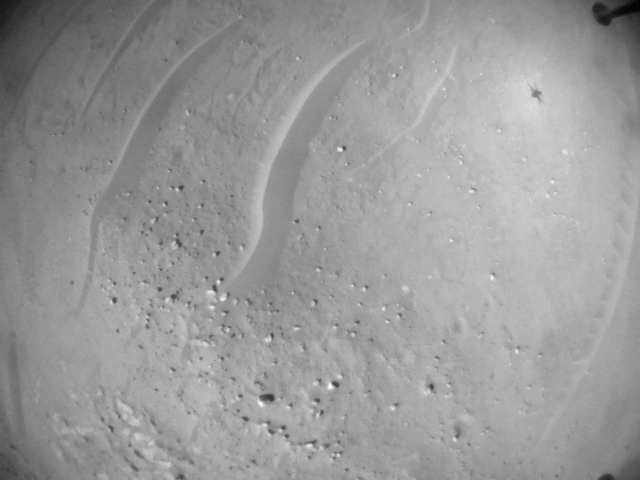

Image credit: Shujianyang Wikimedia Commons, CC BY-SA
China’s Shenzhou-15 taikonauts are preparing to carry out their first spacewalking tasks for outfitting the country’s Tiangong space station.
The extravehicular activities are to occur within the next few days, according to the China Manned Space Agency.
This current trio has been living in orbit for 70 days since they entered the space station combination on Nov. 30, 2022.
Last stage of construction
Since boarding the orbital complex, the three-person crew have completed various tasks, including in-orbit crew rotation with the Shenzhou-14 crew, tests of scientific experiment cabinets, and spacecraft equipment inspections. They also performed medical checks, weightlessness protection workouts and a series of space science experiments, according to China Central Television (CCTV).

Image credit: CNSA/CCTV
The three Shenzhou-15 crew members are Fei Junlong, Deng Qingming and Zhang Lu.
Their six-month mission is aimed at wrapping up the last stage of the space station construction and starting the first stage of its application and development, noted CCTV.
China’s space station features a basic three-module, T-configuration consisting of a core module and two lab modules: Wentian and Mengtian.

Taking the fall. Space hardware dives into Earth’s atmosphere with some fragments making their way to the ground.
Image credit: ESA/D.Ducros
There’s an uptick in reports of people finding downed space junk on Earth. Over the years, some recovered wreckage from incoming rocket bodies and spacecraft has been trucked into research facilities for intensive scrutiny.

A main propellant tank of the second stage of a Delta 2 launch vehicle landed near Georgetown, Texas in January 1997.
Image credit: NASA Orbital Debris Program Office
Up close inspection of the scraps from afar is aiding research into the fiery and destructive reentry process.
One research avenue is to establish design alternatives that would cause incoming space hardware to “disintegrate” during their plummet through Earth’s atmosphere – called “design for demise” in space rubbish vernacular.

Chunks of space junk rained down in Australia, later identified as SpaceX leftovers from its Crew-1 Mission that flew in 2020-2021.
Photo courtesy: Brad Tucker
For more information, go to my new Space.com story – “How fallen space junk could aid the fight against orbital debris – Up-close inspection of space debris here on Earth is helping scientists better understand the destructive reentry process” – at:
https://www.space.com/fallen-space-junk-help-fight-orbital-debris

Image credit: Scientific Coalition for UAP Studies
There is an increased uptick in research focused on Unidentified Aerial Phenomenon, or UAP. In many ways, serious looks into UAP is the classic unveiling of a riddle wrapped up in an enigma.
The pace of government interest in UAP is palpable – underscored by the recent release by the Director of National Intelligence (ODNI), a required-by-law annual report on UAP to Congress. That report flags the fact that UAP reporting is on the increase, thus allowing more opportunities to apply rigorous analysis and resolve events.
Also diving in to study UAP is a NASA blue ribbon study group. Their task is to focus on identifying available data, how best to collect future data, and how NASA can use that data to move the scientific understanding of UAPs forward.

Enigma Labs is offering a new public platform for sighting reports of unidentified aerial objects.
Image credit: Enigma Labs
Government attention to UAP is but one element in an ever-expanding network of private undertakings keen on scoping out sky strangeness.
Go to my new Scientific American story – “Scientists Try to Get Serious about Studying UFOs. Good Luck with That – New dedicated observatories and crowd sourced smartphone apps will study strange sightings in the sky. But questionable data quality and a lack of shared research standards remain key challenges” – at:

Image credit: USNI News
Video stills are in circulation of the Chinese balloon after it was hit with an AIM-9X anti-air missile fired from a F-22 Raptor on Feb. 4, 2023.
The Raptor was dispatched from the 149 Fighter Squadron based at Langley Air Force Base.
Used to down the balloon was a single AIM-9X Sidewinder missile, fired from the jet flying at 58,000 feet to hit the China-lofted balloon that was afloat at 62,000 feet.
Post-shoot down, a trio of Navy warships, service divers and the FBI are on the hunt for the wreckage of a high-altitude Chinese spy balloon. The leftovers of the balloon, about the size of three school buses, are spread over a seven-mile debris field in shallow water in the Atlantic.
Go to: https://youtu.be/VNVhLhq3CEQ
Off coast of South Carolina
In a statement released yesterday by Secretary of Defense, Lloyd J. Austin III, he said that U.S. fighter aircraft assigned to U.S. Northern Command successfully brought down the high altitude surveillance balloon launched by and belonging to the People’s Republic of China (PRC) over the water off the coast of South Carolina in U.S. airspace.
Austin said that “the Department of Defense developed options to take down the balloon safely over our territorial waters, while closely monitoring its path and intelligence collection activities.”
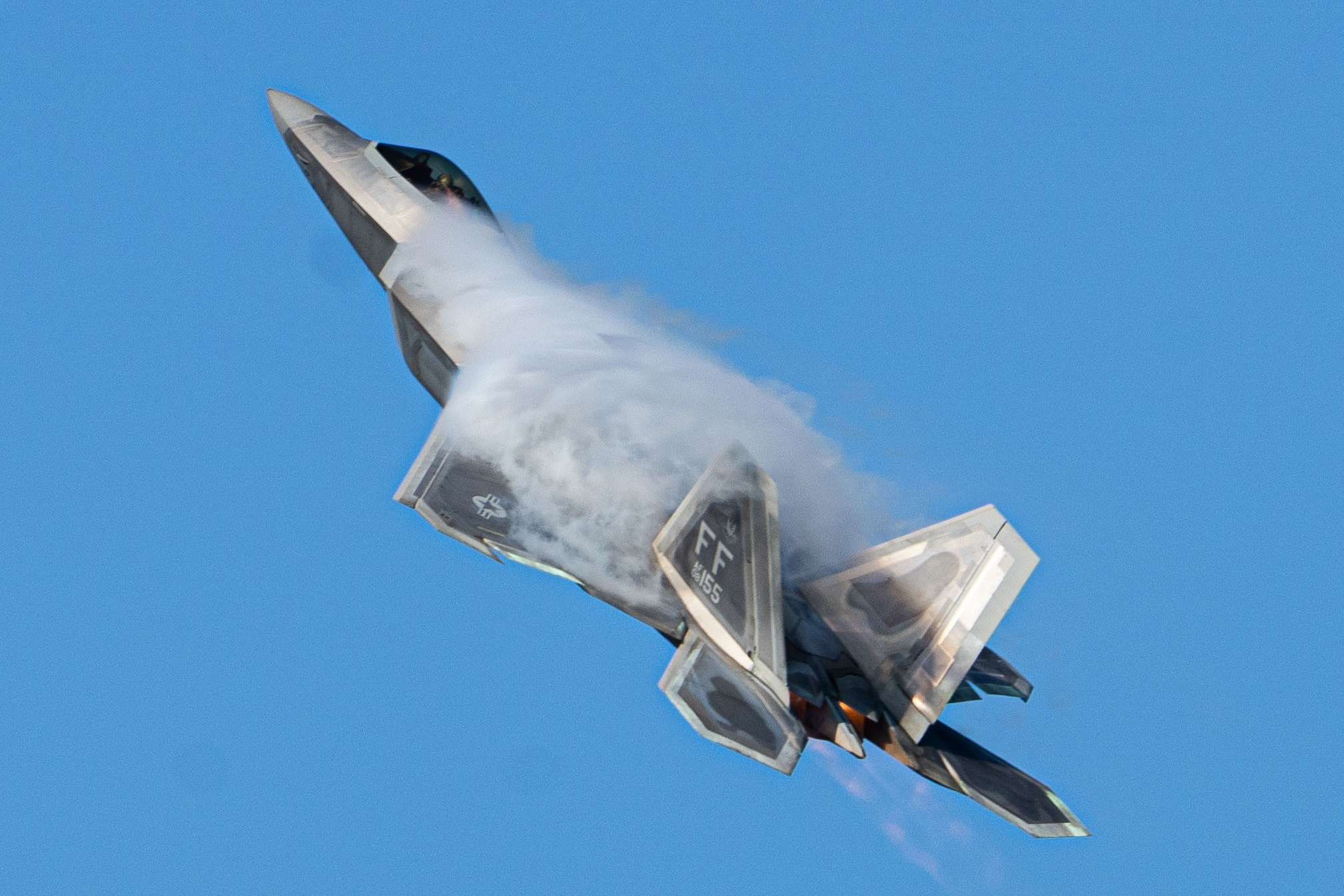
An F-22 Raptor fighter delivered the knock-out punch.
Image credit: DoD
Loitering
This current case showcased China’s willingness to place the balloon over the continental United States for an extended period of time.
Furthermore, it was noted in Pentagon briefings that the U.S. military has sufficient authority to take action under Title 10 against unmanned aerial systems of which this balloon would be a part. That’s 10 U.S.C. 130i – “Protection of certain facilities and assets from unmanned aircraft.”

Image credit: U.S. Homeland Defense
It was also announced that U.S. Secretary of State Antony Blinken deferred the taking of an upcoming trip to China in response to the balloon overflight of the United States.
A State Department official has noted the decision to postpone the China trip:
“We do acknowledge – we note the PRC’s statement of regret, but again, the presence of this balloon in our airspace is clearly unacceptable and a clear violation of our sovereignty. And our clear assessment was that under these current conditions it wouldn’t be constructive to visit Beijing at this time. But I’ll also reiterate that this is a postponement, and the Secretary plans to travel at the earliest appropriate opportunity when conditions allow.”
As explained earlier by Air Force Brig. Gen. Pat Ryder, the balloon was toting surveillance gear as well as a payload, Ryder said, not elaborating about the payload.
“Once the balloon was detected, we acted immediately to protect against the collection of sensitive information,” Ryder added.

Chinese balloon taken by Frank Melliere near Modoc, Illinois.
Image credit: Frank Melliere/Twitter/Facebook
“We know this is a Chinese balloon and that it has the ability to maneuver,” said Ryder, the Pentagon Press Secretary.
China reaction
China’s Ministry of National Defense on Sunday called the U.S. “overreacting” after a U.S. fighter jet shot down a Chinese unmanned airship that China said unintendedly entered the U.S. airspace days ago.
“We express our solemn protest against this U.S. approach and reserve the right to use the necessary means to deal with similar situations,” said Tan Kefei, a spokesperson for China’s Ministry of National Defense on Sunday.
The Chinese government said the civilian airship was used for research, mainly meteorological purposes and was deviated far from its planned course, affected by the Westerlies and with limited self-steering capability.
Image credit: Scientific Coalition for UAP Studies
UAP lessons learned?
Any relevance to the sky-high banter regarding Unidentified Aerial Phenomenon, or UAP – the new term often tied to UFOs?
As noted by Robert Powell, Executive Board Member of the Scientific Coalition for UAP Studies, the recent unclassified report by the All-domain Anomaly Resolution Office (AARO) has 336 new UAP reports as mentioned in their report of a couple of weeks ago.
“They did not supply detailed information on any of them. Reason — national security. No photos, no shapes, no locations, nothing,” Powell told Inside Outer Space.
“Now we have a Chinese balloon and suddenly national security is no longer a problem. We immediately identify it and make a lot of information public. They can supply a photo, its path over the U.S., let us know they shot it down — all sorts of information,” Powell said. “So if the government can supply this information on a Chinese balloon, why can’t it supply similar information on any of these 336 reports?”
Meanwhile, an informative update on the Chinese balloon flying over the USA and an answer on what it might have been has been produced by John Powell of JP Aerospace.
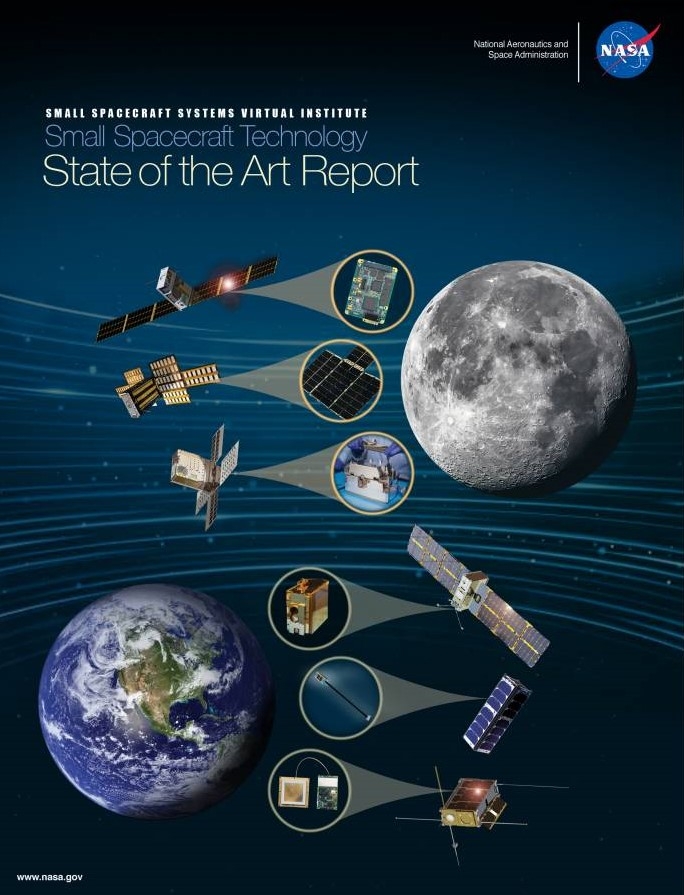
They are small…and they are impactful.
Since 2013, the fight heritage for small spacecraft has increased by over 30% and has become the primary source to space access for commercial, government, private, and academic institutions.
The overall capability of small spacecraft continues to mature, with technologies still being developed to make, for example, deep space SmallSat missions more routine and more cost effective.
NASA’s Small Spacecraft Systems Virtual Institute has issued the 2022 State-of-the-Art Small Spacecraft Technology report.
This informative, fact-filled report contains an overview of current state-of-the-art SmallSat technologies and their development status as discussed in open literature.
This report — State-of-the-Art Small Spacecraft Technology — comes from the Small Spacecraft Systems Virtual Institute at NASA’s Ames Research Center, Moffett Field, California.
https://www.nasa.gov/sites/default/files/atoms/files/2022_soa_full.pdf
Also, go to this website to review the work of the virtual institute at:
https://www.nasa.gov/smallsat-institute/small-spacecraft-body-of-knowledge

Credit: Scientific Coalition for UAP Studies (SCU)
There is a lengthy legacy of flying saucer folklore, of alien interlopers from afar; of governmental cover-ups tied to calls for “full disclosure” – an exposé that would divulge our Earth is, indeed, a stopover for starfolk whisking throughout the universe.
Tales of recovered vehicles and occupants, those poor souls that after crossing interstellar space discover a leak in brake fluid causing their craft to auger into our planet.
It goes on and on.
Unclassified report
The upsurge of public and government interest in Unidentified Flying Objects (UFOs), now tagged as Unidentified Aerial Phenomenon (UAP), is palpable.

That fact is underscored by the January 12 release of an unclassified version of a Director of National Intelligence (ODNI) report on UAP to Congress. It’s a required-by-law annual report.
The ODNI document emphasizes that UAP reporting is on the rise. “This increased reporting allows more opportunities to apply rigorous analysis and resolve events,” the report states.
Office of resolution
ODNI coordinated its report with the newly established All-Domain Anomaly Resolution Office (AARO), stood up last July under the Department of Defense to harmonize efforts across the U.S. federal landscape to help study UAP.
AARO’s mission involves looking into “anomalous, unidentified space, airborne, submerged and transmedium objects.”
Then there’s the signed into law 2023 National Defense Authorization Act (NDAA) that includes U.S. lawmaker lingo calling for more UAP and UFO insight.
Also diving in on UAP is a NASA blue ribbon study group tasked, in part, to scope out how NASA can use data to move the scientific understanding of UAPs forward.
Areas of research
Recently, the Scientific Coalition for UAP Studies noted that some of the key areas stipulated by the U.S. Congress in the 2022 NDAA, items to be included in the UAP report by ODNI, did not make it into the public version presented to Congress.
These are also areas of research that future reports should address a number of items “as openly as possible,” the Coalition explains in a recent statement, such as:
- The number of reported incidents over restricted air space, and an analysis of such incidents.
- An assessment of any UAP activity that can be attributed to one or more adversarial foreign governments.
- Identification of any incidents or patterns.
- An update on any efforts underway on the ability to capture or exploit discovered UAP.
- The number of reported incidents, and descriptions thereof, associated with military nuclear assets, including strategic nuclear weapons and nuclear-powered ships and submarines.
- The number of reported incidents, and descriptions thereof, associated with nuclear material with weapons storage or civilian nuclear facilities.
The Coalition adds that it looks forward to the information that the ODNI and AARO “will be sharing with the public in the future, and is grateful that the U.S. government agrees that UAP are a critical area of scientific study.”

Daniel Evans, the assistant deputy associate administrator for research at NASA’s Science Mission Directorate (Right) gave list of NASA’s UAP panelists to Bill Nelson, NASA chief, for his approval.
Image credit: NASA
Independent study team
For its part, NASA announced in June 2022 that an independent study team was being assembled to look into the UAP state of affairs.
A confab of 16 individuals, including scientists, aeronautical experts, and data analytics aficionados are now engaged in shedding light on the origin and nature of UAP.
That nine-month study effort is under the guidance of NASA’s Science Mission Directorate and NASA’s Aeronautics Research Mission Directorate, with the space agency declaring it is pursuing the assessment for the agency’s own science and air safety motives.
Katherine Rohloff, a spokesperson for NASA’s Science Mission Directorate, says that the space agency has updated its “Unidentified Anomalous Phenomena Independent Study” public website to clarify the meeting cadence and output from the group.
The study team is periodically meeting to identify what data, from civilian government entities, commercial data and information from other sources, can potentially be pored over to help evaluate UAP.
A next step will be recommending a roadmap for potential future NASA unidentified anomalous data analysis.
After wrapping up the study, the information gleaned is to be released in a publicly available report. NASA expects to hold a full meeting of its UAP study team in late spring of this year, the NASA website explains, with the team findings to be broadcast to the public.

UAP have been reported by Navy pilots unlike anything they have ever witnessed.
Image credit: Enigma Labs/Lt. Cmdr. Alex Dietrich
Community of interest
A seeing-is-believing person is Ryan Graves. As a former Lt. U.S. Navy and F/A-18F pilot, he was the first active duty flyer to report publicly about his and fellow pilot encounters with UAP.
Graves now chairs the newly-formed UAP permanent Community of Interest within the American Institute of Aeronautics and Astronautics (AIAA), a group of over 30,000 aerospace professionals. The UAP faction is focused on alleviating the barriers to the scientific study of whatever it is, he says.

Shown at Congressional hearing, Video 1 2021 flyby movie showing a purported UAP.
Credit: Counterterrorism, Counterintelligence, and Counterproliferation Subcommittee/Inside Outer Space screengrab
“We’re off and running,” says Graves with his group subdivided into human factors, hardware factors, and outreach subcommittees. “We’ll also be collaborating with various groups to validate and verify some of our hypotheses about [UAP] detection events,” he told Inside Outer Space.
“I approach this very agnostically. It’s not about aliens, UFOs or what have you. There’s an anomaly. We have detections of something that we can’t explain,” Graves adds. “Our mission is focused on aerospace safety. Our charter is to improve aviation safety by enhancing scientific knowledge, and mitigating barriers to the study of Unidentified Aerial Phenomena.”
Graves is engaged in a series of “Merged Podcast” productions on UAP.
For example, go to a pilot’s UAP Sighting and what it means for aviation at:
https://www.youtube.com/watch?v=UjildVLwSHw
To view the unclassified version of the ODNI document, go to:
https://www.dni.gov/files/ODNI/documents/assessments/Unclassified-2022-Annual-Report-UAP.pdf

Image credit: NASA
Years ago I wrote a story for AIAA’s Aerospace America magazine.
In my view, the reasons and revelations that haunt me to this day about the tragedy are far from being revealed. I covered the loss of the crew for Space.com at the time, reporting on the investigation from my perspective as I attended a number of the “hearings” on the disaster from Houston, Texas.
To this day, the entire calamity — and how it could have been prevented — has never been fully reported.
Adding to my own views regarding the loss of Columbia and crew was a visit to Kennedy Space Center. I saw first-hand recovered, twisted, and scared wreckage of the vehicle.
I cried.
There are truths out there yet to be revealed.
Meanwhile, take a read of my story – and remember Columbia and the seven-person crew:

Wait a Minute!

Curiosity Left Navigation Camera took this image on Sol 3724. Image shows the rock, “Cacao” and the shadow of the unstowed arm in the afternoon light. Is it a meteorite?
Image credit: NASA/JPL-Caltech
NASA’s Curiosity Mars rover at Gale Crater is wheeling about finding and photographing some interesting features, including “foreign stones,” reports Ashley Stroupe, a mission operations engineer at NASA’s Jet Propulsion Laboratory.
A recent photo taken by the robot shows a rock about which Mars researchers are intrigued.
The rock Curiosity parked in front of is one of several very dark-colored blocks in this area which seem to have come from elsewhere, and are dubbed “foreign stones.”
“Our investigations will help determine if this is a block from elsewhere on Mars that just has been weathered in an interesting way or if it is a meteorite,” Stroupe notes.

Curiosity Mast Camera Left image taken on Sol 3724, January 27,2023.
Image credit: NASA/JPL-Caltech/MSSS

Curiosity Mast Camera Right image taken on Sol 3724, Janaury 27, 2023.
Image credit: NASA/JPL-Caltech/MSSS
Meanwhile, Curiosity is taking a look at some other interesting terrain, as well as a look up into the sky of Mars to scan wispy clouds floating by.
At the moment, the Curiosity Mars rover is now ending Sol 3728 tasks.

Curiosity Right B Navigation Camera photo acquired on Sol 3728, January 31, 2023.
Image credit: NASA/JPL-Caltech

Curiosity Right B Navigation Camera photo acquired on Sol 3728, January 31, 2023.
Image credit: NASA/JPL-Caltech

