Author Archive
 Author:
  February 18th, 2023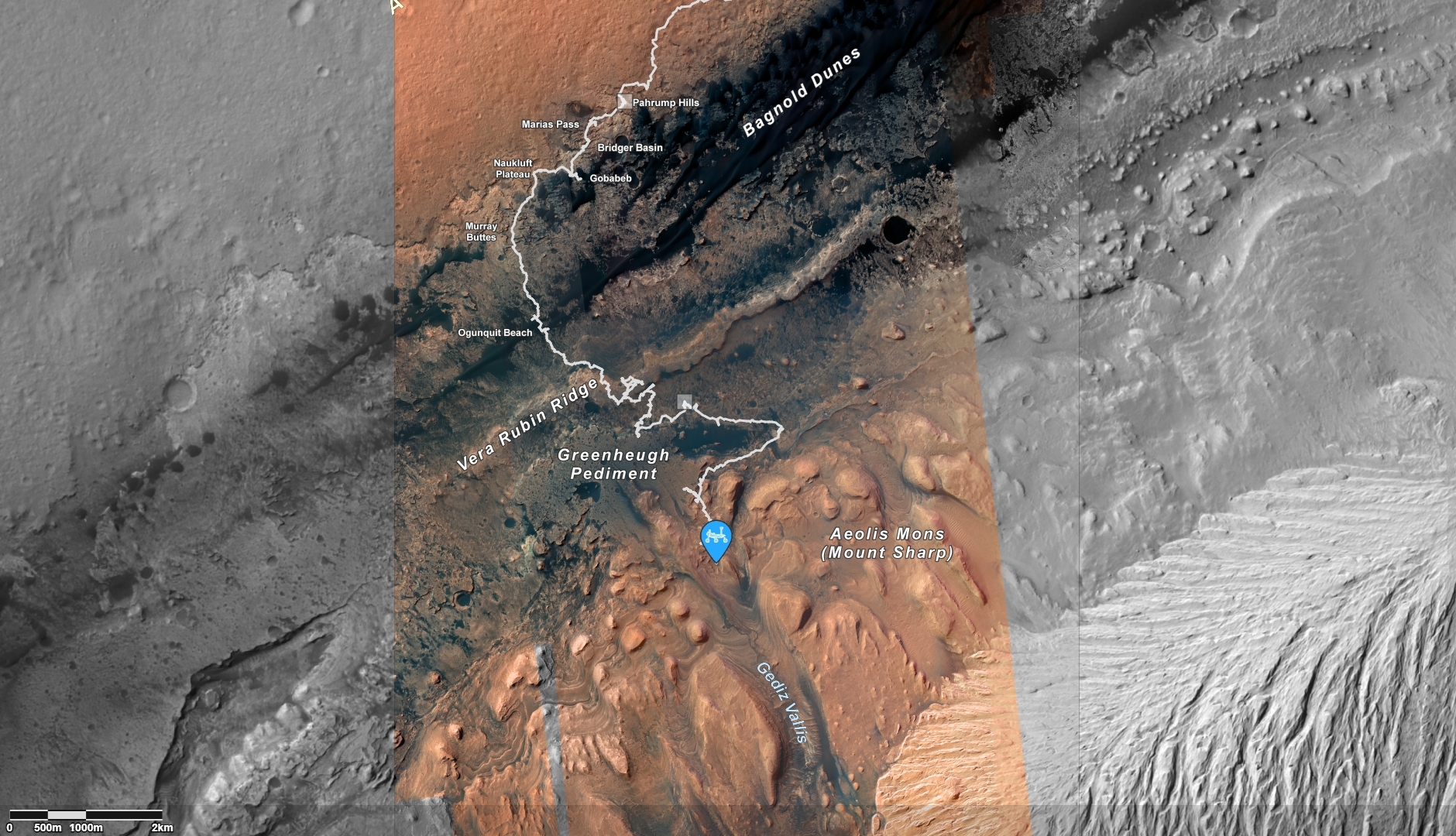
Curiosity’s location as of Sol 3744. Distance driven to this sol, 18.44 miles/29.68 kilometers.
Image credit: NASA/JPL-Caltech/Univ. of Arizona
NASA’s Curiosity Mars rover at Gale Crater is now performing Sol 3746 duties.
Reports Lauren Edgar, a planetary geologist at the USGS Astrogeology Science Center in Flagstaff, Arizona: “The team was eagerly awaiting our downlink this morning to hear how the drill attempt from Sol 3742 went. The images came down and indeed there was a drill hole…a mini drill hole…and sadly not deep enough to get to a sufficient depth for the drill assembly to start collecting sample.”

Curiosity Mars Hand Lens Imager (MAHLI) photo produced on Sol 3744, February 17, 2023,
Image credit: NASA/JPL-Caltech/MSSS
This was the robot’s fourth attempt to drill the marker band, Edgar adds, “and we gave it our best shot from both a geology and engineering perspective. Unfortunately these rocks do not want to cooperate – they’re hard and they weather into resistant and recessive beds which make them very challenging to drill.”

Mosaic view of “Marker Band Valley” taken by Curiosity on December 16, 2022.
Image credit: NASA/JPL-Caltech/MSSS
Difficult decision
Edgar notes that the Curiosity team made the difficult decision to get back on the road, without a drill sample from this location.
“I can imagine future rover scientists telling tall tales of these marker band rocks and the one that got away,” Edgar relates, with scientists saying: “that was the hardest rock I’ve ever seen! It looked me right in the eye and then jumped out of the net (drill bit assembly)…”
“All kidding aside, we’ve learned a lot about these rocks from remote sensing, contact science, and drill attempts, and the team is excited to analyze the data and think about what else lies ahead,” Edgar reports.
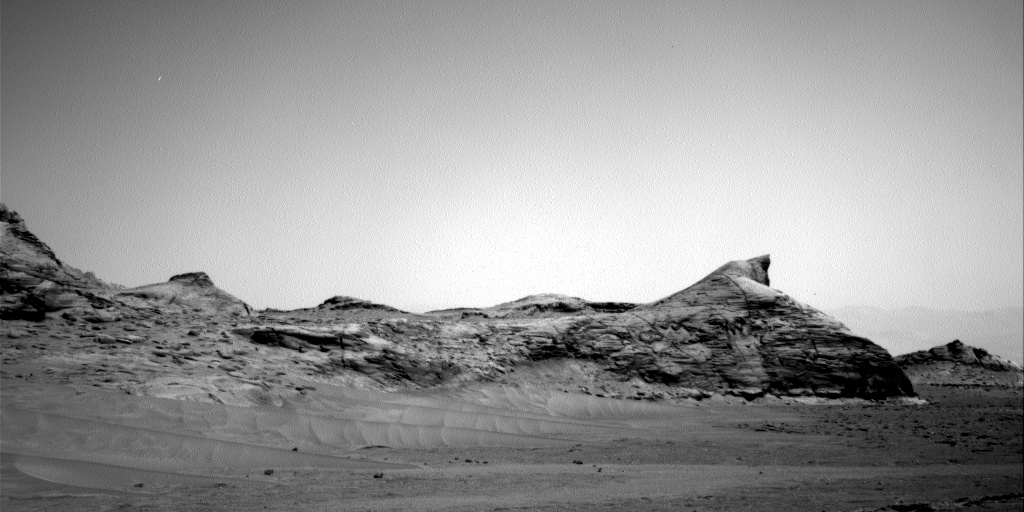
Curiosity Right B Navigation Camera image acquired on Sol 3745, February 17, 2023.
Image credit: NASA/JPL-Caltech
Attempted drill hole
The recent two-sol plan (Sols 3744-3745) is focused on wrapping up science at the “Dinira” drill site.
The rover’s Mars Hand Lens Imager (MAHLI) and the Alpha Particle X-Ray Spectrometer (APXS) will analyze the mini drill hole and drill tailings, and the Chemistry and Camera (ChemCam) and Mastcam will also investigate the chemistry and texture at the attempted “Dinira” drill hole.
The team also planned a long distance ChemCam Remote Micro-Imager (RMI) mosaic to study some distant stratigraphy, Edgar adds, “which is a good reminder that there’s still a lot to explore ahead!”

Curiosity Right B Navigation Camera image acquired on Sol 3745, February 17, 2023.
Image credit: NASA/JPL-Caltech
Drive to the south
The plan calls for a rover drive of roughly 318 feet (97 meters) to the south, “to get us back on track to traverse across the marker band,” Edgar explains.

Curiosity Right B Navigation Camera image acquired on Sol 3745, February 17, 2023.
Image credit: NASA/JPL-Caltech
The second sol includes some untargeted observations, including an autonomously selected ChemCam AEGIS activity. AEGIS stands for Autonomous Exploration for Gathering Increased Science – a software suite that permits the rover to autonomously detect and prioritize targets.

Curiosity Right B Navigation Camera image acquired on Sol 3745, February 17, 2023.
Image credit: NASA/JPL-Caltech
Curiosity will also acquire a number of environmental observations to monitor dust in the atmosphere and search for noctilucent clouds at twilight.

Curiosity Left B Navigation Camera photo taken on Sol 3744, February 17, 2023.
Image credit: NASA/JPL-Caltech

Curiosity Left B Navigation Camera photo taken on Sol 3744, February 17, 2023.
Image credit: NASA/JPL-Caltech
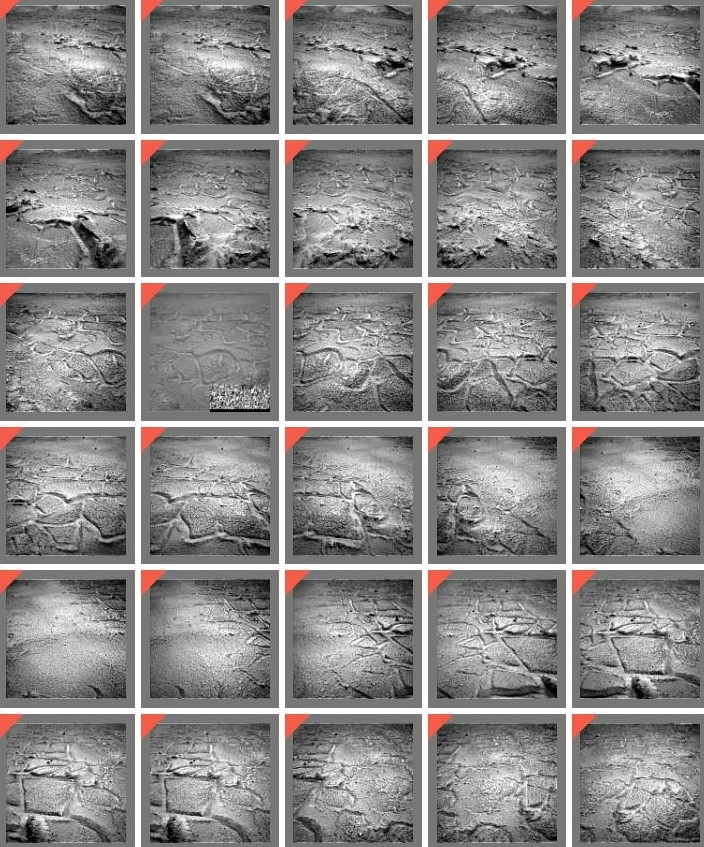
Curiosity Left B Navigation Camera photos taken on Sol 3744, February 17, 2023.
Image credit: NASA/JPL-Caltech
“So we’ll say goodbye to the “Encanto” and “Dinira” drill target vicinity,” Edgar concludes, saying “these targets were not charming and did not deliver wealth as their names may have suggested, but we’ll always remember their elusive and intriguing qualities!”
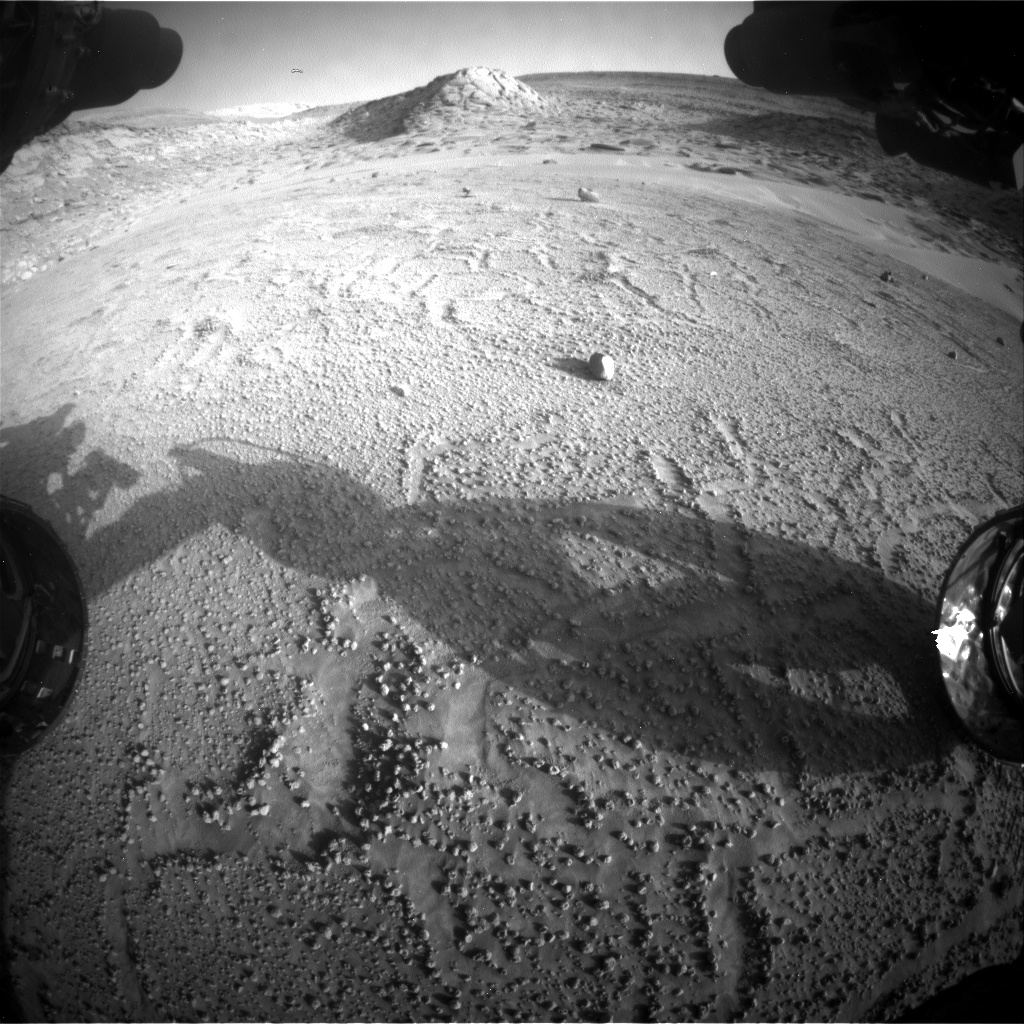
Curiosity Front Hazard Avoidance Camera Right B image taken on Sol 3744, February 17, 2023.
Image credit: NASA/JPL-Caltech
 Posted in

An example of amateur pico-ballooning is this Naval Academy amateur radio balloon experiment.
Image credit: Bob Bruninga, WB4APR
The amateur radio community continues to be in a buzz about those unidentified flying object shoot downs: one in Alaska, Canada, and over Lake Huron in the Midwest.
In one case, the object blasted out of the sky over Canada, Yukon by a U.S. Air Force jet might have been an amateur radio pico balloon, specifically K9YO-15, launched from Independence Grove Forest Preserve in Libertyville, Illinois, north of Chicago.
K9YO-15 was apparently on its seventh circumnavigation of the globe after being aloft for 123 days.

Last contact with K9YO. Image credit: NIBBB
Science in nature
According to Cary Willis of the Northern Illinois Bottlecap Balloon Brigade (NIBBB), there are roughly 3 million amateur radio operators around the globe, with the NIBBB being a very small group of pico balloon enthusiasts.
“Our balloons are very small, 32″ diameter, 100 inch circumference, pre-stretched and carry a payload of around 10 grams including the tracker, solar panel and 33 foot antenna wire,” Willis told Inside Outer Space.
The sky high K9YO-15 balloon made use of a silver mylar 32″ sphere, available for a low-price of $13.33.
“Our pico balloon K9YO had been flying for 123 days preparing for the 7th time around the world when it went missing over Canada. That wasn’t the first time K9YO went missing. After the 5th time around the world in 77 days, K9YO went missing for 30 days, reported on the 106th day over Mongolia and continued the 6th circumnavigation at 112 days,” Willis added.
“I believe our communications with the FBI will help them identify our project as science in nature.”

Image credit: Statista
Missing in action
Willis said that, in a communication with a NIBBB team member, “we should be very proud of the work that we have done, and hope to continue our project connecting with amateur radio stations around the world.”
Since the pico balloon has not been heard from for several days, amateurs are calling pico balloon K9YO, for now: “Missing in Action.” Pico balloon K9YO was last reported on February 11th near Hagemeister Island in the U.S. state of Alaska.
According to the Pentagon, the object shot down over Canada was a “small metallic balloon with a tethered payload” – seemingly a match for a pico balloon.

Image credit: White House
Abundance of caution
“We don’t yet know exactly what these three objects were. But nothing — nothing right now suggests they were related to China’s spy balloon program or that they were surveillance vehicles from other — any other country,” said U.S. President, Joe Biden, in a February 16 briefing specific to addressing the United States’ response to recent aerial objects.
“We acted out of an abundance of caution,” Biden explained, “with established parameters for determining how to deal with unidentified aerial objects in U.S. airspace.”
Biden said that the intelligence community’s current assessment is that “these three objects were most likely balloons tied to private companies, recreation, or research institutions studying weather or conducting other scientific research,” Biden said. A range of entities, including countries, companies, and research organizations “operate objects at altitudes for purposes that are not nefarious, including legitimate scientific research.”

A balloon with a flight computer suspended beneath it.
Image credit: Douglas Malnati
Perfectly safe
The possible shooting down of pico balloon K9YO was an unlucky incident, said Douglas Malnati, an amateur radio operator that launches pico balloons.
“Pico Balloons are safe. I think once the government has a better understanding of what they’re seeing they will agree,” Malnati told Inside Outer Space.
“Pico Balloons don’t spy on anyone, and they’re perfectly safe to be in the sky with aircraft. The FAA has guidelines about what can/can’t fly, and Pico Balloons are well inside the safety threshold, so they don’t pose a danger to aircraft, nor to people on the ground,” Malnati said, adding that they’re very lightweight even if they pop and fall, just grams of weight.
“So in total, I suspect the shoot down was a misunderstanding if that is what happened,” Malnati said. “As far as the future for pico balloons, hopefully the attention brings more people to the hobby and they enjoy it!”
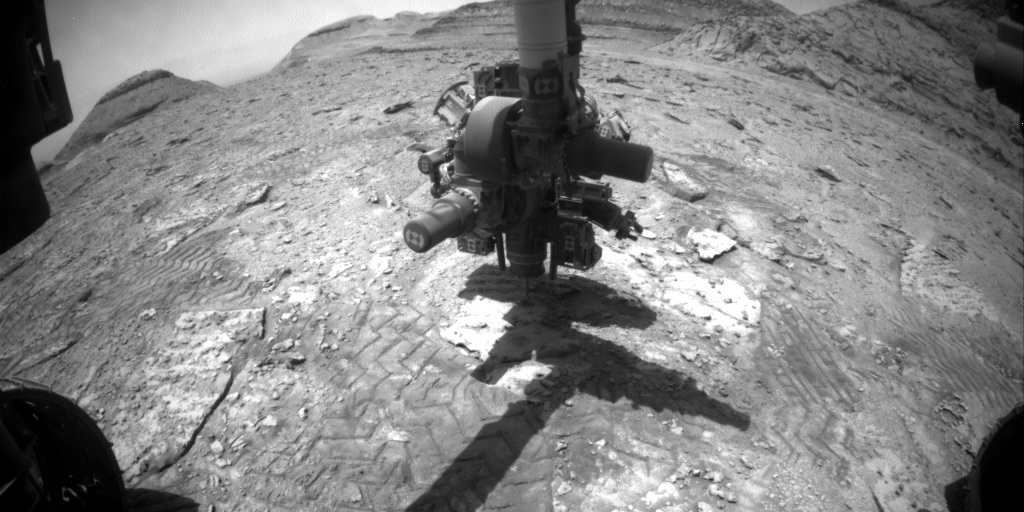
Curiosity Front Hazard Avoidance Camera Left B image taken on Sol 3742, February 15, 2023.
Image credit: NASA/JPL-Caltech
NASA’s Curiosity Mars rover is now carrying out Sol 3744 tasks.
The robot has been at work on the new drilling target, “Dinira.”
Keri Bean, a rover planner deputy team lead at NASA’s Jet Propulsion Laboratory, reports that scientists and engineers have been closely working together to adjust the drilling strategy to give them the best shot of a successful drill while also managing the wear and tear on the rover’s hardware.
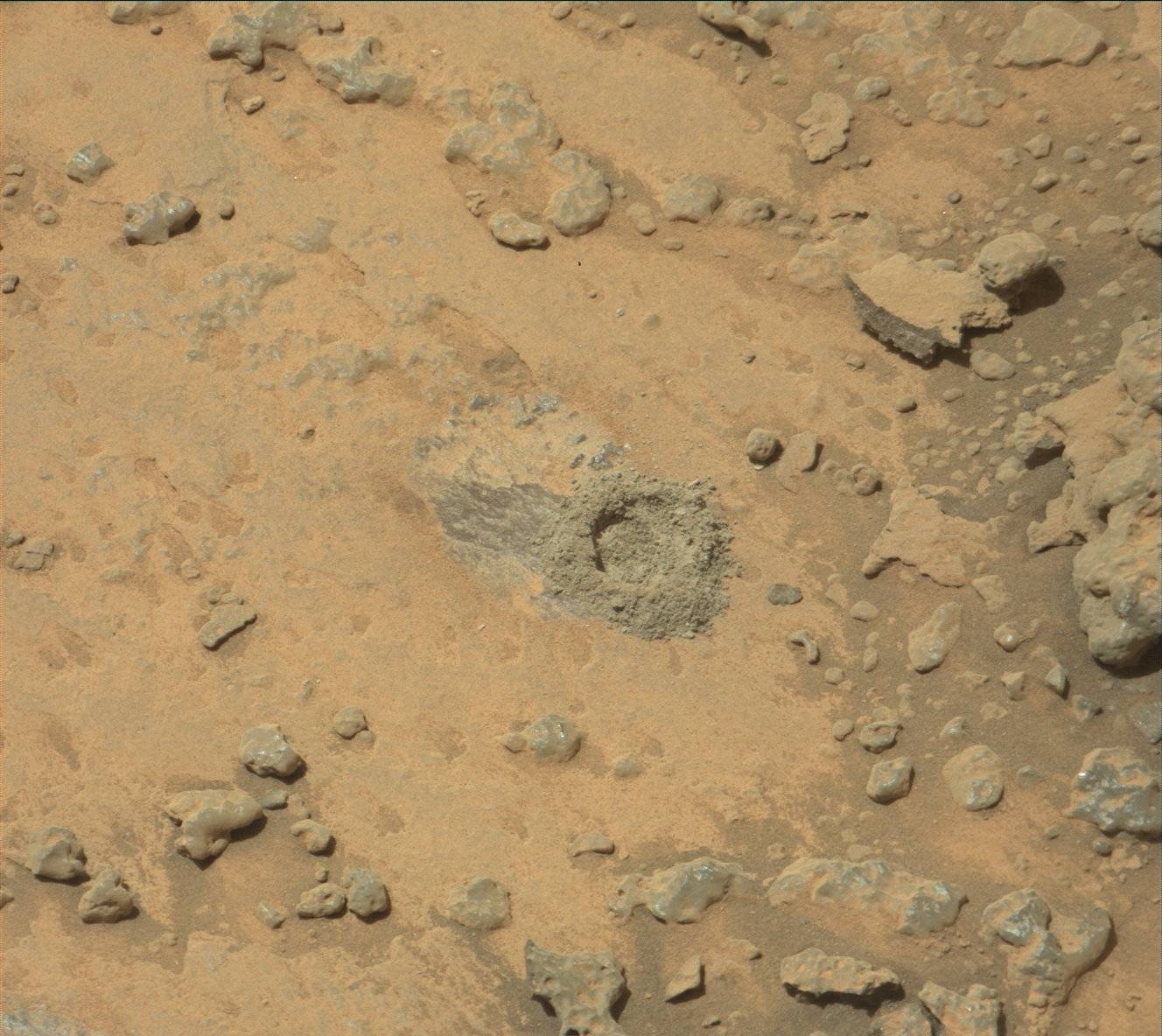
Curiosity Mast Camera Right photo acquired on Sol 3742, February 15, 2023.
Image credit: NASA/JPL-Caltech/MSSS
“There is no guarantee it will work as Mars always loves to throw us curveballs, but we’re giving it our best! It is also cloud season on Mars, so in addition to drilling, this plan is full of sky observations to look for clouds,” Bean notes.
Post-drilling, take a nap
A recent plan, starting with Sol 3742, had the robot take Navcam atmospheric observations followed by Chemistry and Camera laser observations of “Itu,” last weekend, and some long-distance ChemCam imaging as well.
Once that wrapped up, the plan calls for drilling.
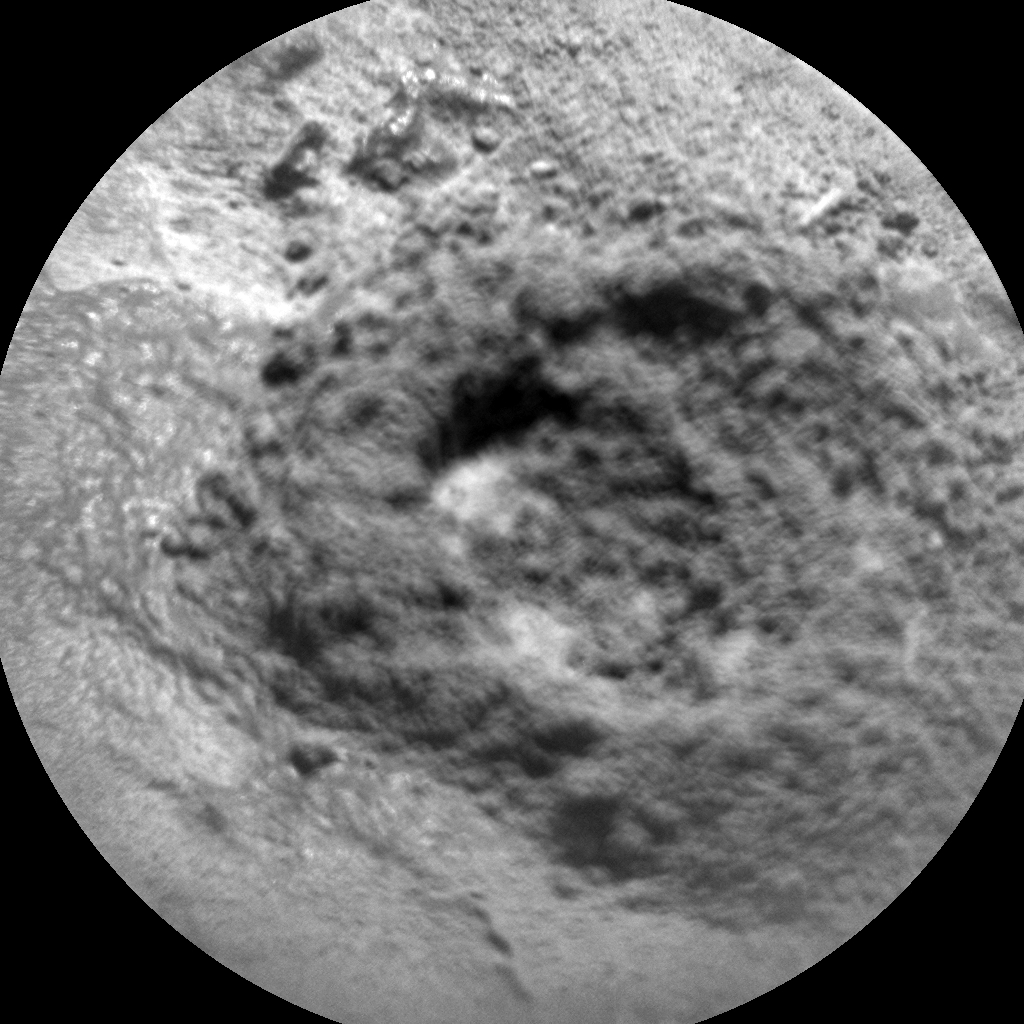
Curiosity Chemistry & Camera (ChemCam) Remote Micro-Imager (RMI) photo taken on Sol 3743, February 15, 2023.
Image credit: NASA/JPL-Caltech/LANL
“Drilling takes up a lot of the rover’s power, so once we’re done, the rover will take a nap until around sunset. At that point the rover will wake up and take some more atmospheric observations with Navcam and Mastcam. Once that wraps up, the rover will sleep most of the night, only waking up for the regularly scheduled communication windows,” Bean reports.
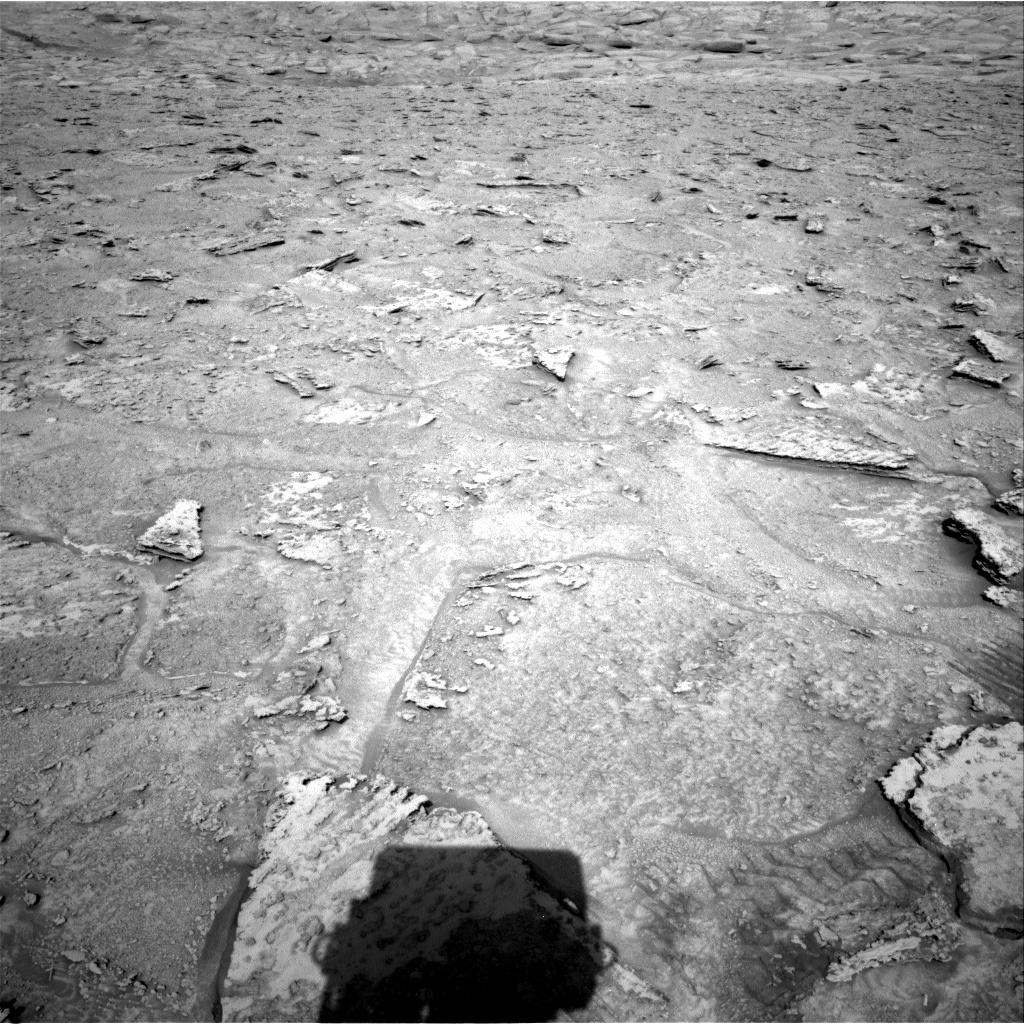
Curiosity Right B Navigation Camera photo acquired on Sol 3743, February 16, 2023.
Image credit: NASA/JPL-Caltech
Atmospheric/environmental observations
On the morning of sol 3743, the plan called for Curiosity to take more atmospheric and environmental observations with Navcam and Mastcam. ChemCam will use its laser on the target “Yakarinta” from the previous plan and also image our drill target Dinira.
Mastcam will also image Dinira along with some long-distance imaging, Bean adds. “The rover will spend most of the rest of the sol sleeping to recover power, although the rover will wake up twice, once mid-afternoon and once just after sunset, to take more Navcam and Mastcam atmospheric and environmental observations.”

SSPIDR photovoltaic wing deployment.
Image credit: MMA Design
Progress is being reported on the Space Solar Power Initiative orchestrated by the Air Force Research Laboratory’s Power Incremental Demonstrations and Research (SSPIDR) program.
MMA design of Louisville, Colorado has developed and delivered a flight deployment subsystem for the AFRL’s Arachne flight experiment.
The Arachne experiment utilizes components known as “sandwich tiles” to perform solar-to-radio frequency (RF) conversion. Solar energy is collected, converted to RF energy, then would be beamed to precise locations on Earth for conversion back into useable power.
According to MMA Design, Arachne is seen as a stepping stone in AFRL’s overarching goal: Developing a larger scale system capable of beaming energy wherever it is needed, including remote military bases or even communities in need of temporary power when ravaged by climate emergencies.

Artist’s rendering of the Air Force Research Laboratory’s Arachne flight experiment on orbit.
Image credit: Partise
Structural backbone
MMA Design, in partnership with Northrop Grumman and AFRL, has delivered the custom designed and fabricated subsystem hardware as the structural backbone of Arachne’s primary payload.
“The Deployment Subsystem includes a dual-port structural adapter for Northrop Grumman’s ESPAStar platform, structural panels for the sandwich tiles, hinges, segment angular position adjustment mechanisms, photovoltaic tiles, a launch restraint/release system, and a camera system for monitoring deployment,” explains an MMA Design press statement provided to Inside Outer Space.
The assembly is being delivered to Northrop Grumman for final integration and test with a planned launch in 2025.
For more information about MMA Design, go to:
An example of amateur pico-ballooning is this Naval Academy amateur radio balloon experiment.
Image credit: Bob Bruninga, WB4APR
The amateur radio community is a buzz about those unidentified flying object shoot downs.
In one case, the object blasted out of the sky over Canada, Yukon by a U.S. Air Force jet might have been an amateur radio pico balloon, specifically K9YO-15, launched from Independence Grove Forest Preserve in Libertyville, Illinois, north of Chicago.
K9YO-15 was apparently on its seventh circumnavigation of the globe after being aloft for 123 days.
The sky high K9YO-15 balloon made use of a silver mylar 32″ sphere, available for a low-price of $13.33.
Since the pico balloon has not been heard from for several days, amateurs are calling Pico Balloon K9YO, for now: “Missing in Action.” Pico Balloon K9YO was last reported on February 11th near Hagemeister Island in the U.S. state of Alaska.
According to one posting, the Pentagon has said the object shot down over Canada was a “small metallic balloon with a tethered payload” – seemingly a match for a pico balloon.
Meanwhile, check out this May 11, 2020 YouTube posting showing one group’s 9th attempt to send a small balloon around the world. “Two weeks ago our balloon crashed in China so we are trying again. It reports its position back to us every 10 minutes as long as it is in sunlight.”
Go to:

Image credit: UCLA SETI
A new crowdsource project is calling upon citizen scientists to search for life in the universe.
The University of California’s UCLA SETI effort will give members of the public an opportunity to help scientists find signs of extraterrestrial intelligence by classifying radio signals that may have been emitted up to tens of thousands of light-years away and collected by a radio telescope.
No special training or education is needed to participate. (No need for those earphones used in the movie Contact).

Image credit: Warner Brothers
According to a UCLA statement, Search for Extraterrestrial Intelligence (SETI) scientists use a radio telescope that observes thousands of stars in the sky, yielding around 5 million signal detections per hour.

Image credit: UCLA SETI
Potential signs
To date, the group has observed 42,000 stars and detected over 64 million radio signals. Their automated data processing software discards about 99.5% of the signals as having been produced either deliberately or as side effects of human technologies.
However, the remaining 10,000 detections per hour “constitute potential signs of alien technology, and the new project is designed to identify the most promising signals among them,” the UCLA statement adds.
The project was designed by UCLA SETI using the Zooniverse platform, with funding from the Planetary Society and NASA’s Citizen Science Seed Funding Program.
For more information, and to sign up, go to:
https://www.zooniverse.org/projects/ucla-seti-group/are-we-alone-in-the-universe

Image credit: UCLA SETI

Image credit: C-SPAN/Inside Outer Space screengrab
Head of Senate Intelligence, Senator Marco Rubio, discusses recent classified briefing on the downing events that have caught public and military attention.
The lawmaker calls for access by scientists to the collected data, information that should be cross-referenced and made public.
Meanwhile, take a read of my Scientific American story, noting the new dedicated observatories and crowdsourced smartphone apps that will study strange sightings in the sky. But questionable data quality and a lack of shared research standards remain key challenges…
Go to: “Scientists Try to Get Serious about Studying UFOs. Good Luck with That” at:
https://www.scientificamerican.com/article/scientists-try-to-get-serious-about-studying-ufos-good-luck-with-that/
For Senator Rubio’s comments, go to:
Go to C-Span link at: https://twitter.com/i/status/1625717882578472962
And also:

Image credit: Shujianyang Wikimedia Commons, CC BY-SA
China’s future space station plans include sending two piloted spacecraft and one or two cargo spacecraft into space every year.
This plan will be followed after the full completion of the country’s space station construction achieved in late 2022.
A statement from the China Manned Space Agency (CMSA) indicates that the country’s space station project has officially entered the “application and development stage.”

Image credit: CNSA/CMSA/CCTV/Inside Outer Space screengrab
Upcoming piloted flights
According to the flight mission plan, the Shenzhou-16 piloted spacecraft will be launched in May and be docked at the radial port of the core module.
The Shenzhou-17 crewed spacecraft will be launched in October, docking at the front port of the core module.
According to China Central Television (CCTV), during the two crewed flight missions this year, the Shenzhou-16 and Shenzhou-17 taikonauts will conduct spacewalking chores and perform cargo airlock extravehicular missions.
In addition, they will carry out in-space science experiments and technical experiments, CCTV adds. There will also be work on platform management, astronaut support, and science education activities.

Image credit:
20th Century Fox
It has been a bunch of busy days for identified and unidentified flying objects scooting across Canadian and U.S. territory, and other locations too.
After that sky-high saga of a purported Chinese spy balloon being shot down off the coast of South Carolina, the follow-up acts involve the U.S. military downing three unidentified flying objects over Alaska, Canada and Michigan.
Statista, a major provider of market and consumer data, offers some looks at all the high-altitude anxiety about what’s going down in the skies above.
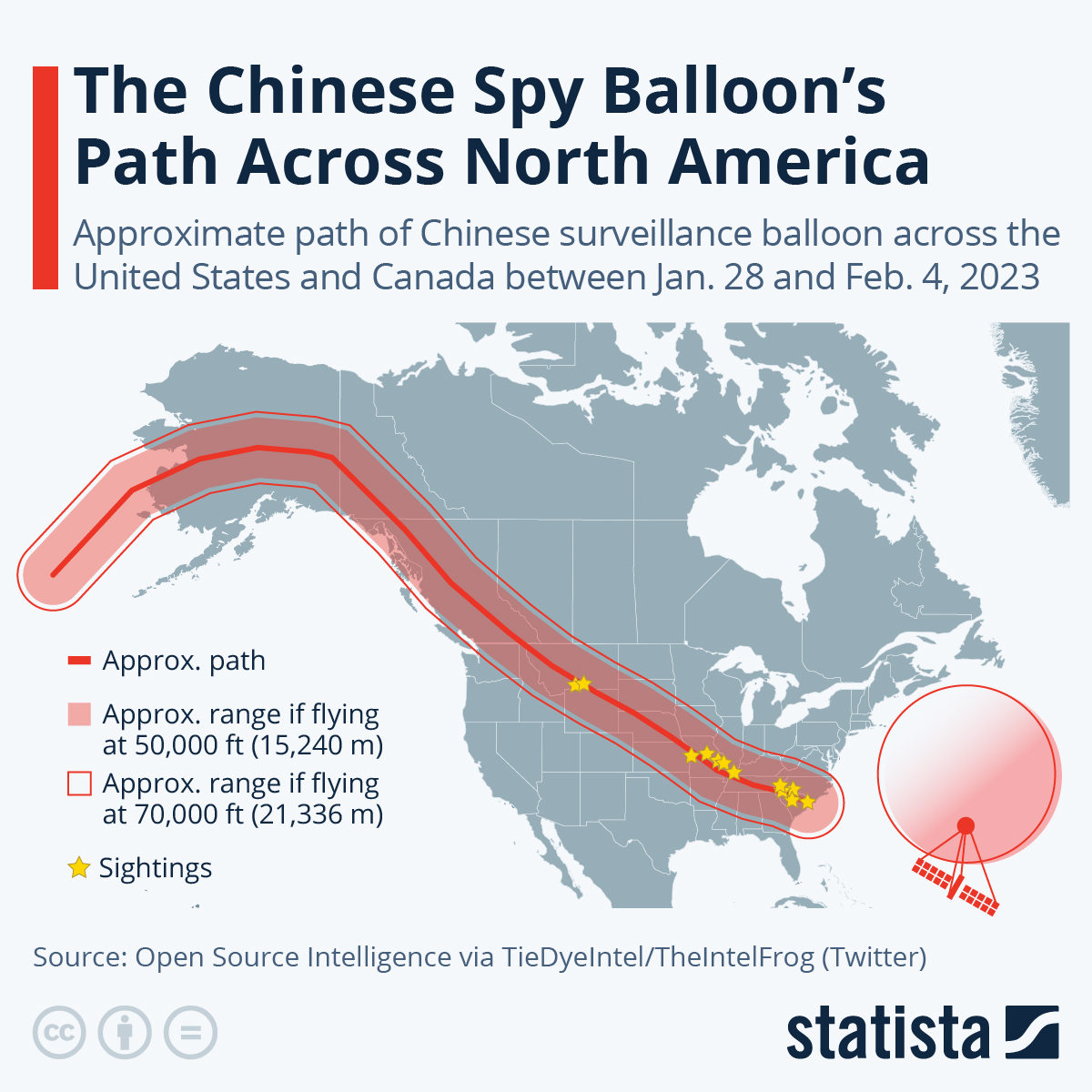
Image credit: Statista
“And while U.S. officials are still figuring out what the flying objects shot down on the weekend were and what purpose they served, unidentified flying objects, or unidentified aerial phenomena, as they are officially called, are not as rare as one might think,” explains Statista’s Felix Richter.
Meteorological equipment?
According to public information collected by open-source intelligence accounts, that Chinese balloon likely made its way across the states of Wyoming, South Dakota, Nebraska and Kentucky, says Katharina Buchholz, a Statista Data Journalist.
“It is less likely but also possible that it traveled across Colorado, Iowa or Georgia. Due to the weather on location as well as the very high altitude that the balloon was traveling at – 50,000 to 70,000 feet compared to an airplane at usually 30,000-40,000 feet – it was not always spotted,” Buchholz explains.
It remains unclear what led to the balloon’s voyage across the United States, with Chinese officials stating that the balloon’s journey was an accident and that is was in fact a piece of meteorological equipment.

Image credit: USNI News
Testing capabilities and reactions?
“Theories to what the balloon could have been doing over the country include China testing U.S. counter-surveillance capabilities and reactions,” Buchholz adds.
Citing ANI and Nikkei Asia as sources, Buccholz says that, through the balloon’s flight, China could have found out how fast military and intelligence sources detect intrusions into U.S. airspace and also how speedy the response.
“The second part of this tactic could also include a psychological component,” Buchholz says. “Chinese military planes are also known to repeatedly intrude into Taiwan’s air defense identification zone, soliciting reactions from Taiwan. Russian also has a long history of similar behavior of fighter planes around NATO countries.”

Image credit: Statista
Detected and destroyed
“As our chart shows, three more objects have since been detected and destroyed,” adds Statista’s Anna Fleck.
“These have all been smaller than the giant balloon and are reported to have different characteristics. According to officials, the object on Feb. 10 flew without any kind of propulsion or control system, while the object on Feb. 11 was described as cylindrical in shape and about the size of a Volkswagen Beetle. The fourth object, shot down yesterday over Lake Huron, was reportedly octagonal and had strings attached to it. It is currently unknown where the latest three objects originated from or what they were designed to do.”
Fleck writes that the series of incidents has also raised the question of whether more objects are indeed flying over the U.S. than usual.
Perhaps more are simply being identified and scrutinized, since the U.S. air defense altered their radar systems after the balloon’s detection to also detect smaller and slower-moving objects, Fleck adds. “Either way, regardless of the intention behind their creation, having objects flying at altitude is a clear flight hazard.”
Image credit: Statista
Balloons, drones…and?
There’s a lot going on in the sky, according to data from the U.S. Office of the Director of National Intelligence, observes Matthias Brandt, also a Data Journalist for Statista.
“According to them, over 350 flying objects were sighted over the USA from March 2021 to August 2022,” Brandt notes.
“Of these, 163 were initially classified as balloons or balloon-like,” writes Brandt. “Another 26 sightings could be due to drones. However, no initial classification was possible for almost half of the aerial phenomena.”
Alien hysteria
Meanwhile, Richter has looked into public attitudes concerning unidentified flying objects (UFOs) and extraterrestrial visits.
“The fact that General Glen VanHerck, commander of U.S. Northern Command and the North American Aerospace Defense Command (NORAD), refused to “rule out anything” when asked if extraterrestrials could be involved in the latest incidents didn’t exactly help stifle the budding alien hysteria,” Richter suggests.

Image credit: Statista
Press Secretary Karine Jean-Pierre did her best to calm everybody down in a White House press briefing on Monday, Richter adds, with Jean-Pierre saying that “there is no — again, no indication of aliens or extraterrestrial activity with these recent takedowns. And it was important for us to say that from here because we’ve been hearing a lot about it.”
Poll results
Looking at the results of an Ipsos poll conducted across 36 countries in late 2022, Richter points out that it doesn’t come as a surprise that the latest incidents involving unidentified flying objects sparked some lively speculation online.
When asked whether or not they think it’s likely that aliens would visit Earth in 2023, an average of 18 percent of respondents said that they considered extraterrestrial visitors a likely scenario for 2023. Respondents from India and China were particularly open-minded when it comes to alien visitors, while people in Great Britain and Japan were among the largest skeptics, Richter writes.
For more information on Statista and its creative infographics, go to:

Roscosmos chief, Yuri Borisov.
Image credit: Roscosmos
Russian space officials have decided to postpone the liftoff of a Soyuz MS-23 spacecraft in uncrewed mode until next month.
That decision was made due to an “emergency situation” involving a February 11th situation that cropped up with the Progress MS-21 supply ship now docked to the International Space Station (ISS).
Roscosmos chief, Yuri Borisov, spoke about the issues that have occurred in recent months at the ISS – a coolant leak from the thermal control system in the piloted Soyuz MS-22 late last year and more recently, a problem with the automated Progress MS-21 spacecraft.

Skin in the game: Soyuz MS-22 coolant leak image from last December.
Image credit: NASA
Commission of experts
Roscosmos notes that there’s been “a violation of the outer skin” of the vehicles.
Meanwhile, a commission of experts is working on the Progress MS-21 case.
“Until the cause of the emergency situation is determined, a decision was made to postpone the launch of the Soyuz MS-23 spacecraft in unmanned mode until March 2023,” notes a Roscosmos Telegram posting. “We emphasize that nothing threatens the life and health of the crew.”

Soyuz craft undergoing preparation for Feb. 20 launch in uncrewed mode, now pushed to next month.
Image credit: RSC Energia
Systematic error?
In an earlier Roscosmos posting, former cosmonaut Sergey Krikalev addressed the situation with the compromised Progress MS-21. That vehicle has been docked to the station for several months, launched from Baikonur on October 26 atop a Soyuz-2.1a carrier rocket.

Former cosmonaut, Sergei Krikalev.
Image credit: NASA/Bill Ingalls
According to Krikalev, by inspecting in detail the leak on the Progress MS-21 radiator, the intent is to find out the cause of its occurrence. There is need to make sure that this is not a systematic error, because it may affect the following ships, he noted in a Roscosmos Telegram communiqué.
The compromised Progress MS-21 has been slated to be ditched in the ocean on February 18 – but not clear if that remains to be the case.
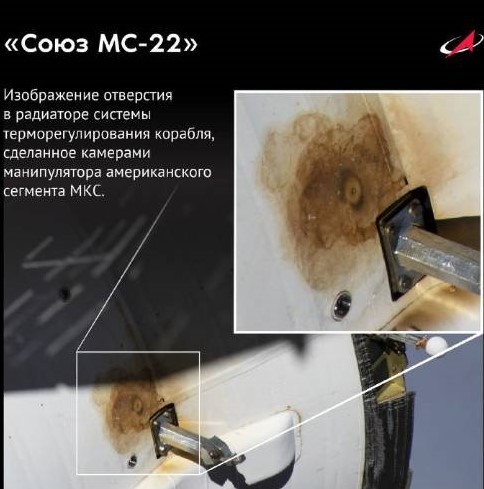
Image credit: Roscosmos

