Author Archive
 Author:
  December 24th, 2025
Wait-a-Minute!
Image credit: Barbara David
The profound prospect of finding out that “we’re not alone” may also have weighty wait-a-minute consequences.
A recent poll indicates that half of Americans believe aliens have visited Earth.
The poll was produced by YouGov US, an international online research data and analytics technology group.
This polling finds that most Americans believe aliens exist, and many think that aliens have paid a visit to Earth in recent years.

Full and deliberate disclosure?
Arguably, one poll result rubs up against “full disclosure” advocates, those seeking an immediate revelation about alien visitation in the past, up to today.
“Americans are more likely to believe alien encounters would have a negative effect on human civilization than to think it would have a positive effect,” YouGov explains.
Also, many believe that aliens would bring “new diseases and unintentional harm or outright hostility to people if we were to encounter them.”

Credit: Orbitz
Indeed, the poll explains that twice as many Americans say an alien visit would have a negative effect on human civilization than a positive one.
Other takeaway messages
According to YouGov data journalist, Jamie Ballard, other takeaway messages from the polling are:
- Americans are split on whether aliens have visited Earth in recent years.
- 16% of Americans believe we will make contact with alien life by 2035.
- Majorities of Americans think if we encountered aliens, it’s likely they would be more technologically advanced than humans and want to stay hidden.
The poll results stem from an online survey conducted on November 4 – 9, 2025 among 1,114 U.S. adult citizens.
To dive into the array of poll findings, go to:
https://today.yougov.com/health/articles/53486-half-of-americans-believe-aliens-have-visited-earth

Wait-a-Minute!
Image credit: Barbara David
 Posted in

Credit: via Roscosmos
Russia’s Roscosmos space agency has announced that a government contract has been struck with NPO Lavochkin to create a lunar power station by 2036.
It is not immediately clear in the Roscosmos statement if that power station would be nuclear. However, the contract implementation period is 2025–2036 and involves Rosatom and the Kurchatov Institute participation.
Rosatom is a Russian state nuclear corporation.
The Kurchatov Institute is Russia’s leading nuclear research institute.
Power to lunar consumers
The power plant work is to also engage the facilities of foreign partners.

Artist’s view of International Lunar Research Station to be completed by 2035. Credit: CNSA/Roscosmos
In a Roscosmos statement, the purpose of the lunar power station is projected to be a long-term power supply to consumers (moon rovers, observatory) of the Russian lunar program, as well as infrastructure facilities of the international scientific lunar station.
Long-term lunar exploration
Roscosmos said a set of tasks are scripted, from development of spacecraft, ground-experimental testing, flight tests and deploying infrastructure on the Moon.
“The project is an important step toward creating a permanent scientific lunar station and transitioning from one-time missions to a long-term lunar exploration program,” Roscosmos stated in a December 24th posting.

Russia is blueprinting a robotic lunar exploration program, such as this Luna-26, a Moon orbiter.
Image credit: NPO Lavochkin
China/Russia cooperation
Roscosmos and the China National Space Administration (CNSA) signed a memorandum on cooperation in building the lunar power plant on May 8.
Furthermore, in March 2021, China and Russia inked an intergovernmental memorandum to cooperate in a multi-phased International Lunar Research Station (ILRS).

Credit: Piplsay
Air vehicles of nameless origin, unknown intent, and seemingly odd capabilities are operating within America’s national airspace, flying over sensitive facilities, and interfering with commercial air traffic.
All of this aerial weirdness involves Unidentified Anomalous Phenomena or UAP for short. Whatever they are, UAPs continue to be seen, reported, and even documented through various technologies.
Perplexing issue
However, there seems to be a bottleneck in getting to the bottom of the UAP issue. Why so?

Credit: DOD/U.S. Navy/Inside Outer Space screengrab
Key specialists appraising UAPs have yet to untangle the perplexing issue, but do appear to be agreeing on what needs to be done now to further resolve what UAP are…and from where?
For more information, go to my new Space.com story – “We didn’t find answers in 2025, but UFO researchers say the search continues” – at:

Image Credit: NASA/JPL-Caltech/Malin Space Science Systems
Mars Guy checks in with Abe after 13 – plus years on Mars.
“A year on Earth has passed since we last checked in on the century old Lincoln penny that’s part of a camera calibration target on the Curiosity rover,” explains Mars Guy. “It was notably clean at that time but Mars has since piled on dust and ruined some camera pixels.”
Go to video at:

Image credit: Blue Origin/Inside Outer Space screengrab
Blue Origin successfully launched the 37th flight of the New Shepard program on December 20, 2025.

Image credit: Blue Origin/Inside Outer Space screengrab
The crew included: Michaela (Michi) Benthaus, Joey Hyde, Hans Koenigsmann, Neal Milch, Adonis Pouroulis, and Jason Stansell.

Image credit: Blue Origin/Inside Outer Space screengrab
This mission marked the first time a wheelchair user has flown above the Kármán Line, the internationally recognized boundary of space.
Go to in-flight video of crew at:
https://x.com/i/status/2002454714575692119

Image credit: Philippine Space Agency
China on Saturday sent a new communication technology test satellite via a Long March-5 booster into space from the Wenchang Space Launch Site in south China’s Hainan Province.
Meanwhile, the Philippine Space Agency (PhilSA) confirmed the launch and expected launch leftovers to careen within identified drop zones: approximately 69 nautical miles away from Burgos, Ilocos Norte, and 94 nautical miles away from Dalupiri Island, Cagayan; and 117 nautical miles away from Santa Ana, Cagayan, and 130 nautical miles away from Camiguin Norte.
Details of the rocket drop zone were disclosed through a Notice to Airmen (NOTAM) warning of an “aerospace flight activity.”
Potential risk
PhilSA disseminated a pre-launch report to relevant government agencies and authorities prior to the launch.

Rocket debris recovered in 2022.
Image credit: Philippine Coast Guard
“While not projected to fall on land features or inhabited areas, falling debris poses danger and potential risk to ships, aircraft, fishing boats, and other vessels that will pass through the drop zone,” PhilSA posted on their website.
“There is also a possibility for the debris to float around the area and wash toward nearby coasts. Additionally, the possibility of an uncontrolled re-entry to the atmosphere of the rocket’s upper stages returning from outer space cannot be ruled out at this time,” PhilSA added.
Furthermore, PhilSA reiterated its advice for the public to inform local authorities if suspected debris is sighted. “PhilSA also cautions against retrieving or coming in close contact with these materials that may contain remnants of toxic substances such as rocket fuel.”

Image credit: White House
Today, President Donald J. Trump signed an Executive Order that sets a bold vision for an “America First space policy,” ensuring the United States leads the world in space exploration, security, and commerce.
Described by the White House as launching a “New Age of American Space Achievement,” the Order calls for Americans’ return to the Moon by 2028.

Image credit: NASA
Furthermore, the Order calls for the establishment of “initial elements” of a permanent lunar outpost by 2030.
The Order also directs the deployment of nuclear reactors on the Moon and in orbit, including a lunar surface reactor ready for launch by 2030.

International Space Station.
Image credit: Roscosmos
Replacing the ISS
The wide-ranging Order also spurs private sector innovation and investment by upgrading launch infrastructure and developing a commercial pathway to replace the International Space Station by 2030.
To read the entire Executive Order issued December 18 by the White House – “Ensuring American Space Superiority” – go to:
https://www.whitehouse.gov/presidential-actions/2025/12/ensuring-american-space-superiority/

Artist’s concept shows Blue Origin’s Blue Moon Mark 1 lander and NASA’s VIPER (Volatiles Investigating Polar Exploration Rover) on the lunar surface.
Image credit: Blue Origin
A few months ago, NASA announced that the Volatiles Investigating Polar Exploration Rover (VIPER) has been green-lighted to set down at the Moon’s south pole region. The space agency awarded Blue Origin a CLPS (Commercial Lunar Payload Services) task order to deliver the Moon machinery.
Blue Moon’s MK1 lander, which is in production, would be used to deploy VIPER.
Headed for a late 2027 landing, NASA’s VIPER is designed to search for volatile resources, such as ice, on the lunar surface and gather science data to support long-term human exploration of the Moon.
Major milestone
VIPER’s lunar journey has reached a major milestone via the Sandia National Laboratories in Albuquerque, New Mexico.

Testing of the VIPER rover at Sandia’s Superfuge
Image credit: Sandia/Craig Fritz
Sandia’s Large Centrifuge, or Superfuge, has been used to help certify VIPER for its mission, validating that the rover’s structure can undergo a launch environment.
The 29-foot underground centrifuge can subject test items to inertial forces up to 300 Gs — 300 times the force of the Earth’s gravity — while integrating vibration, spin, thermal and shock environments simultaneously, mimicking flight conditions.
The Superfuge team spent months preparing for the NASA tests, explains a Sandia press statement.
Testing process
“This is a 1,000-pound article and it has to be oriented in a number of ways throughout the testing process,” said Ben Quasius, VIPER lead stress analyst.
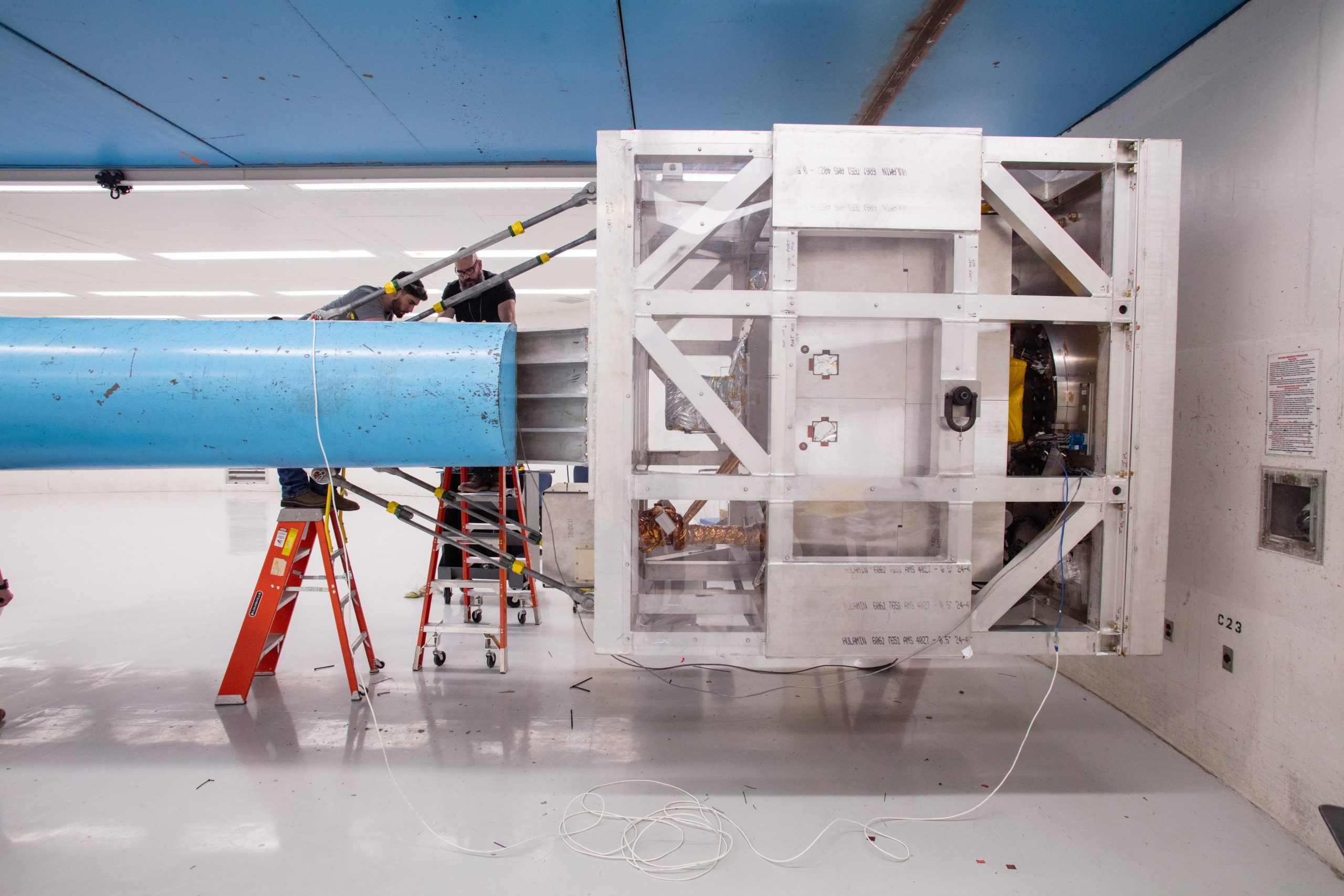
VIPER rover is suspended in a cage at the end of the Superfuge arm at Sandia National Laboratories.
Image credit: Sandia/Dave Linneman
“In many cases we would do a static qualification test where we use pistons to push on certain locations of the article to test flex of the body,” Quasius added, “but there are sensitive things in the way. You have solar panels in prime locations and a drill in the middle that can’t be compromised during flight.”
On the VIPER rover, there were 48 different points of data to be collected and analyzed by the Sandia testing.
Concentrations of water
VIPER is equipped with three scientific instruments: a mass spectrometer, a near-infrared spectrometer and a neutron spectrometer. An onboard drill is capable of reaching one meter beneath the lunar surface to pull up samples of any existing water remnants.
The rover’s mission is to investigate the Moon’s south pole, an expanse of real estate where permanently shadowed craters are believed to contain large concentrations of water. Such a resource could be transformed into oxygen, drinkable water by future crews, as well as rocket fuel.
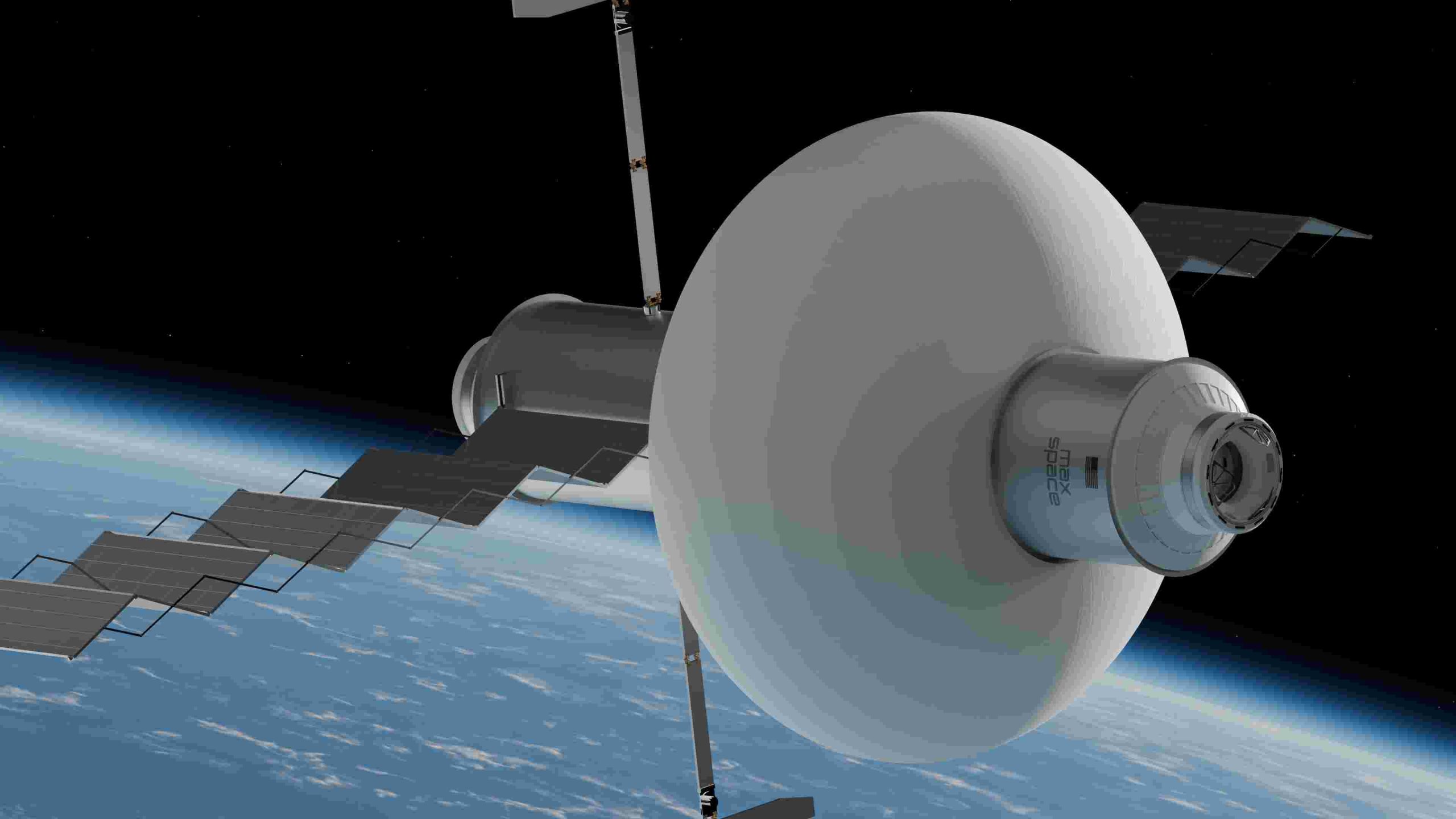
Image credit: Max Space
The private group, Max Space, has turned up the volume on inflatable habitats announcing today its “Thunderbird Station.”
Designed around a large expandable habitat, the station offers more usable volume per launch than any traditional metallic module.
Max Space also stated that its first in-orbit expandable habitat is manifested on a SpaceX rideshare launch in the first quarter of 2027.

Image credit: Max Space
For more information, go to the Max Space website at:
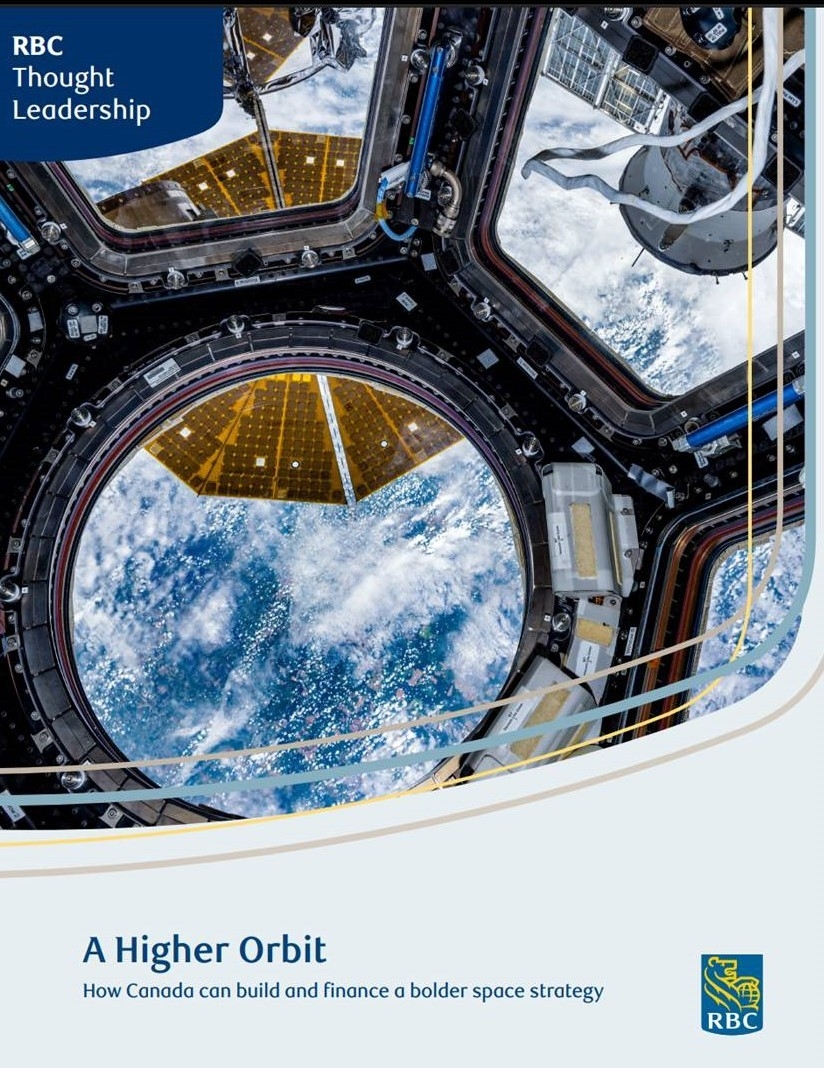
A study from the Royal Bank of Canada (RBC) notes that the global space economy is poised to nearly triple to $1.8 trillion by 2035, making the value derived from orbital assets equivalent to that of some G20 economies.
“We’ve entered an ambitious new space age—and Canada needs an ambitious new space strategy,” the study explains. As for what’s at stake?
“Our sovereignty in a more divided world…our prosperity in a new tech universe…and our relevance to allies when the ‘final frontier’ is suddenly the next economic and strategic frontier,” suggests the study.
Essential pillars
According to the RBC, Canada can seize this moment by building a space strategy around five essential pillars:
- Sovereignty: Building a space industrial base
- Defense: Becoming an essential ally in the Arctic
- Technology: Using satellites to secure a digital leap
- Commercialization: Breakthrough research and development
- Climate: Protecting Earth from the sky
To access the full Royal Bank of Canada report – “A Higher Orbit: How Canada can build and finance a bolder space strategy” – go to:

