Author Archive
 Author:
  July 11th, 2023
Curiosity Right B Navigation Camera on Sol 3881, July 7, 2023.
Image credit: NASA/JPL-Caltech
NASA’s Curiosity Mars rover at Gale crater is now performing Sol 3885 duties.
“Few things are better than planning an action-packed weekend on Mars. It’s even better when the last plan executed like a charm,” reports Natalie Moore, a mission operations specialist at Malin Space Science Systems in San Diego, California.

Curiosity Left B Navigation Camera image acquired on Sol 3881, July 7, 2023.
Image credit: NASA/JPL-Caltech
Last week, on Wednesday, the wheeled robot made it over 144 feet (44 meters), placing it in “veiny, layered bedrock heaven,” Moore added. “We’re still headed towards a local cluster of craters, roughly 490 feet (150 meters) to the east, and my Mastcam brain is excited for a far-field imaging campaign when we get there.”

Curiosity Right B Navigation Camera on Sol 3881, July 7, 2023.
Image credit: NASA/JPL-Caltech
Weekend routine
In the meantime, the rover is using the Mars Hand Lens Imager (MAHLI) to plan some close (and some extremely close) images of the terrain in front of it. “And since the downlink arrived as expected, Curiosity is in great shape for her classic weekend routine,” Moore reported July 7.

Curiosity Chemistry & Camera Remote Micro-Imager (RMI) photo taken on Sol 3881, July 7, 2023.
Image credit: NASA/JPL-Caltech/LANL
On the first sol (3882) in that weekend plan, the rover was to wake up and spend time organizing her data from the previous plan, Moore added. “After a leisurely mid-morning nap she’ll start her first science activities.
Those were to include: Mastcam stereo mosaic of Kukenan butte in the far distance, a Chemistry and Camera (ChemCam) Laser Induced Breakdown Spectroscopy (LIBS) 5-spot raster of a nicely-layered block in the workspace named “Akrata,” a Mastcam-Right documenting image of the LIBS laser spots, and a Dynamic Albedo of Neutrons (DAN) measurement in parallel with those instruments to measure any water-related atoms present in the ground.

Curiosity Right B Navigation Camera on Sol 3881, July 7, 2023.
Image credit: NASA/JPL-Caltech
The robot was scheduled to take another nap to prepare for arm activities later that day.
Swish the dust away
“What does a Martian rover do on a Saturday evening? Stick her cupcake-sized [Alpha Particle X-Ray Spectrometer] (APXS) on some dust-free rocks and ‘sniff’ the surface chemistry of course! But first, she has to pre-game with some dust-clearing and MAHLI images while the sun is still up,” Moore explains.

Curiosity Right B Navigation Camera on Sol 3881, July 7, 2023.
Image credit: NASA/JPL-Caltech
Last weekend, the plan called for picking a layered bedrock target for use of the Dust Removal Tool (DRT) to swish the dust away and named it “Desino.”
“After brushing Desino, it’s time to take our usual Mastcam-Right images of the DRT for documentation and head into some major MAHLI imaging,” Moore notes. Starting with a dark, plate-like target named ‘Planitero,’ MAHLI was to take images at 25 centimeters and 5 centimeters from the surface.

Curiosity Right B Navigation Camera on Sol 3881, July 7, 2023.
Image credit: NASA/JPL-Caltech
Bedrock layers
“Then we have an exciting 2×3 mosaic planned of some bedrock layers at ChemCam’s Akrata LIBS target,” Moore reports, “for a total of 6 images at best focus (actually, we take 8 images at difference focus values for each mosaic position to make sure we’re getting the best focus possible in addition to an extra full frame – so that’s really 54 images, plus 6 subframes. It’s a MAHLI party!”
In a past plan, Curiosity did a similar type of mosaic along a vertical fin, and the surrounding bedrock showing the type of layers Mars researchers are hoping to get in last weekend’s mosaic.
For the MAHLI’s finale, the rover was slated to take images of dust-cleared Desino at 25 centimeters, 5 centimeters, and 2 centimeters from the target’s surface.

Curiosity Mast Camera Right image taken on Sol 3880, July 6, 2023.
Image credit: NASA/JPL-Caltech/MSSS
Western-like heading
“On a side note – this is our first western-like heading in quite some time and for MAHLI that means much better chance at full-sun image lighting, which is almost always preferred,” Moore explains.

Curiosity Mast Camera Right image taken on Sol 3880, July 6, 2023.
Image credit: NASA/JPL-Caltech/MSSS
After the MAHLI party, APXS will settle into some surface sniffing – starting with Planitero and ending with Desino. “It’s an early night for Curiosity, but she’ll be awake in intermittently to send the sol’s data to Earth via orbiters when they pass overhead,” Moore points out.
Local craters
For the second sol (3883), Curiosity will have another late morning and start her science activities around noon.

Curiosity Mast Camera Left image taken on Sol 3880, July 6, 2023.
Image credit: NASA/JPL-Caltech/MSSS

Curiosity Mast Camera Left image taken on Sol 3880, July 6, 2023.
Image credit: NASA/JPL-Caltech/MSSS
Mastcam was scheduled to take a multispectral stereo frame (in 7 wavelength filters for each camera) of Desino and a couple, smaller stereo mosaics of the vertical rock fins and sand cracks around the rover.
ChemCam will shoot another bedrock target named “Skotani” with LIBS and Mastcam follows up with the usual documentation image of the laser-induced spots.
“Then it’s time to pack it up and drive away!” A stroll of roughly 55 feet (17 meters) last Sunday was to hopefully get Curiosity closer to the local craters in the distance, Moore concludes, “and put some more interesting bedrock in the workspace for Monday’s planning.”
 Posted in

Venus cloud encounter – a private sector investigation.
Credit: Rocket Lab
Yes, Venus is hot.
But the controversial detection a few years ago of phosphine (PH3) in the Venusian atmospheric continues to be an astrobiological hot topic.
The source of (PH3) detection on Venus is unknown.
“There could be an as yet unknown geochemical or photochemical process. Or, there could possibly be life in the Venus cloud layers producing PH3,” report MIT’s Janusz Petkowski and Sara Seager.

Image credit: Sara Seager, Janusz Petkowski, William Bains
Recalibrate thinking?
It turns out that “mornings” in Venus’ atmosphere and “evenings” makes for an interesting contrast. On Venus, there is an expected and suspected lower abundance of PH3 when the part of the atmosphere observed has passed through sunlight.
So perhaps it’s time to recalibrate the on-going heated discussion and triple-check research findings?
The debate regarding phosphine in Venus’ atmosphere is surely going to continue.

Venus Life Finder Mission report.
Credit: MIT/Breakthrough Initiatives
Astrobiology-focused missions
Enter the “Morning Star Missions.”
The project entails a series of astrobiology-focused missions to Venus, the morning star planet, with the goal to study the clouds of Venus in order to determine their ability to support microbial life forms and to search for signs of life or life itself.
The mission concepts have been sparked by and evolved from the Venus Life Finder Mission Concept study led by MIT’s Sara Seager.
Kicking off the Morning Star Missions is the first-ever private interplanetary mission to Venus to search for signs of life in the clouds by detecting organic chemistry. The mission is planned for launch in January 2025 aboard Rocket Lab’s Electron rocket.

Morning Star Venus probe will carry an Autofluorescence Nephelometer to search for organic material in the clouds and characterize the cloud particles.
Image credit: Christophe Mandy
Cloud probe
Rocket Lab’s Photon spacecraft will carry a small atmospheric probe weighing about 45 pounds (20 kilograms). It will be dropped near Venus right before spacecraft entry into the atmosphere.
The probe will carry an Autofluorescence Nephelometer to search for organic material in the clouds and characterize the cloud particles.
Each subsequent Morning Star mission will increase in complexity and leverage the technologies and scientific discoveries of the previous missions to enhance knowledge of the Venusian clouds, and the prospect of detecting life high above the planet’s hellish landscape.

Credit: Andreas Treuer via ESA
The European Space Agency (ESA) is inviting researchers for ideas on collecting solar power in space and wirelessly transmitting it to Earth.
ESA is proceeding with the SOLARIS initiative to further investigate and mature the feasibility of Space-based Solar Power, a concept that has the potential to deliver clean energy from space to Earth in support of Europe’s and the world’s efforts to mitigate the climate crisis.
Along with a host of engineering problems, there are many open questions around wirelessly transmitting large amounts of energy through the atmosphere.

Image credit: ESA
Innovation platform
In a new call for ideas on ESA’s Open Space Innovation Platform (OSIP), the Preparation element of ESA’s Basic Activities is soliciting ideas for research activities to address challenges linked to space-based solar power.
Go to: Request for Information – Research Activities in support of Space-Based Solar Power for terrestrial needs at:
For more information, go to:

Curiosity’s location as on Sol 3880. Distance driven tp date: 18.82 miles/30.29 kilometers.
Image credit: NASA/JPL-Caltech/Univ. of Arizona
NASA’s Curiosity Mars rover at Gale Crater is now performing Sol 3881 duties.
The rover recently wrapped up a busy weekend on Mars and a four-sol plan over the 4th of July holiday. It was executed as expected, but planning post-holiday was unusual because new images of the terrain in front of the wheeled robot could not be loaded into planning software.

Curiosity Front Hazard Avoidance Camera Left B image taken on Sol 3880, July 6, 2023.
Image credit: NASA/JPL-Caltech
Although researchers were not able to select Chemistry and Camera (ChemCam) and Mastcam observations, the science team put together a plan and drive for sols 3880 and 3881.
That’s the report from Sharon Wilson, a planetary geologist at the Smithsonian National Air and Space Museum in Washington, D.C.

Curiosity Front Hazard Avoidance Camera Right B image taken on Sol 3880, July 6, 2023.
Image credit: NASA/JPL-Caltech
Fin-like, gray vein
The rover has used its Dust Removal Tool (DRT) plus its Mars Hand Lens Imager (MAHLI), Alpha Particle X-Ray Spectrometer (APXS), and Mastcam multispectral data to characterize the bedrock at “Roghi” – as well as making a MAHLI observation of “Xerocambos,” a fin-like, gray vein sticking out of the bedrock, Wilson explains.
A large Mastcam mosaic of the layered butte named “Chenapau” was also in the plan.

Curiosity Front Hazard Avoidance Camera Right B image taken on Sol 3880, July 6, 2023.
Image credit: NASA/JPL-Caltech
“The science team planned ChemCam AEGIS activities on both sols; AEGIS is an acronym for Autonomous Exploration for Gathering Increased Science and is a mode where the rover identifies and selects a geological target from navigation camera images based on a set of guidelines set by scientists on the team,” Wilson adds.

Curiosity Mars Hand Lens Imager (MAHLI) produced photo on Sol 3880, July 6, 2023.
Image credit: NASA/JPL-Caltech/MSSS
Impact craters
A full slate of environmental team atmospheric observations round out the plan, including images and movies to monitor clouds, a tau observation to monitor dust, and a dust devil survey.

Curiosity Front Hazard Avoidance Camera Left B image taken on Sol 3880, July 6, 2023.
Image credit: NASA/JPL-Caltech
A slated drive of 164 feet (50-meters) was to get the robot closer to an exciting cluster of impact craters on Curiosity’s route.
As always, dates of planned rover activities described in reports are subject to change due to a variety of factors related to the Martian environment, communication relays and rover status.

Image credit: Barbara David
Wait a minute!
Perhaps it is a case of re-inventing the wheel?
The European Space Agency (ESA) has been busy testing the Lunar Equipment Support Assembly (LESA).
The idea is to develop wheeled carriers to assist Artemis astronauts during moonwalks – a way to transport equipment and tools.

Image credit: ESA/Novespace
Recently tested is the LESA-NEST (Near-by Equipment Support Trolley), making use of parabolic flight in an aircraft to mimic the Moon’s one-sixth gravity.

In pre-flight training, Alan Shepard tries out the MET cart.
Image credit: NASA/Apollo Lunar Surface Journal
Rickshaw trouble
This ESA work may have all the makings of an Apollo 14 mission replay from 1971, one that served up deep dust and dubious results.
Apollo 14’s Modular Equipment Transporter (MET) was a two-wheeled, hand-pulled vehicle that was used as an equipment hauling device on traverses across the lunar surface.

Drawing credit: NASA/Apollo Lunar Surface Journal
The MET earned the nickname by astronauts as the “the rickshaw”. It was hauled about by using a pulling bar in the front.

Field testing! Alan Shepard tries out MET cart.
Image credit: NASA/Apollo Lunar Surface Journal
But at one point, the MET was carried by both Apollo 14 moonwalkers – Alan Shepard and Edgar Mitchell. The MET was termed “adequate,” with Shepard and Mitchell disappointed by its performance. It was too difficult to pull the MET through the rough lunar terrain.
So big wheel (s) keep on turnin’…I’m thinking “carte blanche,” maybe even cart before the horse – but it’s Friday.

Apollo 14’s Alan Shepard next to Modular Equipment Transporter (MET)
Image credit: NASA

NASA’s venerable Lunar Reconnaissance Orbiter (LRO), on-duty since swinging into orbit around the Moon on June 23, 2009.
Image credit: NASA/Goddard Space Flight Center
Around and around it goes. The veteran NASA Lunar Reconnaissance Orbiter (LRO) continues to circuit the Moon since June 2009.
Over the decades, this spacecraft has spit out images and data proven to be transformational in our ability to eye and better value Earth’s celestial neighbor.
While the aging craft remains on assignment – now helping plot out where NASA Artemis astronauts will boot their way across select lunar south pole regions – how long will this venerable orbiter last?

Informally tagged as Malapert massif, this feature is thought to be a remnant of the moon’s south pole – Aitken basin rim, which formed more than 4 billion years ago. This peak (lower left) was picked as one of the Artemis III candidate landing regions for an expeditionary crew.
Image credit: NASA/Goddard Space Flight Center/Arizona State University
Uh-oh factor
There’s a new call for how to sustain vigilance of the moon, chart forthcoming landing sites of robotic craft and expeditionary crews, the position of wheeled rovers, even spot and help interpret the “uh-oh factor” behind failed landing attempts.
And given the constant volley of moon-bound vehicles being lobbed by multiple nations and private firms, Earth’s celestial companion is going to be one busy place.
For more information on LRO and what next, go to my new Space.com story – “This NASA probe has been revealing stunning moon views for 14 years. How long will it last?” – at:
https://www.space.com/moon-nasa-lunar-reconnaissance-orbiter-how-long

Curiosity Right B Navigation Camera image taken on Sol 3878, July 4, 2023.
Image credit: NASA/JPL-Caltech
Wheeling and dealing with Mars – not an easy assignment.
Remington Free, Operations Systems Engineer at NASA’s Jet Propulsion Laboratory, notes in a recent report use of the robot’s Mars Hand Lens Imager (MAHLI) to inspect its wheels.

Mars Hand Lens Imager (MAHLI) photo produced on Sol 3878, July 4, 2023.
Image credit: NASA/JPL-Caltech/MSSS
“This is an engineering activity we perform at a regular cadence in order to assess the state of our wheels,” Free explains. “This is crucial for us given the wear and tear we experience from drives due to the sharp rocks and bumpy terrain.

Mars Hand Lens Imager (MAHLI) photo produced on Sol 3878, July 4, 2023.
Image credit: NASA/JPL-Caltech/MSSS
“Full MAHLI wheel imaging (FMWI) is accomplished during a drive by rotating the wheels by a fixed amount for each imaging position so we can get a good look at the entire wheel state,” Free adds.
Here are a few images from the recent inspect of Curiosity’s wheels…some doing fine, others showing a beating.

Curiosity Left B Navigation Camera image taken on Sol 3878, July 4, 2023.
Image credit: NASA/JPL-Caltech

Curiosity Left B Navigation Camera image taken on Sol 3878, July 4, 2023.
Image credit: NASA/JPL-Caltech

Curiosity Left B Navigation Camera image taken on Sol 3878, July 4, 2023.
Image credit: NASA/JPL-Caltech

MMX to explore the moons of Mars – Phobos and Deimos
The Japanese Martian Moons eXploration (MMX) mission is slated for launch in the mid-2020s.
A project of the Japan Aerospace Exploration Agency (JAXA), the MMX spacecraft consists of three modules. The exploration module has landing legs, samplers and some instruments as well as the MMX rover onboard named IDEFIX.
A trilateral cooperation within the framework of the MMX mission involves JAXA, the German Aerospace Center (Deutsches Zentrum fuer Luft- und Raumfahrt; DLR) and the French space agency (Centre national d’etudes spatiales; CNES).
The German-French rover is to be integrated into the Japanese MMX mission for a landing on the martian moon Phobos in the second half of the 2020s.

After release by the MMX mothership and falling to the surface of Mars’ moon Phobos, the rover is to right itself and power up.
Image credit: DLR (CC BY-NC-ND 3.0)
Low gravity
Samples from the martian system, specifically from the martian moon Phobos, will be brought to Earth by the Japanese MMX mothercraft. The IDEFIX rover is to move across and explore the surface of Phobos in conditions of extremely low gravity – roughly two-thousandths of Earth’s gravity.
During the course of the mission, the rover is scheduled to land on Phobos. This will involve setting the rover down from an altitude between roughly 130 feet – 330 feet (40 and 100 meters) above the surface.
After landing, the rover will autonomously upright itself and then become operational, lasting about three months.
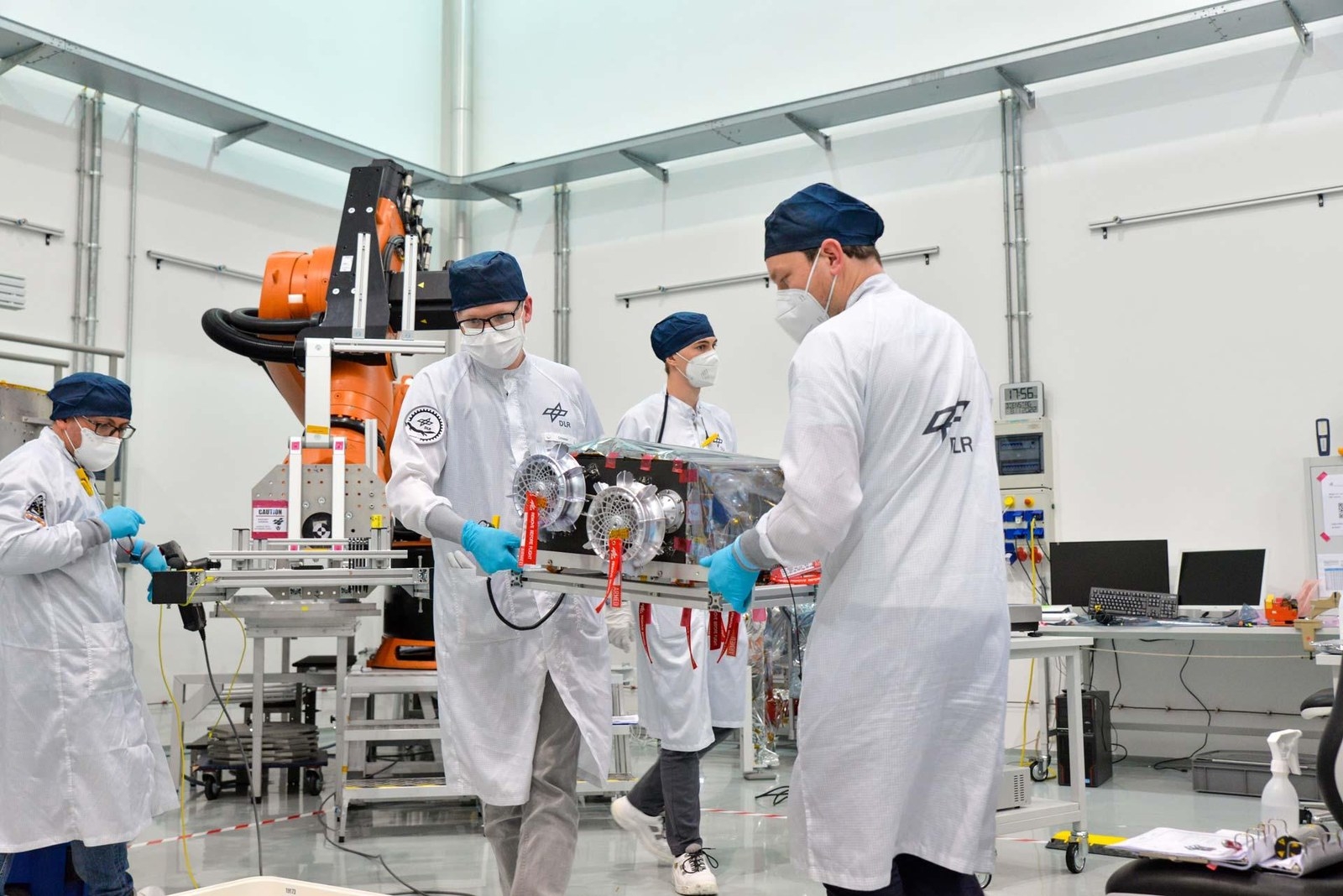
MMX rover being readied for delivery from Bremen, Germany to the French space agency, CNES in November 2022. By the summer of 2023, rover instruments and subsystems will be installed.
Image credit: DLR
Towards the end of the mission, ground samples will be collected by the mother spacecraft, making use of the rover surveillance data collected. These samples are to be delivered back to Earth in the MMX return module for more detailed analyses.
According to the DLR, the completion of the rover, including instruments and systems, is on the home stretch towards summer 2023.
Unsolved mystery
The origin of the martian moons Phobos and Deimos remains an unsolved mystery in planetary research.

NASA Mars Reconnaissance Orbiter imagery captures the two moons of the Red Planet.
Image credit: NASA/University of Arizona/MRO
Both moons are irregularly shaped and resemble asteroids.
Accordingly, one theory is Phobos and Deimos were captured by Mars, possibly originating from the asteroid belt.
On the other hand, both moons orbit Mars near the ecliptic plane on which all planets and most of their moons move around the Sun. In addition, both orbits are almost circular.
Those facts seem to counter the “captured asteroids” theory, with the prospect that Phobos and Deimos are leftovers from a huge asteroid impact on the Red Planet.

Moon as observed from the International Space Station.
Image credit: NASA
What is going on with Compton-Belkovich?
This feature on the Moon, a suspected volcano, is indeed glowing at microwave wavelengths.
A new instrument type has discovered evidence of a volcanic process on the Moon that had only been seen on Earth, reports Matthew Siegler, Senior Scientist at the Planetary Science Institute (PSI) and lead author of “Remote Detection of a Lunar Granitic Batholith at Compton-Belkovich” that appears in the journal Nature.
Using data from both China’s Chang’e-1 (2007) and Chang’e-2 (2010) lunar orbiters, researchers have been able to map temperatures below the Moon’s surface.

Image credit: Matthew Siegler, PSI.
As noted in the paper, “the surprising magnitude and geographic extent of this feature imply an Earth-like, evolved granitic system larger than believed possible on the Moon, especially outside of the Procellarum region” on the Moon.
Extra heat
“What we found was that one of these suspected volcanoes, known as Compton-Belkovich, was absolutely glowing at microwave wavelengths,” Siegler said in a PSI statement. “What this means is that it is hot, not necessarily at the surface, as you would see in infrared, but under the surface.”
Siegler added that the only way to explain this glow is from extra heat coming from somewhere below the feature within the deeper lunar crust.
“So Compton-Belkovich, thought to be a volcano, is also hiding a large heat source below it,” Siegler said.
On the Moon, a granitic batholith is a huge body larger than 20 kilometers of what was once subsurface lava that never erupted.

China’s Chang’e-1 Moon orbiter. Image credit: CNSA via NASA/NSSDCA
Unique data set
Tucson, Arizona-based PSI’s Jianqing Feng is a co-lead author, along with other research colleagues.
Making use of an instrument looking at microwave wavelengths – longer than infrared – sent to the Moon on both the Chinese orbiters — enabled the mapping of temperatures below the lunar surface.
“It was a neat project in that China made their data public – as does NASA – and we were able to work with this unique data set to figure out something really interesting about the Moon,” Siegler noted.

Image taken by the NASA Lunar Reconnaissance Orbiter’s LROC image system. A small portion of the Compton-Belkovich Volcanic Complex. The upper two thirds of the scene shows the volcanic complex, whereas the lower third of the image is outside of the complex. The terrain outside of the complex exhibits a greater abundance of impact craters than inside the complex. Image credit: NASA/GSFC/Arizona State University
Science and politics
Following the rules, there was not direct collaboration with Chinese researchers. All funding for the project came only from NASA, “so we had to follow the breadcrumbs to crack this dataset open” Siegler said.
“Jianqing’s ability to come to the U.S. through the J visa system to navigate the data and existing literature on the topic was very valuable,” Siegler pointed out. “It is a great example of what can be done if science and politics can work together.”
Siegler’s and Feng’s work on the project was funded by a grant to PSI from NASA’s Lunar Data Analysis program and Lunar Reconnaissance Orbiter mission.
To gain access to the Nature published research – “Remote detection of a lunar granitic batholith at Compton–Belkovich” – go to:

Curiosity rover overlooking a canyon of rocks on the Mars surface and was taken by Right Navigation Camera onboard Curiosity on Sol 3872, June 28, 2023. You can faintly see rover tracks in the center of the image, left behind as the robot slowly made its way up the hill.
Image credit: NASA/JPL-Caltech
NASA’s Curiosity Mars rover at Gale crater is now performing Sol 3877 duties.
“We made it!” That’s the report from Catherine O’Connell-Cooper, a planetary geologist at University of New Brunswick; Fredericton, New Brunswick, Canada.
“We are peeking up over the edge of the ridge that we have been trying to climb for a few weeks now. The view ahead is spectacular but it’s worth pausing for a minute to look back down into the canyon,” O’Connell-Cooper adds. “Lots of slipping and sliding, and drives ending too soon or terminating on precarious footings, but we finally made it!”

Curiosity Right B Navigation Camera taken on Sol 3874, June 30, 2023.
Image credit: NASA/JPL-Caltech
Brushed bedrock
A recently scripted plan calls for a “Touch and Go” activity.
Before the robot pushes out onto the ridge, researchers will characterize the local bedrock at “Madero” with the Alpha Particle X-Ray Spectrometer (APXS) and Mars Hand Lens Imager (MAHLI) on some brushed bedrock.

Curiosity Right B Navigation Camera image taken on Sol 3875, July 1, 2023.
Image credit: NASA/JPL-Caltech
“This workspace has mineral veins running perpendicular to the rock layers and fragments of a dark layer that is parallel to the other layers,” O’Connell-Cooper notes.
Vertical vein
“MAHLI will image a vertical vein at “Vesini” to look at its relationship to the host bedrock and some of the dark layer around the vein, reports O’Connell-Cooper whilst the Chemistry and Camera’s (ChemCam) Laser Induced Breakdown Spectroscopy (LIBS) instrument will analyze a vein fragment at “Mega Spilaio.”

Curiosity Mast Camera (Mastcam) Left photo taken on Sol 3873, June 29, 2023.
Image credit: NASA/JPL-Caltech/MSSS
Mastcam will acquire a multispectral image of the same target and was also slated to take four stereo mosaics in a recently scripted plan.
Crater cluster
“The largest mosaic (28 images) looks at the nearby crater cluster, as well as further ahead to “Gediz Vallis ridge” and the “Texoli” butte. Two smaller mosaics look at laminations and erosionally resistant features in bedrock in this area and an area of more active sand,” O’Connell-Cooper points out.
The smallest mosaic (3 images) uses color Mastcam imagery to support a black and white ChemCam Remote Micro-Imager (RMI) observation, which focuses on erosionally resistant features in the direction of Curiosity’s drive.

Curiosity Left B Navigation Camera image acquired on Sol 3875, July 1, 2023.
Image credit: NASA/JPL-Caltech
Slip-and-slide
“Our drive on the afternoon of the first sol [Sol 3873] is relatively short, [about 50 feet (15 meters)] further out onto the ridge,” O’Connell-Cooper adds, “where we hope to catch up on an important housekeeping chore in the upcoming 4th of July long weekend plan.”
Full MAHLI Wheel Imaging (FMWI) uses a combination of Mastcam and MAHLI to image the rover’s wheels and monitor them for wear and tear, and was last done just before Thanksgiving.
“This activity needs some flat ground to be executed, so it had to be delayed while we were playing slip-and-slide on the hill and we are hoping to get it done as soon as possible now in order to keep to our routine cadence (every 1000 meters),” O’Connell-Cooper observes.

Curiosity Chemistry & Camera (ChemCam) RMI taken on Sol 3876, July 2, 2023.
Image credit: NASA/JPL-Caltech/LANL
Dust devils, clouds
Environmental researchers have planned some basic tau measurements for this plan, where Mastcam will help to measure dust in the atmosphere.

Curiosity Chemistry & Camera (ChemCam) RMI taken on Sol 3876, July 2, 2023.
Image credit: NASA/JPL-Caltech/LANL
On the second sol of the plan, the Environmental Continuous Air Monitor (ECAM) will look for dust devils and survey the clouds overhead in Gale.
The plan rounds out with scheduled Dynamic Albedo of Neutrons (DAN) and Rover Environmental Monitoring Station (REMS) data collections, for a full suite of environmental activities, O’Connell-Cooper concludes.

