Author Archive
 Author:
  October 26th, 2023
Image credit: CCTV/CNSA/Inside Outer Space screengrab
China’s Shenzhou-17 crew has successfully linked up with the country’s space station, joining the already resident Shenzhou-16 crewmembers.
The spaceship, atop a Long March-2F carrier rocket, rumbled off the launch pad at 11:14 (Beijing time) October 26 from the Jiuquan Satellite Launch Center in northwest China.
After entering orbit, the spaceship made an automated rendezvous and docking with China’s space station combination. The whole process took about 6.5 hours, the China Manned Space Agency (CMSA) reported.

Image credit: CCTV/CNSA/Inside Outer Space screengrab
Space get-together
The Shenzhou-17 astronauts — Tang Hongbo, Tang Shengjie and Jiang Xinlin – were greeted aboard the Tiangong space station by the Shenzhou-16 crew who arrived at the orbiting outpost back on May 30.
“The space get-together of the two crews kicked off the third in-orbit crew rotation in China’s space station,” noted China Central Television (CCTV).
China’s Shenzhou-16 crew — Jing Haipeng, Zhu Yangzhu and Gui Haichao – are slated to return to the Dongfeng landing site in the Gobi Desert, north China’s Inner Mongolia Autonomous Region on October 31, according to the CMSA.

Image credit: CMS/Inside Outer Space screengrab
Research in orbit
According to the China Global Television Network (CGTN), a total of 70 experiments in space medicine, life ecology, biotechnology, material science, fluid physics, fluid mechanics and space technology, as well as eight research projects on human factors engineering were carried out. Some testing samples will be brought to Earth aboard the Shenzhou-16 spacecraft.
CGTN also noted that the Shenzhou-16 crew will hold HD cameras and take pictures of the Chinese space station before returning to Earth. They are expected to obtain the first full picture of the space station with Earth as the background for the first time in orbit.

Image credit: China Manned Space Agency
Moon plans
“In the near future, we will continue to enhance our space station. Our plans include sending taikonauts to the Moon and further exploration of the universe, including a closer examination of our solar system,” said Qi Faren, an academician of the Chinese Academy of Engineering and first chief designer of the Shenzhou spaceship.
China plans to land its astronauts on the Moon before 2030 to carry out scientific exploration, according to a preliminary plan released CMSA.
The plan is to launch two carrier rockets to send a lunar lander and a piloted spacecraft to a lunar orbit, respectively. The craft and lunar lander will rendezvous and dock with each other, and then astronauts will enter the lander.
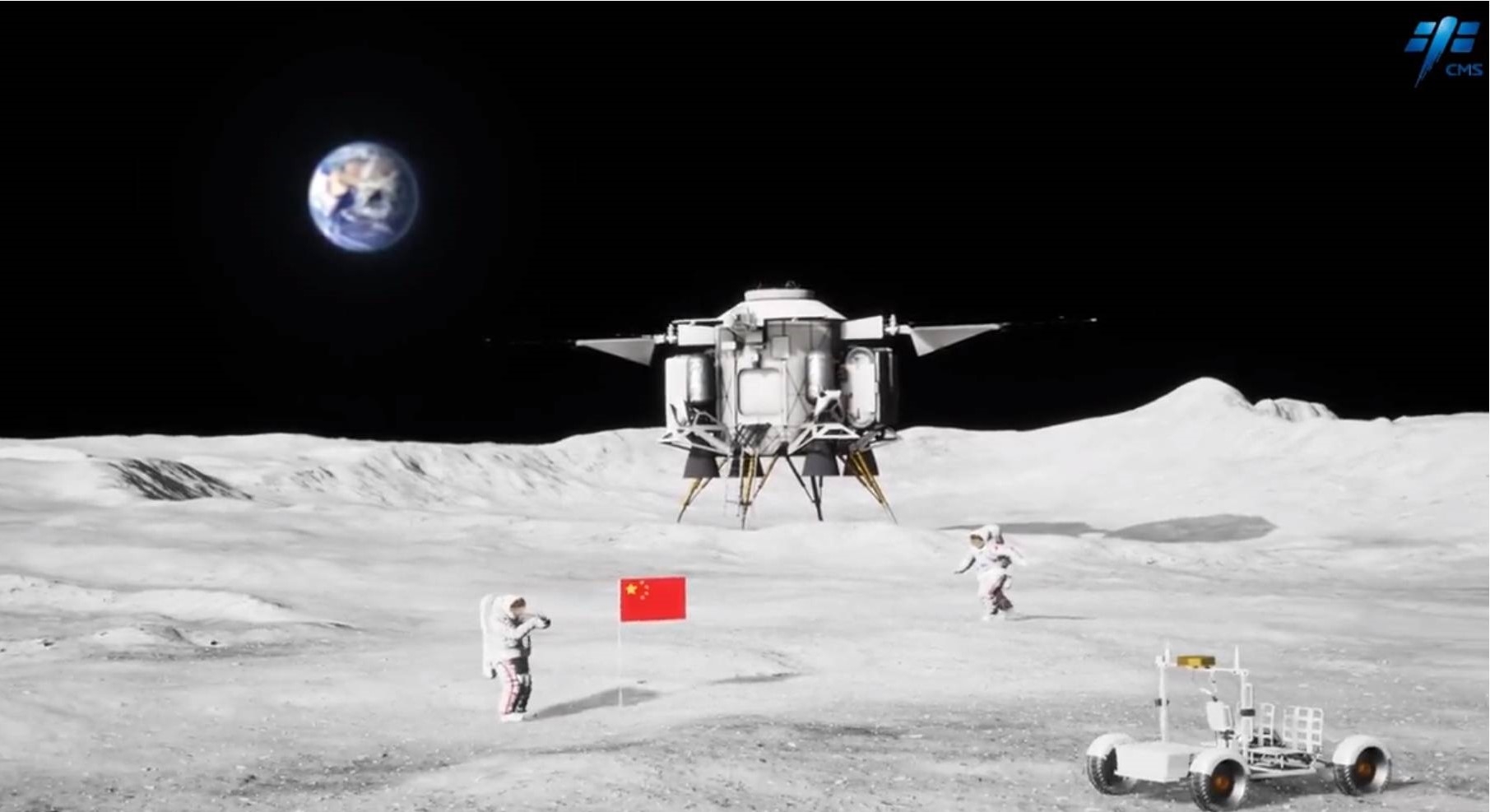
Image credit: China Manned Space Agency
The lunar astronauts are to be selected from individuals with prior space flight experience. China is exploring the construction of a lunar scientific research station for systematic and long-term lunar exploration and related technical tests and verification, according to the CMSA.
For video views of the Shenzhou-17 liftoff to link-up, go to:
https://youtu.be/h_w6wLZy1x4?si=PkDd5m_IAU2edEck
 Posted in

Earth orbit is a heavenly mess and getting messier. Decades of human-made detritus already encircles our planet in the form of clutter – be it discarded rocket stages, aging or lifeless satellites, and other sorts of garbage.
Orbital debris persists and the problem is growing exponentially as space becomes ever more crowded. For instance, there’s the number of Internet-providing satellites being espoused by various private groups; the eventual interaction of those reentering satellites with our biosphere is projected to be sizeable.

Image credit: NOAA
New Investigation
Also in upshot phase is attention to the repercussion of rocket launches and space debris reentries on Earth’s delicate atmosphere, coupled to possible impacts on global climate and stratospheric ozone.
Now an investigative team led by the National Oceanic and Atmospheric Administration (NOAA) has detected in the stratosphere more than 20 elements that mirror those used in spacecraft-building alloys.
Go to my new Scientific American story co-authored with Lee Billings – “Space Junk Is Polluting Earth’s Stratosphere with Vaporized Metal – Defunct satellites and other pieces of orbital debris are pumping metals into Earth’s fragile upper atmosphere, with effects unknown” – at:

Psyche spacecraft sidles up to M-type asteroid 16-Psyche Credit: NASA/ASU
Sent skyward earlier this month, NASA’s outbound Psyche spacecraft is making its way to a unique asteroid of the same name. It is supposedly sporting a metal core that some space miners hungrily value at many trillions of dollars. The object is viewed as a mother lode of high iron-nickel metal.
By August 2029, the Psyche spacecraft will begin to orbit the space rock – the only metal-class asteroid ever to be explored.
First of all, there’s some scientific meandering about what the probe will truly find at destination’s end.
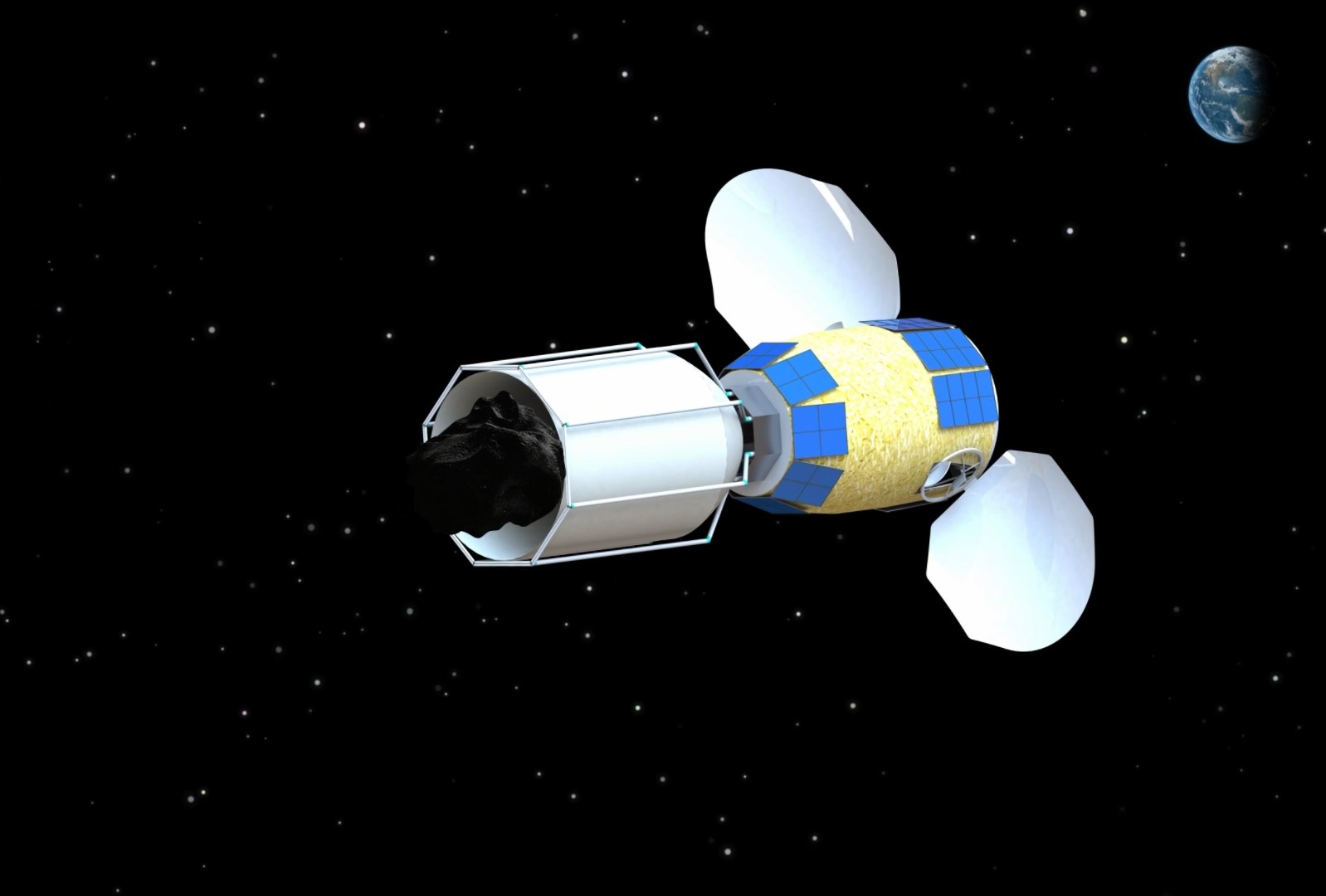
Design concept by TransAstra for early asteroid mining would target easy to get to space rocks in highly Earth-like orbits.
Image credit: TransAstra
Prior to its up-close look-see, this Psyche space rock is being eyed by private sector space mining aficionados as a cosmic cash cow, ripe for the picking to score big bucks.
But how real the promise of this asteroid to claim a mega mother lode?
Check out my new Multiverse Media SpaceRef story – “Psyching out Psyche – Gut-Checking the Asteroid Miner’s Paradise” – at:
https://spaceref.com/space-commerce/psyching-out-psyche-gut-checking-asteroid-miners-paradise/

Image credit: CCTV/Inside Outer Space screengrab
China has revealed the Shenzhou-17 crew slated for launch to the country Tiangong space station: A trio of former fighter pilots, Tang Hongbo, Tang Shengjie, and Jiang Xinlin, are set to carry out the mission.
Commander Tang will also be the first astronaut to return to China’s space station. His launch sets a new record for the shortest interval between two spaceflight missions by a Chinese astronaut.
Tang Shengjie and Jiang are first-time space voyagers. They joined China’s third batch of astronauts in September 2020.

Image credit: CCTV/Inside Outer Space screengrab
Six-month voyage
The Shenzhou-17 crewed spaceship is scheduled to launch Thursday at 11:14 (Beijing Time) from the Jiuquan Satellite Launch Center in northwest China, the China Manned Space Agency (CMSA) announced on Wednesday.
The Shenzhou-17 mission will be the 12th human spaceflight undertaking of China’s space program. The crew will stay in orbit for about six months and are scheduled to return to the Dongfeng landing site in north China’s Inner Mongolia Autonomous Region in April next year.
Go to these videos introducing the Shenzhou-17 crew at:

Image credit: NASA/JPL-Caltech
NASA’s Perseverance rover is scurrying around on the Red Planet, wheeling and dealing with Jezero Crater and inspecting up-close the site of this former lake, perchance with beach-front property.
Newly found by the Mars machinery are eye-catching circular rock structures. They are attention-grabbers for good reason. They resemble ones formed by microbial communities in some lakes on Earth.

Modern, living microbial mats in Bridger Bay, Antelope Island, Great Salt Lake, in October 2013 when the lake was nearly 5.5 feet below its historical average of 4,200 feet.
Image credit: Utah Geological Survey
But the finding underscores, perhaps, how Mother Nature on the Red Planet can flaunt and daunt interpretations of finding evidence for life on that world. Or, on the other hand, could we be missing something?
Take a read of my new Space.com story – “If the Perseverance rover found evidence of life on Mars, would we recognize it?” – at:
https://www.space.com/perseverance-rover-search-for-life-on-mars-is-difficult

Image credit: NASA/JPL-Caltech
As newly posted by NASA/JPL, the Ingenuity Mars helicopter at Jezero Crater flew Flight #63 on October 19th.
The craft covered a horizontal distance of roughly 1,901 feet (579 meters); reached an altitude of approximately 39 feet (12 meters); taking to the thin martian air for 142.6 seconds.
The official flight Log now shows 63 flights of Ingenuity.
Flight time accumulated for the device since April 19, 2021 (1st flight) and now over the 63 take off/landings is roughly 115.3 minutes; total distance flown is 9 miles (roughly 14,492 kilometers); and the highest altitude attained to date is 78.7 feet (24 meters).
Flight #63 imagery as posted:

NASA’s Ingenuity Mars Helicopter acquired this image using its navigation camera mounted in the helicopter’s fuselage and pointed directly downward to track the ground during flight.
Image credit: NASA/JPL-Caltech

NASA’s Ingenuity Mars Helicopter acquired this image using its high-resolution color camera mounted in the helicopter’s fuselage and pointed approximately 22 degrees below the horizon.
Image credit: NASA/JPL-Caltech

Spaceport America in New Mexico is home base for the SpinLaunch Suborbital Accelerator that has spun-up a number of successful test flights.
Image credit: SpinLaunch
Leave behind those rocket fuel tanks that are topped off with propellant on the launch pad. To get into Earth orbit might be just a high-speed spin away.
At Spaceport America in New Mexico a huge centrifuge has been installed and a series of tests have already flung rockets high into Earth’s atmosphere.

Artist’s concept of huge Orbital Launch System as foreseen by SpinLaunch, site location yet to be determined.
Image credit: SpinLaunch
Those experiments are prelude to a major facility capable of pitching satellites into orbit, slingshot-style at high cadence and for low-cost.
SpinLaunch is a group on a trajectory that’s predicated on mastering rebellious rocketry.
For more details on this provocative approach to propulsion, go to my new Multiverse Media Space Ref story – at:
https://spaceref.com/newspace-and-tech/spin-me-up-scotty-have-fling-with-earth-orbit-spinlaunch/

Image credit: CCTV/Inside Outer Space screengrab
Launch preparations are in full-swing in China, readying rocket and the three-person Shenzhou-17 crew for a reported October 25 sendoff.
A set of comprehensive pre-launch tests were conducted Sunday at the launching area in northwest China’s Jiuquan Satellite Launch Center.
According to China Central Television (CCTV), the trio of still-unidentified Shenzhou-17 astronauts participated in a launch simulation to rehearse for an on-time liftoff.

Image credit: CCTV/Inside Outer Space screengrab
Rocket rehearsal
“During today’s all-system launch rehearsal, our rocket systems focused on flight simulation for the last time before the official launch,” said Shi Yaoxin, a rocket engineer of the Long March-2F carrier rocket launch team from the China Academy of Launch Vehicle Technology.

Image credit: CCTV/Inside Outer Space screengrab
“It was a whole-process simulation that covered all instructed maneuvers in the power and electrical systems from ignition to the separation of the rocket and the spaceship. The rehearsal was now completed and it marks that all the systems of the rocket are fully prepared for propellant filling and the official liftoff,” Shi told CCTV.

Image credit: Shujianyang Wikimedia Commons, CC BY-SA
Station handover
Following liftoff, the astronauts will be greeted aboard China’s Tiangong space station by the Shenzhou-16 crew who arrived at the orbiting outpost earlier this year, on May 30.
Now circuiting the Earth, Shenzhou-16 astronauts Jing Haipeng, Zhu Yangzhu and Gui Haichao — the first Chinese civilian in space — will hand over the station to the incoming crew and return to Earth after their near five month mission.

Now onboard China’s space station, the Shenzhou-16 crew.
Image credit: CCTV/Inside Outer Space screengrab
In preparation for the Shenzhou-16 landing, recovery crews at the Dongfeng landing site in north China’s Inner Mongolia have been holding drills in preparation for the landing.
For a video showcasing the launch preparations for Shenzhou-17’s departure, go to:

Image credit: Roscosmos/IKI/NPO Lavochkin
Russia’s re-rendezvous with Moon exploration, despite the crash of its Luna-25 lander, has produced an informative scientific result.
Prior to Luna-25’s smashing encounter with the Moon on August 19, the probe imaged the Zeeman crater on August 17.
Using the craft’s Service Television System (STS-L), the imagery was compared to available data on the lunar regolith at that locale.

The Luna-25 station photographed the Zeeman crater on August 17, 2023.
Image credit: IKI RAS
Water ice
According to researchers at Russia’s Institute of Space Research of the Russian Academy of Sciences (IKI RAS), who built the STS-L hardware, the soil of the crater walls contains a larger proportion of water ice compared to its bottom.
The Zeeman crater is located on the far side of the Moon near the south pole and is a unique formation: This feature is third on the list of the deepest craters in the southern hemisphere of the Moon; it has an unusual size ratio, a diameter of roughly 118 miles (190 kilometers), the depth is nearly 2 miles (3 kilometers), and the height of the walls, compared to the bottom, is about 5 miles (8 kilometers).
Additionally, the crater’s bottom is dotted with smaller “potholes,” and several small craters that formed later, features that are clearly visible on the walls.
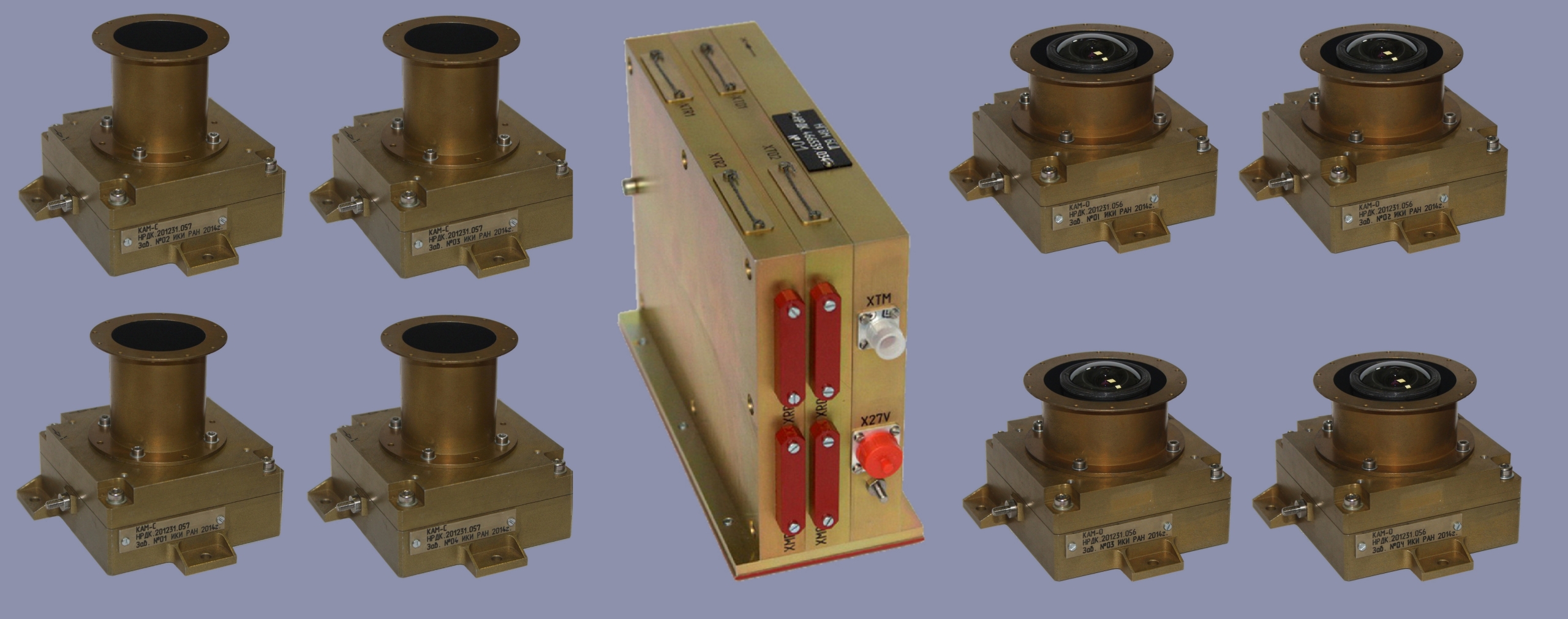
An image of the STS-L equipment carried by Russia’s Luna-25.
Image credit: IKI RAS
Data comparison
“The STS-L image shows how different the bottom and walls of the crater are,” explains an IKI posting on its website. “The bottom surface is rough, and the walls are smoother. As the participants of the Luna-25 project noticed immediately after receiving the image, the walls look in the image as if the camera was not in focus.”
Crater imagery was compared with data from the Lunar Orbiter Laser Altimeter (LOLA) on board NASA’s Lunar Reconnaissance Orbiter (LRO).
According to altimetry data, IKI researchers note, the difference between different parts of the surface is also noticeable, although not as pronounced as in the STS-L photograph.

Lunar crater Zeeman, combination of images obtained using the LOLA laser altimeter (LRO, NASA) and the STS-L equipment of the Luna-25 station (darker fragment in the center of the image). The blue background is a map of the mass fraction of water according to data from the Russian LEND neutron telescope on board LRO (NASA). The contours show areas of the surface that differ in geological characteristics.
Image credit: IKI RAS
LEND a hand
Researchers next superimposed on the image of the crater a map of the mass fraction of water in the ground according to data from the LRO-carried Lunar Exploration Neutron Detector (LEND) – also created by IKI RAS.
LEND gauges the neutron flux from the Moon’s surface, which varies depending on the concentration of hydrogen in the lunar soil.
“Since the main substance in the lunar soil containing hydrogen is water, the LEND data can be converted into the percentage of water ice in the soil at a depth of up to 1 meter,” explains the IKI posting, and the difference in water content in different areas of the surface of the Zeeman crater could be ascertained.
Research results
“The least amount of it is at the bottom of the crater – less than 0.1% by mass. And the ‘wettest’ areas are located in the vicinity of small, more ‘fresh’ impact craters formed on the walls of the main one. Here the proportion of water by mass is estimated to be up to 0.2%,” IKI researchers explain.
The Zeeman crater appraisal how revealed a difference in the properties of the surface, which, as it turned out during a detailed analysis, corresponds to a difference in the content of water frozen into the ground.
These results were presented at the 14th International Moscow Symposium on Solar System Research (IKI RAS, October 9–13, 2023) in a report by M. V. Dyachkova, A. B. Sanin, Ya. D. Elyashev, I. G. Mitrofanov , M. L. Litvak, I. V. Polyansky and A. E. Zubarev.

Onboard STS-L camera captured Luna-25 spacecraft emblem and the bucket of the probe’s lunar manipulator complex, visible (top left).
Image credit: IKI RAS

Image credit: ISRO
Following a hold at 5-seconds before liftoff, India’s TV D1 test flight was accomplished.

Image credit: ISRO
Thanks to a quick rocket check and turnaround, the vehicle did launch at 10 am (India Time), demonstrating the crew escape system as intended.
“Mission Gaganyaan gets off on a successful note,” reported the Indian Space Research Organization (ISRO).
Project Gaganyaan is India’s effort to become a member of the elite cadre of countries capable of independent human spaceflight.
For the Test Vehicle Abort mission-1, an unpressurized, uncrewed module (CM) was used, lobbed skyward by a single-stage liquid rocket developed for this abort mission. The flight involved an escape tower outfitted with fast-acting solid motors.
“This Test Vehicle mission with this CM is a significant milestone for the overall Gaganyaan program as a near-complete system is integrated for a flight test,” explains ISRO. The success of this test flight has now set the stage for the remaining qualification tests and unmanned missions, leading to the first Gaganyaan mission with Indian astronauts.

Image credit: ISRO

Splashdown of uncrewed module in the Bay of Bengal. Image credit: ISRO/Inside Outer Space screengrab

Image credit: ISRO

India is pressing forward on its goal of attaining an indepenent human spaceflight capability.
Image credit: ISRO/Inside Outer Space screengrab
Go to pre-launch, hold video and informative overview of the flight at:

