 By
By  November 5th, 2022
The threat of Near Earth Objects (NEOs).
Credit: NASA
The International Asteroid Warning Network is organizing a second “timing campaign,” one that makes use of space rock 2005 LW3.
That object of their affection is an easily observable object from most of our planet as a bright fast-moving source on the nights of November 23-24, 2022.
2005 LW3, the target of the campaign, will reach magnitude 13 during its upcoming fly-by.
Accuracy of observations
The goal of the International Asteroid Warning Network (IAWN) campaign is to provide an incentive to near Earth Object (NEO) observers to check the accuracy of the timing of the astrometric observations they report to the Minor Planet Center. That international organization is responsible for collecting observations of asteroids, comets, and other small bodies in the Solar System.
“The fast angular motion on the plane of the sky, together with the excellent knowledge we already have of this object’s trajectory, will allow the campaign team to carefully assess the accuracy of the timetags reported by each station,” explains the European Space Agency’s NEO Coordination Center – the operational center of ESA’s Planetary Defense Office.
“These checks are extremely important to detect possible subtle time biases that are often present even at telescopes that synchronize their system time with extreme accuracy,” the ESA NEO center adds.
The IAWN was established with the goal of assessing, strengthening, and coordinating the international response to a possible near-Earth object (NEO) impact threat.
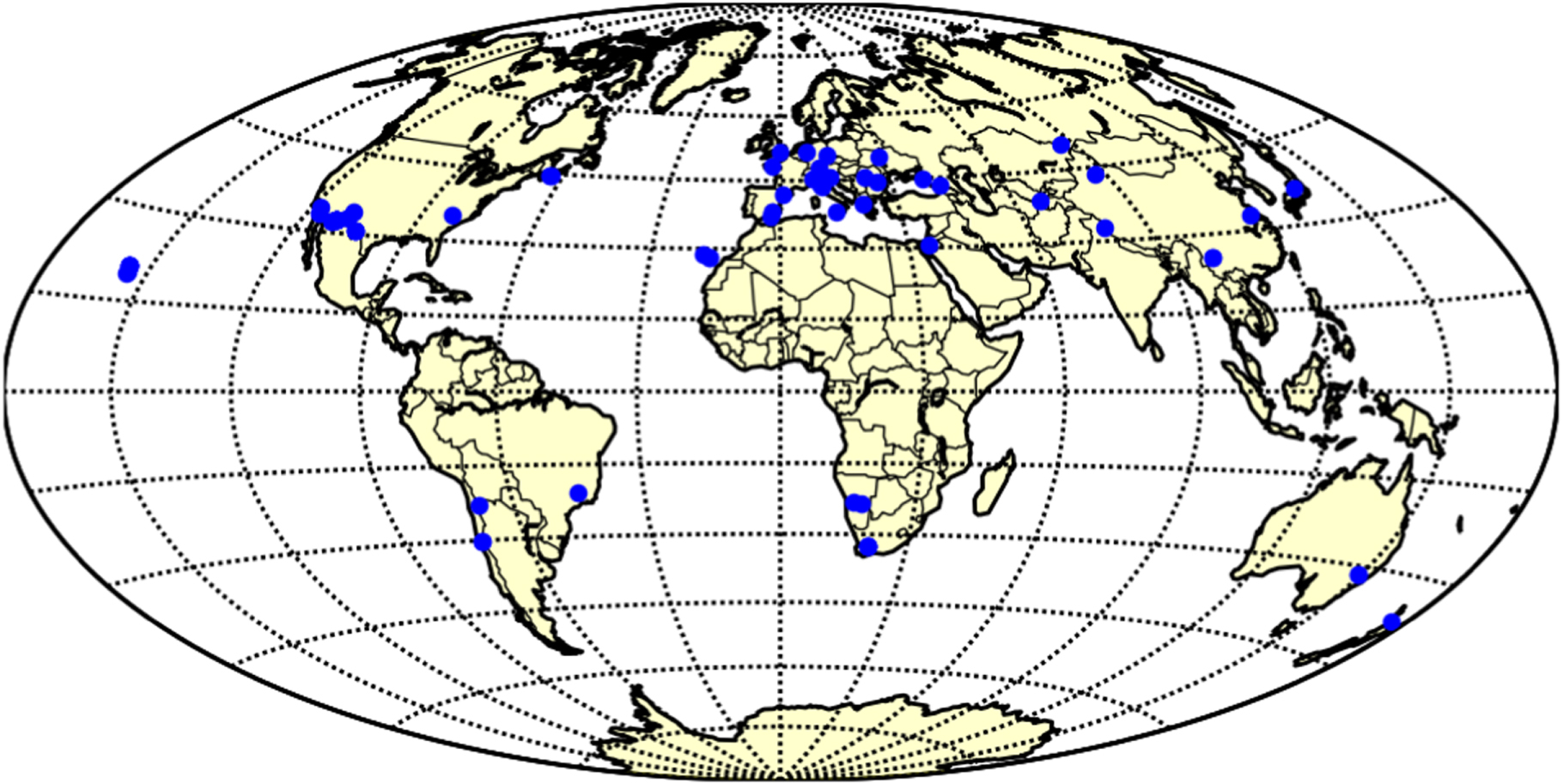
Locations of the 70 ground-based observation sites that participated in the 2019 XS campaign.
Credit: Davide Farnocchia, et al.
Previous campaign
IAWN campaign coordinator Vishnu Reddy at Arizona State University in Tucson is the point of contact for this campaign.
“We have two flavors of the campaign,” said Reddy. “The first is a full-blown planetary defense exercise where we test every component of the system. The most recent Apophis campaign is a good example of that. We have also started doing shorter more focused timing campaign to improve the timing accuracy of observatories collecting asteroid observations,” he told Inside Outer Space.
Reddy said that a previous campaign was performed in November 2021 using 2019 XS, a small Apollo near-Earth asteroid. What was found was a systematic -0.5 second bias across the board, he said.

Chelyabinsk sky rendering is a reconstruction of the asteroid that exploded over Chelyabinsk, Russia on Feb. 15, 2013. Scientific study of the airburst has provided information about the origin, trajectory and power of the explosion. This simulation of the Chelyabinsk meteor explosion by Mark Boslough was rendered by Brad Carvey using the CTH code on Sandia National Laboratories’ Red Sky supercomputer. Andrea Carvey composited the wireframe tail. Photo by Olga Kruglova.
Credit: Sandia National Laboratories.
Good test
“So, the upcoming 2005 LW3 campaign is a follow-on to that to see how we are doing with keeping our clocks accurate. We gave suggestions to improve the clock timing and the campaign this month is a good test of that,” Reddy said.
Observers that are interested or routinely involved in NEO observations can join the exercise, reporting their intention to participate on a webpage dedicated to the campaign at:
https://iawn.net/obscamp/2005LW3/
Also, for detailed information about the earlier 2019 XS campaign, go to “International Asteroid Warning Network Timing Campaign: 2019 XS” in the Planetary Science Journal at:
 Posted in Space News

