Archive for October, 2026
 Author:
 October 30th, 2026

Image credit: CCTV/Inside Outer Space screengrab
The now-orbiting Shenzhou-23 crew aboard China’s Tiangong space station has recently completed the fifth transfer of material exposure experimental apparatus to the station’s exterior, advancing a series of experiments that have yielded multiple world firsts.
Crew members — Zhu Yangzhu, Zhang Zhiyuan and Lai Ka-ying — were sent into space aboard the Shenzhou-23 spacecraft on May 24, with one of them scheduled to spend a full year in orbit.
Space exposure

Image credit: CCTV/Inside Outer Space screengrab
The trio has also conducted space exposure experiments on a high-performance stainless magnesium alloy, verifying its reliability and stability for potential space applications such as lightweight satellite electronic-control and heat-dissipation components, reports China Central Television (CCTV).
Additionally, the Shenzhou-23 team carried out an extravehicular exposure and bearing tribology experiment on liquid-containing gel lubricants.

Image credit: CCTV/Inside Outer Space screengrab
That work is focused on the design and development of new long-life space lubricating materials, CCTV adds, that may be used in lunar rover motion mechanisms.
Superlubricating materials
Also, a tribological experiment in a vacuum environment evaluated oil-based superlubricating materials with near-zero wear, geared for future applications of lubricating materials with near-zero friction.
“Moreover, exposure experiments on shape-memory polymers and their composites outside the space station has helped China screen preferred substrate materials for deployable structures and locking and release structures,” CCTV reports.
The results of this station work are expected to support space station development, crewed lunar landing and planetary exploration.

Artwork depicts China’s Tiangong space station.
Image credit: China Manned Space Agency
For an informative video on this work, go to:
 Posted in


Rollout from Phoenix-Mesa Gateway Airport in Arizona.
Image credit: Virgin Galactic/Inside Outer Space screengrab
Virgin Galactic’s newly named spaceship Apeiron departed Phoenix-Mesa Gateway Airport in Arizona early today mated to Eve, the company’s launch vehicle.
The vehicle combo landed at Spaceport America in New Mexico at 12:59 p.m. Mountain Daylight Time.
Pilot in Command Michael Masucci and Pilot Dan Alix flew Eve, with Flight Test Engineer Tori Crichton on board.
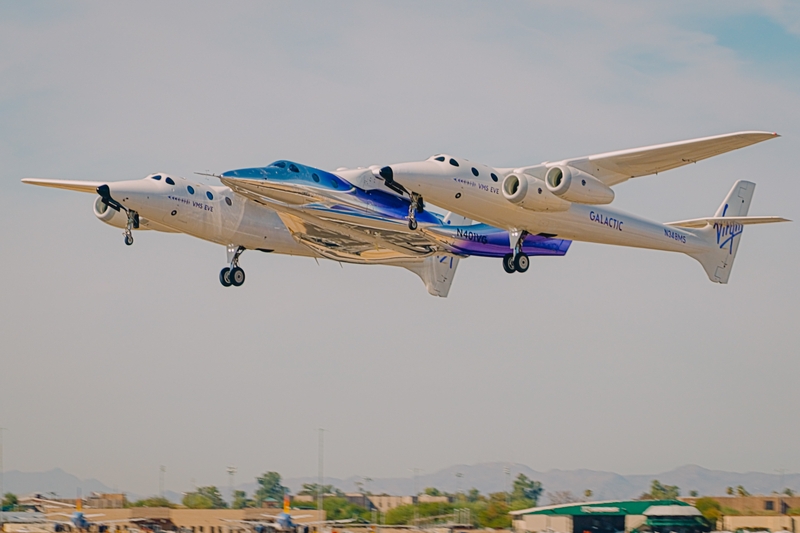
En route to New Mexico’s Spaceport America.
Image credit: Virgin Galactic
Commercial spaceflights are expected to begin in early quarter 2 next year.
Spaceport America in New Mexico is permanent home and base of operations for Virgin Galactic suborbital passenger flights.

Arrival at New Mexico’s Spaceport America.
Image credit: Virgin Galactic/Inside Outer Space screengrab
Spaceship factory
Virgin Galactic announced also that production of the fleet of Delta class suborbital vehicles is moving forward. At the group’s “Spaceship Factory,” assembly of the static test article and the second spaceship is underway, and teams are preparing the rocket motor assembly line.
“Designed to fly twice per week with a vehicle lifetime of more than 500 missions,” said Virgin Galactic in a press statement, “each spaceship in the next-generation fleet is built to support the economics of a scaled commercial operation, with increased flight cadence and a cost profile unprecedented in the industry.”
The second Delta-class spaceship is expected to begin commercial operations in late Q2/early Q3 2027.
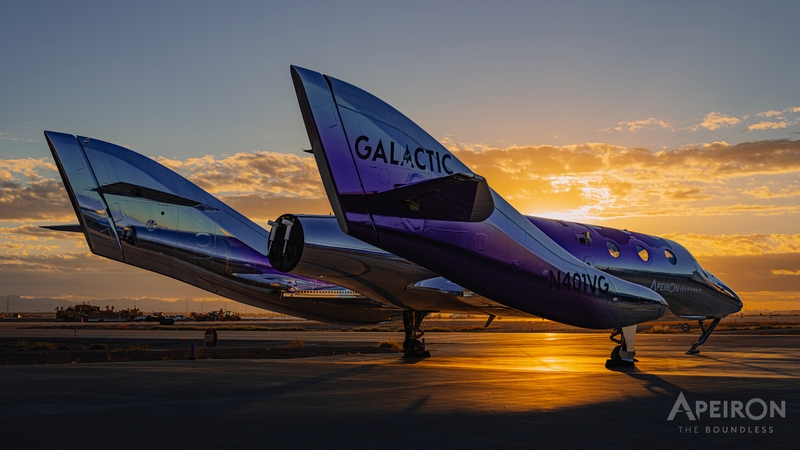
Image credit: Virgin Galactic
Suborbital spaceplane-provider, Virgin Galactic, has announced the name of its lead Delta spaceship: Apeiron (App-Err-On).
That name was chosen by a public vote and draws upon responses from around the world — including 83 countries and six continents.
Aperion stems from the ancient Greek concept of “the boundless.”
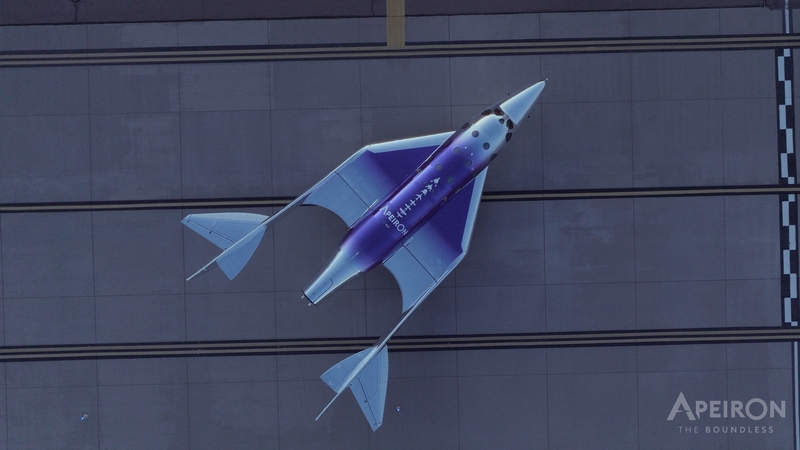
Image credit: Virgin Galactic
Also today, Virgin Galactic’s Apeiron will fly from Mesa, Arizona to Spaceport America, New Mexico, mated to the launch mothership, Eve.
Once at Spaceport America, Virgin Galactic’s engineering team plan to complete avionics software validation before beginning flight tests.

Virgin Galactic’s regular cadence of commercial suborbital travel. Shown is SpaceShipTwo zipping skyward over New Mexico’s Spaceport America.
Image credit: Virgin Galactic
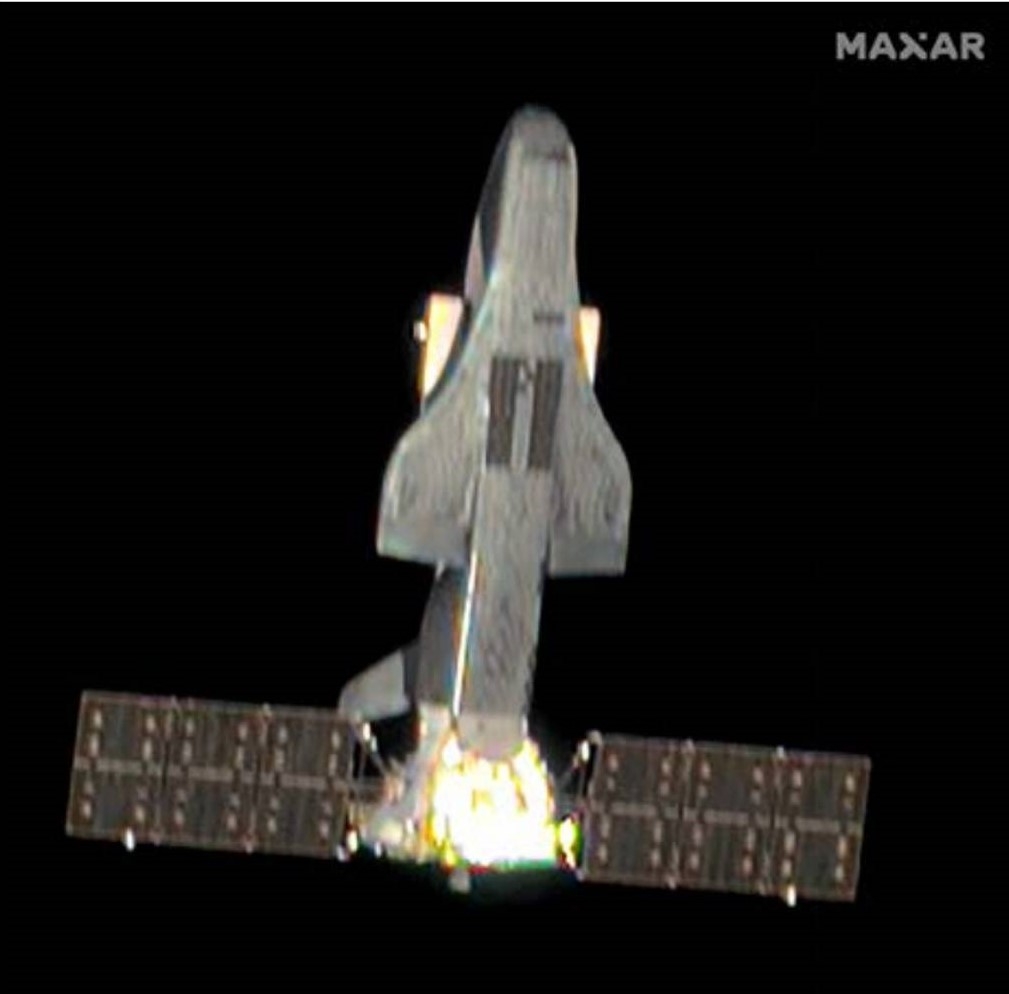
China’s spaceplane as captured by Maxar satellite.
Image credit: Maxar Technologies via DIA
The Defense Intelligence Agency (DIA) has released a new report assessing the scope and breadth of adversary threats in space.
The DIA’s 2026 edition — Challenges to Security in Space — details the space defense and military goals, including strategies, plans and intentions, of China, Russia and the emerging space powers of Iran and North Korea.
The newly-issued report review’s China’s two primary spaceplane models: the Shenlong and Tengyun.
In its pages, the DIA report includes an in-space photo captured by a Maxar spacecraft showing details of a Chinese spaceplane.
China spaceplane development
As noted in the DIA report, in 2020, China launched into orbit its first-ever prototype of a spaceplane, which stayed in orbit for 2 days before returning to Earth.
In August 2022, China’s second spaceplane mission spent 276 days in orbit, much longer than the first mission. In November 2022, this spaceplane appeared to maneuver with a companion satellite and conduct station-keeping operations.
At one point, the two objects appeared within 100 meters of one another.
The spaceplane and satellite possibly rendezvoused before the satellite was re-released.
In December 2023, China launched its third space plane mission, which was on orbit for 268 days.
During this third spaceplane mission, it released and interacted with an object.
Winging it

X-37B (OTV-8) military space plane being readied for flight, with its service module not shown in photo.
Image credit: U.S. Air Force/U.S. Space Force
In related news, China’s reusable spaceplane was launched for the fourth time from the Jiuquan Satellite Launch Center on February 7, 2026.
China’s last spaceplane flight is underway, as is the eighth flight of the Space Force X-37B (OTV-8), lofted on August 21, 2025 from Kennedy Space Center, Florida on a SpaceX Falcon 9.

Image credit: Boeing Space/Inside Outer Space screengrab
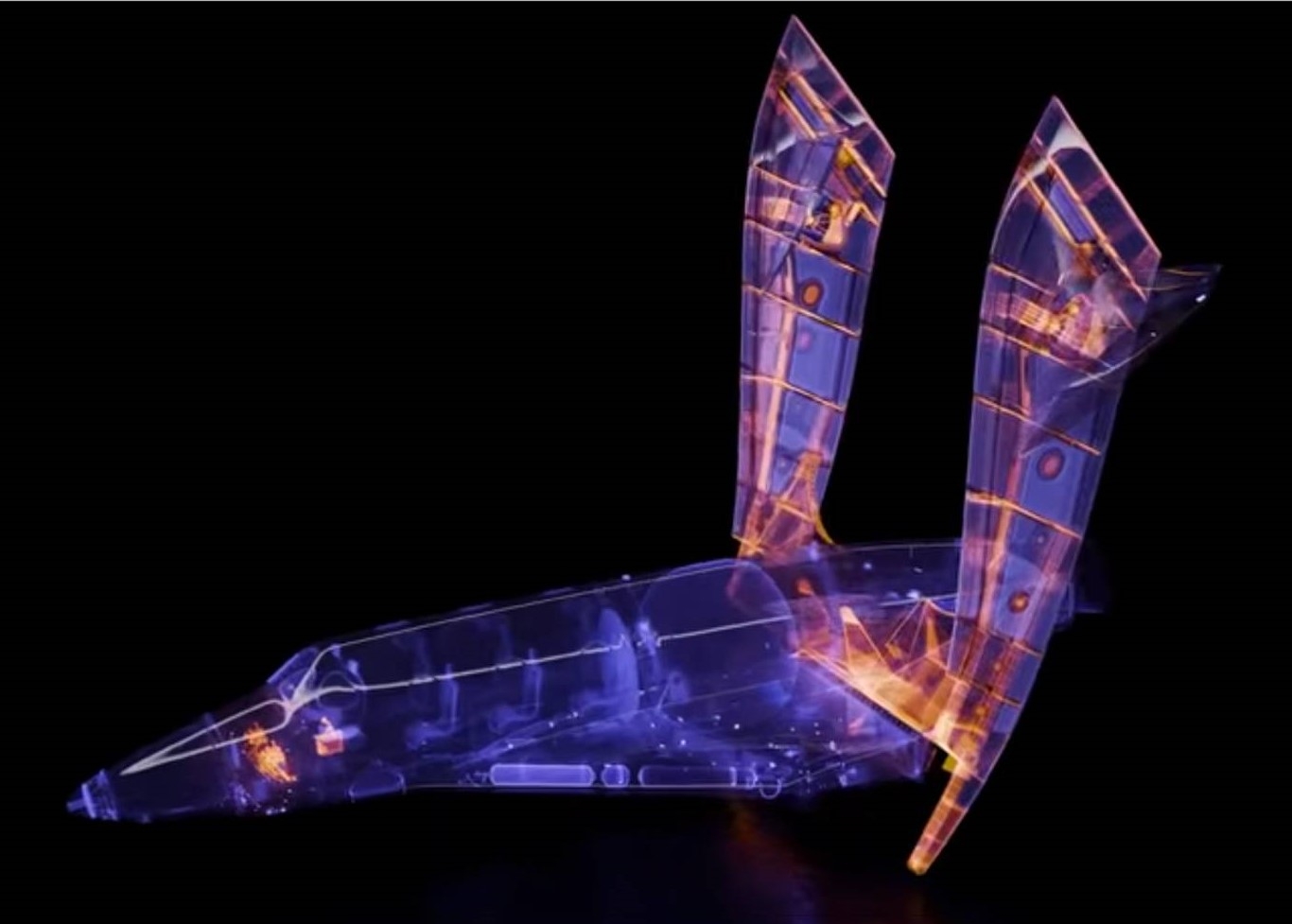
Image credit: Virgin Galactic/Inside Outer Space screengrab
Virgin Galactic announced today that the lead Spaceship of its next-generation fleet is set to fly to its operations base at Spaceport America, New Mexico on October 28.
The Spaceship, mated to launch vehicle Eve for a captive-carry flight, will depart the company’s Spaceship Factory in Mesa, Arizona.
The arrival marks the transition from vehicle assembly to the start of flight test preparations.
Virgin Galactic is set to also reveal the ship’s new name, selected through a global voting campaign.
“The arrival of the lead spaceship in the Delta class fleet at Spaceport America marks the transition to the start of flight test preparations for Virgin Galactic,” the group explained in a press statement.

Credit: Virgin Galactic

Maiden spaceflight of Virgin Galactic’s new Delta SpaceShip carrying research payloads is planned for 2027.
Image credit: Virgin Galactic
What next?
Flight of the first commercial suborbital trek is now expected in early Quarter 2 2027.
The second Spaceship is expected to begin commercial spaceflight operations in late Q2/early Q3 2027.
“The updated timeline reflects additional time for completing avionics software integration and validation, which uses an exhaustive testing process,” explains Virgin Galactic.
With the lead Spaceship repositioned to its operations base in New Mexico, the group’s two-ship commercial spaceflight operations are expected by early Q3 2027.
Lastly, Virgin Galactic is moving more than 100 members of its ready-for-flight astronauts into their first phase of readiness and preparation, with additional suborbital flyers expected to follow on a rolling basis.

Image credit: SCU
The U.S. Department of War has published the seventh release of Unidentified Anomalous Phenomena (UAP).
Today’s new release of declassified and historical Unidentified Anomalous Phenomena (UAP) files is being done under the Presidential Unsealing and Reporting System for UAP Encounters (PURSUE).
The seventh release of UAP files is available now on WAR.GOV/UFO – go to:
https://www.war.gov/UFO/?releaseDate=Release+07&release=07
Data warehouse
In a quick review of the files, the reader can find an interesting report to Bigelow Aerospace Advanced Space Studies, LLC (BAASS) by Documatica Research, LLC titled Project Capella.
“This document is an administrative, programmatic, or contractor-produced record related to the Advanced Aerospace Weapon System Applications Program (AAWSAP), a Defense Intelligence Agency (DIA)-administered program active from 2008 to 2012,” explains a posting on the website.

Space entrepreneur, Robert Bigelow, explains his expansive plans for space.
Credit: Space Foundation
“AAWSAP’s official scope of work identified 12 technical research areas relating to potential aerospace threats over a time horizon of more than 40 years. As part of the broader program record, the file documents how AAWSAP was scoped, organized, tasked, funded, executed, or described at a particular point in time.”
This December 2008 report was developed for BAASS – a proposed data warehouse framework for the capture, processing, classification, and retrieval of information relating to “unusual” aerial phenomena and related anomalies.
“Redactions have been made to protect the identity of eyewitnesses, the location of government facilities, or potentially sensitive information about military sites not related to UAP,” the website explains. “No redactions have been made to any files released under President Trump’s directive concerning information about the nature or existence of any encounter reported as a UAP or related phenomena.”
Underground vault
Furthermore, the new release contains a number of BAASS progress reports (hundreds of pages) including the organization’s need for a highly secure underground vault operated by BAASS “to pursue and acquire recovered hardware and biological samples from the corporate world and/or from private individuals and groups located elsewhere, including in Brazil.”
A design and architectural plan were drawn up for a 5,000 square feet underground vault with 3 foot thick walls, ceiling and floor with a concrete access tunnel leading to multiple security doors, at least one of which comprises a thick vault steel door.
That underground facility would be covered with over 15-20 feet of earth above the structure.
Go to:
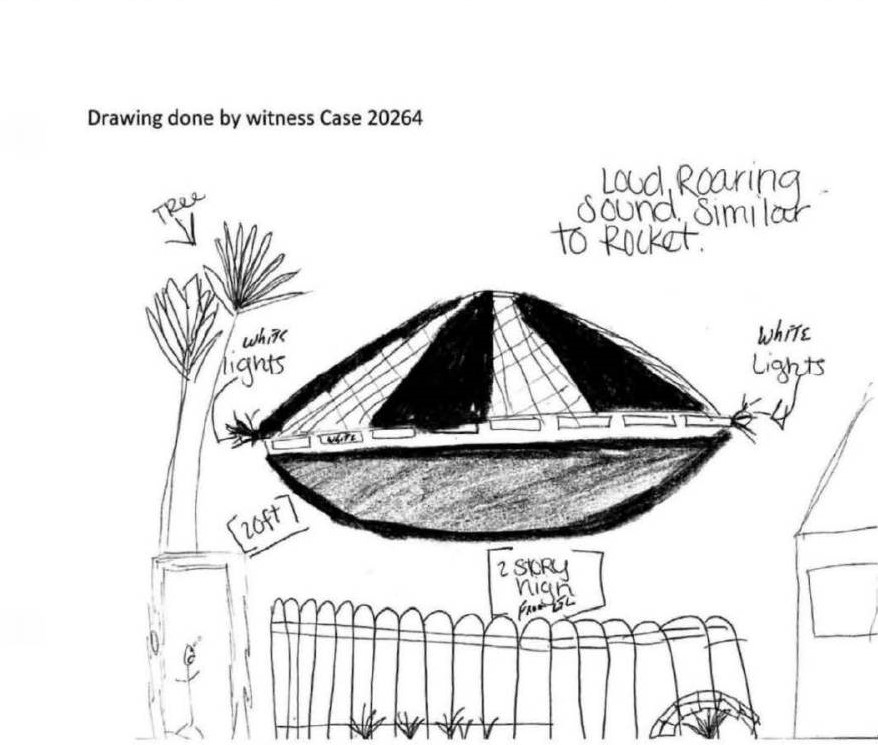
Image from BAASS report from November 2009 Monthly Report
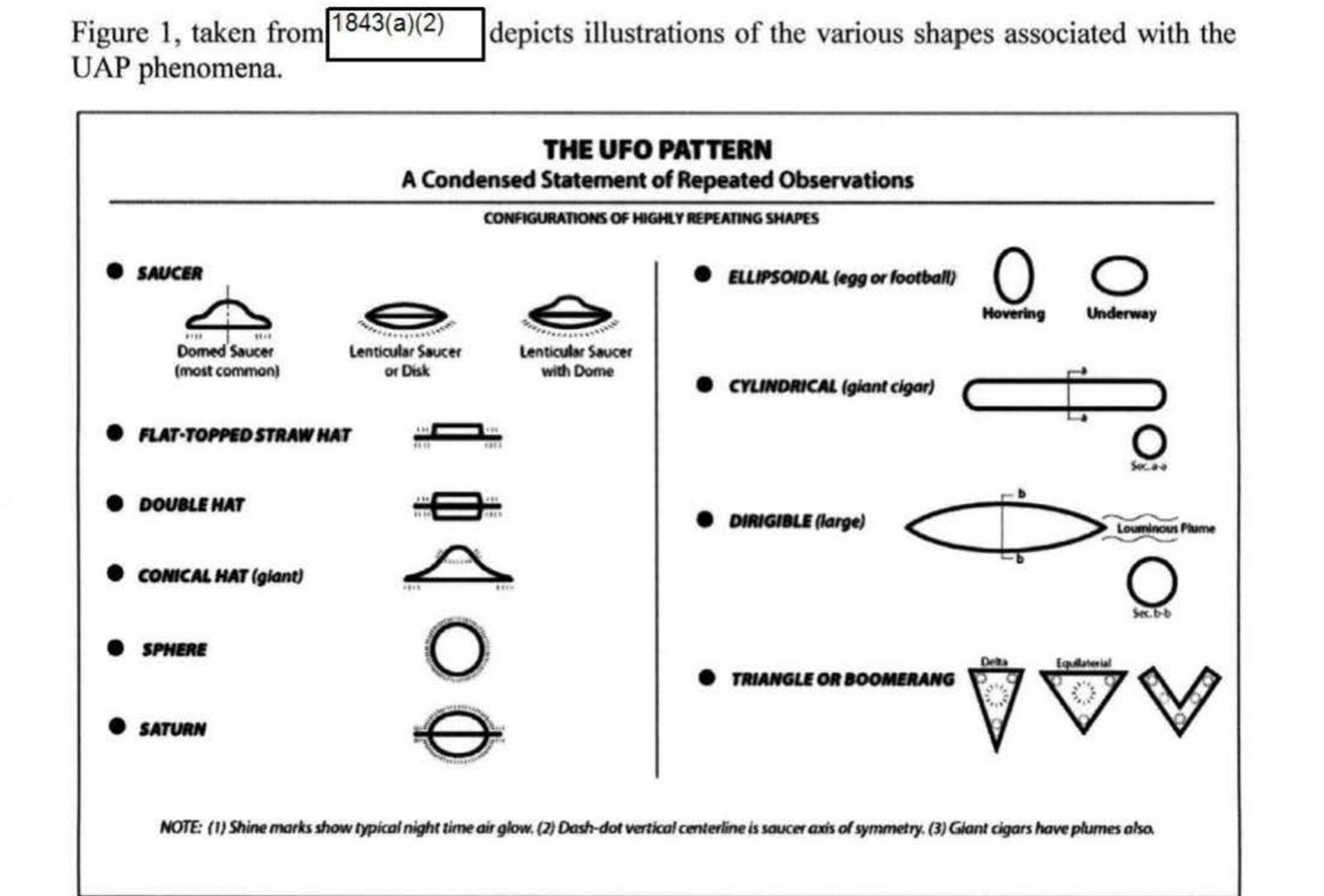
Taken from “Summary Report on BAASS UAP Analysis Capabilities,” dated Nov. 23, 2010.
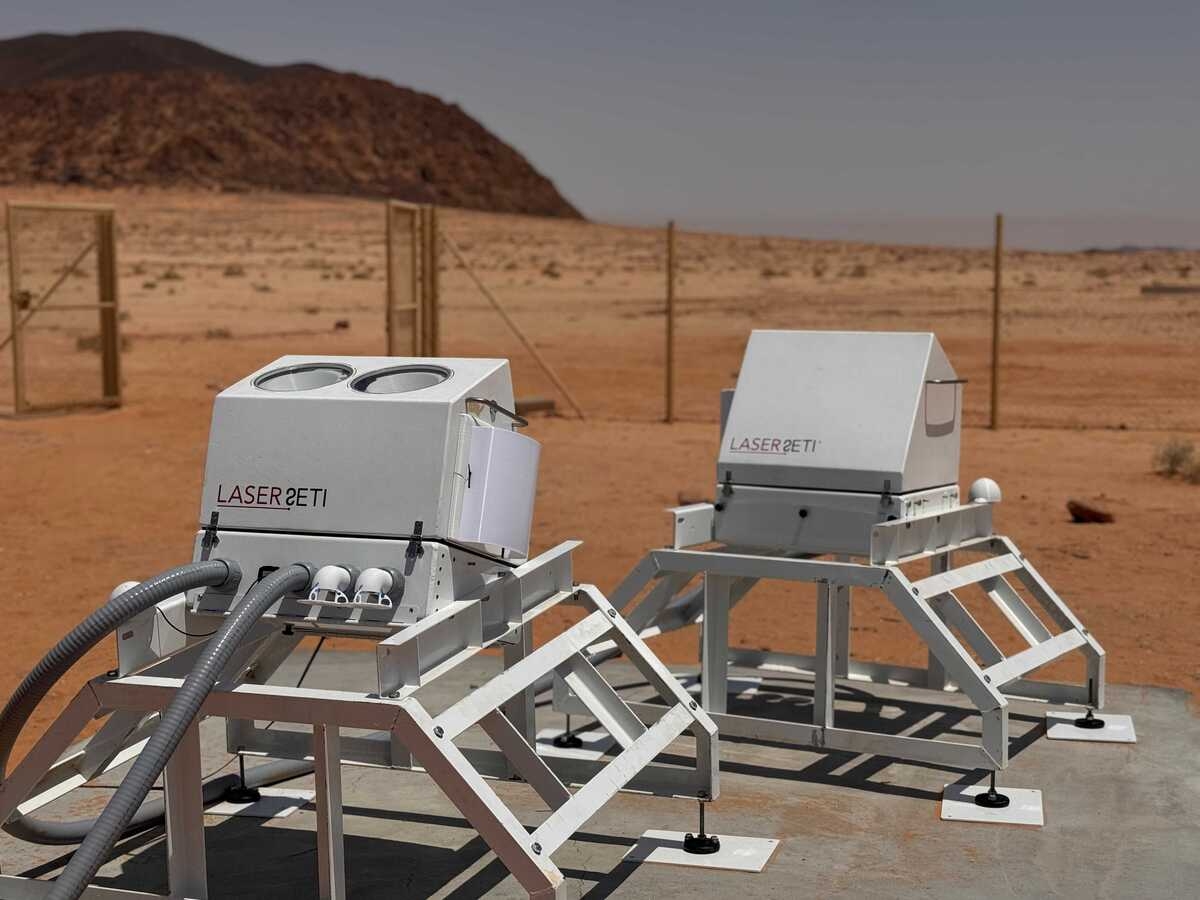
Image credit: SETI Institute
The SETI Institute has designed LaserSETI, technology to keep a constant watch on large parts of the sky, looking for very brief flashes of light.
“LaserSETI was designed from the beginning as a global observatory rather than a single telescope,” said Eliot Gillum, Director of LaserSETI at the SETI Institute in Mountain View, California.
The SETI Institute and the Royal Commission for AlUla (RCU) announced today the installation and commissioning of two LaserSETI stations at AlUla Manara in northwest Saudi Arabia.
AlUla Manara — “the lighthouse” in Arabian — is an initiative that now features a 4-meter primary telescope alongside two 2-meter telescopes, plus a world-class research center, observation platforms, and interactive exhibitions.
As a nature reserve the site has been accredited as International Dark Sky Park.
New geographic vantage point
With these new stations, AlUla becomes LaserSETI’s first and only observing site in Asia and its fifth site worldwide, joining others in California, Hawai’i, Arizona and Puerto Rico.
“AlUla gives LaserSETI an important new geographic vantage point and connects this remarkable astronomical site to a growing global network,” adds Franck Marchis, Senior Planetary Astronomer and Director of Citizen Science at the SETI Institute. This is exactly what LaserSETI needs, “instruments distributed around the world, observing continuously and together.”
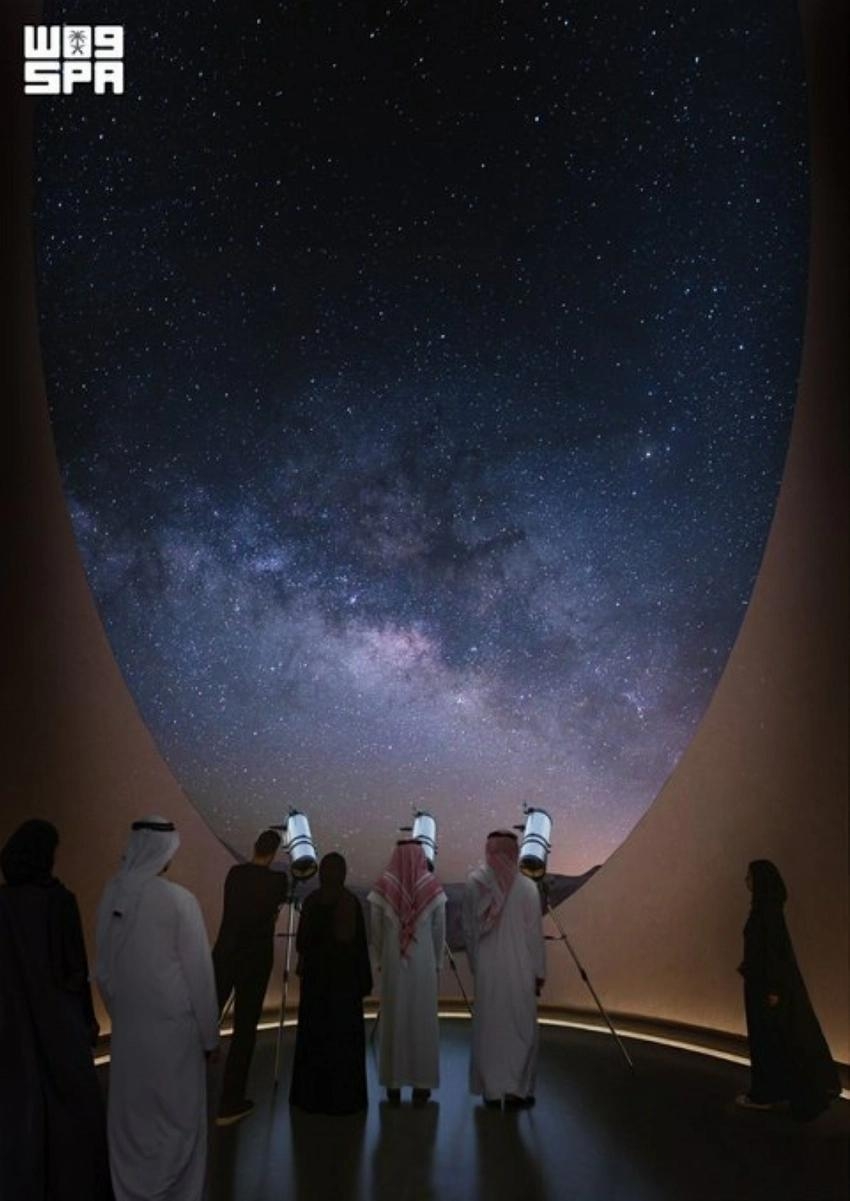
Image creidt: Saudi Press Agency
Laser technology beyond Earth
The two stations were installed on August 19 at the AlUla Manara Astronomical Site Monitor (ASM) Site and are now fully operational and actively collecting astronomical data, from short-lived cosmic events, unusual astronomical phenomena or, potentially, laser technology beyond Earth.
As noted by the SETI Institute, LaserSETI is a project creating a global network of optical instruments to watch the night sky for brief flashes of light and other short events.
By observing large parts of the sky continuously from different locations, “LaserSETI makes it possible to spot short-lived astronomical events and expand the search for possible signs of technology beyond Earth,” the group explains.

Indonesia rocket debris?
Image credit: BRIN
When it rains space debris.
Two cases of suspected Chinese rocket debris have been reported, in Indonesia and in the United States.
Indonesia’s National Research and Innovation Agency (BRIN) reports that several bits of debris crashed into an oil palm plantation in Sampit, East Kotawaringin, Central Kalimantan.
BRIN researcher, Thomas Djamaluddin, said the object found on October 19 was a fragment of a Chinese ZhuQue-2E (ZQ-2E) rocket. There is a ZQE code associated with the ZhuQue-2E rocket, he adds.
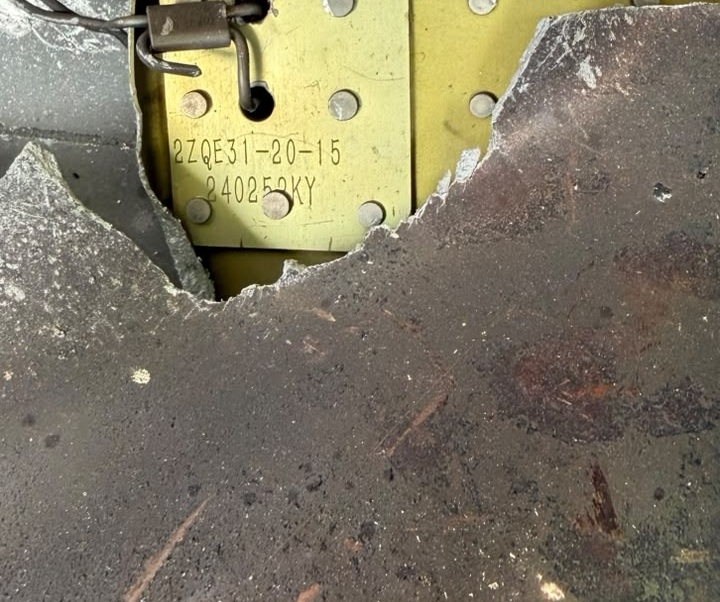
There is a ZQE code associated with the ZhuQue-2E rocket.
Image credit: BRIN
The rocket was developed by LandSpace, a Chinese commercial space startup and departed from the Jiuquan Satellite Launch Center in China on October 14, 2026, carrying ten satellites.

Minnesota object.
Image credit: Stevens County Sheriff’s Office
Minnesota mishap
Yet another incident of possible space junk took place on October 14, 2026, at approximately 3:30pm, the Stevens County Sheriff’s Office in Minnesota received a phone call of foreign debris that was found in a cornfield in Scott Township.
“Upon responding, deputies confirmed that a large, metallic object, approximately 11-feet in diameter, presumably a space object, was present in the cornfield,” reports the sheriff’s office.
The Minnesota duty officer was notified of this and federal agencies responded.
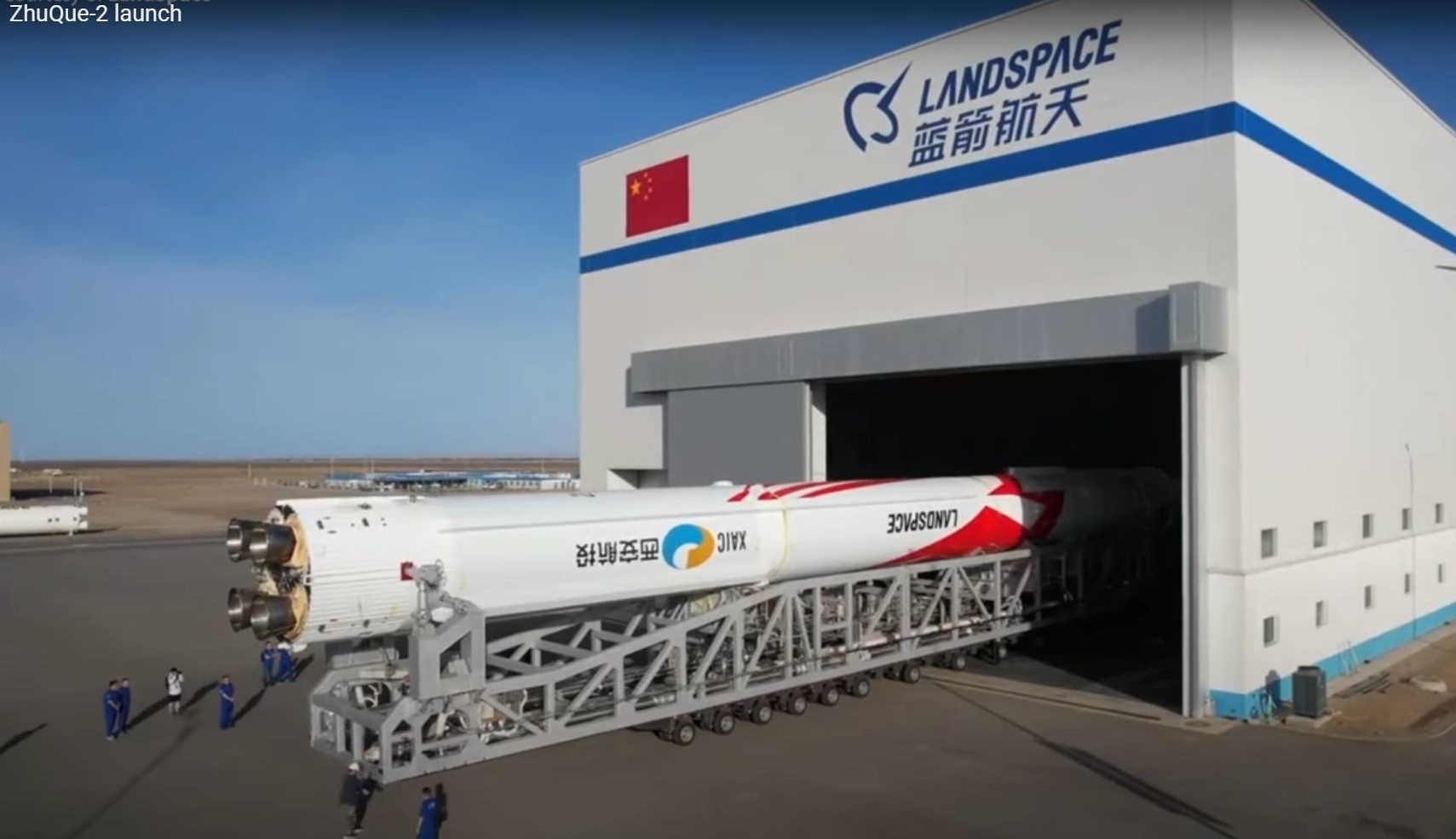
Image credit: LandSpace
“The Sheriff’s Office is working closely with several state and federal agencies to identify and notify the owner of the debris and to plan for removal from the field. Agency officials have determined that there is no danger to the public due to this incident,” the office stated in a press release.
In a twisted bit of irony, the Minnesota debris may also be associated with a LandSpace Zhuque-2E rocket. According to Ars Technica, it could be tied to the rocket’s upper stage, hardware launched from the Jiuquan Satellite Launch Center on September 15.
In both cases – Sampit and Scott Township — the recovered fragments are being examined to help identify their origin.
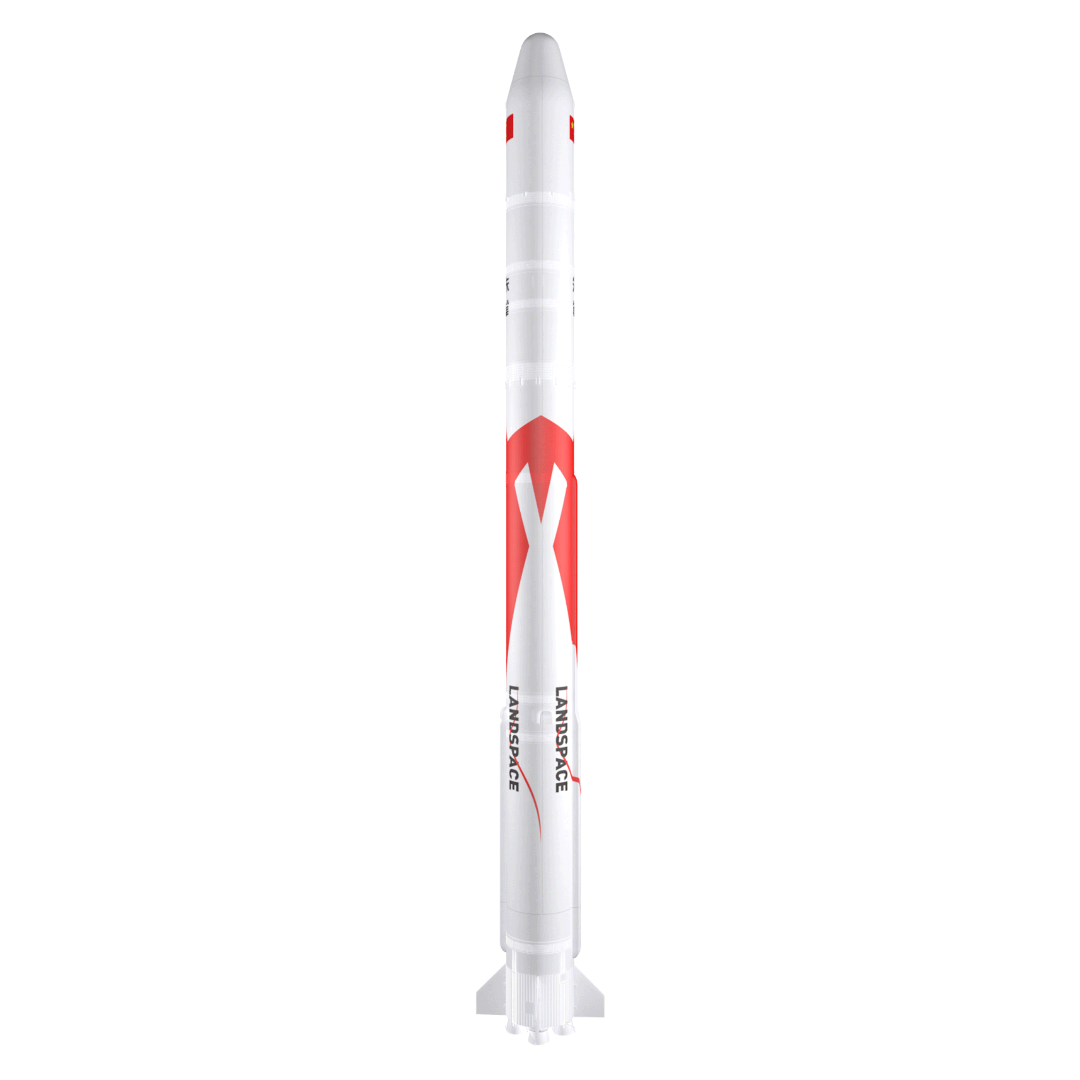
Image credit: LandSpace
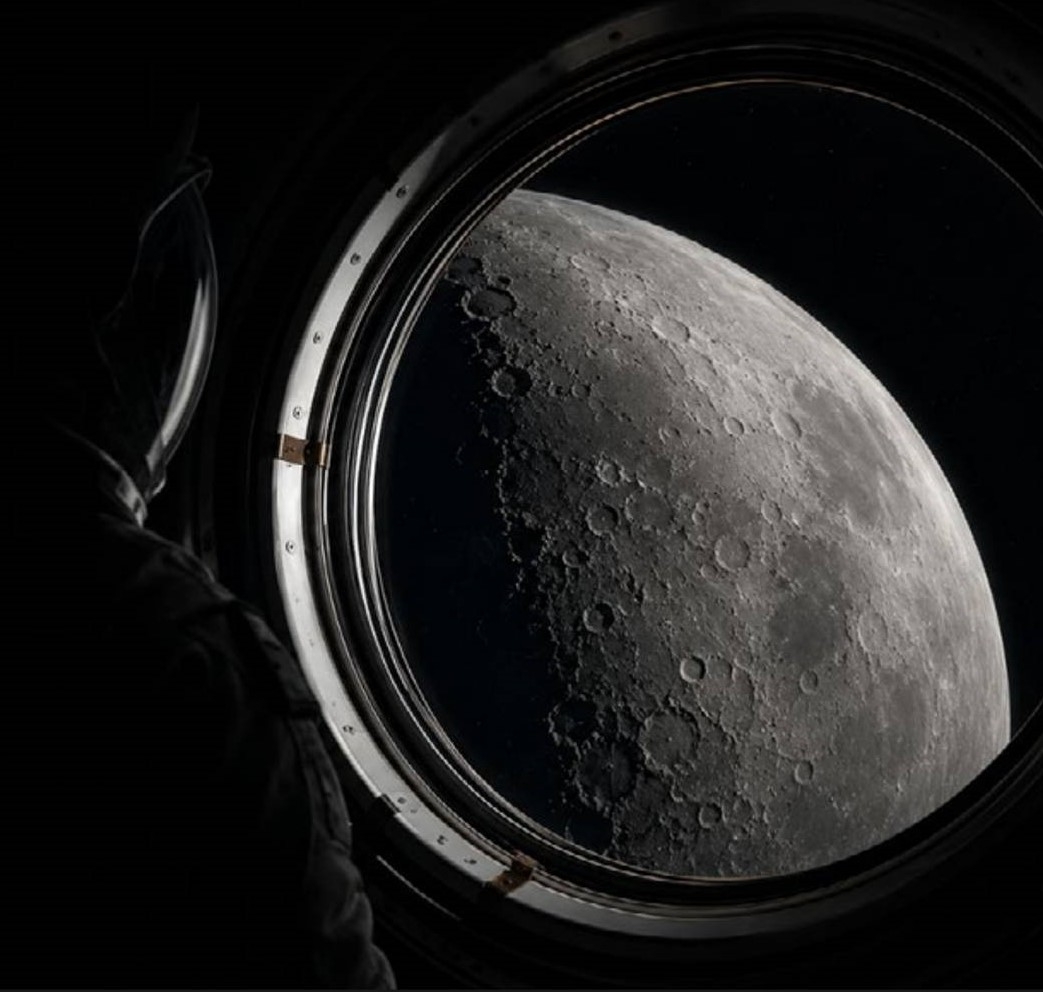
Image credit: Deloitte
Earth’s Moon is deserved of wide-spread exploration, far beyond early robotic and human exploration of the lunar south pole – extraterrestrial real estate now within the sights of NASA’s Artemis program, as well as other nations.
Outside of that lunar south pole target, yes indeed, the Moon is rife with attractive and scientifically important objectives of insight. That’s the view of a blue-ribbon group of experts convened by the National Academies of Sciences, Engineering, and Medicine.
A report issued today contends that studying nonpolar regions of the Moon by human sorties can help erase scientific questions about Earth’s nearest celestial neighbor, as well as about the solar system and universe.
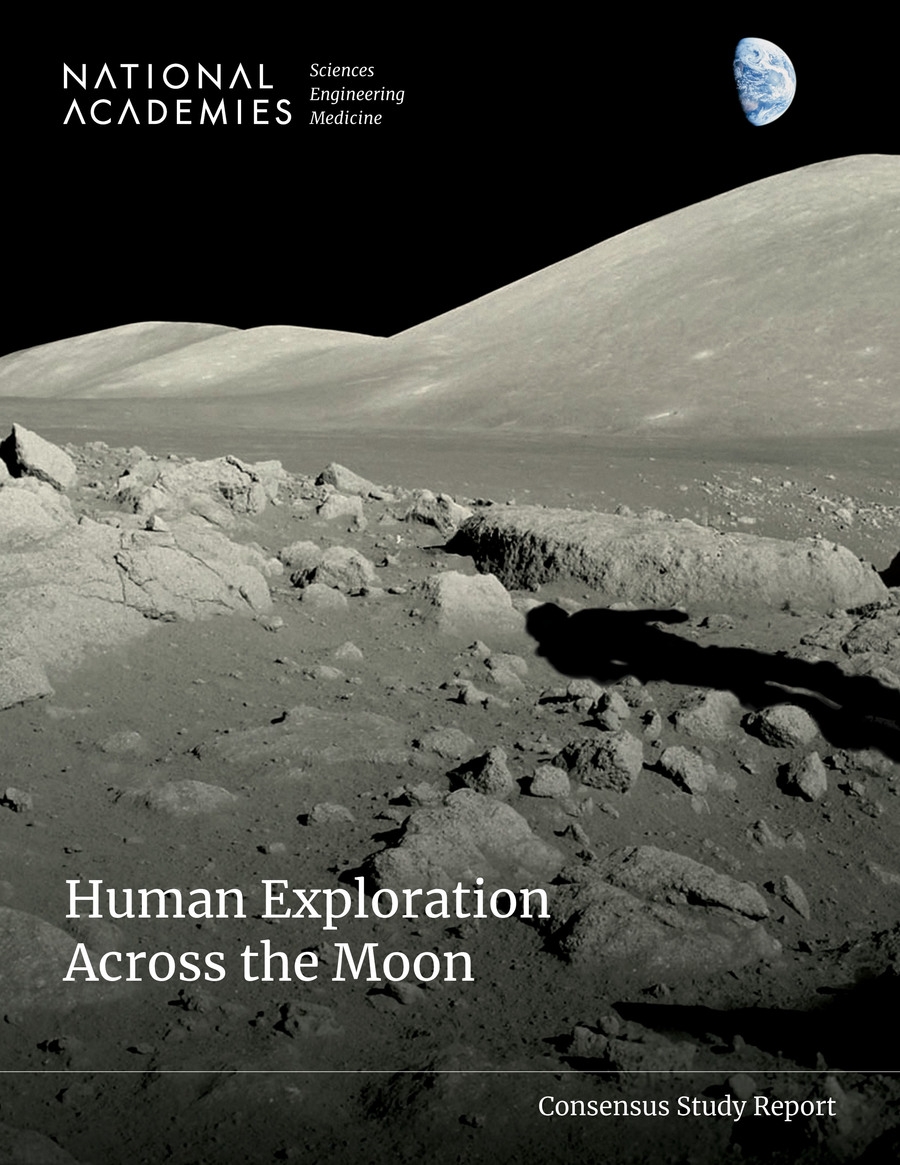
The study was undertaken by the National Academies of Sciences (NAS) Committee on Key Nonpolar Destinations Across the Moon, an appraisal sponsored by NASA.
For more details, go to my new Scientific American story – “These are the most exciting potential human landing sites across the Moon…Besides building crewed outposts at the lunar south pole, where else should astronauts go on the Moon? An authoritative new report has suggestions” – at:
(Note: Open in incognito mode to gain full access to this story)
https://www.scientificamerican.com/article/report-pinpoints-future-exploration-sites-on-the-moon/

Wait-a-Minute!
Image credit: Barbara David
It is a troublesome wait-a-minute moment in space.
Satellite watcher Marco Langbroek in Leiden, the Netherlands, reports that there are worrisome approach maneuvers by Russia’s Cosmos 2612 and a US registered, radar satellite ICEYE-X36.
“This RPO (Rendezvous and Proximity Operation) is completely non-consensual,” explains Langbroek. Another maneuver by the Russian spacecraft took place on October 18. “This could either be to bring the satellite further away from the target, or the first of a set of phasing maneuvers for a future new approach,” he adds.
As noted by Langbroek, starting on September 30, the Russian spacecraft made a series of maneuvers. “These were clearly designed to bring Cosmos 2612 close to ICEYE-X36 and synchronize orbital altitude, eccentricity and orbital period.”
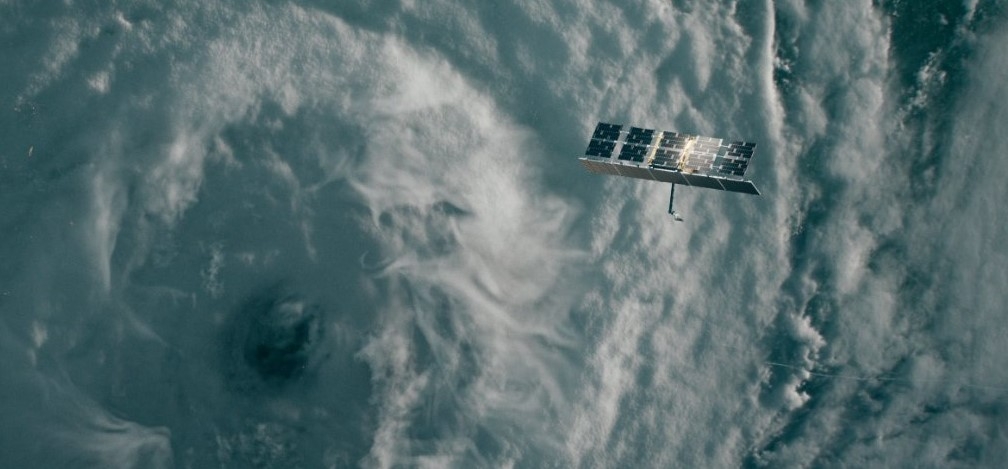
The ICEYE space firm owns the world’s largest and most advanced SAR (synthetic aperture radar) satellite constellation.
Image credit: ICEYE
“Anti-up” warfare?
In an earlier posting, Langbroek pointed out that “if ICEYE-X36 is indeed used by Ukraine, this means that a satellite from one country (Russia) is closely approaching a satellite of another country (Ukraine) with which it is at war.”
All this “worrisome cat-and-mouse-game” has Langbroek stating: “So I wonder and worry whether we are perhaps watching a first actual on-orbit ASAT [Anti-Satellite] attack in the making here…”

ICEYE satellites provide Intelligence, Surveillance, and Reconnaissance (ISR).
Image credit: ICEYE
Dangerous maneuvers
In a related story, “Russian satellite stalked ICEYE spacecraft in potentially dangerous on-orbit maneuvers” reports Theresa Hitchens, senior reporter, space at Breaking Defense.
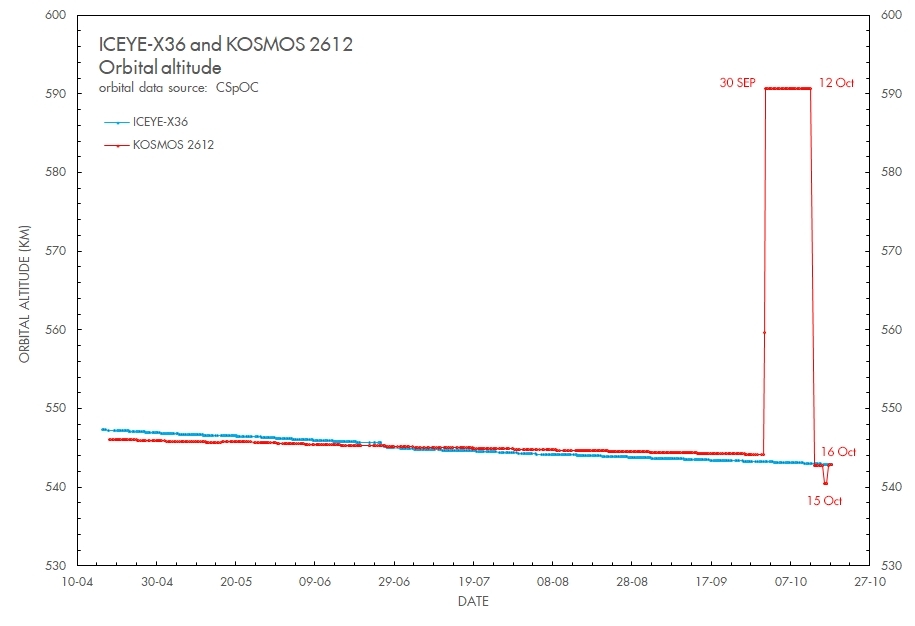
Image credit: Marco Langbroek
For the Hitchens story, go to: https://breakingdefense.com/2026/10/russian-satellite-stalked-iceye-spacecraft-in-potentially-dangerous-on-orbit-maneuvers/
Meanwhile, I reached out to the group providing ICEYE spacecraft for a statement about the situation. The response, attributable to an ICEYE U.S. spokesperson:
“We are aware of the situation and tracking it closely. Our constellation architecture is designed for continuity and resilience.”
For more details on ICEYE, go to:

Wait-a-Minute!
Image credit: Barbara David

