Archive for September, 2026
 Author:
  September 3rd, 2026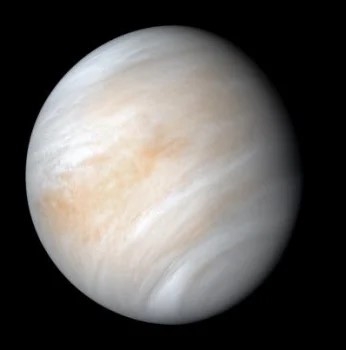
Enigmatic Venus. Cloudy with a scattering of life?
Image credit: NASA
Getting a privately-backed robotic mission en route to Venus has become about as foggy as the planet itself.
Enter a Rocket Lab-backed kick-starter of a spacecraft hike to that cloud-enveloped world, matched up with the step-by-step agenda of a scientific group at the Massachusetts Institute of Technology (MIT).
The first step on that program is the Rocket Lab Mission to Venus, which will deploy a small, nose cone-like probe crafted to sample the Venusian atmosphere using a device called an autofluorescence nephelometer, mercifully shortened to AFN in space lingo.
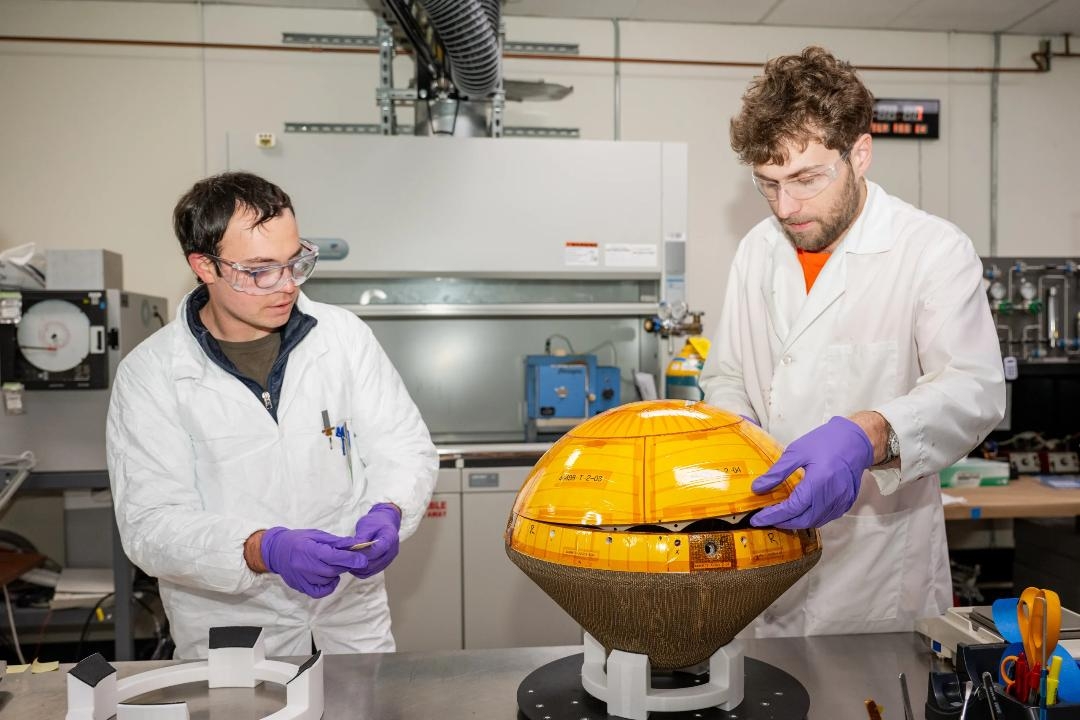
The Venus probe’s heat shield was developed by NASA’s Ames Research Center and called the Heatshield for Extreme Entry Environment Technology (HEEET).
Image credit: NASA/Brandon Torres Navarrete
That AFN can measure individual particles in Venusian clouds, constraining their size, shape, and composition in a search for signs of organic molecules.
But that undertaking, primarily fueled by private dollars, has been waylaid due to getting a needed booster flight-qualified.
For details, go to my new Space.com story – “Rocket issues delay 1st-ever private mission to Venus – ‘We are awaiting Neutron readiness’” – at:
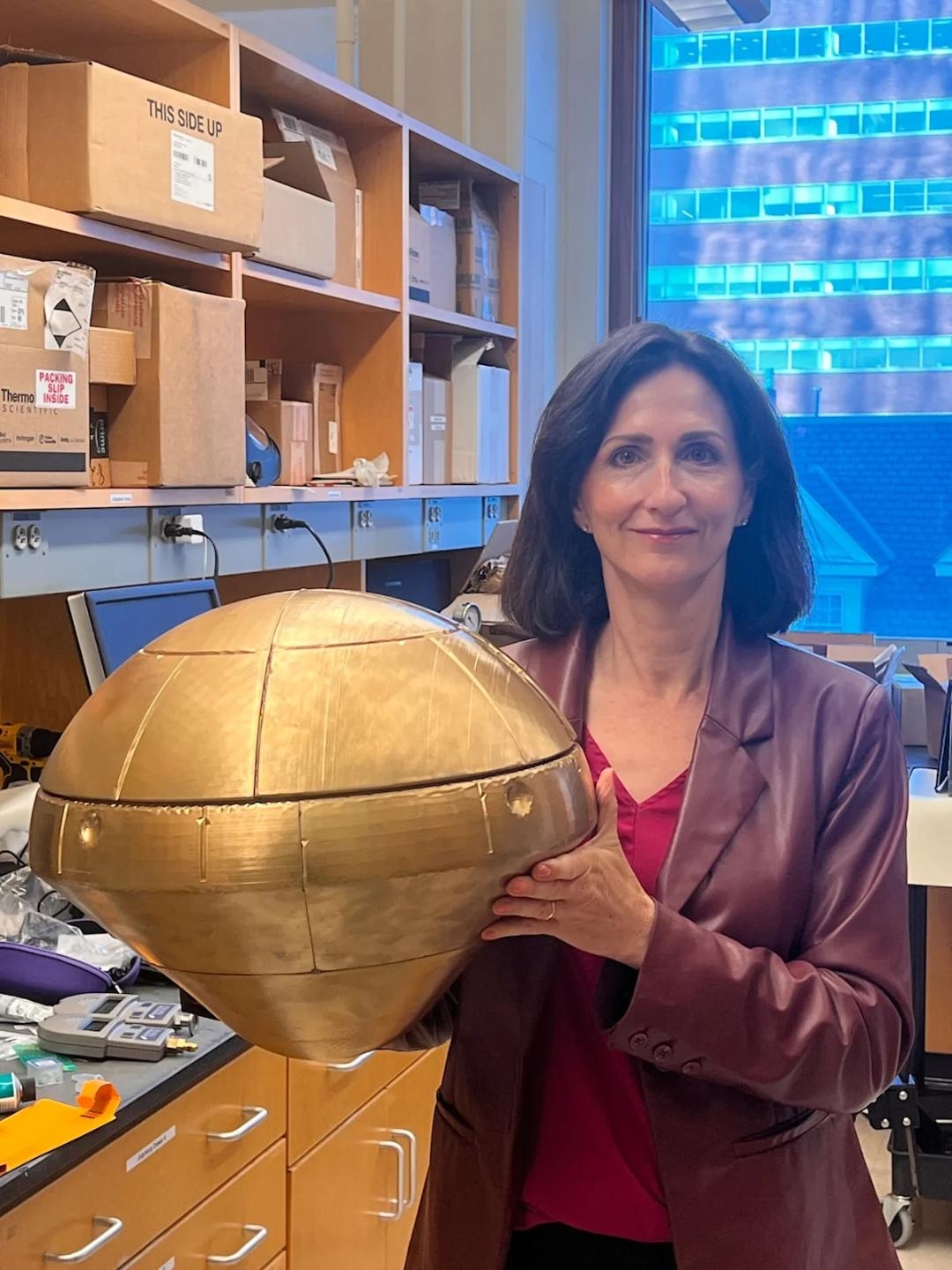
Sara Seager holds a mission to Venus probe to investigate its atmosphere.
Image credit: Sara Seager
 Posted in

Image credit: White House/OSTP
A National Security Science and Technology Strategy has been issued August 31 by the White House Office of Science and Technology Policy.
The document is focused on science and technology competition as it relates to military capabilities, homeland defense and resilience, and other direct intersections with national security.
Priority areas
The strategy identifies three priority areas for U.S. battlefield dominance and power projection, among them space: “Clear technological superiority in the space domain, and ability to detect, characterize, and counter threats to U.S. space interests from very low-Earth orbit and through cislunar space,” the strategy points out.
Enabling space technologies
To maintain and advance U.S. dominance across the critical domain of space, relevant agencies should prioritize leadership in and application of key enabling space technologies. Items noted in the report are:
- Cost-effective on-demand and reusable space launch
- Advanced space vehicle power generation and propulsion
- Novel space vehicle thermal management
- Access to and use of cislunar space and novel orbits
- In-space aggregation and assembly
- Biotechnologies for space applications
- Crewed spaceflight enablers
To review the entire document – “National Security Science & Technology Strategy” – go to:
https://www.whitehouse.gov/wp-content/uploads/2026/08/NSSTS-082026.pdf
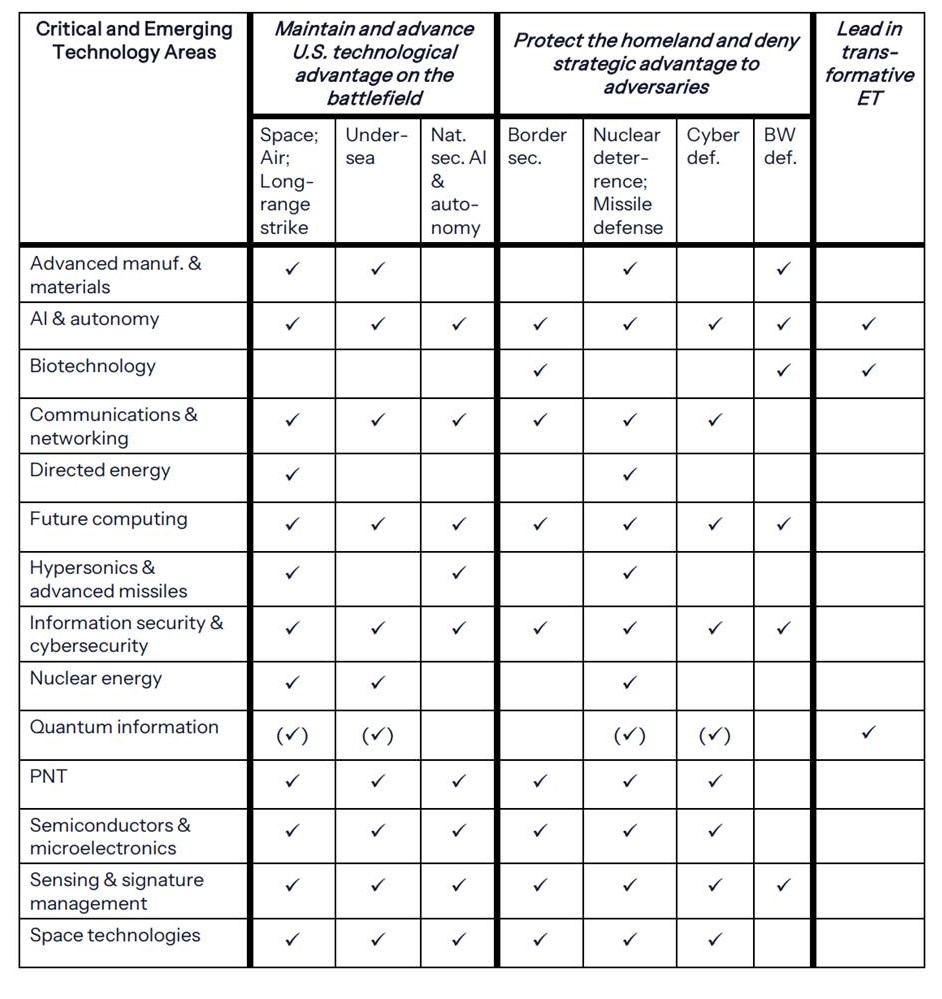
Image credit: White House/OSTP

Wait-a-Minute!
Image credit: Barbara David
Yet another wait-a-minute moment in space exploration?
The in boxes at NASA are now pondering a petition regarding the plasma physics of the outer heliosphere.
Retired NASA chief scientist, James Green, has kick-started the petition “expressing the critical need for continued heliophysics measurements by the New Horizons mission and respectfully ask NASA to ensure future data collection and downlink of all the mission’s data.”
New Horizons is the interplanetary space probe launched back in January 2006, the first spacecraft to reconnoiter far-off Pluto…and continues to plow outward and onward on its exploratory trajectory.
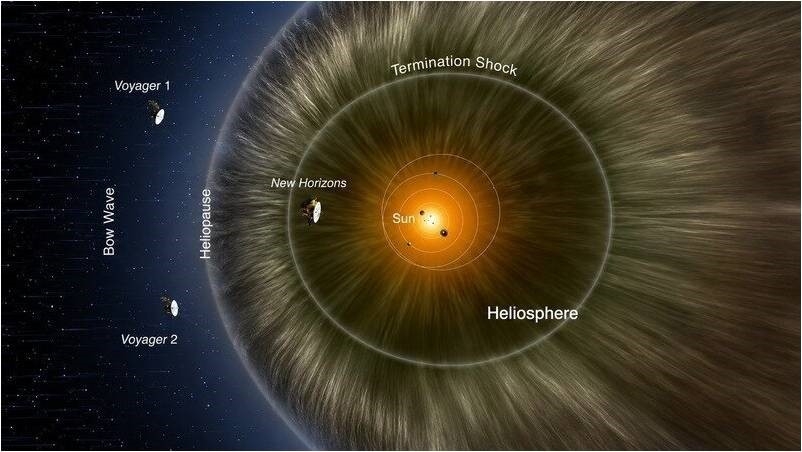
Image from Petition: “Heliophysics Community Support for Continued Measurements by NASA’s New Horizons Mission”
Unique measurements
That probe is projected to operate until 2050 and is currently observing the radial evolution of the solar wind, Pick-Up Ions (PUIs), propagating solar disturbances, energetic particles, Galactic Cosmic Rays (GCRs) and dust throughout the entire heliosphere.
New Horizons is equipped to make “historically unique measurements” of H+ and He+ interstellar PUIs that NASA’s Voyager Mission was not equipped to do.
Bottom line: New Horizons is the only spacecraft that can follow up on what Voyager found, and with more advanced instrumentation.

Onward, ever deeper. NASA’s New Horizons.
Credit: NASA/APL/SwRI
Threatened: downlink data
“It is our understanding that continued New Horizons heliophysics measurements are threatened unless NASA finds a way for the Heliophysics Division to fund the data collection and downlink,” the petition notes.
As the only spacecraft now in the outer heliosphere, New Horizons is therefore an essential element to make unique, on-the-spot heliophysics measurements. As the petition states, those remote observations represent “a unique opportunity that will never again arise and must be fully exploited.”
If these New Horizons measurements were to cease, as currently planned, without the Heliophysics Division funding in FY27 and beyond, the petition states “it would signal that NASA cedes the farthest frontier of space exploration.”
The petition is specifically pitched to Nicola Fox, NASA Associate Administrator, Science Mission Directorate, along with Joseph Westlake, Director of the space agency’s Heliophysics Division, and Louise Prockter, Director, of NASA’s Planetary Science Division.
Take a look at the petition that supports continued measurements by NASA’s New Horizons mission at:

Wait-a-Minute!
Image credit: Barbara David

