Archive for August, 2026
 Author:
 August 2nd, 2026


Meet the Neighbors – Life on Mars and How to Find It by Steven A. Benner; Allen Lane, (an imprint of Penguin Books); July 2026; 416 pages (Hardcover); $40.99 (Amazon).
Talk about a “cold case” – nothing like dealing with life on Mars where the temperature can drop like a rock to roughly – 89°C at night. But that’s just one factor when thinking about is or isn’t there life on Mars today.
Twin NASA spacecraft Mars missions were launched in the 1970’s: a Viking 1 lander planted its legs on the terrain of Chryse Planitia on July 20, 1976, with the Viking 2 lander touching down months later at Utopia Planitia on September 3. Both asked a key question: Is there life on Mars?
Among their duties, the dual landers scooped up the first soil samples of Mars and deposited those precious collectibles into onboard, specialized equipment. To answer their query about life on the Red Planet, Viking scientists had tightly boxed up their cares and woes and sent that science gear to probe that issue.
Here’s the Red Planet rub. After interpreting all the Viking mission call backs: a majority consensus of scientists at the time was that Viking relayed a “no life on Mars” result.
However, is it possible that the two robots actually radioed back a very clear comeback: “Can you repeat the question?’’
Thought provoking chapters
Steven A. Benner is a chemist, synthetic biologist, paleogenetist, and astrobiologist – and author of this exemplary tale and head spinning volume.
You must read this book – a trite saying, but important to emphasize that point to space groupies, chemists, biologists, geologists, historians, philosophers, and scientific soothsayers.
There are those that might get bogged down in a chapter. No worries, Benner adds, skip to the next. Each chapter comes with a bullet point list of conclusions.
The book supplies witty and wonderful thought-provoking chapters, such as: “Our Place in the Cosmos,” “How ‘Yes Life’ Became ‘No Life’”; “Seeking Extant Martian Life Remained . . .Low Priority”; “The Motivational Logic of Exploration” to “The Origins of Life. A Solution”; “How Martian Life Might Survive” and the clarion chapter call “Astrobiologists of the World, Unite!”
In the past, missions to Mars might “follow the water.” They might assess “habitability.” They might even look for signs of ancient Martian life, says Brenner.
But now missions to seek extant life on Mars have been off the table. What’s going wrong here?

Image credit: Meet the Neighbors/Benner
Big questions
Importantly, this book also tells another story generated from Viking. It illustrates how actual scientists manage research that addresses “big questions.”
“For Viking, anomalous results that might have led to a back-and-forth discussion to correct mistakes in interpretations were rationalized away,” the author suggests. Benner provides examples of how fact and logic can prove less important than “culture” in a community of scientists.
Benner writes that the results of the Viking mission can all be explained by bacterial autotrophs that respire with stored oxygen on Mars (BARSOOMS). BARSOOM is the acronym for a Bacterial Autotrophthat Respires using Stored Oxygen.
“It is hard to not be enthusiastic about the results delivered by the Viking landers,” Benner writes. “Yes, with more money and more payload, more experiments could have been done. The conclusions might have been made more secure. But to repurpose a lyric from Meat Loaf, three out of three ain’t bad.”
Benner writes: “You might think therefore that the community would have changed its consensus opinion. You might think that the community would have had a collective Aha! moment. You might think that the search for extant life on Mars would be back on the table. You would be wrong,” he explains.
Propositions
Yes, science is hard, explains Benner, “especially for ape descendants.” Still, advocacy has a logic. “For extant Martian life, we can break that logic into propositions that we can examine individually,” the author suggests.
— Life arose on Mars
— Life survived on Mars
— We know how to identify any extant life that we will encounter on Mars
— We know where to access places on Mars where any extant life survives
From Benner there’s a call to action: “Astrobiologists of the world, unite! Do risky things. Seek to answer big questions. You have nothing to lose, and a world (Mars) to win.”
For more information on this landmark book, go to:
https://www.penguin.co.uk/books/477954/meet-the-neighbors-by-benner-steven-a/9780241808306
 Posted in


Lunar south pole.
Image credit: CGTN/Inside Outer Space screengrab
What’s shaking about water ice deposits on the Moon?
Turns out that assessing how seismic waves propagate on the Moon could be used to locate and map ice buried beneath the lunar surface.
A new study by geologists at the University of Maryland (UMD), Lawrence Berkeley National Laboratory and the University of Hawaii shows that seismic waves—the same kind of vibrations measured during earthquakes here on our planet — could be used to pick up the seismic signature of lunar ice.
The team’s findings have been published in the journal Science Advances on July 31.
Live off the land
“It’s crucial to identify any materials on the Moon that an astronaut can make use of while they’re up there,” said Nicholas Schmerr, an associate professor in UMD’s Department of Geological, Environmental, and Planetary Sciences and a co-author of the study.
“Since they will be limited by the few resources they brought from Earth,” Schmerr explains, “anything they find on the Moon will help them basically live off the land, especially for longer-term missions or outposts.”
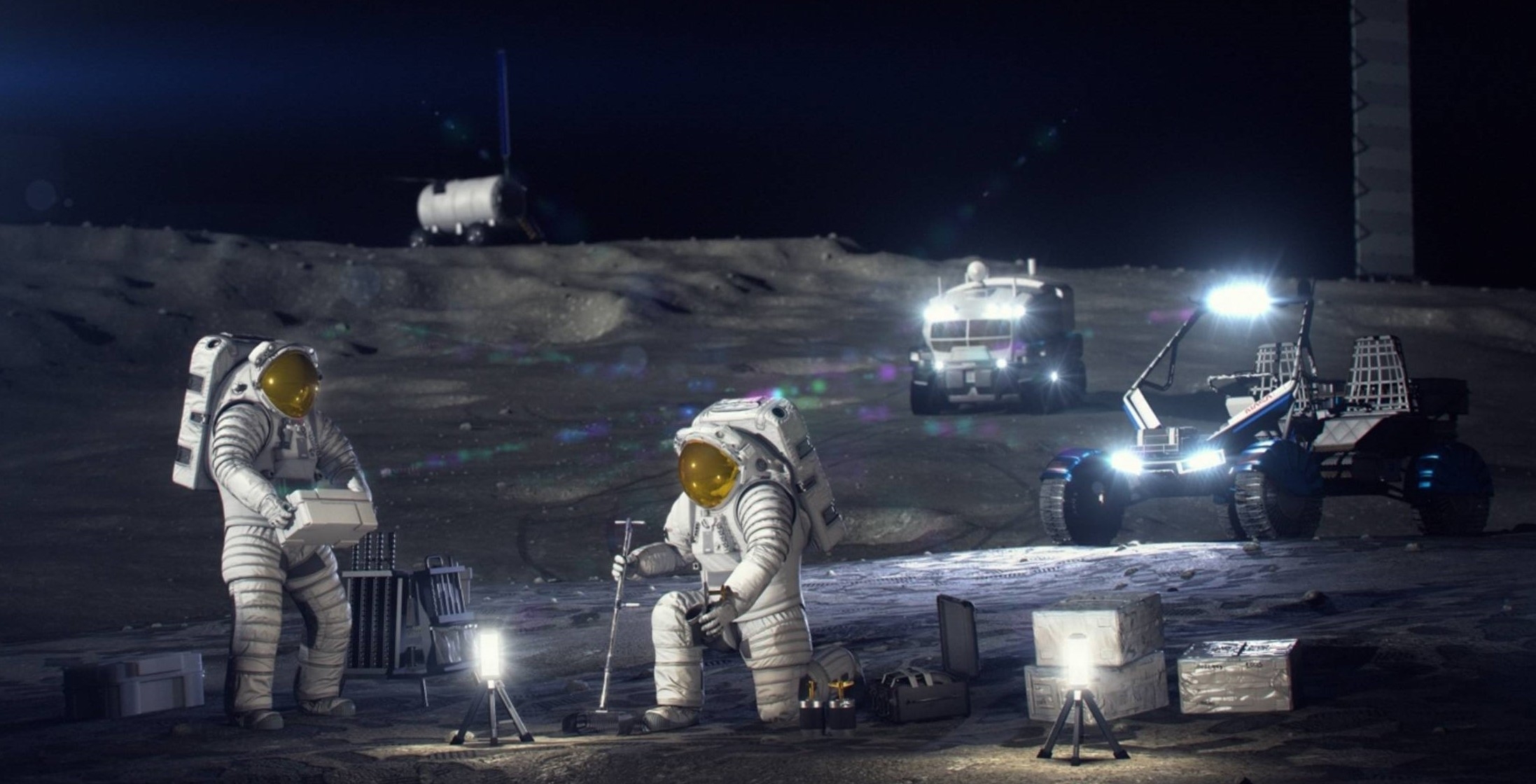
Image credit: NASA
Frozen shadows
Water ice hidden in the deep, frozen shadows of lunar polar craters may well be one of the most valuable resources an astronaut can find.
Ice can become drinking water, split apart with electricity to yield oxygen to breathe and hydrogen for rocket propellant.
So finding quantities of water ice could radically reduce what future missions need to haul from Earth.
But there’s a glitch
Presently, no one knows for sure how much ice is on the Moon, where it is, and in what condition it is for extraction and processing.
“The idea behind the team’s work was straightforward: frozen soil and dry soil behave very differently when a seismic wave passes through them,” states a UMD press statement. “Ice stiffens whatever it’s mixed into, making vibrations travel two to three times faster than they would through dry dirt. Ice-rich zones can also cause seismic energy to bounce back rather than pass through, much like how sounds can echo off a wall.”

Image credit: NASA
Schmerr added that a well-placed seismometer on the Moon would be able to detect these effects. “We can use seismic waves to not just see whether ice is present but also roughly how much of it there is,” he stated.
Testing, testing, testing
To test their idea, the researchers took three approaches.
Harrison Lisabeth, a rock physicist at Lawrence Berkeley National Laboratory, who led the research, froze a volcanic rock from Arizona that when crushed, closely mimics lunar dust.
Using X-rays, researchers studied how ice settles into tiny gaps between soil grains.
Co-author Matthew Siegler from the University of Hawaii modeled detailed temperature maps of the Moon’s south polar region, identifying which craters stayed cold enough to preserve ice for billions of years.
At UMD, Schmerr ran computer simulations of small moonquakes rippling through and interacting with underground lunar ice.
The result?
In every case, the ice left clear and measurable marks on the seismic data.
Chang’e-7.
Image credit: CCTV/Inside Outer Space screengrab
Predictions
As noted in the UMD press statement, the research team won’t have to wait long to put their predictions to the test.
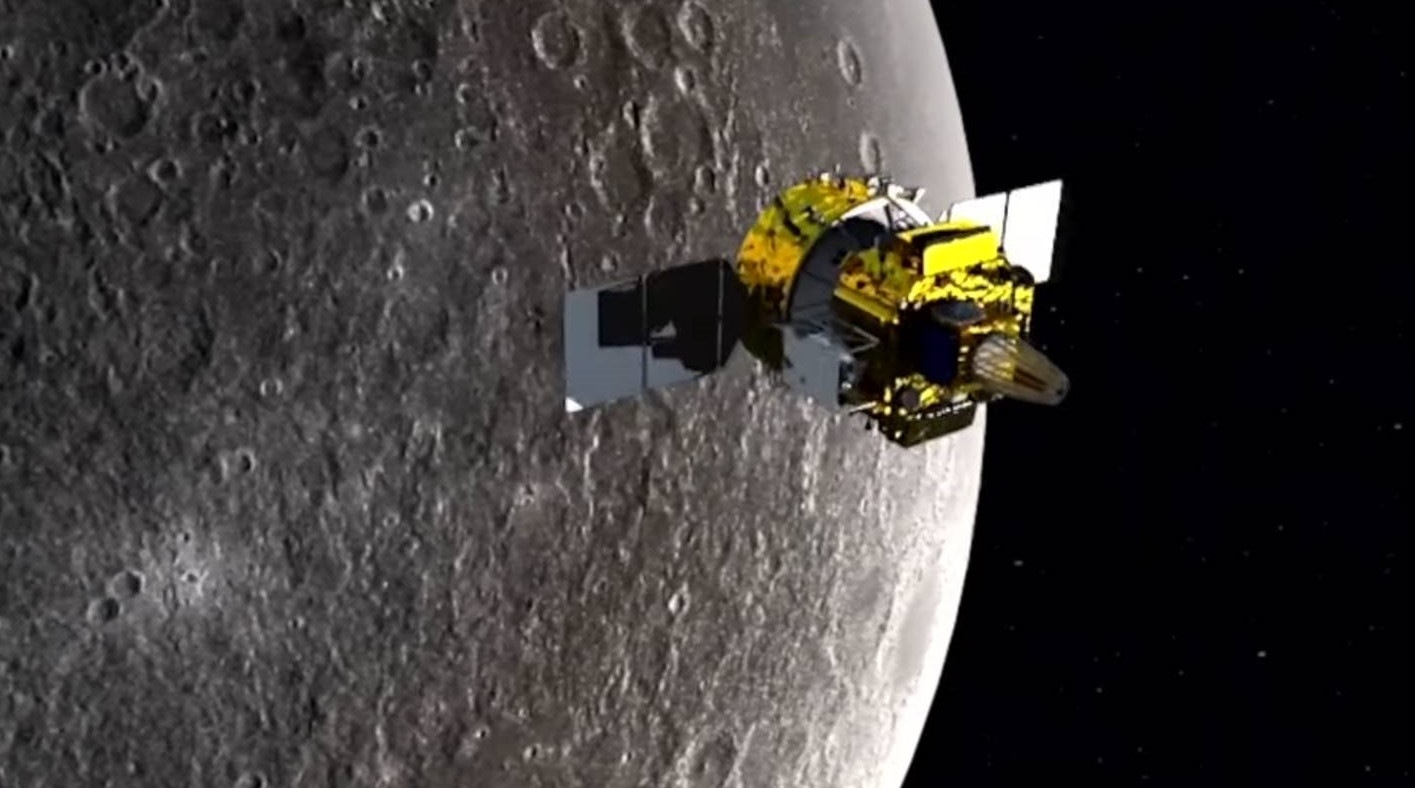
China’s Chang’e-7 mission, expected to be launched later this month, is equipped with a seismograph to study moonquakes and probe the lunar interior.
The robotic lander is targeted to land near Shackleton Crater in late 2026. At that location, numerous suspected ice deposits are present.
Additionally, NASA’s Artemis astronauts will potentially deploy the Lunar Environmental Monitoring Station, an instrument UMD’s Schmerr helped develop for seismic exploration.
“Our findings are laying the groundwork for an observation we’ll get in the next couple of years,” Schmerr said. “No one has physically measured the ice on the moon yet, but we now have a prediction for what to look out for. That’s an important first step.”
To gain access to the research paper — “The seismic signature of lunar ice” – go to:

