Archive for July, 2026
 Author:
  July 23rd, 2026
Image credit: Africa2Moon Project
Africa’s first space exploration mission is the Bounced African Low Lunar Sphere, or BALLS for short. It is to be flown on China’s Chang’e-8 Moon lander mission in 2029.
The Africa2Moon project consists of two missions:
- The first mission will deploy the technology demonstrator on the Moon in 2029. Three antennas constitute a radio astronomy array at the Moon’s south pole region.
- The second mission aims to deploy 55 antennas on the far side of the Moon, one for each nation in Africa.
Paperwork to hardware
Carla Mitchell is with the South African Radio Astronomy Observatory (SARAO), detailing the multi-year effort to move from paperwork to hardware at a NASA Solar System Exploration Research Virtual Institute (SSERVI) gathering.
Mitchell took part in a NASA Exploration Science Forum held this week at NASA’s Ames Research Center in Silicon Valley, California.
BALLS will enable observations below 20 megahertz (MHz) that are inaccessible from Earth due to ionospheric distortion and radio interference.

Image credit: Africa2Moon Project
The mission is led by the Foundation for Space Development Africa and a team of volunteers in collaboration with other organizations, Mitchell said, such as the South African National Space Agency, the National Institute for Theoretical and Computational Sciences, as well as institutions in Kenya, Ghana, Botswana and across the continent.
Pathfinder
Teams at Petrawell, Aerospace Systems Research Institute at the University of KwaZulu-Natal and Electronic Systems Laboratory at Stellenbosch University were involved in manufacturing the components of the structural and functional BALLS models. There were assembled in April 2026, to be delivered to China’s Chang’e-8 team for testing.
This three-BALLS array will serve as a pathfinder for future lunar technologies and radio astronomy experiments, Mitchell reported. They also serve as a technology demonstrator for the full Africa2Moon mission consisting of 55 antennas deployed on the far side of the Moon, she said. The night-time lunar farside is the most radio-quiet location in our vicinity.
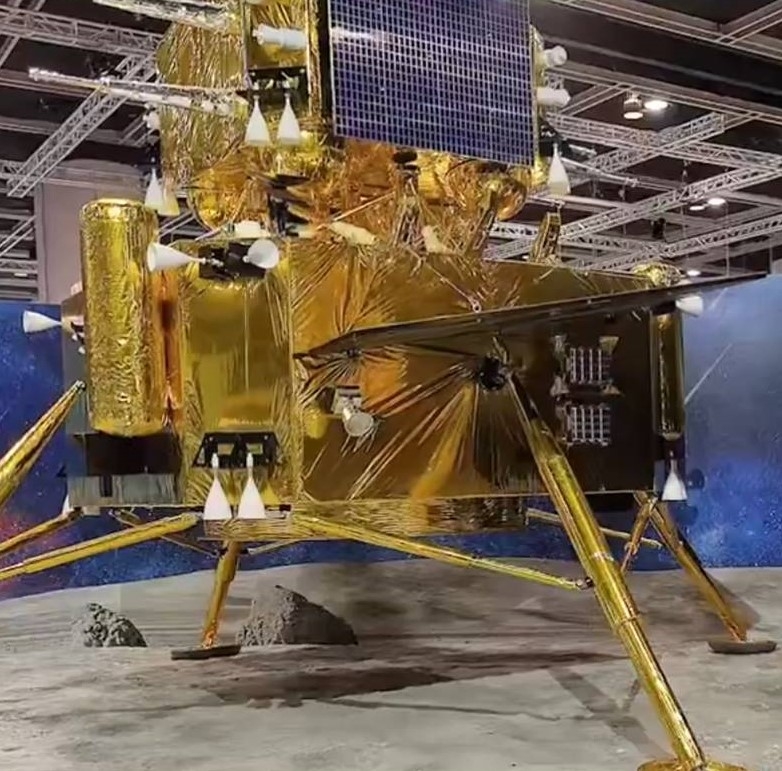
China Moon lander.
Image credit: Africa2Moon Project
Spaced out
Africa2Moon is viewed as a low cost, low mass, low frequency radio astronomy telescope array designed to operate on the lunar farside, perform new science, demonstrate novel African-built technology, said Mitchell, and inspire increased participation in space exploration and science, technology, engineering and mathematics by young people in Africa and the developing world.
The BALLS trio would be spaced out on the lunar surface, on the order of tens of meters apart.
Signals captured from the three BALLS are to be communicated to the Chinese lander and then relayed back to Earth for further processing.

Image credit: Africa2Moon Project
Study the early universe
Each of the BALLS comprises a spherical gyroscope-like frame made of interlocking rings, encasing two large triangular solar panel arrays with a grid-like surface texture.
The panels are oriented in opposite directions — one pointing upward and one downward — giving the structure a tetrahedron-like inner form.
When deployed from the Chinese Moon lander, BALLS are meant to detect very low-frequency radio waves from space and help scientists study the early universe.

Image credit: Africa2Moon Project
 Posted in
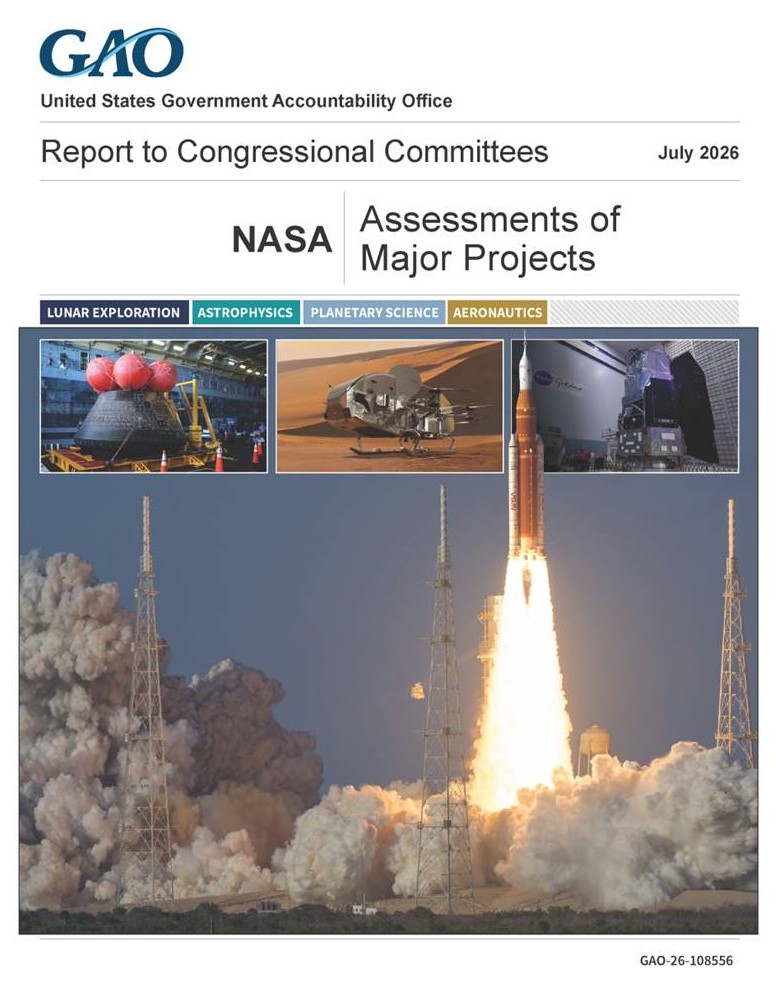 NASA is undertaking some of its most ambitious projects, from returning astronauts to the Moon to preparing for future missions to Mars.
Together, the agency’s major projects represent an estimated investment of about $70 billion.
Here’s what the U.S. Government Accountability Office (GAO) reports in a just-issued document:
Most of NASA’s major projects in development reported no schedule delays or cost overruns in the last year. These projects are in the phase of building and testing their designs.
Two of these 18 projects reported annual schedule delays (totaling 2 months) and three reported cost overruns (totaling $501.4 million). Similarly, the portfolio’s cumulative costs and delays increased slightly, from $4.4 billion to nearly $4.7 billion and from 13.1 years to 14 years, respectively.
The Orion crew capsule accounts for over half of the major projects’ annual cost overruns and almost 75 percent of their cumulative cost overruns.
Artemis program: significant changes
In February and March 2026, NASA announced significant changes to its Artemis missions—its effort to create a sustained lunar operations.
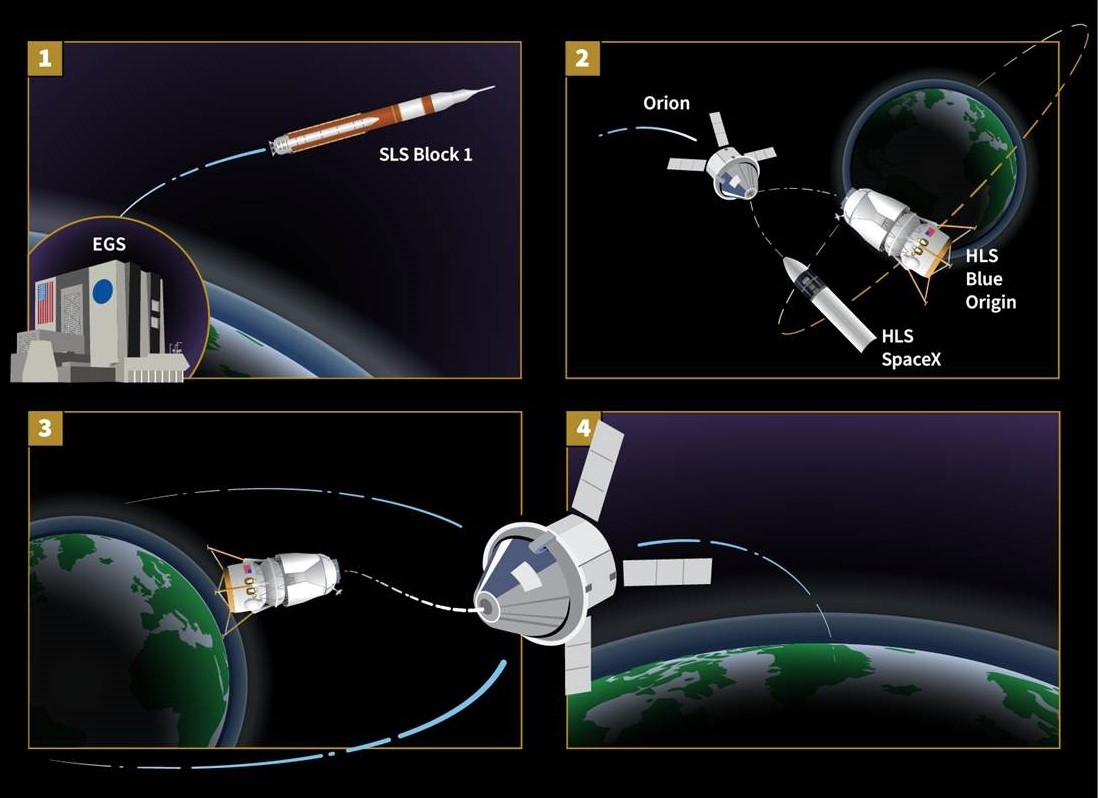
Artemis III mission in Earth orbit.
Image credit: GAO
The changes included revising the focus of the planned Artemis III, IV, and V missions, and pausing work on three Artemis projects. These projects include the Gateway, a small space station in lunar orbit that would have supported lunar missions. Under its new plan, NASA plans to shift its focus to infrastructure that enables sustained lunar surface operations – a Moon Base.
Implementing changes to the Artemis missions will create acquisition management challenges for NASA as each Artemis-related project adjusts to the new plans. For example, two Artemis projects were reporting technical and programmatic risks that were likely to delay their schedules.
Ongoing uncertainty
Acting on GAO’s prior recommendations to improve cost transparency, establish cost and schedule controls, and better manage acquisition risk could provide opportunities for NASA to strengthen its acquisition management.
In response to the administration’s directive to reduce the size of the federal workforce, NASA reduced its civil servant workforce by 4,000 staff—or nearly 22 percent—in 2025. To date, 25 of 36 projects have reported effects from the reduced staffing.

Artwork depicts two Artemis astronauts planting an American flag at the lunar south pole.
Image credit: NASA/Daniel O’Neal
Subsequently, in February 2026, the NASA Administrator announced plans to resume hiring and address skill gaps. The President’s fiscal year 2027 budget request, however, proposes to reduce funding for NASA by more than 20 percent. This request contributes to the ongoing uncertainty as to whether NASA will be able to hire the workforce needed to address skills gaps.
GAO will continue to closely monitor NASA’s management of the Artemis projects, as well as the agency’s efforts to address workforce challenges.
Acquisition management
In its prior work, GAO made multiple recommendations to improve NASA’s management of major projects. NASA has generally agreed with these recommendations, but has not yet addressed some in the areas of cost transparency and program cost and schedule controls.
As of May 2026, NASA also had not yet fully implemented two recommendations to improve its acquisition management, which GAO identified as high priority.

Image credit: NASA
To access the full GAO report – NASA: Assessments of Major Projects – go to:
https://www.gao.gov/assets/gao-26-108556.pdf
GAO video
GAO Director Bill Russell discusses GAO’s latest annual review of NASA’s major projects, including how well they are meeting their cost and schedule goals. He explains what drove much of the portfolio’s recent cost growth, how changes to the Artemis program could affect future missions, and why NASA’s workforce challenges may create additional risks.
Learn what GAO found, what appears to be working, and what NASA and Congress should watch as these complex projects move forward.
Go to this GAO video at:
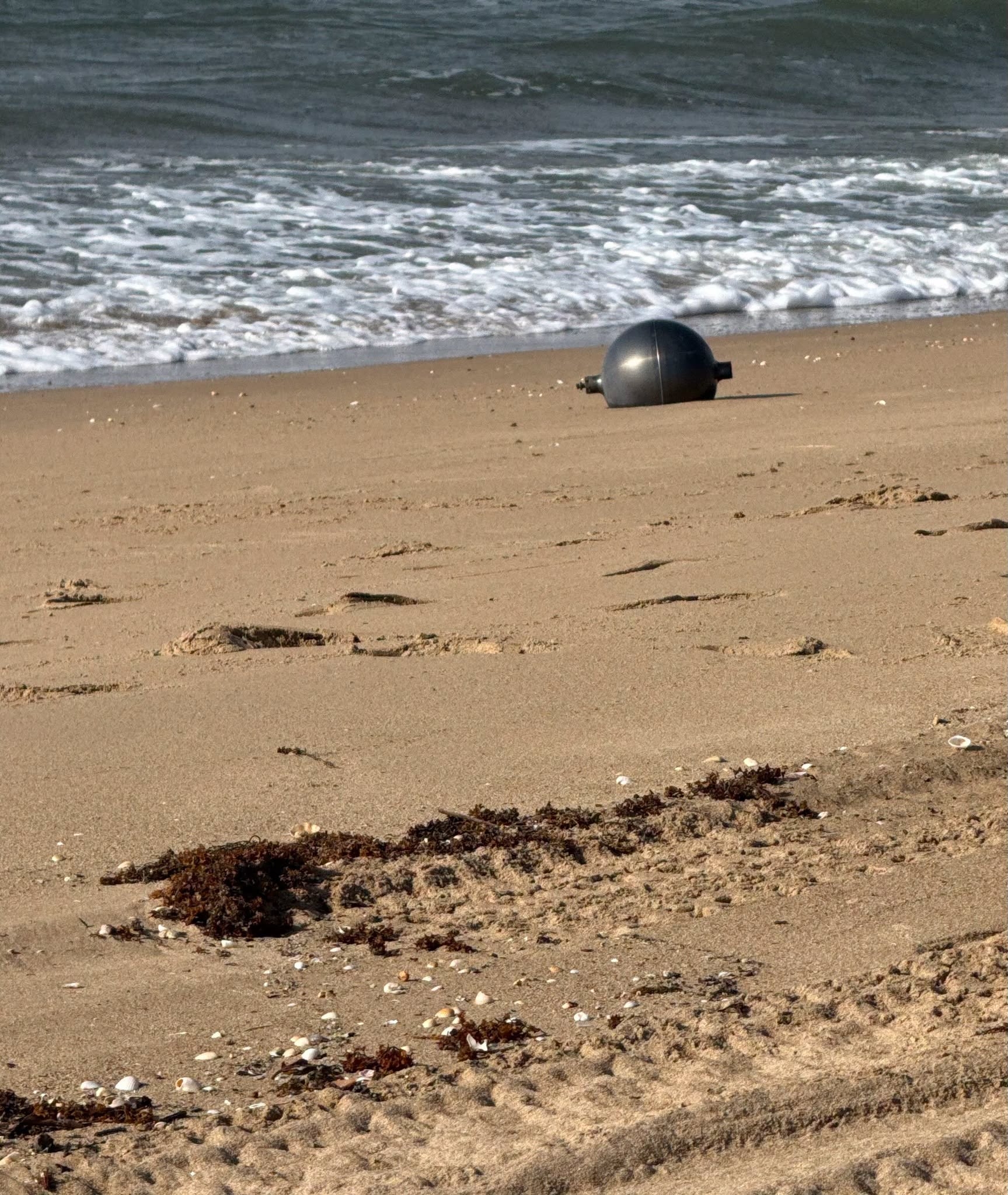
Image credit: Queensland Fire Department
Once again, the “land of down under” is on the apparent uptick for more space debris.
In early July, the Australian Space Agency reported that objects recovered, dubbed “space balls,” are likely pressure vessels from a space launch vehicle.
Six pieces of space junk were found in the small seaside community of Forrest Beach, near Ingham. The nature and origin of the debris are still being investigated.
This latest incident is part of an unwanted legacy of being the “fall guy” for space remains, from U.S. Skylab space station debris that fell into Western Australia in 1979; a chunk of SpaceX Dragon trunk found in New South Wales in 2022; a pressure vessel that washed up in Perth from an Indian booster in 2023; along with a section of Chinese Jielong-3 rocket in October 2025.

Confirmed SpaceX debris found in Australia.
Photo courtesy: Brad Tucker
“The real challenge is that this is still an area that we don’t completely understand. We get surprises now and again,” explains a space debris expert.
For more details, go to my new Space.com story — “Metal spheres found in Australia show how little we still know about falling space debris, experts say” – at:
Also, go to this informative and image-rich site — History of Space and Launch Debris Recoveries — by Paul D. Maley at:

NASA 1976 Viking 2 lander image of the Mars Utopian Plain.
Credit: NASA/JPL-CalTech
In looking back and commemorating the 50th anniversary of the Viking missions to Mars, one is struck by the bold and audacious undertaking.
Twin spacecraft missions — each consisting of a lander and an orbiter – made their way to Mars and into the history books.
The Viking 1 lander planted its legs on the terrain of Chryse Planitia on July 20, 1976, with the Viking 2 lander touching down months later at Utopia Planitia on September 3.
Key question

Credit: NASA/Ben Clark
Among their duties, the dual landers scooped up the first soil samples of Mars and deposited those precious collectibles into onboard, specialized equipment.
Viking scientists had tightly boxed up their cares and woes and sent that science gear to pose a key question: Is there life on Mars?
But is it possible that the two robots actually radioed back a very clear comeback: “Can you repeat the question?’’
For full details, go to my new Space.com story – “Did Viking 1 find life on Mars 50 years ago? Here’s why the debate continues” – at:

Viking Mars Missions Education & Preservation Project
Credit: VMMEPP
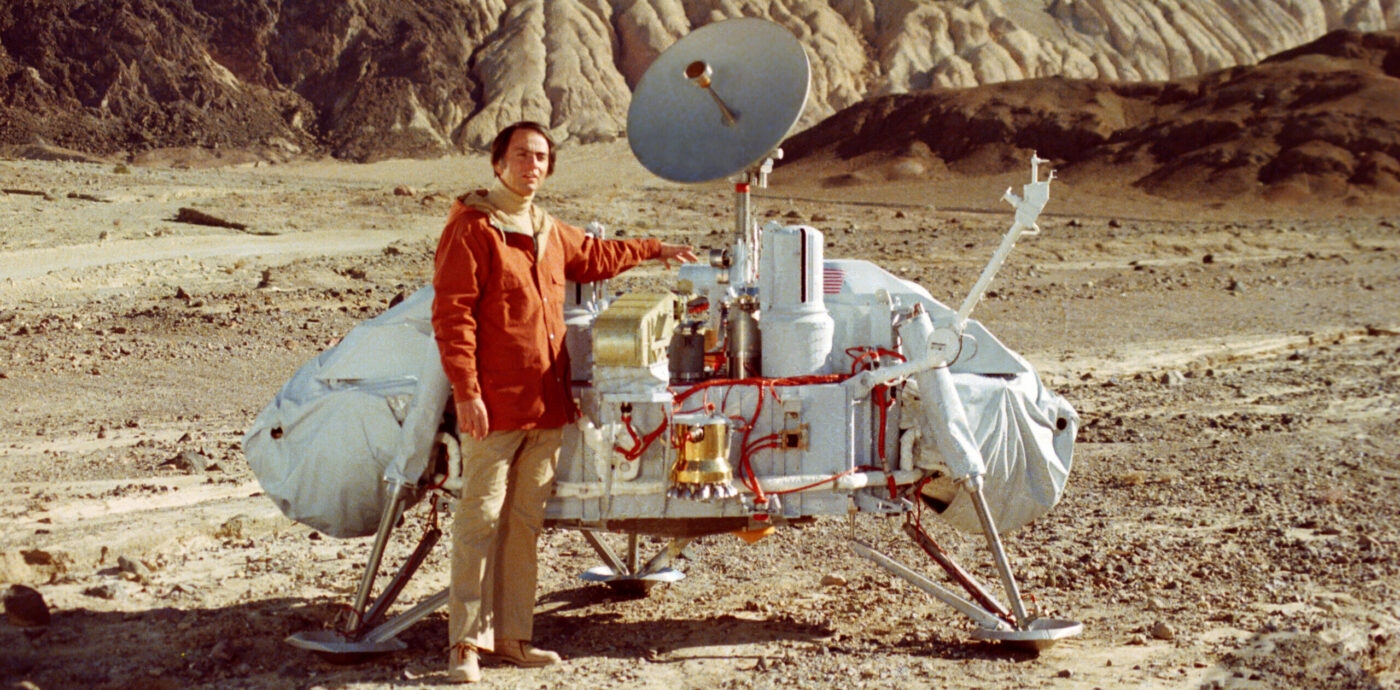
Image credit: NASA, Druyan-Sagan Associates, Inc.
To my local Martians here in Colorado:
This Monday, July 20, 2026 event takes place from 10:30 AM-12:30 PM Mountain Time.
For details, go to
https://wingsmuseum.org/events/the-history-of-viking-1-a-speakers-panel/

Image credit: NASA

Wait-a-Minute!
Image credit: Barbara David
In true wait-a-minute style, the half-century anniversary of NASA’s Viking missions to the Red Planet is a reflective moment in space, time, and astrobiology.
Is there life on Mars was the driving question for the program.
Now 50 years later, top-notch experts have contributed their thoughts in a special issue of Astrobiology, a SAGE publication, subdivided into three sections: Historical Viking, Transition from Viking to Future Astrobiology, and Future Mission Needs and Concepts.

Image credit: SAGE Publications
Evolutionary descendants
For example, J. William Schopf of the Department of Earth, Planetary and Space Sciences at the University of California, Los Angeles, contributes his “Insights into the Possible Composition of a Martian Biota.”
It seems reasonable to suggest that future searches for extant life on Mars, follow-ups to the pioneering Viking Mission of a half-century ago, Schopf explains, “should focus on predicted evolutionary descendants of microorganisms like those known from Earth’s early fossil record—at present, sulfuretum bacteria, photosynthetic bacteria, methane-producing archaea, and methane-consuming archaea.”
Where to look
Given Mars’ current seemingly inhospitable surface environment, Schopf continues, “such searches should not neglect subsurface settings, for example, regions beneath the polar ice caps, samples obtained by crustal drilling perhaps into regions harboring subsurface liquid water, and samples obtained from seeps, vents, and/or caves, if such features are identified.”
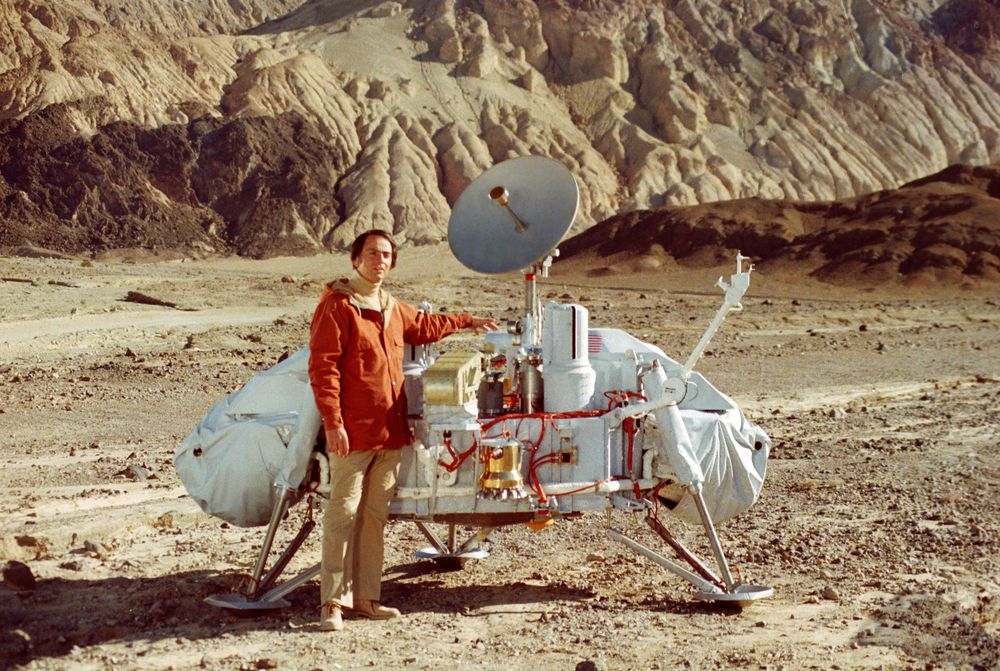
Carl Sagan stands by Viking Mars lander model in desert location. His call continues to ring true that “extraordinary claims need extraordinary evidence.”
Image credit: NASA
Indeed, if a diverse microbiota had once become established on Mars—as seems possible, judging from the similarities of the early environments of Mars and Earth—Schopf writes “it is difficult to imagine that the evolutionary descendants of such a biota would not have evolved in tandem with the slowly changing martian environment and survived to the present, as they have on Earth.”
Range of themes
Among a range of themes advanced in the journal:
- Viking at 50: Rediscovering the People and Ideas That Formed Astrobiology
- NASA Viking Mission: A Perspective of the Labeled Release Biological Experiment on Mars
- How Viking Changed Science Communication
- “20 Years Later: The ALH 84001 Debate in Context with Viking’s Results. Lessons Learned and Portals Opened”
To access this special issue, go to:
https://journals.sagepub.com/toc/asba/26/1_suppl

Wait-a-Minute!
Image credit: Barbara David

Image credit: SpaceX
The thirteenth flight test of the SpaceX Starship program is preparing to launch as soon as Thursday, July 16.
The 90-minute launch window will open at 5:45 p.m. Central “Texas” Time.
According to SpaceX, the Starship’s primary test objective will be executing a successful launch, ascent, stage separation, boostback burn, and landing burn at an offshore landing point in the Gulf of America.
Several modifications
“There have been several modifications to hardware and software to address issues seen on the previous flight,” a SpaceX posting notes:
- The Super Heavy booster on this upcoming flight has hardware modifications to improve re-light reliability along with updates to engine alarms and aborts to match the conditions seen in the multi-engine flight environment.
- There have been several modifications to Starship’s propulsion system to address the engine out issue experienced on the previous flight.
- Several hardware and operational modifications have been made to enhance reliability of the Raptor engine.
Suborbital Starlinks
Starship’s upper stage’s primary objectives this flight includes the deployment of 20 Starlink V3 satellites, a relight of a single Raptor engine while in space, and another controlled entry, descent, and splashdown in the Indian Ocean.
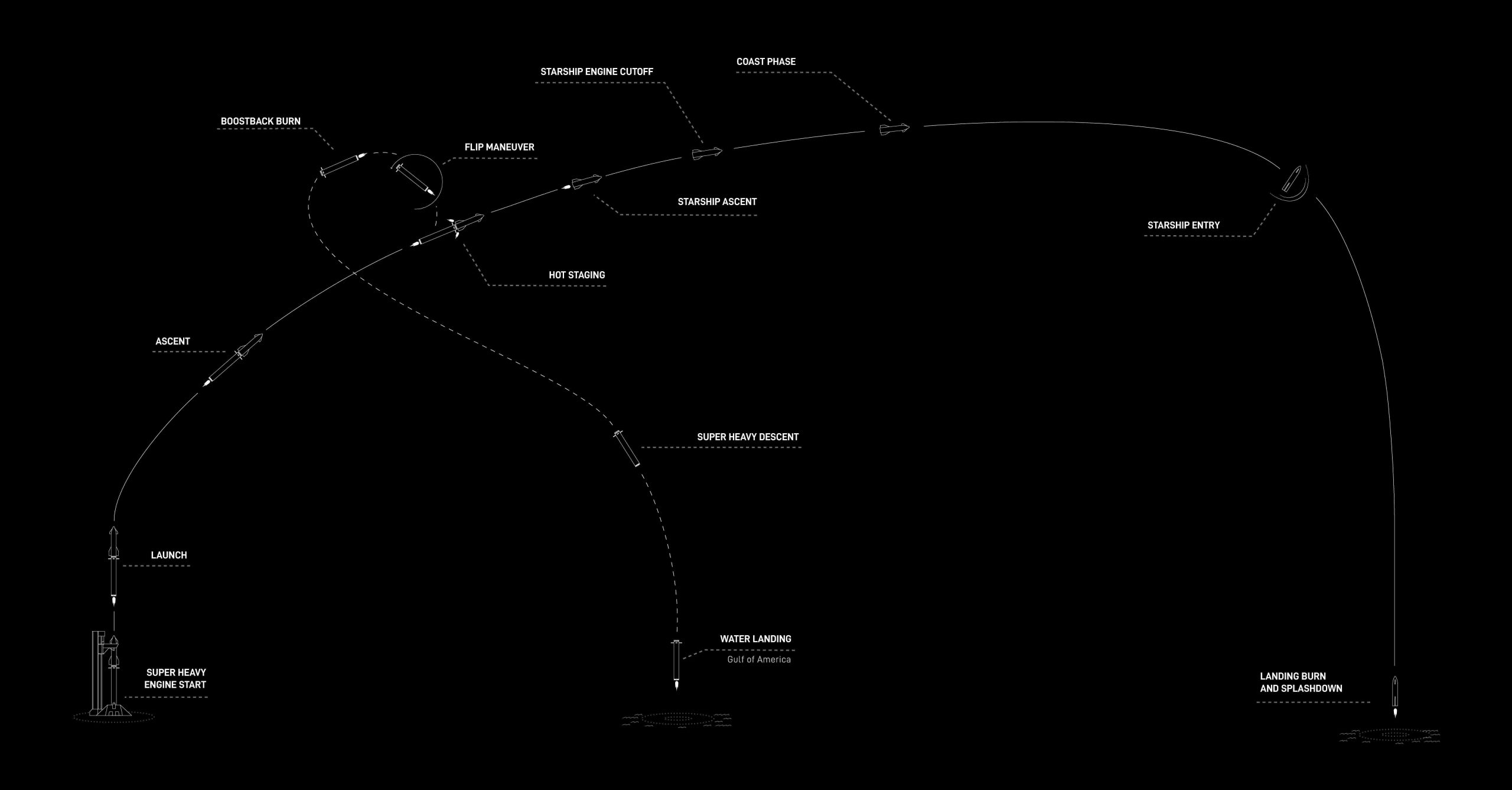
Image credit: SpaceX
Starship’s deployment of the 20 satellites involves extending satellite solar arrays and antennas, and attempting to connect with the larger Starlink constellation via high-capacity lasers.
Note that this flight has the deployed Starlink satellites flying on the same suborbital trajectory as Starship. They are expected to demise upon reentry approximately 20 minutes after deployment.
Heat shield scanning
Six of the Starlink V3 satellites have been modified with a suite of cameras to scan Starship’s heat shield and transmit imagery down to operators. They are to test methods to analyze Starship’s heat shield readiness for return to launch site on future missions.
Several tiles on Starship have been painted white to simulate missing tiles and serve as imaging targets in the test.
A live webcast of the flight test will begin about 30 minutes before liftoff.
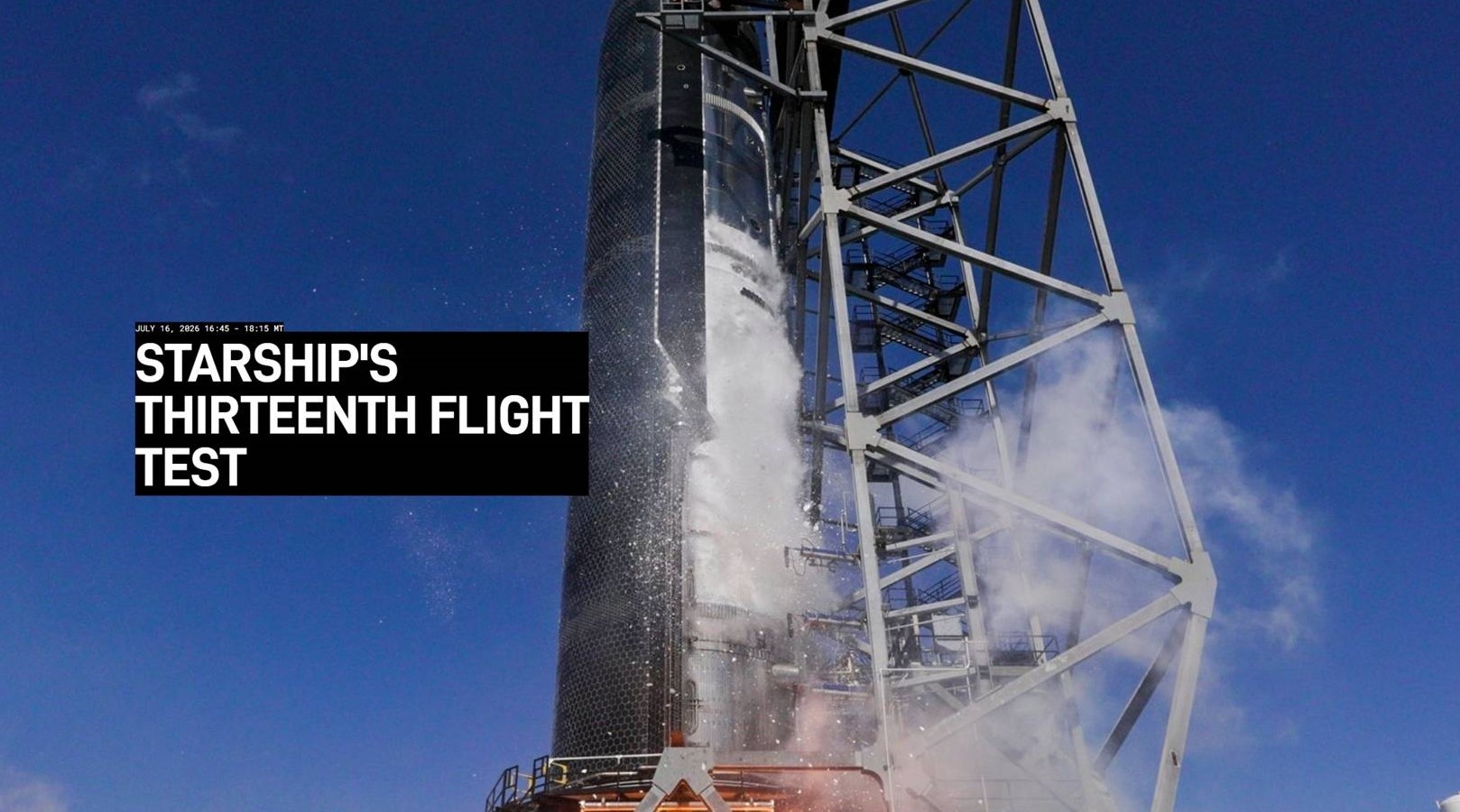
Image credit: SpaceX
“As is the case with all developmental testing, the schedule is dynamic and likely to change, “explains SpaceX, so be sure to check in and stay tuned into their X account for updates at:
To view this Starship test flight, go to:

Image credit: NOAA
Hundreds of offshore oil and gas platforms in federally controlled waters are reaching the end of their operational lifecycle.
Enter Project Able Baker to enhance launch cadence and operational flexibility by exploring innovative maritime recovery options.
First of all, traditional decommissioning and full-removal processes are capital-intensive, costing upwards of $1.6 billion per platform, and often cause significant disruption to established marine ecosystems.
Landing pads
Project Able Baker seeks to address these challenges by developing a Sea-Based Recovery Station (SBRS)framework—a modular, resilient, and environmentally conscious solution that repurposes existing offshore infrastructure into landing pads for heavy-lift launch vehicles.
The Department of Defense, through the U.S. Air Force and U.S. Space Force Small Business Innovation Research (SBIR) program, is looking at proposals for Sea-Based Recovery Stations for reusable launch vehicles, such as Falcon 9, Vulcan, and New Glenn class-rockets.

NASA’s DAVINCI Venus lander.
Image credit: NASA GSFC visualization by CI Labs Michael Lentz and others
Last month, Crater Island in Utah was used as a proxy for Venus.
Project officials from NASA’s DAVINCI (Deep Atmosphere Venus Investigation of Noble gases, Chemistry, and Imaging) descent probe used the area to test a prototype camera system destined to deep dive through the hellish atmosphere of Venus.
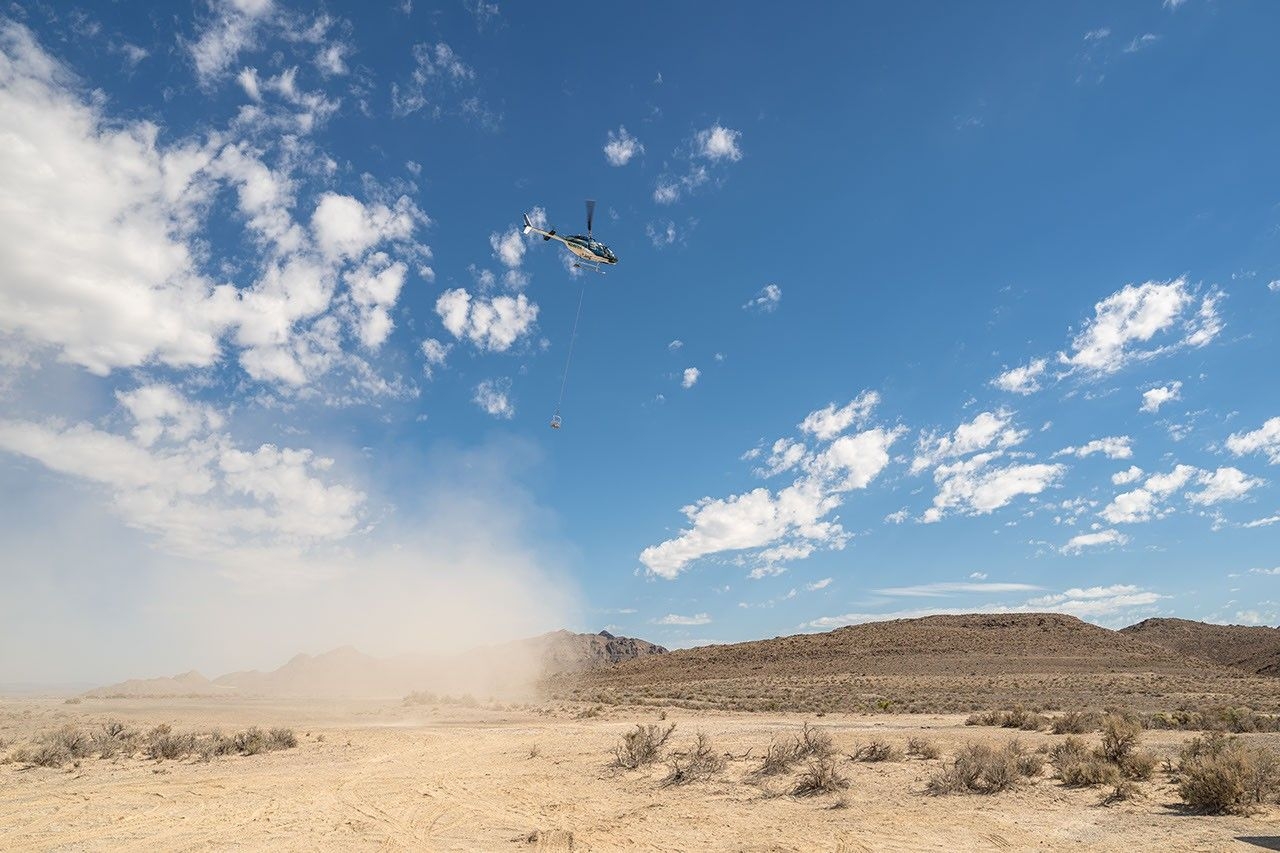
A helicopter carries a basket of nine instruments during a series of tests (June 23-25, 2026) in Utah to trial-run a prototype camera system that will one day fly aboard NASA’s DAVINCI probe to Venus.
Image credit: NASA/Mike Guinto
During its 60-minute descent at Venus, the DAVINCI probe will capture images, measure the atmospheric chemistry, and explore the environment of that world.
DAVINCI IS due for launch in the early 2030s.
Basket of instruments
A helicopter flying in U.S. Air Force restricted space over Crater Island, Utah, carried a basket of nine instruments during a series of tests June 23-25, 2026.
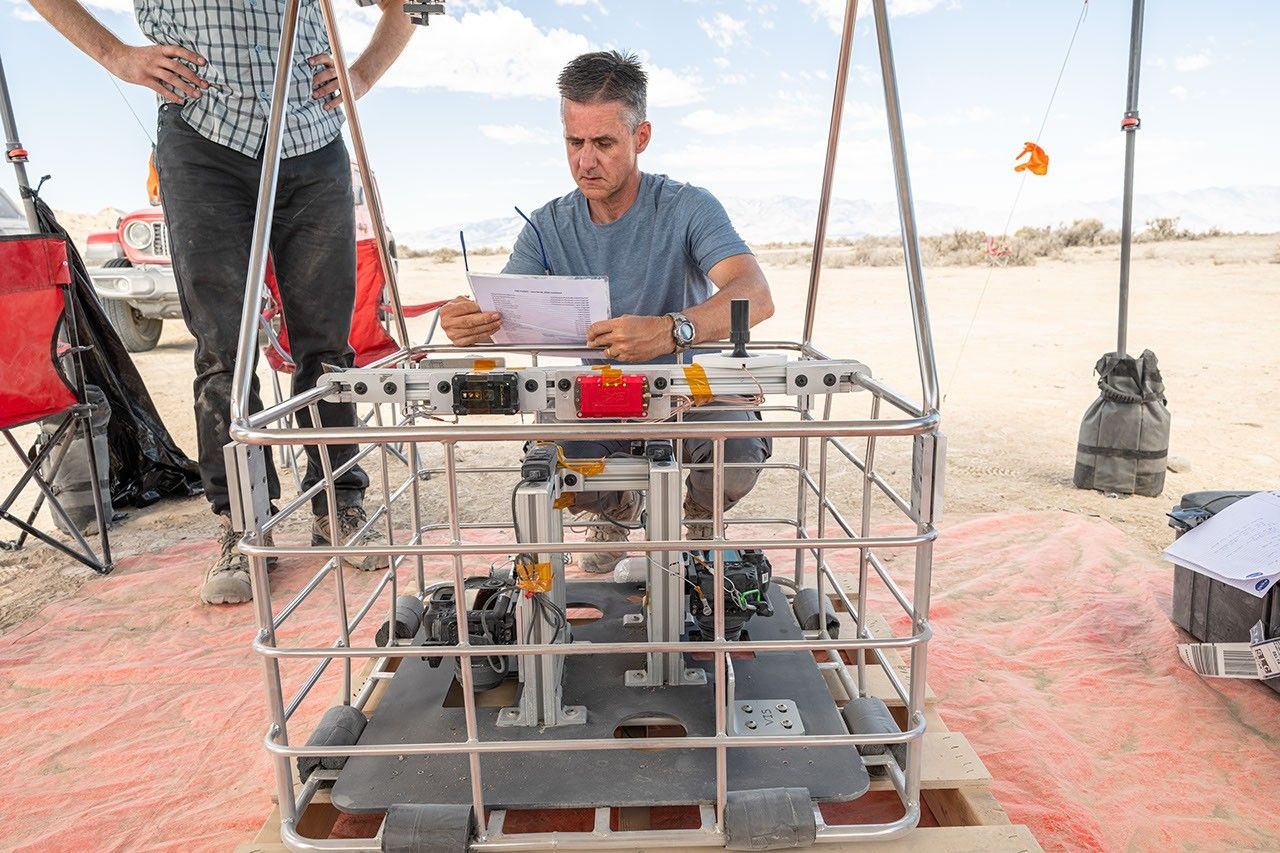
Brent Bos, a research physicist at NASA’s Goddard Space Flight Center in Greenbelt, Maryland, does a pre-flight check of a basket of instruments.
Image credit: NASA/Mike Guinto
Crater Island is a complex of mountains in northern Utah doubling for the mountainous region on Venus called Alpha Regio – the target for the DAVINCI descent probe.
On each of 10 flights, the helicopter ascended into the sky and then descended over nearly 40 minutes to the Utah landscape as the camera system snapped optical and infrared images taken as the chopper descended.
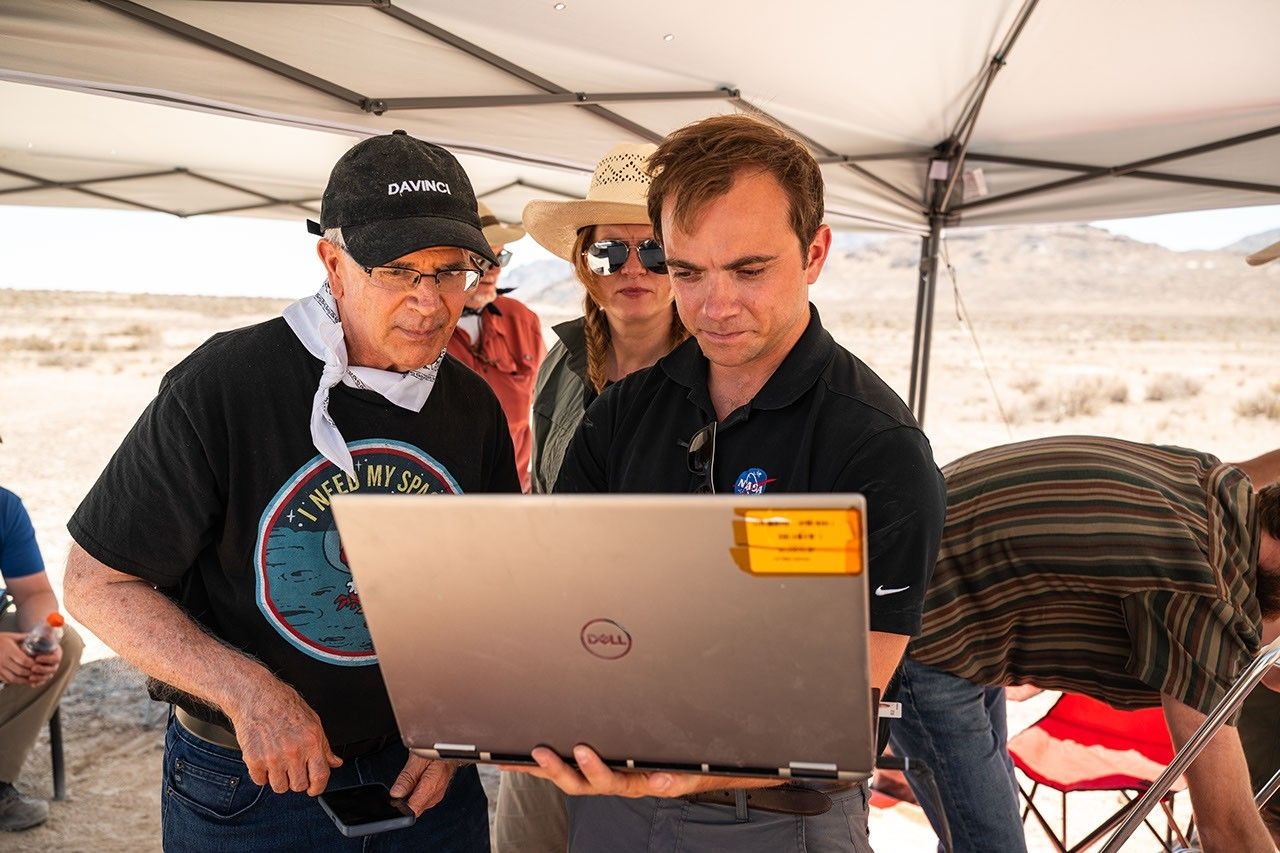
Pictured are DAVINCI’s (left to right) Jim Garvin, mission principal investigator; Erika Kohler, acting deputy principal investigator; and Matthew Mullin, space laser engineer. They evaluated the camera system that will one day fly aboard NASA’s DAVINCI mission probe to Venus.
Image credit: NASA/Mike Guinto
Imaging techniques and technology
Inside the tangling basket were nine instruments, including infrared cameras and pressure and temperature sensors that simulated the ones that will fly on the Venus probe, plus GPS units, gyroscopes, and a magnetometer to track the position and motion of the basket.
Scientists were later able to recreate the landscape in detail using only the images acquired. Those reconstructions have given the DAVINCI team confidence that their imaging techniques and technology also will work to reveal the geology of Alpha Regio.

Infrared image taken over Crater Island, Utah, during a June 24, 2026, test of the camera system that will one day fly aboard NASA’s DAVINCI mission to Venus. The images were captured with a Malin Space Science Systems camera tuned to the near-infrared wavelengths that DAVINCI will use to see through Venus’s thick clouds and capture images of the Alpha Regio region as the probe descends toward the planet’s surface.
Imagae credit: Malin Space Science Systems/NASA/Jay Friedlander
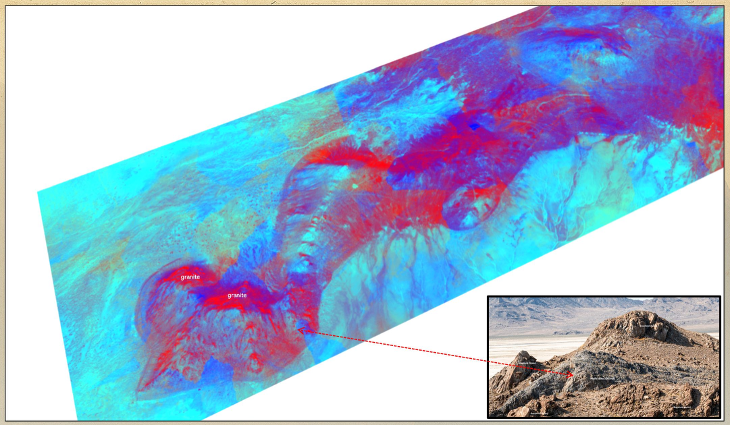
A preliminary three-dimensional view of ridges at Crater Island, Utah, as measured by the DAVINCI imaging system test campaign on June 23-25, 2026. The colors were added to distinguish rock types. The inset image in the bottom right is a helicopter view of the area.
Image credit: NASA Goddard/Jim Garvin
Go to descent video at:
https://x.com/NASASolarSystem/status/2077150426730828274/video/1
It is called the International Mars Prospecting Ride-Share System (IMPRESS).
The concept’s primary objective is to survey the Red Planet for extant life, but it also supports geophysical, soil chemistry, resource, and landing site risk assessments.
Funds from the NASA TechLeap Prize helped in blueprinting the IMPRESS prospecting platform, with a field-tested prototype expected to be ready in summer 2026.
Frequent, affordable, bold
Tagged as a “Frequent. Affordable. Bold.” approach to Mars subsurface exploration, IMPRESS is designed to make shallow-subsurface reconnaissance a recurring opportunity and to provide the distributed prospecting needed before later robotic and human missions commit to a landing site.

Image credit IMPRESS Spaceworks
IMPRESS is being led by Jan Špaček, founder, CEO, of the Agnostic Life Finding Association, Inc. “It is a new project to seek life on Mars with a swarm of planetary penetrators,” Špaček told Inside Outer Space.
“The IMPRESS swarms can be delivered to Mars either as a secondary payload on planned missions, such as the 2028 SR-1 Freedom/Skyfall mission, or as a primary payload on dedicated private or government missions,” explains a preprint of a manuscript headed for the journal Astrobiology.
Planetary penetrators
“Instead of relying on soft landers and drilling systems, IMPRESS deploys swarms of planetary penetrators that use descent kinetic energy to emplace instruments 0.2–1 meters below the surface,” explains the preprint.
The space-ready version of IMPRESS could be ready as soon as 2028. It would offer a mass-produced Mars exploration platform that can be deployed for as little as roughly $40,000 per probe.
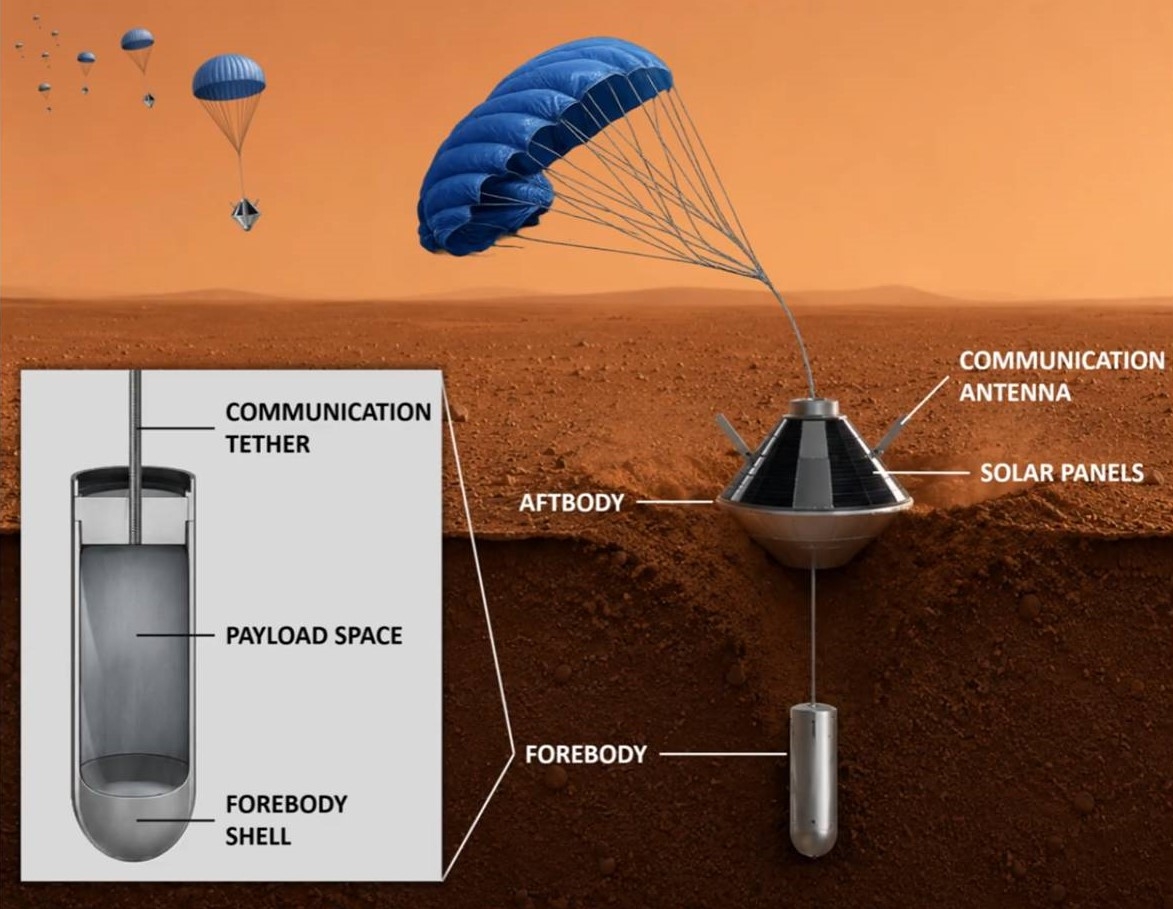
Image credit IMPRESS Spaceworks
“These platforms are comparatively easy to handle and sterilize prior to launch, relative to larger landed systems, making them suitable for biological exploration,” the preprint adds.
This work was supported in part by NASA’s TechLeap Prize and in part by a grant from the CHiwi Foundation in Switzerland under its Call for Proposals 2025. The CHiwi Foundation supports scientific research, education, and innovation in advanced mathematics, alternative energy, and space exploration.
For more details, go to this informative video at:
https://youtu.be/Rm0GTQO7O4g?si=1h4Nyn34no7nxDC9
Also, go to Impress Spaceworks at:

