Archive for January, 2026
 Author:
  January 11th, 2026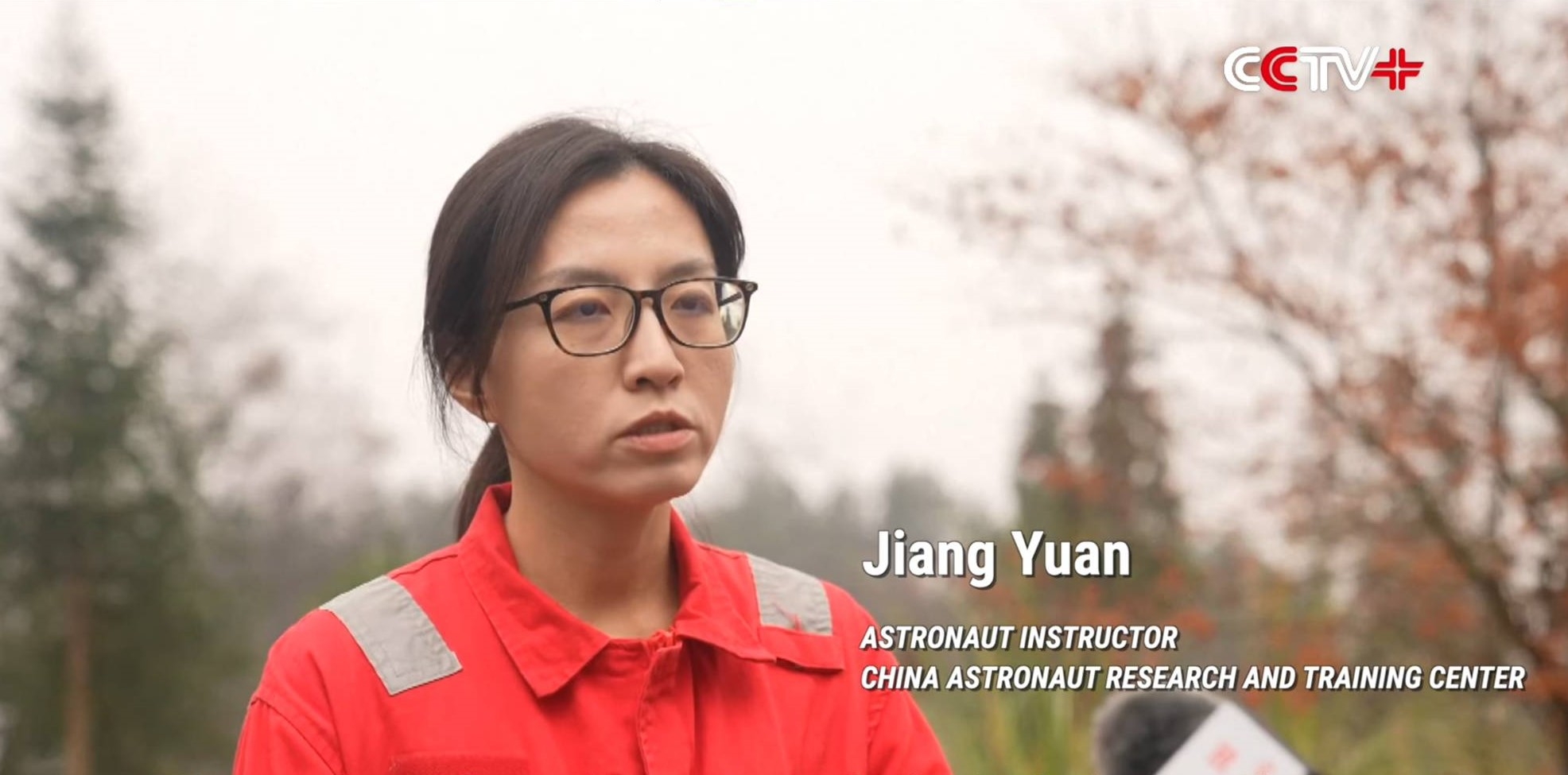
Image credit: CCTV/Inside Outer Space screengrab
A month-long program was organized by the China Astronaut Research and Training Center, one that involved a team of 28 astronauts.
The data collected during the CAVES training experience is helping to shape psychological support systems for astronauts undergoing lengthy space station missions as well as future crewed lunar landing missions, said Jiang Yuan, an instructor from the China Astronaut Research and Training Center.
Cooperative Adventure for Valuing and Exercising human behavior and performance Skills (CAVES) training is similar to those organized by the European Space Agency (ESA).
Isolation, confinement and high risk
The Chinese initiative made use of a mountainous area of southwest China’s Chongqing Municipality. The astronauts were divided into four groups, each taking turns to continuously stay in a cave with an average temperature of eight degree Celsius and humidity as high as 99 percent for six days and five nights.
Isolation, confinement and high risk were experienced by the groups, along with numerous psychological hurdles including fear of darkness and sensory deprivation.

Image credit: CCTV/Inside Outer Space screengrab
Astronaut training
“Our cave training program is primarily designed to meet the requirements of our nation’s manned spaceflight development,” said Wu Bin, an expert in charge of astronaut training with the China Astronaut Research and Training Center.
“We utilize the natural cave environment to enhance astronauts’ capabilities in handling hazardous situations, team collaboration, scientific literacy and research skills, emergency decision-making, physical endurance, and psychological resilience in extreme conditions,” Wu told China Central Television (CCTV).

Image credit: CCTV/Inside Outer Space screengrab
Unique challenges and difficulties
During the CAVES training, groups were placed in emergency scenarios like simulated medical evacuations to test their emergency response and collaborative problem-solving capabilities.
“Exploring four side caves, each with distinct topography and terrain, presents unique challenges and difficulties,” said astronaut Zhu Yangzhu. “Cave training hones one’s comprehensive qualities and capabilities, particularly teamwork skills. This holds significant implications for our future spaceflight missions, prompting me to contemplate how to effectively lead teams and manage crews aboard the space station,” Zhu said.

Image credit: CCTV/Inside Outer Space screengrab
Teamwork
Astronaut Ye Guangfu, who previously received the ESA’s CAVES training, served as one of the commanders for the training in Chongqing.
“In terms of the training procedure, our support team reduced intervention in the activities of astronauts. This approach allows for greater autonomy in teamwork,” Ye said, “thereby further unlocking their potential to accomplish tasks in the cave.
Ye said a series of experimental tasks during the mission were incorporated to deepen understanding of the mutual influence between the cave environment and human behavior. “For support capabilities, we enhanced audio-visual communication methods, significantly improving our external communication support capacity.”
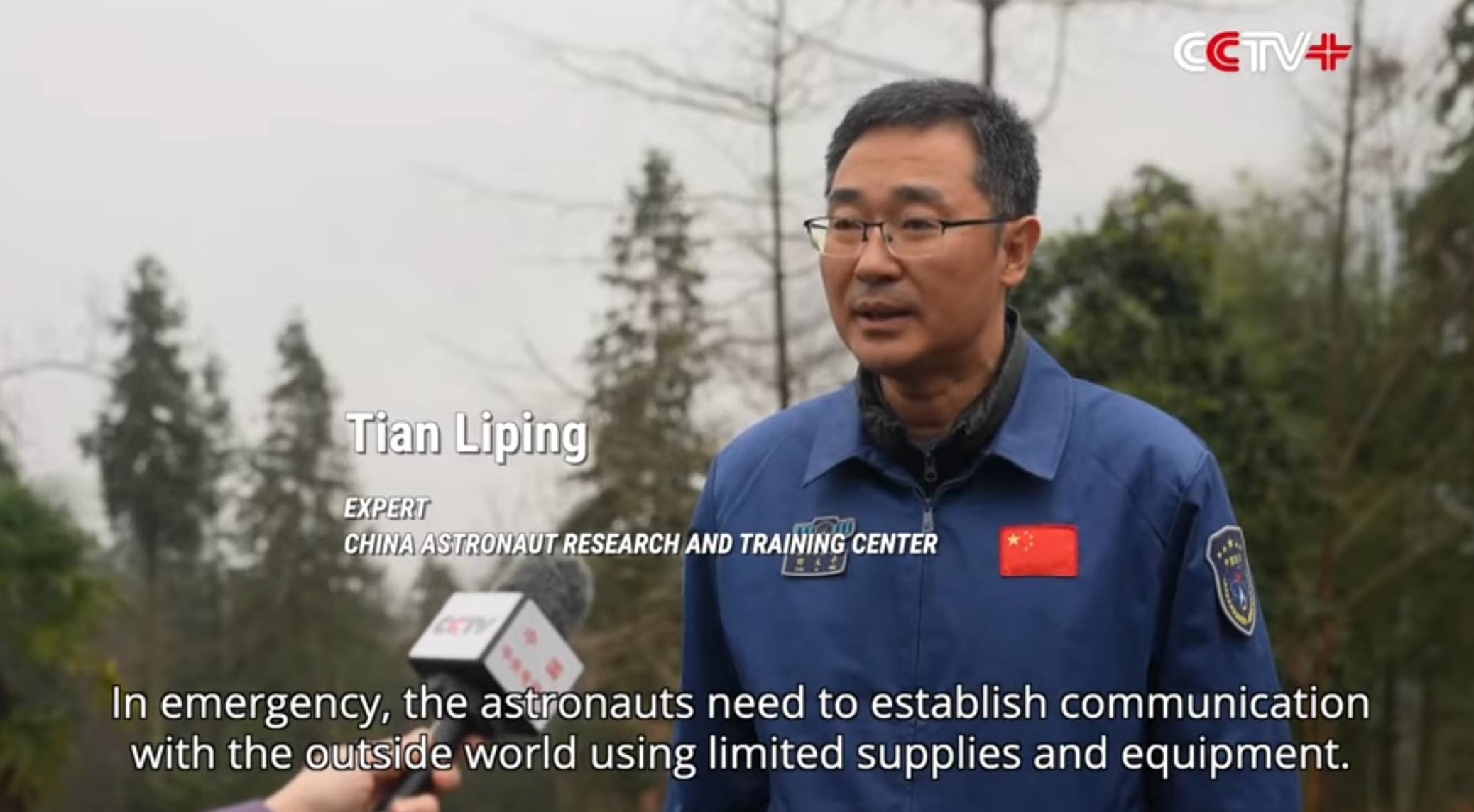
Image credit: CCTV/Inside Outer Space screengrab
Jungle training
This training program also included two days of jungle training for each session.
Tian Liping from the China Astronaut Research and Training Center added: “The jungle training program consists of three main components: First, emergency contact: In emergency, the astronauts need to establish communication with the outside world using limited supplies and equipment. Second, sustaining life: In the event that rescue forces may be unable to arrive promptly, the astronauts need to do all they can to utilize acquired knowledge and skills to maintain survival with minimal tools. And third, safely navigating out of the jungle: Under the premise of guaranteeing safety, the astronauts need to go out of the jungle to rendezvous with search and rescue teams.”
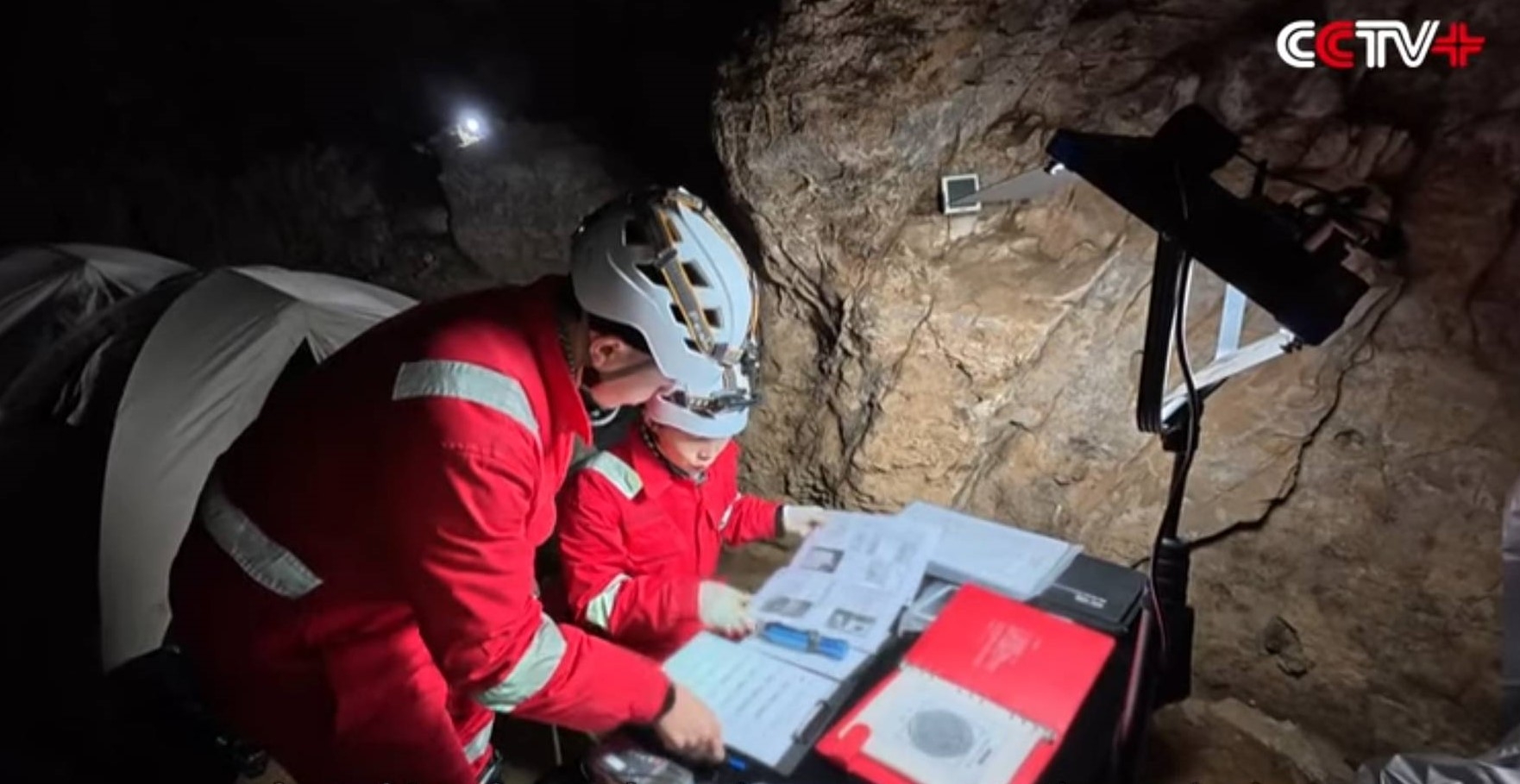
Image credit: CCTV/Inside Outer Space screengrab
Lunar lava tubes
In recent years, the China Astronaut Research and Training Center has carried out training methods and techniques in response to new mission requirements.
Analog missions like Switzerland’s Asclepios project also use subterranean tunnels to simulate lunar lava tubes, testing scientific operations and survival strategies in isolation.
Asclepios is an international non-profit with the goal of enabling analogue space missions, offered exclusively by students for students.
China’s cave training is linked to the country’s lunar ambitions, including crewed landings and a planned uncrewed Moon base by 2027.
For an informative CCTV video on CAVES training, go to:
 Posted in

Image credit: SpaceX
SpaceX is targeting Sunday, January 11 for Falcon 9’s launch of the Twilight mission from Space Launch Complex 4E (SLC-4E) at Vandenberg Space Force Base in California.
The launch window opens at 5:19 a.m. Pacific Time. Following stage separation, the first stage will land on Landing Zone 4 at Vandenberg Space Force Base.
Twilight is a dedicated smallsat rideshare mission.
Pandora
Among the payloads is the University of Arizona’s Pandora mission for NASA. It is built to help scientists untangle the signals from the atmospheres of exoplanets – worlds beyond our solar system – and their stars.

Pandora spacecraft.
Image credit: NASA’s Goddard Space Flight Center/Conceptual Image Lab
Pandora is a small satellite that will provide in-depth study of at least 20 known planets orbiting distant stars in order to determine the composition of their atmospheres — especially the presence of hazes, clouds, and water.
Data from Pandora will establish a firm foundation for interpreting measurements by NASA’s James Webb Space Telescope and future missions that will search for habitable worlds.
Go to this video on Pandora at:

Image credit: CCTV/Inside Outer Space screengrab
China reports progress in performing scientific data simulations for the soon-to-launch Chinese Space Station Telescope (CSST).
The space station-tended facility is also known as the Xuntian Space Telescope. Its launch by a Long March 5B rocket from China’s Wenchang center was last reported to have slipped to the end of this year.
Xuntian will co-orbit with China’s Tiangong space station. Doing so, that would permit docking to the space station where repairs and upgrades could be performed by astronauts, thereby extending the telescopes operational lifespan potentially for decades.

Image credit: CCTV/Inside Outer Space screengrab
Overall performance
CSST reportedly offers a field of view 300 to 350 times larger than the NASA Hubble Space Telescope.
It is expected to facilitate major scientific discoveries across various astrophysical fields, including cosmology, the study of galaxies, the Milky Way, stars and planets, according to the National Astronomical Observatories under the Chinese Academy of Sciences (NAOC), which led the comprehensive evaluation of the telescope’s overall performance.
According to papers just published in the journal Research in Astronomy and Astrophysics, the CSST simulation work marks a crucial step in preparing for the country’s flagship space astronomy facility.

Image credit: CCTV/Inside Outer Space screengrab
The collection of papers spotlight mock observations for the Chinese Space Station Survey Telescope.
Flagship space-based observatory
The CSST is considered a flagship space-based observatory. Its main survey camera is designed to conduct high spatial resolution near-ultraviolet to near-infrared imaging and low-resolution spectroscopic surveys.
CSST is a two-meter aperture astronomical space telescope, equipped with multiple back-end scientific instruments.
To maximize the scientific output of CSST, Chinese researchers have developed a comprehensive, high-fidelity simulation pipeline for reproducing both imaging and spectroscopic observations.

Image credit: CCTV/Inside Outer Space screengrab
Exoplanet research
As noted in one paper, the Cool Planet Imaging Coronagraph (CPI-C) aboard the CSST “represents a major advancement in exoplanet research” and is set to make “significant contributions to our understanding of exoplanets in the Milky Way.”
To gain access to the research papers, go to “Special Issue: Mock Observations for the Chinese Space Station Survey Telescope” at:
https://www.raa-journal.org/issues/all/2026/v26n2/
Also, go to this newly released China Central Television (CCTV) video focused on the Chinese Space Station Telescope at:
https://www.facebook.com/reel/1470954067930276

Image credit: China Media Group

Image credit: NASA/Bill Ingalls
Moon boots and Mars boots. Anyway you look at it there are a lot of NASA shoes still to drop.
One of those in perpetual déjà vu status is flinging off Mars select specimens from that distant orb, an endeavor viewed as a U.S. high priority.
However, there’s also been a recurrent whirlwind of fall out about the Mars Sample Return (MSR) endeavor. Is it too costly, too far in the future, too debatable?

Image credit: NASA
In a nutshell, here’s the extraterrestrial angst.
“The Chinese may well beat the U.S. with a grab sample,” explains one Mars expert.
For details, go to my new Space.com story – “Winning the Red Planet race: Returning Mars samples before China should be a top US priority, experts say” – at:

Mars Sample Return program artwork depicts rocketing collected off the Red Planet specimens for eventual return to Earth.
Image credit: NASA
The existing NASA/European Space Agency effort to establish a Mars Sample Return program is slated to be discontinued.
That’s the word according to the Commerce, Justice, Science, and Related Agencies Appropriations Act, 2026. It calls for an overall NASA budget figure of $24.44 billion and change.
As noted in a section on Mars Future Missions: “As proposed in the budget, the agreement does not support the existing Mars Sample Return (MSR) program.”
However, the technological capabilities being developed in the MSR program, the Act explains, “are not only critical to the success of future science missions but also to human exploration of the Moon and Mars.”
NASA codes to play nice with each other?
The agreement does request $110 million for NASA’s Mars Future Missions program.

Image credit: NASA
That program is to include existing MSR efforts, supports radar, spectroscopy, entry, descent, and landing systems, and “translational precursor technologies that will enable science missions for the next decade, including lunar and Mars missions.”
The Act explains that NASA shall coordinate efforts between the space agency’s Science Mission Directorate (SMD) and its Exploration Systems Development Mission Directorate (ESDMD).
NASA’s ESDMD defines and manages systems development for programs critical to NASA’s Artemis program and planning for the space agency’s Moon to Mars exploration approach.
For a look at the Act, go to:
Also, go to this review at:
https://www.appropriations.senate.gov/imo/media/doc/fy26_cjs_conference_bill_summarypdf.pdf

Depiction of Chang’e-7 lunar mission.
Image credit: China Media Group
China’s next exploratory probe of the Moon is to depart this year. It is a mission that begins to set the stage for that country’s multi-phased lunar outpost.
The Chang’e-7 mission is on tap to reconnoiter the Moon’s south pole, making use of an orbiter, lander, rover, and a water-seeking, well-instrumented lunar hopper.
“The Chinese will be ahead of everyone else by at least one year, but probably several years,” explains one space scientist.

Candidate landing region of China’s Chang’e-7 lunar lander.
Image credit: Yang Liu/Wang C. et al.
Research station
This upcoming Moon trek will set in motion work on a China/Russia collaboration in establishing a multi-phased International Lunar Research Station (ILRS).
For details about what’s ahead, go to my new Space.com story – “China’s next Moonshot: Chang’e 7 could search the lunar south pole for water this year” – at:

Image credit: NASA
“How do you get to Mars when the launch vehicle is not necessarily going to Mars?”
There is a loop de loop space saga underway. It is a celestial long and winding road that may also have consequences for future settlers firmly planted on the Red Planet.
The Mars-bound ESCAPADE twins were lofted November 13 by the Blue Origin New Glenn 2 launcher from Cape Canaveral, Florida. But the dual craft weren’t placed on your standard operating procedure of a route to reach the Red Planet.

The long and winding road to the Red Planet by the twin ESCAPDE spacecraft.
Image credit: Advanced Space
Space loitering, kidney bean paths, gravity assists, hyperbolic orbits and wide-open windows.
Enter the world of Jeffrey Parker, Chief Technology Officer at Advanced Space in Westminster, Colorado, the chief architect behind the ESCAPADE mission’s roundabout road trip to Mars.
Go to my new Space.com story – “Live long and loiter: Why NASA’s ESCAPADE probes will wait a year in space before heading to Mars” – at:

Image credit: PBS/Inside Outer Space screengrab
PBS science correspondent Miles O’Brien reports on the spunky space start-up in New Zealand that’s catching some attention of its own.
The private space economy is growing significantly and 2026 could be a big one.

Image credit: PBS/Inside Outer Space screengrab
Also highlighted is the evolution of the competitive commercial space market, from SpaceX, Virgin Galactic to Blue Origin.
To view this informative PBS offering, go to:

The Green Bank Telescope is the largest moving structure on land, and the largest fully-steerable telescope in the world. It was completed in 2000 and remains the most accurate and versatile large single-dish telescope in use today.
Image credit: NRAO/AUI/NSF
Mum’s the word from 3I/ATLAS!
That interstellar object oddity made its closest approach to Earth on December 19.
On December 18, a Breakthrough Listen-funded program carried out a “technosignature” search of the celestial intruder for evidence of it being a probe dispatched by extraterrestrial intelligence.
Tasked for the “listen up” was the 100 meter Robert C. Byrd Green Bank Telescope at 1–12 Gigahertz (GHz) frequency.
Results
The results are detailed in a preprint – “Breakthrough Listen Observations of 3I/ATLAS with the Green Bank Telescope at 1–12 GHz” – posted on the arXiv server.
Lead author, Ben Jacobson-Bell of the Department of Astronomy at the University of California, Berkeley, reports “we find no credible detections of narrowband radio technosignatures originating from 3I/ATLAS.”
The paper notes that there is currently no evidence to suggest that interstellar objects (ISOs) are anything other than natural astrophysical objects.

NASA’s Hubble Space Telescope reobserved interstellar comet 3I/ATLAS Nov. 30, with its Wide Field Camera 3 instrument.
Image credit: NASA, ESA, STScI, D. Jewitt (UCLA), M.-T. Hui (Shanghai Astronomical Observatory). Image Processing: J. DePasquale (STScI)
However, given the small number of ISOs known (only three observed to date), and the plausibility of interstellar probes as a technosignature, a thorough study was warranted.
Narrowband
“Putative nonanthropogenic interstellar probes are likely to communicate via narrowband radio signals for transmission efficiency and for the low extinction of such signals across interstellar space,” Jacobson-Bell and colleagues explain.
The Breakthrough Listen (BL) funding was provided by the Breakthrough Prize Foundation.
For details, go to the research paper findings at:
https://arxiv.org/pdf/2512.19763

China’s Shenzhou-21 astronauts, the 42nd Antarctic scientific expedition team, and sailors on the aircraft carrier Fujian transmit New Year wishes for 2026 through China Media Group’s New Year Gala that aired on December 31.
Go to:
https://www.facebook.com/reel/869625462594559
Left to Right: Wu Fei, Zhang Lu, Shenzhou-21 mission commander, and Zhang Hongzhang.
Image credit: CMG/CCTV/Inside Outer Space screengrab


