Archive for November, 2025
The Threat of “Space Waste” – New Research Points to Impacts of Reentering Satellite, Rocket Remains
 Author:
 November 4th, 2025

Artwork depicts Cluster satellite reentry.
Image credit: ESA/David Ducross
The upsurge in placing mega-satellite constellations into Earth orbit is amplifying the problem of on-orbit space debris, possible impact on Earth’s atmosphere, and increased risk of space waste hitting the Earth.
New research points to the growing hazard of space waste.
“Large satellite constellations are one of the main reasons for an increasing amount of mass being brought into low Earth orbit in recent years. After end of life, the satellites, as well as rocket stages, reenter Earth’s atmosphere. This space waste burns up and thus injects a substantial amount of its matter into the mesosphere and lower thermosphere.”

One object that survived reentry of an Iridium satellite was discovered on the ground back in 2018. Image credit: Kings County Sheriff’s Office
Transition metals
The soon-to-be published work has been done by researchers at the Technical University of Braunschweig in Germany. They point out that reentering “transition metals” – such as titanium and copper that are used in spacecraft and rocket stages — are threatening Earth’s ozone layer.
The injection of space waste into the Earth’s atmosphere can create “long-term adverse effects on the atmosphere such as ozone depletion, radiative effects and changes in cloud formation, if no action is taken,” concludes Leonard Schulz and colleagues.
“Research is urgently needed into the atmospheric accumulation, chemistry, and general atmospheric effects of specific elements,” the research team explains.

Credit: CORDS
Driving factor
According to the researchers, between 2020 and 2024, the mass influx and injected mass has more than doubled, whereas it stayed almost constant in the years before. “This shows that the onset of the large satellite constellation age is the driving factor of the increased space waste reentry into the atmosphere.”
To gain access to the preprint submitted to the Advances in Space Research journal – “Space waste: An update of the anthropogenic matter injection into Earth atmosphere” – go to:
https://arxiv.org/abs/2510.21328v1

Images taken recently of purported space debris landing in Australia.
Image credit: Western Australia Police Force
 Posted in


The Age of Disclosure: A documentary that reveals an 80-year global cover-up of non-human intelligent life, with testimony from 34 U.S. Government insiders is coming November 21st.
The Age of Disclosure featuring U.S. Government, military, and intelligence community – tells the story of a cover-up of the existence of non-human intelligent life and a secret war to reverse engineer technology of non-human origin.
The film probes the impact of the situation on the future of humanity, while providing a look behind-the-scenes with those at the forefront of the bi-partisan disclosure effort.
For trailer, go to: https://youtu.be/DkU7ZqbADRs
Also, go to this Real Time with Bill Maher discussion with the film’s producer at:

Image credit: CCTV/Inside Outer Space screengrab
Preparations are underway for China’s upcoming Shenzhou-20 crew landing in the Dongfeng Landing Site in north China’s Inner Mongolia Autonomous Region.
Multiple rehearsals have been carried out to prepare for search and recovery operations.
The three Shenzhou-20 crew members — Chen Dong, Chen Zhongrui and Wang Jie — are returning to Earth after a six-month stint in space.
Landing area
“Our five helicopters will be deployed around the landing area of the return capsule, forming a square with the four sides approximately 26 kilometers long each, arranged in a tiered formation into the air,” said Wang Wenjuan, a member of the detachment.
“This setup will ensure that the landing area of the return capsule remains perfectly centered within this square,” Wang told China Central Television (CCTV).

Image credit: CCTV/Inside Outer Space screengrab
Systematic drills
The medical rescue team also carried out systematic drills, centering on medical treatment under extreme conditions, such as low temperature and darkness.
“We’re familiarized with the treatment process and have renewed our first-aid equipment, which allows our team members to conduct treatment more effectively,” Wang Bingjun, leader of the medical aid team with search and rescue mission for Shenzhou-20, told CCTV.
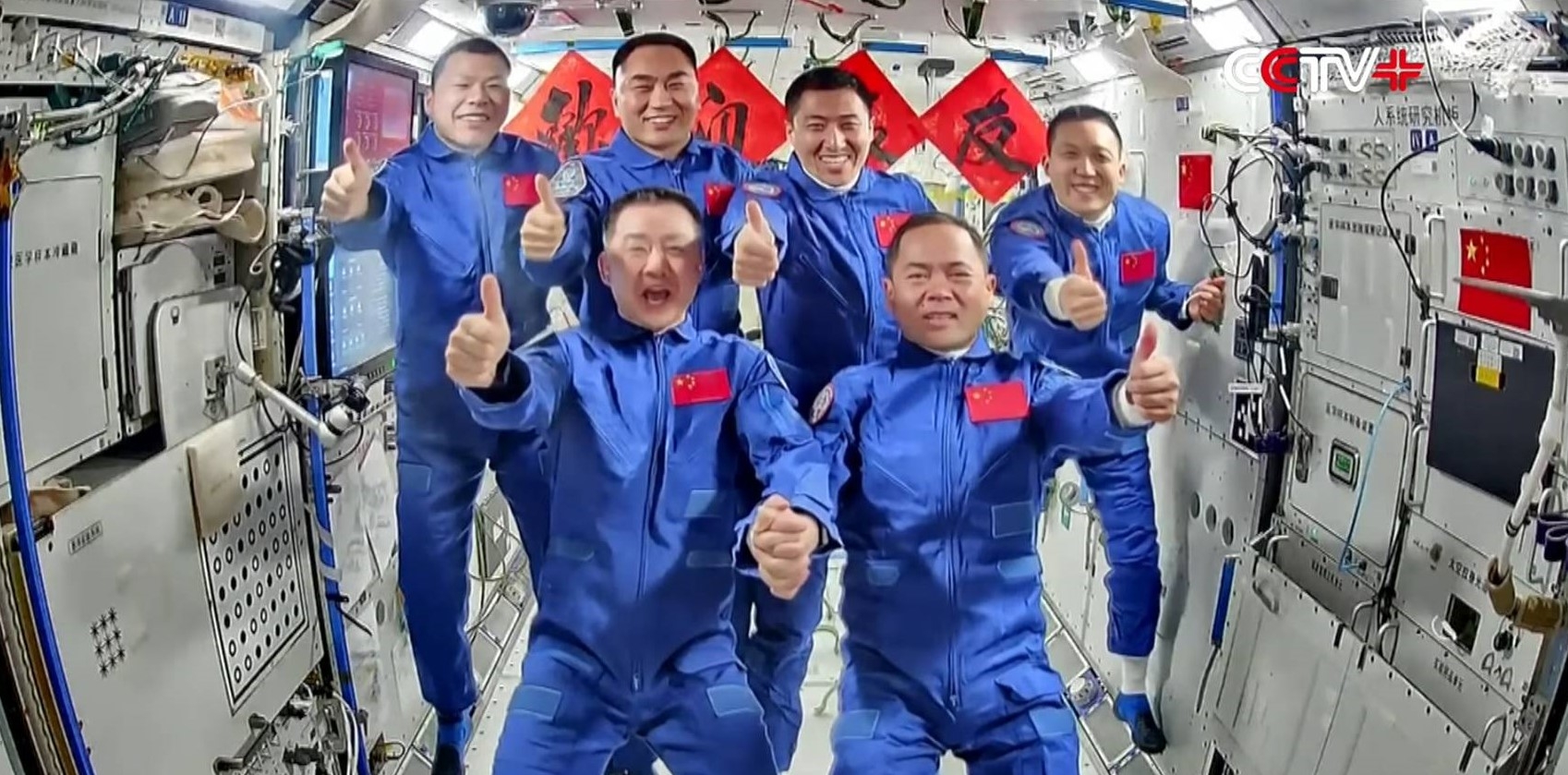
Astronauts on the Shenzhou-21 manned spaceship were greeted by the Shenzhou-20 crew, who they will be replacing, after successfully docking with China’s Tiangong space station in orbit on November 1 to begin the handover of duties.
Image credit: CMSA/CCTV/Inside Outer Space screengrab
The Shenzhou-20 crew is now onboard China’s Tiangong space station, engaged in handover procedures with the recently arrived Shenzhou-21 crew members.
Go to this CCTV video spotlighting practice sessions for recovery of the Shenzhou-20 crew at:

Image credit: CCTV/CMSA
A major element of China’s humans-to-the-Moon program is development of a new generation of crewed spaceship.
The Mengzhou-1 is to be launched in 2026, according to the China Manned Space Agency (CMSA).
A state-run Xinhua news agency story explains that “Mengzhou is developed through a comprehensive upgrade from the Shenzhou crewed spaceship. It adopts a modular design, comprising a return capsule and a service capsule, and it will provide transport between Earth and the space station.”
Maiden flight
The Mengzhou-1 crewed spaceship will make its maiden flight — (uncrewed) atop the Long March-10A carrier rocket from the Wenchang Space Launch Site in southern Hainan Province, and dock with the radial port of the space station’s core module.

New generation Mengzhou spacecraft.
Image credit: CMSA
The spaceship’s overall systems are to be evaluated while delivering to China’s orbital outpost environmental assessment instruments and supplies, technology demonstration payloads, crew necessities, and experiment devices for applied-science tests.
Future launches
CMSA also noted that China will also launch the Shenzhou-22 and Shenzhou-23 crewed spacecraft from the Jiuquan Satellite Launch Center in northwest China next year. Each mission will carry a crew of three astronauts.
The Shenzhou-22 spacecraft will dock with the radial port of the space station’s core module, while Shenzhou-23 will dock with the front port.
“One astronaut of the Shenzhou-22 crew will stay in orbit for a long-duration residency experiment lasting more than one year,” states the Xinhua report.
Astronauts on the Shenzhou-21 manned spaceship were greeted by the Shenzhou-20 crew, who they will be replacing, after successfully docking with China’s Tiangong space station in orbit on November 1 to begin the handover of duties.
Image credit: CMSA/CCTV/Inside Outer Space screengrab
China also plans to launch the uncrewed Tianzhou-10 cargo spacecraft from the Wenchang Space Launch Site in 2026. It will dock with the backward port of the space station’s core module.
Landing site drills
Meanwhile, the recently lofted Shenzhou-21 crew is involved in handover station activities with the Shenzhou-20 trio of space travelers.
Chen Dong, Chen Zhongrui and Wang Jie flew to the space station in April of this year and are preparing to return to Earth in the coming days.
China Central Television (CCTV) states that multiple comprehensive drills have been conducted at the Dongfeng landing site in north China’s Inner Mongolia Autonomous Region. This recovery crew will handle the return of the Shenzhou-20 crew.
For a new video showing the two crews aboard China’s Tiangong space station, go to:

Image credit: CMSA/CCTV/Inside Outer Space screengrab
China’s Shenzhou-21 crew is now onboard the country’s orbital outpost, the Tiangong space station.
The Shenzhou-21 spaceship successfully docked early November 1 with the front port of the Tianhe core module, a docking process that took about 3.5 hours.
That fast-paced launch-to-docking time set a new record for the most rapid rendezvous and docking between a Shenzhou spacecraft and the space station, said the China Manned Space Agency (CMSA).
An in-orbit crew handover from the Shenzhou-20 crew with the newcomers has begun.

Image credit: CMSA/CCTV/Inside Outer Space screengrab
New faces
Chen Dong, commander of the Shenzhou-20 mission, said: “Since you are the new faces here, everything is fresh and exciting, and from this moment on you are embarking on a brand new journey of space exploration.”
The Shenzhou-21 crew consists of mission commander Zhang Lu, who was previously a member of the Shenzhou-15 mission, alongside flight engineer Wu Fei and payload specialist Zhang Hongzhang, each embarking on their first spaceflight mission.

Handover work
The six space travelers will live and work together for about five days to complete planned tasks and handover work, the CMSA said.
At that point, the Shenzhou-20 crew — Chen Dong, along with Chen Zhongrui and Wang Jie — will depart the station and head back to Earth after their six-month journey.
Go to these new videos highlighting the liftoff and docking of the Shenzhou-21 at:
https://www.facebook.com/reel/4019423761689879
https://www.facebook.com/reel/1247595994052395

