Archive for November, 2025
 Author:
  November 30th, 2025
Image credit: CCTV/Inside Outer Space screengrab
A new video spotlights the Shenzhou-21 crew members — Zhang Lu, Wu Fei, and Zhang Hongzhang — on board China’s Tiangong space station.
The trio of taikonauts has been conducting multiple science experiments, including their first full-system emergency response drills in orbit over the past week.
The threesome have been in orbit for a month as of today.
Microgravity experiments
According to a China Central Television (CCTV) broadcast, the crew performed microgravity experiments on intuitive physical behavior, collecting relevant behavioral data to explore “the impact of long-term spaceflight on human’s intuitive physical representations and the mechanisms of their recovery.”
In use has been a Raman spectrometer to analyze metabolic components in urine samples. Additionally, the crew completed the installation of new software for space medical experiments.

Image credit: CCTV/Inside Outer Space screengrab
Medical exams
In addition, they underwent multiple medical examinations, including non-invasive cardiac function tests, providing data for ground teams to closely monitor their health in orbit.
The crew completed scheduled tasks including replacing the high-speed image storage unit in the two-phase system experiment cabinet and disassembling and assembling experimental modules.
They also cleaned and replaced samples within the containerless cabinet’s experimental chamber and cleaned window cover lenses, CCTV adds.

Image credit: CCTV/Inside Outer Space screengrab
Emergency drills
Also undertaken by the Shenzhou-21 crew: Conducting their first full-system emergency pressure response drills. They simulated emergency actions to be taken in the event of an internal depressurization scenario.
This crew was involved in China’s first emergency mission – the rapid launch of an operable (and uncrewed) Shenzhou-22 spacecraft to replace a purported space debris-damaged Shenzhou-20 lifeboat. It remains attached to the space facility.

Image credit: CCTV/Inside Outer Space screengrab
Lastly, the crew performed patrols of the cryogenic storage units and the minus 80-degree space refrigerator, CCTV notes, and appraising pressures in the environmental control gas cylinder, and conducted maintenance on the regenerative life support system equipment.
Go to this video showing the trio working onboard their orbital home at:
 Posted in

Up close and personal! Scene from Earth vs. the Flying Saucers circa 1956.
Image credit: Columbia Pictures
Skeptic magazine publisher and historian of science Michael Shermer has issued a $1,000 bet that discovery or disclosure of alien visitation to Earth in the form of UFOs, UAPs, or any other technological artifact or alien biological form, as confirmed by major scientific institutions and government agencies, will not happen by December 31, 2030.
And what better person to take on Shermer’s bet than Harvard astronomer and Director of the Galileo Project, Avi Loeb.

Oddsmakers: Avi Loeb (Left), Michael Shermer (right).
Image credit: Skeptics Society
Detailed terms
The detailed terms of the Shermer-Loeb wager:
By December 31, 2030, at least two of these three scientific organizations
- NASA
- the National Science Foundation
- American Astronomical Society
will affirm that discovery of extraterrestrial intelligence in the form of UAPs, UFOs, or any other interstellar objects that are determined to be ETI technological in nature, or any alien biological life form found here on Earth, has been made.

Credit: Orbitz
The wager is placed through the Long Now Foundation’s “Long Bets” program.
“Predictor” Shermer’s argument
Since the founding of the Skeptics Society and Skeptic magazine in 1992, I have been documenting predictions by UFOlogists that discovery or disclosure of alien visitation to Earth is coming any day now.
Believers appear in the media boldly predicting that by the end of the year we will have proof of alien contact—33 years later I’m still waiting for said proof. More recently, proponents of UAPs as alien spacecraft have appeared before the U.S. Congress, confidently claiming that they know people who have seen and even touched aliens and/or their spaceships, back-engineered their technologies, and even communicated with the aliens.
Yet when pushed for evidence, they always demur, saying that it’s “classified,” “top-secret,” that Men-in-Black threatened them into silence, that their careers and even their lives are at stake if they disclose said evidence, that they could only reveal the evidence in a “SCIF” (Sensitive Compartmented Information Facility) but not in Congress, and that many people in the U.S. government, CIA, FBI, NSA, etc. (never named) have this information and evidence of alien visitation.
The purpose of this bet, in keeping with the rules of Long Bets and the philosophy of the Long Now Foundation, is to reveal the actual confidence of UFO/UAP alien believers by getting them to put their money where their beliefs appear to be.
You say we will have alien disclosure by the end of the year? O-kay, let’s place a wager on that prediction. I say it won’t happen.

Credit: Piplsay
“Challenger” Avi Loeb’s argument
The search for technological artifacts has just started in earnest in 2025 with the discovery of the anomalous interstellar object 3I/ATLAS, the launch of the Rubin Observatory and the construction of three Galileo Project Observatories.
Given that there are billions of Earth-Sun analogs in the Milky-Way galaxy—most of which are billions of years older than the solar system, and that it will take less than a billion years for our Voyager spacecraft to cross the Milky-Way disk, we must engage in the scientific search for extraterrestrial technological artifacts.
It is better to be an optimist because life is sometimes a self-fulfilling prophecy. This is why I am engaged in the search with the hope that we will find a partner on our blind date with interstellar objects.
The $1,000 stakes will go to Galileo Project Foundation if Shermer wins, or if Loeb wins, the money goes to the Galileo Project Foundation.
The bet stretches over 5 years in duration.
For more details, go to:

Image credit: Roscosmos/Inside Outer Space screengrab
That recent Russian Soyuz liftoff on November 27 in Kazakhstan heading for the International Space Station (ISS) left in its wake launch pad damage.
The Soyuz MS-28 spaceship carried Roscosmos cosmonauts Sergei Kud-Sverchkov and Sergei Mikayev, along with NASA astronaut Chris Williams. They successfully docked with the ISS later in the day.
“Damage to several elements of the launch pad was detected,” according to Roscosmos. “An assessment of the condition of the launch complex is currently underway.”
Service cabin
The space agency said it has “all necessary spare parts” and vowed to repair the cosmodrome “in the near future.”

Image credit: Roscosmos/Inside Outer Space screengrab
The launch pad’s condition is currently being assessed, Roscosmos added. “All necessary spare components are available for repair, and the damage will be repaired shortly.”
According to the science news outlet N+1, the service cabin beneath the launch pad, which is used to access the rocket’s lower stages, was likely destroyed during the launch, observed Moscow News.
Efforts to modernize the cosmodrome, Moscow News added, “have faced delays due to chronic underfunding and geopolitical uncertainty following Russia’s 2014 annexation of Crimea and its 2022 invasion of Ukraine.
Go to video of Soyuz launch that shows debris in the air at:
https://vkvideo.ru/video-27532693_456356543
Also, go to this video via Moscow News at:
Russia’s Baikonur cosmodrome in Kazakhstan was damaged on Thursday following the launch of a manned Soyuz rocket to the International Space Station, the Roscosmos space agency said.
— The Moscow Times (@MoscowTimes) November 28, 2025
Read more: https://t.co/KxtBqiRaSa pic.twitter.com/P6E05SMoNF

Image credit: CCTV/Inside Outer Space screengrab
China has unveiled a program for a new-generation space situational awareness constellation. That gaggle of 156 satellites is named EYESAT, with deployment to start early next year.
EYESAT is aimed at creating a globally covered and rapidly responsive monitoring network in near-Earth orbit to enhance space environment safety, according to China Central Television (CCTV).
Collision prevention
“The primary function of the space awareness constellation is to collect data from both space debris and operating satellites,” said Hu Yu, head of the EYESAT initiative.

Hu Yu, head of the EYESAT space situational awareness constellation program.
Image credit: CCTV/Inside Outer Space screengrab
“The data will be analyzed and offered to active satellites in orbit to prevent them from colliding with one another, or with debris,” Hu told CCTV.
Once fully operational, EYESAT is to detect, track, identify and catalog on-orbit satellites, while also monitoring space debris.
Space traffic management
“By analyzing satellite orbital data and predicting collision risks,” CCTV adds, “it will provide precise and efficient data services for space traffic management.”
On one hand EYESAT is welcomed news.
On the other, this is an Interesting development, suggests a space debris analyst to Inside Outer Space. “Glad they are building a capability to keep an eye on all of the rocket bodies they are abandoning at record pace.”

Julie Payette is the first Canadian astronaut to visit the International Space Station.
Payette completed two spaceflights, STS-96 and STS-127.
A veteran Canadian astronaut has called for international joint efforts to handle emergency events in space, underscoring the rapid launch of the Shenzhou-22 for an emergency mission.
Former astronaut Julie Payette was the first Canadian to reside on the International Space Station in 1999 and also lived onboard the ISS in 2009.
Payette is currently the President of the international executive committee of the Association of Space Explorers. She is also chairwoman of the Astronauts Administrative Committee of the International Astronautical Federation (IAF).
Mitigate safety issue
“We’d like to congratulate the Chinese space program for sending Shenzhou-22 so quickly into space,” Payette told the China Global Television Network (CGTN).

“This was by far the best way to mitigate the safety issue. So we’re very pleased, especially the astronaut community, to see that our colleagues now have a perfectly operating lifeboat attached to the station,” Payette said.
The Chinese program had done many mitigating aspects to alleviate risks by having safety drills and by having new protocols, Payette added. “But still it is better to have just a life boat if something goes on,” she said.
Emergency mission
China launched a crewless emergency Shenzhou-22 spaceship on November 25, transporting food, medicine, spare parts and other essential supplies to the Shenzhou-21 taikonauts now living on China’s Tiangong space station.

Image credit: CCTV/Inside Outer Space screengrab
The emergency mission was needed due to damage caused to the Shenzhou-20 spacecraft by a suspected debris impact. That in-space incident forced the return of the three Shenzhou-20 astronauts to be delayed in their return to Earth. They later used the newly-arrived Shenzhou-21 spacecraft for their landing on Earth on November 14.
Sharing data
Payette emphasized that improving joint monitoring and sharing data through collaboration among global stakeholders is the solution to reducing risks for all future long-duration missions, according to a China Central Television (CCTV) posting.
The International Astronautical Federation has partners and people working together, Payette said, and “this is perhaps one of the most important topics right now.”
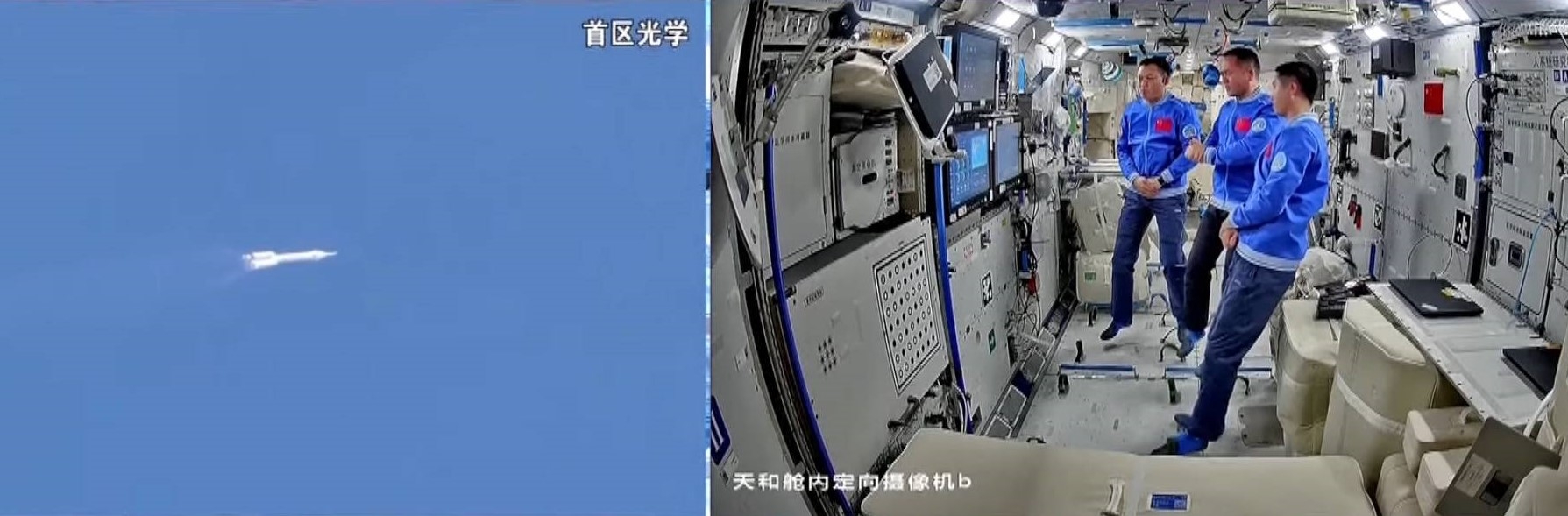
Shenzhou-21 on-orbit crew monitors emergency Shenzhou-22 launch.
Image credit: CCTV/Inside Outer Space screengrab
Help orbit to orbit
There’s a lot of impetus to bring people together, all the players, whether governmental or commercial, Payette added, to collaborate in standardizing procedures.
“And we need also to define some emergency response, help orbit to orbit, depending [on] safety boards and people that can certify spacecraft on the ground to carry humans. And with that, we’ll have a safer and more resilient industry,” Payette concluded.

Image credit: AstroAccess
The message from AstroAccess: “If we can make space accessible, we can make any space accessible.”
AstroAccess Ambassador Michaela “Michi” Benthaus is on a trajectory to become the first wheelchair user in space. Her space journey will take place aboard Blue Origin’s New Shepard suborbital rocket, according to a posting.
AstroAccess, a project of SciAccess, Inc., is dedicated “to promoting disability inclusion in human space exploration by paving the way for disabled astronauts.”
First step
Founded in 2021, AstroAccess has conducted five microgravity missions in which disabled scientists, veterans, students, athletes, and artists perform demonstrations onboard parabolic flights with the Zero Gravity Corporation, as the first step in a progression toward flying a diverse range of people to space.
Benthaus is at the TUM School of Engineering and Design in Munich, Germany and as a space engineer is currently a Young Graduate Trainee at the European Space Agency.

Image credit: AstroAccess
Spinal cord injury
In 2018, Benthaus became a wheelchair user after a mountain biking accident resulted in a spinal cord injury.
In 2022, Benthaus was selected to fly with AstroAccess on a parabolic flight, becoming one of the first wheelchair users to test accessibility experiments in weightlessness.
Since then, the journey by Benthaus has included 18 parabolas and first-of-its-kind accessibility experiments, with a focus on demonstrating innovative methods for anchoring, maneuvering, and securing in microgravity.
For more details, go to:
Image credit: CCTV/Inside Outer Space screengrab
More details are available regarding the saga of engineers and ground staff in China’s first-ever emergency launch – the plight and flight of the uncrewed Shenzhou-22 spacecraft.
The crewless spaceship – including an escape tower — sat atop a Long March-2F Y22 carrier rocket, lifting off shortly after noon local time on November 25 from the Jiuquan Satellite Launch Center in northwest China.
That launch demonstrated the carrier rocket’s rapid-response capability for any space station emergency, space officials explained.
Image credit: CCTV/Inside Outer Space screengrab
Onboard the spaceship were caches of food, medicine, spare parts and other essential supplies – reportedly including devices for treating the cracked spaceship window – quickly prepared for the Shenzhou-21 astronauts that are now living on China’s Tiangong space station.
First-ever emergency
The emergency mission was necessitated by suspected space debris damage to the Shenzhou-20 spacecraft, rendering it not qualified for a safe re-entry to Earth. That delayed the scheduled departure on November 5 of the three Shenzhou-20 astronauts. They used the newly-arrived Shenzhou-21 to return to Earth on November 14.
Shenzhou-21 on-orbit crew monitors emergency Shenzhou-22 launch.
Image credit: CCTV/Inside Outer Space screengrab
As the first-ever emergency operation to be launched at short notice in the history of China’s human spaceflight program, there was limited time for preparation, with engineers working around the clock to prepare the Shenzhou-22 and its booster.
Test-to-launch cycle
According to Zeng Yaoxiang, an engineer for CASC, the team reduced a normal test-to-launch cycle of more than 30 days to just 16.

Image credit: CCTV/Inside Outer Space screengrab
That whole period from tests to launch was considered a very short launch window, Zeng told China Central Television (CCTV).
Zeng said that the next rocket in the series, the Long March-2F Y23, is undergoing assembly and test in Beijing. It will be transferred to the launch site upon completion of related work and will be on standby status for emergency response for the Shenzhou-22 mission now underway.
Clearing and sealing process
Yan Wei, an engineer with CASC, told CCTV that at three hours prior to the launch, a “clearing and sealing” process was in action.

Image credit: CCTV/CMSA/Inside Outer Space screengrab
This process is considered the most critical safety inspection immediately before launch.
Unlike the standard mission preparation cycle, which typically lasts over 30 days, this emergency operation took place under a heavily condensed timeline, with the team having only around half of the normal time to get everything ready for the urgent spaceflight, adds CCTV.
Double-checking
“It was 16 straight days. Work that usually takes five days was compressed into two,” said Wang Peng, another CASC engineer. To ensure the Shenzhou-22 mission would be successful, the team also turned to several veteran engineers that were recalled to provide technical support.
“We needed to come and help reinforce the frontline [of the mission]. As an old team member, I’ve come here to work with everyone, double-checking everything and filling in wherever I’m needed,” said Meng Qingfeng, one of the engineers drafted in by the CASC.
One hour before launch, the last group of on-site engineers started to withdraw from the launch tower.
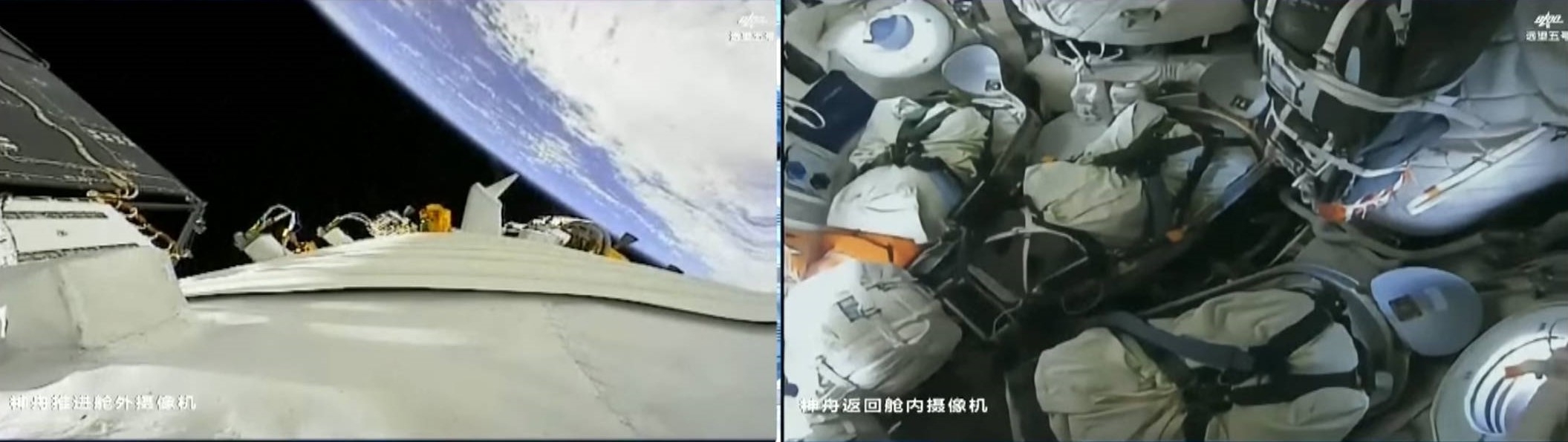
Uncrewed Shenzhou-22 loaded with supplies.
Image credit: CCTV/Inside Outer Space screengrab
Critical situation
“The spacecraft performed very well, and my team performed very well. We withstood the test of this mission,” said He Yu, commander in chief of the Shenzhou spacecraft at the CASC. He said the emergency flight placed a spotlight on the capabilities of China’s space industry.
“We have come through a real critical situation this time. We must be extremely responsible for the lives of the astronauts, and this mission was the best practice of that commitment,” said Jing Muchun, commander in chief of the Long March-2F carrier rocket project at the CASC.
Alternative return procedure
Given the damaged Shenzhou-20 spacecraft, emergency protocols were activated, and a comprehensive simulation analysis, testing and safety assessment of the vessel was conducted to determine the safest course for the astronauts’ return.

As the first-ever emergency operation to be launched at short notice in the history of China’s human spaceflight program, there was limited time for preparation, with engineers working around the clock to prepare the Shenzhou-22 and its booster.
Image credit: CCTV/Inside Outer Space screengrab
Following that review, the CMSA announced that the Shenzhou-20 spacecraft “no longer meets the stringent safety standards required for re-entry,” reported CCTV.
This emergency event, said the CMSA marked the first successful implementation of an alternative return procedure in the country’s space station program history.
Tasks ahead
The trio of on-orbit space crew members are in good condition and are carrying out their tasks as planned, the China Manned Space Agency (CMSA) said, adding that the damaged Shenzhou-20 spaceship will remain in orbit to continue its assigned experiments.
During their projected six-month stay in orbit, the Shenzhou-21 crew members are slated to carry out a total of 27 new in-orbit experiments, including in space life sciences and biotechnology, space medicine, space material science, microgravity fluid physics and combustion, and new space technologies.
Image credit: CCTV/Inside Outer Space screengrab
Billed as the first emergency launch mission in China’s human spaceflight program, an uncrewed, cargo-loaded Shenzhou-22 spaceship was launched on November 25.
Shenzhou-22 later docked with the front port of China’s Tiangong space station’s Tianhe core module.
Flying without a three-person crew aboard, the vessel carried a cargo of space food, medical supplies, fresh fruit and vegetables, as well as devices for treating the cracked window on the Shenzhou-20 spaceship.
Shenzhou-21 on-orbit crew monitors emergency Shenzhou-22 launch.
Image credit: CCTV/Inside Outer Space screengrab
Life and safety
“The success of this mission fully demonstrated the strengths of China’s new system for mobilizing resources nationwide, comprehensively interpreted the principle of ‘prioritizing life and safety above anything else’ in China’s manned space program, said Zhou Jianping, chief designer, China’s manned space program.

Credit: CCTV/Inside Outer Space screengrab
Zhou said the emergency launch “verified the scientific, reliable and safe nature of the ‘one launch, one standby, rolling backup’ strategy for China’s space station missions.”
In addition, Zhou added that it “rigorously tested all personnel’s rapid response and emergency handling capabilities in real-world scenarios,” overcoming hardships, working with a fighting morale, solving technical bottlenecks, and remaining dedicated.
Debris hit
The Shenzhou-22 launch followed the postponed return of the Shenzhou-20 crew aboard the Shenzhou-21 spacecraft on Nov. 14. The Shenzhou-20 spacecraft was struck by space debris, delaying its return originally scheduled to take place on November 5.
Image credit: CCTV/Inside Outer Space screengrab
The spaceship performed a fast, automated rendezvous and docked with the front port of Tiangong’s core module Tianhe in about 3.5 hours after entering orbit, the CMSA said.
The Shenzhou-22 will later serve as the return vessel for the three Shenzhou-21 astronauts currently in orbit.
The damaged Shenzhou-20 spaceship “will remain in orbit to continue relevant experiments,” stated the China Manned Space Agency (CMSA).

Diao Weihe, an engineer for the China Aerospace Science and Technology Corporation.
Image credit: CCTV/CGTN/Inside Outer Space screengrab
Shenzhou-22 upgrades
According to Diao Weihe, an engineer for the China Aerospace Science and Technology Corporation, the Shenzhou-22 launch marks the first emergency launch in the history of the Shenzhou spacecraft program.
“Its preparation-to-launch cycle has been compressed to 16 days, significantly shorter than a standard mission timeline, Diao told China Central Television (CCTV).
Shenzhou-22 is the first spacecraft of a new production batch, and has undergone comprehensive upgrades aimed at enhancing capability, reliability, and crew comfort,” said Diao.
Uncrewed Shenzhou-22 loaded with supplies.
Image credit: CCTV/Inside Outer Space screengrab
“These include upgraded and redesigned instruments for improved operability and accessibility. Additionally, the spacecraft’s downward payload capacity has been significantly increased through optimized cabin layout and miniaturized instrument panels,” Diao noted. “Furthermore, some components have been upgraded to further enhance the spacecraft’s autonomous and control capabilities.”
Go to these CCTV launch videos at:
https://www.facebook.com/reel/1611092220061856
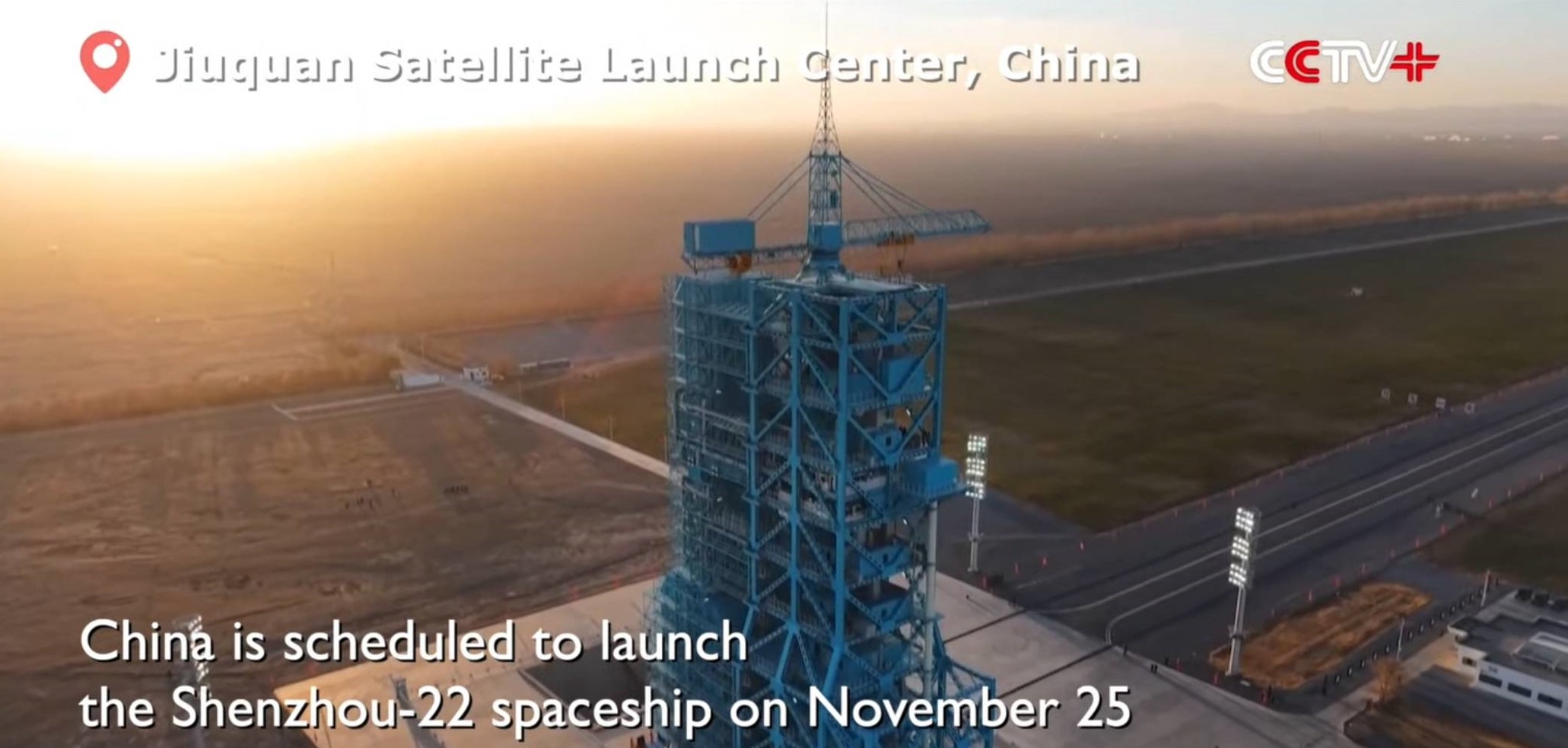
Image credit: CCTV/Inside Outer Space screengrab
Word today from the China Manned Space Agency (CMSA): The launch of the Shenzhou-22 spaceship is set for November 25 Beijing time from the Jiuquan Satellite Launch Center in the northwest.
Currently, the Long March 2F Y22 carrier rocket has completed propellant loading.
The now in orbit Shenzhou-21 astronaut crew is working normally and in good condition in orbit, adds the China Manned Space Engineering (CMSE) office.

Image credit: CCTV/Inside Outer Space screengrab
Space debris hit
China purposely delayed the return of its Shenzhou–20 crew for roughly a week due to a suspected impact of space debris that compromised the crew’s return vessel’s window.
The trio of taikonauts did return to Earth in a fresh but “borrowed” Shenzhou-21 spacecraft on November 14. But doing so left the current on-orbit, three-person space station crew with a damaged and docked vehicle that has been deemed unsafe for re-entry.

Image credit: CCTV/Inside Outer Space screengrab
Space officials in that country labeled the November 5 wave-off of the crew’s return to Earth as the first successful implementation of an “alternative return procedure” in China’s space station program history.
Cargo supplies
The use of the Shenzhou-22 spacecraft and launcher were in standby mode, originally manifested for launch in 2026.
In an earlier statement, Zhou Yaqiang, an official with the China CMSA, told China Central Television (CCTV) that the mission for launching the Shenzhou-22 spacecraft “has been initiated, with preparations for all systems in full swing, including testing the spacecraft and rocket components and preparing the cargo.

Image credit: CCTV/Inside Outer Space screengrab
“The Shenzhou-22 spacecraft is sure to carry supplies. The spacecraft’s cargo-carrying capacity is a highly valuable resource for the manned space program,” Zhou said, “so we will make full use of every opportunity. The Shenzhou-22 spacecraft will mainly deliver food supplies for the astronauts and some equipment for the space station.”
Logo embodies safety of astronauts
With the launch of Shenzhou-22 imminent, CMSE also released the mission logo.
“The Shenzhou-22 mission logo blends Chinese aerospace elements with traditional cultural symbols. Based on the Great Wall, it embodies the solemn commitment to the safety of astronauts,” the CMSE reports.

Image credit: CMSE office
The bow and arrow shape, along with the Long March 2F carrier rocket and the Shenzhou spacecraft, forms the visual core, showcasing a sense of “ready to launch” and a steadfast belief in “mission accomplished.”
Twenty-two arrows surround the logo, precisely corresponding to the mission number.
Swiftness of emergency rescue
In the color scheme, blue represents the foundation of aerospace technology, red represents mission responsibility, and orange “highlights the swiftness of emergency rescue,” notes the CMSE.
The overall design not only continues the aesthetic heritage of Chinese aerospace logos but also innovatively incorporates “emergency rescue elements,” perfectly interpreting the core value of “protecting life with aerospace power” and demonstrating China’s technological strength and humanistic care in the aerospace field, explains the CMSE.
For a short video, go to:
https://www.facebook.com/share/v/17nxoKJ9FT/
Additionally, go to my recent Space.com story – “Space junk strike on China’s astronaut capsule highlights need for a space rescue service, experts say” – at:
Image credit: CCTV/Inside Outer Space screengrab
China purposely delayed the return of its Shenzhou–20 crew from the country’s space station. The reason: a suspected impact of space debris that compromised the crew’s return vessel’s window.
Space officials in that country labeled the November 5 wave-off of the crew’s return to Earth as the first successful implementation of an “alternative return procedure” in China’s space station program history.
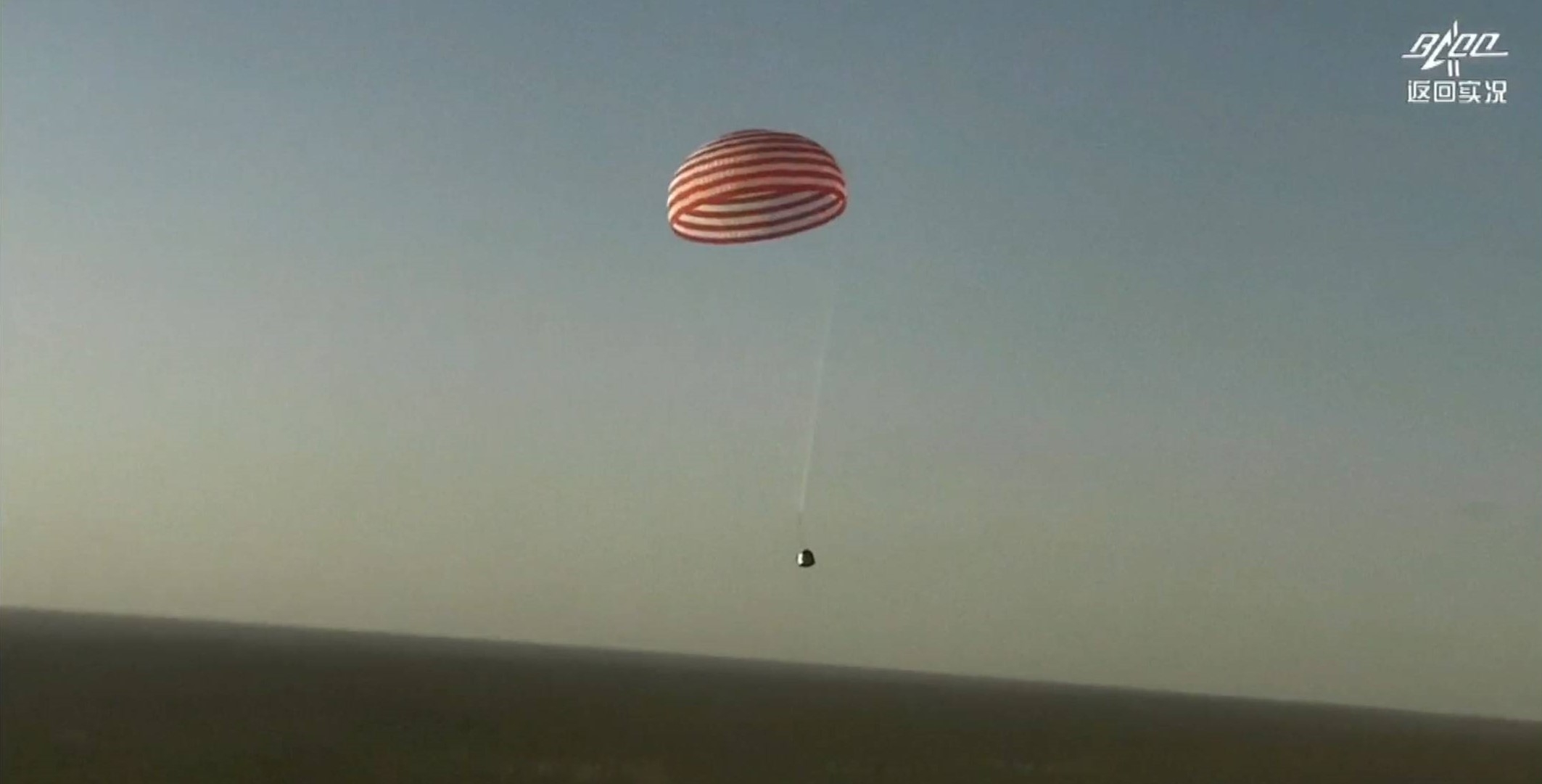
Shenzhou-20 crew back on Earth on November 14. Image credit: CCTV/Inside Outer Space screengrab
The trio of taikonauts did return to Earth in a fresh but “borrowed” Shenzhou-21 spacecraft on November 14. But doing so left the current on-orbit, three-person space station crew with a damaged and docked vehicle that has been deemed unsafe for re-entry.
This incident is a wake-up call by advocates of a space rescue capability, and also a call for an organization to shape that capacity.
Go to my new Space.com story – “Space junk strike on China’s astronaut capsule highlights need for a space rescue service, experts say” – at:

