Archive for October, 2025
 Author:
  October 16th, 2025
Clutter in the cosmos.
Credit: Used with permission: Melrae Pictures/Space Junk 3D
A new and novel protection product has been created, ideal for fending off space junk. And what better name for that creation than “Space Armor (TM),” a multi-functional composite for spacecraft and astronauts.
Space Armor (TM) is fabricated with a proprietary fiber-to-resin manufacturing method courtesy of Atomic-6 of Marietta, Georgia.
“Satellites and astronauts are constantly threatened by millions of untrackable, hypervelocity particles in orbit,” states Atomic-6. “Like a loose pebble hitting your windshield on the highway, orbital debris can strike at any time to do significant damage to spacecraft.”
“We took the shot at making a tile and were blown away by the test results.”
For more details on this novel anti-debris technology, go to my new Space.com story at – “New space debris shield? Satellites and astronauts could suit up in novel ‘Space Armor’ – at:

Photo illustration by Thomas Gaulkin for the Bulletin of the Atomic Scientists’ January 2022 issue (used with permission)
 Posted in

Vanguard I satellite, a component of the Vanguard Project, is a small aluminum sphere designed to partake in the International Geophysical Year (IGY) — a series of coordinated observations of various geophysical phenomena during solar maximum, spanning July 1957 through December 1958.
Image credit: NASA
Back in 2022, it turns out that the longest-lived object in Earth orbit and a Russian rocket body passed within roughly 0.8 miles (1.3 kilometers) from each other.
That U.S. non-operational payload was Vanguard 1, according to Darren McKnight, a senior technical fellow of LeoLabs, a group dedicated to space domain awareness.
In a conjunction review of the situation, McKnight notes that on August 29, 2022, an SL-14 Russian rocket body launched in 1986 and Vanguard 1 found themselves in close collision at an altitude of approximately 590 miles (950 kilometers) altitude above Earth.
Close-call events
“This conjunction was discovered when searching for events with the oldest object in Earth orbit: Vanguard 1,” McKnight reports.
Built by the Naval Research Laboratory (NRL), Vanguard 1 was launched in March 1958 into a highly elliptical orbit (currently at roughly 3,800 kilometers by roughly 650 kilometers).
“As such, it spends most of its time outside of low Earth orbit (LEO). However, despite this non-treacherous orbit relative to most of the LEO population,” McKnight adds that the old Vanguard 1 has had a trio of close-call events since January of 2022.

Instrumentation onboard Vanguard 1 included a set of mercury batteries, a transmitter, two temperature sensors, and a beacon powered by six square solar cells — the first satellite on-orbit to be powered by photovoltaic cells. It remains the oldest artificial object orbiting Earth to this day.
Image credit: Naval Research Laboratory
Transiting space
“While the satellite has been orbiting the Earth for more than 67 years, the battery-powered transmitter onboard the spacecraft only lasted three months and its solar-powered transmitter remained functional for six years,” McKnight explains.
Transiting the space environment all these decades, Vanguard 1 has chalked up a distance equal to two roundtrips from the Earth to Pluto, McKnight notes.
Save Vanguard 1?
Recently, there was a new push to save Vanguard 1, snagging the tiny satellite and safely returning it to Earth.
A team that includes aerospace engineers, historians and writers recently proposed “how-to” options for an up-close look and possible retrieval of Vanguard 1.
Go to my Space.com story earlier this year – “Vanguard 1 is the oldest satellite orbiting Earth. Scientists want to bring it home after 67 years” – at:

Vanguard 1 launches in March 1958 from the Atlantic Missile Range in Cape Canaveral Florida.
Image credit: Naval Research Laboratory
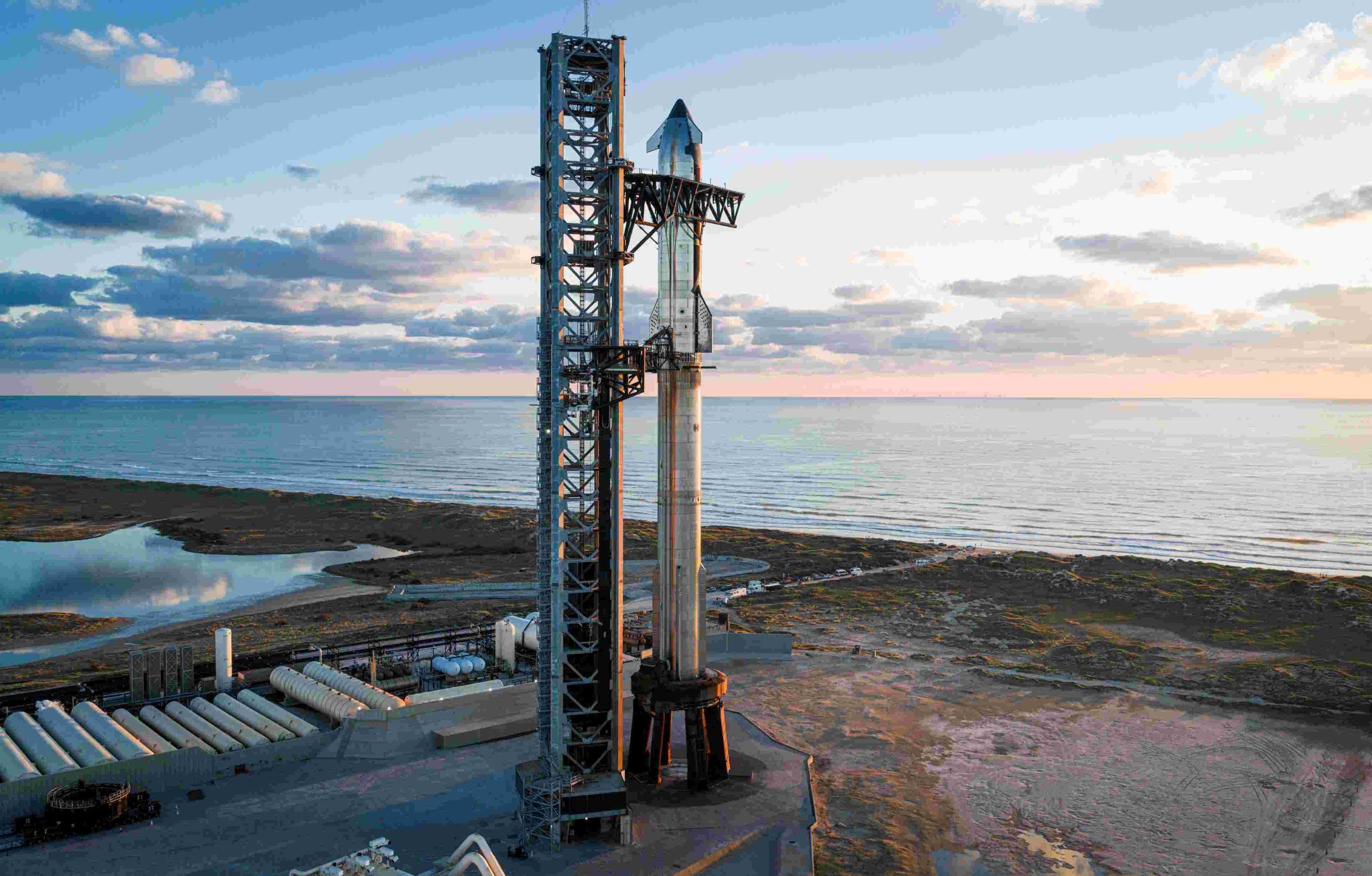
Image credit: SpaceX
On Monday, October 13, 2025, at 6:23 p.m. Central “Texas” Time, the SpaceX Starship lifted off from Starbase, Texas on its eleventh flight test.
Go to this replay at:
https://www.spacex.com/launches/starship-flight-11

Image credit: SpaceX/Inside Outer Space screengrab
Following the flight, SpaceX posted this mission success update:
This was the final flight of the second-generation Starship and first generation Super Heavy booster, as well as the final launch from the current configuration of Pad 1. Every major objective of the flight test was achieved, providing valuable data as we prepare the next generation of Starship and Super Heavy.
The flight test began with Super Heavy igniting all 33 Raptor engines and ascending over the Gulf. The successful first-stage ascent was followed by a hot-staging maneuver, with Starship’s upper stage igniting its six Raptor engines to continue its flight to space.
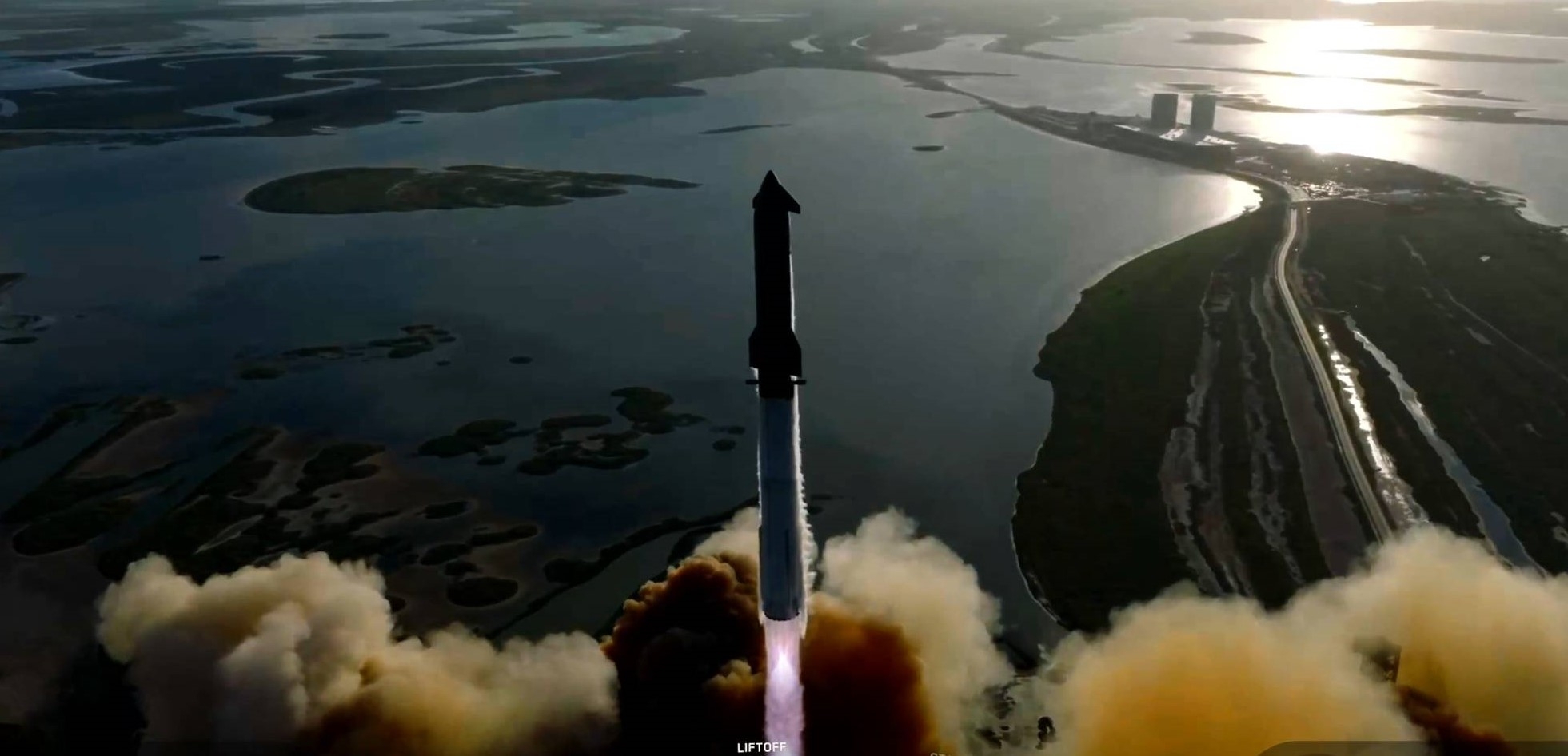
Image credit: SpaceX/Inside Outer Space screengrab
Boostback burn
Following stage separation, the Super Heavy booster completed its boostback burn to put it on a course to a pre-planned splashdown zone off the coast of Texas using 12 of the 13 planned engines.
Under the same angle of attack tested on the previous flight, the booster descended until successfully igniting all 13 planned engines (including one that did not relight during the boostback burn) for the high-thrust portion of the landing burn.
The booster successfully executed a unique landing burn planned for use on the next generation booster. Super Heavy hovered above the water before shutting down its engines and splashing down.
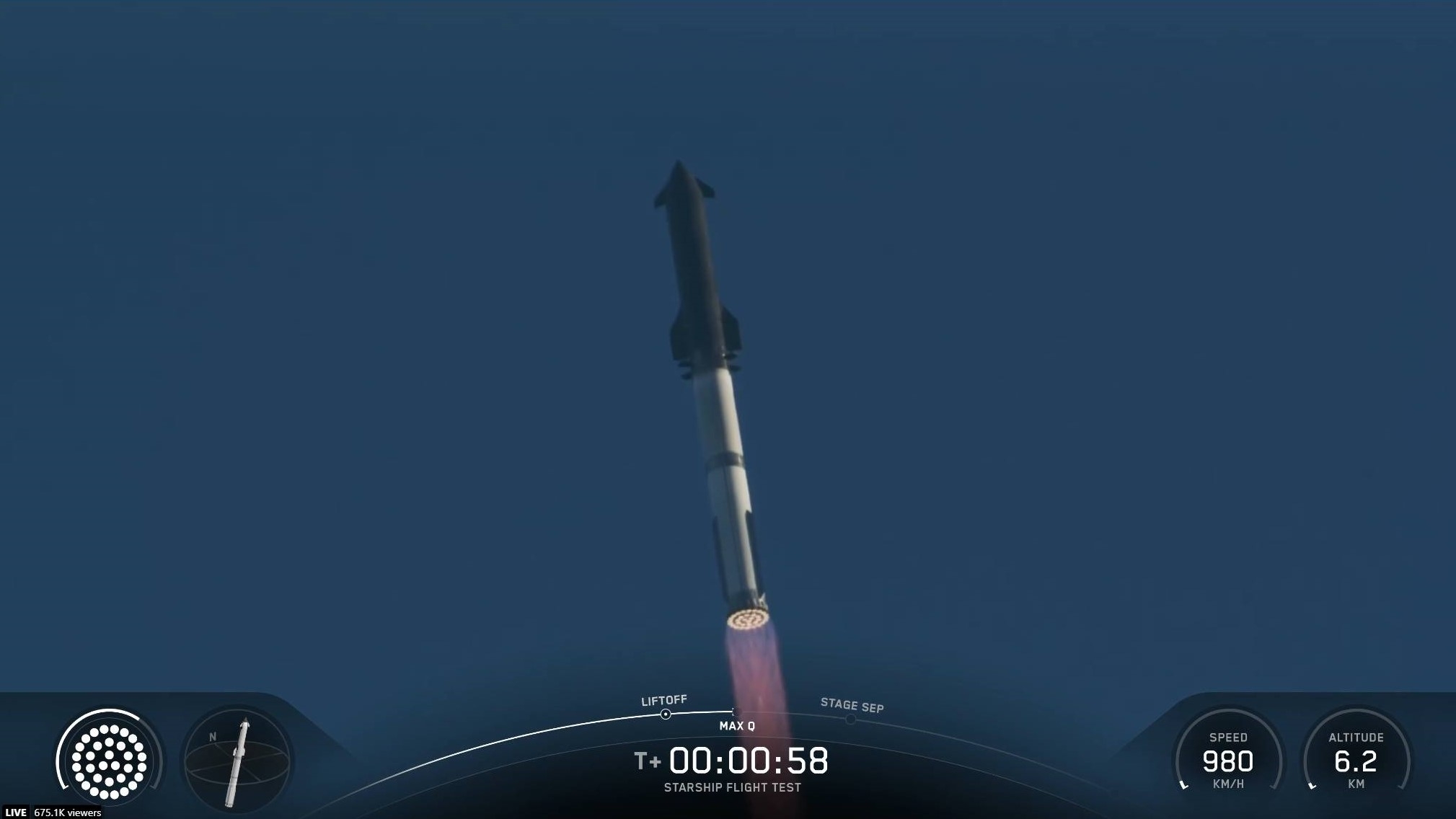
Image credit: SpaceX/Inside Outer Space screengrab
Starlink simulators
After completing a full-duration ascent burn, Starship achieved its planned velocity and trajectory.
During flight, Starship successfully deployed eight Starlink simulators and executed the third in-space relight of a Raptor engine, demonstrating a critical capability for future deorbit burns.
Starship re-entered the Earth’s atmosphere and was able to gather extensive data on the performance of its heatshield as it was intentionally stressed to test the limits of the vehicle’s capabilities.
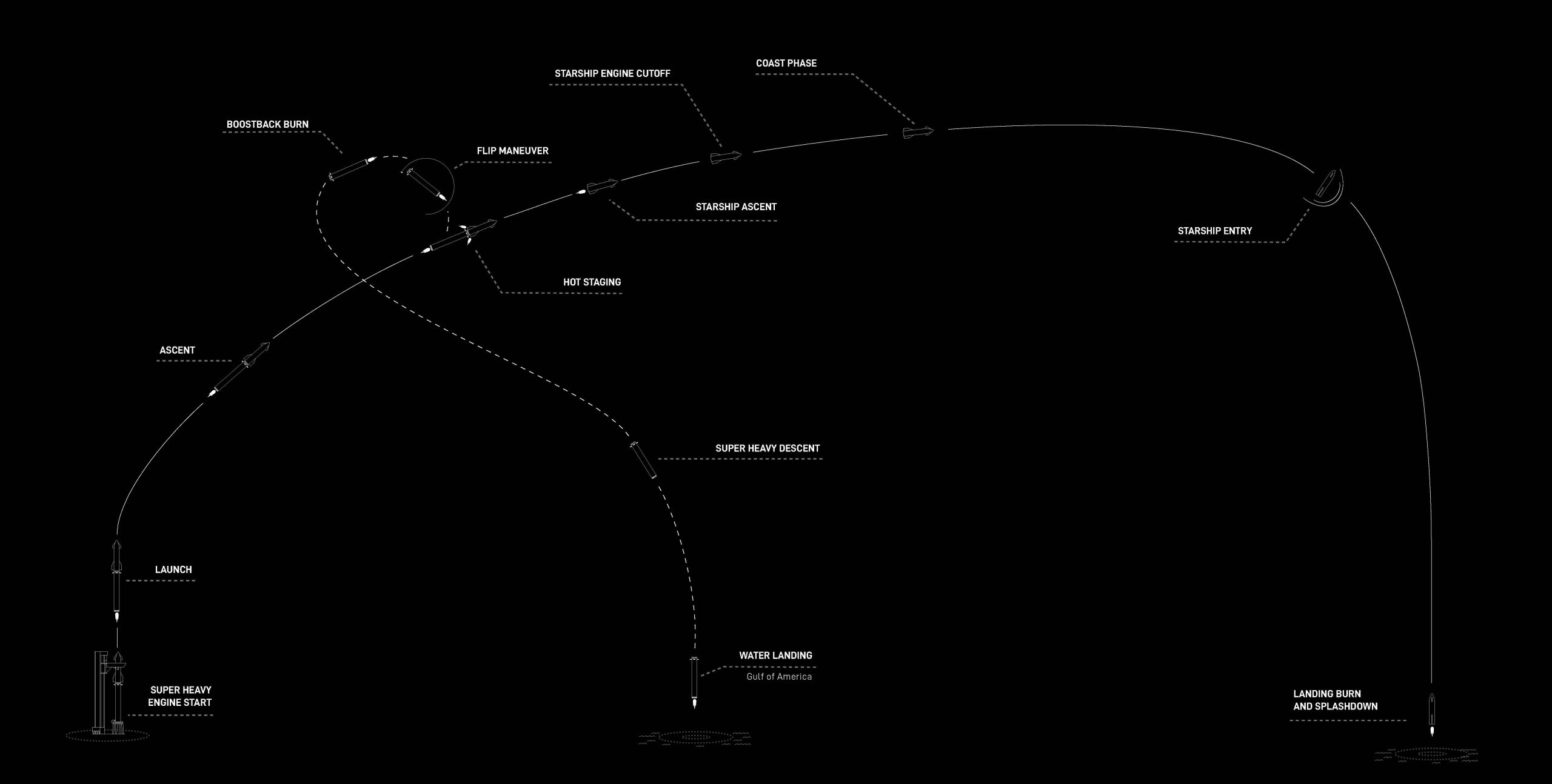
Image credit: SpaceX
Banking maneuver
In the final minutes of flight, Starship performed a dynamic banking maneuver to mimic the trajectory that future missions returning to Starbase will fly. Starship then guided itself using its four flaps to the pre-planned splashdown zone in the Indian Ocean, successfully executing a landing flip, landing burn, and soft splashdown.
Focus now turns to the next generation of Starship and Super Heavy, with multiple vehicles currently in active build and preparing for tests.

Image credit: SpaceX
This next iteration will be used for the first Starship orbital flights, operational payload missions, propellant transfer, and more as we iterate to a fully and rapidly reusable vehicle with service to Earth orbit, the Moon, Mars, and beyond.
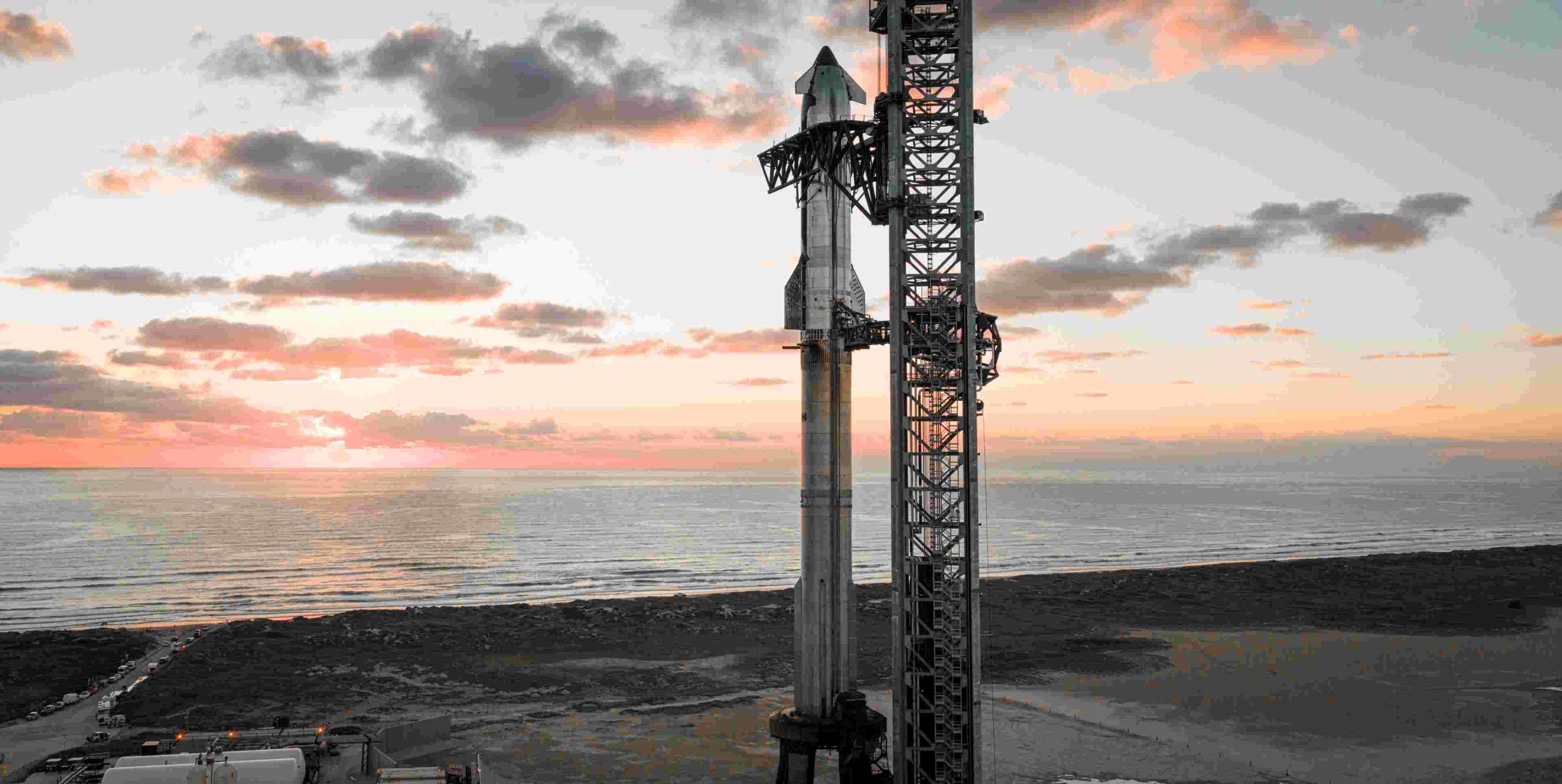
Image credit: SpaceX
SpaceX Starship’s eleventh flight test is ready to launch as soon as today, Monday, October 13. The launch window will open at 6:15 p.m. Central “Texas” Time (CT). For live coverage of the launch starting about one-half hour before liftoff, go to:
https://www.spacex.com/launches/starship-flight-11
Go to video clip at:
https://x.com/i/status/1977733468663562742
For launch details, go to:
SpaceX Starship: Flight Test Eleven Details
https://www.leonarddavid.com/spacex-starship-flight-test-eleven-details/
Image credit: SpaceX
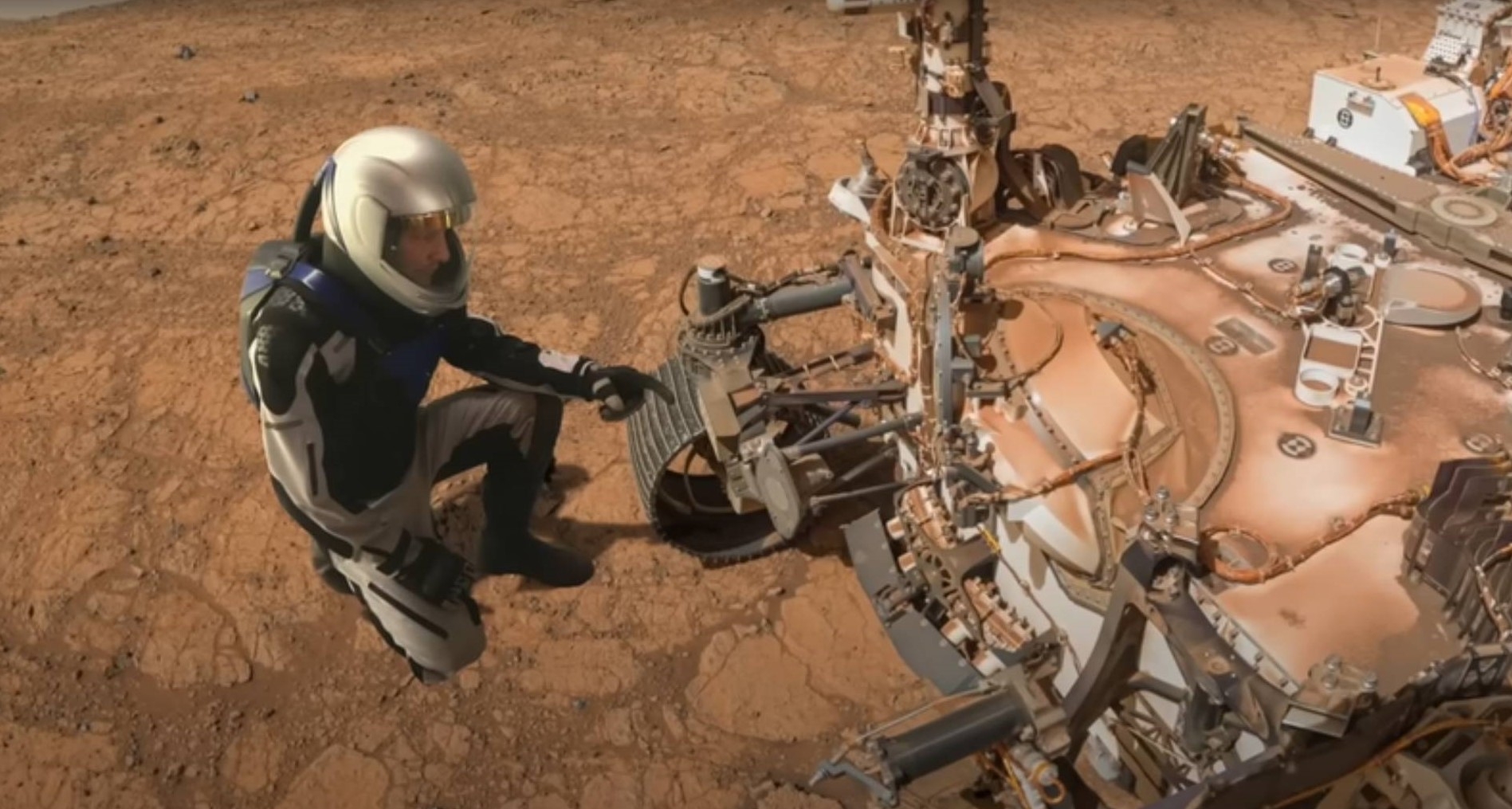
Image credit: Mars Guy/NASA/JPL-Caltech
Mars Guy looks at the surprising condition of spacesuit materials after 4+ years on Mars, outfitted to NASA’s Perseverance rover now exploring Jezero Crater.
“Every mission to the surface of Mars has in some way helped prepare for the eventual arrival of humans,” explains Mars Guy. “But no mission has gone as far as Perseverance with its effort to test the materials that will keep astronauts alive on the surface.”
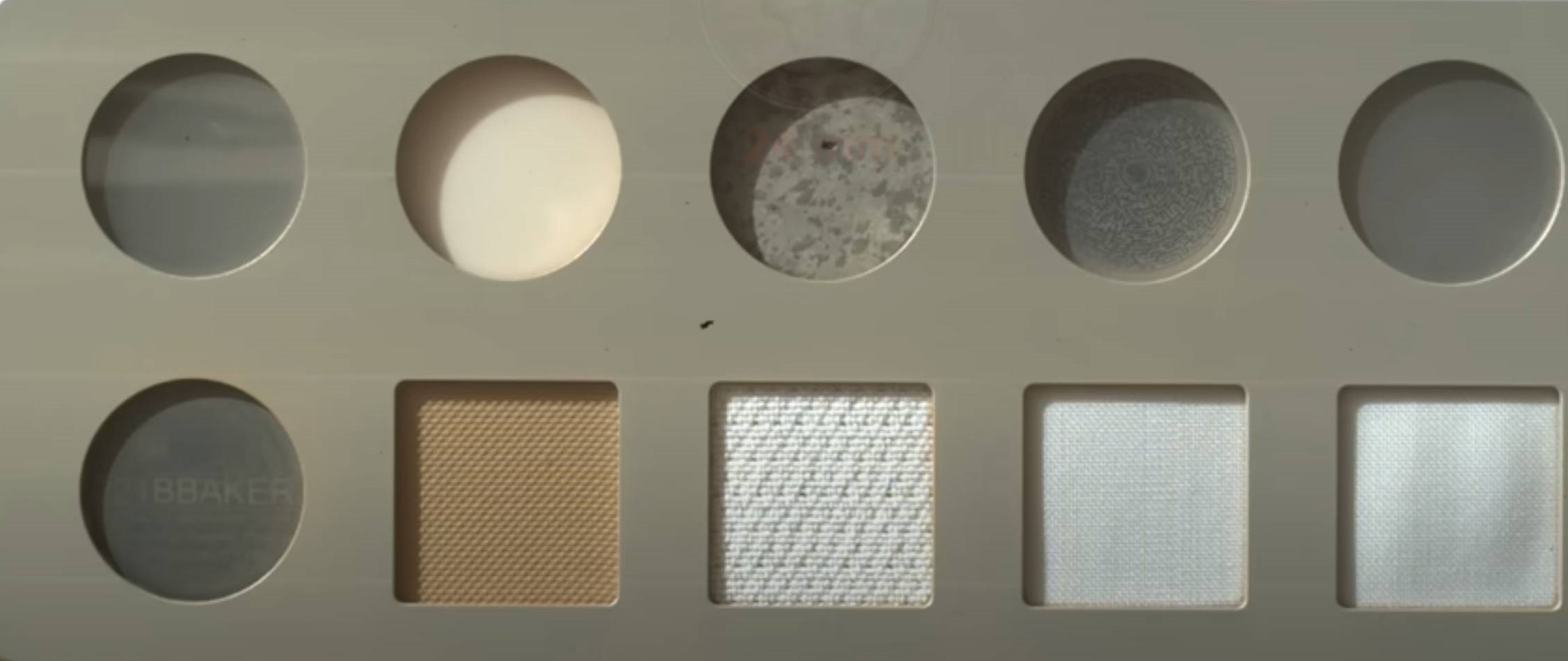
Image credit: Mars Guy/NASA/JPL-Caltech
Go to the video at:
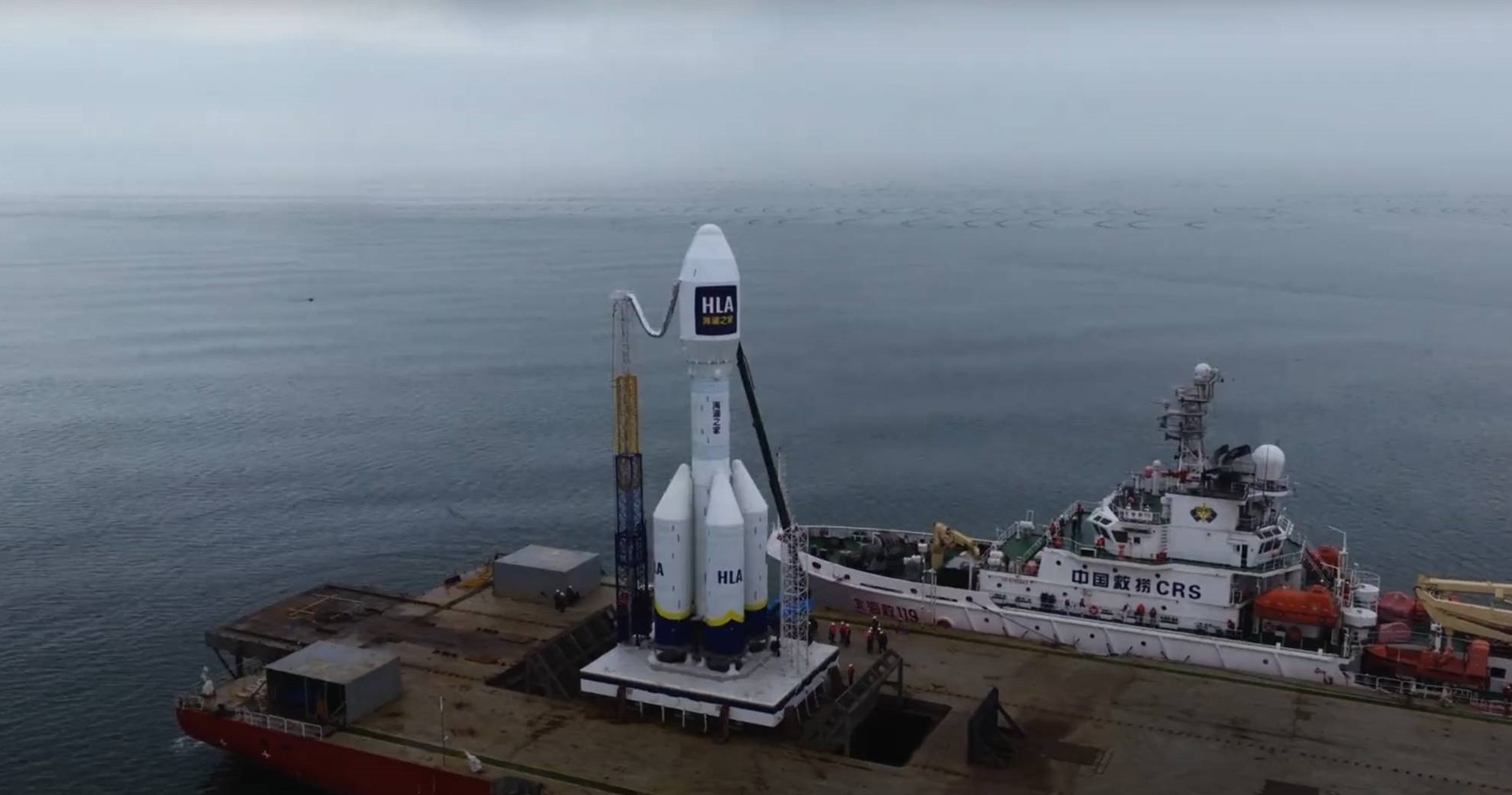
Image credit: China Central Television (CCTV)/Orienspace/Inside Outer Space screengrab
China’s Orienspace Technology, a commercial aerospace enterprise, launched on October 11th its Gravity-1 Y2 booster from a sea-launch platform off the coast of Haiyang, east China’s Shandong Province.
Gravity-1 reportedly placed three satellites into their designated orbits: an Earth-remote sensing satellite and two spacecraft built to look for and image orbital debris, from old rocket stages to out-of-service satellites.
Solid-fueled booster
The booster was adorned with the markings of a fashion clothing firm, the HLA Group, in a branding campaign.

Image credit: China Central Television (CCTV)/Orienspace/Inside Outer Space screengrab
A large solid-fueled booster, Gravity-1 can launch payloads of up to 6.5 tons to low-Earth orbit (LEO), up to 4.2 tons to a 500 kilometer Sun-synchronous orbit or up to 3.7 tons to a 700 kilometer Sun-synchronous orbit.
The Gravity-1 carrier rocket made its debut flight in January 2024.
Take a look at these videos at:
https://www.facebook.com/reel/3752089051759776
https://youtu.be/XhakYpGuXg8?list=PLpGTA7wMEDFjz0Zx93ifOsi92FwylSAS3
https://www.youtube.com/watch?v=_Ox4DKRj_NA&list=PLpGTA7wMEDFjz0Zx93ifOsi92FwylSAS3
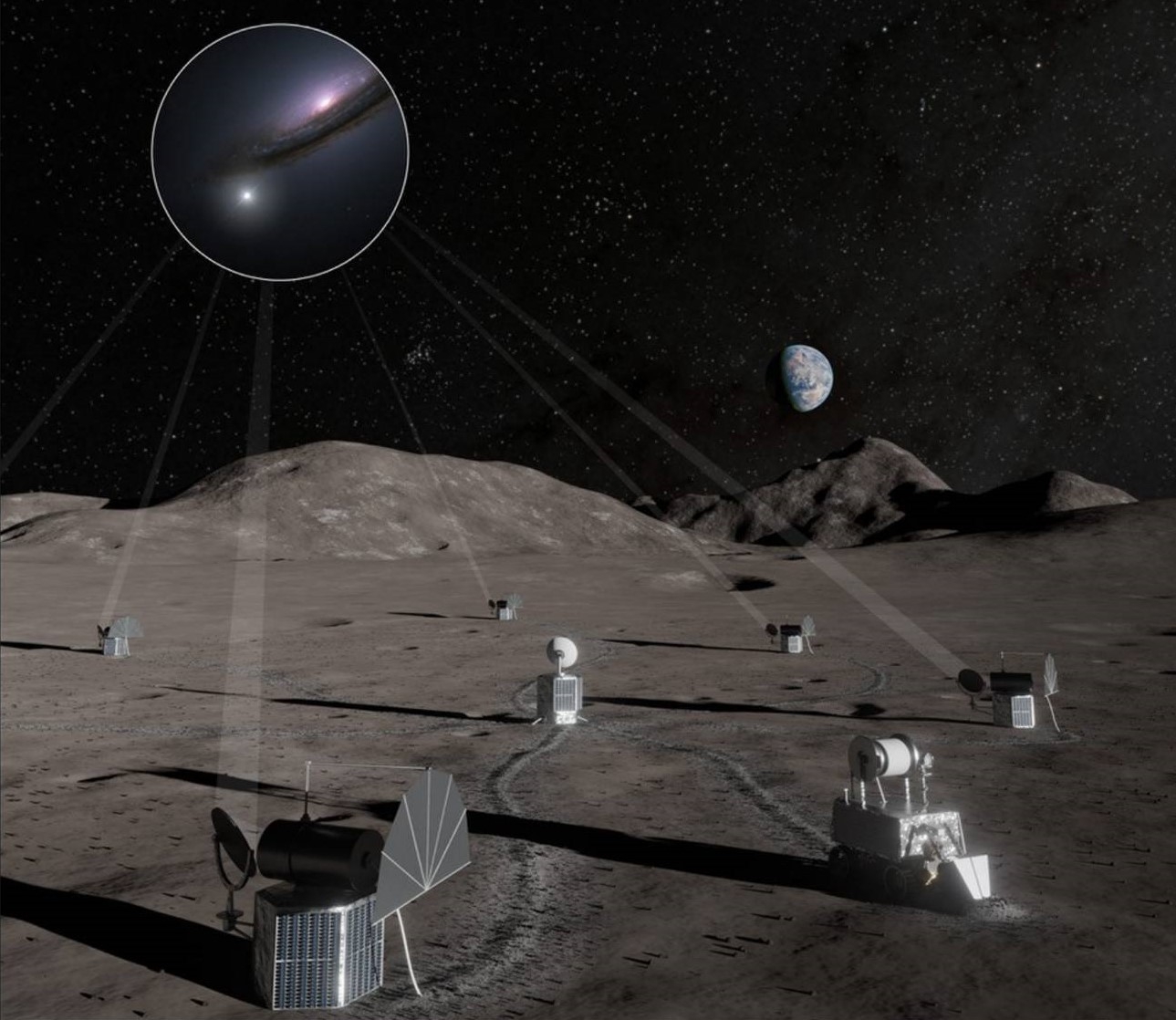
Image credit: Robert Hurt and Keith Miller under CC BY-NC 2.0 (Modified)
Our celestial neighbor, the Moon, is a compelling location for large, distributed optical facilities, enabling exquisitely sharp views of the universe.
The increasing knowledge and experience base about lunar surface operations indicates it is not just suitable, but “highly attractive for lunar telescope arrays.”
That finding and others are flagged in a report from the W. M. Keck Institute for Space Studies at the California Institute of Technology.
A study workshop was held last November, focused on astronomical optical interferometry from the lunar surface.
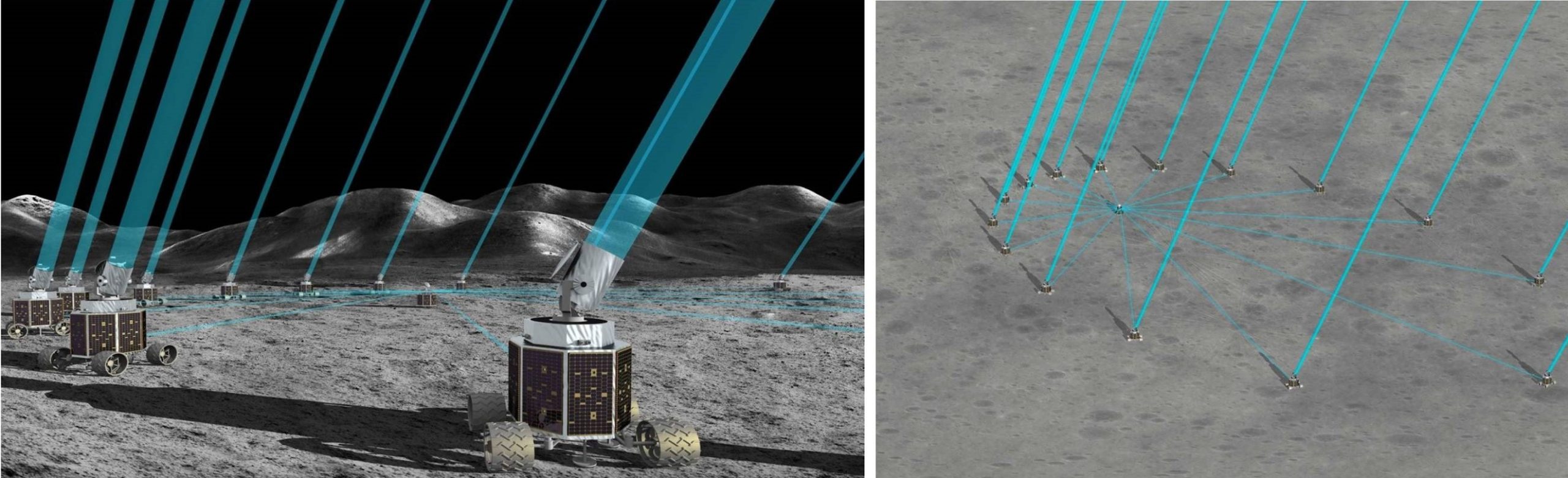
Artemis-enabled Stellar Imager (AeSI) on mobile platforms. The overall facility could start with a small number of apertures (roughly 6) but then could expand to 15-30 units.
Image credit: Britt Griswold
Unprecedented imaging potential
Astronomical gear placed on the Moon’s surface can provide unprecedented imaging potential. “Combining mature terrestrial optical interferometry with emerging lunar surface technologies could enable optical imaging with far greater resolution and sensitivity than current space or ground-based systems,” the report explains.
Indeed, the lack of atmospheric turbulence means small lunar telescopes can outperform even the largest terrestrial telescopes, the report adds. Lunar-based interferometry can unlock sub-milliarcsecond resolution and sensitivity across ultraviolet to Mid Infrared (MIR) wavelengths.
Emerging reality
“This is not a distant dream—it is an emerging reality made possible by converging technological and programmatic developments,” the study declares. “The Moon is now poised to host observatories capable of achieving imaging resolutions far beyond what is possible from Earth or orbit.”
Moreover, lunar access technology is maturing rapidly, the study points out, in the form of both U.S.-based crewed and uncrewed landers, as well as international efforts.
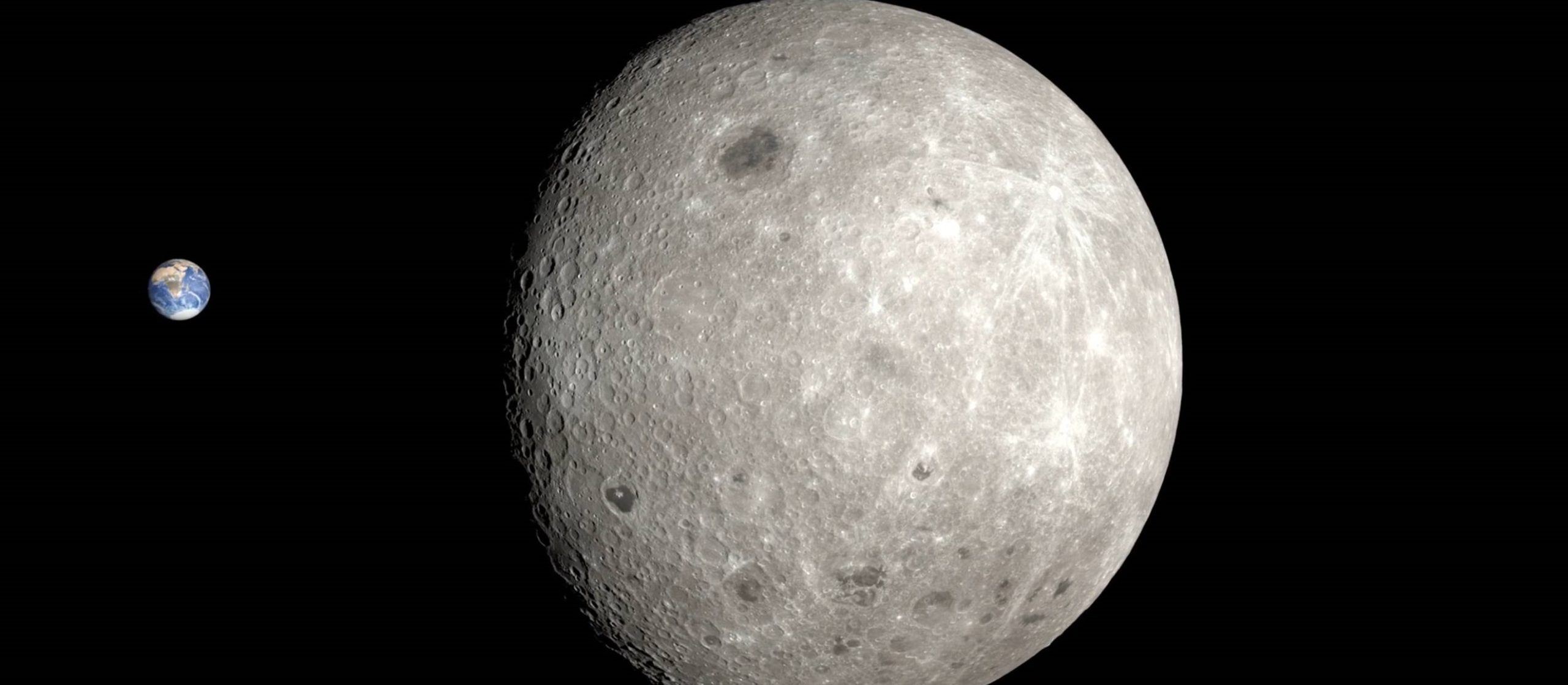
Credit: NASA’s Scientific Visualization Studio/Visualizer Ernie Wright (USRA)
When you put something on the lunar surface, the report notes, “it stays put—no complicated formation-flying infrastructure.”
Achievable steps
Detailed in the study is a near-term, small mission that could demonstrate the feasibility and value of lunar-based interferometry, hardware flown onboard a Commercial Lunar Payload system (CLPS) lander.
A medium-class mission could enable precision interferometric methods like astrometry to support exoplanet reconnaissance.
A large-scale mission could be flown for breakthrough science. It would deliver extraordinary sub-milliarcsecond imaging across UV to MIR wavelengths, leveraging future lunar infrastructure for transformative astrophysics.
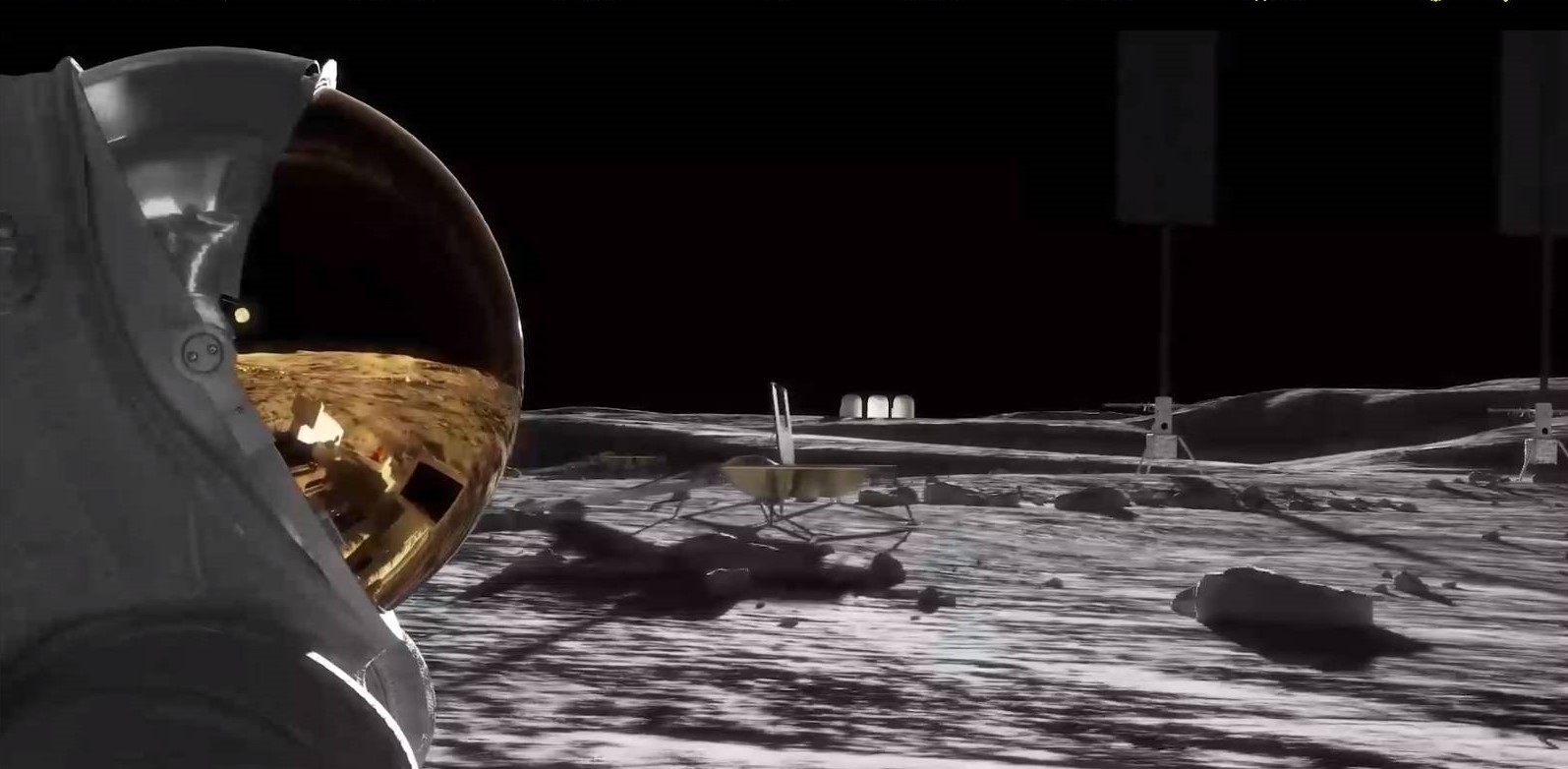
Creating lunar-based infrastructure will take time, hardware, and political willingness to forge a link between the Moon and Earth.
(Image credit: Lockheed Martin)
“We stand at the intersection of technical readiness and lunar opportunity. By advancing lunar interferometry missions today, we can lay the foundation for a revolutionary new era of astrophysics,” the report concludes. “Seizing this moment now with small, achievable steps can build toward a future where the sharpest eyes in the universe watch from the Moon.”
To access the final report – “Astronomical Optical Interferometry from the Lunar Surface – High Sensitivity at Sub-Milliarcsecond Scales” – go to:
https://www.kiss.caltech.edu/final_reports/KISS_AOILS_Orange_Book__FINAL.pdf
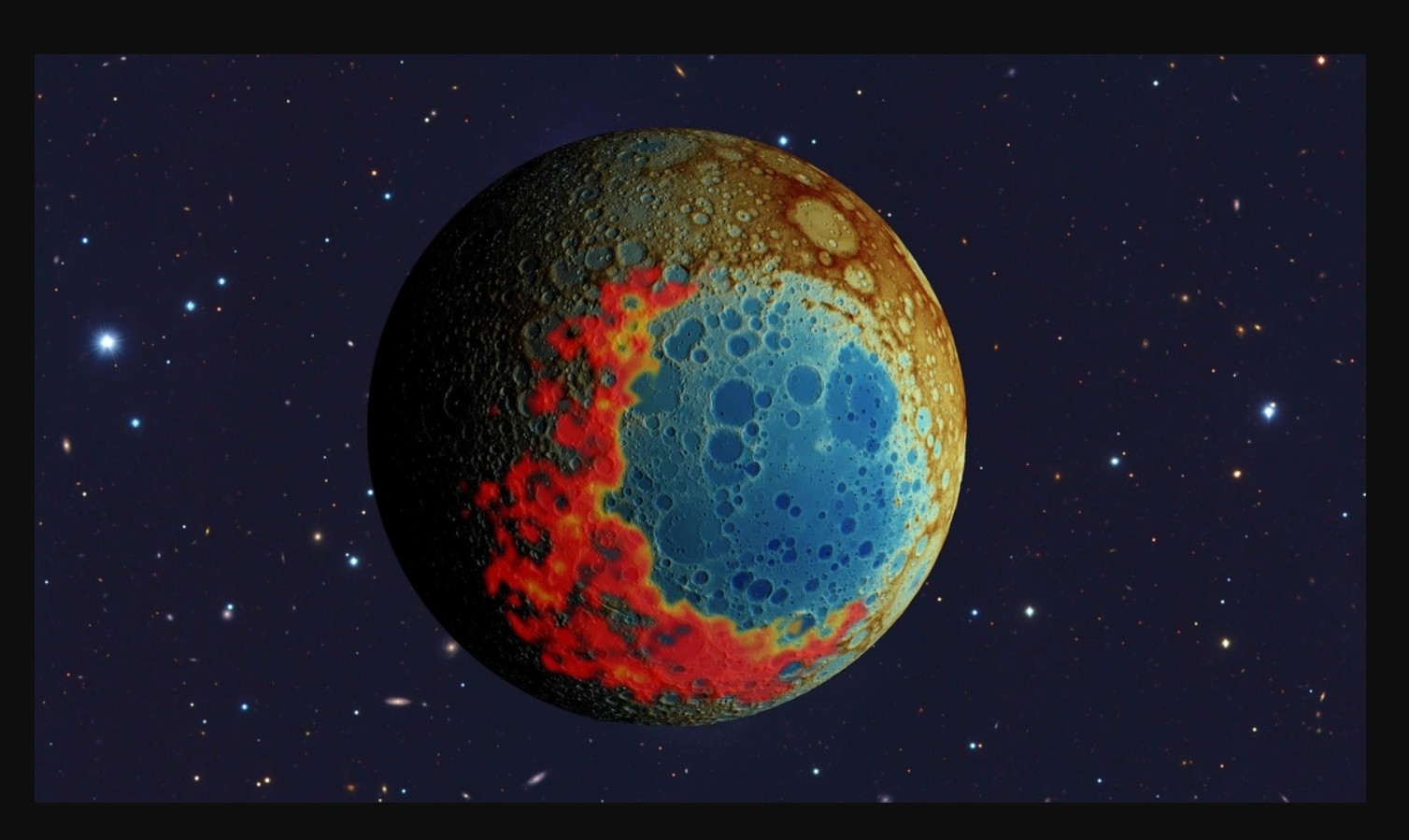
The South Pole-Aitken impact basin on the far side of the Moon formed in a southward impact (toward the bottom in the image). The basin has a radioactive “KREEP-rich” ejecta blanket on one side of the basin (bright red), containing material excavated from the lunar magma ocean. Artemis astronauts will land within this material at the south end of the basin (bottom in image).
Image credit: Jeff Andrews-Hanna/University of Arizona/NASA/NAOJ
Important new research delves into the evolution of Earth’s Moon, focused on the South Pole–Aitken (SPA) basin.
This new understanding of the basin has important implications for robotic and human exploration of the lunar south pole – a target of choice by multiple countries.
The SPA basin-forming impact occurred during a critical stage in lunar evolution, a time when the Moon was subjected to a heavy bombardment of impacts, while potentially still in the final stages of magma ocean crystallization.

Nine candidate landing regions for NASA’s Artemis III mission The background image of the lunar South Pole terrain within the nine regions is a mosaic of LRO (Lunar Reconnaissance Orbiter) WAC (Wide Angle Camera) images.
Image credit: NASA
KREEP-rich
This crystallization of the magma ocean is likely to have formed a dense, titanium-rich, ilmenite (FeTiO3)-bearing cumulates, as well as a final liquid strongly enriched in incompatible elements such as potassium, rare-earth elements and phosphorus (KREEP), including the element thorium (Th).
KREEP is an acronym stemming from the letters K (the atomic symbol for potassium), REE (rare-earth elements) and P (for phosphorus).
This prospect and a number of implications are detailed in the research paper – “Southward impact excavated magma ocean at the lunar South Pole–Aitken basin” – just published in Nature and led by Jeffrey C. Andrews-Hanna of the Lunar and Planetary Laboratory at the University of Arizona in Tucson.

Image credit: NASA
Mantle-excavating impact
“The composition of the SPA basin floor suggests a mantle-excavating impact before the overturn of the buoyantly unstable post-magma ocean cumulates, whereas increased concentrations of titanium and thorium within the basin suggest that the impact excavated into an ilmenite-rich and KREEP-rich reservoir.
“Our results indicate that the SPA basin formed from an impact on a southward trajectory at a time when the Moon still had a partial, discontinuous magma ocean,” the research paper points out.
The age of the SPA basin has been estimated at 4.25 billion years, however there is still uncertainty as to the Moon’s early bombardment history.
“Thus, important questions remain about the age of the basin, the timing and nature of magma ocean crystallization and the relation between these two pivotal events in early lunar evolution,” Andrews-Hanna and colleagues report.
Credit: NASA
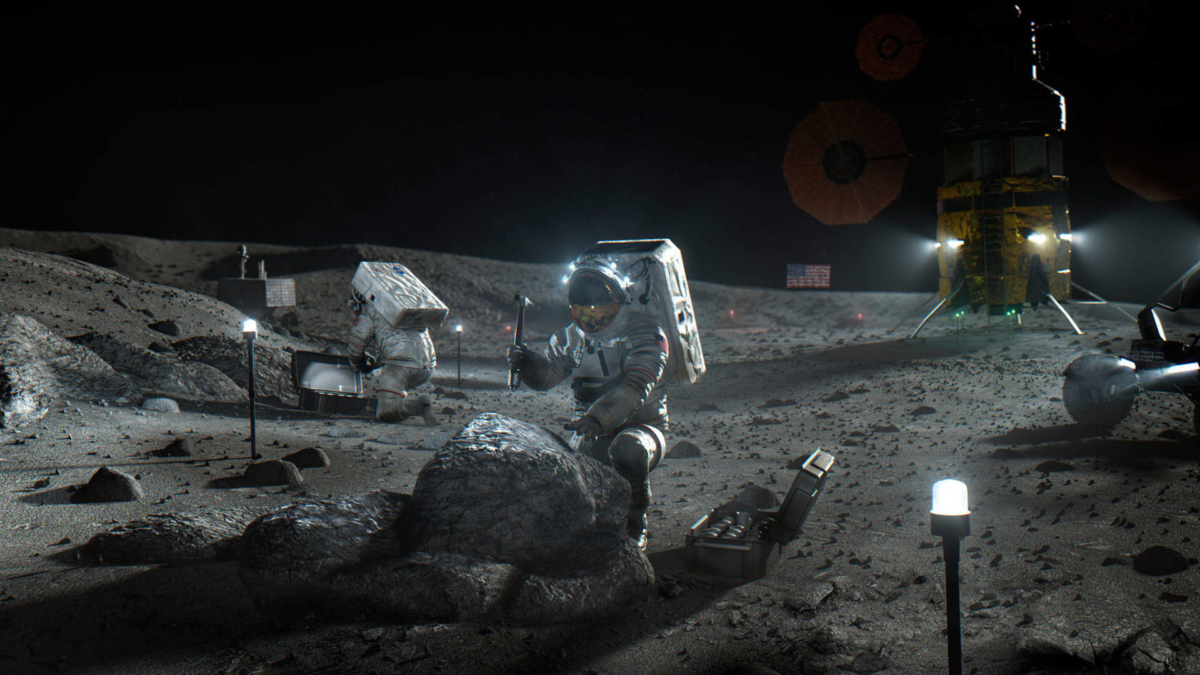
Artemis landing sites
The results highlighted in the paper have “important implications for the upcoming human exploration of the lunar south pole by Artemis, as proposed landing sites are now recognized to sit on the downrange rim and thorium-rich impact ejecta of the basin.”
Proposed south polar Artemis landing sites, the research team states, are now seen to be situated within the Thorium-rich ejecta blanket at the downrange end of the basin.
“Thus, the rocks sampled by Artemis may constrain not only the age of the basin and history of lunar bombardment but also the composition of the late-stage magma ocean and timing of its solidification,” the research team notes.

Image credit: NASA
Rim shot
Observes Andrews-Hanna in a Lunar and Planetary Laboratory statement: “This means that the Artemis missions will be landing on the down-range rim of the basin – the best place to study the largest and oldest impact basin on the Moon, where most of the ejecta, material from deep within the Moon’s interior, should be piled up.”
With Artemis, Andrews-Hanna added “we’ll have samples to study here on Earth, and we will know exactly what they are. Our study shows that these samples may reveal even more about the early evolution of the Moon than had been thought.”
Endurance rover
Explains a co-author of the paper, Bill Bottke of the Southwest Research Institute & Solar System Science & Exploration Division in Boulder, Colorado, this work helps set the stage for NASA’s upcoming Endurance rover, a mission advocated in a recent National Academies of Sciences (NAS) decadal report.
The Decadal tagged the Endurance mission as the highest priority for the NASA lunar exploration program. There is a science definition team now working on the Endurance concept. However, it has yet to be funded.
“Endurance will perform a ‘Lewis and Clark’-like expedition to the Moon by collecting samples from across South Pole-Aiken basin,” Bottke tells Inside Outer Space, “and then delivering them to the Artemis astronauts. What an incredible opportunity to learn how the Moon formed and evolved!”
To read the paper – “Southward impact excavated magma ocean at the lunar South Pole–Aitken basin” – go to:
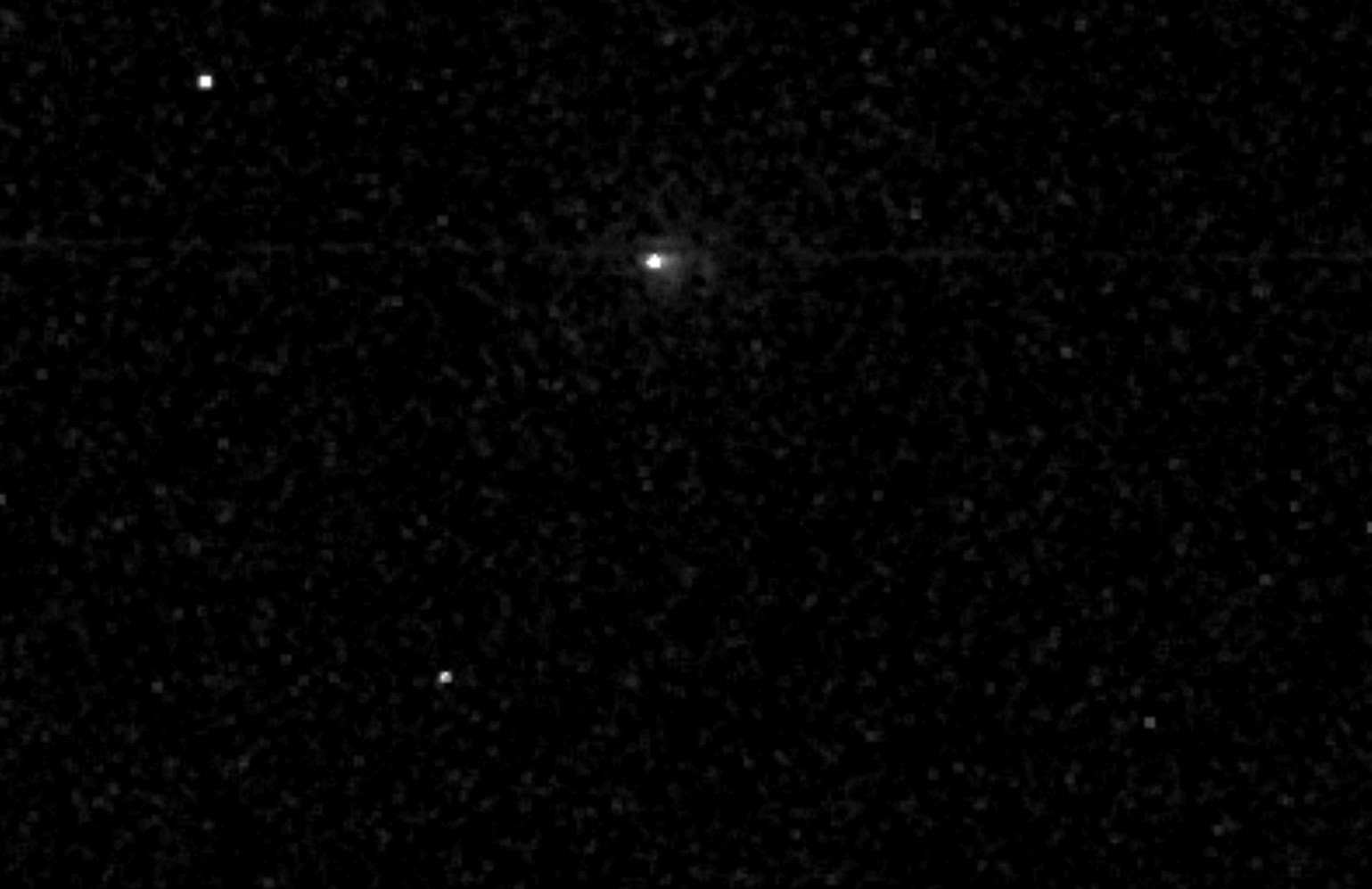
ExoMars TGO images comet 3I/ATLAS Image credit: ESA
That mysterious interloper from afar has been inspected by two Mars orbiters.
The celestial watch of 3I/ATLAS was done by the European Space Agency’s ExoMars Trace Gas Orbiter (TGO) and Mars Express with the interstellar interloper 30 million kilometers away from those spacecraft.
The object’s coma, measuring a few thousand kilometers across, is clearly visible. The Sun’s heat and radiation is bringing the comet to life, causing it to release gas and dust, which collects as this halo surrounding the nucleus.
Originating from outside our Solar System, comet 3I/ATLAS is only the third interstellar comet ever seen, following 1I/ʻOumuamua in 2017 and 2I/Borisov in 2019.
No word as yet of any observation by NASA’s Mars Reconnaissance Orbiter (MRO).

On patrol – NASA’s Mars Reconnaissance Orbiter (MRO).
Image credit: NASA/JPL
True outsiders
An ESA statement explains that “interstellar comets are true outsiders, carrying clues about the formation of worlds far beyond our own.”
Based on its trajectory, ESA says, astronomers suspect that 3I/ATLAS could be the oldest comet ever observed. “It may be three billion years older than the Solar System, which is itself already 4.6 billion years old.”
Next month, ESA’s Jupiter Icy Moons Explorer (Juice) will see the comet just after its closest approach to the Sun. While Juice will view 3I/ATLAS in a more active state, data from that spacecraft won’t be received until early 2026.
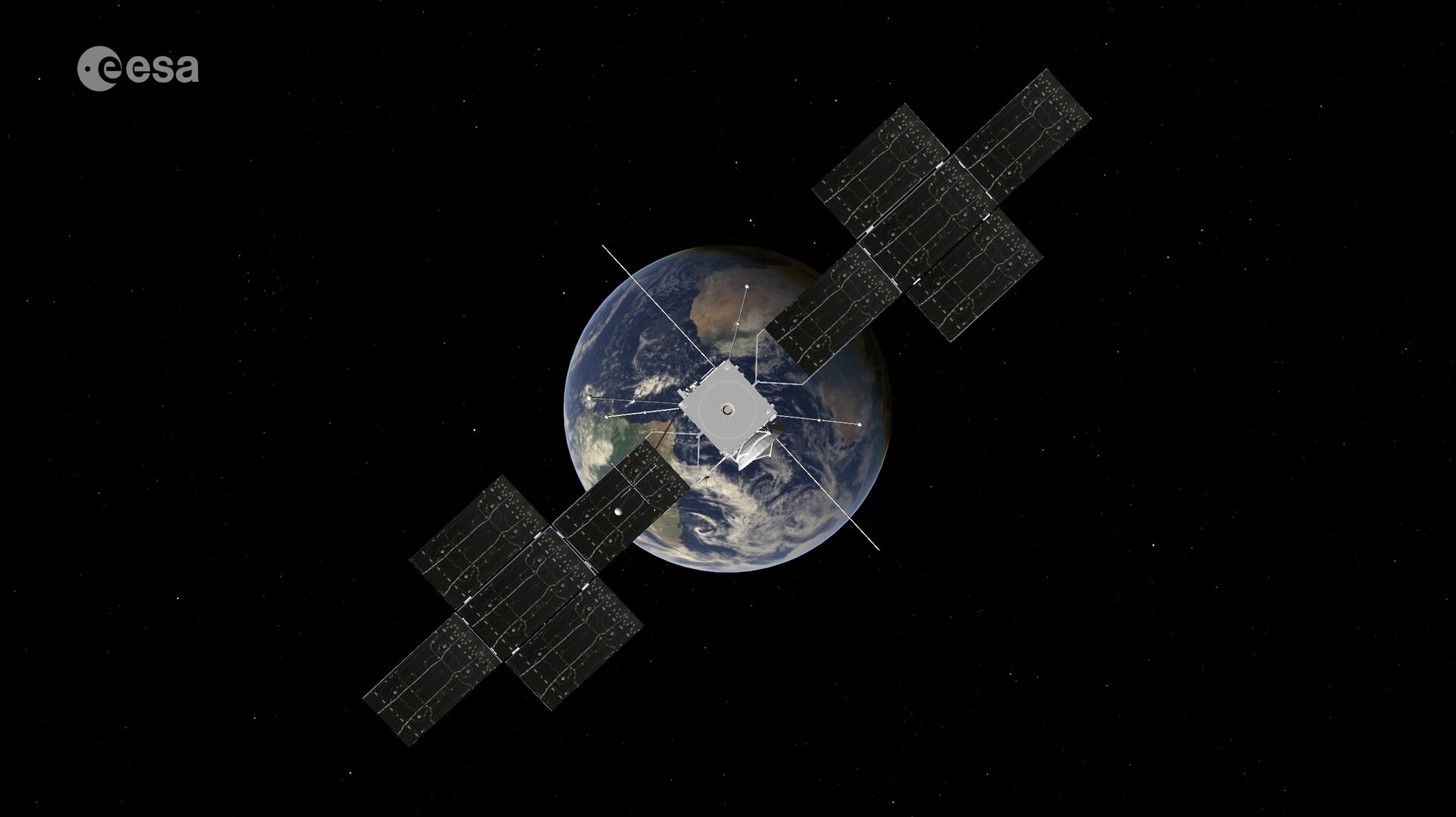
ESA’s Juice spacecraft.
Image credit: ESA
Juice observations
Juice will attempt observations in November 2025 using several instruments, including cameras, spectrometers and a particle sensor. Coordination with NASA’s en route Europa Clipper mission is being considered, in particular to observe using the twin ultraviolet spectrographs (one on each spacecraft).
As Juice is currently close to the Sun, it is using its main high-gain antenna as a heat shield. It is using its smaller medium-gain antenna to send data back to Earth at a much lower rate. It is also far from Earth, on the other side of the Sun. Therefore, ESA adds that researchers don’t expect to receive data from Juice’s observations of 3I/ATLAS until February 2026.
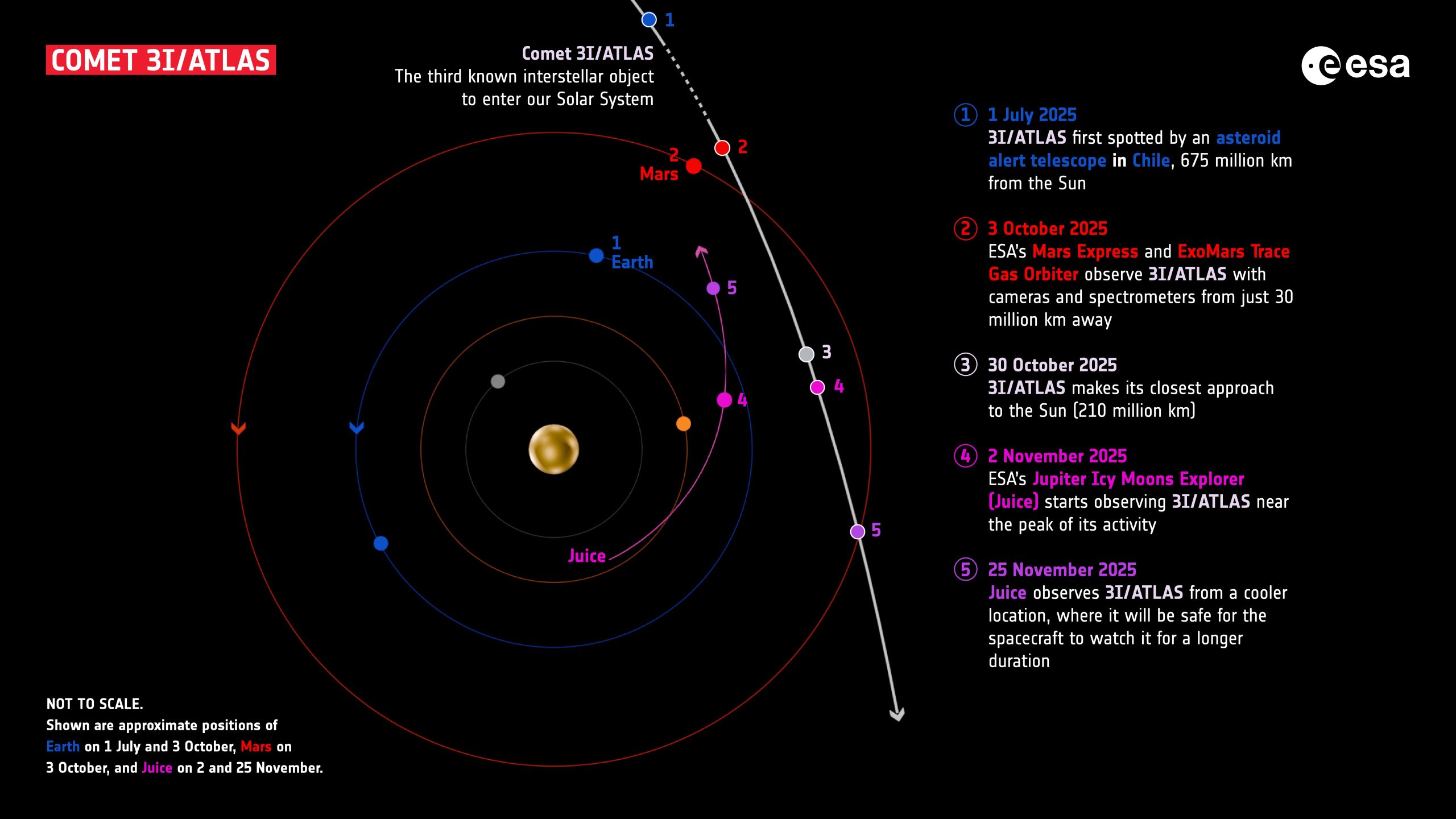
Image credit: ESA
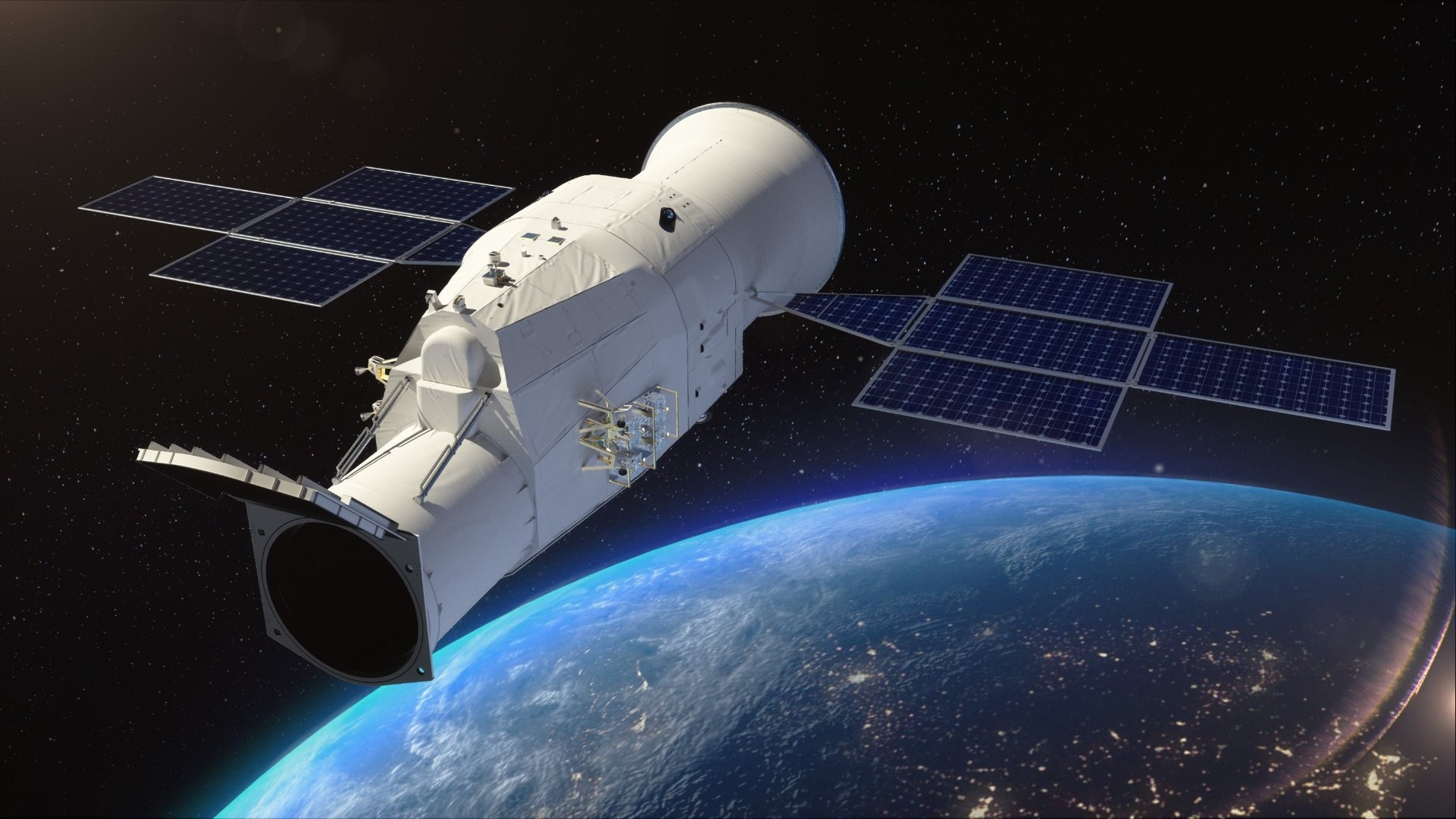
Image via Weibo.
China’s Xuntian space telescope is designed to co-orbit with the country’s Tiangong space station. Orbital phasing of the station and Xuntian would allow docking the telescope with the orbiting outpost for repair, servicing, and upgrades by station crewmembers.
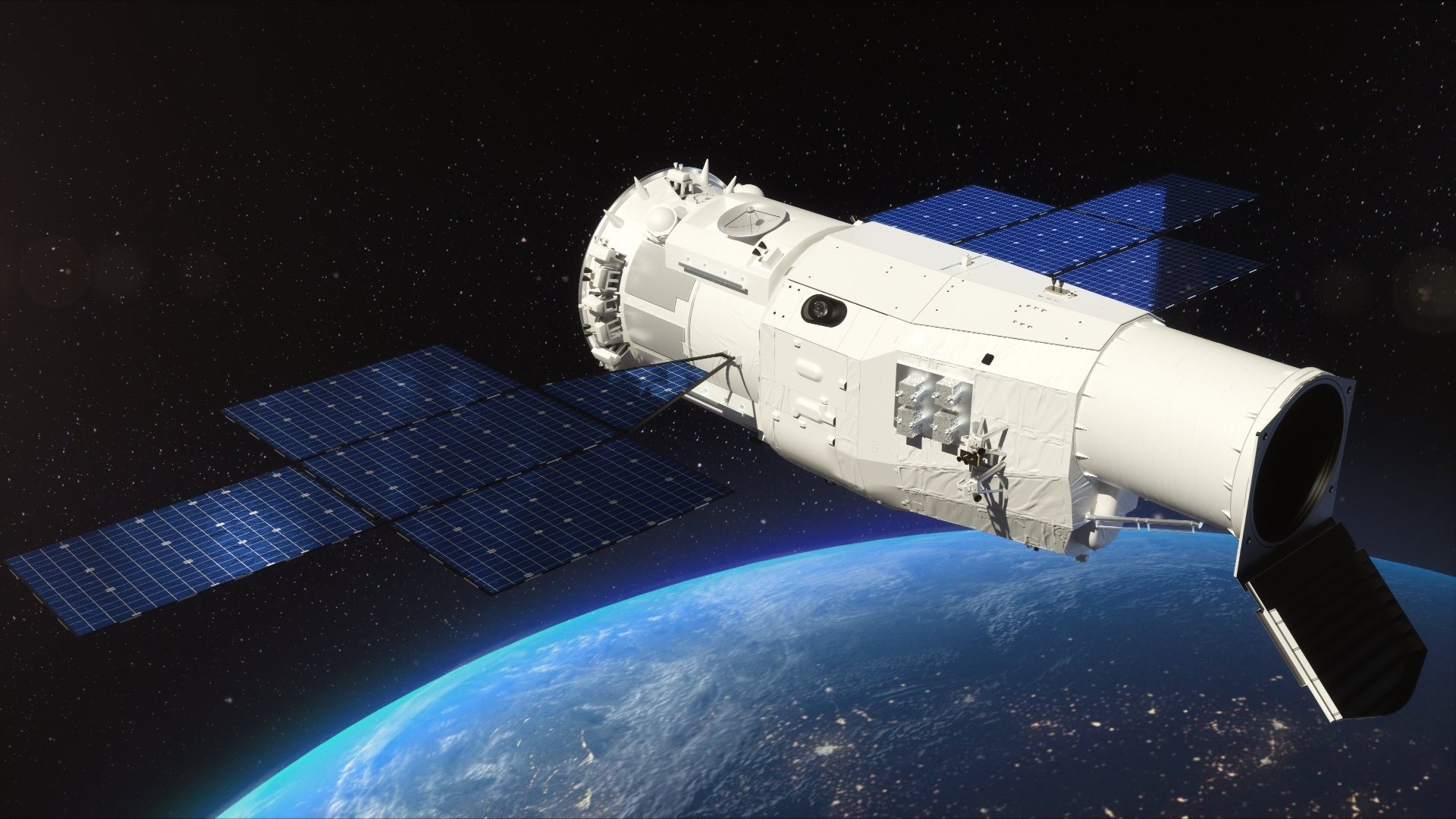
Image via Weibo.
Imagery posted on Weibo, China’s version of Twitter (X), shows the apparent current design of Xuntian.
Late 2026 launch?
Reportedly, the space-based observatory will feature a primary mirror 6.6 feet (2-meters) in diameter and is expected to have a field of view 300–350 times larger than the Hubble Space Telescope.
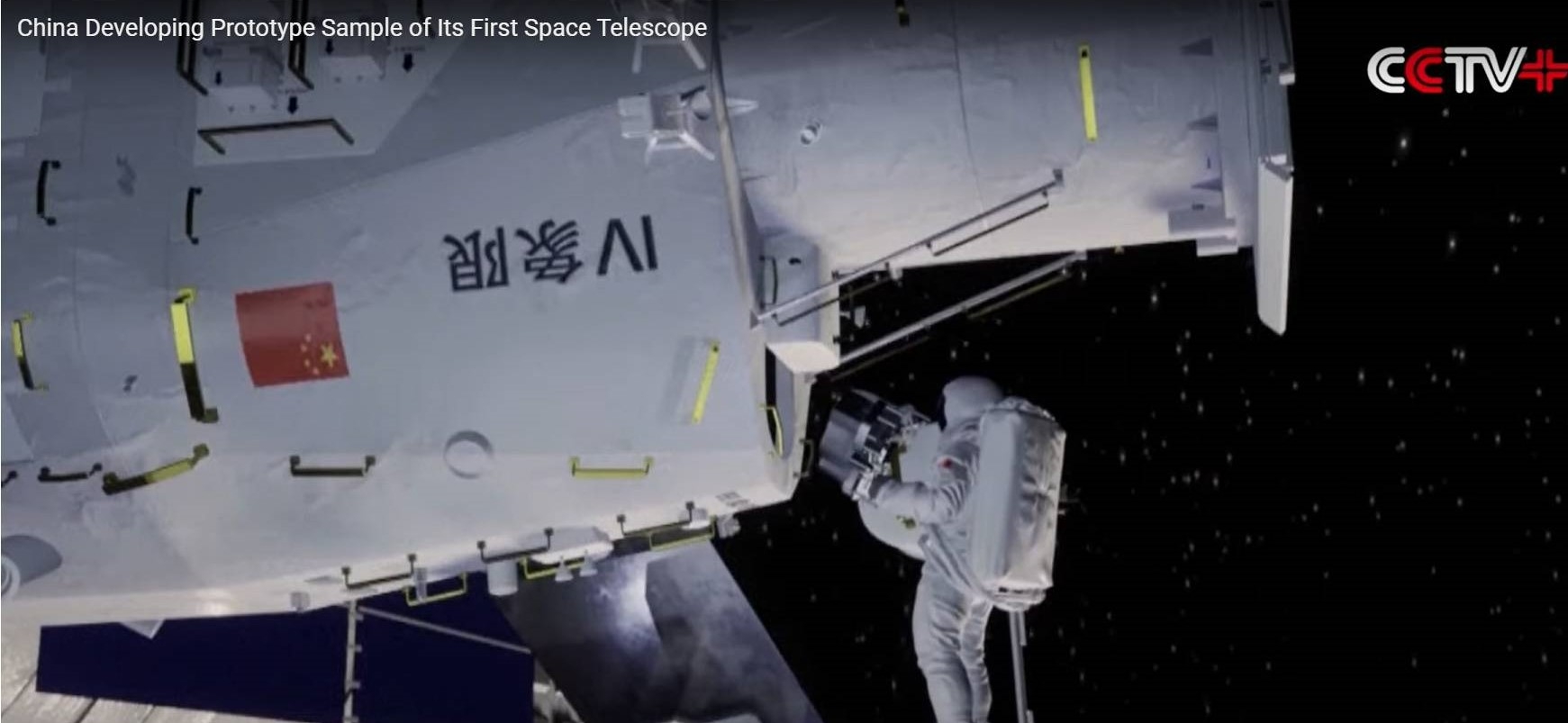
Credit: CCTV/Inside Outer Space screengrab
Xuntian has undergone a lengthy, drawn-out development program. It now appears to be headed for launch via a Long March 5B rocket by late 2026.
To view an earlier video focused on Xuntian, go to:

