Archive for October, 2025
 Author:
  October 21st, 2025
Image credit: Western Naval Command
Rocket remainders from China’s Long March 8A booster launched on October 16 have been picked up by a Philippine Navy missile boat.
The debris with made-in-China markings were recovered off Barangay Rio Tuba in Bataraza, Palawan following maritime operations in the West Philippine Sea.
Drop zones
The Long March 8A rocket was launched from the Hainan International Commercial Launch Center in Wenchang, Hainan early morning on October 16. This rocket deployed the 12th group of low-orbit Internet satellites – and also marked the 600th launch of China’s Long March rocket series.

Image credit: Western Naval Command
Earlier, details of the rocket drop zones were disclosed through a Notice to Airmen (NOTAM) warning of an “aerospace flight activity,” notified the Philippine Space Agency (PhilSA).
PhilSA disseminated a pre-launch report to relevant government agencies and authorities prior to the launch.
Falling debris
“Unburned debris from rockets, such as the booster and fairing, are designed to be discarded as the rocket enters outer space,” the earlier PhilSA advisory notes. “While not projected to fall on land features or inhabited areas, falling debris poses danger and potential risk to ships, aircraft, fishing boats, and other vessels that will pass through the drop zone.”

Image credit: CCTV/Inside Outer Space screengrab
Additionally, PhilSA said in the earlier advisory there was also a possibility for the debris to float around the area and wash toward nearby coasts.
“PhilSA reiterates its advice for the public to inform local authorities if suspected debris is sighted. PhilSA also cautions against retrieving or coming in close contact with these materials that may contain remnants of toxic substances such as rocket fuel,” the earlier advisory pointed out.
 Posted in

The Zhuque-3 by LandSpace.
Image credit: LandSpace
LandSpace, a Chinese private space company, is gearing up for the maiden flight of its partially reusable rocket, the Zhuque-3.
The booster has entered a critical phase after the completion of joint fueling drills and static ignition tests, laying the groundwork for the rocket’s official launch and first-stage recovery later this year. It is set to fly from the Jiuquan Satellite Launch Center.
Zhuque-3 is equipped with landing legs and grid fins for controlled descent, designed to vertically recover its most expensive component — the first stage, which accounts for 70 percent of the total rocket cost, according to China Central Television (CCTV).
LOX-methane engines
Officially initiated in August 2023, ZhuQue-3 is a large, reusable liquid-fueled launch vehicle independently developed by LandSpace for large-scale constellation deployment missions.

Image credit: LandSpace
LandSpace explains that the vehicle features a 4.5-meter body diameter, a 5.2-meter fairing, an overall length of 66.1 meters, and a liftoff mass over 570 tons, delivering over 750 tons of liftoff thrust.
Constructed primarily from stainless steel, a LandSpace posting notes that the first stage is equipped with nine TianQue-12A LOX–methane engines and includes an RCS system, grid fins, and landing legs required for stage recovery — enabling precise autonomous return, soft landing, and reuse.
Landing precision
By parallel clustering of nine liquid oxygen-methane engines, the first-stage can achieve meter-level landing precision, as five of the engines are capable of gimballing, CCTV points out.
In addition, these engines produce a combined thrust of more than 7,500 kilonewtons, setting a new record for Chinese commercial liquid-fueled rockets, CCTV adds.
Go to this informative video showing the LandSpace Zhuque-3 Y1 being delivered to the launch site.

Image credit: CCTV
Chinese scientists have identified remnants from meteorites in lunar samples rocketed to Earth by the country’s Chang’e-6 mission.
The finding sheds light on the Moon’s past and material transfer in the solar system.
Led by a research team from the Guangzhou Institute of Geochemistry (GIG) under the Chinese Academy of Sciences, scientists identified impact remnants originating from the CI carbonaceous chondrites.
The work involved systematic petrographic analyses and examining the trace elements and oxygen isotope compositions of olivine-bearing fragments in the two-gram lunar samples collected by the Chang’e-6 mission.
The study has been published in the latest issue of the journal Proceedings of the National Academy of Sciences (PNAS).

Image credit: CCTV
Rich in water
According to Lin Mang, a researcher at GIG: “There are many hypotheses about the origin of the water on the Moon. Some say it was generated on the Moon, some say it came from the Sun, and some say it came from cometary meteorites.”
The meteorites identified are rich in water, Lin told China Central Television (CCTV), “but previously we thought the percentage of such meteorites was very small on the Moon.
The discovery of numerous such meteorites, Lin added, “suggests their contribution to the lunar water was seriously underestimated. Further research is needed to quantify the true extent of water brought to the Moon by these meteorites.”

Artwork depicts China’s Change’-6 lander/ascender on the Moon.
Image credit: CNSA
As CI chondrites are rich in water and volatiles, this finding supports the hypothesis, CCTV notes that asteroids played a role in delivering water and other volatiles to the lunar surface, according to the findings.
53-day journey
China’s Chang’e-6 collected the first-ever lunar samples from the far side of the Moon, rocketing them to Earth in June 2024, after a 53-day space journey.
Chang’e-6’s returner capsule parachuted into a selected site in north China, bringing back from the Moon over 1.93 kilograms of samples.
To access the PNAS paper – “Impactor relics of CI-like chondrites in Chang’e-6 lunar samples” – go to:
https://www.pnas.org/doi/10.1073/pnas.2501614122

The Chang’e-6 sample container is shown being removed from the Chang’e-6 return capsule.
Image credit: Jin Liwang via SegerYU X posting.

Low-down space conflicts within the high frontier? Powerful lasers or direct-hit kinetic-kill measures are part of the anti-satellite (ASAT) tool kit.
(Image credit: Electro Optic Systems)
There is increasing space-based shenanigans going on up stairs in the heavens. Are anti-satellites (ASATs) becoming the new “must-have” technology for spacefaring nations – like China, Russia, India, as well as the United States?
What’s at stake, what to strike, and why? Those are issues being thrashed out as countries appear to “anti-up” their interest to take out or disrupt operations of select spacecraft.
Go to my new Space.com story — Are we already witnessing space warfare in action? ‘This is not just posturing’ – “The Russians and the Chinese are demonstrating more sophisticated orbital maneuvering abilities. There’s no denying that…” – at:

Images taken of purported space debris in Australia.
Image credit: Western Australia Police Force
Australian police force officers are dealing with what appears to be space debris.
Over the weekend, a hunk of smoking junk was found by mine workers nearly 19 miles east of Newman, Western Australia.
The Australian Space Agency is also carrying out “further technical analysis to identify its origin.”
The mine workers reported the object near a remote access road
A preliminary look at the wreckage suggests it is made of carbon fiber, perhaps a composite-overwrapped pressure vessels typically used in rocket tanks.
Chinese leftovers?
Satellite watcher, Marco Langbroek of the Netherlands, reports that China’s Jielong 3 upper stage 2024-173L “is a good candidate for the origin of the possible space debris object found near Newman on October 18.”
“It could actually be (a significant part of) the upper stage itself, given the large size that the photo’s suggest (and also given that the Jielong 3 upper stage is reportedly a solid fuel stage),” Langbroek reports.
The object resembles a COPV (Composite-Overwrapped Pressure Vessel), a type of space debris that often survives reentry, adds Langbroek.
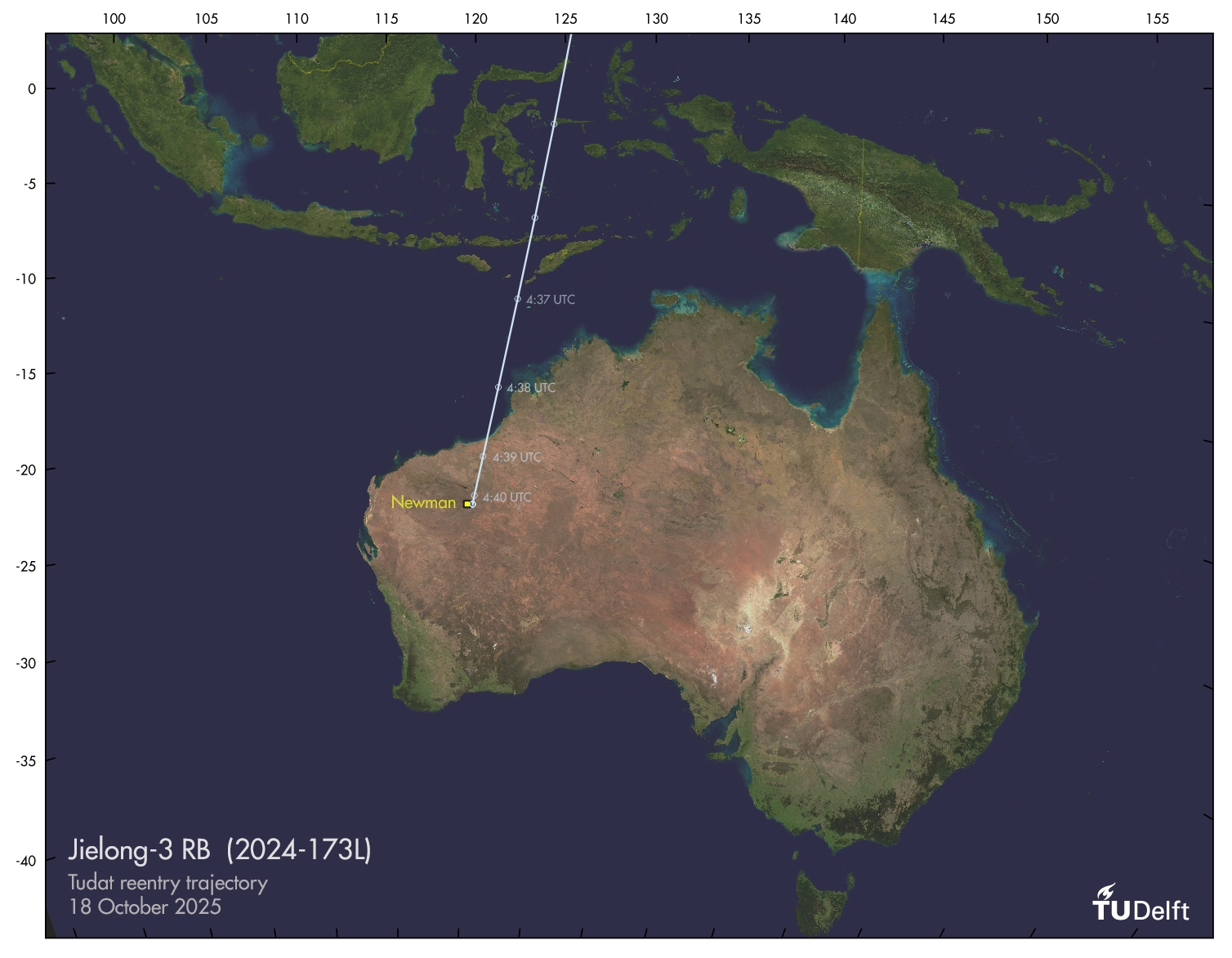
Image credit: Marco Langbroek

China’s Shenzhou-20 crew.
Image credit: CMSA/CCTV/Inside Outer Space screengrab
China’s Shenzhou-20 space station crew has been in orbit more than 170 days and are preparing for returning to Earth, slated for late October.
Now onboard China’s Tiangong space station, Chen Dong, Chen Zhongrui, and Wang Jie, continue a full agenda of space research tasks.
Since entering the space station in late April, the taikonaut trio have performed numerous research experiments prior to ending their six-month mission.
Behavioral tests
According to China Central Television (CCTV), in the field of space medicine, the crew has utilized laptops and specialized equipment to complete behavioral tests for several experiments, including studies on visual fields, functional training, and metacognitive monitoring.
They have also conducted Electroencephalogram (EEG) experiments to gather data on the effects of long-term spaceflight on a person’s perception and cognitive abilities.

Image credit: CCTV/Inside Outer Space screengrab
Additionally, they have looked into perception of gravity from visual motion using a visual function measurement device, eye tracker, and testing software.
Metabolism measurements
The crew have collected and preserved saliva samples to study how changes in gut microbiota during long-term spaceflight affect human’s metabolism and gastrointestinal function.
The space travelers have also used a space Raman spectrometer to analyze metabolites in urine samples, with the collected information aimed at improving the metabolic indicator system and evaluation criteria.

China’s Tiangong space station as imaged by MAXAR satellite.
Image credit: MAXAR
Ultrasounding
In materials science, the crew has utilized a containerless cabinet experiment chamber, changed out samples, maintained the electrodes of the hardware, and replaced window cover lenses. Additionally, they have also installed samples for the fifth batch of microbial control technology cultivation chips, CCTV reports.
As for health monitoring, the Shenzhou-20 crew has performed ultrasounds on their abdomen, muscles, and cardiovascular system to help gauge their health during their stint in space.
Lastly, part of their tasks have them carrying out routine equipment inspections and station management activities.
For a new look at life onboard China’s space station, go to:
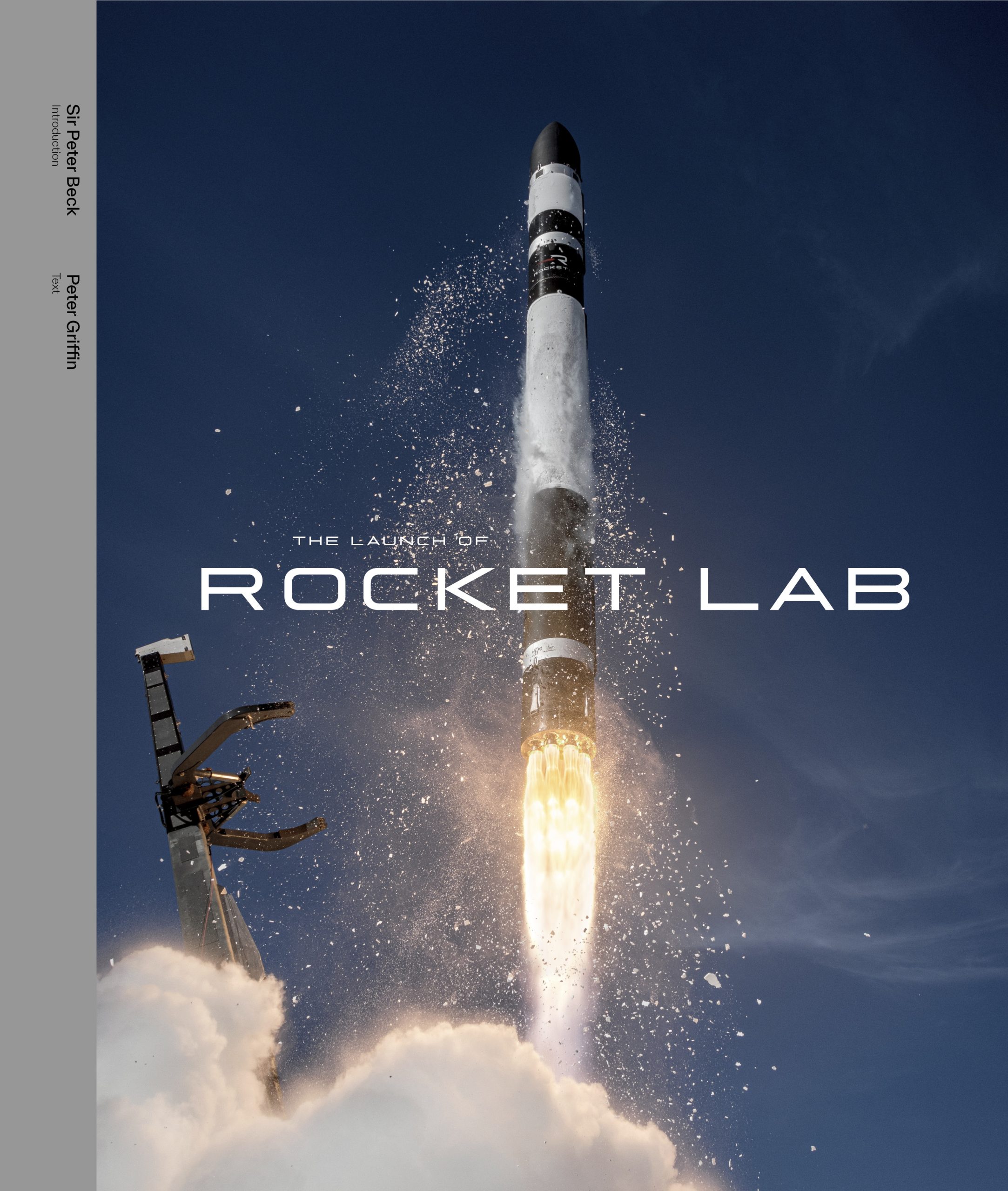
The Launch of Rocket Lab by Peter Griffin, with introduction by Sir Peter Beck, Published by Blackwell & Ruth and distributed by Abrams Books; 312 pages; Hardcover, $60.00.
This stunning, large format book, tells the engaging story of Rocket Lab and how Peter Beck founded this powerhouse of an enterprise. As a self-taught rocket engineer without a college degree, Beck’s garage-based start-up in New Zealand has led to a 2,500 people strong, $22-plus billion publicly traded company now headquartered in Long Beach, California.
This compelling and well-written tale is authored by Peter Griffin, a New Zealand-based science and technology journalist who has been covering emerging technology, start-ups, and the tech sector for decades.
Illustrated by 175 color and black & white images, what’s portrayed in the volume is a first in-depth view of Rocket Lab’s past and where Beck and colleagues foresee as its future. Thanks to firsthand accounts from the engineers and team, The Launch of Rocket Lab delivers an enthralling behind-the-scenes look at this highly successful space company.

Imagineer, Peter Beck
“Somewhere between unlikely and impossible is where magic happens,” explains Beck. “This book captures the essence of Rocket Lab’s spirit. It’s not just a chronicle of our achievements but a testament to what can be accomplished when you dare to try and refuse to give up,” he explains in the volume’s introduction.
“Everyone thinks you are crazy until you do it; then you are just called a visionary,” Beck observes.
The book is divided into three parts: “Looking Upwards”; “The Age of Electron”; and “The Next Frontiers.” The contents are remarkably fresh, including Rocket Lab’s work on the CAPSTONE lunar mission, the soon-to-launch ESCAPADE Mars probes, the group’s highly anticipated Venus Life Finder mission, and nifty details about building the up-and-coming Neutron booster.

Venus Life Finder.
Image credit: Rocket Lab
Captured as well is the company’s funding challenges, near-misses, and failed missions – a non-hiccup-free journey to developing Rocket Lab’s Electron launcher.
Hat’s off to those laying out The Launch of Rocket Lab that tastefully makes use of breathtaking imagery that gives the book a feeling of time, space, and the thirst to thrust into space and set your sights on the unknown.
“Outsized ambition is really the story of Rocket Lab,” writes Griffin, the book’s author. “Rocket Lab is laying the groundwork for a future where it looks likely to play a pivotal role in the shape of the commercial space sector,” he adds.
Indeed, this story of innovation and stick-to-it passion should also become a lessons-learned short-course for fledgling space start-ups.
For more information on this book, go to:
https://www.blackwellandruth.com/books
Note: Special thanks to Kate Greenberg of Arply for the book and press materials.

The Red Planet as seen by Europe’s Mars Express.
Image credit: ESA/D. O’Donnell – CC BY-SA IGO
Future missions dedicated to searching for live today on Mars will require a clear understanding of the organic biosignature degradation processes in the planet’s shallow icy subsurface.
“We found that amino acids in the surface ice on Mars would survive over 50 million years of cosmic ray exposure, which is far greater than the expected age of the current surface ice deposits on Mars,” reports Alexander Pavlov of the Solar System Exploration Division at NASA’s Goddard Space Flight Center in Greenbelt, Maryland.
Sampling location
Pavlov and colleagues explain that, based on their experiments, “locations with pure ice or ice-dominated permafrost would be the best places to look for recently deposited amino acids on Mars and, thus, should be considered as a target sampling location for future Mars missions searching for extant life.”

Image credit: ESA
The research — “Slow Radiolysis of Amino Acids in Mars-Like Permafrost Conditions: Applications to the Search for Extant Life on Mars” — has been published in the September 2025 issue of Astrobiology.
High chance of survival
Ice deposits on Mars have sublimated and continue to sublimate from low and mid-latitudes and redeposit in the polar regions of the Red Planet.
“Thus, any surface ice was exposed to ionizing radiation for a few million years. Therefore, if an abiotic or biological amino acid were deposited in the surface ice matrix on Mars somehow (e.g., spores or interplanetary dust particles), it would have a high chance of survival,” Pavlov and team members point out.

Mars expedition probes the promise that Mars was a home address for past, possibly life today.
Credit: NASA
Based on the results of this study, locations with pure ice and ice-dominated permafrost should be the best places to look for recently deposited amino acids on Mars, they conclude.
Buried water that freezes and does not melt in summer is called permafrost, common here on Earth in polar regions on Earth. On Mars it is planet wide.
To access the full paper — “Slow Radiolysis of Amino Acids in Mars-Like Permafrost Conditions: Applications to the Search for Extant Life on Mars” – go to:
https://www.liebertpub.com/doi/full/10.1177/15311074251366249
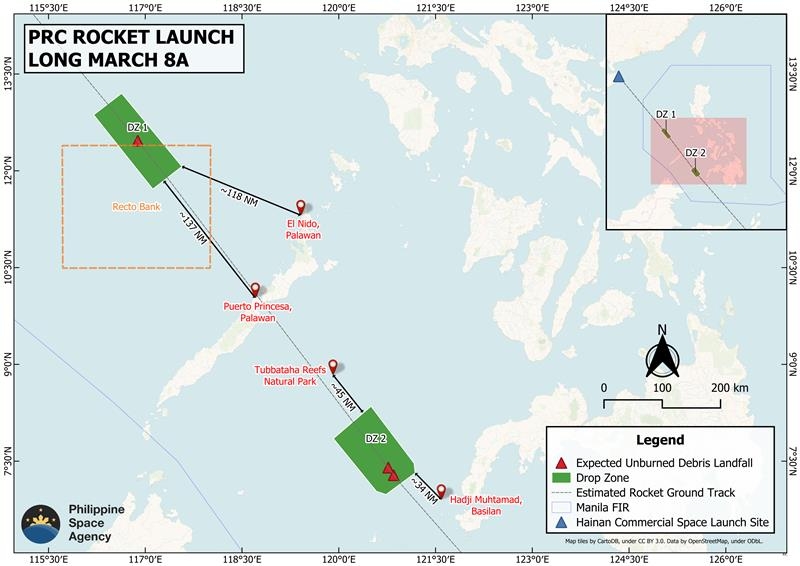
Estimated drop zone of the Long March 8A Launch.
Image credit: PhilSA
Once again, the Philippine Space Agency (PhilSA) has posted an advisory regarding rocket debris stemming from launch of a Chinese rocket.
Leftovers from China’s Long March 8A booster were projected by PhilSA to have fallen within identified drop zones approximately 118 nautical miles away from El Nido, Palawan, 137 nautical miles away from Puerto Princesa, Palawan, 45 nautical miles away from Tubbataha Reef Natural Park, and 34 nautical miles away from Hadji Muhtamad, Basilan.
Image credit: CCTV/Inside Outer Space screengrab
Internet satellites
The Long March 8A rocket was launched from the Hainan International Commercial Launch Center in Wenchang, Hainan early morning on October 16. This launch deployed the 12th group of low-orbit Internet satellites – and also marked the 600th launch of China’s Long March rocket series.
Details of the rocket drop zones were disclosed through a Notice to Airmen (NOTAM) warning of an “aerospace flight activity.” PhilSA disseminated a pre-launch report to relevant government agencies and authorities prior to the launch.
Falling debris
“Unburned debris from rockets, such as the booster and fairing, are designed to be discarded as the rocket enters outer space,” the PhilSA advisory notes. “While not projected to fall on land features or inhabited areas, falling debris poses danger and potential risk to ships, aircraft, fishing boats, and other vessels that will pass through the drop zone.”

Another China launch, another day of picking up the pieces. This photo was taken of China booster recovery earlier this year, back on August 14.
Image credit: Philippine Coast Guard
Additionally, PhilSA said there is also a possibility for the debris to float around the area and wash toward nearby coasts. “Additionally, the possibility of an uncontrolled re-entry to the atmosphere of the rocket’s upper stages returning from outer space cannot be ruled out at this time,” the advisory explains.
“PhilSA reiterates its advice for the public to inform local authorities if suspected debris is sighted. PhilSA also cautions against retrieving or coming in close contact with these materials that may contain remnants of toxic substances such as rocket fuel,” the advisory points out.
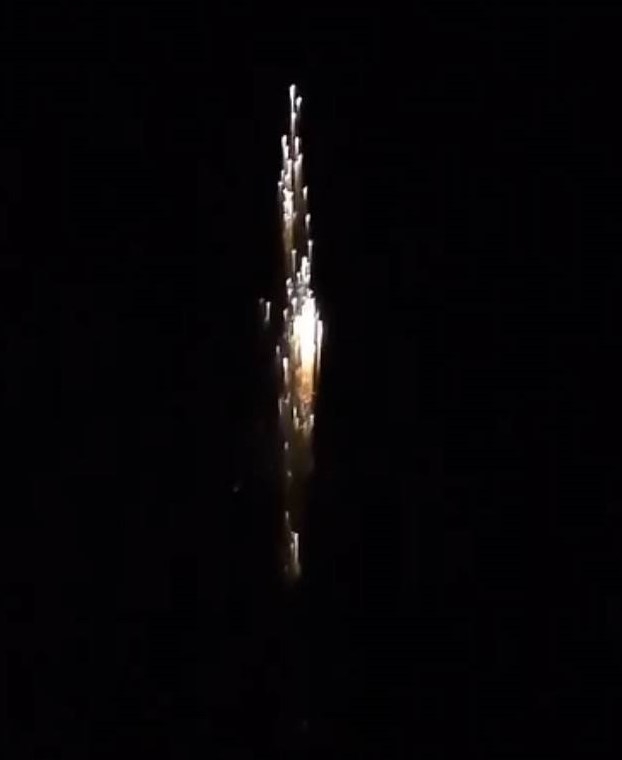
Image credit: Rohan Goes/Inside Outer Space screengrab
It appears that China’s Xinjishu Yanzheng 7 (XJY-7) spacecraft made a stunning sky show as it reentered October 16 over Tenerife, Canary Islands at around 3 a.m. local time.
The nearly 3-ton (2,700 kilograms) satellite was lofted in late December 2020 as New Technology Experiment No. 7 (XJY ) developed by China Aerospace Science and Technology Corporation (CAST). Some reports say it evaluated radar-scanning gear.
XJY-7 was launched from the Wenchang Space Launch Center in China by a Long March 8 Yao-1 carrier rocket.
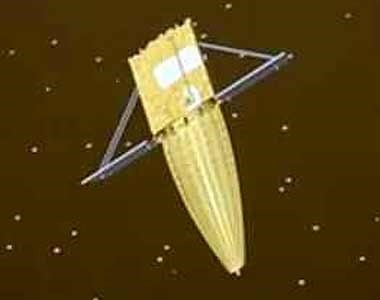
Artwork depicting XJY-7 in orbit/.
Image credit: CCTV
“Resulting sky track matches well with what all-sky cameras recorded,” reports Marco Langbroek, a specialist in space situational awareness in the Netherlands. “Spanish research partners report to me there are detections by seismic stations as well,” he said.
One resident in Arona in the southern part of the island of Tenerife reported very loud explosions.
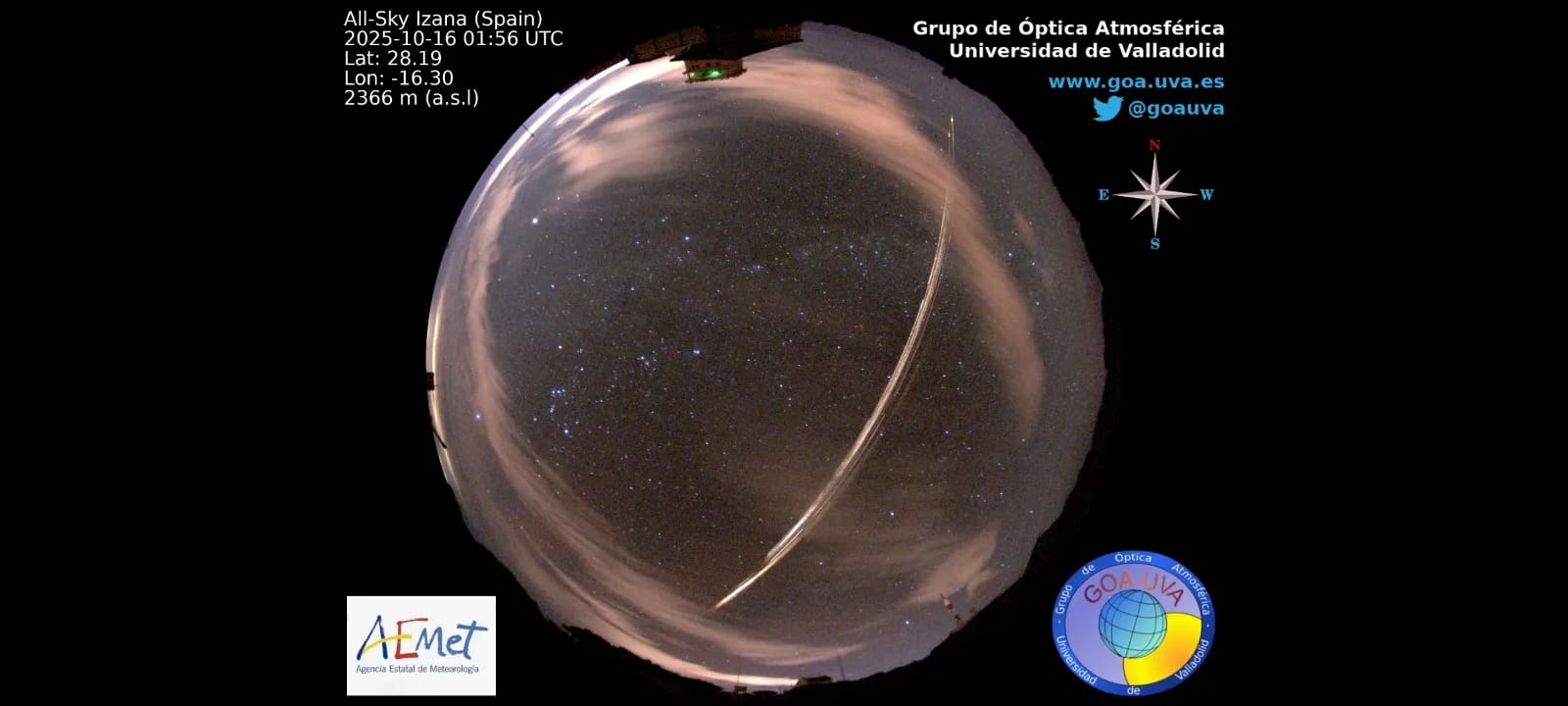
Meanwhile, Rohan Goes, posted a video on X that captured the sky fall.
Go to:
https://x.com/i/status/1978652462132191607
Also go to this video at:

