Archive for October, 2025
 Author:
  October 31st, 2025
Biofabrication of engineered tissues and grafts in microgravity environments can help sustain long-term space missions and provide insights into disease mechanisms in space.
Image credit: ETH Zurich
Researchers at ETH Zurich in Switzerland, via parabolic flight investigation, have succeeded in 3D printing human muscle tissue in microgravity. The intent is to offer a novel approach that would help space travelers cope with health risks that the human body will endure on the Moon, or transiting to Mars.
Printing biological tissue in microgravity means more realistic muscle models that reflect how tissue truly behaves in space.
The technique creates opportunities for on-orbit drug testing and disease modeling (e.g., muscular dystrophy, weightlessness-induced atrophy) in systems that better mimic the human body.

Image credit: Air Zero G by Novespace
Parabolic flights
The ETH Zurich research team used parabolic flights to simulate the microgravity of space for a short period of time. Investigations were carried out onboard an Airbus A310 Zero G flying laboratory operated by Novespace based in France.
ETH researchers developed a new biofabrication system called G-FLight (Gravity-independent Filamented Light). This system enables the rapid production of viable muscle constructs within seconds.
A follow-up aim is to use these techniques to produce complex human “organoids” and tissues on board the International Space Station or future off Earth orbital platforms.

Optical components of G-FLight printer and resin formulations.
Image credit: Michael Winkelbauer, et al.
Gravity’s disruptive forces
According to an ETH statement, “the production of fine, biological structures such as muscle tissue poses a major challenge under normal gravitational conditions on Earth. The goal is to print tissue that looks exactly like the natural structures in the body. However, gravity interferes with the process.”
That said, under microgravity, these disruptive forces disappear.
“Without structural stress, researchers can produce muscle fibers exactly as they are aligned in the body. This precise construction is crucial: only models that accurately reflect the human body structure provide reliable results when testing new drugs or studying disease progression,” the ETH statement explains.
In the micro-g environment of space, researchers can conduct basic research thanks to these ‘organ models.’ The models are used to study diseases such as muscular dystrophy or muscle atrophy caused by weightlessness.
“In addition, they can be used to test the effectiveness of therapeutics in a system that better reflects the complexity of the human body – because 3D printing in weightlessness allows muscle fibers to be aligned with such precision and accuracy,” reports the ETH.

G-FLight printer and example prints of microfilamented constructs.
Image credit: Michael Winkelbauer, et al.
Flight validation
“Biofabrication of engineered tissues and grafts in microgravity environments can help sustain long-term space missions and provide insights into disease mechanisms in space,” points out a research paper led by Michael Winkelbauer of the Institute for Biomechanics, Department of Health Sciences and Technology, ETH Zürich.
“As a necessary precursor to future space applications, we have validated the G-FLight printer within parabolic flights, which recreate several cycles of microgravity lasting 20–22 seconds, which represents the time window for printing the constructs,” Winkelbauer and colleagues report.
For access to the informative paper – “Prolonged Cell Encapsulation and Gravity-independent Filamented Light Biofabrication of Muscle Constructs” – go to:
https://advanced.onlinelibrary.wiley.com/doi/10.1002/advs.202512727
For more information on ETH Zurich, go to:
 Posted in

Image credit: Roscosmos/Makeyev State Space Center
Roscosmos, the lead Russian space agency, has announced Project Korona: Creating a fully reusable launch vehicle.
At a meeting of the Scientific and Technical Council, held at the Roscosmos facility — the Makeyev State Space Center –key technologies were detailed regarding the Korona research project. The feasibility of the project was reviewed, an effort that “will allow Russia to ensure independent access to space and enter the global space services market,” states a Roscosmos posting.
Development work will begin in 2026.
According to Roscomos, the Kornoa rocket
- will be able to quickly launch satellites into orbit,
- return damaged or retired spacecraft to Earth,
- fly from point A to point B, deliver cargo in minutes, or transport people across intercontinental distances.
Key advantages of Korona would be:
- high launch rates
- low cost of payload launch
- no need to identify impact areas
- the ability not only to launch but also to return cargo from orbit
- point-to-point flights
- preserving cargo in emergency situations
Missile design bureau

Image credit: Makeyev State Space Center
The JSC Makeyev Design Bureau is a Russian missile design company located in Miass, Chelyabinsk region, Russia. According to sources, Korona would be 98 feet (30 meters) tall, sporting a diameter of 33 feet (10 meters).
As a single-stage-to-orbit launch vehicle capable of performing vertical takeoff and landing, Korona was reportedly studied by the Makeyev Design Bureau from 1992 to 2012. But its development was curtailed due to lack of funding.
In 2016, the design bureau reportedly resumed development of the vehicle and now appears to have been given the Roscosmos go-ahead.

Robotic and human explorers are on the hunt for lunar polar volatiles that can be utilized for an extended stay on the moon.
Image credit: Hawaii Institute of Geophysics and Planetology, University of Hawaii at Manoa
Earth’s moon is a treasure trove of resources and an upcoming meeting of international experts will focus on today’s state of knowledge regarding volatiles in the lunar polar regions.
Lunar volatiles include hydrogen, water, helium, carbon dioxide, and carbon monoxide – items that can be used as a fuel source, breathable air, and as a source of drinking water.
The goal of next month’s gathering is to help prepare for an onslaught of upcoming robotic and crewed expeditions by multiple nations to explore for, investigate and ultimately utilize lunar polar volatiles.

Nine candidate landing regions for NASA’s Artemis III mission The background image of the lunar South Pole terrain within the nine regions is a mosaic of LRO (Lunar Reconnaissance Orbiter) WAC (Wide Angle Camera) images.
Image credit: NASA
Wanted: definitive measurements
As for water ice possibly lurking in sunlight-shy craters…what’s truly needed is definitive measurements of the ice content, explains one scientist.
For details, go to my new Space.com story – “Can we find water ice on the moon? Only if we know where to look, scientists say” – at:

Image credit: CCTV/Inside Outer Space screengrab
A joint drill has verified the functions and technical status of the combination of the Shenzhou-21 spaceship and its Long March-2F Y21 carrier rocket.
“Through the joint drill involving all the mission areas, we simulated the tracking and control process on the launch day,” said Zhao Guohua, a space engineer at the Qingdao Space Tracking and Control Station under the Xi’an Satellite Tracking and Control Center.

Image credit: CCTV/Inside Outer Space screengrab
Zhao said that, during the drill, technicians conducted a final inspection of the equipment and re-verified its technical status.
“We are ready to escort the Shenzhou-21 astronaut crew into space,” said Zhao.
Status go
The joint drill, held on October 29th, is like a comprehensive physical examination on the spacecraft, said Liu Xiaochen, a space engineer at the China Aerospace Science and Technology Corporation.

Image credit: CCTV/Inside Outer Space screengrab
“First, it proves that the status of all systems and equipment on the spacecraft is good. The drill also tested the conditions of mutual matching between the astronaut system and each of the major systems including the rocket system, launch site system, and telemetry and control system, proving that the interfaces are compatible and in good condition, and that the spacecraft is ready for launch,” Liu added.
Loading of propellants
In a China Central Television (CCTV) interview, He Pengju, an engineer at the Jiuquan Satellite Launch Center said: “The enclosed area where the rocket and spacecraft are located now has two layers of insulation. After today’s full-area drill and the completion of our full-system gas inspection, the following steps include the loading of rocket propellants and the final launch that everyone is eagerly anticipating.”

Image credit: CCTV/Inside Outer Space screengrab
Meanwhile, as the Chinese space station is about to enter the rendezvous and docking orbit, the Shenzhou-20 astronaut crew conducted a manual rendezvous and docking drill to prepare for the arrival of the Shenzhou-21 spacecraft.
Station handover
During the Shenzhou-21 crewed spacecraft launch, multiple land-based tracking and control stations, the space-tracking vessel Yuanwang and the Tianlian relay satellite network will sequentially handle the tracking and control tasks.
The Shenzhou-20 crew has been in orbit for half a year since their launch on April 24, 2025. The Shenzhou-21 mission will replace the Shenzhou-20 crew also for a six-month stay in orbit.
Reportedly, an October 31st launch date is targeted to send the yet to be identified Shenzhou-21 replacement crew to the Tiangong space station.

For a new video of launch preparations, go to:

What happens when you meld the search for ET with Artificial Intelligence (AI) technology?
The SETI Institute has announced it is incorporating the new NVIDIA IGX Thor platform to enhance its real-time search for signals from space at the Allen Telescope Array (ATA) situated in Northern California.
The ATA is the first radio telescope designed from the ground up to be used for SETI searches.
NVIDA is billed as a go-to source for those that need massive computing power to handle their AI needs.
Recognizing unusual or promising data
The SETI Institute is to tap into the ATA’s grouping of 42 antennas that scan the sky for radio signals that may provide clues to cosmic events or, one day, evidence of intelligent life.

NVIDIA IGX Thor.
Image credit: NVDIA
Using the NVIDIA IGX Thor platform there will be the ability to process and interpret these signals directly at the telescope, “dramatically reducing the time it takes to recognize unusual or promising data,” explains the SETI Institute.

Image credit: SETI Institute
This new collaboration builds on the SETI Institute’s earlier success with NVIDIA IGX Orin.
That effort powered the world’s first real-time AI search for fast radio bursts (FRBs)— flashes of radio energy that last milliseconds.
Greater precision
Now the move to IGX Thor will expand those capabilities, allowing researchers to analyze more of the sky, more quickly, and with greater precision.
“By combining scientific curiosity with advanced technology, we’re transforming how we explore the universe,” said Andrew Siemion, Bernard M. Oliver Chair for SETI at the SETI Institute in Mountain View, California.
“The new NVIDIA platform gives us the reliability and performance to run complex AI models right at the telescope,” Siemion said. “It’s an incredible step forward for our mission,” he explained in a SETI Institute statement.

Allen Telescope Array dedicated to astronomical observations and a simultaneous search for extraterrestrial intelligence (SETI).
Image credit: Seth Shostak/SETI Institute

International space law from decades ago was written for a world that no longer exists, explains space lawyer Michelle Slawecki Hanlon.
“The treaties that guide us, visionary as they are, were crafted when only two nations had the power to reach orbit. They focused on peace and principles, not procedures or property rights,” Hanlon explains in a recent Facebook posting.
Cold War time capsule
Hanlon notes that today there are commercial launch providers, multinational resource ventures, private stations, lunar habitats and artificial intelligence systems operating with increasing autonomy. “Yet the legal framework that governs them still reads like a Cold War time capsule,” she responded.
Lawyers are needed, but not as regulators or obstacles.

Signing of Outer Space Treaty.
Image credit: United Nations
“Lawyers are the navigators of this new era. We shouldn’t tell industry what it can’t do; we should help it understand how to do what it wants to do — responsibly, sustainably and lawfully,” Hanlon suggests.
Stalling at the edge of legality
For one, “good space lawyering” isn’t about drawing borders, Hanlon adds. “It’s about drawing pathways and aligning innovation with international obligations so that progress doesn’t stall at the edge of legality.”

Space cowboys? International lawyers are trying to agree on what legislation will be needed to control the exploration of mineral resources in space to avoid a new ‘Wild West’.
Credit: James Vaughan
Space doesn’t need more rules; it needs people who know how to use them, Hanlon says, as the next leap in human civilization “won’t be powered by rockets alone. It will be powered by law that keeps pace with technology and imagination alike.”
For more on the advancement of space law, go to the Space Law Quick Reference Booklet – Digital Edition at:
https://secure.touchnet.net/C21670_ustores/web/product_detail.jsp?PRODUCTID=1582
Image credit: CCTV/Inside Outer Space screengrab
China is set to launch its next human spaceflight crew on their Shenzhou-21 mission, the 10th piloted mission since China began the initial construction of its space station and the sixth one since the space station entered the stage of application and development.
The still unidentified Shenzhou-21 crew will replace the astronauts of the Shenzhou-20 mission, who have been in orbit for six months and will soon return to Earth. Ground teams have carried out drills at the projected landing site.
Reportedly, an October 31st launch date is targeted to send the Shenzhou-21 replacement crew to the Tiangong space station.

Image credit: CCTV/Inside Outer Space screengrab
Launch drills
The combination of the Shenzhou-21 spaceship and a Long March-2F Y21 carrier rocket was transferred to the launch area at the Jiuquan Satellite Launch Center last Friday.
Meanwhile, the Shenzhou-20 crew, who have been in orbit for more than 180 days, continue to make preparations for the upcoming space station handover with the Shenzhou-21 crew.
A joint drill for lofting the Shenzhou-21 crewed mission was held at the Jiuquan Satellite Launch Center in northwest China on Monday, October 27th.
Go to this video highlighting launch preparations at:
https://www.facebook.com/reel/1154481020118369

Image credit: Mars Guy/NASA/JPL-Caltech/Inside Outer Space screengrab
Mars Guy spotlights a rock on the Red Planet inspected by NASA’s Perseverance Rover at Jezero Crater that looks like fossilized hot spring organisms.
“Hot springs on Earth often host microbial communities that produce biofilms in their outflow channels,” says Mars Guy. “Sometimes when hot springs dry up, they leave behind fossilized streamers, which look a lot like the features in a rock found by Perseverance.”
Go to this informative video at:

Image credit: CCTV/Inside Outer Space screengrab
China’s next space station milestone is the upcoming launch of the Shenzhou-21 crew. The country has rolled out the Long March 2F/G launch vehicle with the Shenzhou-21 spacecraft atop to the launch pad at the Jiuquan Satellite Launch Center on October 24th.
“The mission is currently working towards an October 31st launch to the Tiangong Space Station,” reported China Central Television (CCTV).
Upcoming are full rehearsals of the launch process.
Who is flying?
“As is standard for China’s crewed missions, the Shenzhou-21 crew is not currently known and will be announced in the days before launch through two press conferences,” CCTV adds.

China’s Shenzhou-20 crew.
Image credit: CMSA/CCTV/Inside Outer Space screengrab
Now in orbit the Shenzhou-20 trio — Commander Chen Dong, Operator Chen Zhongrui, and Science Operator Wang Jie — who have been in space since April 24th, about six months ago.
Once the Shenzhou-21 crew arrives, the six taikonauts will spend about a week together onboard China’s Tiangong space station, before the Shenzhou-20 mission returns to Earth in November.

China’s Tiangong space station as imaged by MAXAR satellite.
Image credit: MAXAR
Design changes
“This rocket incorporates 16 design changes, with the most important one being the fully upgraded optical navigation system, which greatly improves the redundant inertial measurement units and boost flight reliability,” Sun Yanqiu, an engineer of the China Aerospace Science and Technology Corporation, told CCTV.
The Shenzhou-21 will be the 10th crewed mission since China began the initial construction of its space station.
For a video of the rollout, go to:
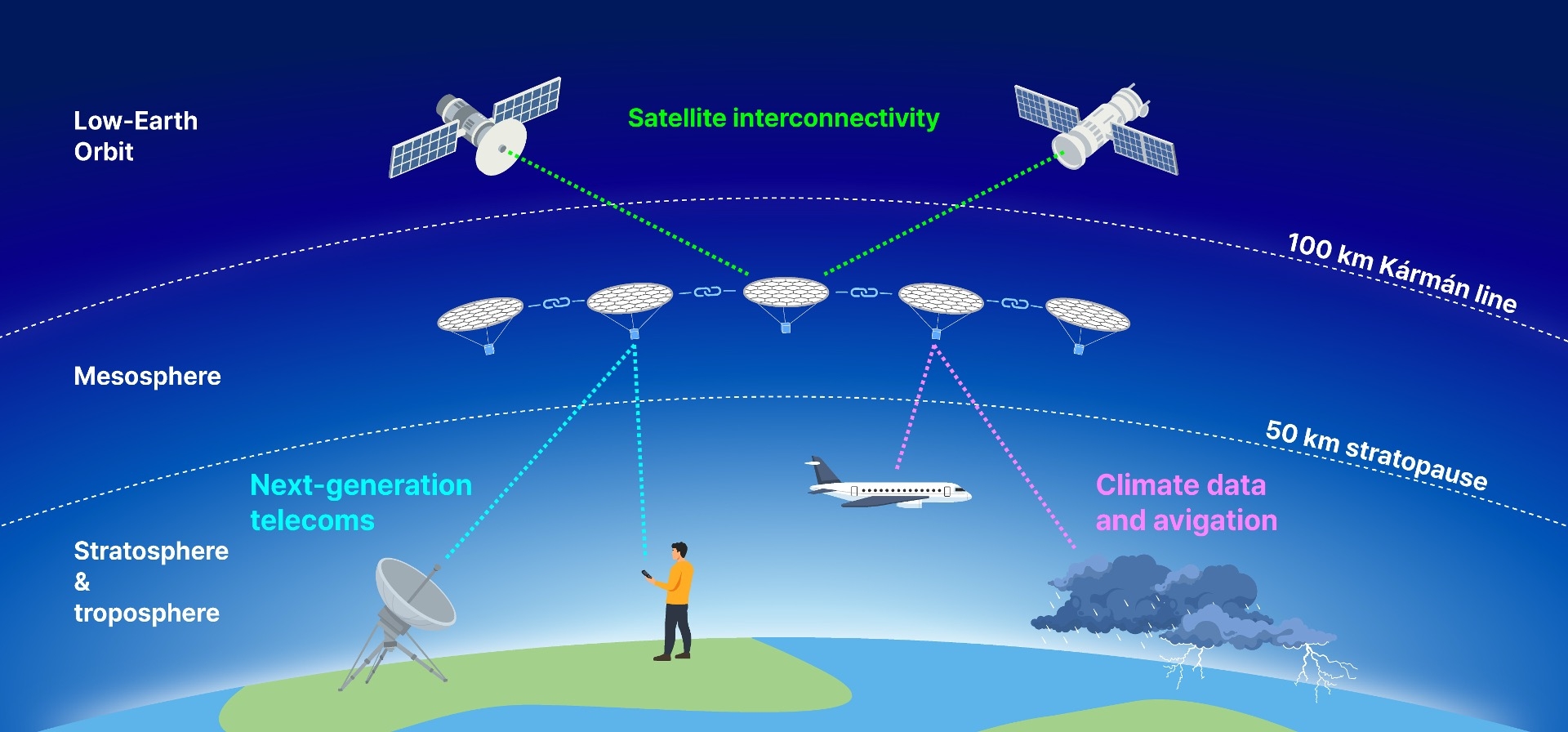
Illustration of photophoresis devices and their uses.
Image credit: Ben Schafer and Jong-hyoung Kim
A slice of Earth’s atmosphere seemingly gets no respect.
There is a high-altitude expanse that is often referred to by scientists as the “ignorosphere,” an under-studied and under-appreciated atmospheric layer because it is above surveillance by aerial vehicles and too low for steady monitoring by speeding satellite sensors.
A research team has come up with a way to grab data from that overlooked region of the unknown. They have tested and validated lightweight nanofabricated structures that can passively float at a level of our planet’s atmosphere that stretches from 50 to 85 kilometers altitude, a region tagged as Earth’s mesosphere.
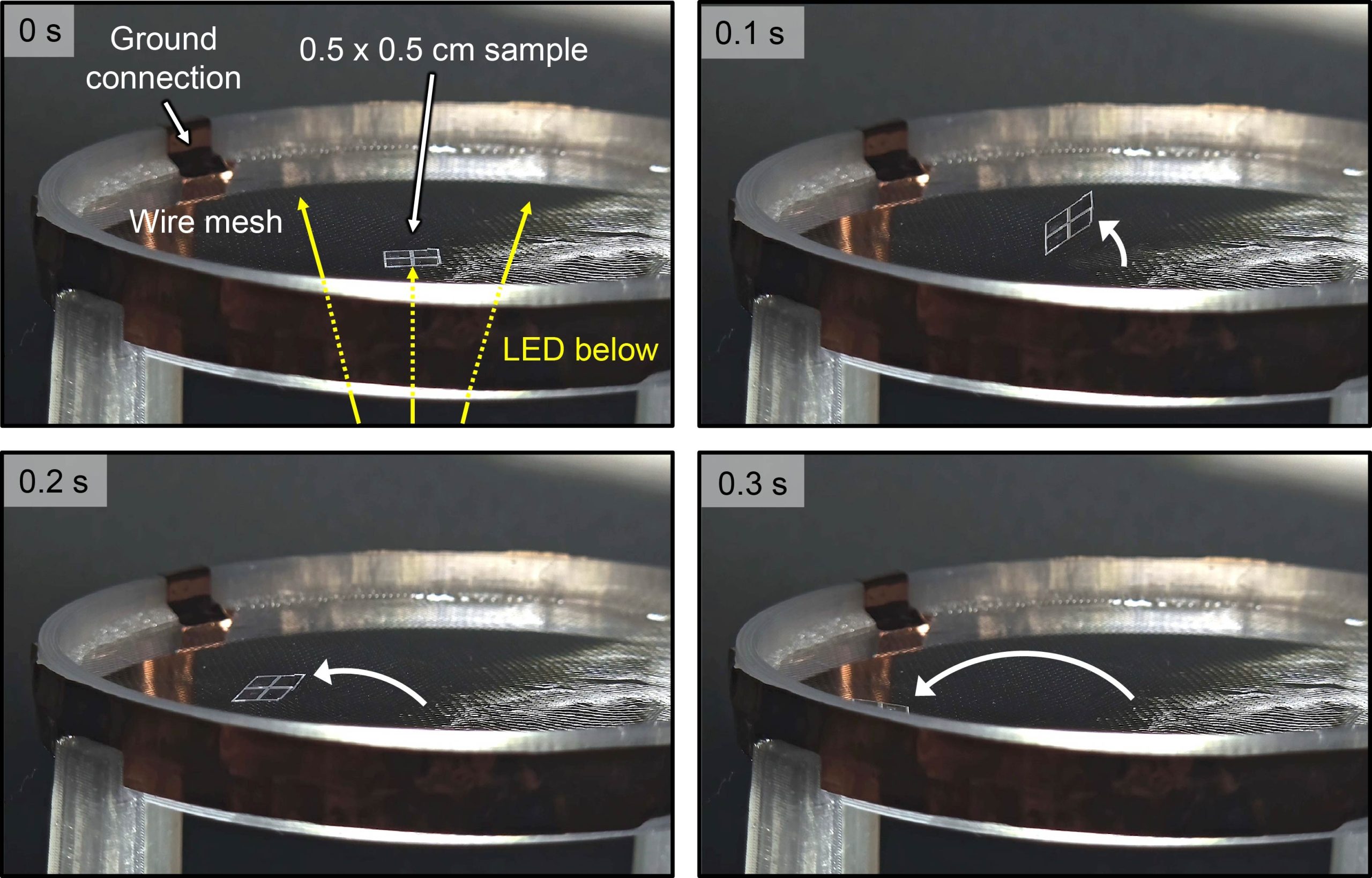
Time-lapse photos of a micro-structure flying when illuminated. Proof-of-concept experiments support use of such devices to fly in the uncharted mesosphere using photophoresis.
Image credit: Ben Schafer, Jong-hyoung Kim, and Gyeong-Seok Hwang
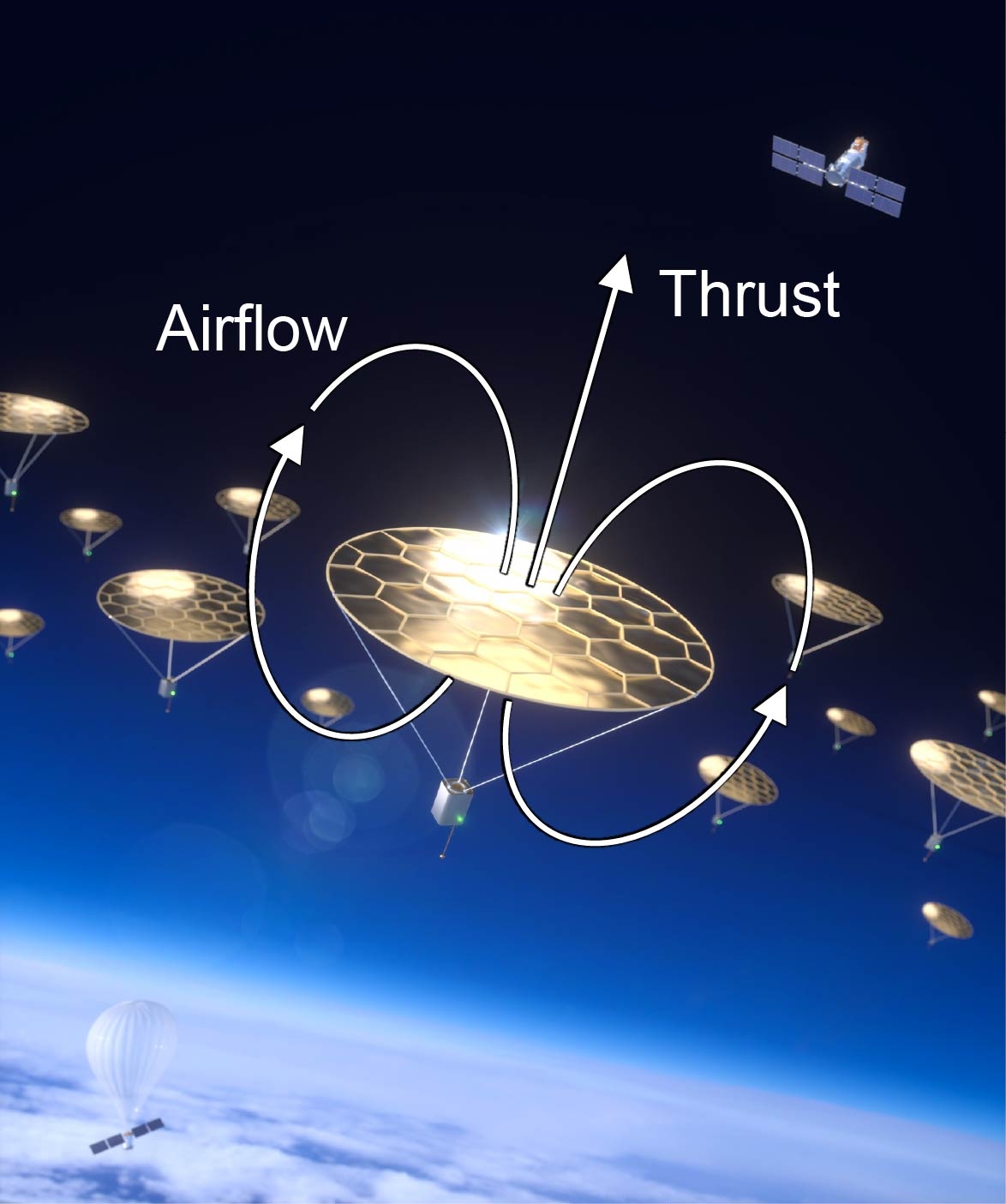
Diagram depicts airflow around a flying device.
Image credit: Ben Schafer and Jong-hyoung Kim
For details, go to my new AIAA Aerospace America story — An upcoming demonstration could shed light on this little-studied atmospheric layer – at:

