Archive for July, 2025
 Author:
  July 18th, 2025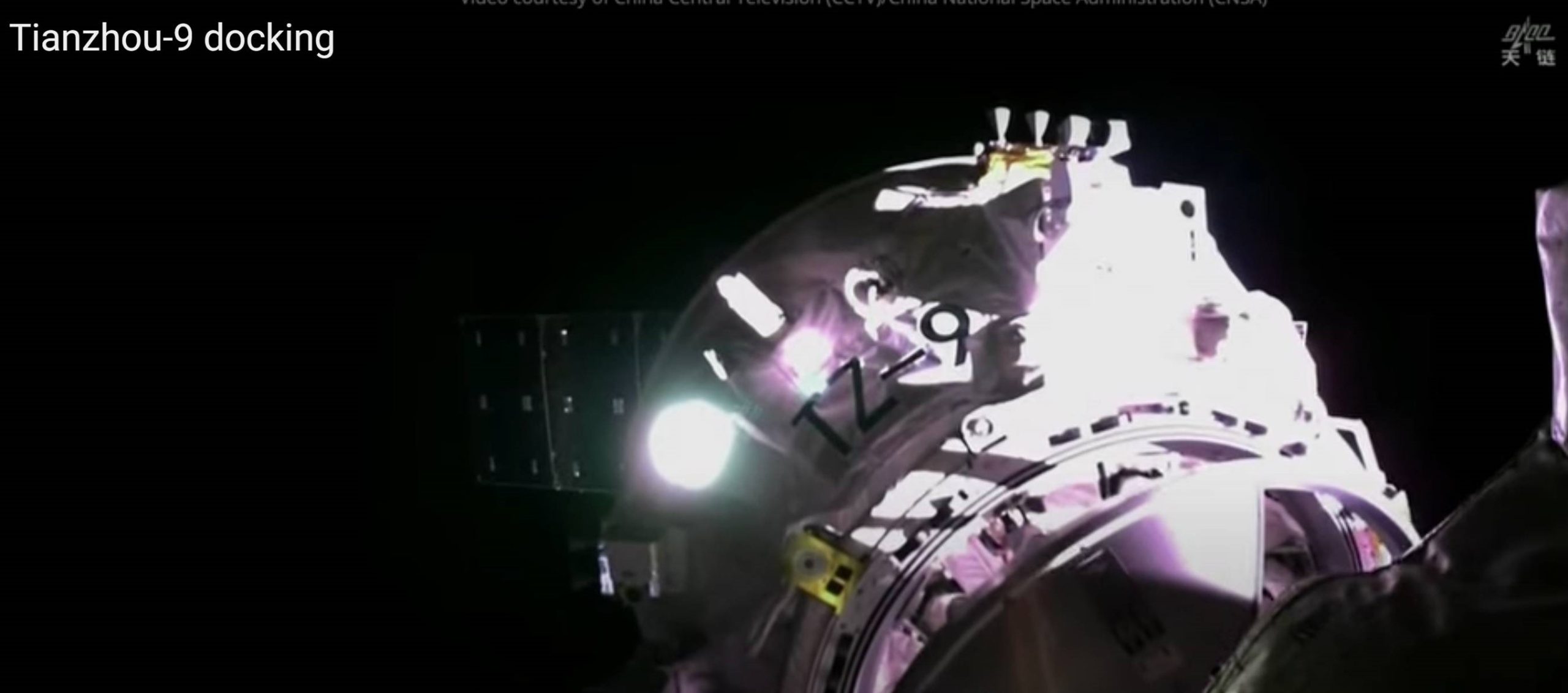
Image credit: CCTV/CMSA/Inside Outer Space screengrab
The Tianzhou-9 cargo spacecraft that recently docked to China’s space station is helping shape the country’s human Moon landing effort.
China employs a three-level positioning approach to rendezvous and dock with the space station. The BeiDou Navigation System first brings the spacecraft within 3 miles (five kilometers) of the space station. The two spacecraft then close the distance to within roughly 330 feet (100 meters). Finally, laser radar achieves millimeter-level positioning when they are 65 feet (20 meters) apart.
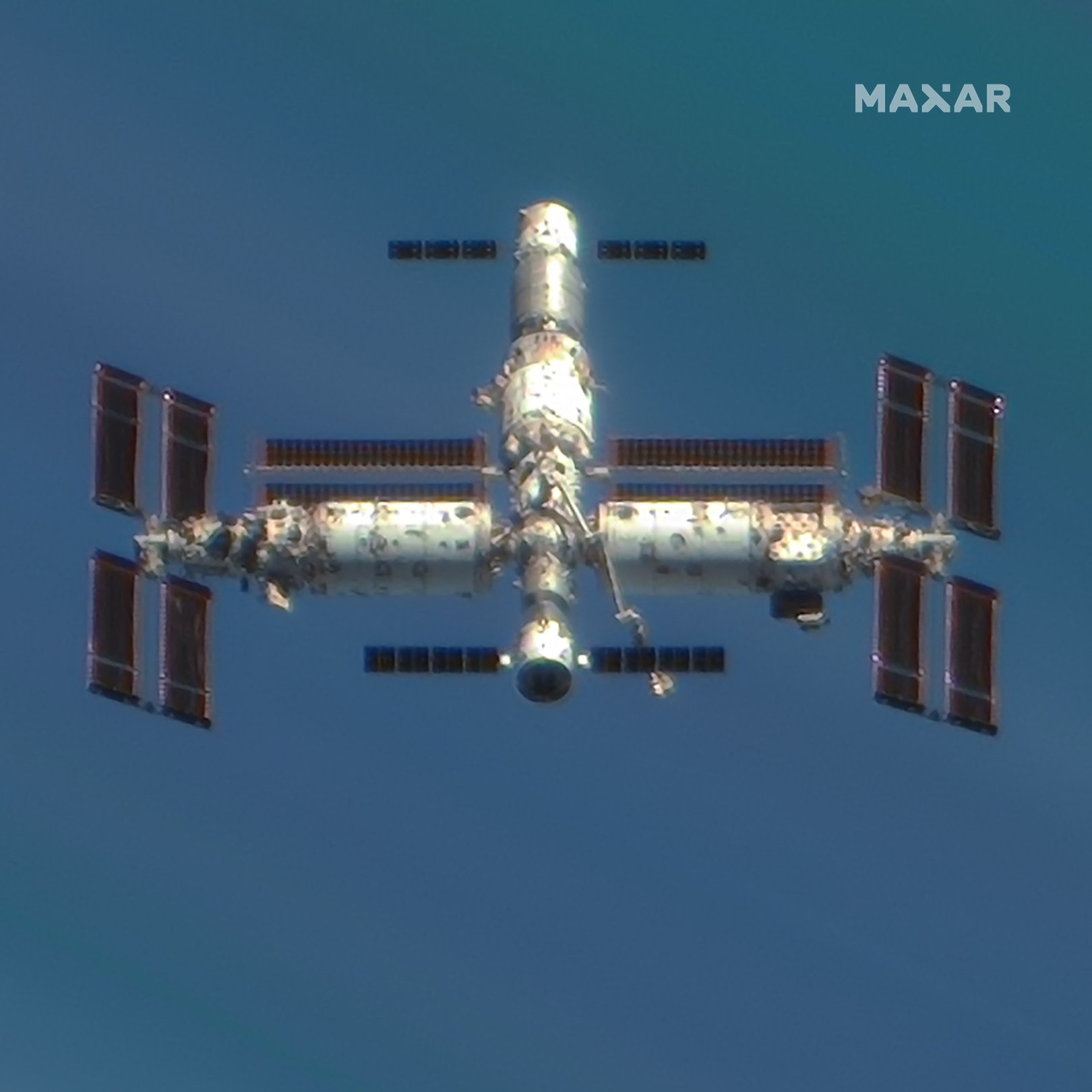
Satellite photo of China’s space station. Image credit: MAXAR
Similarly, China’s lunar robotic return sample missions — Chang’e-5 and 6 — conducted rendezvous and docking in lunar orbit, returning with lunar samples.
Upcoming crewed missions are set to include multiple rendezvous and dockings in lunar orbit, China Central Television (CCTV) reports.
Advanced EVA suits
Also tied to sending crews to the Moon is delivery of two advanced Feitian spacewalk suits to China’s orbital outpost, “marking a technological leap in extravehicular equipment for the country’s space station program,” adds CCTV.
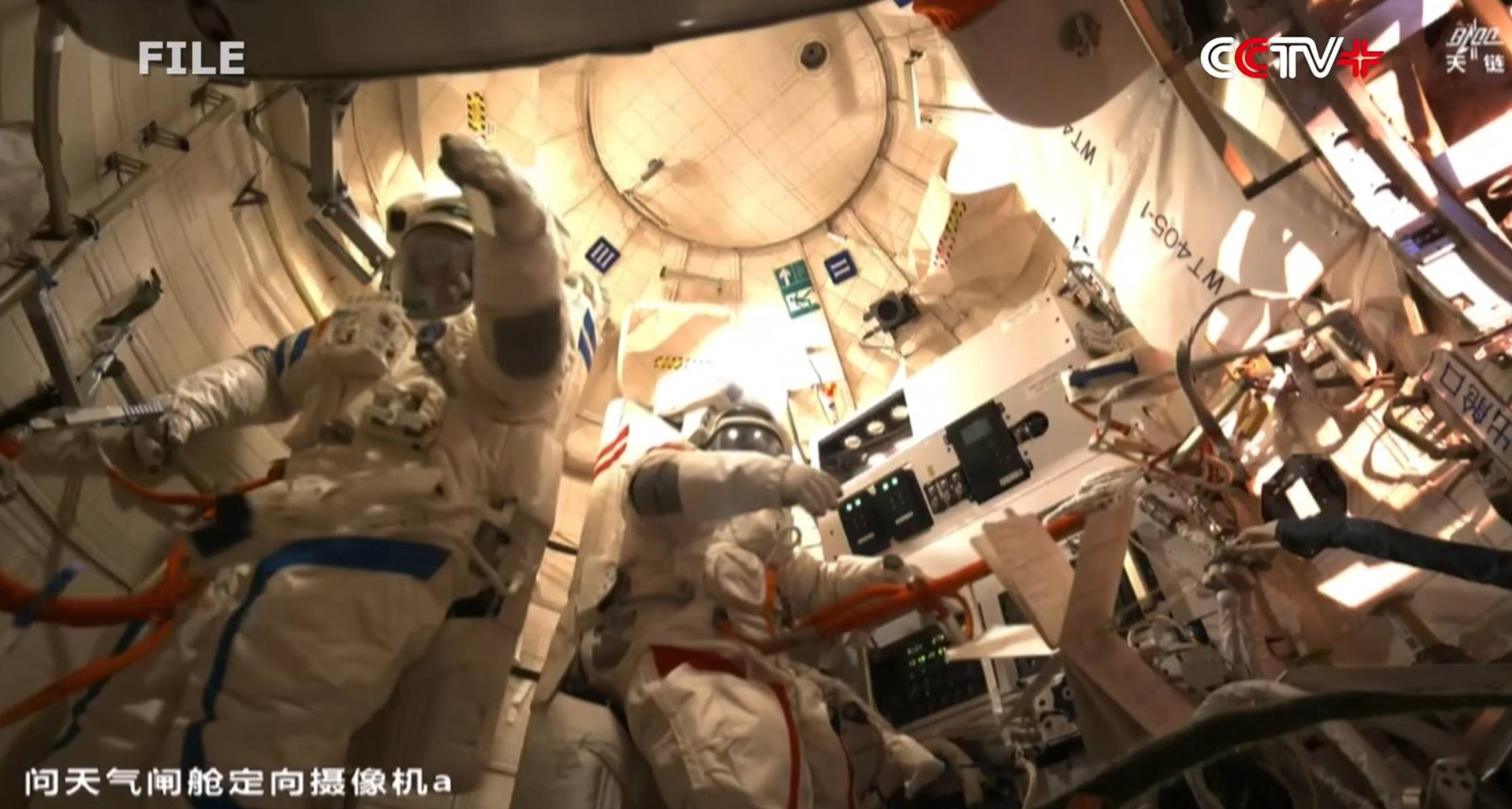
Image credit: CCTV/CMSA/Inside Outer Space screengrab
Tianzhou-9, the fourth cargo spacecraft in the application and development phase of China’s space station, was loaded with about 6.5 tons of supplies — consumables, propellants, science experiments and equipment – to support the in-orbit life and working of China’s now orbiting Shenzhou-20 crew and a future trio of Shenzhou-21 astronauts.
Muscle exercise device.
Also carried to the facility was a core muscle exercise device.
Li Yinghui, a researcher at the China Astronaut Research and Training Center told CCTV: “The stronger (our astronauts are), the longer and farther we can go. Core strength is crucial not only for space station operations but also for future missions to the Moon.”
Li added, “when we first arrive on the Moon, maintaining postural stability is crucial, and core muscles play a key role in that. So this is also part of our preparation to ensure astronauts have the physical control and motor ability required for future lunar exploration.”
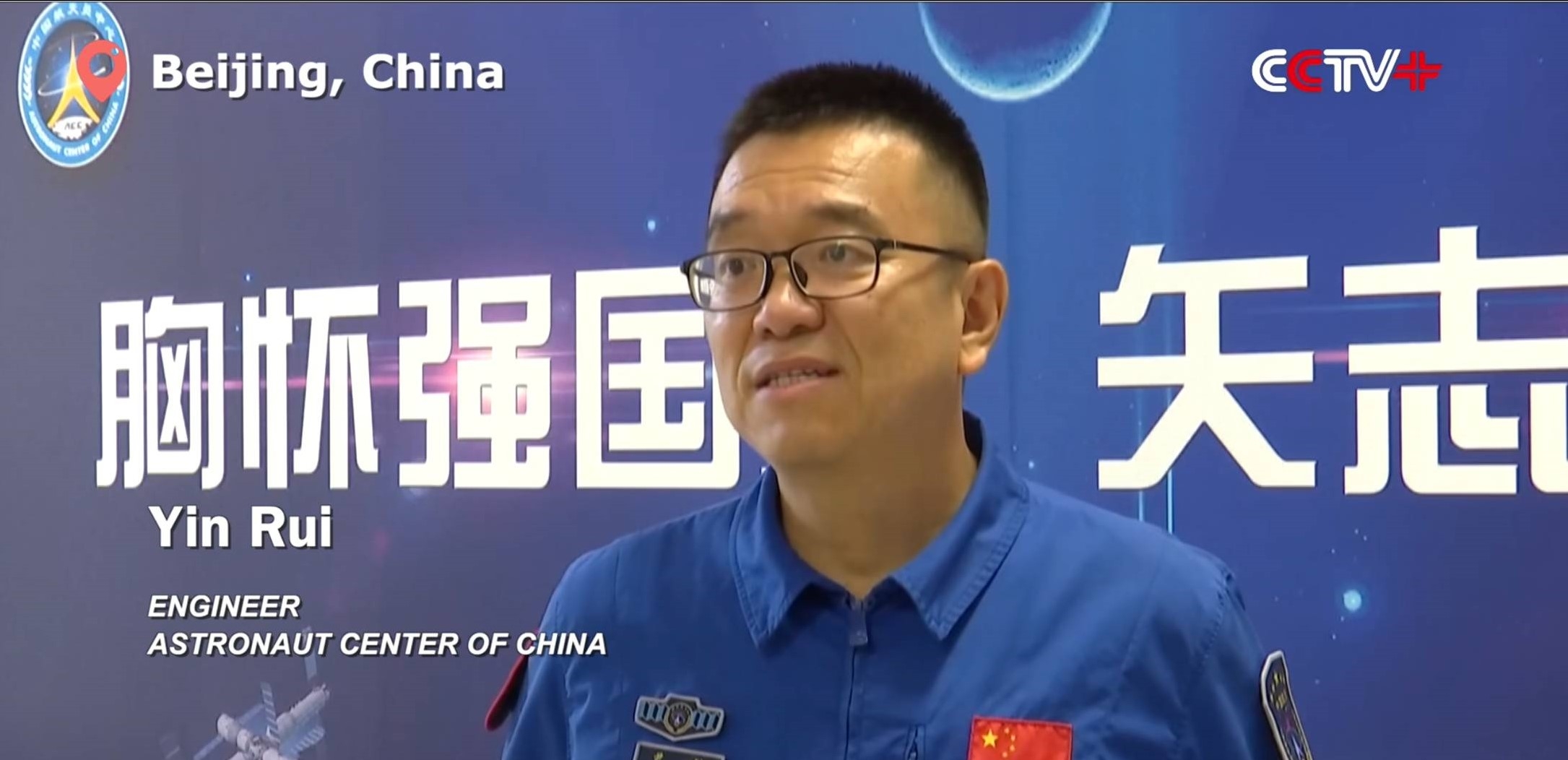
Image credit: CCTV/Inside Outer Space screengrab
Increased performance metrics
Regarding the two new sets of Feitian extravehicular spacesuits, Yin Rui, an engineer at the Astronaut Center of China, said the upgraded space walking suits have increased performance metrics. “These new suits now last four years and can support 20 spacewalks, compared to the previous three-year, 15-mission lifespan,” Yin said.
“Following our principle of continuous design optimization,” Yin added, “we’ve established China’s first space suit lifespan evaluation system based on data from 42 astronaut participations across 21 spacewalks, combined with extensive ground testing.”

Image credit: CCTV/CMS/Inside Outer Space screengrab
According to CCTV, the suit refinements come as China develops its next-generation “Wangyu” moonwalking suits for future lunar missions, with researchers making strides in life support systems and space suit ergonomics.
Emergency response
Li Zhiyong, a researcher with the China Aerospace Science and Technology Corporation noted that “Tianzhou-9 is the first cargo spacecraft capable of emergency launch, able to be launched to the space station within three months if required. This is the significance of an emergency response spacecraft.”
The rendezvous and docking duration has been shortened from the initial two days to 6.5 hours, and to the current three hours, said Li. “The three-hour approach helps us reduce fuel consumption and takes relatively less time, plus we have a lot of autonomous control to ensure the reliability of the rendezvous and docking.”
Tianzhou-9 was lofted on July 15 (local time) by a Long March-7 Y10 rocket that departed from the Wenchang Spacecraft Launch Site in the southern island province of Hainan.
Go to this CCTV video at: https://www.facebook.com/share/v/18tztGuUDF/

Image credit: CCTV/CMSA/Inside Outer Space screengrab
 Posted in

Image credit: Kall Morris Inc (KMI)
A robotic system outfitted with mechanical tentacles has been tested onboard the International Space Station.
Called REACCH, this system can carefully clutch and move objects in space, even objects not designed to be embraced.
Kall Morris Inc (KMI), a space logistics company, is headquartered in Marquette, Michigan and has completed the first commercial demonstrations of REACCH on the ISS.
Capture cycles
Launched aboard SpaceX CRS-31 on November 4, 2024, REACCH spent over eight months within the ISS where it was operated in six separate test sessions by astronauts Suni Williams, Butch Wilmore, Don Pettit, and Takuya Onishi.
Following 172 capture cycles aboard the ISS, REACCH was returned to Earth aboard the SpaceX CRS-32 Dragon capsule on May 25, 2025.
Operated by the Astrobee payload, REACCH became the largest ever Astrobee payload by both mass and volume. Additionally, KMI became the first commercial entity to capture an unprepared object in space and became the first private company to capture objects repeatedly in space.

REACCH patent and digital mockup of Astrobee with REACCH during ISS experiment.
Image credit: Kall Morris Inc (KMI)
KMI is reviewing what was learned in flexing the REACCH tentacles and is continuing technology iteration, embarking upon the next stage of development.
A full-scale, commercial-ready flight demonstration is planned for the first quarter of 2028, using lessons learned from the ISS campaign.
Long and short of it
REACCH is short for Reactive Electro-Adhesive Capture ClotH. “The short name is a play on the robotic ‘octopus tentacles’ that quite literally ‘reach’ for satellites and other space objects,” said Gabby Muehlenbeck, KMI’s design and communications coordinator.
“The long name references the electro-adhesion and Gecko adhesion capture cloth material that is hosted on the robotic tentacles of REACCH,” Muehlenbeck told Inside Outer Space.

Image credit: Kall Morris Inc (KMI)
Making use of its bio-inspired tentacle arms, REACCH is designed to provide satellite operators an in-space capability to safely move objects of nearly any shape, size, or surface without damage or leaving residue.
REACCH supports KMI’s Relocation as a Service (RaaS), an innovative approach for commercial, national security, or scientific satellite repositioning, repair, or retiring spacecraft.
The results of this demonstration will further enable REACCH for its critical mission of orbital debris collection.
“The success of these tests showcase the immense capability of the REACCH system and most notably advance the state of the art of microgravity capture of uncontrolled objects,” said Austin Morris, KMI co-founder and director of engineering in a company statement.

OTV-6 return. Image credit: Boeing/Inside Outer Space screengrab
Trump’s ‘One Big Beautiful Bill’ gives US Space Force $1 billion for secretive X-37B space plane: Go to Space.com story at:
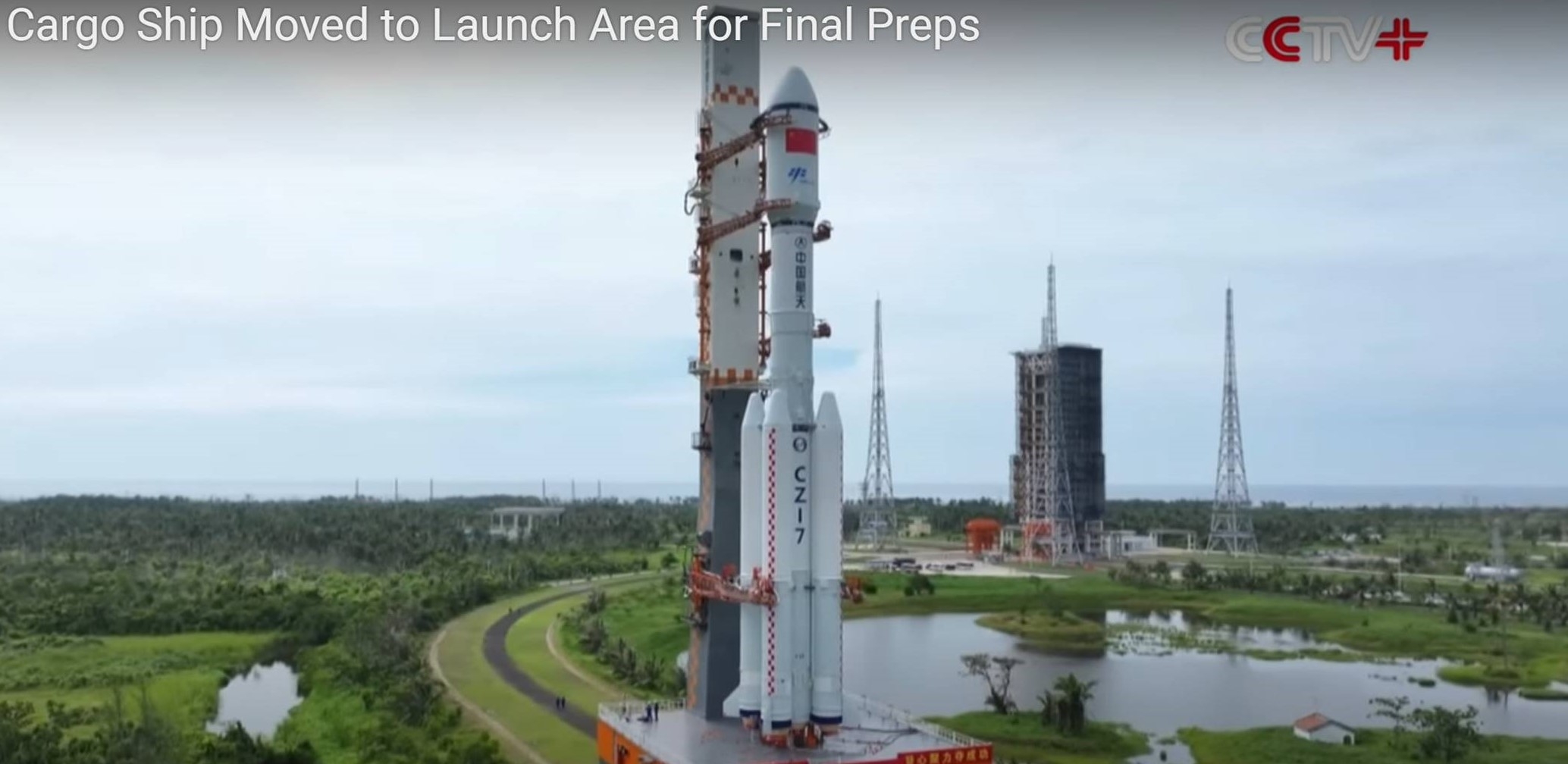
Image credit: CCTV/Inside Outer Space screengrab
The National Disaster Risk Reduction and Management Council (NDRRMC) of the Philippines have issued a “rocket Launch Advisory.”
The NDRRMC cautions the public for the possible falling of debris from the People’s Republic of China’s Long March 7 rocket that is scheduled to be launched July 15-17.
The Chinese rocket is topped by the uncrewed Tianzhou-9 space station supply ship to be launched from Wenchang Space Launch Site in Wenchang, Hainan with parts of the rocket expected to drop within a set of identified drop zones.
Tianzhou-9 is carrying 6.5 tons of food, water, fuel and scientific equipment. Being used is a Long March-7 Y10 booster to loft the Tianzhou-9 cargo spacecraft. This supply ship carries the highest payload weight, carrying hundreds more of kilograms than its predecessors.
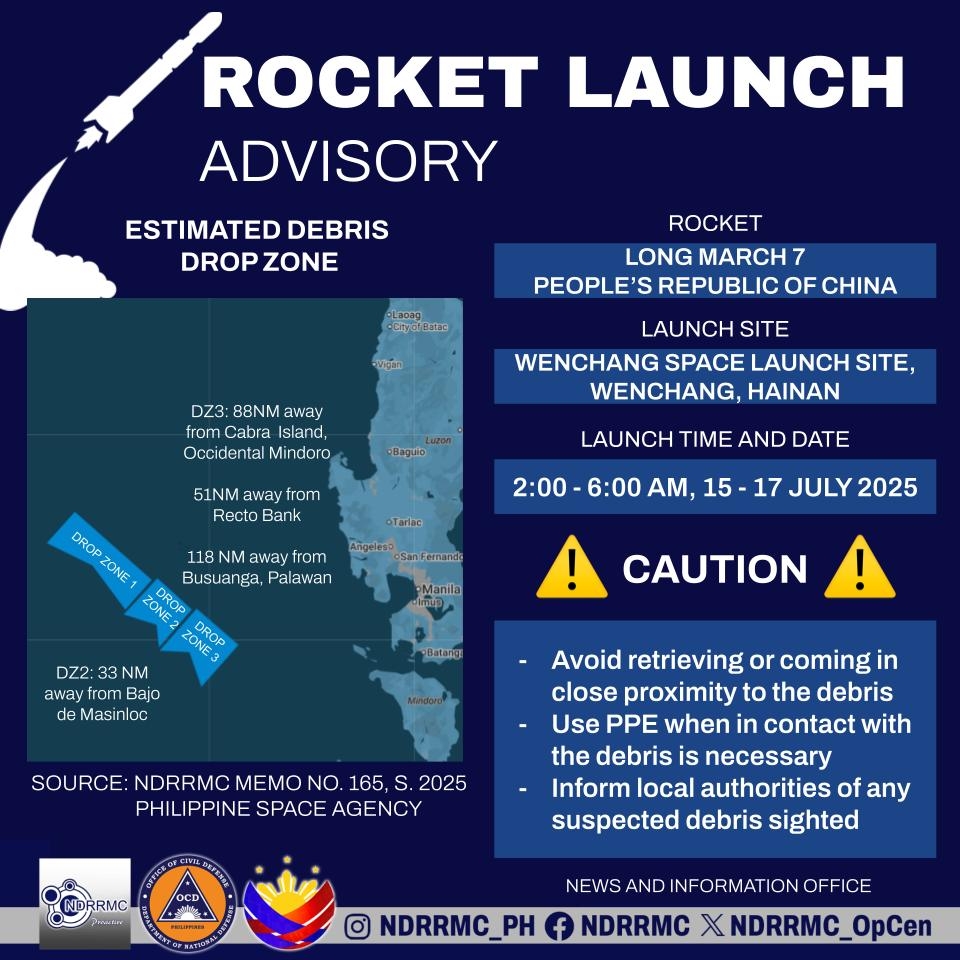
Image credit: National Disaster Risk Reduction and Management Council (NDRRMC)
Toxic fuel
The Philippine Space Agency cautions everyone against retrieving or coming near these materials “to minimize risk from remnants of toxic substances such as rocket fuel.”
The public is advised to immediately inform local authorities of any suspected debris sighted at sea or land.
Philippine Coast Guard (PCG), Bureau of Fisheries and Aquatic Resources (BFAR), and Department of Environment and Natural Resources (DENR) NAMRIA are advised “to consider temporary restrictions and the issuance of Notice to Mariners, Coastal Navigational Warnings, or NAVAREA XI warnings as applicable in the identified drop zones.”
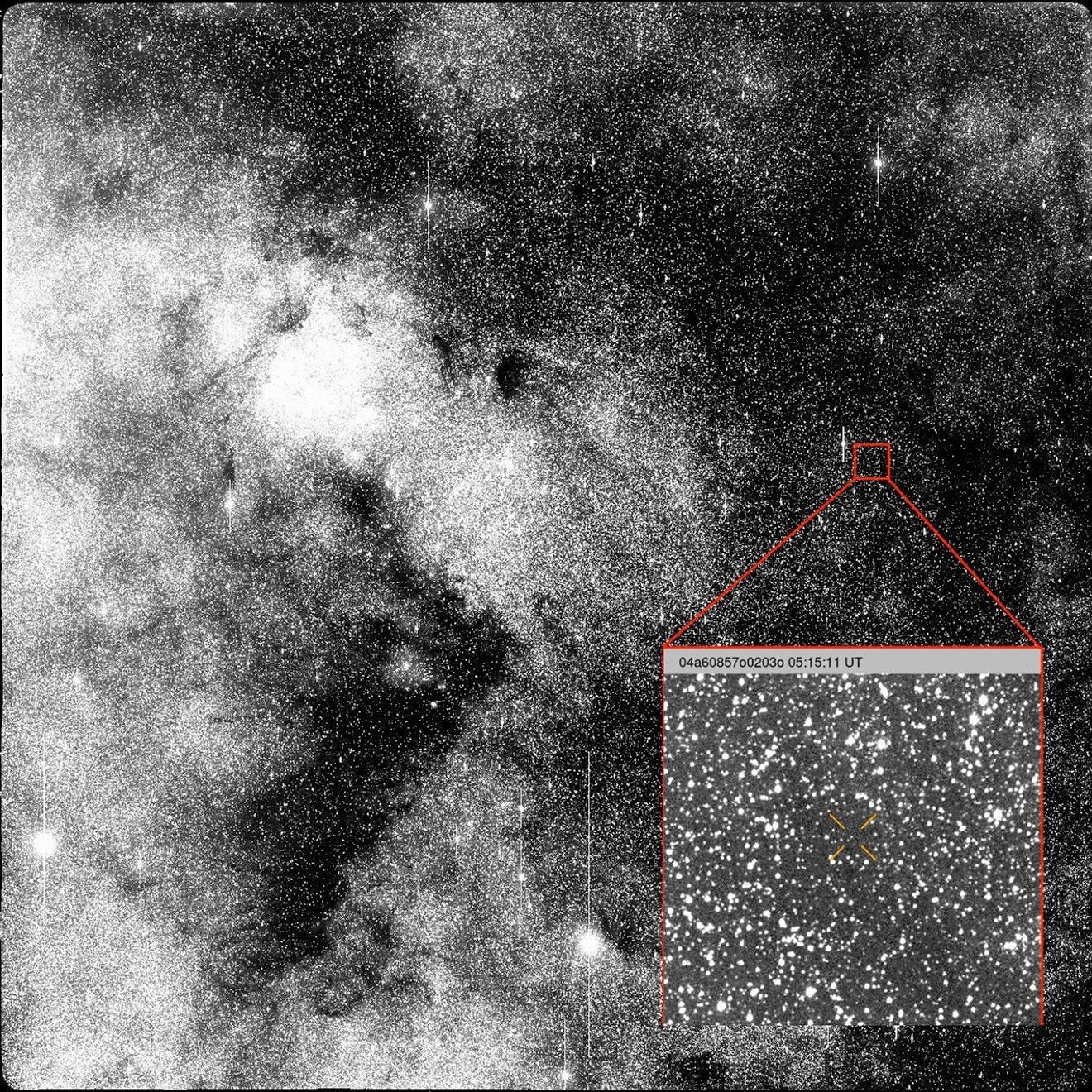
This image shows the observation of comet 3I/ATLAS when it was discovered on July 1, 2025. The NASA-funded ATLAS survey telescope in Chile first reported that the comet originated from interstellar space.
Image credit: ATLAS/University of Hawaii/NASA
Is the new interloper in our solar system — 3I/ATLAS — a comet or something else?
That’s an intriguing question posed by Avi Loeb, head of the Galileo Project, a founding director of Harvard University’s Black Hole Initiative, and director of the Institute for Theory and Computation at the Harvard-Smithsonian Center for Astrophysics.
Never shy about probing and questioning the cosmos, Loeb has looked at new observational data of 3I/ATLAS, calling attention to several factoids.
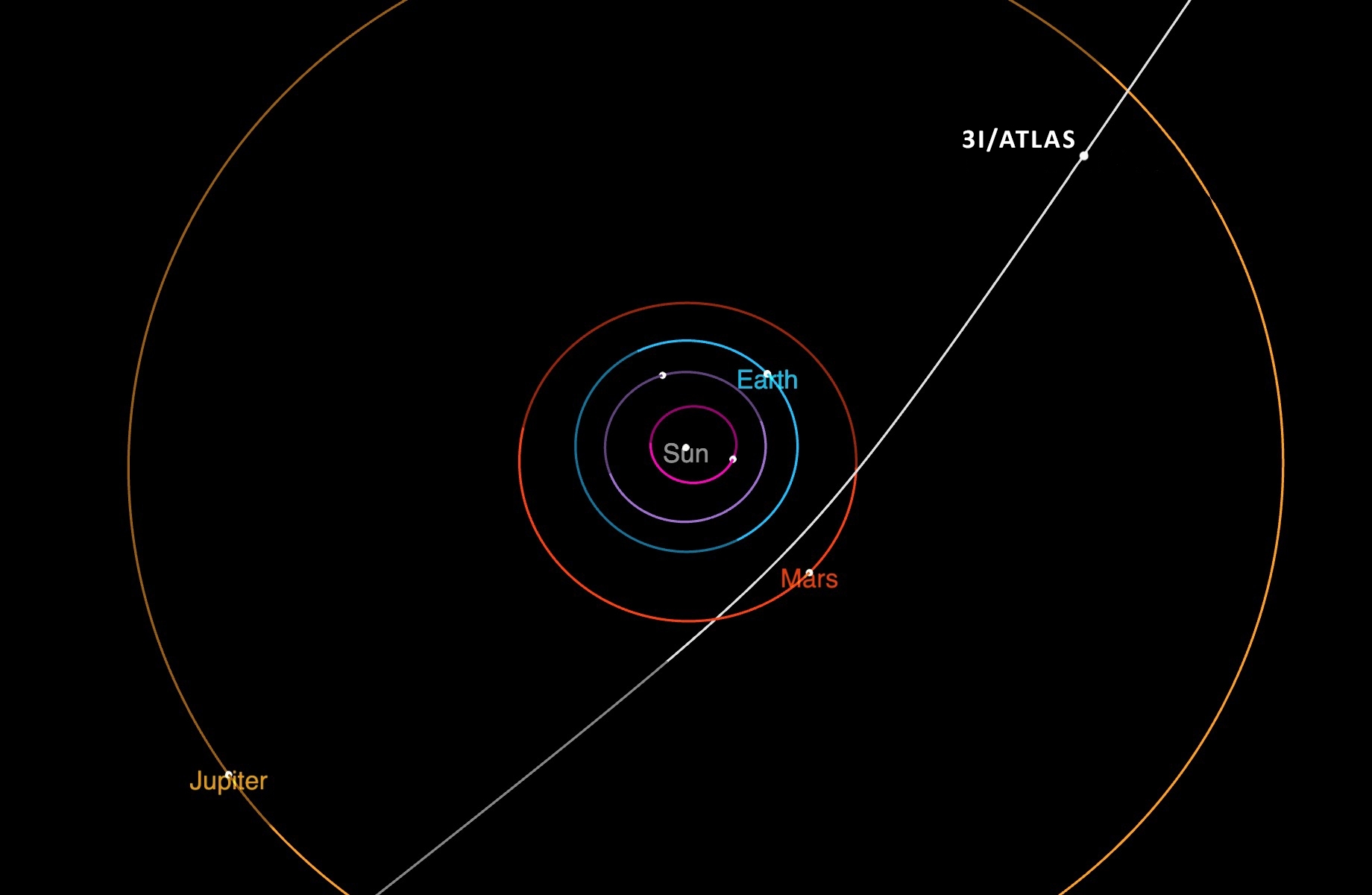
This diagram shows the trajectory of interstellar comet 3I/ATLAS as it passes through the solar system. It will make its closest approach to the Sun in October.
Image credit: NASA/JPL-Caltech
Puzzling size
For one, the total brightness of 3I/ATLAS remained nearly constant over a period of a few days, suggesting that either the object is hidden beyond the veil of dust or it is nearly spherical, Loeb explains.
“Future observations of 3I/ATLAS as it comes closer to the Sun will provide a key opportunity to witness the evolution of its activity, infer the size of its solid nucleus, study its composition, test predictions for the abundance and velocity dispersion of its population, and compare 3I/ATLAS to Solar System comets,” Loeb explains in a recent essay.
The fundamental question, Loeb adds, “is whether 3I/ATLAS is a comet with a kilometer-scale nucleus or a solid object that is 20 kilometers in diameter which shows very limited evaporation? In the latter case, the large size of 3I/ATLAS is puzzling.”
3I/ATLAS, expected to get more prominent as the object is heated along its path to closest approach from the Sun (perihelion), is anticipated to occur on October 29, 2025.

Avi Loeb
(Image Credit: Chris Michel, National Academy of Sciences, 2023)
Forrest Gump effect
Loeb advises stay-tuned for future spectroscopic data from space-based telescopes — like the James Webb or Hubble space telescopes, including the state-of-the-art ground-based Vera C. Rubin Observatory.
If those instruments demonstrate that 3I/ATLAS has a solid core with a diameter of order 12 miles (20 kilometers) or more, “then the limited interstellar reservoir of rocky materials would suggest that its trajectory favored a plunging orbit towards the inner Solar system, perhaps by technological design,” Loeb speculates.
Concludes Loeb, paraphrasing Forrest Gump: “Science is like a box of chocolates, you never know what you’re going to get.”
Go to Loeb’s new research paper in draft– “Comment on Discovery and Preliminary Characterization of a Third Interstellar Object: 3I/ATLAS” at:

Image credit: Mars Guy/Inside Outer Space screengrab
Mars Guy takes a look at recent coring operations by NASA’s Perseverance Rover busily working within Jezero Crater.
The robot extracted a sample that was momentarily stuck in limbo. After some cajoling, the piece was freed from the teeth of the coring bit, only to arrive in another state of limbo.

Image credit: Mars Guy/Inside Outer Space screengrab
Also discussed is the Perseverance cache of 21 samples stored in the belly of the Mars machinery – also in a state of limbo.
Highlighted is a Rocket Lab proposal to bring back the stash of collectibles. Spotlighted as well is the SpaceX/Elon Musk plan for future Mars exploration.

Image credit: Mars Guy/Rocket Lab/Inside Outer Space screengrab
Go to this informative video at:
https://www.youtube.com/watch?v=nIO1lfpqDcc

Image credit: Mars Guy/SpaceX/Inside Outer Space screengrab

Asteroid mining is on the mind of AstroForge, a private firm. They were successful in getting their Odin spacecraft headed outward to reconnoiter 2022 OB5, a small near-Earth asteroid, but later lost contact with the probe.
Image credit: AstroForge
GOLDEN, Colorado – There are those that envision big bucks pouring in from the heavens by cashing in on resource-rich asteroids.
In increasing number, probes are being dispatched by multiple countries that can plumb the depths of deliverables from space rocks.

NASA Psyche spacecraft is set for arrival in August 2029 at its target asteroid, Psyche. It is supposedly sporting a metal core that some space miners hungrily value at many trillions of dollars.
Image credit: NASA/ASU
School of hard knocks and rocks
But could it be more advantageous, and therefore more lucrative, to mine asteroids that have impacted the Moon rather than the ones that are zipping through space.
Can humanity enjoy the benefits of both asteroid and lunar mining without compromise, or do we have to choose one at the expense of the other?
To learn more, go to my new Space.com story – “Could asteroid mining actually work? Maybe if we start with impact sites on the Moon” — at:

Image credit: NASA via ISS

Image credit: MAXAR Intelligence
An in-orbit spacecraft has snapped crystal-clear imagery of China’s Shijian-26 spacecraft, a Chinese optical remote sensing satellite.
This type of satellite-to-satellite observation heralds a new ability for space situational awareness, suggests Susanne Hake, general manager of Maxar Intelligence, operator of the WorldView Legion satellite constellation. “This capability fundamentally changes space security for the future.”
As space becomes increasingly crowded with thousands of new satellites from multiple nations, “we can now monitor satellite operations, detect modifications or threats, and provide near real-time intelligence on space-based assets in unprecedented detail,” Hake adds. “It’s like having a microscope trained on the new space race, ensuring we can protect critical infrastructure and communications while maintaining strategic awareness of emerging space capabilities.”

Image credit: MAXAR

Chang’e-6 scooping operation on Moon’s far side.
Image credit: CNSA/CLEP
China’s pioneering robotic lunar sampling mission — Chang’e-6 – is shedding light on the evolution of Moon’s far side.
Last year, the Chang’e-6 lunar lander system collected 1,935.3 grams of lunar far-side samples and rocketed them back to Earth.
These samples were collected from the South Pole-Aitken (SPA) Basin, the largest, deepest, and oldest basin on the Moon.
The specimens under intensive study are helping to clarify the compositional differences between the near and far sides of the Moon.

China’s Chang’e-6 lander/ascender in far side sampling scenery.
Image credit: CNSA/CLEP
Large basalt sample
Chinese researchers are reporting that a large basalt sample collected during the Chang’e-6 lunar mission is around 2.5 centimeters in size and weighs around 10 grams.
“It’s extremely rare to find rock fragments larger than one centimeter. The majority of the rock debris we collected is mostly around 0.1 centimeters,” said Zhou Qin, an associate research fellow at the National Astronomical Observatories of the Chinese Academy of Sciences.

Zhou Qin, an associate research fellow at the National Astronomical Observatories of the Chinese Academy of Sciences.
Image credit: CCTV/Inside Outer Space screengrab
“It’s basalt. The dark regions visible on the lunar surface are comprised of this type of rock,” Zhou told China Central Television (CCTV).
“For smaller rock debris, due to the limitations of its size or weight, the scientific analyses we can conduct are relatively limited. Therefore, for the larger one, we can conduct more scientific analyses,” Zhou said.
Thin sections
Given that large sample, a small portion of it is used to make thin sections to observe its petrographic features and determine its mineral composition.

Image credit: CCTV/Inside Outer Space screengrab
“Additionally, we can take a bit more of the sample to conduct some high-precision quantitative work, including its elemental chemical composition and isotopic composition,” said Zhou. “All these can be done simultaneously, which is equivalent to viewing and interpreting the same sample from different dimensions. However, for the smaller sample particles, we cannot interpret the matter from multiple dimensions at the same time.”
Lunar researchers have obtained ancient magnetic field information from the far side of the Moon, revealing a possible rebound in the Moon’s magnetic field intensity around 2.8 billion years ago.
“This discovery indicates the presence of fluctuations in the driven power of the lunar dynamo,” CCTV notes.

Image credit: CCTV/Inside Outer Space screengrab
Water content
“Scientists have found that the water content in the lunar far-side mantle is significantly lower than that of the near side, indicating a significant difference in water distribution between the two hemispheres.
The researchers have also found that the mantle source of basalt from the SPA basin is extremely depleted in incompatible elements, underscoring the profound influence of large impacts on the evolution of the Moon’s deep interior.
Four studies by the research teams from the Institute of Geology and Geophysics, the National Astronomical Observatories, both under the Chinese Academy of Sciences (CAS), Nanjing University, and other institutions were published in the latest issue of Nature.

The CAS held a press conference on Wednesday of this week to introduce these research findings.
Go to Nature, Volume 643 Issue 8071, 10 July 2025, at:
https://www.nature.com/nature/volumes/643/issues/8071
Also, go to this informative CCTV video at:

The U.S. Space Force’s X-37B Orbital Test Vehicle Mission Seven successfully landed at Vandenberg Space Force Base, Calif., March 7, 2025. The X-37B landed at Vandenberg SFB to exercise the service’s ability to recover the spaceplane across multiple sites.
Image credit: U.S. Space Force courtesy photo
U.S. President Trump’s “One, Big Beautiful Bill Act,” H.R. 1 includes $1 billion for the U.S. Space Force (USSF) X-37B military spacecraft program.
That classified robotic space plane effort – also called the Orbital Test Vehicle (OTV) program – carried out its seventh mission, landing at Vandenberg Air Force Base in California on March 7, touching down after 434 days in orbit.
As for how that $1 billion would be spent, and when the next X-37B would depart, Inside Outer Space reached out to the space plane’s builder, Boeing.

Image credit: Boeing/Inside Outer Space screengrab
I received a “thank you for the query” in response, and an inquiry-altering note to contact the Air Force for comment on the X-37 schedule and budget.
Space test platform
“The USSF X-37B program supports technology risk reduction, experimentation, and operational concept development for future re-usable space vehicles,” responded USAF Colonel Lori Astroth, Public Affairs Deputy Director for Space within the Secretary of the Air Force Office of Public Affairs at the Pentagon.

X-37B space plane. Image credit: Boeing/Inside Outer Space screengrab
The X-37B program “serves as a flexible space test platform to conduct various experiments that can be transported to space and returned to Earth,” Col. Astroth added. “Further information regarding X-37B’s cost and budget information is not releasable.”
Highly elliptical orbit
That last hush-hush flight of the X-37B Orbital Test Vehicle-7 (OTV-7) featured the craft being hurled into a highly elliptical high Earth orbit via a Falcon Heavy rocket back on December 28, 2023.
After aerobraking to a low Earth orbit and completing its test and experimentation objectives, the space plane successfully performed its deorbit and landing procedures.

An onboard camera captured the X-37B and Earth during its OTV-7 flight, during which it also performed an aerobraking maneuver for the first time. Image credit: U.S. Space Force
As did the previous (OTV-6) space plane trek, OTV-7 also involved a service module that expanded the capabilities of the spacecraft.
“The successful completion of the novel aerobraking maneuver demonstrated the agile and flexible capabilities the X-37B provides the United States Space Force,” according to the statement issued by the Secretary of the Air Force Public Affairs.
The aerobraking technique entails use of atmospheric drag over the course of multiple passes to change orbits while expending minimal fuel.
“While on orbit, Mission 7 accomplished a range of test and experimentation objectives intended to demonstrate the X-37B’s robust maneuver capability while helping characterize the space domain through the testing of space domain awareness technology experiments,” the statement notes.

OTV-6 was the first mission to introduce a service module that expanded the capabilities of the spacecraft.
Image credit: Staff Sgt. Adam Shanks
Flight roster
Here’s a listing of previous flights of the space plane:
OTV-1: launched on April 22, 2010 and landed on December 3, 2010, spending over 224 days on orbit.
OTV-2: launched on March 5, 2011 and landed on June 16, 2012, spending over 468 days on orbit.
OTV-3: launched on December 11, 2012 and landed on October 17, 2014, spending over 674 days on-orbit.
OTV-4: launched on May 20, 2015 and landed on May 7, 2015, spending nearly 718 days on-orbit.
OTV-5: launched on September 7, 2017 and landed on October 27, 2019, spending nearly 780 days on-orbit.
OTV-6: launched on May 17, 2020 and landed on November 12, 2022, circling Earth for 908 days.
OTV-7: lofted on December 28, 2023 and touched down on March 7, 2025, circling Earth for 434 days.

X-37B Air Force space plane.
Credit: Boeing/Inside Outer Space Screengrab
First use technologies
The builder of the vehicle, Boeing, has previously noted that the X-37B makes use of several “first use in space” technologies including:
— Avionics designed to automate all de-orbit and landing functions.
— Flight controls and brakes using all electro-mechanical actuation; no hydraulics on board.
— Use of a lighter composite structure, rather than traditional aluminum.
— New generation high-temperature wing leading-edge tiles and toughened uni-piece fibrous refractory oxidation-resistant ceramic (TUFROC) tiles and advanced conformal reusable insulation (CRI) blankets.
According to Aviation Week & Space Technology, the Space Force is utilizing the X-37B system as an on-orbit testbed to try out new technologies, to better understand similar adversarial platforms and to design new training environments, citing comments to the publication in January by Chief of Space Operations General Chance Saltzman.

