Archive for December, 2024
 Author:
  December 7th, 2024
Artist rendering of the X-37B performing an aerobraking maneuver using the drag of Earth’s atmosphere.
Image credit: Boeing Space
That secretive U.S. Space Force X-37B Orbital Test Vehicle (OTV-7), now some 345 days in orbit, is engaged in performing aerobrake maneuvers, a technique to alter its orbit around Earth and safely dispose of its attached service module.
Lofted back in late December of 2023, the military spaceplane was placed in an orbit higher than any spaceplane, in a highly elliptical high Earth orbit. From that orbit, the United States Space Force, supported by the Air Force Rapid Capabilities Office, conducted radiation effect experiments and tested Space Domain Awareness technologies.

X-37B (OTV-7) is also referred to as United States Space Force-52 (USSF-52). Image credit: SpaceX
This OTV-7 flight marks the first time the U.S. Space Force and the X-37B have attempted to carry out a dynamic aerobraking maneuver.
Expending minimal fuel
“The Boeing-built X37B will perform ground-breaking aerobraking maneuvers to take the dynamic spaceplane from one Earth orbit to another while conserving fuel. Partnered with the United States Space Force, this novel demonstration is the first of its kind,” Boeing explains.

Image credit: Boeing/Inside Outer Space screengrab
The use of the aerobraking maneuver requires the heat-tiled spacecraft to conduct a series of passes using the drag of Earth’s atmosphere. That technique enables the spacecraft to change orbits while expending minimal fuel.
There are no details as yet on whether the aerobrake maneuvering is complete. If so, the X-37B was slated to resume its test and experimentation objectives until they are accomplished. At that point, the vehicle is to de-orbit and execute a safe return to Earth, likely at the Kennedy Space Center.

OTV-6 return at Kennedy Space Center. Image credit: Boeing/Inside Outer Space screengrab
Apollo, Zond programs
“I wouldn’t exactly call it ground breaking. Aerobraking occurs every time something re-enters. If the object has a heat shield, it survives, if not – it breaks up,” explains Bob Christy of the informative Orbital Focus website at https://www.orbitalfocus.uk/
As far as using aerobraking for trajectory control goes, Christy told Inside Outer Space that you can look back as far as the 1960s to the U.S. Apollo and former Soviet Union Zond programs.
“Zond used aerobraking to modify the incoming extremely elliptical orbit to a sub-orbital trajectory. Original perigee was within the atmosphere, above the Indian Ocean. Encounter with the atmosphere shaved off sufficient velocity to result in a ballistic arc with a second atmosphere entry point above Russia,” Christy advised.

Image credit: Boeing Space/Inside Outer Space screengrab
“I believe Apollo had a plan to do something similar. There was a fear that a small error could strand the CM [command module] in low Earth orbit so it was modified to keep the aerobraked trajectory within the atmosphere,” Christy said, recalling Voice of America coverage of the re-entries and the danger of “skipping off into space” that was often mentioned.
Lowering orbital height
A recent reported orbit of the X-37B came November 2 by an amateur observer, Toni Simola, who observed the craft in an orbit of about 100 x 30,000 kilometers, nearly 9,000 kilometers down from its original height, Christy said. “There was never any way for the craft to return to Earth using a retro-rocket as it cannot carry sufficient propellant for the job,” he said.

OTV-6 was the first mission to introduce a service module that expanded the capabilities of the spacecraft.
Image credit: Staff Sgt. Adam Shanks
“It probably continued with the low perigee, with a plan to raise it once apogee reached 400-500 kilometers so it can continue its mission in low Earth orbit. I notice that the Boeing press release mentions disposal of the [vehicle’s] Service Module so maybe it was planned to be released before the X-37B raised perigee, to re-enter above the southern hemisphere,” said Christy. “We’ll not know whether the maneuver is complete or successful until either Boeing/Space Force announces it or an amateur observer detects it again.”
Go to this Boeing video at:
 Posted in

I was pleased to join my fellow space colleagues – Rod Pyle and Tariq Malik – December 6 th for an episode of their hit podcast to discuss the next NASA Administrator, delays in the Artemis rebooting of the Moon, as well the murky and mysterious nature of UFOs and UAPs, along with the consequences of contact with other star folks.
Go to:

Image credit: Huazhong University
Space travelers aboard China’s space station are soon to affix bricks made of Moon simulant to the outside of the station’s Wentian module.
The experiment involves brick samples to test techniques for fabricating lunar housing at the Moon’s south pole region.
According to the Xinhua news agency, future lunar domiciles make use of “mortise-and-tenon” fabrication, joining pieces at right angles without the use of nails.
“The earliest example of this technique dates back 7,000 years to the Hemudu culture in east China’s Zhejiang Province,” the Xinhua report adds.

Image credit: CCTV/Inside Outer Space screengrab
Space exposure
Concocted by a team at Huazhong University of Science and Technology (HUST) in Wuhan, the brick samples weigh 226 grams and are simulated lunar regolith based on authentic samples brought back to Earth from the Moon by China’s Chang’e-5 robotic mission in December 2020.
Ding Lieyun, a professor at HUST, leads the work on interlocking joints on the Moon for assembly of habitats.

Chinese team on lunar habitat construction is led by Ding Lieyun at central China’s Huazhong University.
Image credit: CCTV/nside Outer Space
Once placed outside the Wentian module, the lunar bricks are to provide data about their resilience to temperature extremes and cosmic radiation. They were brought up from Earth to the orbiting outpost by the Tianzhou-8 supply ship last month.
The Wentian module is outfitted with 22 standard payload interfaces outboard for conducting extravehicular exposure experiments, Xinhua notes.
Cylindrical/slab forms
The brick samples in the experiment, divided into three groups, come in cylindrical and slab forms: the cylinders test mechanical integrity, while the slabs appraise insulation and heat resistance.

Image credit: CCTV/Inside Outer Space screengrab
These first samples are to be retrieved from their space exposure by the end of 2025. A second retrieval is slated for 2026, followed by the last retrieval in 2027.
According to the Xinhua news story, Ding’s team made use of a brick-making process that uses a caustic soda solution or sulfur to solidify lunar regolith. Volcanic ash from Changbai Mountain in northeast China’s Jilin Province closely mirrors the composition of lunar regolith.
The set of experimental bricks were prepared using three sintering techniques: vacuum, inert gas and air sintering.

Lunar building specialist, Zhou Cheng, a professor at the National Center of Technology Innovation for Digital Construction.
Image credit: CCTV/Inside Outer Space screengrab
Lunar dwelling design
HUST research includes development of a robotic system to handle the assembly, with the final step involving the use of 3D printing to reinforce the structure.
At China’s National Center of Technology Innovation for Digital Construction (NCTI-DC), a center under the HUST, lunar dwelling designs are being evaluated. A building model takes on the look of a vertically oriented eggshell structure, divided into an upper work area and a lower rest area.
Research is also underway for fabricating a Lego-like lunar base and a lunar landing pad, the Xinhua news agency story points out.

Image credit: Huazhong University

Artemis 2 crewmembers will cruise by the moon during their mission, an eye-encounter of the lunar kind.
Image credit: NASA/Kennedy Space Center
NASA STATEMENT: “Through the Artemis campaign, NASA will land the next American astronauts and first international astronaut on the South Pole region of the Moon. On Thursday, NASA announced the latest updates to its lunar exploration plans.
Experts discussed results of NASA’s investigation into its Orion spacecraft heat shield after it experienced an unexpected loss of charred material during re-entry of the Artemis I uncrewed test flight.
For the Artemis II crewed test flight, engineers will continue to prepare Orion with the heat shield already attached to the capsule.
The agency also announced it is now targeting April 2026 for Artemis II and mid-2027 for Artemis III. The updated mission timelines also reflect time to address the Orion environmental control and life support systems.

Image credit: NASA
“The Artemis campaign is the most daring, technically challenging, collaborative, international endeavor humanity has ever set out to do,” said NASA Administrator Bill Nelson. “We have made significant progress on the Artemis campaign over the past four years, and I’m proud of the work our teams have done to prepare us for this next step forward in exploration as we look to learn more about Orion’s life support systems to sustain crew operations during Artemis II. We need to get this next test flight right. That’s how the Artemis campaign succeeds.”

Image credit: NASA OIG
The agency’s decision comes after an extensive investigation of an Artemis I heat shield issue showed the Artemis II heat shield can keep the crew safe during the planned mission with changes to Orion’s trajectory as it enters Earth’s atmosphere and slows from nearly 25,000 mph to about 325 mph before its parachutes unfurl for safe splashdown in the Pacific Ocean.
“Throughout our process to investigate the heat shield phenomenon and determine a forward path, we’ve stayed true to NASA’s core values; safety and data-driven analysis remained at the forefront,” said Catherine Koerner, associate administrator, Exploration Systems Development Mission Directorate at NASA Headquarters in Washington. “The updates to our mission plans are a positive step toward ensuring we can safely accomplish our objectives at the Moon and develop the technologies and capabilities needed for crewed Mars missions.”

Image credit: NASA
NASA will continue stacking its SLS (Space Launch System) rocket elements, which began in November, and prepare it for integration with Orion for Artemis II.
Throughout the fall months, NASA, along with an independent review team, established the technical cause of an issue seen after the uncrewed Artemis I test flight in which charred material on the heat shield wore away differently than expected.
Extensive analysis, including from more than 100 tests at unique facilities across the country, determined the heat shield on Artemis I did not allow for enough of the gases generated inside a material called Avcoat to escape, which caused some of the material to crack and break off.

Orion heat shield features ablative material, called Avcoat.
Image credit: Lockheed Martin
Avcoat is designed to wear away as it heats up and is a key material in the thermal protection system that guards Orion and its crew from the nearly 5,000 degrees Fahrenheit of temperatures that are generated when Orion returns from the Moon through Earth’s atmosphere. Although a crew was not inside Orion during Artemis I, data shows the temperature inside Orion remained comfortable and safe had crew been aboard.
Engineers already are assembling and integrating the Orion spacecraft for Artemis III based on lessons learned from Artemis I and implementing enhancements to how heat shields for crewed returns from lunar landing missions are manufactured to achieve uniformity and consistent permeability. The skip entry is needed for return from speeds expected for lunar landing missions.”

Arc Jet Complex at NASA’s Ames Research Center in California’s Silicon Valley has been used to study unexpected heat shield issues found after Orion capsule’s Artemis I flight in 2022.
Image credit: NASA Ames Research Center

Wait-a-Minute!
Image credit: Barbara David
Stand by for NASA Administrator Bill Nelson and space agency leadership today to offer a briefing about the Artemis “re-booting” of the Moon campaign. The NASA news conference is at 1 p.m. Eastern Time, Thursday, Dec. 5, from the agency’s headquarters in Washington, D.C.
Sure to be highlighted and brought up by heavy-breathing reporters is the current status of the Orion heat shield and reported “root cause” findings about the heat shield’s unexpected problems that cropped up during the uncrewed Artemis I mission in December 2022.
Image credit: NASA OIG
Participants in the briefing include:
- NASA Administrator Bill Nelson
- NASA Deputy Administrator Pam Melroy
- NASA Associate Administrator Jim Free
- Reid Wiseman, NASA astronaut and Artemis II commander
- Catherine Koerner, associate administrator, Exploration Systems Development Mission Directorate, NASA Headquarters
- Amit Kshatriya, deputy associate administrator, Moon to Mars Program Office, Exploration Systems Development Mission Directorate
Mars on the mind
Given the Moon to Mars NASA agenda, the current status of the space agency’s sample plan for the Red Planet is likely to be discussed.
Now in limbo and sanity check status due to budget-busting problems, along with how and when the robotic outing to Mars can be scheduled, the NASA/ESA Mars Sample Return (MSR) is in revision mode.

Image credit: NASA/JPL-Caltech
Industry, NASA and other agencies have been diving into MSR details of how to pull off the undertaking. Where this stands at the moment is likely to also be brought up during the press event.
Crosshairs and crossroads
Lastly, the recent National Academies study of NASA’s overall health may surface. The prestigious National Academies has taken a hard look at the NASA of today and what’s ahead.
That report was titled “NASA at a Crossroads: Maintaining Workforce, Infrastructure, and Technology Preeminence in the Coming Decades.”

It details out-of-date infrastructure, pressures to prioritize short-term objectives, budget mismatches, inefficient management practices, and nonstrategic reliance on commercial partners are spotlighted as core issues needing attention.
So hold on tight and tune in via NASA+ at:
https://plus.nasa.gov/scheduled-video/nasa-artemis-campaign-leadership-news-conference/
Meanwhile, take a read of my past postings on these NASA issues:
Artemis II: Orion Heat Shield Issues – Decision Forthcoming
https://www.leonarddavid.com/artemis-ii-orion-heat-shield-issues-decision-forthcoming/
NASA at a Crossroads: Hard-hitting Report Flags Budget Woes, Aging Infrastructure, Hard Choices Ahead
Also, check out this just-out evolution of Mars exploration video at:
https://youtu.be/9rJ4vWDfiI8?si=CWPwMU-cPOK7LAVm

Wait-a-Minute!
Image credit: Barbara David

Pile driving the International Space Station into the Earth’s atmosphere is on the books, but what are the consequences?
Image credit: NASA
The International Space Station is a problem child.
The orbital outpost is plagued by cracks, coolant and air leaks, even a surprising smell that recently wafting into the station from a just-arrived Russian Progress cargo ship.
Toss into the mix a number of high-speed, close encounters with space clutter from time to time that make the space facility a risky residence.
Bottom line: There’s escalating worry that the aging complex has become a questionable home for crews to be safe and sound.
Making the Elvis Presley maneuver
Sustaining ISS operations through 2030 is touch-and-go, prior to a projected 2031 “safe, controlled de-orbit” into remote ocean territory as foreseen by NASA.
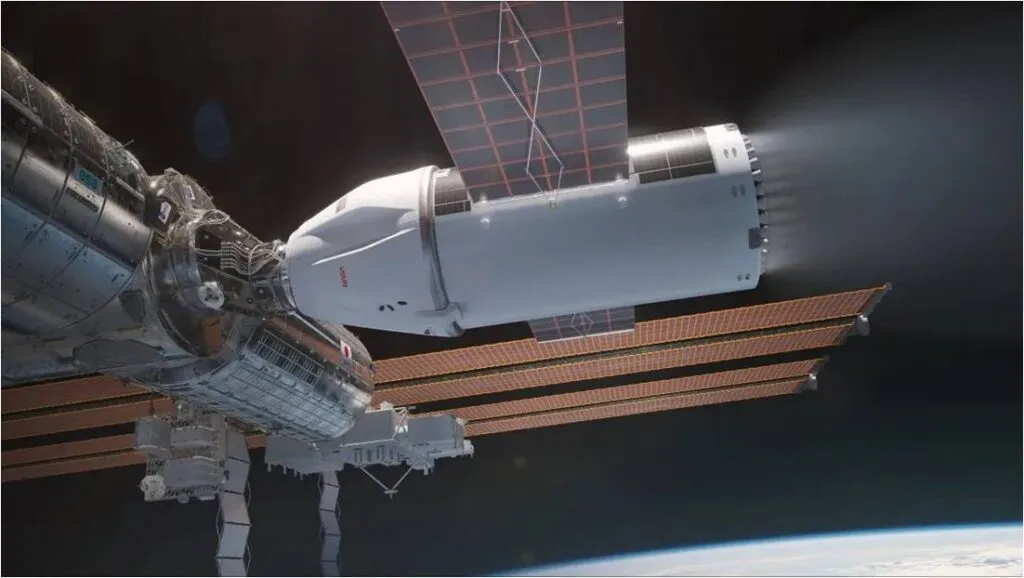
Nuanced nudge to final plunge. Artwork shows a SpaceX-provided United States Deorbit Vehicle (USDV).
Image credit: SpaceX
Think of it this way.
Such a destructive plunge might as well be labeled the Elvis Presley maneuver, one that renders the ISS as “just a hunk, a hunk of burning love,” as its temperature rises high and higher while violently deep diving into Earth’s atmosphere.
For more details, go to my new Space.com story – “Will the International Space Station’s 2031 death dive cause pollution problems? Some people have begun asking the question” – at:

Image credit: GLOBALink/Inside Outer Space screengrab
China on Saturday scored a successful maiden launch of its Long March-12. Also, the booster lifted off from the Hainan commercial spacecraft launch site in the southern island province of Hainan. It marked the inaugural mission from the country’s first commercial launch facility.
The Long March-12 departed the site’s No. 2 launch pad, hurling two experimental satellites into their planned orbits.
The November 30th flight also tested a key model of rocket engine known as YF-100K that powered Long March 12’s first stage.

Image credit: CCTV/Inside Outer Space screengrab
Importantly, YF-100K engines will also be used to power Long March-10, the booster now under development to send Chinese astronauts to the Moon before 2030.
Liquid oxygen/kerosene engines
The Long March-12 was developed by the Shanghai Academy of Spaceflight Technology under the China Aerospace Science and Technology Corporation (CASC). That rocket is currently the country’s largest single-core carrier rocket in payload capacity, featuring a two-stage configuration propelled by six liquid oxygen/kerosene engines.
The first stage is powered by four liquid oxygen/kerosene engines, each with a thrust of 1,250 kilonewtons.

Image credit: GLOBALink/Inside Outer Space screengrab
The second stage uses two liquid oxygen/kerosene engines with a thrust of 180 kilonewtons each, China Central Television (CCTV) reported.
The booster sports a carrying capacity of no less than 12 tons in low Earth orbit and no less than six tons in 700-km sun-synchronous orbit.
Dual launch pads
The Hainan commercial spacecraft launch site currently features two launch pads for liquid-propellant rockets. The Number 1 pad is designed for the Long March-8, China’s new-generation medium-lift carrier rocket.

Image credit: GLOBALink/Inside Outer Space screengrab
The Number 2 pad can accommodate multiple rocket types with varying diameters from commercial rocket companies.
Each pad has an annual launch capacity of 16 launches, reports CCTV.
Pump-backswing
Li Bin, vice president, Sixth Academy of the China Aerospace Science and Technology Corporation (CASC) is chief engineer of the liquid oxygen kerosene engine.
“The pump-backswing engine operates like a person swinging only their legs while keeping the upper body still. In other words, the engine’s nozzle is the only part that moves. This limited movement reduces the engine’s profile and the area it sweeps, allowing the rocket to be designed more compact,” Li told CCTV.

Image credit: CCTV/Inside Outer Space screengrab
Li confirmed that more engines can be installed in a diameter of 3 meters or 8 meters.
“This engine is an improved version based on our original 120-ton engine. It features a pump-backswing design with a supplementary combustion cycle. Compared to the previous 120-ton engine, we have reduced the weight by 20 percent, increased the thrust by five percent, and enhanced the overall performance,” said Li.
Batch production
“The success of the new service tower, the new rocket, as well as our new team and new mechanism, could be viewed as a milestone in the history of China’s commercial space sector,” said Liu Hongjian, president of the Hainan International Commercial Aerospace Launch (HICAL), which built and operates the launch site.

Image credit: CCTV/Inside Outer Space screengrab
Wu Jialin of the Shanghai Academy of Spaceflight Technology under the CASC, added that design engineers took into account the rocket’s batch production and industrialization.
“The diameter of the Type I rocket decides its carrying capacity. Both of its first stage and second stage have a diameter of 3.8 meters. Its first stage has four 130-tonne liquid oxygen kerosene engines and the second stage has two 18-tonne liquid oxygen kerosene engine. Its takeoff thrust is at 5,000 kilonewtons, which makes it a medium-sized rocket,” said Zhao Zhijie, a staff member of CASC.

Image credit: CCTV/Inside Outer Space screengrab
The carrying capacity of the rocket can be enhanced by a larger diameter, Zhao said, which allows it to fly with more fuel, but diameter enlargement should take into consideration factors like transportation and manufacturing.
Assembly, test, transportation
“A larger diameter has a higher demand for manufacturing techniques and transportation, because the rocket needs to be transported to the launch pad once it completes manufacturing. The third consideration is the carrying capacity of the rocket,” Zhao added.
To make the rocket a medium to large-sized one, “we have to make it a cluster carrier rocket, which means it has higher complexity,” continued Zhao. “If we take into the simplicity of configuration into consideration, the diameter should not be too large or too short. Besides, diameter of the rocket’s body should also match its engines. The diameter of 3.8 meters of Long March-12 carrier rocket can meet all the demands I [have] mentioned,” said Zhao.

Image credit: GLOBALink/Inside Outer Space screengrab
Targeting the country’s commercial flight sector, the carrier rocket has a different model for assembly, test, and transportation, allowing it to lie flat while completing the procedures, notes CCTV.
“Our technical area no longer needs a high assembly building, which is typically seen when the rocket stands vertically. Since its assembly and tests can be completed while the rocket now lies flat, it does not need a high factory,” said Zhao.
Go to these CCTV/GLOBALink videos that focus on the Long March-12 at:
https://www.facebook.com/share/v/18KEjxVY2x/

