Archive for November, 2024
 Author:
  November 20th, 2024
Image credit: SpaceX/Inside Outer Space screengrab
Flight test six of the SpaceX Starship departed from Starbase, near Brownsville, Texas on November 19, “seeking to expand the envelope on ship and booster capabilities and get closer to bringing reuse of the entire system online,” noted the company, founded by chief rocketeer, Elon Musk.
The Super Heavy booster successfully lifted off at the start of the launch window, with all 33 Raptor first stage engines powering it off the pad.

Image credit: SpaceX/Inside Outer Space screengrab
Boostback burn
Following a nominal ascent and stage separation, the mega-booster successfully transitioned to its boostback burn to begin the return to launch site.
However, a SpaceX posting notes that, during this phase, “automated health checks of critical hardware on the launch and catch tower triggered an abort of the catch attempt.”
Aborting that on-the-pad catch, the booster then executed “a pre-planned divert maneuver,” but made a landing burn and soft, water splashdown in the Gulf of Mexico.

Image credit: SpaceX/Inside Outer Space screengrab
Indian Ocean: soft splashdown
Continuing onward, Starship completed a successful ascent, placing it on the expected trajectory.
“The ship successfully reignited a single Raptor engine while in space,” SpaceX adds. In doing so, that demonstrated the capabilities required to conduct a ship deorbit burn before starting fully orbital missions.

Image credit: SpaceX/Inside Outer Space screengrab
Relayed by SpaceX Starlink, live views and telemetry from the ship showed the craft plowing its way through reentry, executing a flip, making a landing burn, followed by a soft splashdown in the Indian Ocean.
Closing in on full and rapid reusability
“Data gathered from the multiple thermal protection experiments, as well as the successful flight through subsonic speeds at a more aggressive angle of attack,” explains SpaceX, “provides invaluable feedback on flight hardware performing in a flight environment as we aim for eventual ship return and catch.”

Image credit: SpaceX/Inside Outer Space screengrab
Starship’s sixth flight test delivered, yielding data and flight knowledge as the mission’s primary payload. “Lessons learned will directly make the entire Starship system more reliable as we close in on full and rapid reusability,” SpaceX concludes.
“We will do one more ocean landing of the ship. If that goes well, then SpaceX will attempt to catch the ship with the tower,” Musk posted post-test flight.
Moon, Mars plans
SpaceX’s Starship spacecraft and Super Heavy rocket – collectively referred to as Starship – represent a fully reusable transportation system designed to carry both crew and cargo to Earth orbit, the Moon, Mars and beyond.

Image credit: SpaceX
Starship is the fully reusable spacecraft and second stage of the Starship system. The vehicle offers an integrated payload section and is capable of carrying passengers and cargo to Earth orbit, planetary destinations, and between destinations on Earth.

Image credit: SpaceX
Starship leverages tanker vehicles (essentially the Starship spacecraft minus the windows) to refill the Starship spacecraft in low-Earth orbit prior to departing for Mars. Refilling on-orbit enables the transport of up to 100 tons all the way to Mars. And if the tanker ship has high reuse capability, the primary cost is just that of the oxygen and methane, which is extremely low.

Image credit: SpaceX
Starship will be used to land astronauts on the lunar surface on NASA’s Artemis III mission, which will put the first humans on the Moon since 1972.
For a replay of the test flight six, go to:
https://www.spacex.com/launches/mission/?missionId=starship-flight-6
For flight profile, go to:
https://x.com/i/status/1858988675423772928

Image credit: SpaceX/Inside Outer Space screengrab
 Posted in

the Soviet Union’s National Exhibition came to New York City in June 1959 and ran until late July. The focal point of the exhibition was Sputnik, including full-scale models of the first three Soviet sputniks – and proudly on floor display was the “Lunik” mounted to its upper stage..
Image credit: Walter Sanders/The LIFE Picture Collection/Shutterstock
Now in the works is a retro-fire look back in time at a bizarre Cold War caper by the Central Intelligence Agency thanks to a forthcoming, star-studded comedy/drama movie called “Lunik Heist.”
Lunik Heist is described as a “a wild, roller-coaster ride, filled with subterfuge and unlikely heroes.”
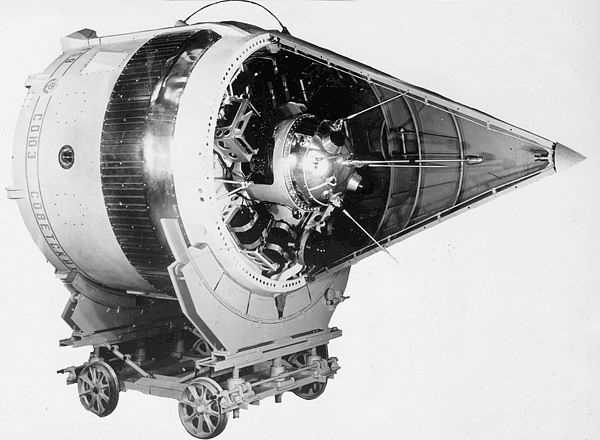
A model of Lunik 1 on display in Moscow.
Image credit: Don Mitchell/Mental Landscape
The film is based on a for real incident that saw CIA operatives plot to disassemble and inspect overnight a Soviet Union spacecraft on exhibit during a 1959 expo in Mexico City.
For more information, go to my new Space.com story – “’Lunik Heist:’ A real-life CIA rocket kidnapping goes to Hollywood” – at:

Image credit: CCTV/CNSA/Inside Outer Space screengrab
China’s now-orbiting Shenzhou-19 astronauts are moving supplies and equipment into the Tiangong space station, brought to the orbiting facility by the newly docked Tianzhou-8 cargo craft.
Weighing about six tons, China’s Tianzhou-8 cargo craft includes supplies for the astronauts, propellant, application experiments and test equipment, with over 880 pounds (400 kilograms) of scientific gear.
Roughly three hours after the launch, the Tianzhou-8 cargo craft autonomously docked at the rear docking port of the space station’s core module Tianhe.

Handover of station between Shezhou-18 and Shenzhou-19 crew.
Image credit: CCTV/CMSA/Inside Outer Space screengrab
Larger cargo capacity
China launched the Shenzhou-19 crewed spaceship on October 30, sending a fresh crew of three astronauts — Cai Xuzhe, Song Lingdong and Wang Haoze — to its space station for another six-month mission.

Image credit: CCTV/CNSA/Inside Outer Space screengrab
The newly arrived cargo craft, compared to its predecessors — Tianzhou-6 and Tianzhou-7 — boasts a larger cargo capacity — an increase of more than 200 liters of space and more than 100 kilograms of cargo load.
Friday’s launch is the third cargo delivery mission since China’s crewed space program entered the space station’s application and development stage.

Lunar brick specialist, Zhou Cheng.
Image credit: CCTV/Inside Outer Space screengrab
Lunar bricks
According to China Central Television (CCTV), for the first time, a brick made of synthetic lunar soil will be brought aboard the space station and subject to an exposure experiment to test whether it could be used to construct buildings on the Moon.
It is expected that the lunar soil brick will be returned to Earth by the end of next year, following the experiment.

Image credit: CCTV/Inside Outer Space screengrab
“What we are most concerned with are: first, its mechanical properties, as they are most closely related to building structures; second, its thermal properties, particularly how well it performs in terms of insulation and heat resistance; third, the impact of radiation on it,” said Zhou Cheng, professor, National Center of Technology Innovation for Digital Construction, Huazhong University of Science and Technology. “We want to know if these lunar bricks can withstand the exposure to cosmic radiation,” Zhou told CCTV.
Go to video detailing the supply ship docking at:

FLIR
Credit: DOD/U.S. Navy/Inside Outer Space screengrab
A release today of the Department of Defense annual report on Unidentified Anomalous Phenomena (UAP) comes one day after a witness-based Congressional hearing on the topic.
The All-domain Anomaly Resolution Office’s Annual Report on Unidentified Anomalous Phenomena is required by the National Defense Authorization Act (NDAA) for Fiscal Year 2022, as amended by the NDAA for Fiscal Year 2023.
“Analyzing and understanding the potential threats posed by UAP is an ongoing collaborative effort involving many departments and agencies,” said a DoD statement.
“The safety of our service personnel, our bases and installations, and the protection of U.S. operations security on land, in the skies, seas, and space are paramount. We take reports of incursions into our designated space, land, sea, or airspaces seriously and examine each one,” adds the DoD.

Credit: DOD/U.S. Navy/Inside Outer Space screengrab
Rigorous scientific framework
The All-Domain Anomaly Resolution Office is leading DOD’s efforts with others to document, analyze, and when possible, resolve UAP reports using a rigorous scientific framework and a data-driven approach.
This year’s UAP report covers UAP reports from May 1, 2023, to June 1, 2024, as well as any UAP report from previous time periods that were not included in an earlier report.
This brought the total cases that AARO has been reviewing to over 1,600 as of June 1, 2024.
According to the AARO report itself, to date, AARO has no indication or confirmation that these activities are attributable to foreign adversaries.”

Image credit: AARO
Wanted: timely, actionable sensor data
AARO is continuing to coordinate with the Intelligence Community (IC) to identify whether these activities may be the result of foreign adversarial activities.
However, AARO’s ability to resolve cases “remains constrained by a lack of timely and actionable sensor data.”
To that end, AARO has begun collections using a prototype sensor system, GREMLIN, for detecting, tracking, and characterizing UAP.
The just-issued report explains that GREMLIN demonstrated functionality and successfully collected data during a test event in March of 2024.
“The next step for GREMLIN is a 90-day pattern of life collection at a site of national security,” the AARO report states.

Image credit: Statista
Partnerships
The AARO report notes that the group continues to address this challenge by working with military and technical partners to optimize sensor requirements, information-sharing processes, and the content of UAP reporting.
“AARO is also expanding engagement with foreign partners to share information and collaborate on best practices for resolving UAP cases,” the report concludes. “AARO will continue to develop partnerships across the USG [US Government], academia, and commercial communities. Through these partnerships, AARO will expand its sensor technology capabilities, analytic tool suites, and the UAP-related sciences spanning the space, air, and maritime domains.”
To dive into the full report — The All-domain Anomaly Resolution Office’s Annual Report on Unidentified Anomalous Phenomena – go to:

Image credit: CCTV/Inside Outer Space screengrab
China’s next supply ship is ready for liftoff from the Wenchang Spacecraft Launch Site in the southern island province of Hainan.
Loaded with supplies for now orbiting space station taikonauts, China’s Tianzhou-8 cargo craft will be carried by a Long March-7 Y9 rocket. A joint rehearsal for the launch was conducted on Wednesday.
According to China Central Television (CCTV), compared to its predecessors, Tianzhou-6 and Tianzhou-7, the Tianzhou-8 cargo spacecraft boasts a larger cargo capacity — an increase of more than 200 more liters of space and more than 100 kilograms of cargo load.

Image credit: CCTV/Inside Outer Space screengrab
Lunar bricks
Alongside astronaut supplies and experimental facilities, CCTV adds that the Tianzhou-8 cargo spacecraft will carry bricks made of varying compositions from lunar soil simulant to the Tiangong space station.
These lunar bricks will undergo outside the station exposure tests to assess their durability in extreme conditions and their potential use in constructing lunar bases, CCTV reporting explains.
To view a video showing pre-launch rollout of the cargo craft, go to:

The U.S. Government Accountability Office (GAO) has identified three technologies in science, technology, and engineering that are trending toward maturity: Gene editing, Biodegradable bioplastics, and guess what – Space-based manufacturing of semiconductor crystals.
Space-based manufacturing of semiconductor crystals, may enable the production of high-quality semiconductors, the GAO reports.
“The unique conditions of space—such as microgravity, a natural vacuum, and reduced contamination—could enable the production of semiconductor crystals with fewer defects and greater purity than those manufactured on Earth,” the report explains.
Of what on-Earth use?
“These semiconductors could lead to more powerful computers, faster communication systems, and improved consumer electronics,” notes the GAO document.

As for the implications, GAO spotlights the dependency on foreign supply chains for raw materials, and safeguarding the spacecraft needed for enabling such manufacturing.
“A potential consideration for policymakers is whether a comprehensive licensing framework for investment, development, and intellectual property protection would benefit the development of these technologies,” concludes the GAO study.
GAO developed this report focused on technologies approximately 10 years on the horizon. “The goal is to provide foresight into developing technologies that could have significant impacts on Americans,” the report explains.
Go to the full GAO report at:

Image credit: NASA
As humanity prepares to “reboot” Earth’s Moon, one expected outcome is putting in place a sustained human presence on that nearby world. There is need to develop long-term and reliable lunar surface infrastructure and systems for safe robotic and crewed exploration.
That assignment won’t be easy.
To establish a permanent foothold on the Moon, future crews must deal with impact hazards, moonquakes, rough and tumble terrain, radiation, as well as thermal day/night issues. And don’t forget the pesky lunar dust.

Image credit: NASA
Suite of videos
It’s dubbed Lunar Engineering 101 by experts at The Johns Hopkins University Applied Laboratory (APL) for NASA’s Lunar Surface Innovation Initiative, part of the agency’s Space Technology Mission Directorate.
An informative suite of videos has been produced by the Lunar Surface Innovation Consortium (LSIC), which is managed by APL.

Image credit: Breakthrough, Innovative and Game-changing (BIG) Idea Challenge/NASA
“Lunar Engineering 101 combines the knowledge obtained and lessons learned from previous missions to provide a resource for technology developers with the background needed to design systems to withstand extreme conditions on the lunar surface,” explains APL’s Milena Graziano, the Lunar Engineering 101 point of contact.
Subject matter experts
The videos serve as a resource for engineers, Graziano adds, by presenting the main characteristics of lunar surface environments — including reduced gravity, radiation, dust, regolith, moonquakes, and others — along with their respective challenges and hardware design considerations to ensure system function and reliability.
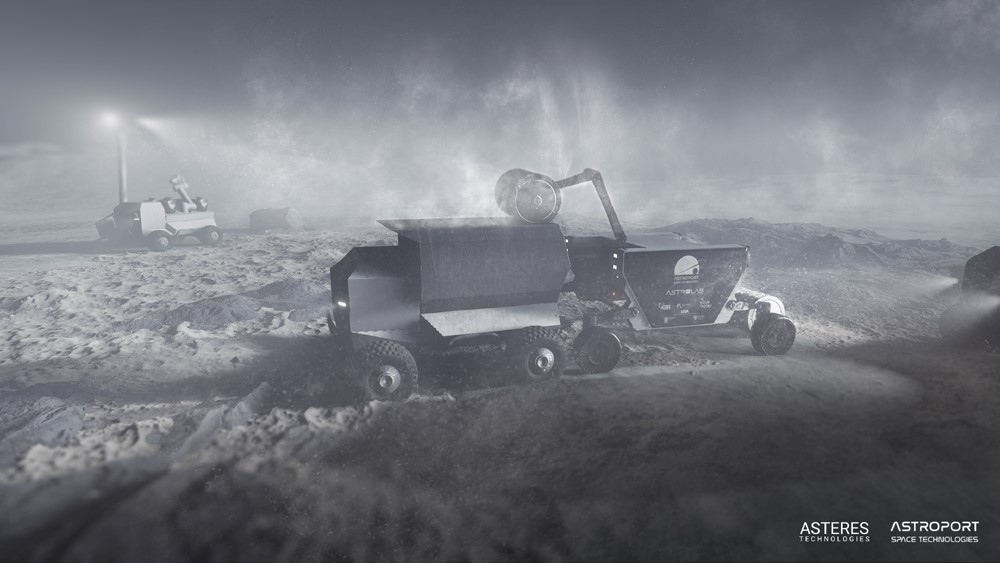
Image credit: Astroport Space Technologies
“This new resource has been prepared by subject matter experts in lunar science and spacecraft engineering to serve as an aid to engineers and scientists, providing an overview of the content, topics, and key practices that will prove beneficial to the development of lunar systems,” Graziano points out.
Go to the videos at:

Image credit: U.S. Congress/Inside Outer Space screengrab
Testimony of a new congressional hearing on the topic of Unidentified Anomalous Phenomena (UAP) has been released.
The open hearing today, on November 13, is being staged by the House subcommittee on Cybersecurity, Information Technology, and Government Innovation as well as the National Security, the Border, and Foreign Affairs subcommittee.

Credit: Piplsay
Pull back the curtain
According to a joint hearing statement the hearing “will attempt to further pull back the curtain on secret UAP research programs conducted by the U.S. government, and undisclosed findings they have yielded. The hearing will examine the Department of Defense’s (DoD) reluctance to appropriately declassify material on UAPs, and ways to make sure the American public is better informed on this topic.”
“This is our second hearing on the topic of UAPs and the American people are tired of the obfuscation and refusal to release information by the federal government,” observes Chairwoman Nancy Mace (R-S.C.) and Subcommittee on National Security, the Border, and Foreign Affairs Chairwoman Glenn Grothman (R-Wis.).

Credit: SatelliteInternet.com
“Americans deserve to understand what the government has learned about UAP sightings, and the nature of any potential threats these phenomena pose,” Mace and Grothman state.
“We can only ensure that understanding by providing consistent, systemic transparency. We look forward to hearing from expert witnesses on ways to shed more light and bring greater accountability to this issue,” said Mace and Grothman.

Credit: Orbitz
Written testimony
- Tim Gallaudet, Rear Admiral, U.S. Navy (RET.), Chief Executive Officer, Ocean STL Consulting, LLC: “As a former science agency leader, I have always sought the truth in human knowledge and thought. Now that we know UAP are interacting with humanity, and these include unidentified submerged objects (USOs) in the ocean40, we should not keep our heads stuck in the sand, but boldly face this new reality and learn from it.”
https://oversight.house.gov/wp-content/uploads/2024/11/Updated-Testimony-Gallaudet.pdf
- Luis Elizondo, former Department of Defense Official and author of the recently released book: Imminent: Inside the Pentagon’s Hunt for UFOs: “Let me be clear: UAP are real. Advanced technologies not made by our Government – or any other government – are monitoring sensitive military installations around the globe. Furthermore, the U.S. is in possession of UAP technologies, as are some of our adversaries. I believe we are in the midst of a multi-decade, secretive arms race — one funded by misallocated taxpayer dollars and hidden from our elected representatives and oversight bodies.”
https://oversight.house.gov/wp-content/uploads/2024/11/Written-Testimony-Elizondo.pdf
- Michael Gold, former NASA Associate Administrator of Space Policy and Partnerships; Member of NASA UAP Independent Study Team: “When NASA studies celestial objects and phenomena, planets, black holes, and galaxies, it does so with equipment that has been developed specifically for such tasks. If NASA had to study space with data collected from fighter cockpit cameras, radar from military installations, and cell phones, very little good science would be done. Therefore, it’s worth considering building instruments tailored to study the UAP phenomena.”
https://oversight.house.gov/wp-content/uploads/2024/11/Written-Testimony-Gold.pdf
- Michael Shellenberger, founder of Public, a group that focuses on free speech, civilization, and humanity: “President-elect Trump ran on and was elected with a mandate to make government more transparent and release long-held secrets on everything from Covid origins and the Hunter Biden laptop to the JFK files and UAPs. I encourage Congress to help the President-elect make that commitment a reality, including by extending stronger protections to at-risk whistleblowers, putting in place protransparency leaders of DOD and IC [Intelligence Community] organizations, and passing the UAP Disclosure Act.”
https://oversight.house.gov/wp-content/uploads/2024/11/Written-Testimony-Shellenberger.pdf
Tune in today
Today’s hearing is open to the public and is being livestreamed online starting at 11:30 am Eastern Time at:

Up close and personal! Scene from Earth vs. the Flying Saucers circa 1956.
Credit: Columbia Pictures

Image credit: SCU
Stand by for a new congressional hearing on the topic of Unidentified Anomalous Phenomena (UAPs).
The open hearing on November 13, 2024 is being staged by the House subcommittee on Cybersecurity, Information Technology, and Government Innovation as well as the National Security, the Border, and Foreign Affairs subcommittee.
According to a joint hearing statement the hearing “will attempt to further pull back the curtain on secret UAP research programs conducted by the U.S. government, and undisclosed findings they have yielded. The hearing will examine the Department of Defense’s (DoD) reluctance to appropriately declassify material on UAPs, and ways to make sure the American public is better informed on this topic.”

Image credit: Yannick Peings, Marik von Rennenkampff/AIAA
Tired of obfuscation
“This is our second hearing on the topic of UAPs and the American people are tired of the obfuscation and refusal to release information by the federal government,” observes Chairwoman Nancy Mace (R-S.C.) and Subcommittee on National Security, the Border, and Foreign Affairs Chairwoman Glenn Grothman (R-Wis.).

Image credit: RAND
“Americans deserve to understand what the government has learned about UAP sightings, and the nature of any potential threats these phenomena pose,” Mace and Grothman state.
“We can only ensure that understanding by providing consistent, systemic transparency. We look forward to hearing from expert witnesses on ways to shed more light and bring greater accountability to this issue,” said Mace and Grothman.

Image credit: NASA UAP study group
Image credit: NASA
Who is testifying?
Tim Gallaudet, Rear Admiral, U.S. Navy (RET.), Chief Executive Officer, Ocean STL Consulting, LLC
Luis Elizondo, former Department of Defense Official and author of the recently released book: Imminent: Inside the Pentagon’s Hunt for UFOs
Michael Gold, former NASA Associate Administrator of Space Policy and Partnerships; Member of NASA UAP Independent Study Team
Michael Shellenberger, founder of Public, a group that focuses on free speech, civilization, and humanity.
The hearing will be open to the public and livestreamed online starting at 11:30 am Eastern Time on Wednesday, November 13 at:

UAP have been reported by Navy pilots unlike anything they have ever witnessed.
Image credit: Enigma Labs/Lt. Cmdr. Alex Dietrich

Image credit: CCTV/Inside Outer Space screengrab
China is outing details regarding a reusable space cargo shuttle, showcasing the space plane at the Zhuhai airshow.
The airshow is being held November 12 to 17 with a scaled model of the Haolong craft on display.
“The Haolong space cargo shuttle is a winged aircraft with an aerodynamic design featuring a large wingspan and a high lift-to-drag ratio, said Fang Yuanpeng, chief designer of Haolong space cargo shuttle in a China Central Television (CCTV) interview.
“With blunt-nosed fuselage and large, swept-back delta wings, it combines the characteristics of both spacecraft and aircraft, allowing it to be launched into orbit by a carrier rocket and land on airport runway like a plane,” Fang added.
Reportedly, the space plane will have a 1.8 ton capacity and comes replete with folding wings.
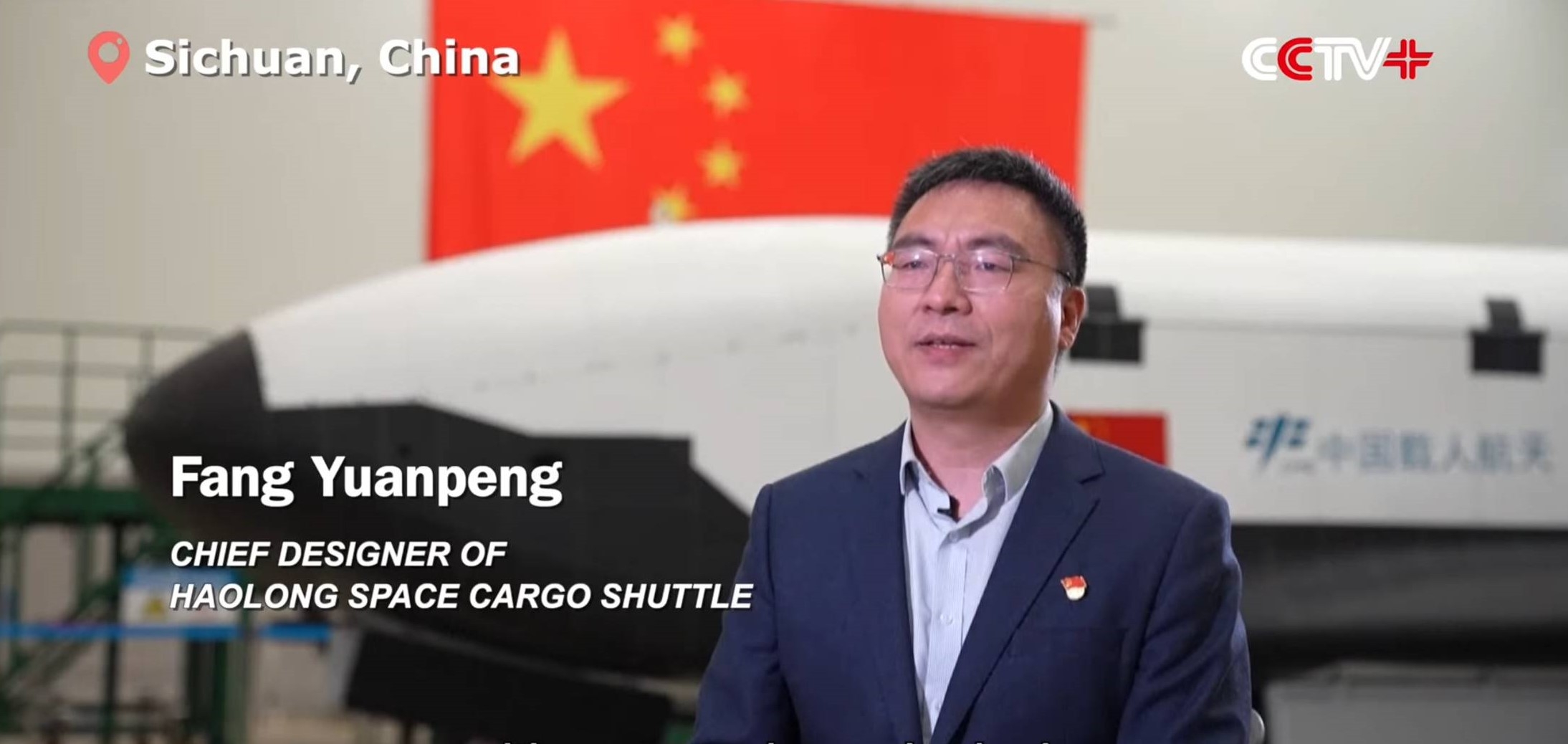
Image credit: CCTV/Inside Outer Space screengrab
Low-cost, reusable
Haolong is being developed by the Chengdu Aircraft Design and Research Institute under the Aviation Industry Corporation of China (AVIC), and is designed as a low-cost, reusable spacecraft for transporting cargo to China’s space station.
“After completing the cargo transport mission, it can perform a horizontal landing on airport runways,” Fang said, “enabling it to meet cargo transport needs both to and from the space station. Furthermore, its reusability helps reduce costs in spacecraft development and cargo transportation.”
According to CCTV, the cargo space shuttle is 33 feet (10 meters) long and 26 feet (8 meters) wide, weighing less than half of China’s now in use Tianzhou supply ships.

Image credit: CCTV/Inside Outer Space screengrab
Auto-pilot
“During the docking period,” Fang said, “the cargo hold of Haolong will be opened and connected to the space station cabin, and astronauts can enter and exit the cargo hold freely to fetch the cargo brought to the space station or place the materials to be sent to Earth according to their needs.”
After completing a cargo transport mission, Haolong will separate from the space station, autonomously deorbit and brake, re-enter the atmosphere, and land horizontally on a designated airport runway without power on auto-pilot mode, added Fang. After inspection, maintenance and repair, the craft would be ready for a repeat performance, he said.

Image credit: CCTV/Inside Outer Space screengrab
Flight verification
As stated by CCTV, Haolong has recently been selected as one of the winners of a China Manned Space Agency’s solicitation for a low-cost cargo transportation system and has secured a contract for the flight verification phase.
At present, explains CCTV, the design scheme of the space shuttle has been completed, and the project has entered the stage of full-scale engineering research and development.
In viewing the newly issued animations, Haolong appears to be a double-take on the Sierra Space Dream Chaser, now being readied for its maiden flight next year from Florida.
Go to this informative video at:
https://www.facebook.com/share/v/1TaKEfmKRV/
Also an AVIC promotion film as posted by the
China ‘N Asia Spaceflight website at:
https://x.com/i/status/1855875068913734045

Image credit: CCTV/Inside Outer Space screengrab

