Archive for September, 2024
 Author:
  September 20th, 2024
While that mysterious Chinese space plane rolled to full stop on a landing strip earlier this month, little is known about the craft.
It was hurled into orbit on December 14, 2023 atop a Long March 2F rocket from the Jiuquan Satellite Launch Center in northwest China.
The whatever it is and does spacecraft touched down after 268 days of in-orbit operation, making its touchdown on September 6, 2024.
Growing maturity
“Its mission was to conduct reusable technology verification and space science experiments to provide technical support for the peaceful use of space,” explained the state-run China Global Television Network (CGTN). “This achievement underscores the growing maturity of China’s reusable spacecraft technology, paving the way for more convenient and cost-effective space travel for peaceful purposes in the future.”
CGTN also noted that China had launched reusable experimental spacecraft in September 2020 and August 2022, which respectively spent two days and 276 days in orbit “before returning to their designated landing sites.”

Image credit: Felix Schöfbänker
Delta-wing design
While the recent space plane flight was underway, space watcher veteran Felix Schöfbänker in Upper Austria took imagery of the craft.
In a recent posting, Schöfbänker reported he has imagery taken August 10 of the Chinese space plane which shows a delta-wing design, captured when the craft turned 180 degrees since an earlier observation he made on July 30.
The dark spot between the wings could possibly be the cargo bay, Schöfbänker suggests.
Go to new video at:
https://cdn.astrobin.com/images/107843/2024/b2b3728f-1138-4061-a271-046b8a94b92b.gif
Meanwhile, still circling the Earth is the U.S. Space Force X-37B. It has been on an equally mysterious sojourn since its launch on Dec. 29, 2023. It is now 267 days into its secretive mission.

U.S. Space Force X-37B space plane.
Image credit: Boeing
 Posted in
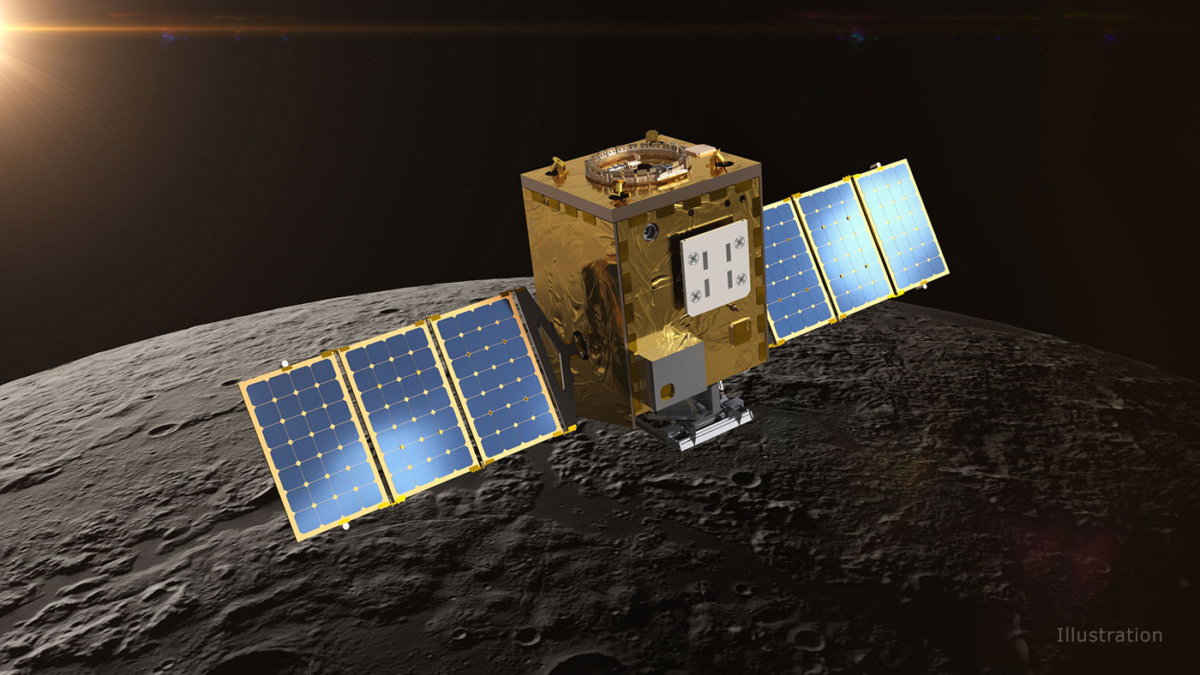
Artistic view of Lunar Trailblazer.
Credit: Lockheed Martin
A spacecraft that is hot on the trail of scouting out super-cold water ice on the Moon is the Caltech-led Lunar Trailblazer orbiter.
This NASA-backed mission is to be co-launched with the Intuitive Machines (IM-2), a Nova-C lunar lander now dubbed Athena under the space agency’s Commercial Lunar Payload Services (CLPS) initiative.
The unique Lunar Trailblazer orbiter is a secondary spacecraft to be hurled into space with the IM-2, launched together on a SpaceX Falcon 9 rocket.
Inside Outer Space sources indicate the window of opportunity for takeoff appears to be January 1-5, 2025.

Image credits:
Lunar south pole basemap: LROC
PSR detections from Mazarico, et al. (2011)
Crater: Caltech/PCC/Hongyu Cui for Lunar Trailblazer project
Co-collected datasets
Lunar Trailblazer is a NASA Small Innovative Missions for Planetary Exploration (SIMPLEx) program spacecraft, built to gather science data as it circuits the Moon. Here on Earth, it will be operated by both Caltech and Pasadena City College students at the Caltech-based Infrared Processing and Analysis Center (IPAC).
Lunar Trailblazer is to utilize “co-collected datasets” gleaned from two instruments: the High-resolution Volatiles and Minerals Moon Mapper (HVM3) and the Lunar Thermal Mapper (LTM).
Great gobs of water ice?
Hypothesized to be resident at the poles of the Moon are great gobs of water ice, sitting within regions that are permanently in shadow. They could also potentially host organic content.
Gauging the amount of water ice present — its form, purity, and geologic and topographic context — are viewed as critical to not only figuring out the role of these reservoirs in the lunar water cycle but could they be tapped as a resource to sustain future human expeditions.

Infographic of Lunar Trailblazer’s data acquisition strategy. Image credit: Filo Merid (PCC/Caltech)
Curio
Under contract with Caltech, Lockheed Martin has provided the spacecraft and is integrating the flight system.
Lockheed Martin has developed a scalable deep space SmallSat spacecraft and tagged the architecture with the name Curio.
“The Lunar Trailblazer spacecraft team has completed the assembly of the vehicle and integration of its instruments, and has also taken the fully assembled spacecraft through its environmental testing,” said Ryan Pfeiffer, Lunar Trailblazer program manager at Lockheed Martin.
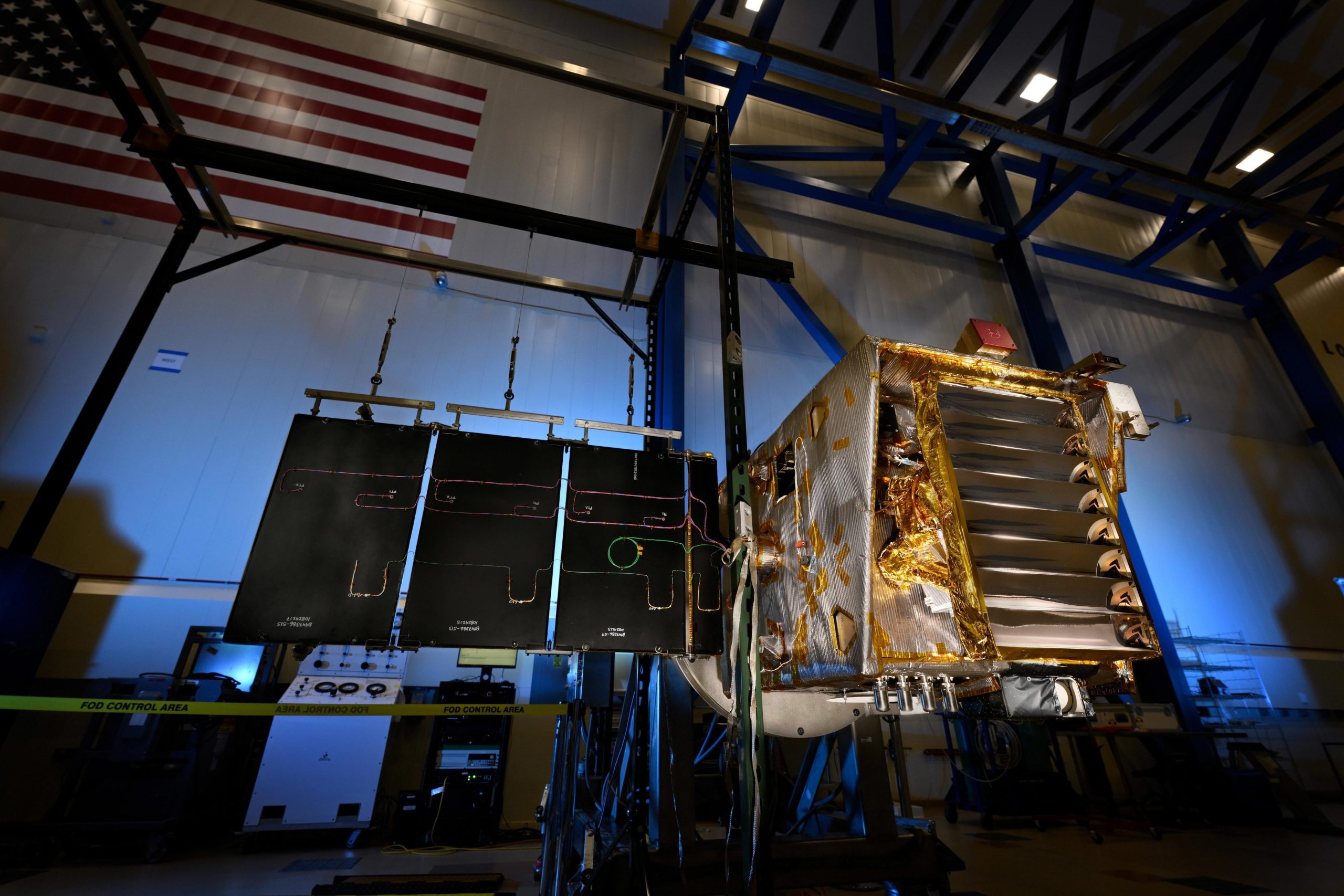
Lunar Trailblazer undergoes final checkout and testing.
Image credit: Lockheed Martin
“We’re very excited to demonstrate our Curio small-sat, a low-cost and rapidly flexible spacecraft, in this first-of-its-kind mission to seek out water on the lunar surface and advance humanity’s exploration and understanding of the universe around us,” Pfeiffer told Inside Outer Space.
Ship to Florida
The team is now performing tests that will simulate key aspects of the Lunar Trailblazer mission, such as launch and the primary science mission to ensure the spacecraft will perform as designed once it arrives in lunar orbit, said Pfeiffer.
“We’re planning to ship the spacecraft to Florida about a month prior to launch,” Pfeiffer added, “where we will perform final checkouts and then assist our partners with integration onto the launch vehicle.”

This approximate model was created by fellow satellite enthusiast Oliver Jankovich based on Schöfbänker’s interpretation of collected images.
Image credit: Oliver Jankovich/Felix Schöfbänker
In the hush-hush, secretive world of space-based spy satellites, few details are publicly available – and groups like the U.S. Space Force, National Reconnaissance Office, the Central Intelligence Agency, and the National Geospatial-Intelligence Agency like it that way.
There’s an armada of classified spacecraft assigned an array of vigilant duties. Some intercept radio waves or detect missile launches. Others yield close-up looks at select areas using sharp-eyed optical systems or scan the Earth with powerful radar technology.

Image credit: Felix Schöfbänker
Imagery details
These high-flying satellites are temping targets for amateur astro-photographers.
Such is the case for space watcher veteran Felix Schöfbänker in Upper Austria.
For imagery and details on what’s being seen, go to my new Space.com story – “Caught on camera: Satellite tracker photographs secret spacecraft” – at:
https://www.space.com/secret-satellites-caught-on-camera

Image credit: Felix Schöfbänker

Chang’e-4 far side mission – lander and Yutu-2 rover.
Credit: CNSA/CLEP
Still on a roll on the Moon is China’s Yutu-2 far side rover.
Wheeling and dealing with the scenery within the Von Karman Crater in the South Pole-Aitken Basin, the mini-robot has traveled 5,292 feet (1,613 meters) as of Tuesday, report its operators. It is currently the longest-working lunar rover in history, noted China Central Television (CCTV).
Deployed from the Chang’e-4 lander, Yutu-2, or Jade Rabbit-2, back in early January 2019, the rover has completed its work for the 71st lunar day. In “Moon time” that marks nearly five years and nine months of operation and far beyond its original three month design lifespan.

Image credit: CCTV/Inside Outer Space screengrab
Lunar photos
Zuo Wei, deputy chief designer of the Chang’e-4 mission’s ground application system, noted that collection of lunar photos highlighted a variety of features of the Moon’s surface, including flat areas, hills, impact craters and large rocks.
Zuo told CCTV that the Moon-based optical telescope onboard Chang’e-3 lander “is still operational, performing regular on-off cycles every month, though it is no longer conducting scientific observations. Chang’e-4 is also still active.”

China’s Chang’e 3 lander as view by Yutu rover.
Image credit: National Astronomical Observatories of Chinese Academy of Sciences
In addition to Yutu-2, the Chang’e-3 Moon lander that touched down mid-December 2013 within Mare Imbrium and the Chang’e-4 mission lander are both operational on the Moon.
The Chang’e-3 lunar lander dispatched the first Yutu rover that reportedly ceased transmitting data in March 2015.
“While some scientific instruments continue to function and transmit data, researchers are also evaluating their long-term operational capabilities,” CCTV reports.
Next lunar lander
In other China lunar updates, the country’s Queqiao and Queqiao-2 relay satellites are working in orbit around the Moon.
Queqiao mainly provides Earth-moon relay communications for Chang’e-4 and Yutu-2, CCTV adds. After completing its mission for Chang’e-6, Queqiao-2 is currently conducting scientific observations in orbit while awaiting the arrival of Chang’e-7, scheduled for launch around 2026.

Image credit: CCTV/CGTN/Inside Outer Space screengrab
Meanwhile, China’s Chang’e-7 lunar lander mission is tasked to find if there is evidence of water at the Moon’s south pole.
Wu Weiren, chief designer of the country’s lunar exploration project, recently told CCTV that finding water ice would be an important milestone.
“Some international peers have launched probes and they think the detected results show the presence of water molecules in the atmosphere above the south pole,” Wu said. “If this is true, then it’s possible that water exists in the permanently shadowed regions there, likely in the form of ice, as these areas have not been exposed to sunlight for long time. Whether there is water, and how much it is there, are key questions that concern people and the scientists worldwide,” he said.

Image courtesy U.S. Defense Intelligence Agency (DIA) in its “2022 Challenges to Security in Space” report.
Technology testing
Following Chang’e-7, China plans to launch Chang’e-8 around 2028 to test technology for utilizing local lunar resources.
By 2030, China has its sights set on a crewed lunar landing, and by 2035 to establish the core structure of an international lunar research base. According to CCTV, now more than 50 countries and international organizations have signed cooperation agreements with China on the Moon-situated facility.
For a video on China’s Yutu-2 operations, go to:

Artwork depicts Cluster satellite reentry.
Image credit: ESA/David Ducross
In an era of increasing global launch rates, heightened by the buckshot approach to tossing mega-satellite constellations into Earth orbit, there’s also escalating anxiety about the ramifications from reentry of defunct space hardware.
What’s lacking in the United States is a single coordinated effort, one that is consistently funded and engages a variety of disciplines. There is also no agreement about who should fund reentry studies; government space interests and roles are spread out over multiple federal agencies.

Image credit: Chelsea Thompson/NOAA
For more details, go to my new SpaceNews story – “The Aerospace Corporation pushes research on hard-to-spot spacecraft reentries” – at:

Moon as viewed from the International Space Station:
Image credit: Matthew Dominick/NASA
The size of the cislunar market industrial base is in growth mode.
A new lunar activities infographic has been assembled by BryceTech of Alexandria, Virginia.
“As interest in lunar exploration grows, both government and commercial programs are pushing forward,” BryceTech notes. “Companies are now focusing on essential services like transportation, telecommunications, and maintenance, and even mining, to support lunar missions.”
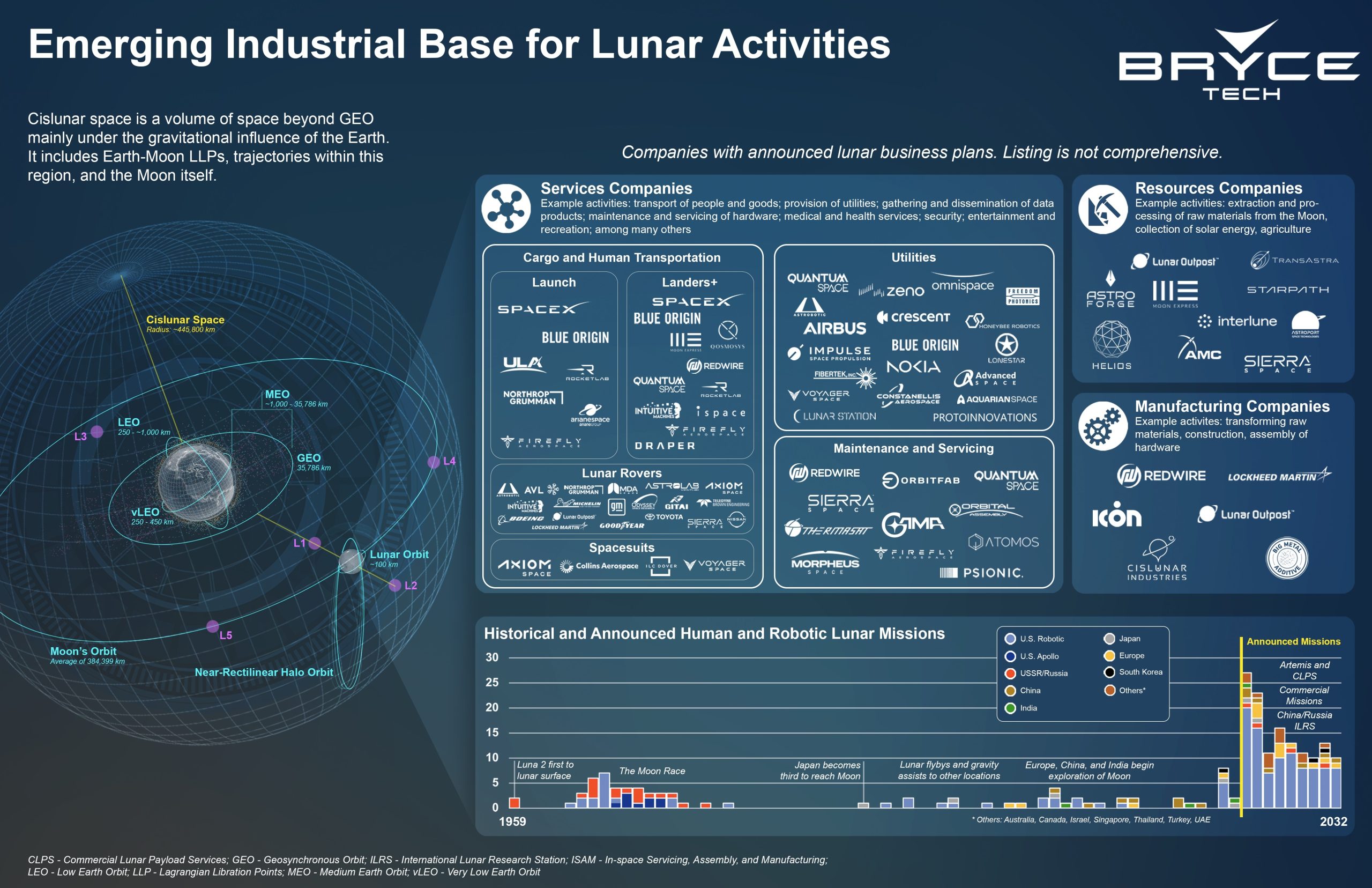
Market elements
The BryceTech infographic flags the market elements as:
Services: Companies providing transportation, utilities, and maintenance.
Resources: Companies focused on lunar resource extraction.
Manufacturing: Companies building hardware for lunar activities.
Complex interplay
Bryce is providing insight and expertise on the blossoming space economy, a complex interplay of national security, civil and commercial space programs, technical capabilities, and markets.
To download the Bryce infographic, go to:
https://brycetech.com/reports/report-documents/emerging-industrial-base-lunar-2024/

Image credit: SpaceX
The Federal Aviation Administration (FAA) is proposing that SpaceX cough up $633,009 in civil penalties for allegedly failing to follow its license requirements during two launches in 2023, in accordance with statutorily-set civil penalty guidelines.
The FAA proposal cites two incidents in May and June of 2023.
SpaceX submitted a request to revise its communications plan related to its license to launch from Cape Canaveral Space Force Station in Florida. The proposed revisions included adding a new launch control room at Hangar X and removing the T-2 hour readiness poll from its procedures.
But on June 18, 2023, SpaceX used the unapproved launch control room for the PSN SATRIA mission and did not conduct the required T-2 hour poll.
The FAA is after $175,000 for each alleged violation.
Propellant farm

Image credit: SpaceX
In July 2023, SpaceX submitted a request to revise its explosive site plan related to its license to launch from the Kennedy Space Center in Florida. The proposed revision reflected a newly constructed rocket propellant farm.
But on July 28, 2023, SpaceX used the unapproved rocket propellant farm for the EchoStar XXIV/Jupiter mission, earning them the FAA proposed $283,009 civil penalty.
SpaceX has 30 days to respond to the FAA after receiving the agency’s enforcement letters.

Image credit: CCTV/Inside Outer Space screengrab
Leading space officials in China are detailing deep space exploration plans, from setting up a scientific research station on the Moon, collecting and returning specimens of Mars and asteroid, as well as exploring the Jupiter system.
A recently held 2nd International Deep Space Exploration Conference in Tunxi of Huangshan City in east China’s Anhui Province provided the stage to discuss China’s long-range plans.
Image credit: CCTV/CGTN/Inside Outer Space screengrab
Lunar south pole
In the cue is putting in place an International Lunar Research Station (ILRS).
Wu Weiren, chief designer of China’s lunar exploration project, explains that the ILRS project will be implemented in two phases. Wu is also director and chief scientist of Deep Space Exploration Lab.
The first phase will see a basic facility built by 2035 in the lunar south pole region, Wu explains in recent interviews, posted by China Central Television (CCTV) and China Global Television Network (CGTN).
An ILRS second phase, Wu added, is being scripted to establish a network connecting the Moon’s south pole, equator and far side by 2050.
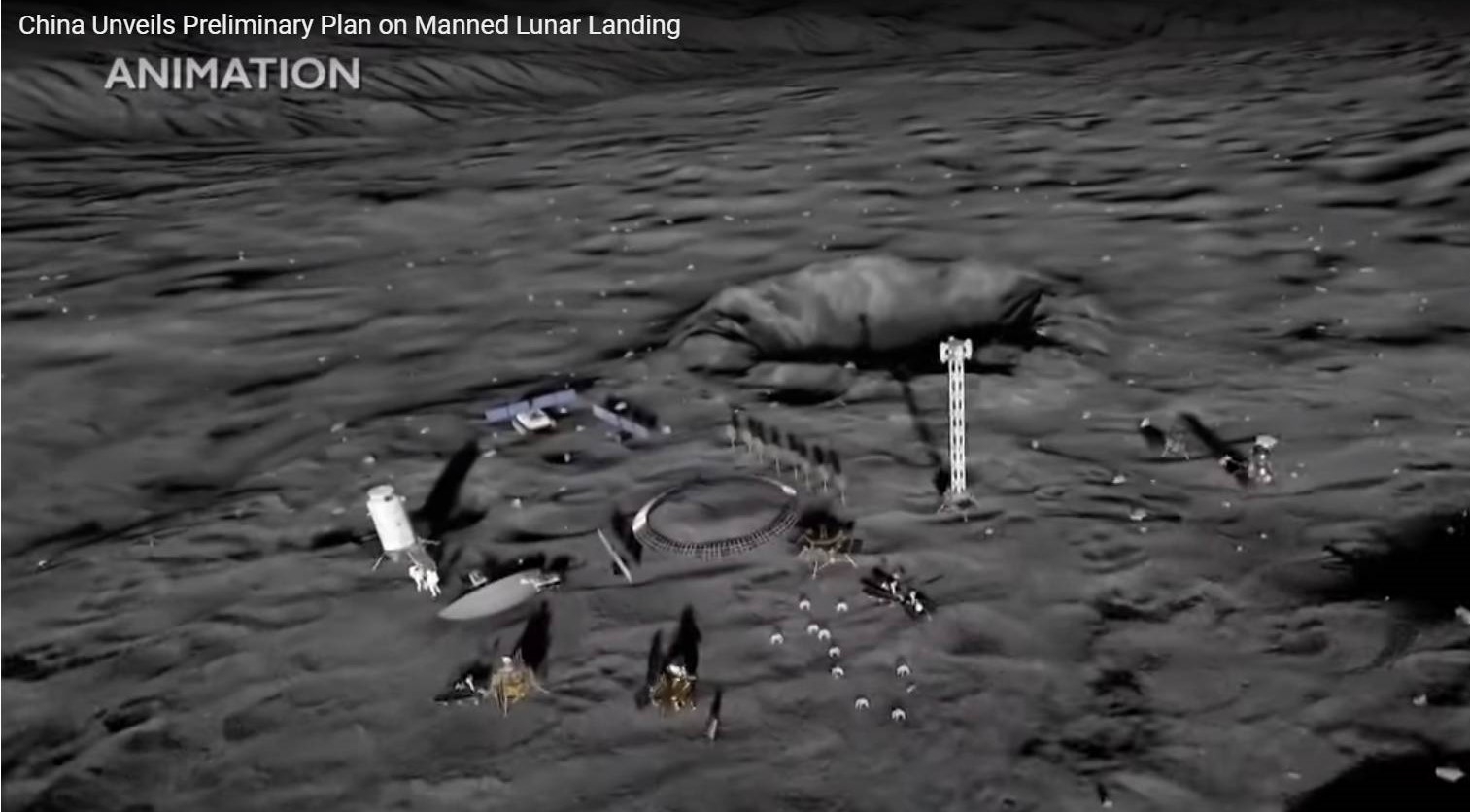
Artist’s view of International Lunar Research Station to be completed by 2035. Credit: CNSA
Shadow pits
“According to scientists’ deduction, or based on our international counterparts’ previous long-time scientific exploration,” Wu said, “we should strive to have people go up to the Moon in a short term. Then we could see whether there is water in the permanent shadow pits there.”
If water molecules are indeed found and direct evidence of the existence of water ice on the Moon at the poles of the Moon, Wu continued, “that will pave the way for humans to stay on the Moon for a long time and even lay a foundation for humankind to reach farther deep space from the Moon, such as Mars or other planets.”

Chang’e-8 south pole lander.
Image credit: CNSA
Upcoming lunar landers
Following two successful robotic Moon sampling, Earth-return ventures – near-side Chang’e-5 (December 2020) and far-side Chang’e-6 (June 2024), upcoming is the Chang’e-7 that will land on the south pole of the Moon and search for water.
Chang’e-8 will also touchdown at the south pole of the Moon and will join Chang’e-7 “to form the basic structure of the south pole station on the Moon,” Wu said.
The ILRS initiative, officially launched by the China National Space Administration (CNSA) in 2017, has been bolstered since that time with more than 40 institutions from around the world already signing agreements for cooperation with China.

Tianwen-3 mission’s chief designer, Liu Jizhong.
Image credit: CCTV/CGTN/Inside Outer Space screengrab
Mars sample return
Chinese space engineers are also moving ahead in orchestrating a Mars sample retrieval plan, a mission known as Tianwen-3. That robotic snag, bag, and rocket to Earth Red Planet bits and pieces involves two launches to Mars by around 2028, according to the mission’s chief designer, Liu Jizhong.
Liu unveiled details of the plan in a recent interview with CGTN.

Image credit: CCTV/CGTN/Inside Outer Space screengrab
The plan is structured into 13 stages, employing both on-the-spot and remote sensing techniques to conduct comprehensive research on Mars samples to ensure that they can be successfully returned and yield meaningful scientific discoveries. The mission’s top priority, Liu said, is to search for traces of life on Mars, and will involve critical engineering technologies, according to CGTN.

Image credit: CCTV/CGTN/Inside Outer Space screengrab
Challenges ahead
“We have made many optimizations and upgrades during the demonstration process. So, it should be carried out with two Long March 5 carrier rockets, which basically would be launched in succession,” said Liu. “Then all the samples can finally be returned.”
However, Liu added that the sample return mission still faces many challenges.
“First of all, there is the issue of landing accuracy. Secondly, the return mission requires a launch from the surface of Mars, which actually involves a small rocket launch. Therefore, it is very difficult to ensure the reliability of the entire flight process. Thirdly, the temperature of Mars is relatively low, which poses a challenge to the propellants used in our current rockets,” Liu said.

Conceptual video of China’s Mars sample return plans show robot specimen collection.
Image credit: CCTV/CGTN/Inside Outer Space screengrab
Payload collaboration
International cooperation on the Tianwen-3 mission, Liu continued, will focus on three areas: payload collaboration, sample and data sharing, and planning for future missions.
“International cooperation has always been an important part of China’s deep space exploration. Throughout the process, we’ve been working together with our international fellow scientists,” said Liu.
According to Liu, space planners have set aside certain resources for international payloads.
“Basically, we kept 25 kilograms for the orbiter and five kilograms for the service orbiter. Many international scientific research institutions and universities have expressed great interest,” Liu noted, “including Russia, Europe and some other countries. Other forms of international cooperation include data cooperation in future, such as data sharing, including joint research on the samples.”

Sample handoff high above Mars.
Image credit: CCTV/CGTN/Inside Outer Space screengrab
Humans to Mars
Liu underscored China’s progress in its crewed Moon exploration plans, and said they could pave the way for future human missions to Mars in the decades to come.
“Currently, we are working on the manned lunar landing mission, and it’s progressing smoothly. In fact, one of the goals of this mission is to conduct research through landing humans on the lunar surface, which will pave the way for future missions to Mars. Therefore, it is definitely a possibility for us humans to land on the Mars,” Liu said.

Image credit: CCTV/CGTN/Inside Outer Space screengrab

Caltech-led Lunar Trailblazer mission on the prowl to probe the abundance, distribution of water on the Moon, as well as the lunar water cycle.
Image credit: Lockheed Martin
A hot topic in Moon exploration is finding reservoirs of water ice within “cold traps” at the lunar south pole.
If found in permanently-shadowed regions, or PSRs, that resource may be ripe for the picking and processing into oxygen and hydrogen – ideal for life support, even manufacturing rocket fuel.
Exploitable water ice at the lunar south pole is high on NASA’s Artemis agenda to facilitate a “sustainable” human presence on the Moon.

Intuitive Machines (IM-2), a Nova-C lunar lander dubbed Athena is being prepared for sendoff to the Moon’s south pole. Onboard the lander is the Polar Resources Ice Mining Experiment-1 (PRIME-1), a NASA experiment designed to search for water ice on the Moon.
Image credit: Intuitive Machines
But NASA is not alone in wanting to locate and use that celestial commodity.
For more information, go to my new SpaceNews story – “Ice-hunting Lunar Trailblazer and IM-2 nearly ready for January 2025 launch” – at:
https://spacenews.com/ice-hunting-lunar-trailblazer-im2-nearly-ready-january-2025-launch/

NASA’s Mars rover Curiosity prepares for a thorough examination of the unusual, dark “Tungsten Hills” rocks in front of it, studying these rugged boulders covered in paper-thin sedimentary layers, some of which contain intriguing ripple structures that may have formed in running water or windblown sand.
Curiosity Left B Navigation Camera image acquired on Sol 4298, September 8, 2024.
Image credit: NASA/JPL-Caltech
NASA’s Mars rover Curiosity at Gale crater is targeted to make a thorough examination of the unusual, dark “Tungsten Hills” rocks.
The robot is studying these rugged boulders covered in paper-thin sedimentary layers, some of which contain intriguing ripple structures that may have formed in running water or windblown sand.

Curiosity Mars Hand Lens Imager (MAHLI) image produced on Sol 4301, September 11, 2024.
Image credit: NASA/JPL-Caltech/MSSS
Earlier this week, Deborah Padgett, Operational Product Generation Subsystem (OPGS) Task Lead at NASA’s Jet Propulsion Laboratory, reported that Curiosity completed its most southerly planned exploration of the Gediz Vallis channel.

Curiosity Mast Camera Left image taken on Sol 4301, September 11, 2024.
Image credit: NASA/JPL-Caltech/MSSS
Climb out of the channel
“From here, our rover will head north and climb out of the channel to explore terrain to the west. Our planned drive to the ‘Tungsten Hills’ rocks, named for a famous mining district near Bishop, California, completed successfully over the weekend, placing a pile of unusual dark rocks within our workspace,” Padgett said.

Curiosity Mast Camera Left image taken on Sol 4301, September 11, 2024.
Image credit: NASA/JPL-Caltech/MSSS
The Mars machinery is currently in the “Bishop” quadrangle, so all targets in this area of Mount Sharp are named after places in the Sierra Nevada and Owens Valley of California.

Curiosity Mast Camera Left image taken on Sol 4301, September 11, 2024.
Image credit: NASA/JPL-Caltech/MSSS
Rugged boulders
On sols 4300-4301, Curiosity was slated to perform a thorough examination of these rugged boulders, which are covered in paper-thin sedimentary layers like the pages of a book, Padgett reports. “Some layers have intriguing ripple structures that may have formed in running water or windblown sand. These features are the prime targets for contact science and remote observation at this location.”
On Sol 4300, the plan for Curiosity was to obtain Chemistry and Camera (ChemCam) laser spectra and Mastcam imagery on a part of the closest plate-like rock called “Bonita Flat,” after a high valley above the southern Kern River canyon in Sequoia National Forest, Padgett adds.

Curiosity Chemistry & Camera (ChemCam) RMI photo taken on Sol 4301, September 11, 2024.
Image credit: NASA/JPL-Caltech/LANL
Telescopic views
ChemCam was also set to obtain telescopic views of a section of the Gediz Vallis channel banks with its Remote Micro-Imager (RMI) camera. Mastcam will take a mosaic of the upper reaches of the channel, then turn its cameras on the interesting bedrock of “Coffeepot Canyon,” honoring a ravine along the precipitous East Fork of the Kaweah River canyon in Sequoia National Park, explains Padgett.

Curiosity Front Hazard Avoidance Camera Left B image taken on Sol 4301, September 11, 2024.
Image credit: NASA/JPL-Caltech
The first science block ends with atmospheric observations, including a dust-devil movie, supra-horizon cloud imaging, and Mastcam measurement of dust in the air across the crater.

Curiosity Left B Navigation Camera image acquired on Sol 4301, September 11, 2024.
Image credit: NASA/JPL-Caltech
Dog’s eye maneuver
“Curiosity will then use its arm to brush the dust from the closest block in an area dubbed ‘Pond Lily Lake,’” Padgett adds, “for a petite meadow lake atop the canyon wall of the San Joaquin River, downstream of Devil’s Postpile National Monument.”

Curiosity Left B Navigation Camera image acquired on Sol 4301, September 11, 2024.
Image credit: NASA/JPL-Caltech
This cleared spot will then be imaged by the rover’s Mars Hand Lens Imager (MAHLI) and Mastcam, and its composition will be measured by Alpha Particle X-Ray Spectrometer (APXS) spectroscopy.
MAHLI will perform an intricate “dog’s eye” maneuver to obtain detailed images of ripples in “Window Cliffs,” named after sheer walls above the spectacular fault-controlled Kern River canyon west of 14,505-foot Mount Whitney, the tallest peak in the lower 48 states.

Curiosity Left B Navigation Camera image acquired on Sol 4301, September 11, 2024.
Image credit: NASA/JPL-Caltech
MAHLI wraps up a very full day of work by imaging the scalloped edge of the largest nearby block, dubbed “Boneyard Meadow” for a wetland in the western Sierra foothills where many sheep sadly perished due to a late spring snowstorm in 1877.

Curiosity Left B Navigation Camera image acquired on Sol 4301, September 11, 2024.
Image credit: NASA/JPL-Caltech
Morning light
Early on sol 4301, Curiosity was scheduled to use Mastcam to thoroughly document the Tungsten Hills in pre-sunrise morning light.

Curiosity Left B Navigation Camera image acquired on Sol 4301, September 11, 2024.
Image credit: NASA/JPL-Caltech
Padgett points out that, later in the day, a second science block starts with ChemCam spectroscopy and Mastcam imagery of “Castle Domes,” honoring the granite domes of Castle Valley, acclaimed as some of the most beautiful mountain scenery in Kings Canyon National Park.

Curiosity Left B Navigation Camera image acquired on Sol 4301, September 11, 2024.
Image credit: NASA/JPL-Caltech
ChemCam RMI will perform telescopic observations of the channel floor.
Drive north
Mastcam is on tap to look for possible sulfur rocks at the base of the Tungsten Hills blocks in a target named “Hummingbird Lake,” for an alpine lake at 10,000 feet between Bloody and Lundy Canyons near Mono Lake.
“This science block of the plan ends with Navcam deck monitoring, dust measurement, and a large dust-devil survey. Curiosity will then drive north, taking a MARDI [Mars Descent Imager] “sidewalk” video of the terrain under the rover during the drive,” Padgett says in completing the report.

Curiosity Front Left B Hazard Avoidance Camera photo taken on Sol 4298, September 9, 2024.
Image credit: NASA/JPL-Caltech

Curiosity Front Left B Hazard Avoidance Camera image taken on Sol 4291, September 1, 2024.
Image credit: NASA/JPL-Caltech

Curiosity Left B Navigation Camera image acquired on Sol 4301, September 11, 2024.
Image credit: NASA/JPL-Caltech

Curiosity Left B Navigation Camera image acquired on Sol 4301, September 11, 2024.
Image credit: NASA/JPL-Caltech

Curiosity Left B Navigation Camera image acquired on Sol 4301, September 11, 2024.
Image credit: NASA/JPL-Caltech


