Archive for July, 2024
 Author:
  July 13th, 2024
Image credit: Barbara David
Wait-a-minute: A misbehaving SpaceX Falcon 9 upper stage has led to Starlink satellites each taking destructive dives, willy-nilly style, into the Earth’s atmosphere.
The July 11 liftoff of the SpaceX Starlink Group 9-3 from Vandenberg Space Force Base in California was a definite dud, with several of the 20 Starlinks already nearing their plunge to oblivion according to The Aerospace Corporation’s Center for Orbital and Reentry Debris Studies (CORDS).
To keep an eye on incoming Starlinks associated with the rare SpaceX upper stage mishap, go to https://aerospace.org/cords
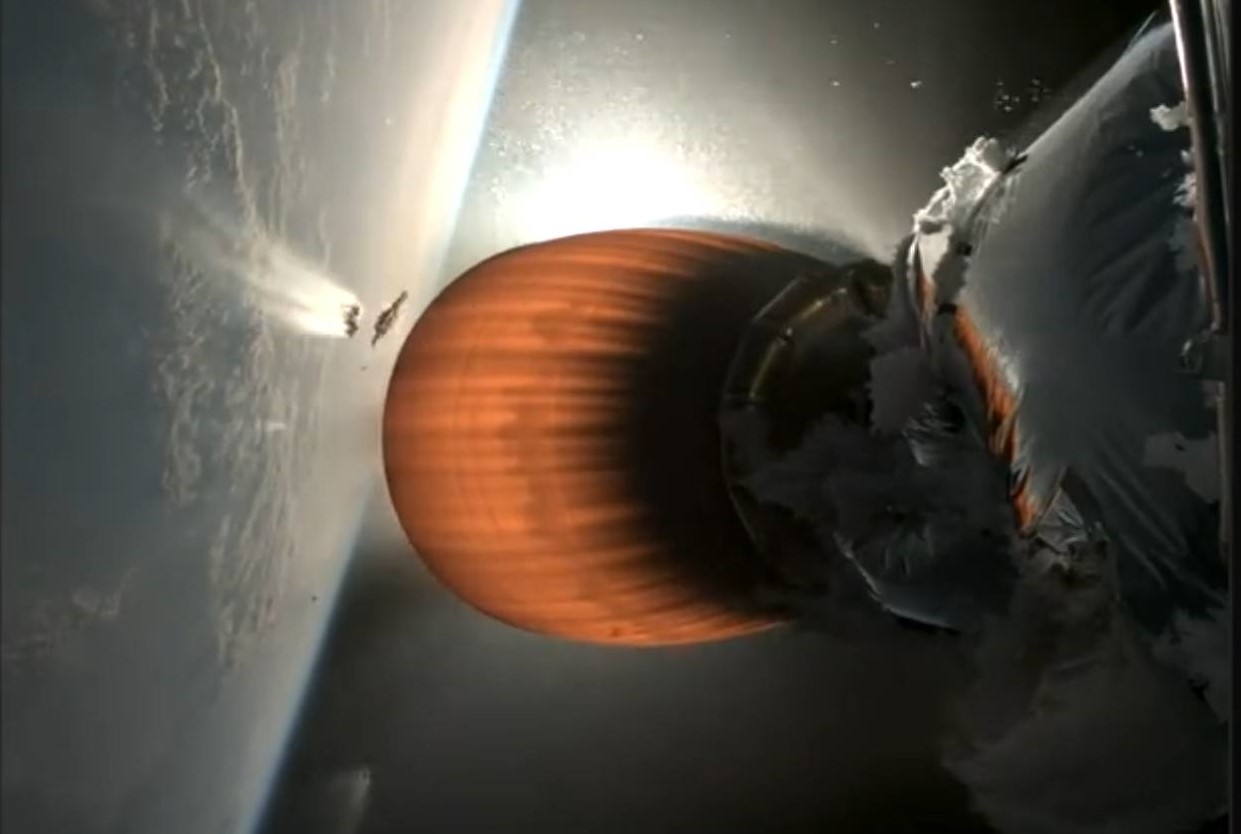
Misbehaving upper stage. Image credit: SpaceX/Inside Outer Space screengrab
Eccentric orbit
As explained in a SpaceX posting, Falcon 9’s second stage performed its first burn nominally, “however a liquid oxygen leak developed on the second stage.”
After a planned relight of the upper stage engine to raise the lowest point of orbit, that stage’s Merlin Vacuum engine experienced an anomaly and was unable to complete its second burn.
“Although the stage survived and still deployed the satellites, it did not successfully circularize its orbit,” SpaceX explained, but the stage did passivate itself, a step normally performed at the end of each mission.
This left the satellites in an eccentric orbit, SpaceX added, with a very low perigee to Earth of under 85 miles (135 kilometers) altitude, which is less than half the expected perigee altitude.
Incident investigation
“No public injuries or public property damage have been reported,” reports the Federal Aviation Administration that is now requiring an investigation of the incident.
“An investigation is designed to further enhance public safety, determine the root cause of the event, and identify corrective actions to avoid it from happening again,” states the FAA.
Furthermore, the FAA must approve SpaceX’s final report, including any corrective actions.
“A return to flight is based on the FAA determining that any system, process, or procedure related to the mishap does not affect public safety,” the FAA explains. “In addition, SpaceX may need to request and receive approval from the FAA to modify its license that incorporates any corrective actions and meet all other licensing requirements.”
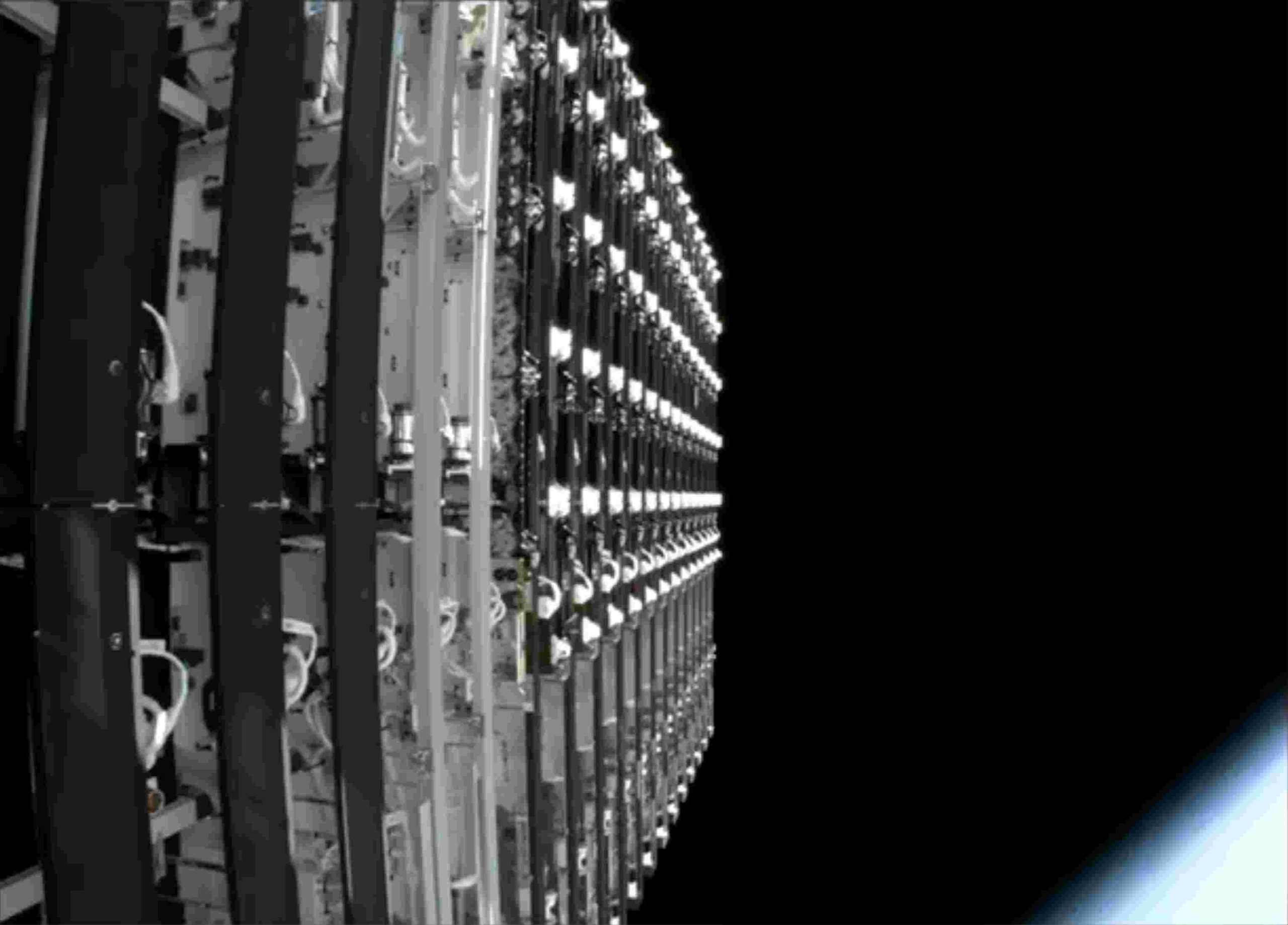
Load of Starlink satellites in doomed deployment.
Image credit: SpaceX via CelesTrak
I’ll raise you
According to SpaceX, the satellites were left in an enormously high-drag environment as they circuited the Earth.
At that level of drag, “our maximum available thrust is unlikely to be enough to successfully raise the satellites.”
The Starlink satellites will re-enter Earth’s atmosphere and “fully demise,” SpaceX added. “They do not pose a threat to other satellites in orbit or to public safety.”
Fully demise
The term “fully demise” is worth a note here.
Evidence is mounting that the high-heating of spacecraft materials as they plow through the atmosphere at high speeds do off-load chemistry into the Earth’s upper stratosphere. How destructive to the atmosphere that process is remains in research mode.
Then there’s the issue of spacecraft pieces that do find their way to Earth’s surface, be it ocean or land.

Image credit: NOAA
Increased activity
Meanwhile, satellite tracker T.S. Kelso and the CelesTrak chief, has been monitoring all 20 Starlink spacecraft, eyeing their individual decay rates as they circle Earth.
“At least geomagnetic activity is low (normal) right now,” Kelso told Inside Outer Space, but NOAA’s Space Weather Prediction Center is forecasting increased activity today.
CelesTrak ‘s mission is focused on making data and other resources freely available to the space community “to facilitate understanding of our orbital environment and how to use it safely and responsibly.”

Confirmed SpaceX debris found in Australia.
Photo courtesy: Brad Tucker
Uptick in skyfall
All in all, SpaceX and company leftovers falling from the heavens have garnered increased attention.
Last May, the remainders of a SpaceX Dragon “trunk” from its Crew-7 mission peppered separate sites in North Carolina.
While Starlink’s construction and the Dragon trunk design are worlds apart, the uptick from uncontrolled riff-raff coming down is a growing, worrisome trend.
For one, the list of other trunk dumps that survived their fiery skyfall also includes Australia, as well as Canada.
As reported by Canada’s CBC News, SpaceX employees visited a farm near Ituna, Saskatchewan, northeast of Regina, whisking away a number of trunk fragments in a U-haul trailer.

SpaceX Dragon “trunk” Image credit: SpaceX
The farmer that owns the property where the clutter came to full-stop was later compensated by SpaceX, CBC reports, for an undisclosed amount. Some of that money was subsequently donated to installation of a new local hockey rink.
Hot-lines
For its part, SpaceX has established a “SpaceX debris hot line” call-in number, as well as a “recovery@spaceX.com” email address.
“If you believe you have identified a piece of debris, please do not attempt to handle or retrieve the debris directly. Instead, please either email or leave a voice mail here with your name, number, and a brief description of what you have discovered and where,” the hot-line phone message explains.
“Teams are actively monitoring both message boxes and will ensure the notification is handled appropriately,” the recording adds. “If you have concerns about an immediate hazard, please contact your local law enforcement agency. Thank you, your assistance is greatly appreciated.”
Not sure if any recovered Starlink bits and pieces can use these same hot lines, but why not?
“I wish I may, I wish I might…Have the wish I wish tonight.”
 Posted in

Chris Sembroski, the well-suited for space travel private astronaut for the Inspiration4 mission in 2021. His spacesuit is on permanent display at the U.S. Space and Rocket Center in Huntsville, Alabama.
Image credit: Chris Sembroski
Inspiration4 was the world’s first all-civilian mission to climb into orbit, a four-person crew transported skyward atop a SpaceX Falcon 9 rocket. The privately-funded commercial mission took place September 16-18, 2021.
The SpaceX Crew Dragon “Resilience” spacecraft was commanded by the well-heeled Jared Isaacman, entrepreneur, founder and chief executive officer of Shift4 Payments. Get familiar with the name as he’s lead spaceman for the upcoming Polaris Dawn mission, a three-flight program all backed and commanded by the tech billionaire.

Artwork depicts the specially outfitted SpaceX Dragon spacecraft with its viewing dome.
Image credit: SpaceX
Raffle for liftoff
On Inspiratio4, Isaacman’s nongovernment crewmates were Sian Proctor, Hayley Arceneaux, and Chris Sembroski. This low-Earth orbit three-day, “tourist-class” expedition was procured by Isaacman, the flight itself and the Dragon spacecraft’s four seats. Two of those seats were donated to St. Jude Children’s Research Hospital, used to ignite a highly successful fund-raising and awareness campaign for the hospital.
A raffle was held, in which a seat-hungry entrant was picked, but that winner gave up his place in space to fellow raffle entrant and friend throughout college, Chris Sembroski – and as they say, the rest is history.

Under the dome. Inspiration4 crew’s space selfie. Left to right top, Jared Isaacman, Chris Sembroski, and Sian Proctor with hair-hovering Hayley Arceneaux.
Image credit: Inspiration4 Photos
I caught up with Sembroski last month via video link at a dazzling pre-grand opening event of Home Beyond Earth, an impressive and immersive new exhibition at The Museum of Flight in Seattle.
Go to my new Space.com story –‘Drawn to our planet:’ How spaceflight changed SpaceX Inspiration4 astronaut Chris Sembroski -“Even though I felt physically separated from Earth, I felt more drawn to our planet than I had before – at:
https://www.space.com/spacex-inspiration4-mission-chris-sembroski-interview

Earth’s Moon as viewed from the International Space Station.
Image credit: NASA
The Moon needs power!
That’s the on-switch approach suggested in the House NASA Reauthorization Act of 2024.
A “Lunar Power Purchase Agreement Program” is in the House Science, Space, and Technology Committee language just released.
Independent entity
It authorizes NASA to enter into an arrangement with an independent entity to conduct a study on the feasibility of using power purchase agreements to facilitate the development and deployment of lunar surface power.
“The study will identify the needed infrastructure and capabilities to support lunar surface power production, forecast the demand for lunar surface power, and consider associated policy and legal challenges,” according to the language.
Anywhere on the Moon
Whatever the outcome of pushing this concept forward it could be energized by the Moon plans in the making by Blue Origin.
Since 2021, the group has been making solar cells and transmission wire from Moon regolith simulants – Earth-made lunar turf that mimics the real stuff.

Image credit: Blue Origin
Their approach is called Blue Alchemist.
“To make long-term presence on the Moon viable, we need abundant electrical power,” explains a Blue Origin statement. “We can make power systems on the Moon directly from materials that exist everywhere on the surface, without special substances brought from Earth. We have pioneered the technology and demonstrated all the steps. Our approach, Blue Alchemist, can scale indefinitely, eliminating power as a constraint anywhere on the Moon.”
Deployable solar arrays
Last year, NASA selected a trio of companies at the tune of $19.4 million to further advance work on deployable solar array systems for the Moon.

Image credit: NASA
These three companies are to build prototypes and perform environmental testing, with the goal of deploying one of the systems near the Moon’s south sole near the end of this decade:
Astrobotic Technology: $6.2 million
Honeybee Robotics: $7 million
Lockheed Martin: $6.2 million

Lots of lunar activity means lots of needed power.
Image credit: APL/NASA
Generate, distribute, store power
Also weighing in on lunar surface power needs is the Lunar Surface Innovation Consortium, run by the Johns Hopkins Applied Physics Laboratory (APL). It operates in collaboration with the NASA Space Technology Mission Directorate.
Surface Power Focus Area experts are looking into technologies that generate, distribute, and store power in the harsh lunar surface environment. The intent of this research is to arrive at power systems that enable sustained presence and exploration.
Topics include fission surface power, solar power, low-temperature batteries, fuel cells, wireless transmission, long-distance transmission, power electronics, and grid-scale energy storage.

“Above us in the heavens, an intergalactic land grab is unfolding,” explains an upcoming HBO documentary Wild Wild Space, premiering on HBO and Max next Wednesday, July 17.
“It’s a fast-paced and high-stakes race in which rockets and satellites are taking over low earth orbit to gain control over our planet,” explains a press statement focused on the upcoming documentary’s release.

Image credit: Astra

Image credit: Rocket Lab
Directed by Oscar-winning filmmaker Ross Kauffman, the film focuses on the intense rivalry between two visionaries and founders of contesting rocket companies: Chris Kemp of Astra and Peter Beck of Rocket Lab.
Dark $ide
Kauffman follows the rollercoaster journey of these tech startups vying for a piece of uncharted space territory.
“From exhilarating triumphs to gut-wrenching setbacks, we witness the fierce competition to seize humanity’s next great frontier,” adds the statement.
“But beneath the shiny veneer of progress is the dark side of capitalism’s insatiable appetite for profit.”
Go to this trailer at:

China’s Mars Sample Return mission.
Image credit:
Details regarding China’s plan to return samples from Mars spotlights the country’s work on planetary protection – not only to protect the Red Planet from hitchhiking Earth microbes but also guard our biosphere and we Earthlings from the prospect of hauling back Mars biology.
The importance of planetary protection in China’s deep space exploration plans is reportedly “fully recognized” as the country moves forward on its Tianwen-3 mission.
Hauling back the goods
Projected to rocket back samples from Mars in the 2030 time period, Tianwen-3 would technologically mirror in many ways China’s Moon sampler probes: the Chang’e-5 near side specimen return in December 2020 and last month’s Chang’e-6’s two-day “grab, stash and go” of lunar far side collectibles.
Tianwen-3 will also build upon China’s successful Tianwen-1 Mars orbiter/lander/rover mission launched in July 2020.

Tianwen-1 Mars mission.
Image credit: Kanyan Xu/COSPAR
That lander/rover combination soft landed on the Red Planet in May 2021. The lander’s Zhurong rover reconnoitered the southern part of the Mars Utopia Planitia.
But hauling back the goods from Mars adds new complexity, as well as how best to safely handle the samples once on Earth.

On-location. Lander and Zhurong Mars rover.
Credit: CNSA/Inside Outer Space screengrab
COSPAR presentation
Research on planetary protection technology in China was highlighted during a special Committee on Space Research (COSPAR) “Planetary Protection Week” held last April.
The event was staged at the Royal Society in London, hosted by the Open University’s Astrobiology research group and funded by the UK Space Agency as part of the International Bilateral Fund.
Among the presentations, Kanyan Xu of the Laboratory of Space Microbiology, Shenzhou Space Biotechnology Group, Chinese Academy of Space Technology in Beijing, China, outlined planetary protection work in China’s deep space exploration projects.
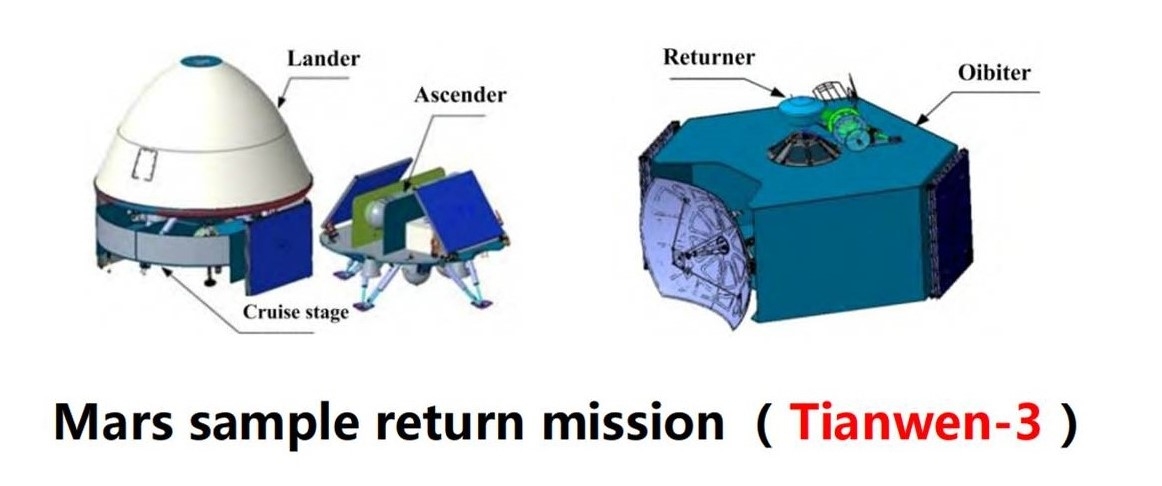
Image credit: Kanyan Xu/COSPAR
Strict measures
“China fully recognizes the importance of planetary protection in achieving the scientific goals of the Tianwen-3 mission and ensuring the biosafety of the Earth,” Kanyan reported to COSPAR. “Strict forward and backward planetary protection measures will be taken.”
As noted in the Kanyan presentation, the Tianwen-1 Mars mission was China’s first planetary protection Category IV mission.
The Tianwen-1 mission did not carry Mars life detection instruments. It did not come into contact with Martian “special regions,” thus it was classed as a Category IVa undertaking: Category IVa is for lander systems not carrying instruments designed for searching for evidence of extant life on Mars.

China’s Tianwen-1 Mars orbiter.
Credit: CNSA
The term special regions are locales on Mars within which terrestrial organisms are likely to replicate or have a high potential for the existence of extant, now present, martian life forms.
The Category IVa definition calls for bioburden levels on the spacecraft’s surface restricted to below ≤ [Less-Than or Equal To] 3 × 10⁵ spores with an average of ≤ 300 spores per square meter.
Clarified requirements
Kanyan’s presentation states that China space specialists, for the Tianwen-1 mission, established a planetary protection team and clarified the requirements for planetary protection including bioburden control, probability of Mars impact, organic inventory, etc.
Major planetary protection measures included: cleanroom for assembly, integration, and testing (AIT); microbial examination; cleaning, disinfection and sterilization; recontamination control and organic inventory.
The pre-launch bioassay of Tianwen-1 showed the bioburden level of the probe met the requirements for Category IVa missions, Kanyan noted.

Image shows dozens of individual bacterial cells of Tersicoccus phoenicis. This species has been found in only two places: clean rooms in Florida and South America where spacecraft are assembled for launch.
Image credit: NASA/JPL via Victoria Pearson, Open University
Microbial database
For China’s projected Mars sample return mission, the Kanyan presentation points out that it falls into a Category V effort that designates a restricted Earth return: the outbound leg of the mission needs to meet the requirements of Category IVb – a requirement that translates into missions searching for extant martian life.
In reviewing research on planetary protection technology in China, Kanyan’s presentation explains that a large amount of research has been conducted on planetary protection techniques through both international cooperation and independent study and development.
“Through long-term monitoring and sampling of AIT and launch site cleanroom environments in various parts of China, a microbial database and strain storage center have been set up and can be used for future planetary protection technology development and positive control for space mission,” a presentation chart explains.

Image credit: Kanyan Xu/COSPAR
Portable clean environments
“We have developed operational and data analysis protocols for deep space exploration missions, by studying publicly available documents from NASA and ESA,” the presentation states.
For example, work in China has been done on portable clean environments through cooperation with Thales-Alenia Space Italia (TASI).
Through the collaboration with TASI, China has formed a series of planetary protection documents, especially for cleanroom operations and recontamination control for assembly, integration, and testing activities.

The huge canyon that is Valles Marineris is arguably Mars’ most dramatic landscape and offers a scientific bonanza for future robotic and human expeditions.
Image credit: ESA/DLR/FU Berlin (G. Neukum), CC BY-SA 3.0 IGO
Bioburden, sterilization technologies
Members of China’s planetary protection team have passed training classes on planetary protection, cleanroom operations and recontamination control.
“We have various bioburden reduction and sterilization technologies which can be used for PP [planetary protection] purpose, including dry heat sterilization, UV sterilization, hydrogen peroxide gas sterilization, cold plasma sterilization, alcohol/Isopropanol wiping, and so on,” the Kanyan overview explains.
Furthermore, rapid microbial examination technology has been created to more quickly detect spores, thereby shortening the assembly, integration, and testing of Mars-bound hardware.
Protect the Earth
In a summary slide, the goal of planetary protection, Kanyan concluded, “is not only to protect the effectiveness of research on major scientific issues in deep space exploration, but also to protect the Earth and the safety of human[s].”
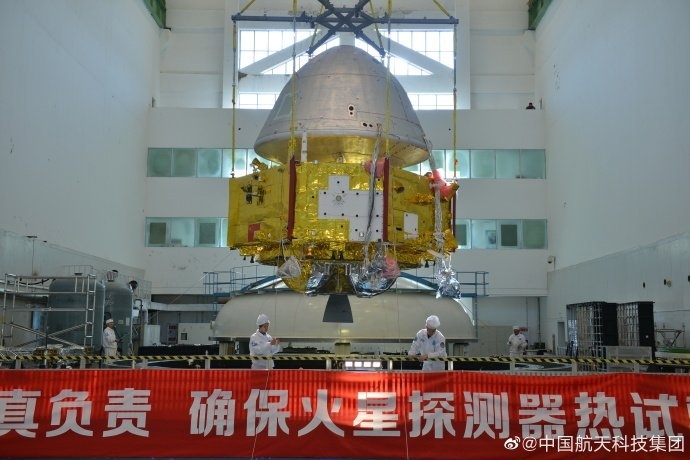
Tianwen-1 Mars orbiter/lander/rover mission launched in July 2020.
Image credit: China Aerospace Technology Corporation
It is necessary to take planetary protection measures for ensuring the achievement of scientific goals of deep space exploration missions, Kanyan reported.
“China has complied with the [United Nations] outer space treaty and the planetary protection policies formulated by COSPAR,” the summary slide adds, “and has conscientiously carried out planetary protection work during both lunar and Mars exploration missions.”
International consensus
“Their summary slide says it all, concisely,” said John Rummel, a former and founding chair of the panel on planetary protection of the COSPAR, an international confab of experts.
Rummel previously worked at NASA Headquarters (1986 to 1993 and 1998 to 2008) as the space agency’s senior scientist for astrobiology and as NASA’s Planetary Protection Officer.
Rummel told Inside Outer Space it appears that China is innovating to do the planetary protection tasks more effectively with less of a burden than might otherwise be the case.
“Reaching an international consensus on those requirements, despite a lack of direct collaboration with the United Sates, is precisely the reason that COSPAR maintains a Panel on Planetary Protection,” Rummel said.
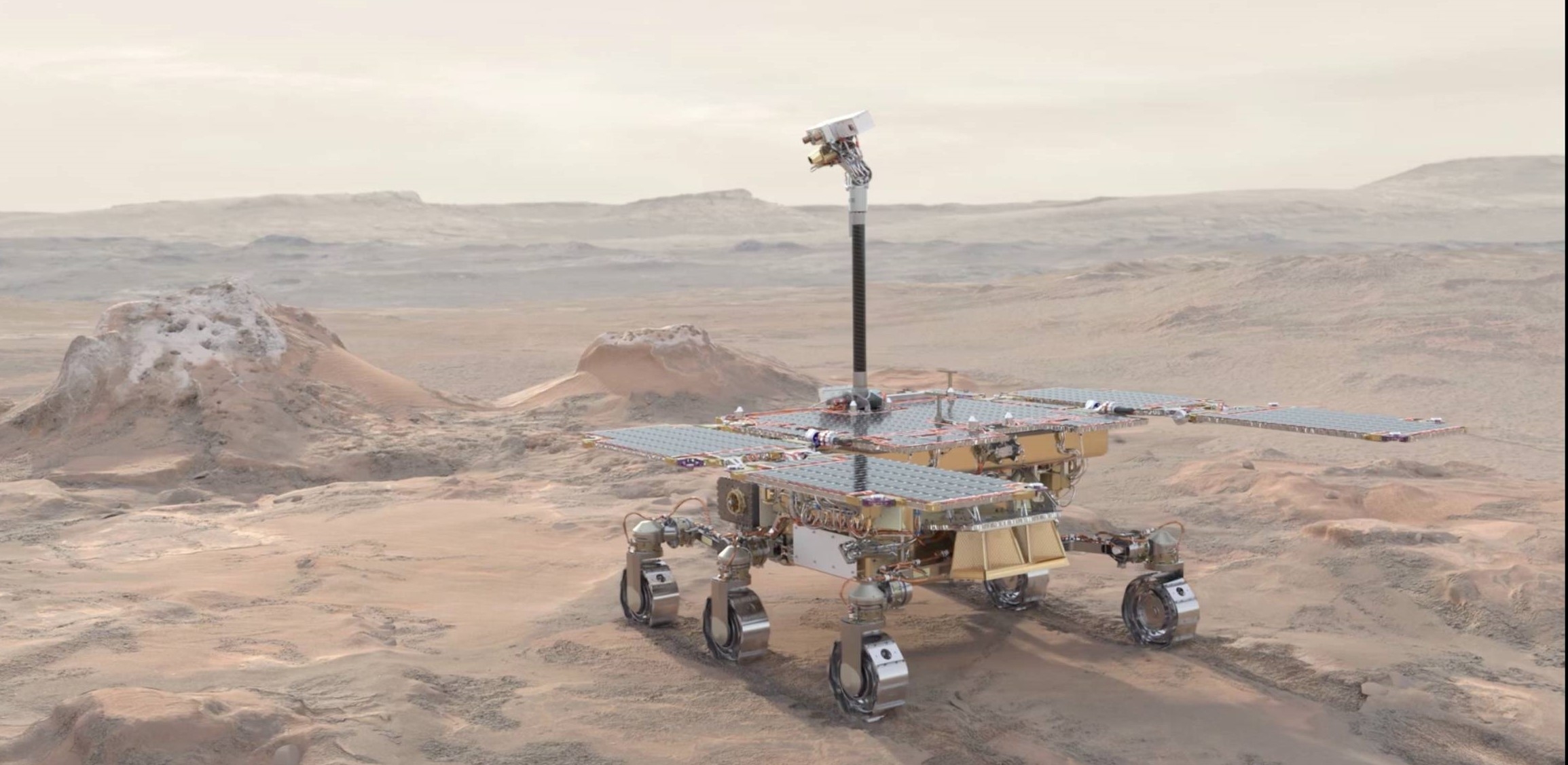
Europe’s ExoMars mission.
Image credit: ESA/Mlabspace
Doing all the right things
Also assessing the China COSPAR presentation is Cassie Conley, a former NASA planetary protection officer, the longest-serving scientist in that post to date.
Conley said it’s definitely the case that China says they’re doing all the right things for Mars planetary protection.
Specifically, Conley pointed to use of rapid spore assay and plasma sterilization.
Also, the collaboration with Thales-Alenia Space Italia (TASI) “is a very promising sign, since the same group did a good job with planetary protection for the ExoMars lander/rover. TASI did solid work on ExoMars,” she said.
The European Space Agency’s ExoMars is slated for launch between October and December 2028. That venture via its Rosalind Franklin rover — aims to explore the martian surface in pursuit of evidence indicating past life, as well as hunt for present signs of life on Mars.

Substantial resources
Another encouraging aspect of China’s approach, Conley added, based on the COSPAR presentation, are images that may well show the actual facilities China has built for Mars exploration. “They’ve almost certainly invested substantial resources in planetary protection facilities,” Conley added.
“Two things I’d want to know more about include the actual bioburden numbers for the Mars mission China has already sent, and how they’re implementing ‘UV sterilization,’” Conley told Inside Outer Space.
UV light is easily blocked by very thin layers of material, Conley added, “so it’s not a reliable method for any surface that doesn’t have a mirror-finish, since some of the microbes one worries most about will create caves in metal surfaces to live in.”
Arguably, perhaps a highly beneficial scientific consequence from knowing more detail about China’s Mars planetary protection plans is having NASA experts on this issue work cooperatively with China’s Mars team. Doing so would, however, require a relook at U.S. Congressional restrictions on bilateral US-China collaboration, Conley concluded.

Image credit: Roscosmos TV Studio/Inside Outer Space screengrab
A general schedule for the creation of the Russian orbital station has been approved.
Along with Roscosmos chief, Yuri Borisov, 19 general directors of the main cooperation enterprises recently inked the document.
The deployment of the Russian station is planned to begin with the launch of the scientific and energy module in 2027.
By 2030, the plan is to create the core of the station from four modules launched into orbit: scientific and energy (NEM-ROS), universal node (UUM), gateway (SM) and base (BM).

Next-generation spacecraft to replace the Soyuz spacecraft approached Russia Orbital station.
Image credit: RoscosmosTV Studio/Inside Outer Space screengrab
A second stage phase, from 2031 to 2033, involves station expansion by docking two target modules: CM1 and CM2.
The schedule includes not only the work on the design and manufacture of the station modules, but also ensuring flight tests of the new-generation manned transport ship, the creation of launch vehicles and ground-based space infrastructure facilities, and the work of scientific institutes in the industry to support the project.
Why now?
A Roscosmos posting notes that the creation of the Russian orbital station will allow:
- continuation of the Russian human spaceflight program, taking into account the termination of the Russian Federation’s participation in the International Space Station (ISS) project;
- solving problems of scientific and technological development, the national economy and national security “that are not accessible on the Russian segment of the ISS due to technological limitations and the terms of international agreements”;
- increasing the competitiveness of domestic crewed space complexes;
- utilization of the station as a platform for testing space technologies.
Signed contracts

Image credit: Roscosmos TV Studio/Inside Outer Space screengrab
Government contracts are signed, Roscosmos adds, for experimental design work on the creation of the Russian space station, including a heavy-class launch vehicle “Angara” at the Vostochny Cosmodrome.

Image credit: University of Arizona/CatSat Project
In outer space can you hear the sound from ballooning expectations?
That “Noise of Summer” liftoff of Firefly’s launcher on July 3 from Vandenberg Space Force Base was loaded with eight CubeSats under NASA’s CubeSat Launch Initiative (CSLI).
One of the mini-spacecraft is a technology demonstration of a novel inflatable antenna for high-speed communications.
Called CatSat, this University of Arizona payload is showcasing inflatable technology, a deployable antenna consisting of a Mylar balloon.
CatSat’s central body is roughly the size of a large cereal box.

Image credit: Firefly Aerospace
Half-and-half
The front half of the balloon is transparent, allowing microwaves to pass through. The back half of the balloon is aluminized, creating a reflecting antenna.
After reaching low Earth orbit, CatSat’s antenna is slated to deploy and inflate to a diameter of just over one-and-a-half feet.
CatSat’s demonstration will be to transmit high-definition Earth photos at high-speed. The CubeSat will also relay data about the structure of the Earth’s ionosphere, gathered by listening-in to thousands of beacons from ground-based ham radio stations.
That’s a drag
CatSat will use a whip antenna to study Earth’s upper atmosphere before deploying its beachball-looking antenna.
“Once the inflatable antenna is deployed, it will increase drag,” said Shae Henley, the CatSat team’s lead integration and testing engineer at the University of Arizona.
“Even though we’re in low Earth orbit,” Henley said in a university statement, “there’s still some residual atmosphere in that part of space. That’s why there will still be drag due to the inflatable antenna’s larger size. So, we want to get some good ionospheric data beforehand.”
Size constraints
CatSat is a student-run project involving NASA’s Space Technology Mission Directorate, Freefall Aerospace, the University of Arizona, and Rincon Research Corporation in Tucson, Arizona.

Artwork depicts CatSat in Earth orbit, with its inflatable, beachball-like antenna deployed.
Image credit: University of Arizona/CatSat Project
The Large Balloon Reflector concept, said Chris Walker, a UArizona professor of astronomy and principal investigator of the CatSat project, is an inflatable technology that creates large collecting apertures that weigh a fraction of today’s deployable antennas.
The Large Balloon Reflector was an early-stage study developed through NASA’s Innovative Advanced Concepts (NIAC) program.
Walker is the father of the inflatable antenna concept used by CatSat.
The compactness of CubeSats has its drawbacks, pointed out Henley.
“But while the technology can be shrunk down with miniaturized components, the size of the antenna can’t break the laws of physics, and therefore there are size constraints,” Henley said in a university press statement. “Our solution to that challenge is an inflatable antenna.”

Future concept goes the lunar distance. Image credit: Freefall Aerospace
Moon, Mars designs
The CatSat team is looking into what they could do next with CubeSats, beyond Earth orbit.
One idea involves a CubeSat orbiting the Moon (LunaCat). Another design would use a CubeSat as a data transmitter for a Mars mission (MarsCat).
Fortifying those future plans, last May the team received a 3U CubeSat valued at about $500,000 from GOMspace North America, who donated the spacecraft to the CatSat team for a future mission. CatSat itself uses a GOMspace spacecraft bus.
“CatSat is definitely more Earth focused,” Henley said. “But an inflatable antenna has a lot of potential, even for deep space and longer, farther missions.”

Permanently shadowed regions (PSRs) on the Moon are those sunlight-shy craters that may well contain loads of precious water ice. Image credit: Hongyu Cui
The call from the Moon is clear – try and find my water ice.
There is the prospect that oodles of water ice could be lurking in the bottom of south polar craters on the Moon.
Forgive the cosmic colloquialism but these super-chilly features – “where the Sun don’t shine” – are tagged as permanently shadowed regions or PSRs. These south pole cold traps, if indeed laden with tons of water ice, are ideal for renovating that resource into drinkable water, oxygen, even rocket fuel.

Image details future water ice mining at Shackleton crater on the Moon.
Image credit: School of Mines/Dreyer, Williams, Sowers
It has been projected that a total of between two tons and 60 tons of surface water was charted by NASA’s Lunar Reconnaissance Orbiter Lyman Alpha Mapping Project, tempting tonnage right there on the floors of the larger permanently shadowed south polar craters. LAMP’s main mission is to find water ice in deep polar craters.
But new research flags a concern.
Fouling the goods
Could human landing systems touching down on the Moon deliver water from their rocket exhaust plumes, thereby fouling that locked-up, au naturel nector?
A newly published research paper – “Possible Anthropogenic Contributions to the LAMP-observed Surficial Icy Regolith within Lunar Polar Craters: A Comparison of Apollo and Starship Landings” – takes a look at such consequences.
Published in The Planetary Science Journal this study is led by Bill Farrell, a senior research scientist in Columbia, Maryland for the Space Science Institute.

SpaceX Lunar Starship off loads crew and cargo onto the moon’s surface.
Image credit: SpaceX
Native water
As pointed out in the research, the SpaceX Starship, picked by NASA to plop down Artemis moonwalkers on the lunar surface, could be rocket ruckus as far as native water ice is concerned.
The Starship landing plume, the paper notes, has the potential, in some cases, to deliver over 10 tons of water to the PSRs.
“This anthropogenic contribution could possibly overlay and mix with the naturally occurring icy regolith at the uppermost surface,” the report states. “A possible consequence is that the origin of the intrinsic surficial icy regolith, which is still undetermined, could be lost as it mixes with the extrinsic anthropogenic contribution.”

Apollo 17 Moon lander: Ascent and Descent segments.
Image credit: NASA
Apollo landings
The research paper also looked at past human activity, such as the Apollo lunar module landings. Could those exhaust plumes from the historic touchdowns churn out some or all of the surficial PSR water now being observed by the LAMP onboard the Lunar Reconnaissance Orbiter (LRO)?
The answer is no, the research team found. Those Apollo landings provided only a very small, less than 1% of the surface water in PSRs. That’s an inconsequential fraction of water to the intrinsic PSR surficial water, they report.
“However, Starship landings in the south polar region have the potential to add a substantial contribution of water to the PSRs, possibly exceeding the mass of the existing surface frost in the PSRs over as few as four landings,” the paper observes.

NASA Administrator Bill Nelson discusses lunar landing sites as he testifies during a House Science, Space and Technology Committee hearing.
One photo – multiple nations headed for lunar territory.
Image credit: NASA/Bill Ingalls
An output is that naturally occurring water veneer in PSRs is expected to be altered (obscured/mixed) by Starship landings. “This additional anthropogenic water mass deposited onto the surface of the PSRs could reduce or destroy the ability to understand the origin of the intrinsic, naturally occurring surface icy regolith,” suggest the scientists.
Exospheric modeling
Farrell told Inside Outer Space that he and colleagues determined the amount of water deposited into the high-latitude polar region from the landing plumes of 20th century Apollo landings and Starship touchdowns of the 21st century.
Used for the research was exospheric modeling work done by Parvathy Prem, a planetary scientist at the Johns Hopkins Applied Physics Laboratory in Laurel, Maryland. It was used to find out the amount of this surface water that outgasses and migrates into the polar cold traps.
“It turns out that about 20% of the high latitude water deposit finds its way into the permanently shadowed craters in the south pole,” Farrell said.

Imagery produced by the Lyman Alpha Mapping Project (LAMP) aboard NASA’s Lunar Reconnaissance Orbiter (LRO) reveal features at the Moon’s northern and southern poles in the regions that lie in perpetual darkness. They show many permanently shadowed regions.
Image credit: Southwest Research Institute
Distinctly different sources?
Interestingly, there’s a bit of a mystery involving the Lunar Reconnaissance Orbiter’s LAMP output.
“To date, investigators simply don’t know the origin of this LAMP-observed top-surface icy-regolith in the cold traps,” Farrell explained. It may be a manifestation of the deeper ice that has been sensed by the neutron spectrometers on NASA’s Lunar Prospector orbiter and the LRO.
However, it may also be from one or more distinctly different sources, Farrell added, possibly from active, ongoing sources like solar wind-created water migration or water delivery from micro-meteoroids.
“With a big lander delivering 10’s of tons of water to the cold traps, investigators may lose the ability to uniquely determine the source of this top-surface ice,” Farrell said. “The opportunity will be lost.”
Inspect the effect
Farrell and colleagues suggest that existing and future orbital and landed assets be used to inspect the effect of polar landers on the cold traps within PSRs.

NASA’s venerable Lunar Reconnaissance Orbiter (LRO), on-duty since swinging into orbit around the Moon on June 23, 2009.
Image credit: NASA/Goddard Space Flight Center
One suggestion is to have assets currently in orbit scrutinize the south polar PSRs both before and after Starship polar landings. That collected data could determine the effect of the rocket’s landing on the natural, intrinsic surface icy regolith.
Prior to the first Artemis human landing (now scripted as Artemis III), Starship is to make a demonstration landing, and the effects of this landing on the PSRs could be monitored by Moon-circling assets.

NASA’s Volatiles Investigating Polar Exploration Rover is to investigate the Nobile Region of Moon’s south pole.
Image credit: NASA
Ground truth
As for a “ground truth” look, NASA’s still to fly Volatiles Investigating Polar Exploration Rover (VIPER) could possibly snoop around to examine the delivery of water by Starship.
VIPER and its array of instruments should be on-duty, pre-Starship touchdown. VIPER could provide a first-ever, on-the-spot PSR “trapping ratio” using the local Starship-released engine chemistry at landing as a known source, the paper states.
The paper – “Possible Anthropogenic Contributions to the LAMP-observed Surficial Icy Regolith within Lunar Polar Craters: A Comparison of Apollo and Starship Landings” – can be found here at:
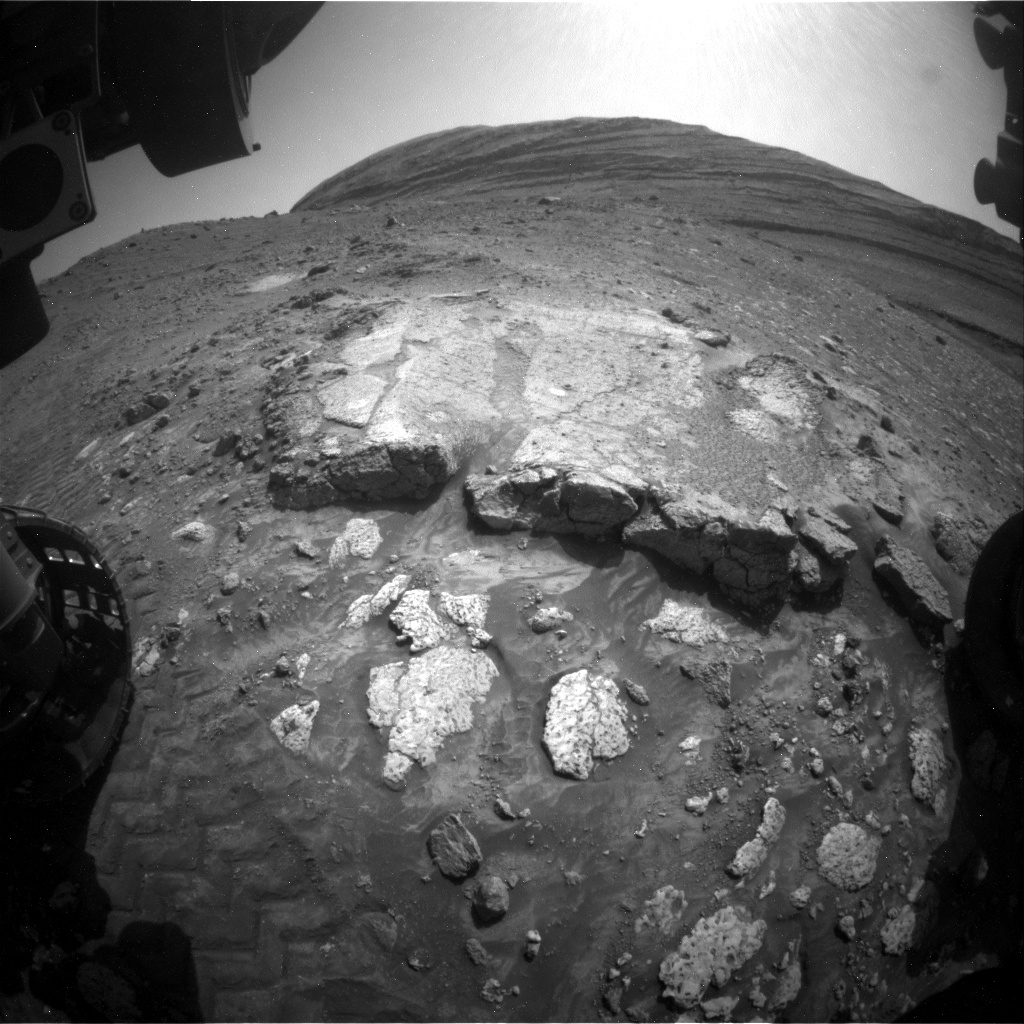
Curiosity Front Hazard Avoidance Camera (Left B image taken on Sol 4235, July 5, 2024.
Image credit: NASA/JPL-Caltech
NASA’s Curiosity Mars rover at Gale Crater is now performing a number of duties.
Abigail Fraeman, a planetary geologist at NASA’s Jet Propulsion Laboratory, reports that researchers received data from the robot’s Sample Analysis at Mars (SAM) Instrument Suite focused on the Mammoth Lakes sample late Monday afternoon of this week.
“After chewing over the results,” Fraeman notes, “the team declared we are very happy with all of the analyses we’ve done with this sample, and we are ready to move on to greener pastures… er, redder rocks!”

Curiosity Mars Hand Lens Imager (MAHLI) photo produced on Sol 4235 July 5, 2024.
Image credits NASA/JPL-Caltech/MSSS
Drill tailings
This decision means that Curiosity handlers will go ahead and clear out the drill assembly, and subsequently use the arm to collect Mars Hand Lens Imager (MAHLI) and Alpha Particle X-Ray Spectrometer (APXS) observations of the pile of drill tailings around the drill hole.
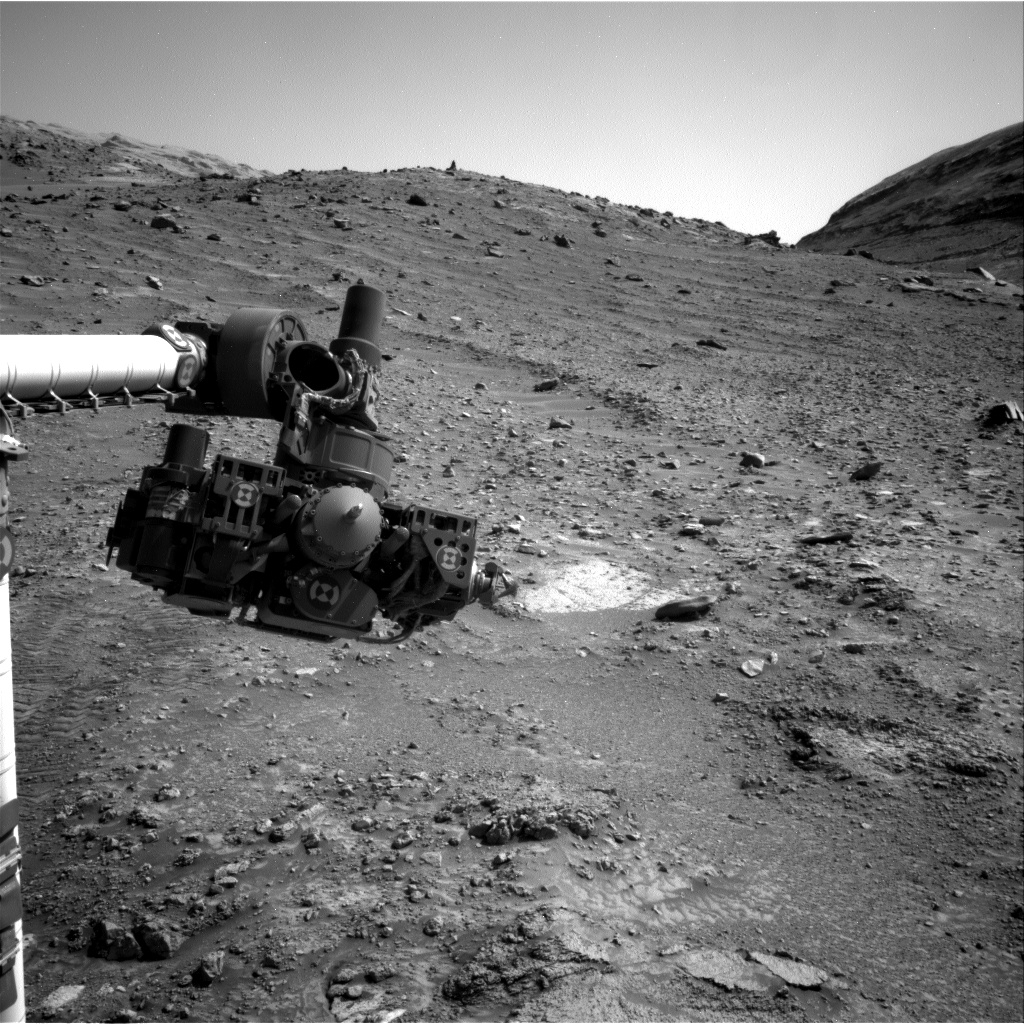
Curiosity Right B Navigation Camera image taken on Sol 4235, July 5, 2024.
Image credit: NASA/JPL-Caltech
“We’ll also have some time for remote sensing activities that use our mast-mounted instruments,” Fraeman adds. “Even though we’ve been parked at this location for several weeks, we’re still finding lots of things to look at!”

Curiosity Right B Navigation Camera photo acquired on Sol 4234, July 4, 2024.
Image credit: NASA/JPL-Caltech
What’s around the corner?
A new plan has the rover using its Chemistry and Camera (ChemCam) collecting Laser Induced Breakdown Spectroscopy (LIBS) observations on a light-toned rock target named “Finger Peaks,” as well as a bumpy rock named “Glen Aulin.”
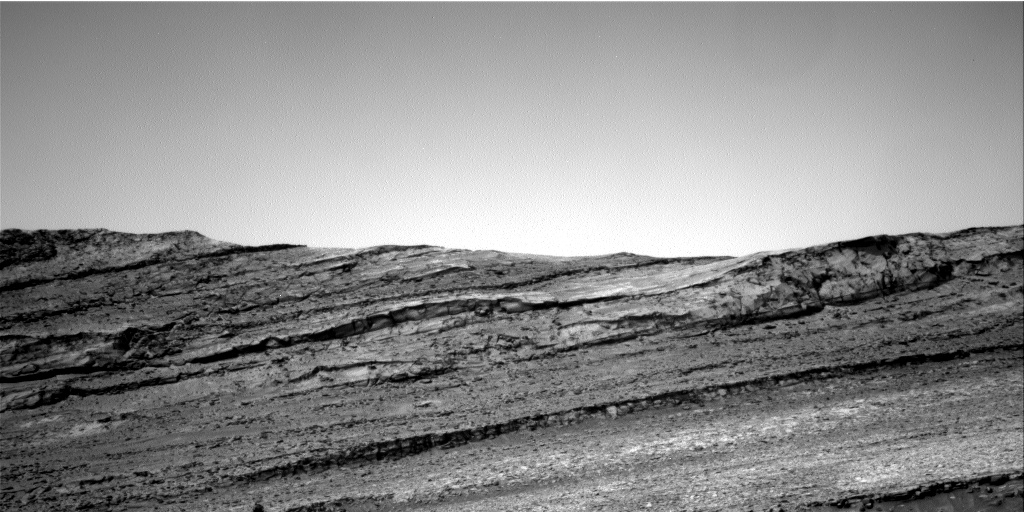
Curiosity Right B Navigation Camera photo acquired on Sol 4234, July 4, 2024.
Image credit: NASA/JPL-Caltech
“We’ll also collect some additional Mastcam images of interesting features in the area, and a long-distance Remote Micro-Imager (RMI) mosaic of a target named ‘Rock Island Pass.’ Several kinds of environmental monitoring activities will round out the plan,” Fraeman reports.
“It’s been a very productive drill sampling campaign here at Mammoth Lakes, our first after crossing into Gediz Vallis channel, and I’m excited to start getting ready to move on,” Fraeman concludes. “What’s around the corner in this fascinating area of Mt. Sharp?”
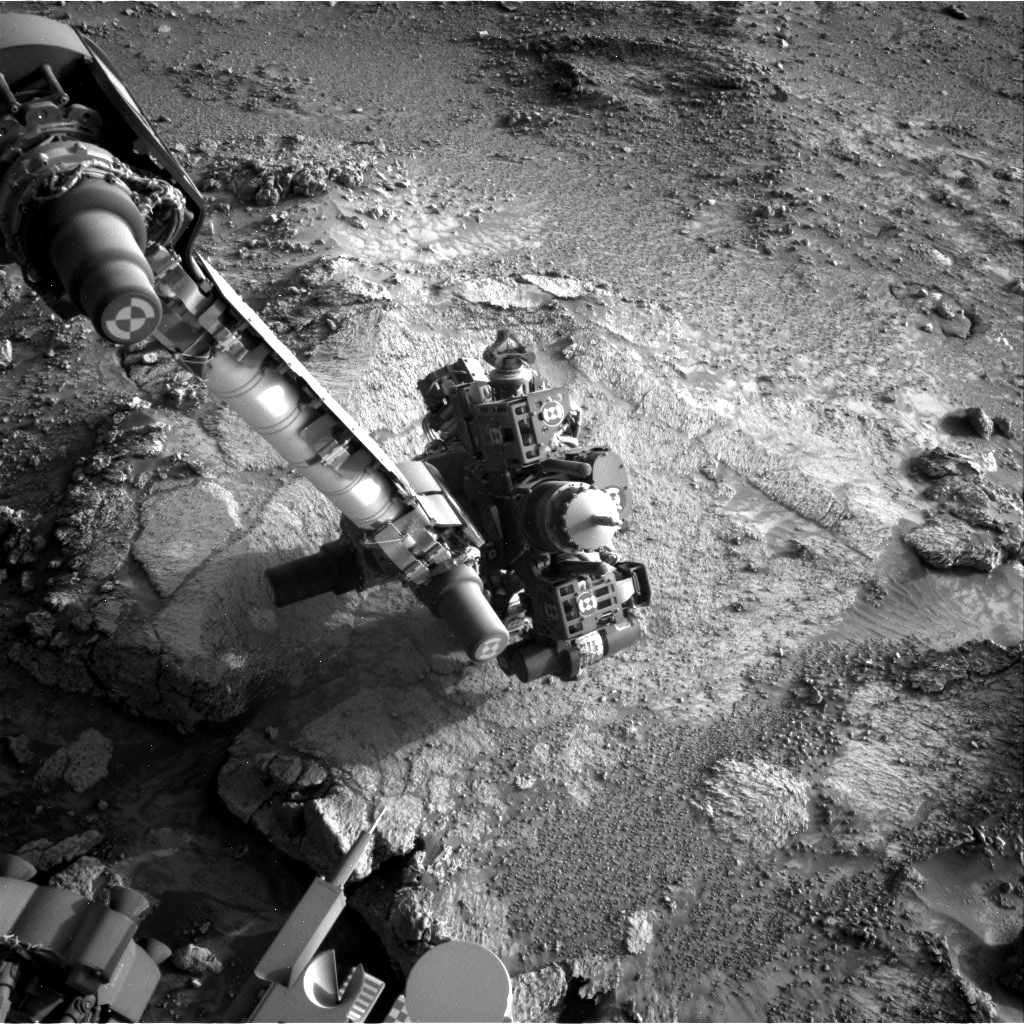
Curiosity Right B Navigation Camera photo acquired on Sol 4234, July 4, 2024.
Image credit: NASA/JPL-Caltech

Image credit: CMSA/CCTV/Inside Outer Space screengrab
China’s Shenzhou-18 space station crew has completed its second spacewalk.
The China Manned Space Agency (CMSA) stated on Wednesday that Ye Guangfu, Li Cong and Li Guangsu worked together for about 6.5 hours to complete multiple tasks.
Co-taikonaut Li Guangsu remained inside the space station. Beijing Aerospace Control Center staff assisted in carrying out spacewalk tasks.
Space debris protection
China Central Television (CCTV) has reported: “With the assistance of the space station’s robotic arm and researchers on Earth, they installed space debris protection devices for the pipelines, as well as cables and key equipment outside the Tiangong space station, and conducted an extravehicular inspection.”

Image credit: CMSA/CCTV/Inside Outer Space screengrab
Liu Ming, engineer for the China Aerospace Science and Technology Corporation said the main purpose of this most recent spacewalk was to install protection devices for extravehicular equipment, mainly cables and pipelines, “so as to improve the space station’s ability to operate safely and steadily over the long term.”
Robotic arm
China astronaut Li Cong opened the hatch door of the Wentian space lab module to begin his first spacewalk, aided by the orbital outpost’s robotic arm.

Image credit: CMSA/CCTV/Inside Outer Space screengrab
He was followed by Ye that transferred the relevant equipment and devices out of the space station. Working in concert with Li, they installed protection devices for the cables of the Wentian lab module and the pipelines of the Tianhe core module.
The station trio carried out their previous spacewalk on May 28, installing protection devices for the extravehicular cables on the Mengtian lab module.
“There are more protection devices we have to install this time than the previous spacewalk. During the process, astronauts needed to get from the exit hatch to the relevant operation points, which took them a lot of time. But they have completed the task with ease,” Wu Dawei, an expert with the China Astronaut Research and Training Center, told CCTV.

Image credit: CMSA/CCTV/Inside Outer Space screengrab
Stable status
The Shenzhou-18 crew was launched April 25 this year. At this point in their mission, the threesome have completed one third of their space journey.
As the third crewed mission in the “application and development stage” of China’s space station, it is also the 32nd flight mission of the country’s overall human spaceflight program.
According to the CMSA, the space station combination is now in a stable status with all equipment functioning well.

High-definition images of China’s space station were taken by the departing Shenzhou-16 crew last October 30.
Image credit: CMS
Go to this CCTV video focused on the second spacewalk at:

