Archive for July, 2024
 Author:
  July 20th, 2024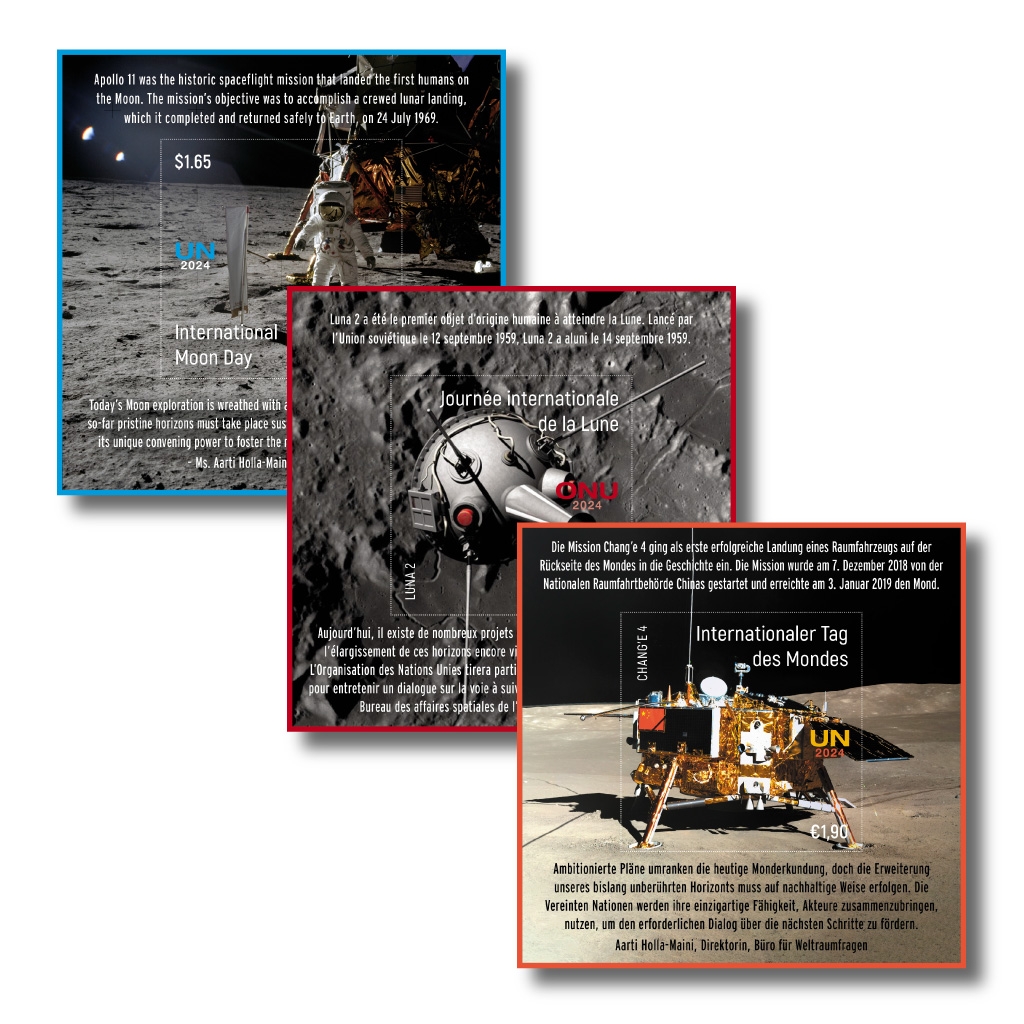
Image credit: UNPA
Call it the UN “stamps of approval” to commemorate July 20, 2024 as International Moon Day.
The United Nations Postal Administration (UNPA) is issuing six postage stamps and three souvenir sheets to commemorate this day, saluting America’s Apollo 11 landing on the Moon on July 20, 1969.
“Following the birth of space exploration nearly 70 years ago, the Moon quickly became the ultimate destination for countless scientific missions, including crewed flights that brought the first human footprints to another place in the universe. Many national space agencies and corporate entities have ambitious plans to reach and explore the Moon,” the UNPA notes in a press statement.
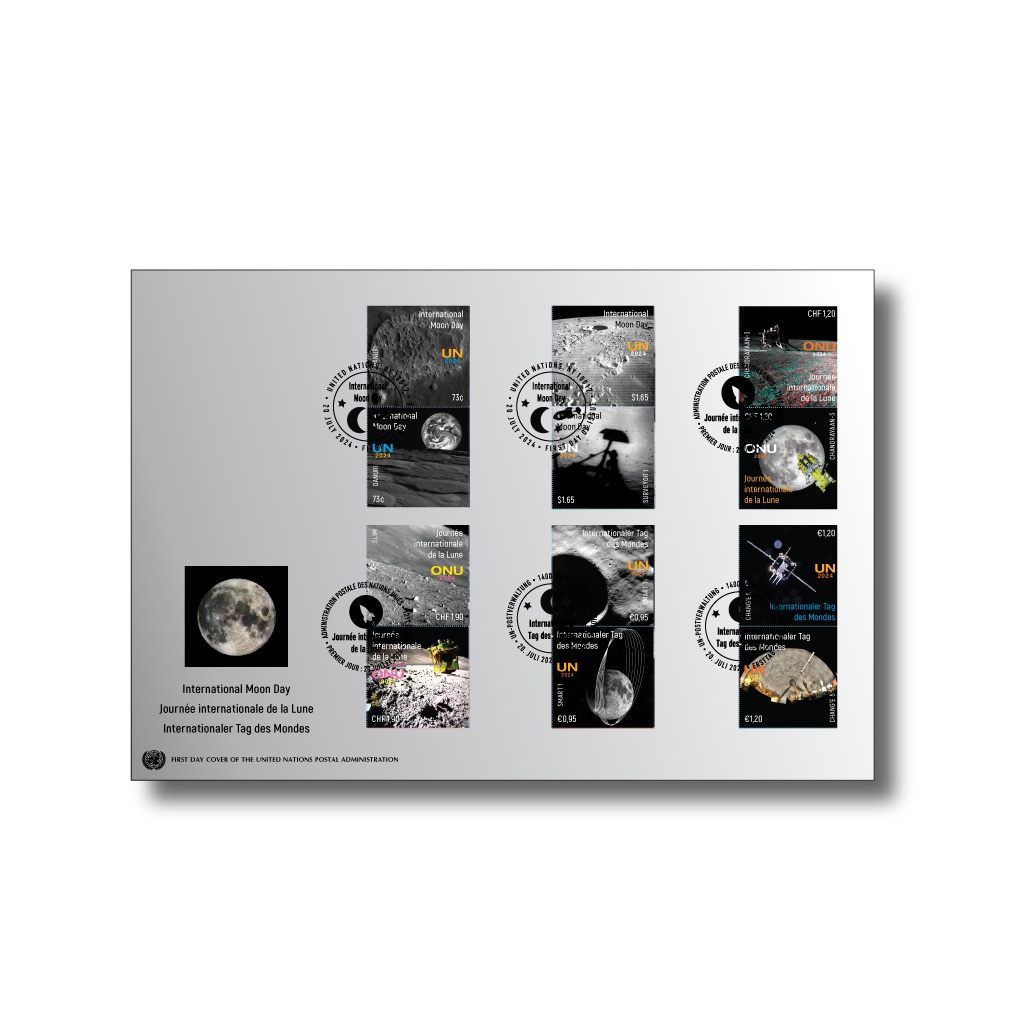
Image credit: UNPA
The way forward
In its resolution on “International cooperation in the peaceful uses of outer space” in 2021, the United Nations General Assembly declared International Moon Day, to be observed annually on July 20.
“Today’s Moon exploration is wreathed with ambitious plans, but the expansion of our so-far pristine horizons must take place sustainably,” explains Aarti Holla-Maini, Director of the United Nations Office for Outer Space Affairs. “The United Nations will leverage its unique convening power to foster the necessary dialogue on the way forward.”
For more information on available stamps and souvenir sheets, go to:
 Posted in

Image credit: NASA
NASA has requested SPACEX to carry out a month-long “Special Study for Emergency Response,” a contract valued at $266,678.00. The work request was signed on July 15 and the work is to be completed by August 15. This action was signed by a procurement officer at Kennedy Space Center.
There has been speculation that the SpaceX requested study is related to the Boeing Starliner woes and return of crew members Butch Wilmore and Sunita Williams back to Earth via the technically challenged Starliner.
Contingency event
However, in response to an Inside Outer Space inquiry, this statement:
“NASA continuously explores a wide range of contingency options with our partners to ensure crew safety aboard the International Space Station. Over the past couple of years, the agency has worked with its commercial partner SpaceX to provide additional return capability on the Dragon spacecraft in the event of a contingency. This is not related to Starliner.”
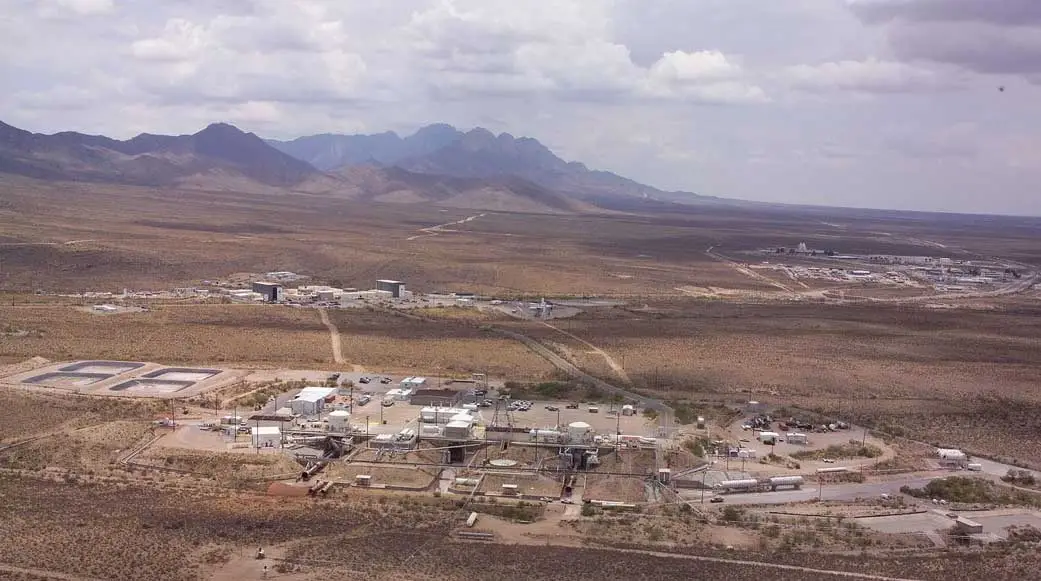
NASA’s White Sands Test Facility in Las Cruces, New Mexico.
Image credit: NASA
Hot firings at White Sands
Meanwhile, back on Earth, Starliner thruster ground testing has been completed and data reviews are underway.
In a Boeing statement, ground testing of a Starliner Reaction Control System (RCS) thruster at NASA’s White Sands Test Facility in Las Cruces, New Mexico is complete, and teams are now turning their attention to data reviews.
“The test objective was to observe thruster degradation so teams could get a better understanding of why some thrusters were deselected in-flight and what, if any impacts, returning those thrusters to service could have on the remainder of the Crew Flight Test (CFT).”
Readiness reviews
According to Dan Niedermaier, the lead Boeing engineer for the thruster testing: “We decided to run additional profiles with longer and more frequent pulses to see if we could more closely simulate the higher thermal conditions the thrusters experienced in-flight.”
The team was able to replicate the thrust degradation on the ground, the Boeing update added.
“Boeing and NASA engineers will proceed with thruster disassembly and inspections, and move forward with finalizing flight rationale in support of readiness reviews for Starliner’s nominal return to Earth with commander Butch Wilmore and pilot Suni Williams in the coming weeks,” according to the update from Boeing.

Artwork depicts the Intuitive Machines’ Nova-C IM-2 lander carrying NASA’s Polar Resources Ice-Mining Experiment-1.
Image credit: Intuitive Machines
While NASA has cancelled its VIPER lunar rover, the private group, Intuitive Machines, has finalized a landing site for its “sold-out” IM-2 lunar prospecting mission.
Still on track for a launch later this year, the IM-2 mission is designed to prospect for water ice and other volatiles on the Moon’s south pole, an effort backed by NASA’s Commercial Lunar Payload Services (CLPS) program.
In an Intuitive Machines statement, IM-2’s desired landing site supports the high probability of ice stability within one meter of the lunar surface.

A spectacular, specially produced near-ground level oblique view of the “Connecting Ridge” between Shackleton and Henson craters. The lunar south pole (SP) occurs on the rim of Shackleton crater. The ridge along the rim of the South Pole-Aitken impact basin is a potential Artemis landing site (001) and another (004) occurs on the rim of Shackleton crater. (Image credit: ETHZ\LPI\Valentin T. Bickel and David A. Kring)
Favorable terrain
Working with NASA, Intuitive Machines selected “favorable terrain” – a roughly 650 feet in diameter (200 meters) elliptical region on the Shackleton Connecting Ridge at the Moon’s south pole.
That landscape also provides a good Earth communications position, along with solar angles for power generation.
To align with the landing site’s solar power conditions, the mission must be timed between November 2024 and January 2025.
“IM-2 is currently planned for late 2024,” and the selection finalized a previously announced pending task order with NASA, according to the Intuitive Machines statement.
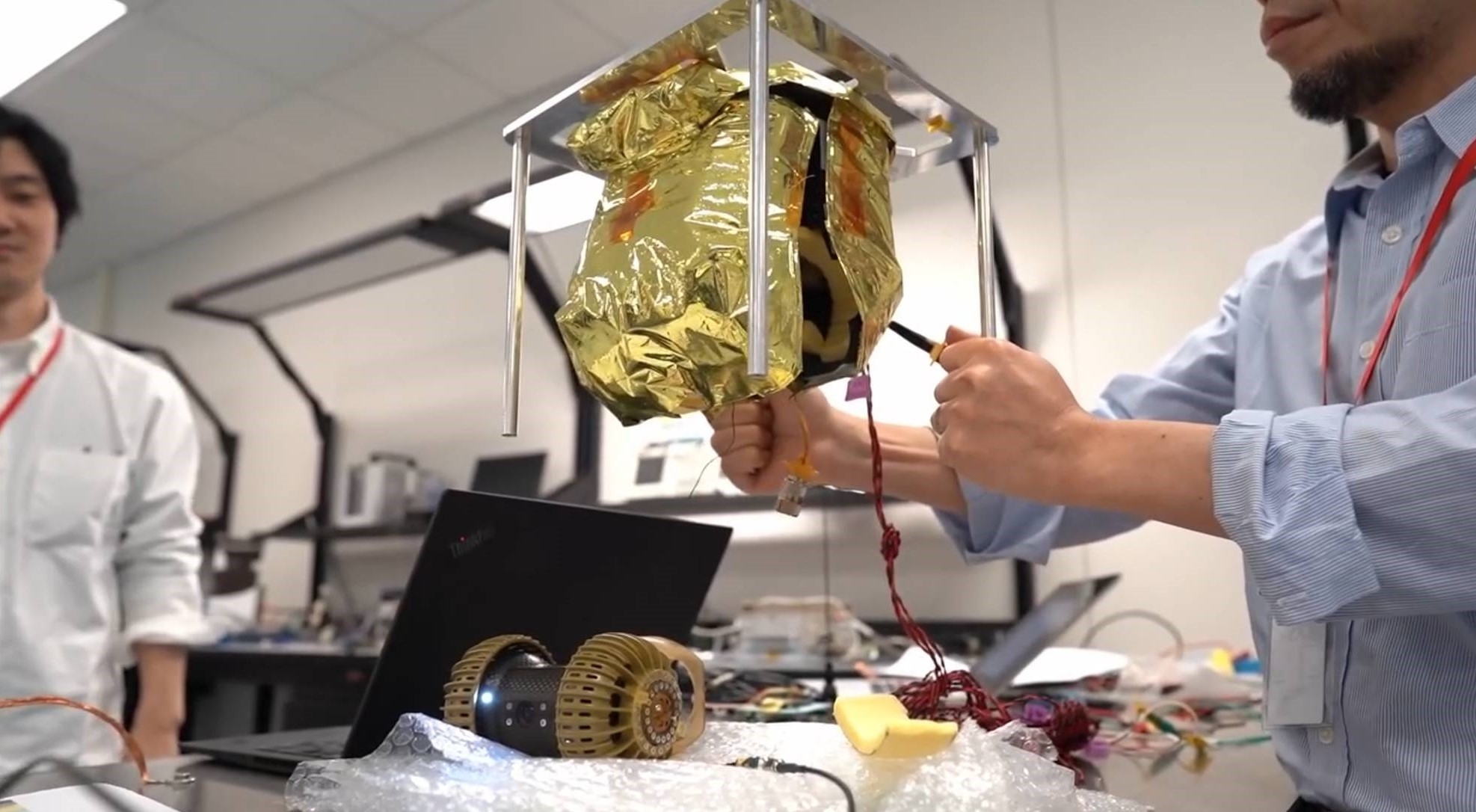
The lunar rover “YAOKI” – a Japanese commercial payload.
Image credit: DAMON Co., Ltd./Inside Outer Space screengrab
YAOKI mini-rover
“A sold-out commercial and civil government mission early in our commercialization roadmap validates our approach to supporting an economy in deep space,” said Intuitive Machines CEO Steve Altemus.
“Our expertise in landing site selection is world-class,” Altemus added, “and we believe the ability to identify landing areas with valuable resources will be essential to the future of the lunar economy.”
One payload onboard IM-2 is small enough to fit in the palm of your hands.
The lunar rover “YAOKI” has been developed by DAMON Co., Ltd., a company led by robot creator Shinichiro Nakajima. The rover is set to join the IM-2 lunar lander’s other experiments as the company’s first Japanese commercial payload.

Image credit: Intuitive Machines

“Wait-a-minute”
Image credit: Barbara David
UPDATE: NASA’s Moon News: VIPER CANCELLED
Go to NASA announcement at:
https://www.nasa.gov/news-release/nasa-ends-viper-project-continues-moon-exploration/
“VIPER is 100% built and has completed part of its testing. It is ready to go and NASA is junking a very capable rover and ceding leadership in resource exploration. It is a dark day for lunar science and exploration and maybe the Artemis program,” responds Clive Neal, a lunar exploration expert at the University of Notre Dame.
Posted earlier:
In wait-a-minute style, the Moon exploration community is holding its collective breath for the news stemming from today’s “Exploration Science Program Update” by NASA.
Nobody is quite sure what’s coming, but on the rocket docket is Nicola Fox, associate administrator, Science Mission Directorate at NASA Headquarters.
Perhaps a tip on things to come, joining Fox is NASA’s Joel Kearns, deputy associate administrator for exploration, Science Mission Directorate.
Kearns also leads the Commercial Lunar Payload Services initiative, the CLPS space agency/private sector activity.
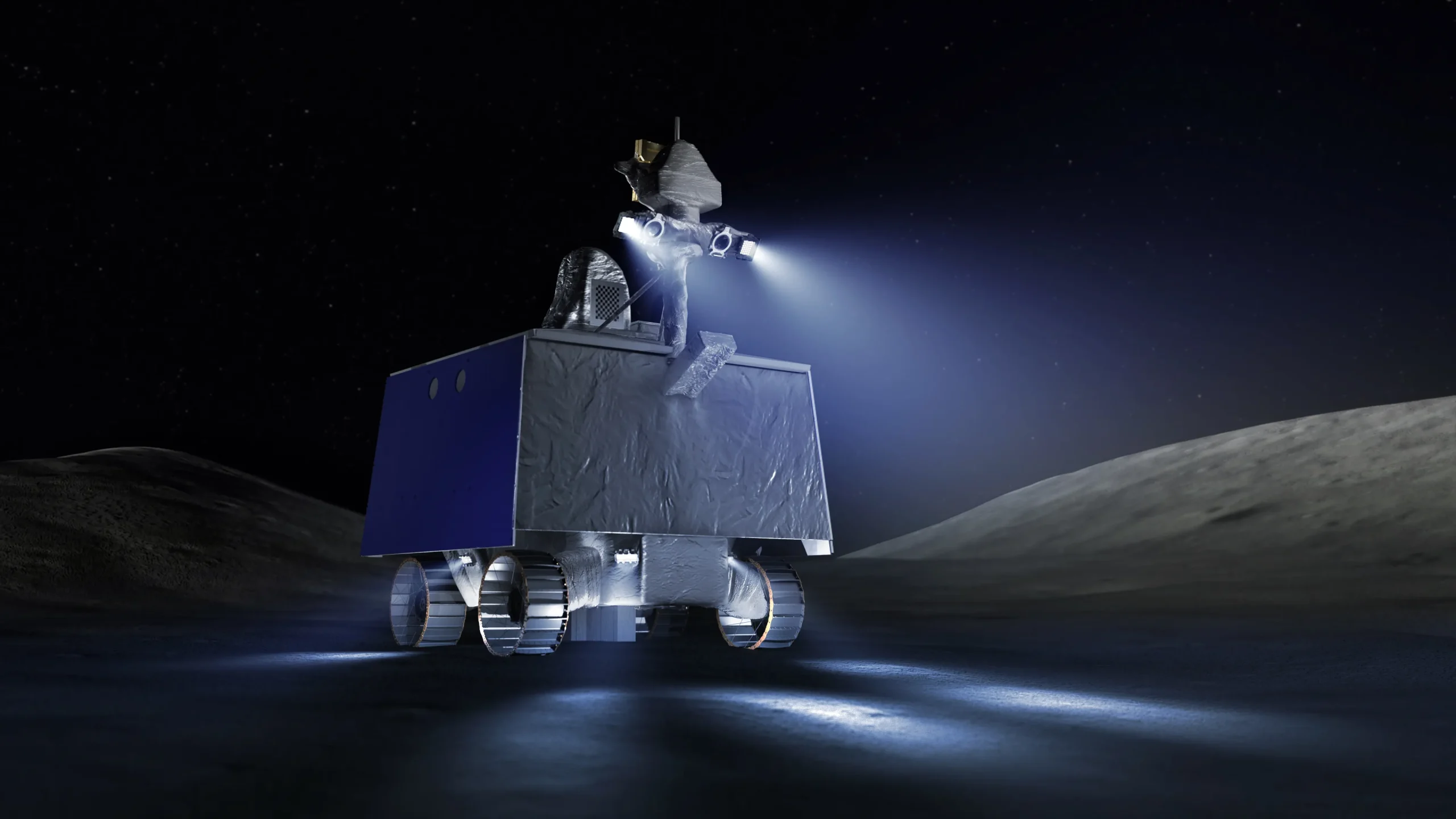
Oh dear, caught in the headlights? NASA’s VIPER Moon rover?
There is some speculation that an update will be given on the status of CLPS, particularly the NASA contracted Astrobotic delivery of the agency’s Volatiles Investigating Polar Exploration Rover (VIPER).
VIPER bite?
VIPER is a key part of NASA’s Artemis lunar exploration plan, a robotic endeavor in search of Moon ice and other potential resources.
Astrobotic is on tap to use its Griffin lunar lander to deliver VIPER to the Moon’s south pole, supposedly by year’s end. But the company experienced a rough-and-tumble start with CLPS.
In January of this year, the Astrobotic Peregrine Mission One to the Moon failed due to an in-space propulsion glitch.

Earth’s Moon as viewed from the International Space Station.
Image credit: NASA
So, perhaps, news on the whereabouts and timing of a VIPER sendoff?
Then, on the other hand, maybe no.
But stay tuned later today for some sort of Moon news.

Image credits: Elaboration of a photo of A. Romeo. LRO 3D model by NASA (Brian Kumanchik, Christian Lopez. NASA/JPL-Caltech), Earthrise photo captured on Taken on December 24, 1968 by Apollo 8 astronaut Bill Anders
The existence of lunar lava tube caves, cozy conduits for expeditionary crews below the Moon’s surface has been reported.
Thanks to analysis of NASA Lunar Reconnaissance Orbiter (LRO) radar data, what lies below the Apollo 11 landing site of Mare Tranquillitatis has been detected.
A team of international scientists, under the lead of the University of Trento, Italy, published their research findings in Nature Astronomy.

Image credits: the surface topography part of the image has been taken by ROC NAC data (Wagner, R. v., & Robinson, M. S. (2022). Lunar Pit Morphology: Implications for Exploration. Journal of Geophysical Research: Planets, 127(8). https://doi.org/10.1029/2022JE007328)
Radar reflections
“These caves have been theorized for over 50 years, but it is the first time ever that we have demonstrated their existence,” explains Lorenzo Bruzzone, professor at the University of Trento in a press statement.
Bruzzone said that in 2010, as part of the ongoing LRO NASA mission, an onboard Miniature Radio-Frequency (Mini-RF) instrument acquired data that included a pit in Mare Tranquilitatis.
“Years later we have re-analyzed these data with complex signal processing techniques we have recently developed, and have discovered radar reflections from the area of the pit that are best explained by an underground cave conduit,” Bruzzone states. “This discovery provides the first direct evidence of an accessible lava tube under the surface of the Moon.”
Solution to the problem
An upshot of the finding is this downward realization: Cosmic and solar radiation can be as much as 150 times more powerful on the lunar surface than we experience on Earth and there is a steady threat of meteorite impacts.
Lunar conditions topside drive a need to find safe sites for the construction of infrastructure that can support sustained exploration.

Mare Tranquillitatis pit crater.
Image credit: NASA/GSFC/Arizona State University
“Caves such as this one offer a solution to that problem,” the press statement adds.
The Mini-RF principal investigator, Wes Patterson, from the Johns Hopkins Applied Physics Laboratory in Laurel, Maryland points out that this research demonstrates how radar data of the Moon can be used in novel ways.
That data can address fundamental questions for science and exploration, Patterson adds, “and how crucial it is to continue collecting remotely sensed data of the Moon. This includes the current LRO mission and, hopefully, future orbiter missions.”
Underground volume
In their paper, Bruzzone and colleagues point out that several potential subsurface openings have been observed on the surface of the Moon.
“However, it remains uncertain whether such pits provide access to cave conduits with extensive underground volumes,” the researchers state.

NASA’s Lunar Reconnaissance Orbiter (LRO).
Credit: NASA’s Goddard Space Flight Center Conceptual Image Lab
The radar reflections studied can be attributed to a subsurface cave conduit tens of meters long, suggesting an accessible cave conduit beneath the Moon’s surface.
This discovery suggests that the Mare Tranquillitatis pit “is a promising site for a lunar base, as it offers shelter from the harsh surface environment and could support long-term human exploration of the Moon,” the research team concludes.
To gain access to the research paper — “Radar Evidence of an Accessible Cave Conduit below the Mare Tranquillitatis Pit” — go to:

Image credit: Skyeports
What happens when you mix an architect with material, electrical, mechanical, aerospace and software specialists – but then blend in a glass blower?
“We are a pioneering space architecture and engineering company at the forefront of shaping the future of interplanetary living,” explains the Skyeports website. “We integrate the principles of robust structural design, advanced materials, and state-of-the-art technologies to ensure the highest level of protection and resilience for our interplanetary structures.”
At Skyeports, the group is diving into innovative use of space composite materials, including advanced glass composites. “Our designs are meticulously crafted to provide a secure and adaptable living environment for our explorers.”

Image credit: Creative Commons Attribution-Share Alike 4.0 International license.
Positive results
Martin Bermudez is the CEO of Skyeports, telling Inside Outer Space that they are currently working on prototyping hardware in vacuum conditions at California Polytechnic State University in San Luis Obispo. Also being used is a NASA facility to test the behavior of the engineer glass compounds in one-sixth gravity field, like that offered by Earth’s Moon.
“We have already done some computer thermal, fluid, mechanical, and chemical modeling analysis of the types of glass that we intend to use, with very positive results so far,” Bermudez adds.

Image credit: Skyeports
Simple and challenging
The group applied this past month for a NASA Innovative Advanced Concepts (NIAC) program grant. The fingers-crossed hope is to garner early seed funding to further develop the idea, said Bermudez.
That Skyeports idea is very simple and challenging at the same time.
“During our research, we have found out that glass is going to be a major advancement in material science soon,” Bermudez points out. “We’re currently exploring how glass blowing, a traditional technique, could be adapted for use on airless planets and moons.”
While encouraged by their research, there are many challenges ahead. But the concept holds great potential for creating large glass structures using available, local materials found on other worlds.

Image credit: Skyeports
Plasma furnace
“Our plan involves designing a smart, possibly autonomous microwave plasma furnace on Earth, then deploying it on the Moon,” Bermudez says.
This furnace would be used to create a series of concentric glass spheres, providing protection against radiation, heat, micrometeorites, dust, and lunar quakes for extended lunar stays.
“The innermost living sphere called ‘The Nest’ will be designed to be protected by a couple of spheres filled with regolith to provide radiation protection,” Bermudez explains. Also on the research table, he says, is how to engineer one glass type that could potentially produce energy using sunlight to power the entire habitat.
On the Skyeports website, it’s made clear that the challenges of space exploration require audacious thinking and novel approaches.
“By harnessing the immense wealth of materials and energy found beyond our planet, we ensure the sustainability and self-sufficiency of future space missions.”
For more information on Skyeports, go to:

Image credit: Sierra Space
The yet-to-fly Sierra Space Dream Chaser commercial spaceplane is already listing landing sites around the globe.
Spaceport Oita in Kunisaki, Oita, Japan, is a possible landing spot, according to a recent Sierra Space statement.
Meanwhile, Dream Chaser, billed as the world’s first winged commercial spacecraft recently arrived at NASA’s Kennedy Space Center. The Dream Chaser spaceplane, named Tenacity, arrived at Kennedy on May 18.
The Tenacity spaceplane is slated for its maiden orbital flight aboard a United Launch Alliance Vulcan rocket from Space Launch Complex-41 at Cape Canaveral Space Force Station in Florida. However, that 2nd certification of the ULA booster is still to come. There’s hope that Dream Chaser will be launched on a Vulcan third flight perhaps this fall, according to reports.
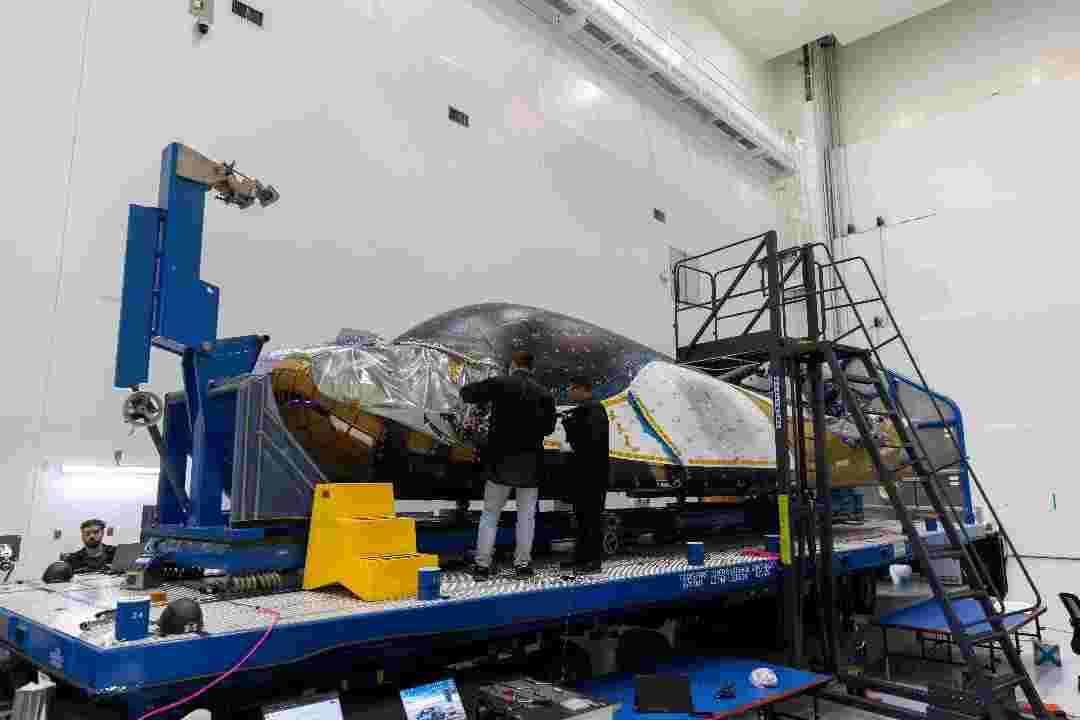
Dream Chaser Tenacity, Sierra Space’s uncrewed cargo spaceplane, is processed inside the Space Systems Processing Facility at NASA’s Kennedy Space Center in Florida in this photo taken May 20.
Image credit: NASA/Kim Shiflett
Fleet afoot
That maiden Dream Chaser flight is scheduled to be the vehicle’s first International Space Station servicing mission.
Meanwhile, build-up of the Dream Chaser “fleet” is underway with a second spaceplane under construction.
Sierra Space is also eyeing multiple global partnerships to establish the following runway landing sites in addition to Oita, Japan. They are Kennedy Space Center, Florida; Spaceport Cornwall, U.K.; Huntsville, Alabama; and Spaceport America in New Mexico.

CAPSTONE, NASA’s cis-lunar pathfinder CubeSat.
Image credit: NASA/Daniel Rutter
Sent moonward over two years ago, NASA’s Cislunar Autonomous Positioning System Technology Operations and Navigation Experiment — mercifully shortened to CAPSTONE – is trial-running techniques to enhance spacecraft operations in cis-lunar space.
Launched on June 28, 2022 aboard a Rocket Lab Electron booster from New Zealand, CAPSTONE — a microwave oven-sized CubeSat weighing a modest 55 pounds — is on task assessing Near Rectilinear Halo Orbit (NRHO) operations.
Artemis Gateway

The Gateway space station will operate in a Near Rectilinear Halo Orbit supporting crewed Artemis missions to the Moon.
Image credit: NASA/Alberto Bertolin, Bradley Reynolds
NRHO is the locale of NASA’s cislunar Gateway space station. That outpost is to shore up long-term human exploration of the Moon, allowing crews to access the lunar south pole – an early priority zone for the space agency’s Artemis program.
Advanced Space of Westminster, Colorado owns and operates CAPSTONE for the entirety of its mission.
Find out what CAPSTONE is doing on its slate of on-duty tasks by reading my new SpaceNews story – at:
https://spacenews.com/nasa-capstone-testing-autopilot-software-suite-cislunar-operations/

The largest stratospheric balloon ever to be launched from Sweden’s Esrange Space Center is on its way to its destination in North America.
Its mission is to study X-rays in the polar atmosphere.
Toted skyward by the huge balloon on July 13, an onboard experiment aims to take the first high-resolution images of X-ray radiation from so-called electron microbursts.
This precipitation only occurs in certain places in the Earth’s magnetic field.

NASA BOOMS balloon launch.
Image credit: SSC
BOOMS payload
As noted by a Swedish Space Corporation (SSC) statement, the Balloon Observation of Microburst Scales (BOOMS) payload is a high-resolution imager.
Given the balloon’s projected altitude, BOOMS enables study of radiation that would otherwise be blocked by Earth’s atmosphere.

Image credit: Google/SSC/Inside Outer Space screengrab
“Qualification of this balloon will allow NASA to continue to stretch the boundaries of what we provide to the scientific community,” says Andrew Hamilton, Director of NASA’s Balloon Program Office in the SSC statement.
Follow the flight in real-time:
https://www.csbf.nasa.gov/map/balloon4/Google741NT.htm
Go to this video for the delicate art of launching a giant, instrument-carrying balloon at:
https://sscspace.canto.global/s/NBHUN?viewIndex=1&column=video&id=5gv1ro9ood5ddad3d3kks0t54l

Mars beckons. Human explorers can maximize the science output for unraveling the complex nature of the Red Planet.
Image credit: NASA/Pat Rawlings
In charting the actions of future foot soldiers on Mars, the Committee on Space Research (COSPAR) has been busily addressing knowledge gaps for planetary protection of the Red Planet.
Established in 1958, COSPAR is a prestigious scientific confab of international researchers, anchored in tackling problems that may affect space exploration.
A COSPAR Principles and Guidelines for Human Missions to Mars has been scripted by a top-tier panel of experts on planetary protection.

Image credit: NASA
Back contamination
“The intent of this planetary protection policy is the same whether a mission to Mars is conducted robotically or with human explorers,” the document explains.
As such, planetary protection goals should not be relaxed to accommodate a human mission to Mars, the document notes. “Rather, they become even more directly relevant to such missions—even if specific implementation requirements must differ.”
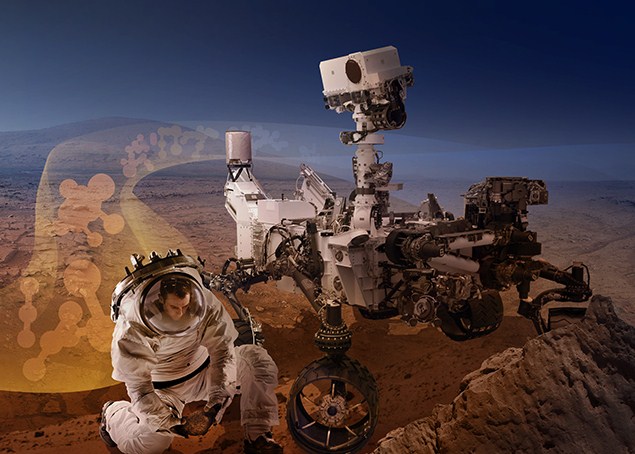
Humans and robots on Mars are likely to team up to augment the types of exploration avenues that can be done on the Red Planet.
Credit: NASA/Ames Research Center
General principles include:
— Safeguarding the Earth from potential back contamination is the highest planetary protection priority in Mars exploration.
— The greater capability of human explorers can contribute to the astrobiological exploration of Mars only if human associated contamination is controlled and understood.
— For a landed mission conducting surface operations, it will not be possible for all human-associated processes and mission operations to be conducted within entirely closed systems.
— Crewmembers exploring Mars, or their support systems, will inevitably be exposed to martian materials.
Monitoring of microbes
The COSPAR panel has made specific implementation guidelines for human missions to the Red Planet.
For instance, human missions will carry microbial populations that will vary in both kind and quantity, and it will not be practicable to specify all aspects of an allowable microbial population or potential contaminants at launch of an expeditionary crew to Mars.

Artist’s concept depicts astronauts and human habitats on Mars.
Image credit: NASA
Once any baseline conditions for launch are established and met, continued monitoring and evaluation of microbes carried by human missions will be required to address both forward and backward contamination concerns.
Quarantine
Akin to steps taken by early Apollo moon landings in that program, a quarantine capability for both the entire crew and for individual crewmembers shall be provided during and after the mission, “in case potential contact with a martian life-form occurs,” the COSPAR document adds.

On Earth recovery, Apollo 11 crew donned Biological Isolation Garments to protect Earth from possible Moon bugs.
Credit: NASA
A comprehensive planetary protection protocol for human missions to Mars should be developed, one that encompasses both forward and backward contamination concerns, and addresses the combined human and robotic aspects of the mission, including subsurface exploration, sample handling, and the return of the samples and crew to Earth.
Special regions
Neither robotic systems nor human activities should contaminate “Special Regions” on Mars, as defined by the COSPAR policy.
A Special Region is defined as a region within which terrestrial organisms brought from Earth are likely to replicate.
Any region which is interpreted to have a high potential for the existence of extant martian life forms is also defined as a Special Region, explains the COSPAR panel.
Regions like gullies, bright streaks associated with gullies, subsurface cavities, the subsurface below roughly 16 feet (5 meters) are called out in the document.

Artwork depicts many of the potential “Special Regions” in or near which proliferation of terrestrial microorganisms is a possibility.
Image credit: Carol Stoker, et al./Julie Fletcher.
So too are those perplexing Recurrent Slope Lineae, or RSL for short.
RSL’s are observed simultaneous incremental growth of flows on a warm slope, fading, and recurrence of this sequence in multiple Mars years.
Over the years, RSLs have been suggested by some experts to be a product of salty water flows occurring during the warmest months on Mars. On the other hand, other Mars scientists believe they are dry grains that stream down slopes.
Send in the robots
The COSPAR panel points out that any uncharacterized martian site should be evaluated first by robotic means prior to human crews gaining access.

Robotic exploration supervised by human expeditionary crew on Mars.
Image credit: NASA
Furthermore, any pristine samples or sampling components from any uncharacterized sites or Special Regions on Mars should be treated as restricted Earth return, with the proper handling and testing protocols.
That is, there’s need to rigorously preclude backward contamination of Earth by extraterrestrial life to prevent potentially harmful consequences for humans and the Earth’s biosphere.
Conservative approach
As for who gives the planetary protection orders on Mars, the COSPAR document says a crewmember should be given primary responsibility for the implementation of planetary protection provisions affecting the crew during the expedition.
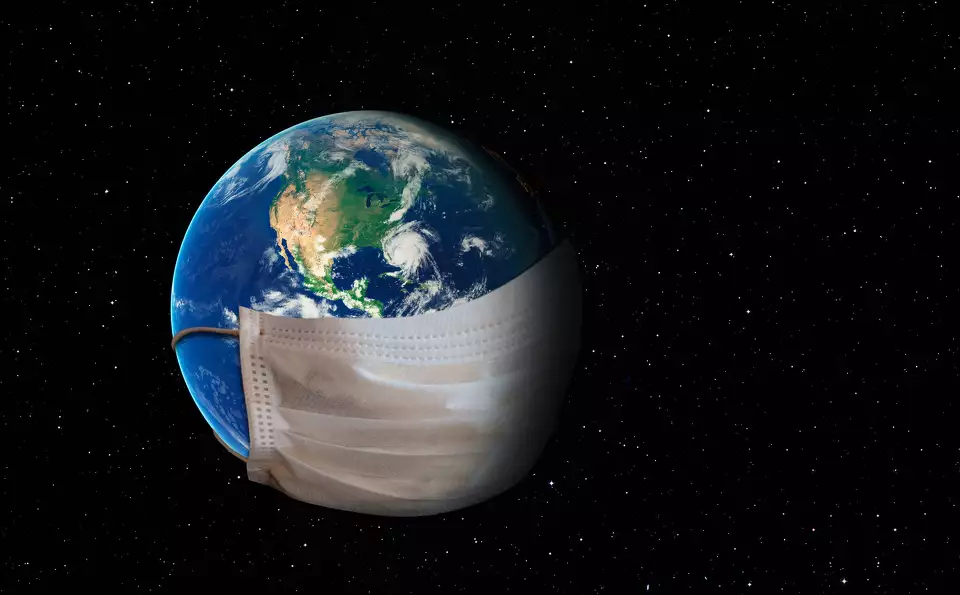
Image credit: Bipartisan Commission on Biodefense
The COSPAR thinking is that planetary protection requirements for initial human missions “should be based on a conservative approach consistent with a lack of knowledge of martian environments and possible life, as well as the performance of human support systems in those environments.”
For later human sojourns to Mars, planetary protection rules of the road “should not be relaxed without scientific review, justification, and consensus,” the COSPAR document says.
For detailed information regarding COSPAR and its work, go to:

