Archive for July, 2024
 Author:
  July 26th, 2024
Image credit: Sierra Space/Inside Outer Space screengrab
Sierra Space is working on expandable space station technology. The group reports that on June 18 the firm’s full-scale structural test passed a seventh key validation milestone – its second full-scale structural test.

Image credit: Sierra Space/Inside Outer Space screengrab
The “Ultimate Burst Pressure test” was done at NASA’s Marshall Space Flight Center in Huntsville, Alabama, in collaboration with ILC Dover (an Ingersoll Rand Business) and NASA.
Pathfinder mission
Sierra Space notes in a press statement that test results move the company forward to build the world’s first end-to-end business and technology platform in low Earth orbit.
Planned for an initial stand-alone pathfinder mission before the end of the decade, the technology is also a key element of Blue Origin’s Orbital Reef commercial space station under NASA’s Commercial Low Earth Orbit Development Program.

Image credit: Sierra Space/Inside Outer Space screengrab
Go to this eye-popping video of the test at:
 Posted in

Professor Kip Thorne.
Image credit: Irina Logra
Do you believe time travel is possible and if so, how?
What is something you don’t know but you would like to understand?
What’s the future of gravitational wave astronomy?
The answers flow from noted astrophysics guru/Noble Prize winner, Kip Thorne – yes, he was the science advisor for “Interstellar” the memorable science fiction epic.
Thorne recently provided an audience at CalTech an odyssey through the warped side of our Universe
Weird facets
“In the sixty-odd years of my career in astrophysics, we have come to understand that our universe has a very rich warped side,” Thorne explains. “By this I mean objects and phenomena made from warped spacetime instead of from matter.”
Thorne details weird facets of black holes that you may not have not heard of before. And also likely new to you: voracious, “vacuum fluctuations” — tiny bits of everything that ever could inhabit our universe, flashing in and out of existence, randomly.
“These fluctuations suck energy from rapidly distorting spacetime and use it to convert themselves into real, material stuff,” Thorne advises.
Sit back, relax, and float up stream with Thorne in his July 12 presentation and conversation with other noted astrophysicists at:

Space for Humanity hosted the D.C. premiere of “FORTITUDE: Forging The Trillion Dollar Space Economy” at the Library of Congress – a special screening of Torsten Hoffman’s documentary.
The evening featured the film’s director, astronauts, industry leaders, and government voices.
Go to: https://youtu.be/xV65tyP2Ja8?si=x92ukc0SZ0qNPonN
Also, go to the official website at: https://www.fortitudemovie.com/

NASA’s Curiosity Mars rover used its left Mast Camera, or Mastcam, to capture this 180-degree view of Gediz Vallis channel, taken on March 31, released on July 18. This area was likely formed by large floods of water and debris that piled jumbles of rocks into mounds within the channel and created a long ridge downhill (Gediz Vallis ridge). The region, rich in salty minerals called sulfates, is in the foothills of Mount Sharp, a 3-mile-tall (5-kilometer-tall) mountain within Mars’ Gale Crater.
Image credit: NASA/JPL-Caltech/MSSS
NASA’s Curiosity Mars rover at Gale Crater is now performing a slate of science duties.
Lauren Edgar, a planetary geologist at USGS Astrogeology Science Center in Flagstaff, Arizona, reports that the robot wrapped up activities at Fairview Dome.
Curiosity has started heading south towards its next potential drill location in the Upper Gediz Vallis ridge campaign.

Typical bedrock in the rover’s workspace, as seen by this Curiosity image taken by the Front Hazard Avoidance Camera on Sol 4251, July 22, 2024.
Image credit: NASA/JPL-Caltech
Bedrock chemistry
Last weekend, Curiosity made a drive of about 95 feet (29 meters)which set it up for contact science and remote sensing tasks, Edgar notes.

Curiosity Chemistry & Camera Remote Micro-Imager took this photo on Sol 4253, July 24, 2024.
Image credit: NASA/JPL-Caltech/LANL
A recent two-sol plan (Sols 4253-4254) includes Alpha Particle X-Ray Spectrometer (APXS) and Mars Hand Lens Imager (MAHLI) observations on a gray rock named “Discovery Pinnacle” to assess variations in bedrock chemistry and compare it to what Mars researchers have seen recently.
Also planned was a Chemistry and Camera Laser Induced Breakdown Spectroscopy (LIBS) look at “Miguel Meadow” to evaluate the typical bedrock in the rover workspace.

Curiosity Left B Navigation Camera image acquired on Sol 4252 July 22, 2024.
Image credit: NASA/JPL-Caltech
Variations in lithology
“The plan also includes a Mastcam mosaic covering the large patch of light-toned rocks in front of the rover to look for variations in lithology,” Edgar explains. The lithology of a rock unit is a description of its physical characteristics visible at outcrop, in hand or core samples, or with low magnification microscopy.

Curiosity Right B Navigation Camera photo taken on Sol 4252, July 22, 2024.
Image credit: NASA/JPL-Caltech
Two ChemCam long-distance Remote Micro-Imager (RMIs) were also planned to evaluate the stratigraphy exposed by a channel cut into the Gediz Vallis ridge deposit, and to look more closely at a well-laminated dark-toned boulder on the channel floor.

Curiosity Right B Navigation Camera photo taken on Sol 4252, July 22, 2024.
Image credit: NASA/JPL-Caltech
Post-drive imaging
“Then Curiosity will drive about 52 feet (16 meters) farther south,” Edgar reports, “and will take post-drive imaging to help us evaluate another patch of light-toned bedrock in the next plan.”

Curiosity Right B Navigation Camera photo taken on Sol 4252, July 22, 2024.
Image credit: NASA/JPL-Caltech
In addition to targeted remote sensing, the recent plan includes observations of atmospheric opacity, searching for dust devils, an autonomously selected ChemCam AEGIS target, and standard Dynamic Albedo of Neutrons (DAN) and Rover Environmental Monitoring Station (REMS) activities.

Curiosity Mast Camera Left image taken on Sol 4251, July 22, 2024.
Image credit: NASA/JPL-Caltech/MSSS
AEGIS stands for (Autonomous Exploration for Gathering Increased Science) – a software suite that permits the rover to autonomously detect and prioritize targets.
“We’re all curious to see what Wednesday’s workspace will hold,” Edgar concludes, “as we start thinking about the next place to drill!”

Curiosity Mast Camera Left image taken on Sol 4251, July 22, 2024.
Image credit: NASA/JPL-Caltech/MSSS

Image credit: CCTV/Inside Outer Space screengrab
China’s big Moon booster for supporting the country’s human exploration of the Moon is progressing.
A new report spotlights a three-stage hydrogen-oxygen engine designed to power a new generation rocket capable of sending astronauts to the Moon.
Testing at China’s first vertical high-altitude simulation stand for rocket engines has verified the reliability of the engine according to China Central Television (CCTV).

Image credit: CCTV/Inside Outer Space screengrab
Longest test time
The stand has been developed and constructed by the Institute 101 of the Sixth Academy of the state-owned China Aerospace Science and Technology Corporation (CASC).
According to CCTV, this test rig can simulate high-altitude conditions for engines in a vacuum environment below one kilopascal and sustain high-altitude simulation tests for thousands of seconds.
That’s the longest test time for the engine using liquid hydrogen and liquid oxygen as propellants in the world, CCTV adds. “The successful test will provide strong support for the smooth implementation of China’s manned lunar exploration program.”

Image credit: CCTV/CGTN/Inside Outer Space screengrab
The celebrated “International Moon Day” on July 20 that marks the 20th century landing of Apollo 11 has also spotlighted China’s proposed lunar base ideas for the 21st century.
Wu Weiren, chief designer of the country’s lunar exploration program, told China Global Television Network (CGTN), that the country welcomes international cooperation.
“We are open and welcome international cooperation from all countries, including those countries from the Global South, emerging BRICS countries, as well as Western countries,” Wu told CGTN, with BRICS nations now involving Brazil, Russia, India, China and South Africa.

Image courtesy U.S. Defense Intelligence Agency (DIA) in its “2022 Challenges to Security in Space” report.
Share data, results
“We do not have any isolating or exclusionary policies, and we want to cooperate in an all-round way. I think our principle is to share data, share results,” Wu added. “We are willing to co-build and co-share with our partners. We have no intention to establish small circles or groups. Therefore, China’s aerospace and lunar exploration programs, including planetary exploration, are all open to the whole world.”
International research station
Meanwhile, Wu offered an update on the development of the international lunar research station (ILRS).
“The international lunar research station is actually the first large-scale scientific project to be implemented in our country. We are preparing to build a lunar scientific research station at the south pole of the Moon,” said Wu.
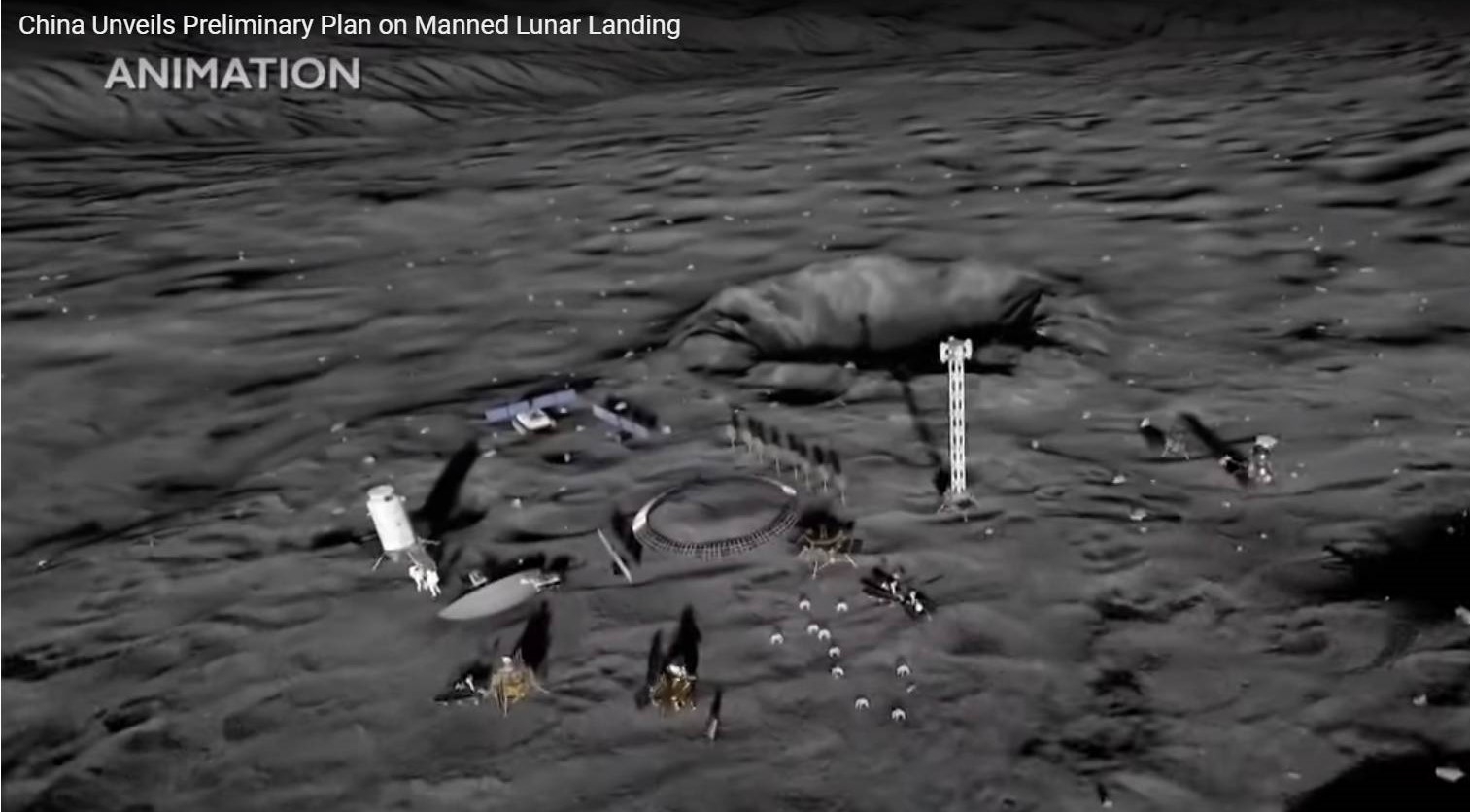
Artist’s view of International Lunar Research Station to be completed by 2035. Credit: CNSA
The ILRS will be combined with an orbital station and a lunar surface station, plus ground facilities such as the headquarters for major scientific projects.
With or without people
“This is being done so that work can continue for a long time, with or without people at the south pole of the Moon. It will enable scientific exploration and resource development,” said Wu.
Wu said the intent is to emplace on the Moon a basic station by 2035, and an extended station by 2045.
“So far, we have signed agreements with more than 10 countries and nearly 30 international research institutions. We hope to work with 50 countries by inviting 500 foreign scientific research institutions, and 5,000 foreign scientific research personnel to jointly build our international lunar scientific research station,” Wu stated.
Go to this video at:
https://www.facebook.com/NewsContent.CCTVPLUS/videos/1007724844433089/

Mini-rover imagery of Chang’e-6 lander/ascender.
Image credit: CNSA/CLEP
That photo of China’s Chang’e-6 far side lunar lander/ascender came courtesy of a tiny, 11-pound (5 kilograms) mini robot rover.
The device was powered by autonomous piloting and artificial intelligence (AI) camera technology.
Once detached from the Chang’e-6 lander, the small rover moved to an optimal position and using onboard artificial intelligence and neural networks, it composed and captured the third-person view of the Moon scene without human input.

Tiny rover on lunar surface as viewed by Chang’e-6 lander.
Image credit: CLPS/CNSA/China ‘N Asia Spaceflight
Best angle and composition
The mini-rover moved to a relatively suitable location for taking pictures, then intelligently choose the best angle and composition, “leaving some precious memories for the Chang’e-6 mission,” said Xing Yan, staff member of China Aerospace Science and Technology Corporation (CASC).

Image credit: CCTV/Inside Outer Space screengrab
“We are enhancing its autonomy with AI technology, and we’re still using neural networks. We give full play to neural networks’ ability to learn from human experience, and it can achieve many things that cannot be achieved with traditional methods, such as adjusting the angle of the photo,” Xing told China Central Television (CCTV).
“This also verifies the feasibility of this AI technology based on neural networks under the constraints of limited computing resources on the lunar surface,” said Xing.

Mini-rover underges deployment testing. Image credit: CCTV/SegerYU/Inside Outer Space screengrab

Image credit: CCTV/Inside Outer Space screengrab

Image credit: NASA
Now 55 years ago, Apollo 11’s “flag raising” of Old Glory on the ancient lunar surface took all of 10 minutes during Neil Armstrong’s and Buzz Aldrin’s two-and-a-half hour moonwalking adventure in July 1969.
But that seminal event in “vexillological” history was not without a lot of debate, discussion and early worries that were run up the policy flagpole about “who owns the Moon?” The term vexillology is the study of the history, symbolism and usage of flags.
In the early 1990s, Anne Platoff, then working with Hernandez Engineering Inc. in Houston, Texas put together a NASA contractor report titled, Where No Flag Has Gone Before: Political and Technical Aspects of Placing a Flag on the Moon.
For more details, go to my new story on Space.com – “What became of the flags Apollo astronauts left on the moon?” – at:

Wait-a-Minute!
Image credit: Barbara David
It is a classic wait-a-minute Moon moment.
The message from NASA last week: “NASA Ends VIPER Project, Continues Moon Exploration.”
The space agency’s Volatiles Investigating Polar Exploration Rover (VIPER) project had undergone a comprehensive internal review. NASA found price tag sticker shock, delays to the launch date, and risk of future cost growth – reasons to “stand down” the lunar ice-hound mission.

Lights out for NASA’s VIPER ice-hound?
Image credit: NASA
Some disassembly required
At this point in time, NASA had put in $450 million into VIPER.
NASA said it’s planning to disassemble and reuse VIPER’s instruments and components for future Moon missions.
Prior to disassembly, NASA’s open to expressions of interest from U.S. industry and international partners for use of the existing VIPER rover system at no cost to the government.

Recent photo shows engineers testing the VIPER rover’s wheel movement and rotation in a clean room at NASA’s Johnson Space Center in Houston.
Image credit: NASA/Helen Arase Vargas
The VIPER project will conduct an “orderly close out through spring 2025,” said NASA.
Dead meat, dead weight
Under NASA’s Commercial Lunar Payload Services (CLPS) public-private partnership, VIPER was headed for Earth departure via an Astrobotic Griffin Moon lander.
But the Astrobotic firm is trying to overcome its own problems that have pushed Griffin’s readiness for flight to September 2025.
The landing without VIPER onboard “will provide a flight demonstration of the Griffin lander and its engines,” NASA stated. In VIPER’s absence, a “mass simulator” will be used to mimic the weight of the missing NASA rover.

Artistic view of Griffin lander deploying NASA VIPER.
Credit: Astrobotic
Rocky start to smooth sailing
To start with, it has not been smooth sailing for Astrobotic.
In January of this year, the Astrobotic Peregrine Mission One to the Moon failed due to an in-space propulsion glitch.
A mishap review investigation of why the private company’s first Moon lander failed is forthcoming, Astrobotic told Inside Outer Space.
“Continuation of VIPER would result in an increased cost that threatens cancellation or disruption to other CLPS missions,” the space agency statement explains. “NASA has notified Congress of the agency’s intent.”

Artwork depicts the Intuitive Machines’ Nova-C IM-2 lander carrying NASA’s Polar Resources Ice-Mining Experiment-1.
Image credit: Intuitive Machines
Nicola Fox, associate administrator, Science Mission Directorate at NASA Headquarters in Washington, added in a statement:
“The agency has an array of missions planned to look for ice and other resources on the Moon over the next five years.”
Ceding leadership
“VIPER is 100% built and has completed part of its testing. It is ready to go and NASA is junking a very capable rover and ceding leadership in resource exploration,” said Clive Neal, a leading Moon scientist at the University of Notre Dame in Indiana.
“It is a dark day for lunar science and exploration and maybe the Artemis program,” Neal told Inside Outer Space. “I am still in shock at the reasoning used to justify the cancellation of VIPER.”
Norbert Schörghofer, a senior scientist for the Planetary Science Institute, has a research focus on studying water ice in the polar regions of the Moon.

Map of the lunar south polar region with the age of permanently shadowed areas. PSR ages are indicated in the legend and the angles in parenthesis are the maximum elevation of the Sun above the south pole.
Image credit: Norbert Schörghofer/PSI
Schörghofer calls identifying the abundance and distribution of water ice in the lunar polar regions “a science and exploration priority.”
“The cancellation of VIPER is a major loss for science,” Schörghofer told Inside Outer Space. “No other robotic US mission to the Moon in the next three years has the needed capabilities. Required are mobility and a way to explore the subsurface, not just the surface.”
Ground-truth
The ground-truth hunt for lunar water ice, Schörghofer added, will likely be made by Japan’s Lunar Polar Exploration (LUPEX) project now underway with India, projected to be launched in 2025. Observation equipment from NASA and the European Space Agency (ESA) will also be installed on the LUPEX rover.

Japan’s Lunar Polar Exploration (LUPEX) project now under development with India.
Image credit: JAXA
Or perhaps the needed detective work on lunar water ice, Schörghofer said, could be carried out by China’s robotic lander, Chang’e-7 in 2026.
“A crewed mission to the south polar region could achieve the goal, but who is to say it will fly as scheduled,” Schörghofer said.
“If one is serious about finding ice on the Moon, we also need a mission that can explore large permanently cold and dark craters, which even VIPER and [NASA’s crewed] Artemis 3 will not be able to reach. And that appears to be even further off in the future,” Schörghofer said.

Rendering of Artemis astronauts exploring a lunar south pole crater. A water ice-rich resource ready for processing?
Image credit: NASA
Devastating news
The intended termination of VIPER is devastating news said Benjamin Greenhagen, chair of the Lunar Exploration Analysis Group (LEAG).
Since 2004, LEAG supports NASA in providing analysis of scientific, technical, commercial, and operational issues in support of lunar exploration goals.
“The LEAG community has long supported VIPER and Resource Prospector before it,” Greenhagen advised his Moon exploration colleagues via the community posting website, Lunar-L. “We believe in this mission and the unique value that it brings for lunar exploration that will be lost if VIPER does not fly.”
Uncertain situation
Beyond the hardware, Greenhagen said that “VIPER is people and there should be significant concern for the engineers and scientists working to test and fly the completed rover given the uncertain situation. Please keep the VIPER team in mind.”
Greenhagen posted that “LEAG will be working to bring that message to NASA in the coming weeks and I expect there will be other individual- and community-organized efforts as well.”

China’s Chang’e-7 is to launch a mini-scout that will overfly a shadowed crater at the Moon’s south pole to look for possible traces of water or ice.
Image credit: CCTV/Inside Outer Space screengrab
One such action has already begun.
In light of the news of NASA’s decision to cancel the VIPER mission, space scientists have put together a sign-on-the-dotted line support letter to be sent to members of the U.S. Congress urging them to reconsider the decision.
Opposing NASA’s termination
In an open letter to Congress, the communiqué asks lawmakers to refuse NASA’s cancellation of the VIPER Moon mission.
That open letter already has over 140 signatures from more than 24 states in the United States. Plans are underway to reach out directly to the House and Senate Committees addressed in the letter, asking them to oppose NASA’s termination of VIPER.
“We are deeply concerned by NASA’s shocking announcement on July 17 that it intends to discontinue the VIPER lunar rover mission,” the letter states. “VIPER was to be a groundbreaking American project and the first NASA mission to characterize the origin and distribution of water ice on and below the surface of the Moon, a key step in enabling human exploration…”

Image credit: U.S. Capitol
Unprecedented, indefensible
The open letter points out that the decision to cancel the mission “was taken by NASA without giving the wider VIPER team or lunar exploration community an opportunity to propose cost-saving solutions or alternatives to the dismemberment or scrapping of the rover.”
The VIPER rover is already fully built, the letter notes, and was scheduled to undergo final testing in the coming months prior to launch in 2024-2025.
“The decision to cancel the project at this stage, after spending $450 million,” the letter argues, “is both unprecedented and indefensible.”
Go to the NASA VIPER cancellation statement at:
https://www.nasa.gov/news-release/nasa-ends-viper-project-continues-moon-exploration/

To gain insight on how the Soviet Union built moon-bound gear, the U.S. Central Intelligence Agency (CIA) carried out a covert spy job on a Soviet exhibit in 1959.
A CIA action team dismantled a “Lunik 2” exhibit to document what techniques and technologies were used by the Soviet Union.
Stealthy spy operation
Years later, that secretive act was detailed by the CIA and ballyhooed as a stealthy spy operation that was done unbeknownst to the Soviet Union.
The unusual overnight caper by the CIA involved Soviet upper stage space hardware that was being toted around as part of an exhibition to promote Soviet industrial and economic achievements.
For more details, go to my new Space.com story – “How the CIA ‘kidnapped’ a Soviet moon probe during the space race” – at:
https://www.space.com/how-the-cia-kidnapped-a-soviet-moon-probe-during-the-space-race

