Archive for June, 2024
 Author:
  June 5th, 2024
Taking the fall. Space hardware dives into Earth’s atmosphere with some fragments making their way to the ground.
Image credit: ESA/D.Ducros
Last March a high-speed cylindrical object weighing nearly two pounds shot through the roof of a Naples, Florida homeowner, smashing through a ceiling and punching through a floor.
NASA later confirmed that the object was an item from the International Space Station – a small leftover from a discarded, multi-ton pallet let loose some three years earlier.

Image credit: WINK News/Inside Outer Space screengrab
That occurrence and the follow-on confirmation that the errant object was, indeed, an old ISS battery-related part, has spun up worrisome views regarding the escalation of human-made refuse plummeting to Earth in an uncontrolled manner.
SpaceX: more trunk trash
Even more recent, more human-made space debris leftovers have been found to hot-foot their way onto terra firma.

SpaceX Dragon trunk debris falls into North Carolina.
Image credit: WLOS TV staff
This latest incident in late May is within North Carolina in which objects of various sizes and weights are being tied to surviving fragments of the jettisoned “trunk” associated with the SpaceX Dragon Crew-7 mission.
For a view of my new SpaceNews story – “Uncontrolled reentry of space debris poses a real and growing threat” – go to:
https://spacenews.com/uncontrolled-reentry-of-space-debris-poses-a-real-and-growing-threat/
 Posted in

Image credit: SpaceX
The Federal Aviation Administration (FAA) has approved a license authorization for SpaceX Starship Flight 4.
“SpaceX met all safety and other licensing requirements for this test flight,” explains an FAA statement.
SpaceX has been eying a June 6 liftoff of the next Starship test flight.
For SpaceX details regarding the test flight, go to:
https://www.spacex.com/launches/mission/?missionId=starship-flight-4
As part of a request for license modification, SpaceX proposed three scenarios involving the Starship entry that would not require an investigation in the event of the loss of the vehicle.

SpaceX/Inside Outer Space screengrab
Scenarios
The FAA approved the scenarios, but if a different anomaly occurs with the Starship vehicle an investigation may be warranted as well as if an anomaly occurs with the Super Heavy booster rocket.
In addition, the FAA approved the mission profile that included a controlled and uncontrolled entry of the Starship vehicle.
If SpaceX chooses to execute an uncontrolled entry, the FAA statement explains, the company must communicate that decision to the FAA prior to launch.

Image credit: SpaceX
“As such, the loss of the Starship vehicle would be considered a planned event and an investigation will not be required,” concludes the FAA statement.
For details about the modifications and licensing go to:

Chang’e-6 lander/ascender image from the Moon’s far side.
Image credit: CNSA/CLEP
China’s Chang’e-6 lunar lander mission has lobbed far side snag and stash specimens into orbit around the Moon. The lander served as a temporary “launching pad.”
A 3,000-newton engine worked for about six minutes, pushing the ascender with its cache of lunar materials into lunar orbit.
If all continues on schedule, Chang’e-6’s ascender craft will carry out an autonomous rendezvous and docking with the mission’s orbiter-returner on Friday. After orbiting the Moon for around 14 days, the orbiter-returner combination will shove off on a Moon-Earth transfer orbit.
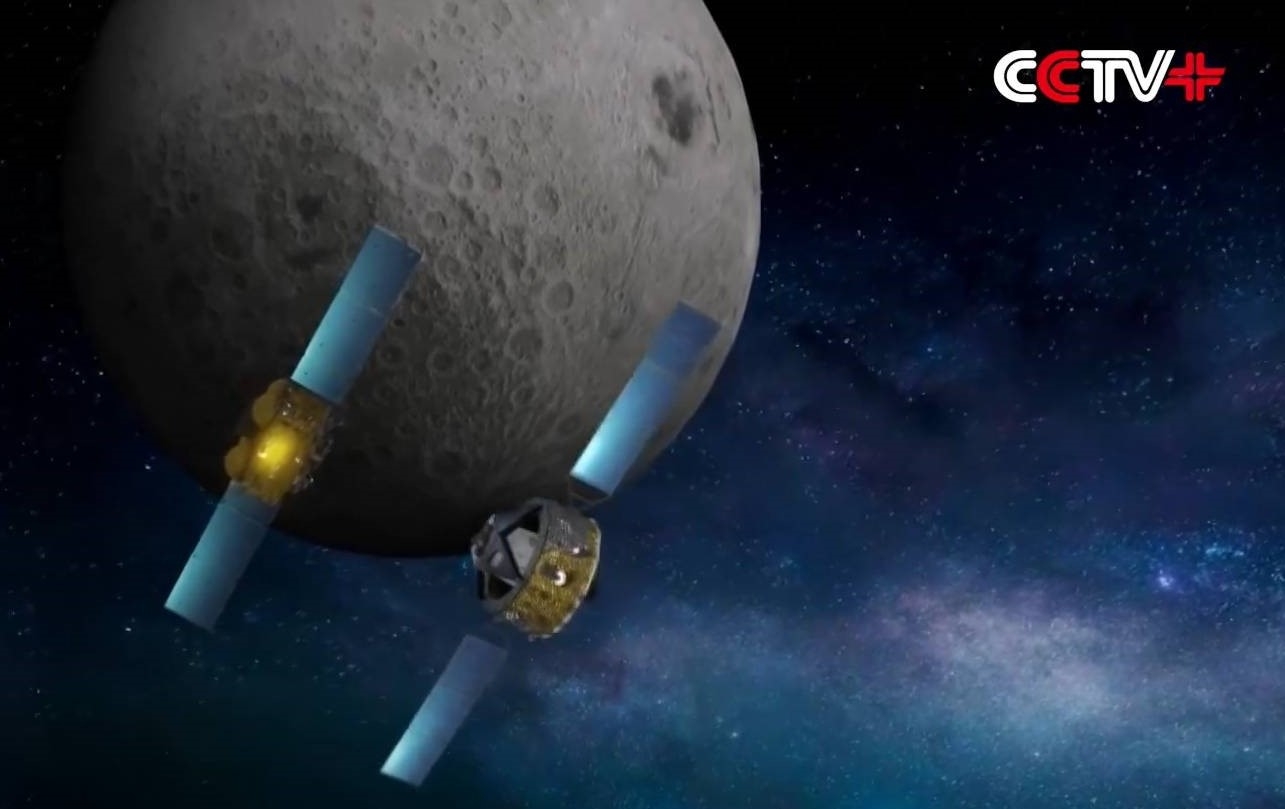
Ascender rendezvous and docking with returner craft for transfer of lunar samples.
Image credit: CNAS/CCTV
Mini-rover
The Chang’e-6 lander-ascender combination, separated from the orbiter-returner combination on May 30, touched down in the South Pole-Aitken (SPA) Basin on June 2.
From a post-landing panoramic image, the landing area was shown to be very flat.
“Looking into the distance, we can see some mountains, which are the edges of circular craters in the Apollo Basin located beyond the lunar surface,” said Ren Xin, researcher of the National Astronomical Observatories.
During sampling, the spacecraft adopted two methods of lunar far side sampling, including using a drill to collect subsurface samples, which lasted for about three hours, and grabbing samples on the surface with a robotic arm.

Mini-rover images Chang’e-6 lander/ascender.
Image credit: CNSA/CLEP
While not highlighted by China media, a mini-rover was deployed from the lander/ascender, a wheeled Wi-Fi-capable companion that imaged the scene before the lunar specimens were rocketed off the Moon.
This capability was showcased during China’s Zhurong Mars rover mission in 2021. Early in the mission, the rover deployed a Wi-Fi device that captured via an image the Red Planet lander and Zhurong rover positioned side-by-side.

Chang’e-6 pre-launch look with wheeled rover (left) attached.
Image credit: CNSA/CCTV/Inside Outer Space screengrab
Challenge ahead
Duan Chenglin from the Beijing Aerospace Control Center told China Central Television (CCTV) that the upcoming rendezvous and docking in Moon orbit of the ascender and returner craft is challenging.
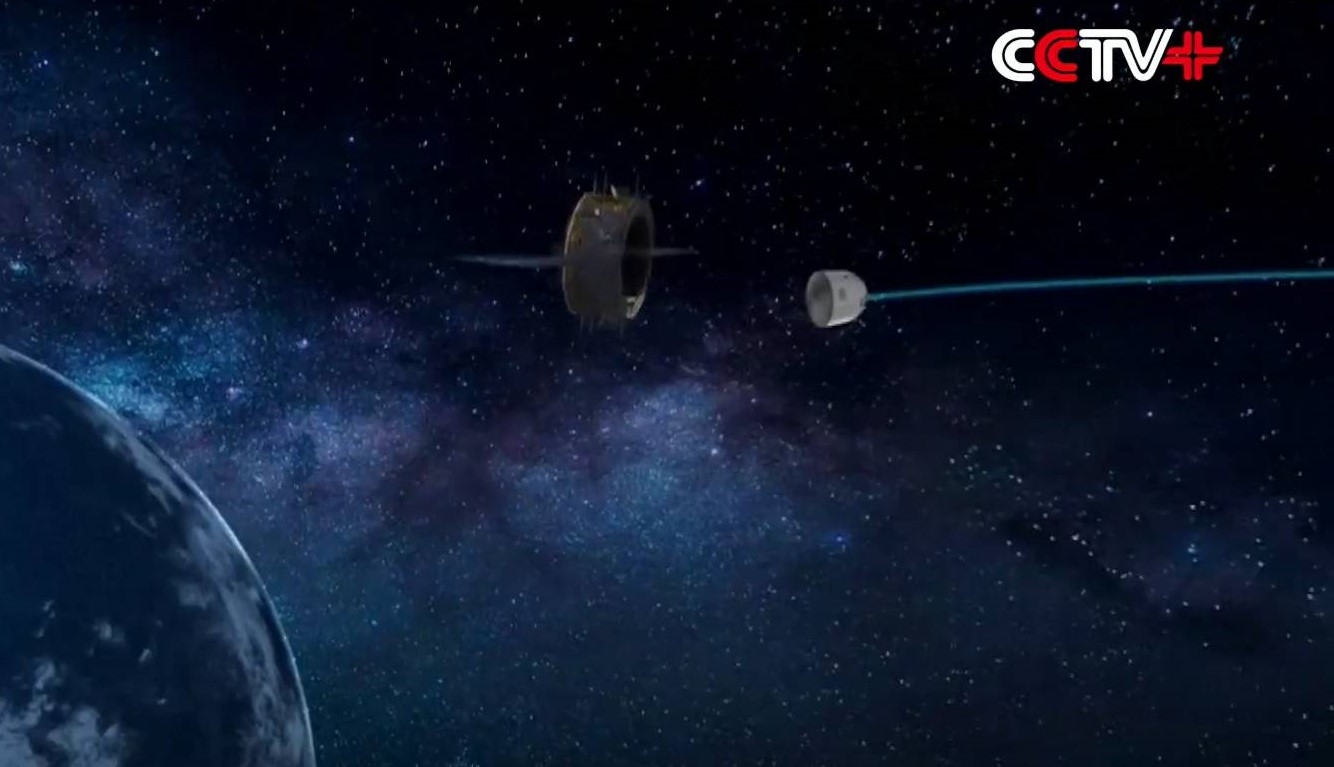
Returner craft lets loose the sample container for landing on Earth.
Image credit: CNSA/CCTV
“Rendezvous and docking processes for the space station are very different from those in lunar orbits,” Duan said. The rendezvous and docking of Chang’e-6’s ascender with the orbiter-returner combination in lunar orbit “will be subject to limited capabilities of ground system, short window period for entering the Moon-Earth transfer orbit, as well as limited energy and sunlight, so it must be completed within the planned time.”
Duan added that if the first rendezvous and docking fail, to reverse it for a second try will be highly likely to risk the missing of the window for returning from the moon to Earth, with the returner never being able to come back.”
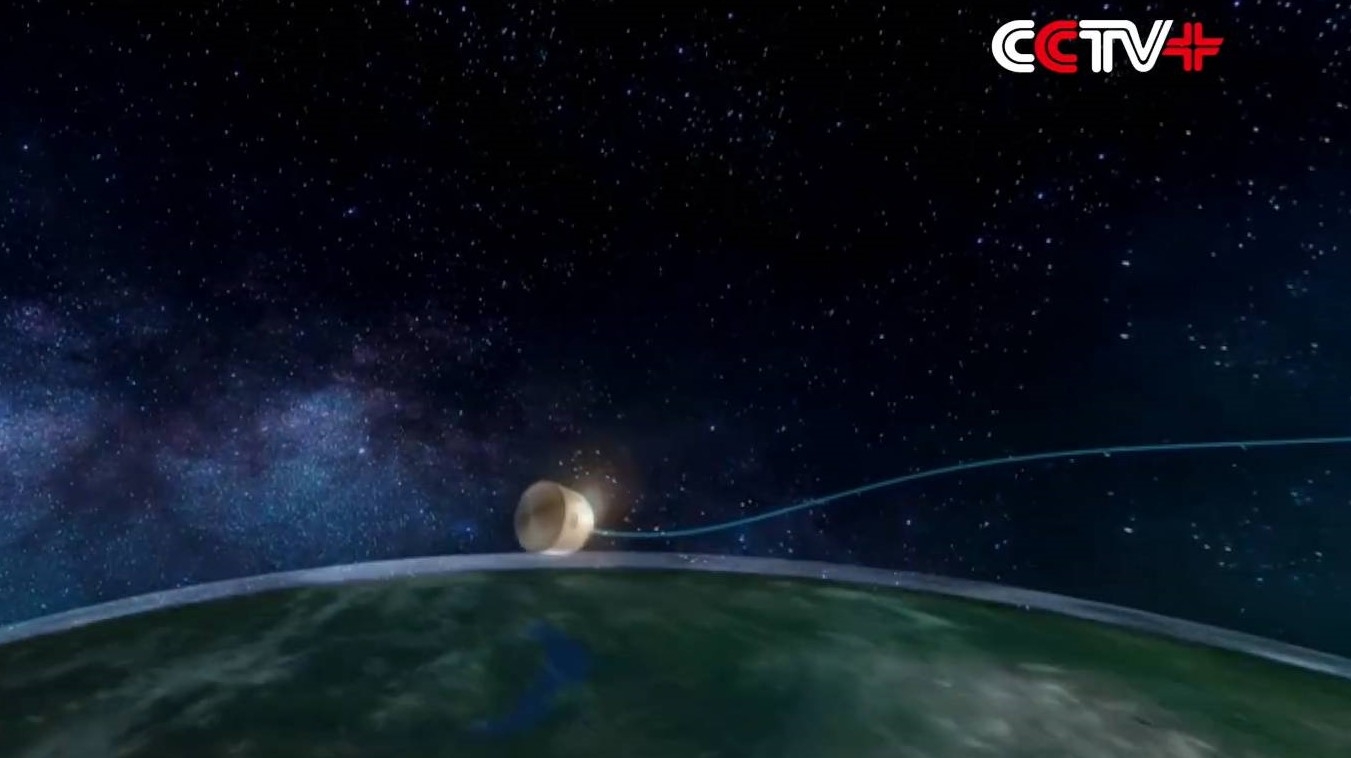
Capsule begins atmospheric re-entry.
Image credit: CNSA/CCTV
Back to Earth
Given success of rendezvous and docking, the Chang’e-6 probe’s ascender will transfer the samples to the returner, which will then bring the samples back to Earth.
After one to three corrections in about five days, the combination will reach a position above the Earth, where the returner will separate from the orbiter and start the phase of re-entering the atmosphere and returning to Earth.

Taking the heat as capsule maneuvers ever-deeper into Earth’s atmosphere before parachute touchdown.
Image credit: CNSA/CCTV
A capsule carrying the far side specimens will touchdown at a landing area at Siziwang Banner in the Inner Mongolia Autonomous Region.
Parachuting to Earth, that touchdown will mark the end of the Chang’e-6’s 53-day journey of flying to the Moon and back.
Go to this informative video at:
https://www.facebook.com/NewsContent.CCTVPLUS/videos/817958543594501

Puzzle pieces.
Image credit: Leonard David
New revelations have come to light regarding “Project” Moon Dust, long known by Freedom of Information investigators as a clandestine U.S. Air Force operation to retrieve leftovers associated with re-entered objects.
Over the decades, for example, hardware from Soviet Union space missions was recovered for intensive study by specialized teams, items collected by U.S. or U.S. allies under the name “Moon Dust.”

The newly-issued documents were made available by the “Government Attic” website, a site that posts electronic copies of Federal Government documents obtained under the Freedom of Information Act.

Example of recovered space clutter in Indonesia, identified as part of a Russian Soyuz A-2 rocket. Not from Moon Dust documents (shown as example of types of hardware that survive re-entry).
Image credit: Thomas Djamaluddin
Delicate issue
Posted June 3 on Government Attic as “Department of State (DOS) Communications Regarding Recovery of Deorbited Space Debris (Moon Dust), 1967-1972,” the released collection offers an eyeful.
The just declassified communiqués underscore that recovered space objects from non-U.S. launching states were considered a “delicate issue” and pieces recovered were of great interest, as they can be exploited to provide valuable information on inspection.
For example, there’s chasing down Soviet Union rocket bodies associated with Cosmos 208 in Nepal, recovering spheres two feet in diameter in Mexico, and Moon Dust individuals working with New Zealand officials to gather up fallen space clutter.

Signing of Outer Space Treaty.
Image credit: United Nations
U.S. mid-west fragments
In one message, there is pro/con deliberation about negotiations on the Outer Space Liability Convention at the United Nations that were in the final phase and what actions to take due to a fall of fragments from a Soviet satellite within the United States.
On August 28, 1970, a number of fragments from the Soviet satellite Cosmos 316 peppered a wide section of the U.S. mid-west – Oklahoma, Kansas, and Texas.
“The Department of State has physical custody of the Soviet space fragments, one document points out, “the largest of which is roughly a square, 4 ft by 4 ft, weighing 640 lbs.”
Additionally, “the Soviet Union was provided a full physical description of the fragments and invited to claim them if inspection confirmed Soviet origin. Soviet Embassy officers declined either to inspect or claim the fragments.”

The Soyuz 11 crew of Georgi T. Dobrovolski, left, Viktor I. Patsayev, and Vladislav N. Volkov in a Soyuz simulator. Image credit: courtesy of RKK Energia
In the once secret report, it explains that “if additional fragments are recovered which are suspected to have come from Cosmos 316, all of the fragments may be assembled and used for an appropriate time in further intelligence evaluations.”
Death of soviet cosmonauts
From an Intelligence Information Report under the Directorate of Intelligence, the declassified document discusses the 1971 death of Soyuz-11 cosmonauts “prior to reentry.”
This report explains that, “contrary to widespread popular belief,” the crew were dead before their vehicle reentered the Earth’s atmosphere. Electrocardiographic telemetry “indicated that the three cosmonaut’s hearts had stopped before the reentry procedure was begun.”
Cited in the report as the “fairly probable” cause for the accident was “some type of leakage from the spacecraft of which they were completely unaware.”
Furthermore, the deaths served to trigger the belated realization by Soviet space engineers, the report states, “that their pursuit of mission objectives has dangerously outstripped their design engineering.”
Rummaging through the government attic
As for governmentattic.org, it provides “electronic copies of thousands of interesting Federal Government documents obtained under the Freedom of Information Act. Fascinating historical documents, reports on items in the news, oddities and fun stuff and government bloopers, they’re all here. Think of browsing this site as rummaging through the Government’s Attic — hence our name,” the group’s website explains.
To cast your eyes on the “Department of State (DOS) Communications Regarding Recovery of Deorbited Space Debris (Moon Dust), 1967-1972” go to:
https://www.governmentattic.org/54docs/ProjMoondust1967-1972.pdf
Image credit: CNSA/CLEP
Image credit: CNSA/CLEP

Artwork depicts China’s Change’-6 lander/ascender on the Moon.
Image credit: CNSA
In a “groundbreaking” mission, China’s Chang’e-6 Moon lander wrapped up two days of drilling and scooping at its far side lunar landing spot.
The 8.35-metric-ton, multi-pronged Chang’e-6 mission involves an orbiter, a returner, a lander, and an ascender, built by the Beijing-based China Academy of Space Technology, a subsidiary of China Aerospace Science and Technology Corporation (CASC).
Given successful stowage of the lunar collectibles onboard the lander/ascender, the mission’s ascender rocketed off the lunar surface, headed for a rendezvous with the mission orbiter circling the Moon.
Prior to the ascent vehicle departure with its cache of collectibles, a small rover (with a wifi camera), traversed away from the lander, taking a photo of the lander + ascent vehicle combination.
If all goes well, a June 25 return capsule stuffed with the assortment of samples will parachute to Earth.

Image credit: CCTV/Inside Outer Space screengrab
Sealed for sendoff
The Chang’e-6 probe touched down at roughly 06:23 (Beijing Time) Sunday in the South Pole-Aitken (SPA) Basin.
The Chang’e-6 spacecraft departed the southern Chinese island province of Hainan on May 3, starting a projected 53-day mission to collect and bring back samples from the Moon’s far side.
As planned, the lander/ascender used a robotic arm and a drill to collect surface and underground substances. They were then placed in a container that was sealed for sendoff into lunar orbit, slated for transfer into a returner craft for the trek to Earth.
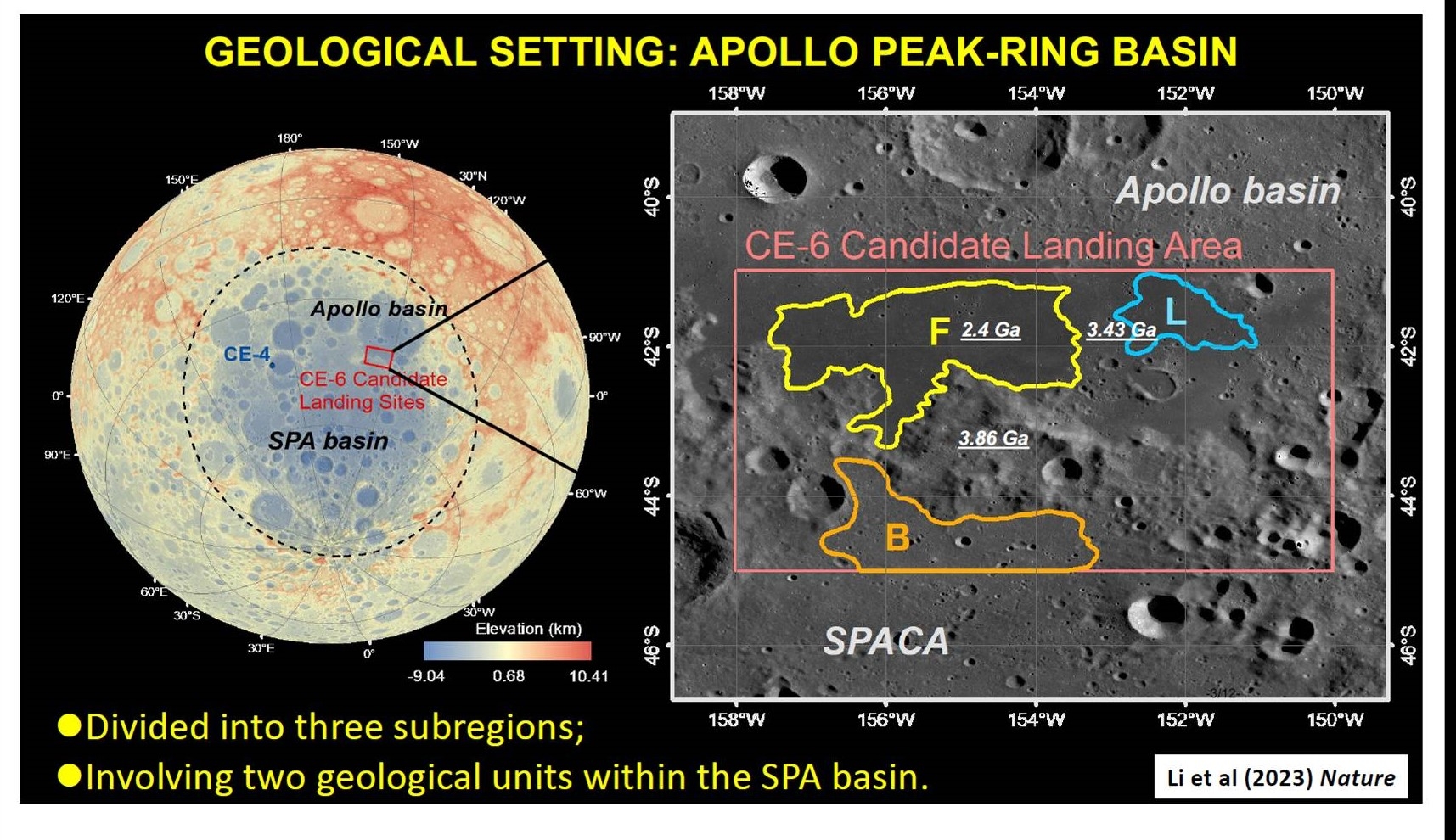
Image credit: James Head
According to Li Chunlai, deputy chief designer of the Chang’e-6 mission, the lander/ascender combination touched down precisely at the designated area, a locale likely to be basalt-rich and of important scientific value in unraveling the Moon’s past.
Simulation lab
Jin Shengyi from the CASC explained to Chinese media outlets that the Chang’e-6 probe development team has built a simulation lab to ensure a smooth sampling process.
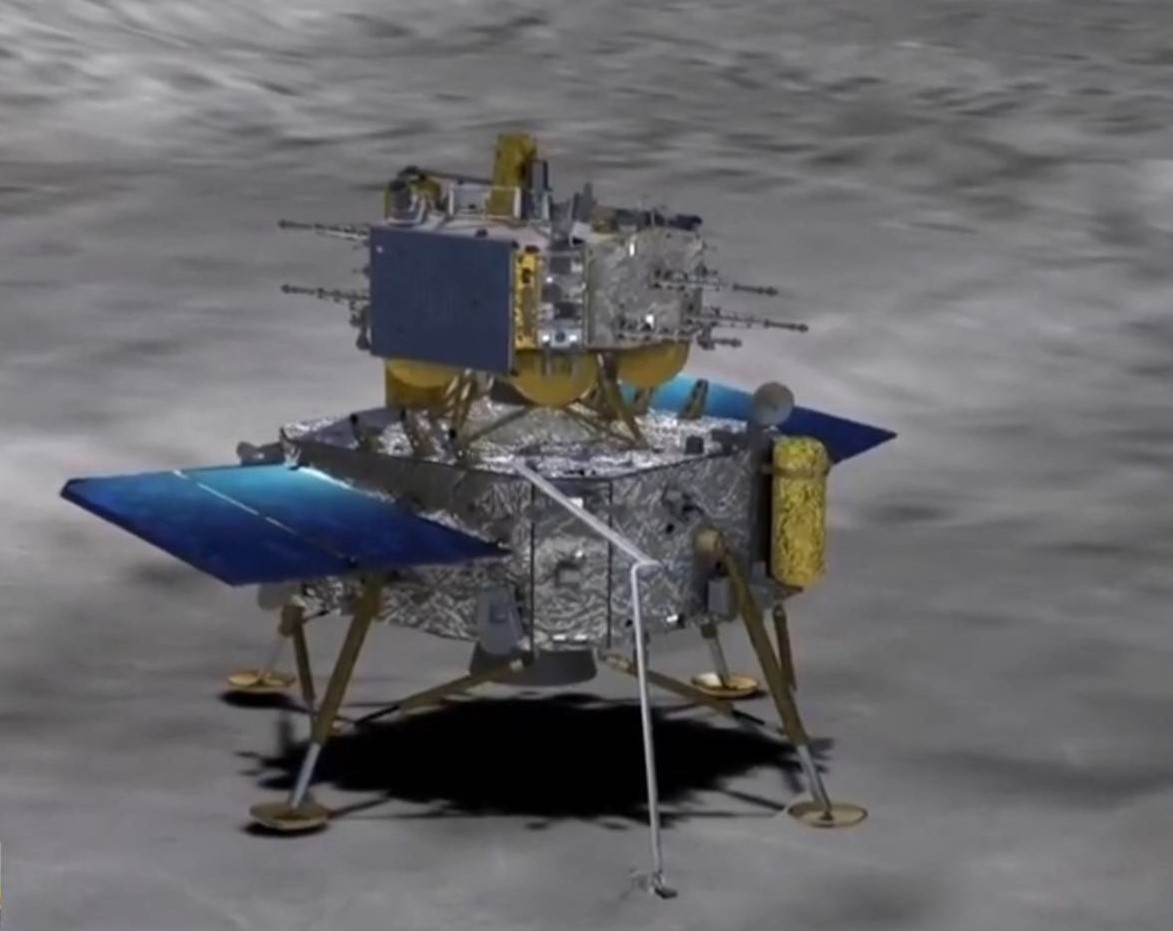
Artwork credit: CNSA/CCTV
A full-scale replica of the sampling area in view of the Chang’e-6 lander/ascender reportedly mimics rock distribution, and lunar soil conditions around the landing site. The simulated site here on Earth is geared to develop and verify sampling strategies and equipment control procedures.
Even with China’s Queqiao-2 relay satellite service, the far side sampling time of Chang’e-6 is reduced to about 14 hours, contrasted with the 22 hours used by its predecessor, China’s Chang’e-5 Moon sampling mission in the winter of 2020.

Image taken during 2020 mission of Chang’e-5 lunar sample project. Image credit: CNSA/CLEP
Chang’e-5 landed on the Moon’s near side and gathered 1,731 grams of samples, the first lunar substances obtained since NASA’s Apollo missions to the Moon by astronauts ended in December 1972.
China is the third nation, after the former Soviet Union and United States, to have brought back to Earth collected lunar specimens.
Autonomous, onboard intelligence
The sampling process utilized by Chang’e-6 involved autonomous, onboard intelligence and relyed on real-time data collected by lander/ascender sensors – thereby reducing Earth-Moon control interaction and instruction.
Soon after the Chang’e-6 touchdown, the craft’s solar panels and directional antennas unfolded, initial checks and setup were performed, followed by operation of lunar sampling hardware.
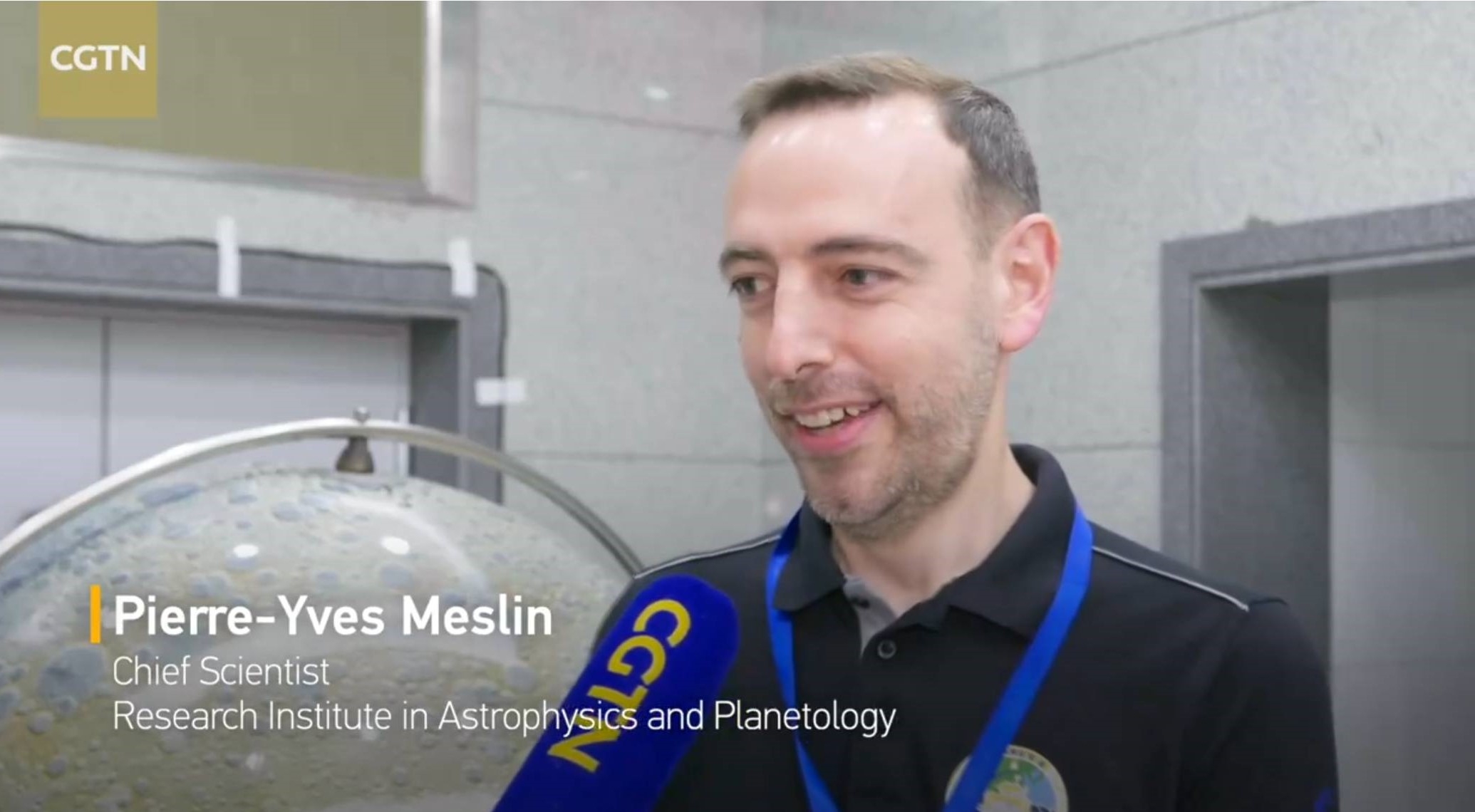
Image credit: CGTN/Inside Outer Space screengrab
European experiments
Meanwhile, also turned on were two European scientific experiments carried by the Chang’e-6 landing craft — a radon-measuring instrument from France’s national space agency and a dedicated negative ion instrument developed by the Swedish Institute of Space Physics with support from the European Space Agency.
The Detection of Outgassing RadoN (DORN) was developed by French scientists. It will detect radon isotopes and study the transmission and diffusion mechanisms of volatile compounds in the lunar environment.
Witnessing the progress of the Chang’e-6 mission in Beijing was Pierre-Yves Meslin, principal investigator of DORN from France. This first time measurement is expected to advise researchers on how radon might move from warm to cold regions of the Moon.
Artwork depicts China’s Change’-6 lander/ascender on the Moon.
Image credit: CNSA
China’s Chang’e-6 lunar mission has carried out a successful far side touchdown and is already busily gathering specimens for send-off to Earth.
The first batch of data has been relayed from the Chang’e-6 lander-ascender combination following its arrival on Sunday morning (Beijing Time).
The landing was aided by China’s newly positioned Queqiao-2 relay satellite to provide a stable communications link to mission controllers on Earth.

Image credit: CCTV/CLEP/Inside Outer Space screengrab

Image credit: CCTV/CLEP/Inside Outer Space screengrab

Engine interaction with lunar surface. Image credit: CCTV/CLEP/Inside Outer Space screengrab
Chang’e-6’s lander-ascender combination soft landed in the South Pole-Aitken (SPA) Basin, at an impact crater known as the Apollo Basin, located within the SPA Basin.
Landing process
A six-stage landing process enabled the craft’s soft landing: deceleration, quick adjustment, approaching, hovering, obstacle evasion and slow descending. Collectively, those stages spanned about a 900 second time period.
Deceleration happened at roughly 10 miles (15 kilometers) from the lunar surface, with the probe adjusting its angle, making it nearly perpendicular to the surface.
During the descent, an autonomous visual obstacle avoidance system was used to automatically detect obstacles, with a visible light camera selecting a comparatively safe landing area based on the brightness and darkness of the lunar surface.

Image credit: James Head
Obstacle avoidance
When reaching within two to three kilometers from the lunar surface, the probe entered the approaching stage and its optical sensors began scanning the landing area for obstacles.
The probe then entered a hovering stage when descending ever-closer to the Moon, with sensors working to scan the surface and quickly select a suitable space where all four of its legs would land on an even surface while evading obstacles.

Li Xiaoning. Image credit: CCTV/Inside Outer Space screengrab
At under a 100 feet (30 meters) altitude above the lunar surface, the probe entered its final landing stage, with its descending speed reduced to 4.5 miles per hour (two meters per second) until making the soft landing.
“So far, the entire Moon landing process is very smooth and successful. The power descent control is relatively accurate, while the relay link is uninterrupted. And the landing is smooth and steady. The ideal landing location creates a favorable environment for subsequent lunar sample collection,” said Li Xiaoning, an engineer from the Beijing Aerospace Control Center during a China Central Television (CCTV) interview.
China space watcher, Seger YU, suggests on X (formerly Twitter) that the Chang’e-6 landing point is located northeast of a pre-selected landing point, about 10 miles (16.7 kilometers) away.

Image credit: CNSA
Rapid sampling
China space officials have noted that the Change’-6 mission aims to realize key technologies of intelligent and rapid sampling, as well as takeoff and ascent from the far side of the Moon.
“The mission is quite tough, primarily due to the need to establish relay communications between the Earth and the far side of the Moon,” Li said. “We launched the Queqiao-2 relay satellite in the early stages, providing the necessary communications support for soft landing and sampling on the far side.”

Ge Ping, deputy director, Lunar Exploration and Space Engineering Center, China National Space Administration.
Image credit: CCTV/Inside Outer Space screengrab
Added Ge Ping, deputy director of the Lunar Exploration and Space Engineering Center under the China National Space Administration (CNSA): “We adopted rapid intelligent sampling and take-off and ascent from the Moon’s surface, which have laid a solid foundation for technologies, such as soft landing and sampling on extraterrestrial bodies.”
It is anticipated that by honing those skills they will be mirrored by China’s Mars sample return initiative in the comings years.

Image credit: Xingguo Zeng, et al.
Substantial challenge
Now busily at work, the Chang’e-6 lander is slated to finish lunar sampling tasks within two days. To do so, the spacecraft has two methods of lunar sampling: a drill to snag subsurface samples and grabbing samples on the surface with a robotic arm.
The landing site within the SPA Basin is expected to yield unique scientific data; the far side has been subjected to a longer history of impacts, indicating an older geological age for in-depth exploration. Also, the landing area – and flatness of the landscape — offers communications and telemetry conditions to execute the mission.

Ye Peijian, an academician of the Chinese Academy of Sciences.
Image credit: CCTV/Inside Outer Space screengrab
“It’s the first time in human history to retrieve lunar samples from the far side of the Moon,” Ye Peijian, an academician of the Chinese Academy of Sciences told CCTV.
“If Chinese scientists succeed in obtaining lunar regolith samples from the far side, there will be numerous technological achievements. This represents a significant advancement for us, but also poses a substantial challenge,” Ye added.

Image credit: CCTV/Inside Outer Space
Landing/sampling area
Chang’e-6 carries instruments to facilitate scientific research.
Zuo Wei, chief engineer of the Chang’e-6 mission, told CCTV one of that trio of instruments is the foreground camera, which captures high-definition images of the landing and sampling areas.
Another is the mineral spectral analysis instrument, Zuo said, which obtains spectral data at the sampling area to aid in analyzing the mineral composition there.
Another instrument is the structural detector, installed at the bottom of the lander, which detects the structure of the soil beneath the Moon’s surface and provides information for further drilling and sampling procedures, Zuo explained.

Image credit: CCTV/Inside Outer Space screengrab

Image credit: CCTV/Inside Outer Space screengrab

Image credit: CCTV/Inside Outer Space screengrab
International payloads
Also onboard the lander are several international payloads including a detector from France, a lunar surface negative ion analyzer from the European Space Agency (ESA) and a laser angle reflector from Italy.
As the first French-made instrument to land on the moon, the Detection of Outgassing RadoN (DORN) is dedicated to measuring the radioactive gas of radon on the moon’s surface.
The lunar surface negative ion analyzer developed by the ESA/Sweden will be used to detect negative ions and study the interaction between plasma and the lunar surface.
The laser retro-reflector developed by Italian scientists will be used for positioning and distance measurement in future lunar missions.

Pakistan ICUBE-Q. Image credit: CCTV/Inside Outer Space screengrab
In addition to scientific instruments from European countries, the probe also carried a cube satellite from Pakistan known as ICUBE-Q, which separated from the Chang’e-6 orbiter on May 8 to carry out exploration activities, such as capturing images of the Moon.
“Samples into our pocket”
The multi-component Chang’e-6 mission consists of an orbiter, a returner, a lander and an ascender.
Since the mission’s departure from China on May 3 it has carried out Earth-moon transfer, near-moon braking, lunar orbiting and landing descent. The lander-ascender combination separated from the orbiter-returner combination on May 30, said the China National Space Agency (CNSA).
“The drilling and collecting work are reaching an end,” advised Ren Depeng, a space expert from the China Aerospace Science and Technology Corporation (CASC).
“Now we have samples and the last action is to put the samples into our pocket. We can say that the drilling and collecting are progressing smoothly,” Ren told CCTV.

Image credit: Ascender (right) reaches orbiter to enable return of lunar samples.
Image credit: CGTN/Inside Outer Space screengrab
Moon-to-Earth journey
Following Chang’e-6’s drilling and sample collection duties, the probe will seal all the samples off before the ascender performs take-off preparations.
Ren added that the ascender will then blast off from the Moon’s surface, connect with the returner combination that has been waiting in orbit and transfer those collected samples into the returner combination.
That combination is set to conduct a Moon-to-Earth journey and return the specimens to the Earth under parachute, now eyeing a June 25 (Beijing Time) targeted landing.

Photo taking during Chang’e-5 surface sampling.
Credit: CCTV/Inside Outer Space screengrab
With samples on Earth, they will be transferred to a lunar receiving lab in Beijing for examination. The far side specimens are to be described and documented, prior to publication of a Chang’e-6 sample catalog.
The Chang’e-6 mission profile is essentially identical to China’s Chang’e-5 robotic Moon mission in late 2020. That earlier effort returned 1,731 grams of lunar materials from Northern Oceanus Procellarum near a huge volcanic complex, Mons Rümker, located in the northwest lunar near side.
Spectacular accomplishment
According to Jim Head, a lunar exploration authority at Brown University, the Chang’e-6 landing and sampling operations represent a spectacular accomplishment.
Head pointed out that China, with its earlier Chang’e-4 mission, demonstrated the first successful landing on the farside of the Moon, followed immediately by surface operations with the deployed Yutu-2 rover.

Yutu-2 rover as imaged by Chang’e-4 lander earlier in its far side mission.
Credit: CNSA/CLEP
The Chang’e-4 mission accomplished two very difficult tasks five years ago in 2019, Head said, with the help of the Queqiao-1 farside relay satellite.
“Now, with the help of the new Queqiao-2 far side communication satellite, China has successfully landed a sample return spacecraft, Chang’e-6, in the Apollo basin within the huge South Pole-Aitken basin, an area of intense scientific interest and importance,” Head told Inside Outer Space.
Mission critical steps
Successful return and analysis of these samples, currently undergoing collection and stowage, Head said, “will help to address age-old fundamental questions about the many differences between the lunar near side and far side, and what they mean about the origin and evolution of the Moon.”
The return of lunar samples from the nearside of the Moon by China’s Chang’e-5 mission in 2020, now followed by the successful landing on the lunar far side by the Chang’e-6 sample return mission, helps to orchestrate future projects, Head advised.
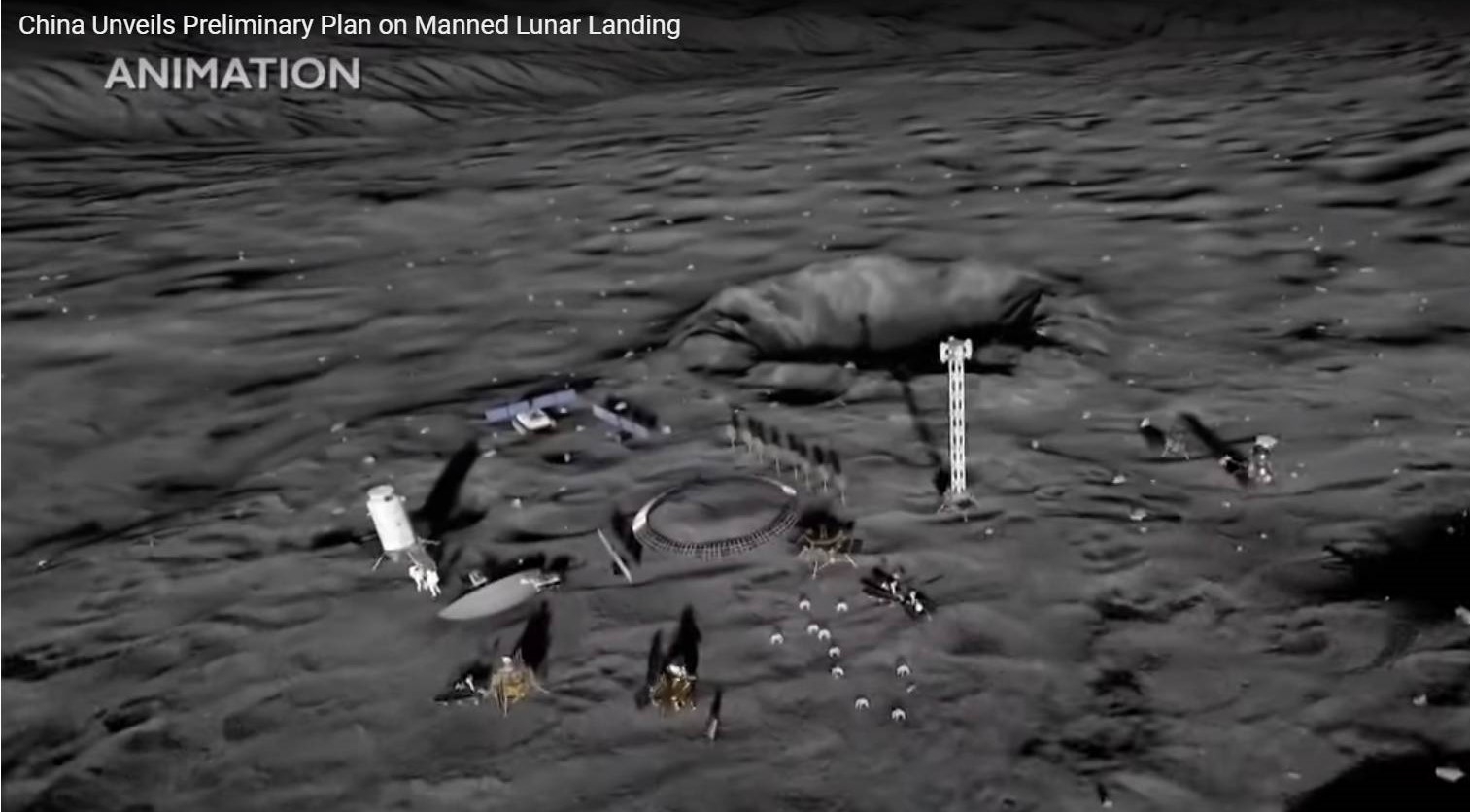
Artist’s view of International Lunar Research Station to be completed by 2035. Credit: CNSA
“It’s clearly very important practice for Chinese engineers and operations personnel, as each step of these missions duplicates important and mission-critical steps in the Chinese plans to land taikonauts on the Moon and robotically return samples from Mars,” Head said.
Go to these informative videos spotlighting the Chang’e-6 Moon landing (including a sampling of music, Blue Danube by Strauss:

