Archive for May, 2024
 Author:
  May 15th, 2024
Curiosity Left B Navigation Camera image taken on Sol 4185, May 15, 2024.
Image credit: NASA/JPL-Caltech
NASA’s Curiosity Mars rover at Gale Crater is now surveying its surroundings.
Emma Harris, a graduate student at the Natural History Museum in London, England is studying “Texoli butte” to see very high detail of rocks hundreds of meters away via the robot’s suite of instruments.

Curiosity Chemistry & Camera (ChemCam) Remote Micro-Imager (RMI) photo acquired on Sol 4185, May 15, 2024.
Image credit: NASA/JPL-Caltech/LANL

Curiosity Chemistry & Camera (ChemCam) Remote Micro-Imager (RMI) photo acquired on Sol 4185, May 15, 2024.
Image credit: NASA/JPL-Caltech/LANL
Curiosity’s Chemistry and Camera (ChemCam) instrument has gazed long distance at Texoli butte by way of the Remote Micro-Imager (RMI).
Glimpse between buttes
A recent plan also called for looking at a structure further up Gediz Vallis channel that the rover won’t be driving up to named “Milestone Peak.”

Curiosity Left B Navigation Camera image taken on Sol 4185, May 15, 2024.
Image credit: NASA/JPL-Caltech
“The long-distance observations are really useful in ensuring we can see everything we need to, even if we don’t drive super close,” Harris reports. “We then take a glimpse between the buttes of Gediz Vallis and above the sulfate-bearing unit we are currently driving in to the yardang unit for the final long-distance RMI of this plan.”

Curiosity Left B Navigation Camera image taken on Sol 4185, May 15, 2024.
Image credit: NASA/JPL-Caltech
Close-in duties too
Curiosity’s super vision is also looking at the atmosphere, Harris notes, with the rover’s Mastcam gauging the amount of dust in the atmosphere in a tau measurement, and Navcam will take a suprahorizon movie as well as being on the lookout for dust devils.

Curiosity Front Hazard Avoidance Camera Left B Sol 4185 taken on May 15, 2024.
Image credit: NASA/JPL-Caltech
As well as really far away, Curiosity is a specialist at looking and taking measurements of rocks right in front of us.
Closer-in duties involve Curiosity taking Alpha Particle X-Ray Spectrometer (APXS) measurements and Mars Hand Lens Imager (MAHLI) observations on two nearby rocks named ‘Tenaya Lake’ and ‘Buck Lake.’

Curiosity Left B Navigation Camera image taken on Sol 4185, May 15, 2024.
Image credit: NASA/JPL-Caltech
Morning light on Mars
On the same rock as Buck Lake, ChemCam will be taking a Laser Induced Breakdown Spectroscopy (LIBS) measurement on a target named ‘Illilouette Falls,’ and another rock a little further away called ‘Redwood Canyon,’ as well as a passive observation on a dark-toned rock named ‘Cox Col.’

Curiosity Left B Navigation Camera image taken on Sol 4185, May 15, 2024.
Image credit: NASA/JPL-Caltech
“Mastcam will document these observations, as well as looking back at the south side of Pinnacle Ridge we have just driven around,” Harris explains. In total, Mastcam will spend 1 hour documenting the rocks at the Gediz Vallis Ridge, including a 15×3 mosaic during an early morning wake-up call to take advantage of the morning light on Mars.

Curiosity Left B Navigation Camera image taken on Sol 4185, May 15, 2024.
Image credit: NASA/JPL-Caltech

Curiosity Right Navigation Camera image taken on Sol 4185, May 15, 2024.
Image credit: NASA/JPL-Caltech
 Posted in

Ingenuity Mars helicopter yielded sweeping, low-level, imagery over its 72 flights.
Image credit: NASA/JPL-Caltech
The NASA Ingenuity Mars helicopter chalked up many a milestone during 72 airborne flights before incurring a destructive encounter with a sand dune. That “hit-the-dirt” mishap caused rotor-blade damage that now prevents it from additional aerial treks.

Ingenuity made use of commercial, off-the-shelf (COTS) high-tech hardware.
(Image credit: NASA/JPL-Caltech/Theodore Tzanetos)
Not only was Ingenuity’s flight experience exemplary, the rotorcraft achievements have opened the door for follow-on aerial craft to fly the friendly but thin atmospheric skies of the Red Planet.
As a technology demonstrator goal, Ingenuity was assigned the duty to make up to five flights over 30 days. But from its celebrated April 19, 2021 first voyage to its last airborne journey on January 18, 2024, Ingenuity pushed its self-made envelope in altitude attained, distance flown, and speed reached over those nearly three years.

A Mars craft concept is now being appraised, a Mars Science Hexacopter that is far larger and more capable than Ingenuity.
Image credit: NASA/JPL-Caltech/Theodore Tzanetos
For more information on what Ingenuity taught us…and what next thinking, go to my new Space.com story – “How NASA’s Ingenuity helicopter opened the Mars skies to exploration” – at:
https://www.space.com/mars-helicopter-ingenuity-opened-red-planet-skies-exploration

Earth’s Moon and cis-lunar space are new destinations for numbers of nations. To what extent is that presence demand or promote a military presence?
Image credit: Inside Outer Space
There is increasing interest in defining the military utility of cislunar space.
But just how valuable is that “open space” to armed forces of various nations? What is potentially promising, after so many decades of going to the Moon robotically and with humans, is the prospect of an economic kick-back.
But what are the implications for defending economically valuable extraterrestrial turf?

Framework for In-situ Resource Utilization (ISRU) of lunar water and asteroids.
Credit: Aiden O’Leary/Jason Aspiotis/Booz Allen Hamilton
Debatable topic
The Aerospace Corporation’s Center for Space Policy and Strategy has a series for sponsoring debates on national security space topics.
The first of the series features two essays written by experts external to The Aerospace Corporation under the title: High Ground or High Fantasy: Defense Utility of Cislunar Space.
The essays are authored by Namrata Goswami, a space policy expert at the Thunderbird School of Global Management, and Bleddyn Bowen, an associate professor of international relations at the University of Leicester in the United Kingdom.

The U.S. Defense Advanced Research Projects Agency (DARPA) is moving forward on the Novel Orbital and Moon Manufacturing, Materials and Mass-efficient Design (NOM4D) program. (Image credit: DARPA)
Shades of gray
“This paper presents two perspectives, but there is a spectrum of views on the military utility of cislunar space,” comments Robert S. Wilson, a systems director at The Aerospace Corporation’s Center for Space Policy and Strategy.
“Our goal has not been to capture all positions about this debate but to showcase opposing arguments that can help policymakers and non-specialists understand where their own views fit on this spectrum,” Wilson comments.
While there are those that see this issue as black and white, Wilson adds that others will see it in shades of gray “and those different shades could mean different levels of defense investment in cislunar space as well as different roles and operations for the Space Force.”

President Donald Trump signs S.1790, the National Defense Authorization Act for Fiscal Year 2020 on, Friday, Dec. 20, 2019 at Joint Base Andrews. The act directed the establishment of the U.S. Space Force as the sixth branch of the armed forces.
Credit: Airman 1st Class Spencer Slocum, 11th Wing Public Affairs
Rapid-fire rebuttal
The debate about the military importance of the Moon and cislunar space can be difficult to follow, suggests Wilson, and the Bowen and Goswami essays “clarify the issues at the heart of it.”
After having written their essay, the external authors had the opportunity to review the opposing essay and offer a rebuttal.
Page link is here at:
https://csps.aerospace.org/papers/high-ground-or-high-fantasy-defense-utility-cislunar-space

What’s brewing on Mars?
Image credit: Explore Mars
The National Academies has assembled a new committee to gather and review information for a report: “A Science Strategy for the Human Exploration of Mars.”
”It will identify high-priority science objectives in all relevant disciplines to be addressed by human explorers across multiple science campaigns on the surface of Mars,” explains Colleen Hartman, Director, Aeronautics, Astronomy, Physics, and Space Science at the National Academies of Sciences, Engineering, and Medicine.

Credit: Lockheed Martin
“We are performing the work under two of my Boards: the Space Studies Board (SSB) and the Aeronautics and Space Engineering Board (ASEB),” Hartman told Inside Outer Space.
The study co-chairs are two leading researchers: Lindy Elkins-Tanton from Arizona State University and MIT’s Dava Newman.
Four panels are to be formed to provide input to the steering committee. Those panels are focused on: Atmospheric Science and Space Physics, Geosciences, Biological and Physical Sciences and Human Factors, and on Astrobiology.

Overview map shows proposed Exploration Zones (EZ)/human landing sites for NASA’s humans-to-Mars undertaking.
Credit: ICA/NASA
Landing sites
One output from the report is identifying preliminary criteria for the selection of appropriate landing sites on Mars, Hartman advised. The committee will also take up commonalities with Moon exploration.
For the highest priority science campaigns, the blue-ribbon group will identify preliminary criteria for appropriate landing sites, based on available data, that will enable science objectives to be met.

Human explorers on Mars will enlist a variety of tools to reveal the secrets of the Red Planet.
Image credit: NASA
Examples of criteria that might be considered include: 1) ice within a certain surface depth, 2) salt-bearing materials accessible to crew, or 3) caves with accessible entrance points for human explorers.
A number of meetings are to be held this year, into 2025.
Wanted: senior scientist for Mars
Meanwhile, the hunt is on at NASA for a senior scientist for Mars Exploration within the agency’s Planetary Science Division.

Image credit: NASA
That person will serve as a senior science advisor on all matters concerning scientific content and strategy for Mars exploration, including the Mars Exploration Program, as well as the forthcoming restructuring of the Mars Sample Return program.
Among other tasks, the senior scientist will also lead NASA science planning and coordination, in collaboration with international partners, in preparation for delivery of Mars samples.

Photo taking during Chang’e-5 surface sampling.
Credit: CCTV/Inside Outer Space screengrab
Back in December 2020, China’s Chang’e-5 spacecraft returned Moon samples, hauling them back to Earth from the Ocean of Storms.
Fast forward to today.
The delicate nature of Chinese/NASA cooperation regarding those Chang’e-5 returned collectibles was discussed by Lori Glaze, Director of NASA’s Science Mission Directorate’s Planetary Science Division.
Glaze spoke May 13, briefing the Extraterrestrial Materials Analysis Group (ExMAG), a meeting being held this week in Houston, Texas.

Chang’e-5 return capsule holding lunar specimens.
Credit: National Astronomical Observatories, CAS
Limited exemption
Key points that Glaze spoke to:
China opened applications for access to Chang’e-5 lunar samples to international scientists in late 2023.
In November 2023, NASA chief Bill Nelson certified to Congress NASA’s intent to allow NASA-funded researchers to apply to the China National Space Agency (CNSA) for access to the Chang’e-5 returned specimens.
What is termed a “limited exemption” under the Wolf Amendment is advancing NASA coordination with U.S. researchers that applied for the Chang’e-5 samples.

Chinese President Xi Jinping inspects Chang’e-5 lunar sample return capsule.
Credit: CCTV/Inside Outer Space screengrab
The Wolf Amendment was passed by the U.S. Congress in 2011, shaped by then-U.S. Representative Frank Wolf. Its language prohibits NASA from using government funds to engage in direct, bilateral cooperation with the Chinese government and China-affiliated organizations from its activities without explicit authorization from the U.S. Congress, even the Federal Bureau of Investigation.
Application process
Glaze noted that NASA is aware that as part of the application process, the CNSA recently interviewed the international loan applicants, and U.S. researchers were interviewed virtually.
A second opportunity for international proposers for Chang’e-5 samples is expected in the summer of 2024.

Artwork depicts Chang’e-6 now in Moon orbit.
Image credit: CNSA/CGTN/Inside Outer Space screengrab
Glaze advised that NASA is aware of the U.S. science communities’ interest in access to further samples – such as from the Chang’e-6 lunar sampling mission now underway – and will pursue this in the future based on outcomes of the Chang’e-5 lunar sample process.
Far side samples
After its May 3 launch, Chang’e-6 performed a braking maneuver and is now circling the Moon.
The 8.2 metric ton Chang’e-6 is targeted for a touchdown in the South Pole-Aitken Basin on the lunar far side. The overall mission spacecraft consists of four components: an orbiter, a lander, an ascender and a reentry module.

Image credit: Xingguo Zeng, et al.
If all goes to plan, within 48 hours after Chang’e-6 landing its robotic arm is to be extended, then scoop up rocks and soil from the lunar surface, as well as perform drilling duties to probe below the lunar topside.
Up to 4.4 pounds (2 kilograms) of lunar bits is to be collected, stashed and packed in a vacuum-sealed metal container inside an ascender.
The ascender then rockets off the Moon and auto-docks with the Chang’e-6 orbiter circling the Moon.
Following a roughly five-day journey from the Moon, a returner capsule, stuffed with lunar samples, is to parachute into a pre-determined site in Inner Mongolia.
The entire flight — from Earth launch to return sample capsule landing back on Earth — is expected to last about 53 days.

Who Owns Outer Space? – International Law, Astrophysics, and the Sustainable Development of Space by Michael Byers and Aaron Boley; Cambridge University Press/Cambridge Studies in International and Comparative Law (2023); 428 pages; Available by Open Access.
This highly acclaimed book melds space activities, international law, and global governance to underscore major, now-looming, environmental, safety, and security challenges now on full-boil.
Authors Byers and Boley are from the University of British Columbia, Vancouver and this incredibly rich, information-packed book should give the reader pause in how to grapple with perplexing issues of today. The volume offers proposed “actionable solutions” to those challenges.
“Social scientists and lawyers are needed to ensure that solutions are politically feasible, and to carry them forward into lasting rules and institutions. Engineers are needed to develop technologies that can be used in beneficial ways, with environmental scientists guiding us forward by identifying what is beneficial, and what might not be,” they write in the volume’s introduction.
The book is divided into 9 solid chapters: Space Tourism, Mega-constellations, Mega-constellations and International Law, Abandoned Rocket Bodies, as well as sections on Space Mining, Planetary Defense, Space Security, Anti-satellite Weapons and International Law, and ending with a conclusion chapter – Where to from Here?

Credit: DARPA/DSO
That’s a diverse suite of subject topics. But this very readable, fully-referenced book launches a warning flare that space activities of today and tomorrow can be endangered, and just how those undertakings — and space itself — should be sustainably governed.
Who Owns Outer Space? – International Law, Astrophysics, and the Sustainable Development of Space reviews existing international treaties and state practices, but also details limitations in those treaties and practices.
Ideally, by strengthening those elements the hope is to short-circuit calamitous incidents. “War in space has no good outcomes,” they write, while observing that “long-term solutions to grand challenges in space require approaches that integrate multiple disciplines.”
On May 8 of this year, this book won the prestigious 2023 Donner Prize.
Go to this video capturing the views of Byers and Boley at:
For more information about this book, and to gain free access to its contents, go to:
https://www.cambridge.org/core/books/who-owns-outer-space/960CCB0464744F845B09434D932699EC

Wait-a-minute.
Image credit: Barbara David
In a wait-a-minute moment, pre-launch imagery of China’s Chang’e-6 shows some sort of a mini-rover with four wheels.
But so far, as far as I know, there’s been no official word from the China National Space Agency (CNSA) regarding the rover.
A glimmer of information has come from a story via China’s Science Network (news.sciencenet.cn). It does note the presence of a Chang’e-6 lunar rover.

Chang’e-6 pre-launch look with wheeled rover attached, left.
Image credit: CNSA/CCTV/Inside Outer Space screengrab
Imaging spectrometer
According to the article, the Shanghai Institute of Ceramics, Chinese Academy of Sciences (later referred to as Shanghai Institute of Ceramics) undertook the development of a number of key materials.
“The large-sized tellurium dioxide crystal developed by the Shanghai Silicate Institute has excellent acoustic and optical properties and is a key material to achieve a large field of view, high spatial and spectral resolution, and is used in the infrared imaging spectrometer of the Chang’e-6 lunar rover,” the story explains.

Artwork of Chang’e-6 landing on Moon’s far side.
Image credit: CGTN/CNSA/Inside Outer Space screengrab
Shutter speak
“The ultrasonic motor is the ‘helper’ that presses the shutter for the ‘Chang’e Family’ lunar rover’s infrared imaging spectrometer. Piezoelectric ceramics are the core material of the ultrasonic motor,” the story continues. “Following Chang’e-3, 4 and 5, the wide temperature range and highly stable piezoelectric excitation element developed by Shanghai Silicate Institute was successfully used in the Chang’e-6 ultrasonic motor.”
So there you have it, all of it so far. But surely more is to come given a successful far side touchdown of the Chang’e-6 sample return mission. If the rover is deployed and in good shape, perhaps looks at lunar sampling operations may be in the offing.

China’s first Moon lander, Chang’e-3, taken by Yutu-1 rover during 2013 nearside exploration.
Image credit: CNSA/CLEP
Then there’s the prospect of a view of the Chang’e-6’s ascender craft departing the area, loaded with its precious cargo of collected Moon goodies.
Rover comparisons
On the other hand, the Chang’e-6 rover machinery is clearly different than the earlier Yutu-1 and Yutu-2 rovers, each with six wheels, both loaded to their solar panels with lots of equipment.
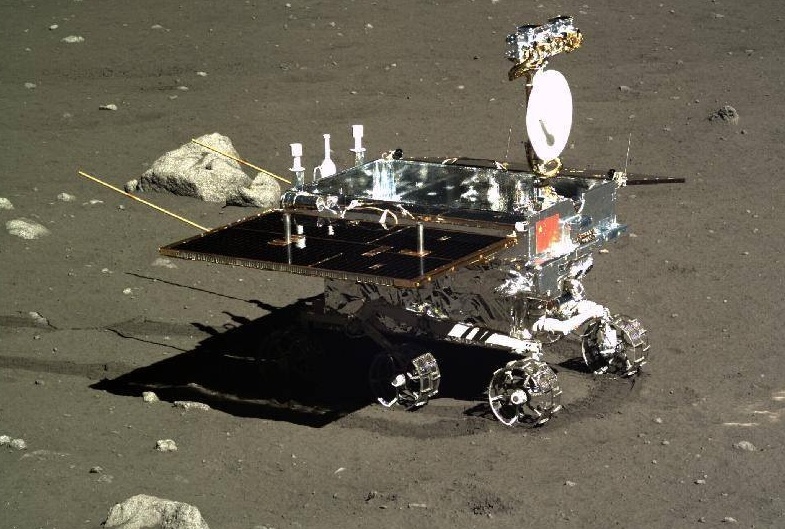
China’s Yutu-1 Moon rover.
Image credit: Chinese Academy of Sciences

Yutu-2 on the prowl.
Image credit: CNSA/CLEP
The Chang’e-3 Moon lander let loose Yutu-1 in Mare Imbrium after its December 2013 arrival on the Moon.
Yutu-2’s home turf since deployed by the Chang’e-4 lander in January 2019 is Von Kármán crater within the Moon’s south pole-Aitken basin. It is reportedly alive and well and still on the move.

Chang’e-4 lander as observed by Yutu-2 rover.
Image credit: CNSA/CLEP
Lastly, as a prelude to the launch of Chang’e-6, a communication test between China’s recently lofted Queqiao-2 relay satellite was carried out, one aspect of which was linking up with Chang’e-4 far side lander/rover hardware.
Hopefully, more details about the Chang’e-6 rover duties are forthcoming, once rolling about the landing zone.
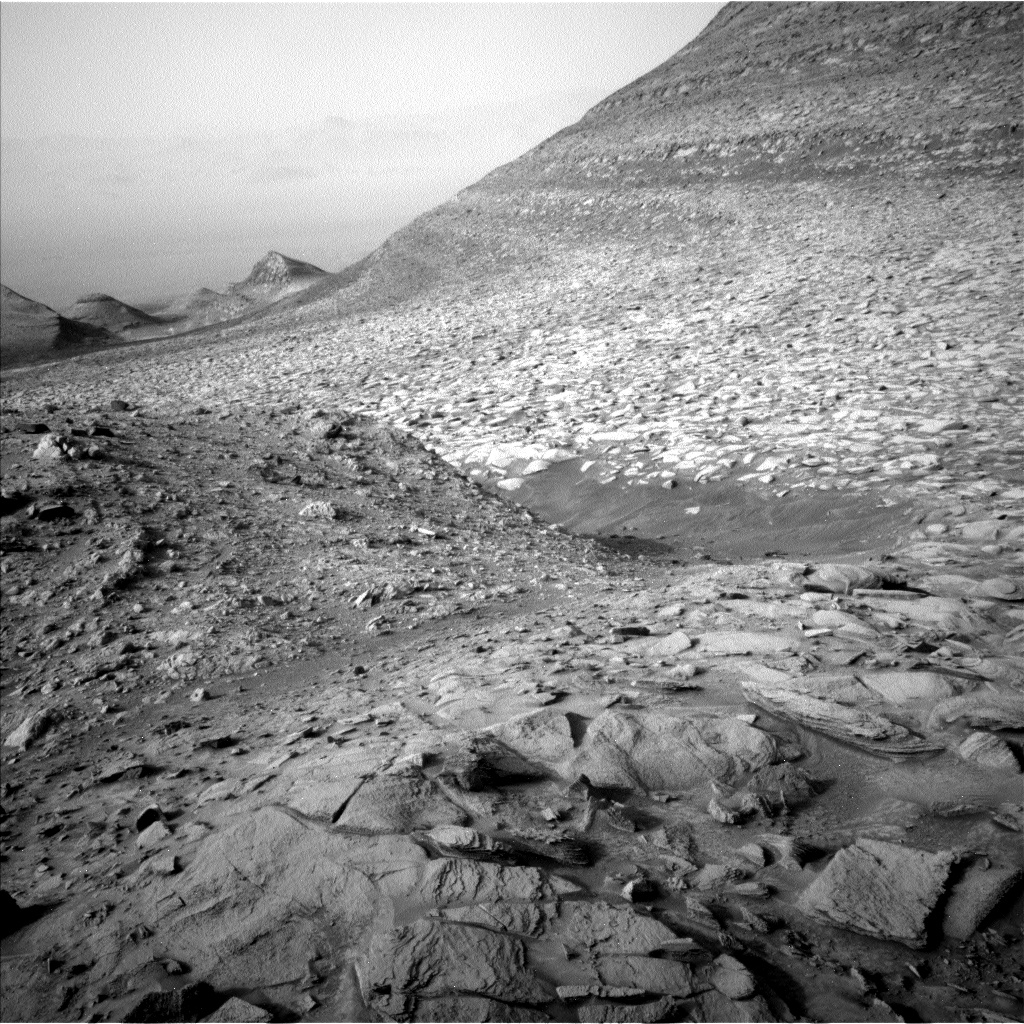
Curiosity Left B Navigation Camera photo acquired on Sol 4180, May 10, 2024. Image credit: NASA/JPL-Caltech
NASA’s Curiosity Mars rover is on the move at Gale Crater.
Abigail Fraeman, a planetary geologist at NASA’s Jet Propulsion Laboratory, reports on recent activities of the robot.
“We planned quite a drive on Wednesday, with lots of twists and turns over very bumpy terrain, Fraeman says.
The team was gratified to learn everything completed as planned given data from a recent downlink from Curiosity.
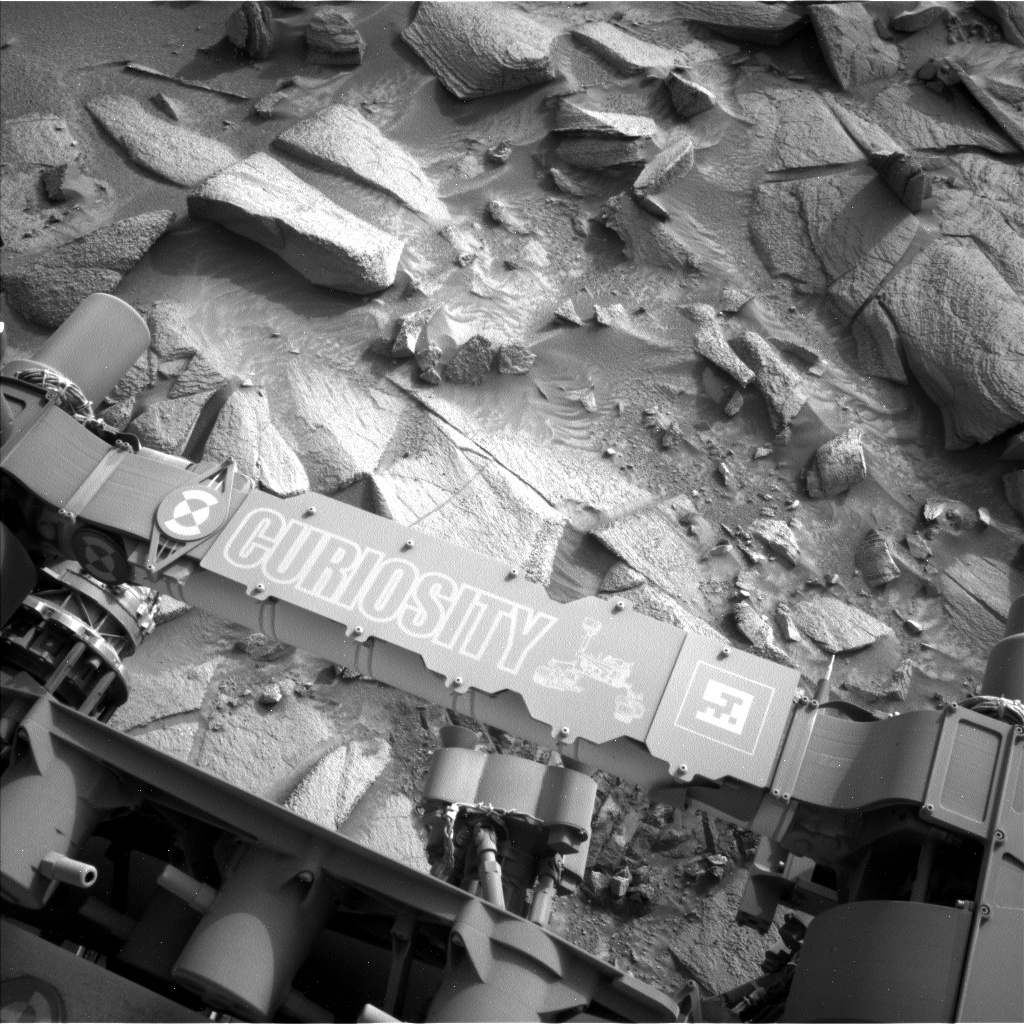
Curiosity Left B Navigation Camera photo acquired on Sol 4180, May 10, 2024.
Image credit: NASA/JPL-Caltech
Big decision
“The successful drive means Curiosity is now parked on the south side of Pinnacle Ridge, the final area of upper Gediz Vallis ridge that we planned to investigate before we cross Gediz Vallis channel,” Fraeman reports. “We visited the north side of Pinnacle Ridge last week and collected all sorts of data that tell us a lot about the composition and textures of the rocks that form the ridge.”
Fraeman adds that a recent big decision was at hand.
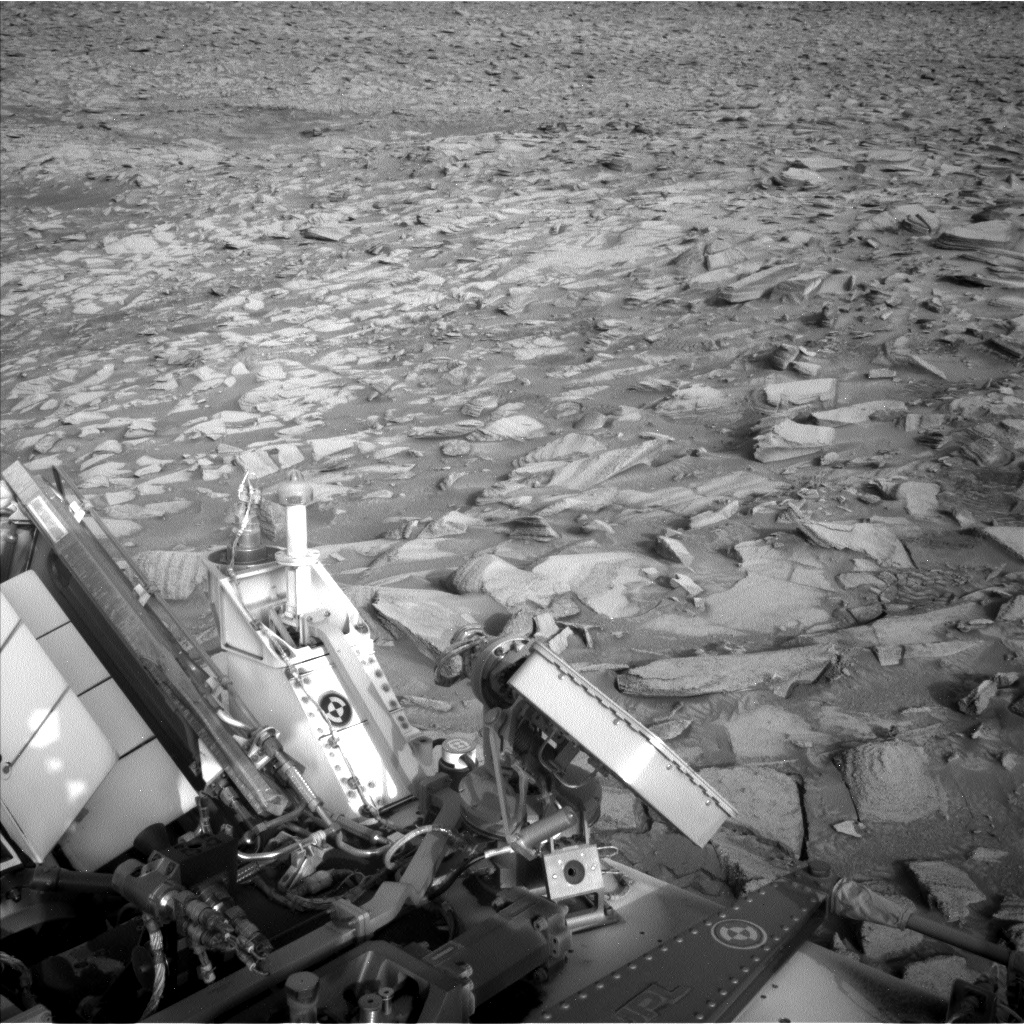
Curiosity Left B Navigation Camera photo acquired on Sol 4180, May 10, 2024.
Image credit: NASA/JPL-Caltech
Now that Mars researchers can see that the south side of Pinnacle Ridge is traversable, should the robot drive onto it to get additional contact science data on the Gediz Vallis ridge rocks? Or should Curiosity continue to drive along Gediz Vallis channel towards a planned channel crossing spot?
“Driving onto Pinnacle Ridge at this location could give us an opportunity to learn more about the materials that make up the ridge and the role of water in this area,” Fraeman points out. “But it could also take several sols and not tell us much more than what we already learned from our investigation on the north face of Pinnacle Ridge.”
As the on-duty Long Term Planner, Fraeman spearheaded discussion of the pros and cons of this decision, dialogue that promoted team agreement.
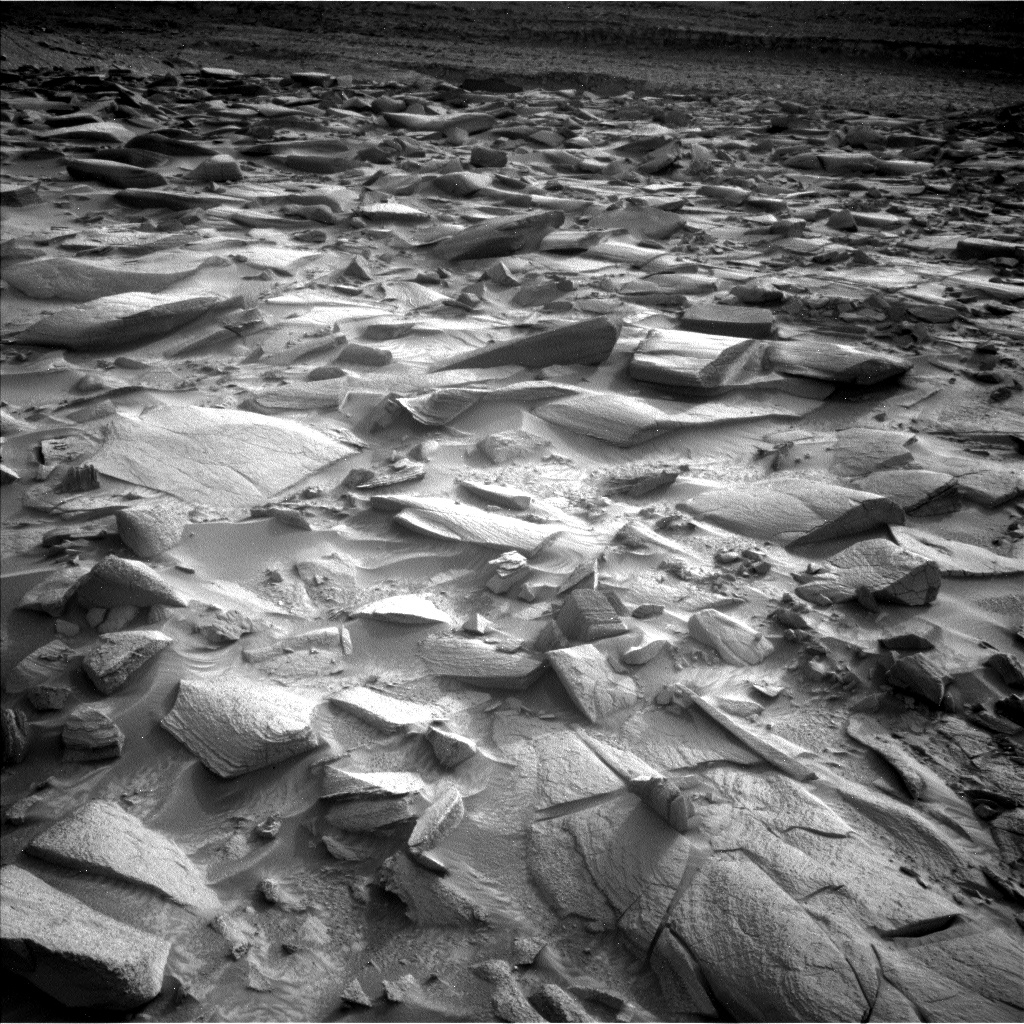
Curiosity Left B Navigation Camera photo acquired on Sol 4180, May 10, 2024.
Image credit: NASA/JPL-Caltech
Consensus decision
“We talked a lot about how the rocks we could see from our current location compared with the rocks we already investigated on the north side, and ultimately the roughly 25 scientists who were on the tactical operations planning group today came to a consensus decision,” Fraeman explains.
“We’d rather move on then spend more time here,” was the call.
Curiosity is to collect Mastcam observations and then continue to make its way up and along the channel, heading some 75 feet (23 meters) to the southwest.

Swirl mark of Dust Removal Tool is imaged. Curiosity Mars Hand Lens Imager (MAHLI) image produced on Sol 4180 May 10, 2024.
Image credit: NASA/JPL-Caltech/MSSS
Contact science
“Before driving away we’ll also take the opportunity to do some contact science on the rocks at our feet,” Fraeman says, with the rover using its Dust Removal Tool (DRT) followed by Alpha Particle X-Ray Spectrometer (APXS) and Mars Hand Lens Imager (MAHLI) observations on the target named “Boyden Cave.”
Also on tap, APXS and MAHLI observations on a nearby (dusty) target named “Royal Arches,” and finally a MAHLI-only target of a nearby rock named “Quarry Peak.”
Additionally, on the plan is collection of two Chemistry & Camera (ChemCam)/Laser Induced Breakdown Spectroscopy (LIBS) observations of “Otter Lake,” a target very close to Royal Arches, and another nearby rock named “Nevada Falls.” A suite of environmental monitoring observations will round out the plan.
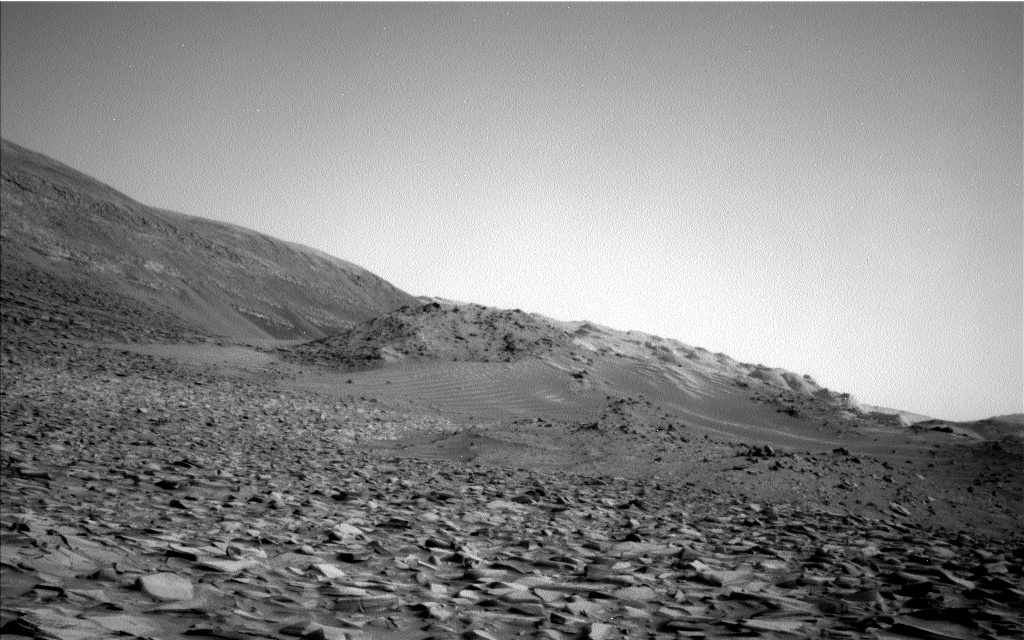
Curiosity Left B Navigation Camera photo acquired on Sol 4180, May 10, 2024.
Image credit: NASA/JPL-Caltech
New Martian vista
“I really love operations days like today,” Fraeman reports. “We came in this morning with a completely new Martian vista to admire, and then we had to work together as a team to make a quick decision about what to do next.”
“I think the pace of this decision making, the ability to talk through tough choices with a group of really smart, passionate people, and the realization that these decisions are guiding the course of a one-ton vehicle on an entirely different planet is one of the coolest ways to spend a morning,” Fraeman concludes.

Curiosity Mars Hand Lens Imager (MAHLI) image produced on Sol 4180 May 10, 2024.
Image credit: NASA/JPL-Caltech/MSSS
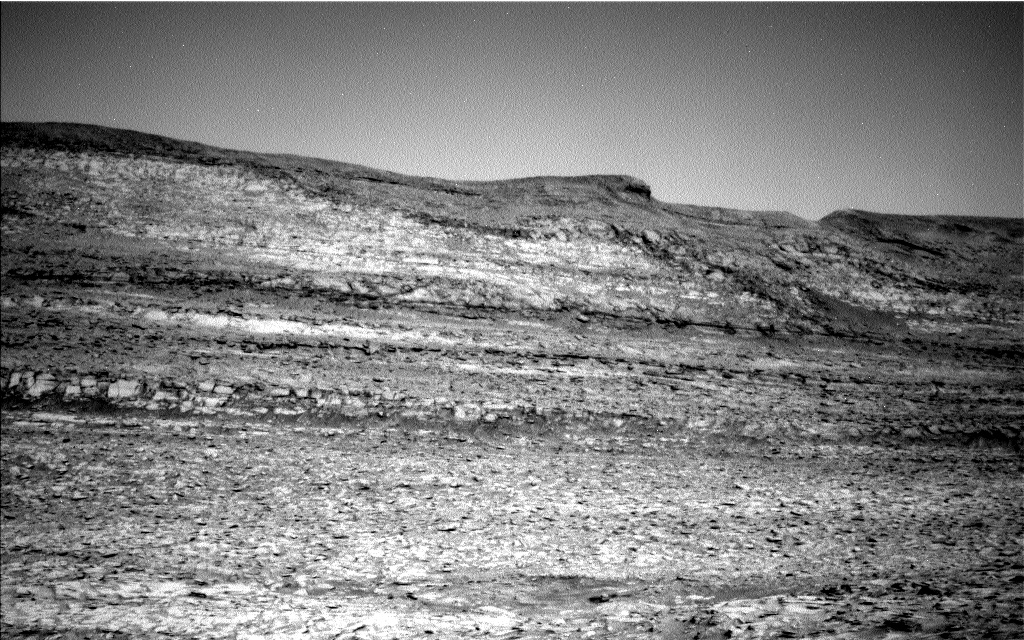
Curiosity Left B Navigation Camera photo acquired on Sol 4180, May 10, 2024.
Image credit: NASA/JPL-Caltech

Illumination map of the south polar region of the Moon. Areas in black receive no sunlight, and areas in warmer colors are illuminated a greater fraction of the time.
Image credit: Base image mosaic from NASA, Arizona State University, and Applied Coherent Technology Corp.
New research casts a spotlight onto those dark, sunlight shy cold traps on the Moon – spots where water could be lurking as a valuable, exploitable resource.
Volatiles like water may exist in the shadows at the bottom of craters near the poles of the Moon.
However, the Moon has been on the receiving end of intense bombardment by high-velocity meteorites, and the subsequent bombardment by the rocks meteorite impacts kick up, a new research paper explains. “Crater-forming bombardment controls both the production and destruction of craters where volatiles may be safe.”

Informally tagged as Malapert massif, this feature is thought to be a remnant of the Moon’s south pole – Aitken basin rim, which formed more than 4 billion years ago. This peak (lower left) was picked as one of the Artemis III candidate landing regions for an expeditionary crew.
Image credit: NASA/Goddard Space Flight Center/Arizona State University
The research offers a model of how long volatile-harboring cold traps last on the Moon. That modeling suggests that small cold traps are extremely ephemeral, while large cold traps could last for geologic time.
The work — “The Age and Evolution of Lunar Micro Cold Traps at the Scale of Surface Exploration” – is authored by Emily Costello and Paul Lucey at the Department of Earth and Planetary Science, University of Hawai’i at Manoa in Honolulu, HI.

Lunar south pole – future Moon base location?
Credit: NASA
Production and destruction
“From our model, we can reason that 100 meter [nearly 330 feet] cold traps which formed 1 billion years ago may still be present today and may have captured the last 1 billion years of lunar volatile history,” the paper explains.
Those lunar micro cold traps that are less than 1 meter are extremely transient and last only thousands of years.
“Our model thus constrains the production and destruction timescales of cold traps,” the paper observes, “and can be used to develop expectations concerning the discoverability and history of lunar volatiles at exploration scales relevant to landers, rovers, and humans.”

Artistic depiction of NASA astronauts at the lunar south pole carrying out early work to establish an Artemis Base Camp.
Image credit: NASA
Testable exploration
Given the future “re-booting” of the Moon and the projected zones for NASA Artemis expeditions to explore, cold traps can represent candidates for investigating both the origins and distributions of volatiles, while older — greater than 100 meter to 1 kilometer craters — may have been cold traps for geologic timescales, the paper notes.
The punch line: Larger cold traps persevere against the threat of obliteration longer than smaller cold traps.
If volatiles are discovered within sub-meter micro cold traps, Costello and Lucey add, the volatiles must have arrived over less than thousands of years timescales.

NASA’s Volatiles Investigating Polar Exploration Rover (VIPER) is to investigate the Nobile Region of Moon’s South Pole. Slated for liftoff late this year but may slip into 2025.
Image credit: NASA
The research team notes that the central conclusions of their work “hold and are both relevant to and testable by the landers, robots, and humans, who will explore the South Polar regions of the Moon.”
The research paper — “The Age and Evolution of Lunar Micro Cold Traps at the Scale of Surface Exploration” – published in AGU’s Geophysical Researcher Letters can be found at:
https://agupubs.onlinelibrary.wiley.com/doi/10.1029/2023GL105369
Chang’e-6 in Moon orbit.
Image credit: CNSA/CGTN/Inside Outer Space screengrab
China’s new Moon lander mission is undertaking a multi-step program involving the four components of the spacecraft: an ascender, a lander, a returner and an orbiter.
“Therefore every step of the Chang’e-6 mission is interlinked and crucial,” said Hu Zhenyu, head of the engineering and technical team of the launch site of the Chang’e-6 mission project, an endeavor that includes international experiments.
“Change’-6 carries four international payloads – a radon measuring instrument from France to detect radon isotopes in the lunar environment, a lunar surface negative ion analyzer developed by the European Space Agency (ESA)/Sweden to detect negative ions and study the interaction between plasma and the lunar surface, a cube-satellite from Pakistan to carry out in-orbit imaging tasks,” Hu added.

Image credit: China Central Television (CCTV)/China National Space Administration (CNSA)/China Global Television Network (CGTN)/Inside Outer Space screengrab
Also manifested is a laser retro-reflector developed by Italy, as a control point for positioning on the far side of the Moon to conduct joint positioning and distance measurement assistance with other lunar exploration missions, said Hu.

ICUBE-Q.
Image credit: Shanghai Jiao Tong University
ICUBE-Q
Meanwhile, data gleaned by the Chang’e-6’s deployed Pakistan cube satellite is being heralded during a ceremony held today in Beijing.
The cube satellite, ICUBE-Q, was developed by Pakistan’s Institute of Space Technology and China’s Shanghai Jiao Tong University – the result of the first lunar exploration cooperation project between China and Pakistan. ICUBE-Q separated from the Chang’e-6 orbiter on May 8 to carry out exploration activities such as capturing images of the moon.
Next step
For the next step, the now-circling lunar probe is spending some 20 days to find the best position for a soft landing on the far side of the Moon by the lander/ascender components.
Within 48 hours after touchdown, a robotic arm will be extended to scoop rocks and soil from the lunar surface and a drill will bore into the lunar topside.
Those lunar collectibles will be placed within the ascender for departure from the Moon and docking with the orbiter/returner in lunar orbit.
After completing all tasks, the Chang’e-6 mission will start its homeward-bound leg. After roughly five days of flight, a returner capsule is to re-enter the atmosphere and land in the Siziwang Banner of north China’s Inner Mongolia.
From launch on May 3 to the Moon and return to Earth of the capsule-contained Moon specimens adds up to a projected 53-day mission.
For an informative video on the international payloads aboard the Chang’e-6 mission, go to:

