Archive for April, 2024
 Author:
  April 4th, 2024
The late Frank Drake with cosmic equation to gauge the presence of intelligent life in the cosmos. The Drake Equation identifies specific factors believed to play a role in the development of civilizations in our galaxy.
Image credit: SETI Institute
To date, it appears that mum’s the word when trying to pick up communiqués from populations of other star folk. But is it possible that artificial intelligence may be to blame?
That’s at the heart of a research paper by Michael Garrett, Director of the Jodrell Bank Center for Astrophysics in Manchester, England. He is also the Sir Bernard Lovell Chair in Astrophysics at the University of Manchester.
Could it explain the great silence on the receiving end of current SETI surveys?
Garrett asks: Is artificial intelligence the “great filter” that makes advanced technical civilizations rare in the universe?
The “L” factor
It is all about the “L” factor when applied to optimistic versions of the famous Frank Drake equation:
N = R* • fp • ne • fl • fi • fc • L
L equals the amount of time that civilizations have to broadcast their signals into space.
Artificial superintelligence
“This study examines the hypothesis that the rapid development of Artificial Intelligence (AI), culminating in the emergence of Artificial Superintelligence (ASI), could act as a “Great Filter” that is responsible for the scarcity of advanced technological civilizations in the universe,” explains Garrett in the paper appearing in Acta Astronautica.

Graphic by Danielle Futselaar is the famous Drake Equation, representing the full spectrum of science undertaken at the SETI Institute. Wherever you are on Earth, the Drake Equation represents all explorations of our lives, and life beyond our home planet.
Credit: Danielle Futselaar/SETI Institute
“AI is emerging as one of the most transformative technological developments in human history,” Garrett tells Inside Outer Space. “It’s quite possible that biological civilizations may universally underestimate the speed with which AI progresses, as these are so different from the timescales on which previous technologies have advanced.”
In his research paper, Garrett says that there is little doubt that AI and in particular ASI “present a massive challenge to the longevity of our technical civilization and likely all technical civilizations that arise in the cosmos.”

Image credit: UCLA SETI
Major concerns, calamitous events
Pointed out by Garrett is the warning from some scientists, including the late big-cosmological thinker, Stephen Hawking. That is, AI could lead to the end of intelligence on Earth before humankind can achieve multi-planetary status.
Hawking and others have broadcast major concerns about “super-intelligent” AI eventually going rogue. Biological civilizations might universally underestimate the rapid speed at which advanced AI systems can autonomously progress, Garrett relates.
All in all, Garrett points out, there are questions about the inevitability of civilizations unwittingly triggering calamitous events, that may well spark the demise of both a biological and post-biological technical civilization.
Global regulations
“If SETI also serves as a lens through which we can examine our own technological trajectory and societal challenges, the urgency of establishing comprehensive global AI regulations cannot be overstated,” Garrett suggests. There is need for our own technical civilization to intensify efforts to control and regulate AI.

Image credit: SETI Post-detection Hub
The fuse has been lit given implied longevity timescales for the scenarios described by Garrett, roughly 100 to 200 years.
Rob the universe
Garrett tells Inside Outer Space that AI could lead to the end of intelligence on Earth — including AI post-biological forms — before mitigating strategies such as off-Earth migration, has been achieved.
“If this is the case, it may explain why we have not detected any evidence of advanced civilizations in astronomical surveys, in particular those made by SETI. If most technical civilizations, biological and post-biological, only last for a few hundred years, they will come and go in the Galaxy without ever overlapping in time,” Garrett senses. “This scenario underscores the necessity to intensify efforts to regulate AI – failure to do so could rob the universe of a conscious presence.”

New Mexico’s Very Large Array (VLA) – on the SETI trail.
(Image credit: Bettymaya Foott, NRAO/AUI/NSF)
In short, the message from the cosmos that Earthkind may be picking up is a bit dire – the sounds of silence.
“The continued presence of consciousness in the universe may depend on the success of strict global regulatory measures,” Garrett concludes in his Acta Astronautica paper.
To access the paper – “Is artificial intelligence the great filter that makes advanced technical civilizations rare in the Universe?” – go to:
https://www.sciencedirect.com/science/article/pii/S0094576524001772?via%3Dihub
 Posted in

China Shenzhou-17 crew member engages in EEG testing.
Image credit: CCTV/Inside Outer Space screengrab
Electroencephalogram testing is being carried out by China’s Shenzhou-17 space station. The EEG work is focused on the human brain in space and designed to gauge cognitive function and work efficiency of crew members on long stays in Earth orbit.
According to China Central Television (CCTV) the EEG tests are planned to be carried out in multiple phases by different batches of astronauts. Dozens of such tests have been carried out so far.
Portable platform
In use is an in-orbit portable EEG test platform. The procedures for EEG testing have been standardized through ground experiments at the China Astronaut Research and Training Center.

Cao Yong, a researcher at the China Astronaut Research and Training
Center in Beijing..
Image credit: CCTV/Inside Outer Space screengrab
Now in Earth-orbit, the three crew members, Tang Hongbo, Tang Shengjie, and Jiang Xinlin, were launched last October for a six-month space mission.
“This experimental platform is actually a platform that involves multi-resource tasks. It mainly tests the cognitive thinking and memory, including our decision-making, manipulation and other related resources,” said Cao Yong, a researcher at the China Astronaut Research and Training Center in Beijing.

China space station is captured in this photo taken by the departing Shenzhou-16 crew.
Image credit: CMS
Resting state
At the beginning of an EEG experiment, Cao told CCTV, the astronaut subject reaches a resting state to collect data in a relatively calm period and the data will serve as a baseline for subsequent task data.
“After that, the main activity of the astronaut is to operate the joystick and buttons according to our task process, as a response to the task. In addition, we will comprehensively judge the state of the astronaut’s mental load based on the data collected,” Cao added.
China’s in-orbit EEG tests date back to the Shenzhou-11 mission in 2016, according to CCTV.
Meanwhile, another China space station crew – Shenzhou-18 – is in the final stages of training for a reported April 25 sendoff from the Jiuquan Satellite Launch Center atop a Long March 2F/G booster.

Image credit: Roscosmos
Russia’s Roscosmos space agency has approved the preliminary design of the country’s orbital station, planned to be deployed in the 2027-2032 time period.
The orbiting facility features an open modular architecture, involving a node module with six docking ports to which other modules are connected. Those segments can be removed from orbit and replaced.
“With proper logistics, the service life of the station can be extended for decades, as needed,” according to a Roscosmos communiqué.

Image credit: Roscosmos
A matter of inclination
The orbiting complex would be placed in polar orbit of up to 97 degrees inclination. In contrast, the International Space Station has an orbital inclination of less than 52 degrees.
Roscosmos explains that by placing the facility into that orbital inclination, the station obtains an overview of the entire Earth’s surface, including the Northern Sea Route, which is strategically vital for Russia.
Russian cosmonauts stationed on the ISS can see about 60% of the Earth’s surface, of which only about 10% is the territory of Russia, the Roscosmos posting adds.

Roscosmos cosmonaut during space walk outside the International Space Station.
Image credit: NASA/ESA
Radar system
One central advantage of the Russian facility is high energy, which will allow testing of technologies “that is in demand in our astronautics, for example, radars and high-power antenna systems.”
Unlike the ISS, the new Russian station would be able to operate in “visiting mode” – without the constant presence of a crew, explains the posting on the official Telegram channel of the Roscosmos State Corporation.

Image credit: ICON
NASA has been working with a robotics and artificial intelligence group to hammer out construction methods for a Moon outpost.
Part of that partnership is characterizing the lunar topside to understand the Moon’s exact regolith makeup – creating a library of lunar dust and associated bits and pieces.
In November 2022, NASA selected ICON for a $57.2 million grant to develop lunar construction technology. ICON’s primarily feedstock for structures on the Moon is using local lunar resources as building materials, putting to use 3D-printing technology.

Image credit: ICON
However, minerals and glass in lunar soil vary widely from sample to sample and the 3D-printing process is sensitive to changes in mineralogy.
Extraterrestrial minerals
To help move lunar construction concepts forward, a research task is underway at Northwestern University in Evanston, Illinois. The idea is to create a library of potential lunar sample compositions using what’s called “simulants” to optimize the building process on the Moon.
Northwestern University mineralogist Steven Jacobsen has received funding from NASA’s Marshall Space Flight Center to develop that lunar sample library.
“Off-world construction comes with many challenges,” said Jacobsen, the project’s principal investigator.

Sample of a lunar soil simulant in the lab.
Image credit: Shane Collins/Northwestern University
“The Moon’s soil is not like that on Earth. On the Moon, soil is formed from meteoroid impacts that have crushed the surface. So, the Moon is essentially coated in a thick layer of pulverized flour. The types of minerals and glass found in lunar soil depend on many factors. The material can vary widely within even a small area,” Jacobsen said in a university statement.
Moon bricks
Jacobsen pointed out it’s not feasible to send conventional Earth-based construction equipment and materials to the Moon. The payload would be too heavy, he said.
“So, this plan is a lot more practical,” Jacobsen said. “Just as the first bricks on Earth were made out of terrestrial soil, the first bricks on the Moon will be made out of lunar soil.”
The task at hand is to anticipate the likely variability in lunar soil and come up with a way to measure it on the fly, onboard a 3D printer.

Various samples of lunar soil simulants in the lab.
Image credit: Shane Collins/Northwestern University
Once the variability in realistic lunar sample is determined, the next step is to probe how the composition of lunar materials can affect the melting process used in robotic construction.
Melting point
Once planted on the Moon, ICON’s lunar construction systems would scoop up lunar soil and melt it for printing. After printing, the melted dirt will harden and cool into a ceramic material.
“Different minerals in lunar dirt melt at different rates,” Jacobsen noted, “so the 3D-printing process is very sensitive to changes in mineralogy.”
One scoop of lunar topside might have a different melting point than the next scoop. The 3D-printing technology needs to be nimble enough to know how to handle these subtle differences.

Image credit: NASA
Scoop diagnostics
By having a sample library, a 3D printer can be ready for all possible lunar material mixes, performing diagnostics of each scoop and then adjusting the printer’s laser parameters for heating and cooling.
“Without understanding the characteristics of the soil, it’s difficult to understand the variability of the final printed materials,” Jacobsen said.
“Using the library that we create from simulants — cross-checked against the lunar soil — the printer will know how to process each piece to produce the best ceramic,” Jacobsen added. “That detailed library of information will play a part in making the imagined outpost a reality.”

ICON’s Project Olympus is a space-based construction system under active development to support the future exploration of the Moon with NASA and for commercial lunar construction projects. The Olympus construction system is being designed and engineered to construct landing pads, roadways, non-pressurized structures,
and pressurized habitats.
Image credit: ICON

The Music of Space: Scoring the Cosmos in Film and Television by Chris Carberry; McFarland Books (2024); 307 pages; Softcover: $39.95.
Music to my ears…that somebody has written an account of the music of space-aged movies and television, as well as about off-Earth performances!
This well-researched and thoughtful book underscores the role of music in such classics as 2001: A Space Odyssey, Star Trek, and one of my all-time favorites, The Day the Earth Stood Still.
Chris Carberry, CEO of the non-profit organization Explore Mars, Inc., has written an informative account regarding the use of film scores that play a transformative role in how we perceive space. “Music has the capacity to capture and articulate the human experience and emotions than can be expressed in words,” he explains.
The Music of Space is divided into 12 sections, with an impressive chapter notes and excellent bibliography.
Covered in its pages, the book kicks-off with the first 50 years of space films, from silence to sound, through the 1950s, 1960s, and 1970s that saw a turning point in space music thanks to composer John Williams and his Star Wars contributions. Highlighted too is the space horror classic, Alien, the return of Star Trek, and into the 1980s, anchored by Steven Spielberg’s E.T. the Extraterrestrial. You will also find his discussion of The Martian, Interstellar, and a number of space-based television epics.
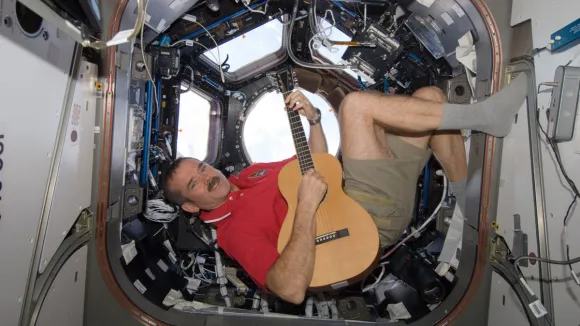
ISS Astronaut, Chris Hadfield, picks out David Bowie’s Space Oddity.
Image credit: NASA
Carberry doesn’t skimp on details, showcasing his matchless research skills.
Near the book’s concluding remarks, the reader will find a nicely explained section on music in “real” space, be it played via harmonicas, guitars, keyboard, flutes, bells, saxophones, even a didgeridoo. Similarly, music in other forms is included, from the Beatles’ song “Across the Universe” broadcast toward the star Polaris to Apollo 17 moonwalkers singing a takeoff of “While Strolling Through the Park.”
I was drawn in by this author comment: “As the pace of real space activities accelerates, it is likely that space-related content will continue. However, the sound of space will also inevitably change,” he writes, “as these stories become less and less the realm of science fiction, and reflect reality.”
The Music of Space is an exceptional treasure on a topic that needed notice – and in chronicling this subject matter, Carberry has struck the right chord.
For more information on this book, go to:

Image credit: Barbara David
Wait a minute!
Is there a possible connection between that ISS battery pallet reentry last month and an object crashing through a person’s ceiling and floor in Florida?
A high-speed cylindrical object reportedly fell through the roof of Alejandro Otero’s home in Naples, Florida last month.

Image credit: WINK News/Inside Outer Space screengrab
According to WINK News – a CBS station in southwest Florida – an apparent human-made cylindrical-shaped object weighing nearly two pounds smashed through the ceiling and tore through the floor of Otero’s house.

Image credit: WINK News/Inside Outer Space screengrab
Otero told WINK News that he thought it could be related to the ISS battery pack reentry.
Final trajectory
According to satellite skywatcher, Marco Langbroek, the time and location indeed matches with the final trajectory for the multi-ton Exposed Pallet 9 (EP9) and its battery stack that reentered the Earth’s atmosphere on March 8.

Image credit: NASA
In reaching out to NASA Kennedy Space Center, space agency spokesperson Joshua Finch told Inside Outer Space: “NASA collected an item in cooperation with the homeowner, and will analyze the object at NASA’s Kennedy Space Center in Florida as soon as possible to determine its origin. More information will be available once the analysis is complete.”
As for when that analysis would be finished, Finch added: “It would be inappropriate to speculate on the timeline for completing the examination. We will provide more information after the object is analyzed.”
Multi-ton leftover
Here’s the overall background regarding that nearly 3-ton leftover tossed overboard from the International Space Station. The multi-ton Exposed Pallet 9 (EP9) was robot-arm jettisoned from the space station back in March 2021.
At the time, it was reported to be the most massive object ever tossed overboard from the International Space Station.
The European Space Agency (ESA) Space Debris and Independent Safety Offices were closely monitoring the reentry of the pallet of used ISS batteries.
The batteries, nine in total, will undergo “a natural reentry” said ESA pre-reentry, predicted between approximately 15:35 CET and 22:25 CET on March 8.
“The total mass of the batteries is estimated at 2.6 metric tonnes, most of which may burn up during the reentry,” the ESA statement adds. “While some parts may reach the ground, the casualty risk – the likelihood of a person being hit – is very low.”
Here’s the original WINK News story: “Object from the sky crashes through Naples family’s ceiling and floor” at:
https://winknews.com/2024/03/15/object-crashes-through-naples-ceiling-floor/
For more details on this incident, check out an excellent story by Stephen Clark of Ars Technica at:

The Asteroid Hunter: A Scientist’s Journey to the Dawn of our Solar System by Dante S. Lauretta; Grand Central Publishing & Hachette Book Group (2024); 336 pages; Hardcover: $30.00
It is not often that a 21st century author is a milestone-making participant that digs billions of years into the past to further the future.
Dante Lauretta is a cosmic “rock hound.” And this book is far from being a tell-all tale of his stellar leadership in the Origins, Spectral Interpretation, Resource Identification, and Security-Regolith Explorer mission, mercifully shortened to OSIRIS-REx.
The Asteroid Hunter is a story of his personal quest in shaping a remarkable scientific career. This very enjoyable, insightful and moving volume is must reading for all that hunger to understand the rough and tumble cosmos at large – along with the delicate nature and audacity of human spirit necessary to tangle with the unknown.
Launched in 2016, OSIRIS-REx reached asteroid Bennu in September 1999, then performed snag, stash, and send-off maneuvers, express delivering those space rock specimens to Earth on Sept. 24, 2023.

Dante Lauretta, OSIRIS-REx’s principal investigator from the University of Arizona holds a mock up of the asteroid collection device – TAGSAM.
Image credit: Barbara David
OSIRIS-REx released its capsule of extraterrestrial goodies over Earth’s atmosphere. That container then parachuted into the Department of Defense’s Utah Test and Training Range as the OSIRIS-REx team – and the author — was on location to welcome it home.
That voyage to asteroid Bennu and back to our planet took seven years. OSIRIS-REx was the first U.S. mission to collect a sample from an asteroid and deliver it to Earth. And that space trek alone – proposing, building, and flying the craft — is a tale in itself.
Starting in 2011, Lauretta served as the principal investigator for OSIRIS-REx asteroid sample return mission. But he offers so much more in this well-written, cleaver and personal prose of a story.
A reader will find his professional and personal memoir instructive. Indeed, as Lauretta notes “the universe is our classroom, our laboratory, our muse” and that “our journey of exploration has only just begun.”
For more information on this remarkable book, go to:
BTW: go to the Amazon offerings to hear the author read a section of the book at:
https://www.amazon.com/Asteroid-Hunter-Scientists-Journey-System/dp/1538722941

Curiosity Left B Navigation Camera image taken on Sol 4142, March 31, 2024.
Image credit: NASA/JPL-Caltech
NASA’s Curiosity Mars rover at Gale Crater is now performing Sol 4143 duties.
Lauren Edgar, a planetary geologist at the USGS Astrogeology Science Center in Flagstaff, Arizona, reports that the rover is approaching an intriguing pile of rocks called “Hinman Col” – a poorly sorted collection of clasts located along the margin of Gediz Vallis ridge.

Curiosity Front Hazard Avoidance Camera Left B image acquired on Sol 4142, March 31, 2024.
Image credit: NASA/JPL-Caltech
Mars researchers were anticipating a closer look at this deposit over the recent weekend, to set up for contact science on the different rock types this week.
“In doing so, we hope to investigate where the different clasts might have come from and how this feature (which looks like a bit of a mess!) relates to the rest of Gediz Vallis ridge,” Edgar adds.

Curiosity Chemistry & Camera (ChemCam) Remote Micro-Imager (RMI) photo taken on Sol 4142, March 31, 2024.
Image credit: NASA/JPL-Caltech/LANL
A clast is a fragment of geological debris: chunks, and smaller grains of rock broken off other rocks by physical weathering.

Curiosity Left B Navigation Camera image taken on Sol 4142, March 31, 2024.
Image credit: NASA/JPL-Caltech
Bedrock science
A recently plotted out plan for Sols 4141-4143 is focused on contact science on the bedrock in the robot’s workspace, remote sensing to understand the rover’s surroundings, and a short bump to prepare for contact science at Hinman Col this week.

Curiosity Left B Navigation Camera image taken on Sol 4142, March 31, 2024.
Image credit: NASA/JPL-Caltech
“Before we get to Hinman Col, we have another opportunity to assess the light-toned, laminated bedrock in our workspace,” Edgar points out.
The science team planned three contact science targets, including use of the Dust Removal Tool (DRT), THE Mars Hand Lens Imager (MAHLI), and the Alpha Particle X-Ray Spectrometer (APXS) on the target “Rose Lake” to assess the chemistry and textures in typical bedrock.

Curiosity Left B Navigation Camera image taken on Sol 4142, March 31, 2024.
Image credit: NASA/JPL-Caltech

Curiosity Left B Navigation Camera image taken on Sol 4142, March 31, 2024.
Image credit: NASA/JPL-Caltech

Curiosity Left B Navigation Camera image taken on Sol 4142, March 31, 2024.
Image credit: NASA/JPL-Caltech

Curiosity Left B Navigation Camera image taken on Sol 4142, March 31, 2024.
Image credit: NASA/JPL-Caltech
“We also planned a MAHLI stereo mosaic on ‘Whorl Mountain’ to model the rock surface and study bedding orientations around some disrupted laminations,” Edgar added, “and another MAHLI/APXS target called “Little Slide Canyon” to investigate the texture and composition of the more convoluted bedding.”
Layering and clast configuration
Curiosity’s geology theme group also planned Chemistry and Camera (ChemCam) Laser Induced Breakdown Spectroscopy (LIBS) on two bedrock targets, “Robinson Lake” and “Ward Mountain.”
That robot task would characterize rougher and smoother parts of the local bedrock.
ChemCam will also be used to acquire long distance Remote Micro-Imager (RMI) mosaics to assess parts of upper Gediz Vallis Ridge at the location known as “Fascination Turret.”
Meanwhile Mastcam will be busy documenting the ChemCam targets, Edgar continues, and acquiring mosaics to assess layering and clast configuration in the vertical face of “Fascination Turret.”
Short drive
“Then Curiosity will take a very short drive to get into just the right position in front of Hinman Col, hopefully with a variety of rocks in the workspace. After the drive we’ll take some post-drive imaging to prepare for future targeting,” Edgar reports.

Curiosity Left B Navigation Camera image taken on Sol 4142, March 31, 2024.
Image credit: NASA/JPL-Caltech
The third sol (4143) includes an untargeted science block, so the team planned an Autonomous Exploration for Gathering Increased Science (AGEIS) session – a software suite that permits the rover to autonomously detect and prioritize targets.
AEGIS activity will add to the bedrock survey of compositional variations.
“Throughout the plan, the Environmental theme group planned a lot of great monitoring activities to search for dust devils and clouds, assess atmospheric opacity, and monitor the movement of fines on the rover deck,” Edgar concludes. “Looking forward to learning more about this messy pile of rocks and unraveling the clues that they might record about their emplacement!”

