Archive for April, 2024
 Author:
  April 14th, 2024
Image credit: CCTV via China ‘N Asia Spaceflight
China’s reusable rocket engine research is engaged in multiple challenges, including use of various, on the factory floor, manufacturing processes.
Chinese engineers have overcome various technical difficulties in developing an engine for reusable rockets, which recently underwent its 30th ignition test.
Developing a reusable engine can make a rocket land accurately, be more durable and easier to repair, China Central Television (CCTV) reports.
CCTV reports that another major problem faced by the research team is what kind of materials can be utilized and how to control the manufacturing process to produce an engine with high technical standards and reliable quality.

Song Yaqing, 11th Institute, Academy of Aerospace Propulsion Technology, China Aerospace Science and Technology Corporation (CASC).
Multiple ignitions
“First of all, it [the engine] has to be used for a long time or for multiple ignitions,” explains Song Yaqing, 11th Institute, Academy of Aerospace Propulsion Technology, China Aerospace Science and Technology Corporation (CASC).
Song told CCTV that the most important thing is identifying the lifespan of every component and the entire machine after extremely accurate adjustment, which cannot be simulated. “The only way is to have constant test runs.”

Liu Chaofeng, senior engineer, Xi’an Aerospace Engine Company, Academy of Aerospace Propulsion Technology at CASC.
Repeatability, durability and reliability
Rocket engine production was spotlighted by Liu Chaofeng, senior engineer, Xi’an Aerospace Engine Company, Academy of Aerospace Propulsion Technology at CASC.
“Focusing on the requirement of technical indicators including repeatability, durability and reliability of the reusable engine, we have tackled a series of key issues and carried out a series of research projects,” Liu told CCTV.
“There were nearly 70 major research projects, which have greatly improved the technological level and stability of our engine’s manufacturing process, and ensured the consistency and reliability of our products’ quality,” Liu added.

Zhou Xianqi, a researcher with the Sixth Academy of CASC.
Image credit: CCTV/Inside Outer Space screengrab
Liquid oxygen-kerosene engine
Zhou Xianqi, a researcher with the Sixth Academy of the CASC reports that China successfully completed two consecutive ignition tests of the 130-ton reusable liquid oxygen-kerosene engine last Friday, laying a foundation for the maiden flight of reusable carrier rockets.
“The key characteristic of the reusable engine is safe and reliable, which can meet relevant requirements. We ran so many tests mainly to find out the state of the engine in these tests,” Zhou told CCTV.
The engine with multiple-start capability, CCTV reports, was developed on the basis of the existing high-thrust liquid oxygen and kerosene engine. It can increase the thrust while reducing its weight and “rocket space occupation,” thus making reusable rockets possible.

Image credit: CCTV via China ‘N Asia Spaceflight
 Posted in

This illustration shows a concept for multiple robots that would team up to ferry to Earth samples collected from the Mars surface.
Image credit: NASA/JPL-Caltech
NASA is set to offer its response to that hard-hitting report issued last September by the Mars Sample Return Independent Review Board, including the rolling out of next steps for the program.
This Monday, NASA will share the agency’s recommendations regarding a path forward for the costly Mars Sample Return initiative, but within a balanced overall science program.
Indeed, such an enterprise has long been a major goal of international planetary exploration for the past two decades.
But the concept of snag, bag, and hurling samples from Mars back to Earth has also been met with controversy in some quarters; for one, the specter of Andromeda Strain and putting the Earth’s biosphere in jeopardy by ecologically-hungry martian microbes continues to be a topic of concern.

The Andromeda Strain – the 1971 movie, but how real for a 21st century return to Earth of Mars samples?
Image credit: Universal Pictures
Space bugs
“Is the U.S. ready for extraterrestrials? Not if they’re microbes. How to defend Earth from space bugs” is an opinion piece posted April 11 by the Houston Chronicle.
Under the rubric of the Bipartisan Commission on Biodefense, former Democratic Congresswoman Donna Shalala and Susan Brooks, a former U.S. Attorney and Republican Congresswoman. Together they serve on the Bipartisan Commission on Biodefense.
Donna Shalala served as Secretary for Health and Human Services in the Clinton Administration. Brooks served parts of Indiana.
The Bipartisan Commission on Biodefense is a privately funded entity established in 2014, set up to evaluate the status of U.S. biodefense efforts and issues recommendations to produce meaningful change.
Image credit: Bipartisan Commission on Biodefense
Unforeseen dangers
“Space exploration provides some of the greatest challenges and opportunities of our time. But as we venture further into the unknown, we also expose ourselves to new and previously unforeseen dangers,” Shalala and Brooks write.
While many debate the possibility of advanced, intelligent life elsewhere, few consider the probability of non-intelligent alien microorganisms. These life forms could exist on other planets or moons, hitchhike on spacecraft, or move through the universe in the asteroids they inhabit. They could also be Earth microbes that mutate or evolve in response to the stress of spaceflight, becoming more virulent, resistant, or invasive. Either would seriously threaten the public health, safety, and security of humans, animals, and plants operating in space or living on Earth,” they note.
Labeling it “Astrobiodefense,” as they term it, is an expression anchored in the defense against biological threats in space and on Earth that result from space exploration.
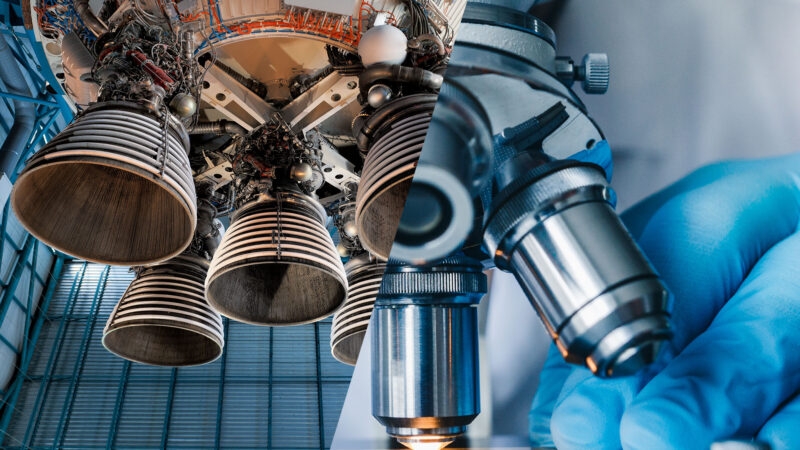
Image credit: Bipartisan Commission on Biodefense
Neither hypothetical nor fictional
There are two goals, Shalala and Brooks point out: to prevent the contamination of extraterrestrial environments with Earth organisms; and to prevent extraterrestrial or mutated terrestrial microbes from harming Earth’s inhabitants.
“As fantastical as it may sound, astrobiodefense is neither hypothetical nor fictional,” they observe, calling for urgent attention and action.
“For the United States, NASA has already started programs to prevent forward and backward contamination, ensure the health and safety of astronauts, and identify and control biological hazards. The FAA [Federal Aviation Administration] is also responsible for monitoring the payloads of commercial spaceflight and how they might affect public health.”
But now, they write, given more missions into space, the potential dangers are mounting.
Wanted: coordination and collaboration
“Recent missions, for example, brought specimens back from asteroid Bennu and aimed to drop human remains on the Moon. We need to do more and soon,” they add.
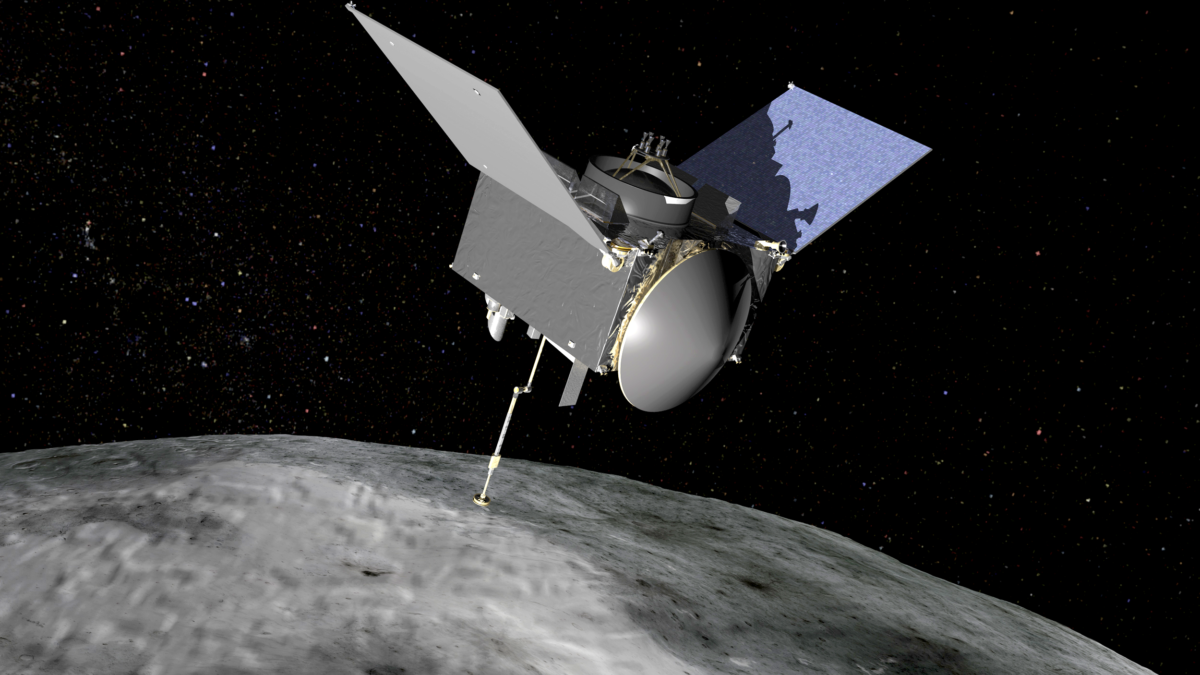
Artwork shows OSIRIS-REx spacecraft at asteroid Bennu.
Image credit: NASA/University of Arizona
Shalala and Brooks state that the U.S. needs to invest in research and development of new technologies and medical countermeasures to detect, diagnose, treat, and prevent diseases in space and on Earth.
Furthermore, there is need to enhance our bio-surveillance and symptom monitoring to track and analyze space-related biological threats in real time.
“We need to strengthen our coordination and collaboration between agencies and partners, both nationally and internationally,” they continue, “to share information and resources without compromising the kinds of competition that result in scientific advances and economic gains.”

Image credit: ESA/Hubble & NASA
Perils of the unknown
Additionally, they observe, there is need for more than modest, and fluctuating, budgets, a wing, and a prayer. “More policymakers and decision-makers in Washington need to understand the importance and benefits of astrobiodefense in particular and the space program in general.”
In closing, Brooks and Shalala state in our pursuit of promise, “we have a duty to protect ourselves and our planet from the perils of the unknown, and to preserve and respect the integrity and diversity of life in the universe.”
By investing in and strengthening astrobiodefense, they conclude, “we can ensure that our quest for discovery does not jeopardize our security and survival. Let’s get ahead of this problem, before we are ‘go’ to launch.”
For more information, visit the Bipartisan Commission on Biodefense website at:
https://biodefensecommission.org/
To read the op-ed in its entirety, go to:

Wait a minute!
Image credit: Barbara David
Suspected Space-Junk Strike in Florida Signals New Era of Orbital Debris – Three years ago astronauts threw out the largest piece of trash ever tossed from the International Space Station. Now some of it seems to have punched a hole through a house in Naples, Fla.
BY LEONARD DAVID in Scientific American.
A pallet of batteries discarded in low-Earth orbit from the International Space Station.
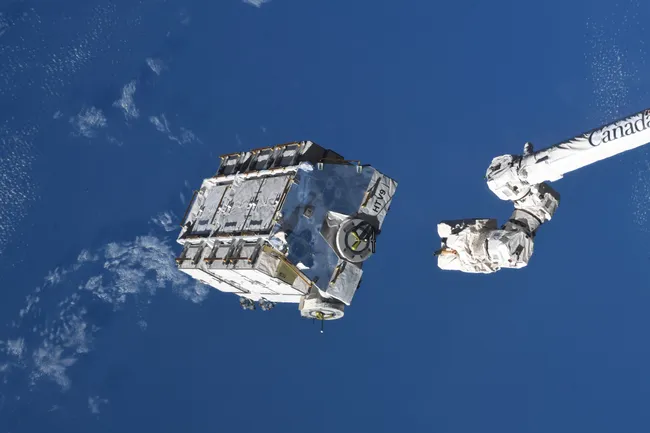
Catch and release. ISS robot arm is used for grabbing and letting lose space hardware.
Image credit: NASA
A heavy pallet filled with tons of spent nickel-hydrogen batteries drifts above the Earth in March 2021, shortly after being discarded from the International Space Station. A nearly two-pound metallic cylinder that recently struck a house in Florida may be debris from the pallet’s uncontrolled atmospheric reentry.

Taking out the trash. Multi-ton pallet tossed off years ago returns to Earth.
Image credit: NASA/Mike Hopkins
Space Exploration
In what may be judged as a bizarre and twisted case of “breaking and entering,” last month a plummeting cylindrical object weighing nearly two pounds hit the roof of Alejandro Otero’s home in Naples, Fla., smashed through a ceiling and punched through a floor.
Although yet to be officially verified as such, the most likely explanation for this high-speed home invader appears to be that it’s a piece of space junk cast off from the International Space Station (ISS) in low-Earth orbit. As the latest close encounter with clutter from the cosmos, the space junk strike has already sparked technical and legal banter about the worrisome escalation of Earth-circling, human-made refuse.
As the saying goes, timing is everything. This event appears to have been years in the making, however.

Image credit: WINK News/Inside Outer Space screengrab
TAKING OUT THE TRASH
Back in March 2021 astronauts onboard the ISS used a Canada-supplied robotic arm to tip an abnormally hefty hunk of refuse into space—the heaviest object ever jettisoned from the space station, in fact. NASA explained at the time that the trash, called Exposed Pallet 9 (EP9), had the approximate mass of a large SUV “and is safely moving away from the station and will orbit Earth between two to four years before burning up harmlessly in the atmosphere.”

Image credit: WINK News/Inside Outer Space screengrab
After being ferried to the ISS via a Japanese cargo ship the previous year, EP9 had been filled with 5,800 pounds of spent nickel-hydrogen batteries. But a series of logistical complications—chief among them the fact that the battery pallet could only fit in Japan’s cargo ships, of which there were no more to fly—left EP9 stranded, taking up precious space on the ISS. So NASA decided to throw it overboard. After a few years of drifting aimlessly through space, EP9 finally met its fiery fate on March 8 when its decaying orbit sent it nose-diving into Earth’s atmosphere over the Gulf of Mexico.

Image credit:
EU Space Surveillance and Tracking (SST)
The European Space Agency’s Space Debris and Independent Safety Offices closely monitored the reentry of the pallet of used ISS batteries. These batteries were to undergo “a natural reentry,” said ESA in a pre-reentry communiqué, using a twist on the term for an uncontrolled plunge from space.
“The total mass of the batteries is estimated at 2.6 metric tonnes, most of which may burn up during the reentry,” ESA stated. “While some parts may reach the ground, the casualty risk—the likelihood of a person being hit—is very low.”

During the uncontrolled fall of space hardware, seconds and minutes count. They can add up to de-orbiting riff raff plunging into isolated ocean waters or reaching land.
(Image credit: The Aerospace Corporation/Center for Space Policy and Strategy)
A SERIOUS CANDIDATE
Marco Langbroek, a devoted satellite tracker and a faculty member in aerospace engineering at the Delft University of Technology in the Netherlands, says it certainly does look possible that the object in Florida stems from the reentry of the EP9 battery pack.
Langbroek has reviewed EP9’s ground track as well as the reported timing and trajectory of its reentry. Handily, there’s also a time-stamped security video and sound clip of the object that pierced the homeowner’s roof.
After entering the atmosphere and losing much of its speed, the debris piece probably spent a couple of minutes in subsonic free fall, Langbroek says.
“Reentries take multiple minutes, with the object fragmenting and the reentering fragments spreading along the trajectory over a stretch that can be hundreds of miles long,” he adds. “Given the force of impact, I think this is a serious candidate for potential debris from this [EP9] reentry. It might well be a part of one of the nickel-hydrogen battery cells.”

Image credit: The Aerospace Corporation
There’s not much guesswork here, says Tobias Lips, managing director of satellite aerodynamics company Hyperschall Technologie Göttingen in Germany. As a specialist in reentry analysis, he robustly simulated the fall of the ISS pallet of batteries days before the actual event occurred using “moderately conservative” rather than “worst-case” assumptions. Even so, his results suggested more than 130 fragments would survive to reach the surface. That’s “about 10 times more than for a typical reentry object of this size and mass,” he says.
Most of those predicted fragments, Lips says, would be cylinders made of Inconel—a high-strength nickel-chromium superalloy often used in aerospace applications. Nearly 350 such cylinders were in the EP9 pallet’s payload of spent batteries, where they served as power cells. “The fragment found in Naples, Florida, is most likely one of these cylinders,” Lips says.
“The recovered fragment was reported to be about two pounds in weight. Thirty-eight percent of my [simulation’s] surviving fragments are within this mass class,” he explains. “I would be very surprised if investigations of this fragment don’t confirm it being a battery cell from the ISS.”

Space debris plunges to Earth, burning its way through the atmosphere.
Image credit: The Aerospace Corporation
ONGOING ANALYSIS
Whatever it is, the Florida object in question was handed over to NASA’s neighboring Kennedy Space Center. NASA spokesperson Joshua Finch tells Scientific American that in cooperation with Otero, the agency collected the item for deeper study to determine its origin. “More information will be available once the analysis is complete,” Finch says.
NASA’s analysis will likely begin with a rigorous examination of the object’s trajectory—as well as that of EP9—tracked against the locations of any other recovered debris, says Mike Weaver, a space debris expert at the Aerospace Corporation.
“In this case, the location of the object in Naples, Florida, appears to be consistent with the timing and the location of the ISS battery pallet reentry,” Weaver says. “However, this is not sufficient to positively identify an object.”
Alongside the trajectory work, scrutinizing the candidate chunk of space junk for signs of scorching, melting and other effects of reentry heating would be desirable, Weaver says. Metallurgical analysis to determine its composition could be useful as well.
Sometimes serial numbers or part numbers can be found on an object, Weaver notes, which would rapidly simplify things.

Launch and reentry particle emissions in the Earth’s stratosphere.
Image credit: The Aerospace Corporation
WHAT GOES UP MUST COME DOWN
Threats from incoming orbital rubbish are real and set to grow, says Darren McKnight, a senior technical fellow at LeoLabs, a commercial provider of space domain awareness services, based in Menlo Park, Calif. As more space systems are deployed in low-Earth orbit, the old adage applies: what goes up must come down.
The vexing nub of the problem is that removing ever proliferating small pieces of orbital debris is vital for maintaining a safe space environment—and uncontrolled atmospheric reentry is by far the easiest way to do it. In fact, this happens automatically for objects in low-Earth orbit, which begin to fall as they bleed off momentum against the outer edges of our planet’s atmosphere. Yet the hands-off nature of this process means any sizable piece of unguided debris has a large swath of the planet upon which it or its fragments might fall, potentially constituting a low but real risk to multiple aviation corridors and population centers.
“The issue of aviation and ground hazard from space operations is a problem that will not go away any time soon,” McKnight says.

Signing of the Outer Space Treaty. Soviet Ambassador Anatoly F. Dobrynin,
UK Ambassador Sir Patrick Dean, US Ambassador Arthur J. Goldberg, US President
Lyndon B. Johnson and others observe as US Secretary of State Dean Rusk signs the
Outer Space Treaty on January 27, 1967 in Washington, DC
Source: UNOOSA.
LEGAL LIABILITY
If the downed debris in question is confirmed as coming from the ISS, a dialogue about liability would likely begin, says Joanne Gabrynowicz, a professor emerita of space law at the University of Mississippi and editor in chief emerita of the Journal of Space Law.
Some of the provisions of the United Nations Outer Space Treaty and its Convention on International Liability for Damage Caused by Space Objects, as well as the ISS International Governmental Agreement (IGA), could be relevant, Gabrynowicz says.
An analysis of various provisions in these sources and how they interrelate would probably be necessary, Gabrynowicz says, including Article II of the U.N.’s Liability Convention. Article II states that any country launching anything into space shall be responsible for damage any associated space objects may cause back on Earth’s surface.
In the case of an object striking a house, the launching nation would, at minimum, be liable for funding requisite structural repairs. Gabrynowicz adds, however, that while this protocol is simple in principle, its translation to reality can become extremely complex. Things get murky, for instance, if the errant object that struck Otero’s house is proved to be part of the spent batteries from EP9’s reentry: the batteries are NASA’s property, but they were attached to EP9—a payload launched by the Japan Aerospace Exploration Agency (JAXA).
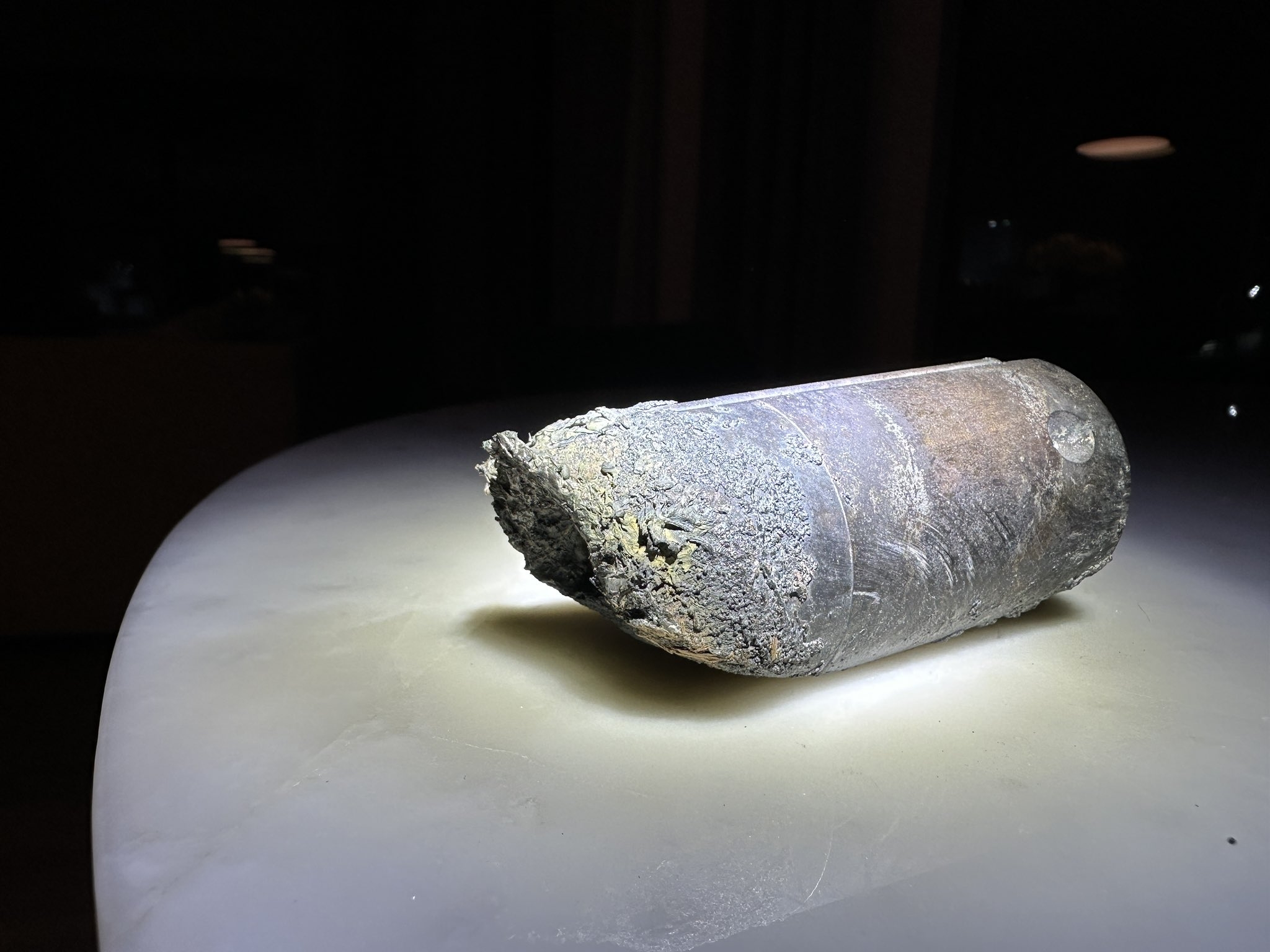
A Naples, Florida home reported possible space junk damage.
Image credits: Alejandro Otero postings on X
“That could be complicated, requiring analysis of various contracts, treaties, insurance policies and the IGA. Of course, the entities involved can also agree as to how to resolve the situation,” Gabrynowicz concludes.
AN ACT OF ABANDONMENT
“NASA will want to minimize this by saying chucking stuff off the ISS is rare and this isn’t a satellite or rocket body … and therefore is disconnected to increasing launch rates,” says Ewan Wright, a Ph.D. candidate at the University of British Columbia and a junior fellow of the Outer Space Institute.
“But clearly there is an issue here that uncontrolled reentries are fairly accepted, and nobody thought to look into it much further,” Wright says. One reason for laxity, he notes, is that the risks from uncontrolled space debris reentry are literally and figuratively dumped in the ocean, which covers most of Earth’s surface. But treating Earth’s seas as a space junkyard is unlikely to be sustainable forever.
“There are over 50,000 ships in the ocean at any given time and hundreds of thousands of smaller boats. The chance of a ship being hit by space debris is likely to be small, but it’s growing, and we don’t know the number for sure,” Wright says. “A cruise ship being hit by uncontrolled space debris may not kill someone, but it would raise serious questions about our continued abandonment of space debris in orbit. And the launching state would be liable to pay damages.”

Taking the fall. Space hardware dives into Earth’s atmosphere with some fragments making their way to the ground.
Image credit: ESA/D.Ducros
Many aerospace companies employ an ethos of “design for demise” for their space-bound components to try to ensure that if the parts do reenter, they reliably burn up at high altitude. Yet even leaving aside growing concerns about the resulting contamination of Earth’s upper atmosphere with heavy metals and other pollutants, some experts consider the practice ill-advised at best.
Moriba Jah, an expert in space debris tracking and management at the University of Texas at Austin and a co-founder and chief scientist at Privateer Space, a group focused on space sustainability issues headquartered on the island of Maui in Hawaii, is one such critic.
Jah emphasizes that discarding our detritus in low-Earth orbit in hopes that this material will “naturally reenter” the atmosphere “is not a responsible disposal method but rather an act of abandonment.” Even if not legally classified as such, uncontrolled reentry “is inherently irresponsible due to the potential risks it poses to life and property on Earth,” Jah says.

Credit: NASA
In some sense, the unlikely intersection of a probable piece of orbital debris with a home could ultimately prove to be a good thing: it could provide another wake-up call to policymakers, major aerospace players and the public at large that when it comes to space junk in low-Earth orbit, the sky really is falling.
LEONARD DAVID is author of Moon Rush: The New Space Race (National Geographic, 2019) and Mars: Our Future on the Red Planet (National Geographic, 2016). He has been reporting on the space industry for more than five decades.

Image credit: JPL/Caltech
The Jet Propulsion Laboratory in Pasadena, California is home base for building pioneering spacecraft that have probed every planet in our solar system, including the Sun.
Federally funded by NASA and managed by Caltech, JPL and its cadre of engineers and scientists are being led by Laurie Leshin, the first woman to serve as JPL director, taking on that role in May 2022.
Leshin’s career path prior to running JPL draws from her work as a leading geochemist and space scientist, along with stints in academia and government, including holding senior NASA positions.
Now the helmswoman at JPL, Leshin points to space technology achievements, but has also been plagued by program setbacks and beleaguered by space budget woes, heightened by the cost-overrun, mega-dollar needs of the distressed JPL-led Mars Sample Return project.

Credit: JPL/Caltech
Budget uncertainty and shortfalls
In adjusting to NASA budgetary uncertainty and shortfalls, Leshin announced last February a JPL workforce reduction through layoffs. “It was very difficult and painful from a human perspective,” she said, “among the largest layoffs that we’ve ever had.”
For my SpaceNews interview with Leshin, go to – “JPL chief Laurie Leshin on science, Mars and budget infighting” – at:
https://spacenews.com/jpl-chief-laurie-leshin-science-mars-budget-infighting/

Pre-launch photo of lunar relay satellite.
Image credit: CCTV/CNSA/Inside Outer Space screengrab
The China National Space Administration (CNSA) announced on Friday the Queqiao-2 completed a communication test on April 6, linking up with the already on the Moon Chang’e-4 far side lander/rover hardware.

Image credit: CCTV/Inside Outer Space screengrab
Additionally, the new relay spacecraft communicated with the Chang’e-6 lunar probe still here on Earth and expected to be launched next month. This far side lander — in a historic first if successful – is built to snag, bag and rocket back to Earth select lunar specimens, similar in technological scope of the Chang’e-5 Moon sampler mission.
Meanwhile, two communication and navigation technology test satellites, Tiandu-1 and Tiandu-2, also completed near-moon braking and entered their respective circumlunar orbits.

Tiandu-1 and Tiandu-2 subsatellites are to trial-run lunar communications technology.
Image credit: DSEL
Long life span
“The success of the Qiaoqiao-2 mission means it can provide relay communication services for more probes to be launched for lunar surface exploration missions,” Xiong Liang, one of the developers for Queqiao-2 satellite, told China Central Television (CCTV).
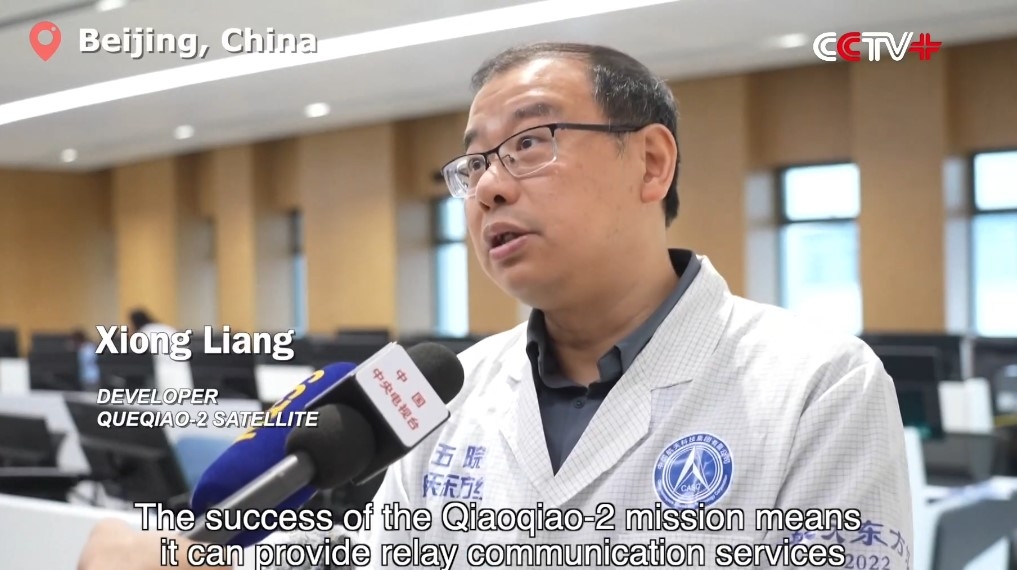
Image credit: CCTV/Inside Outer Space screengrab
China’s Queqiao-2, weighs about 1.2 tons and is in a highly elliptical orbit to perform Earth-Moon communications tasks. Queqiao-2 was launched on March 20, and then entered its target highly elliptical orbit on April 2 after midway correction, near-Moon braking and orbital maneuvering around the Moon.
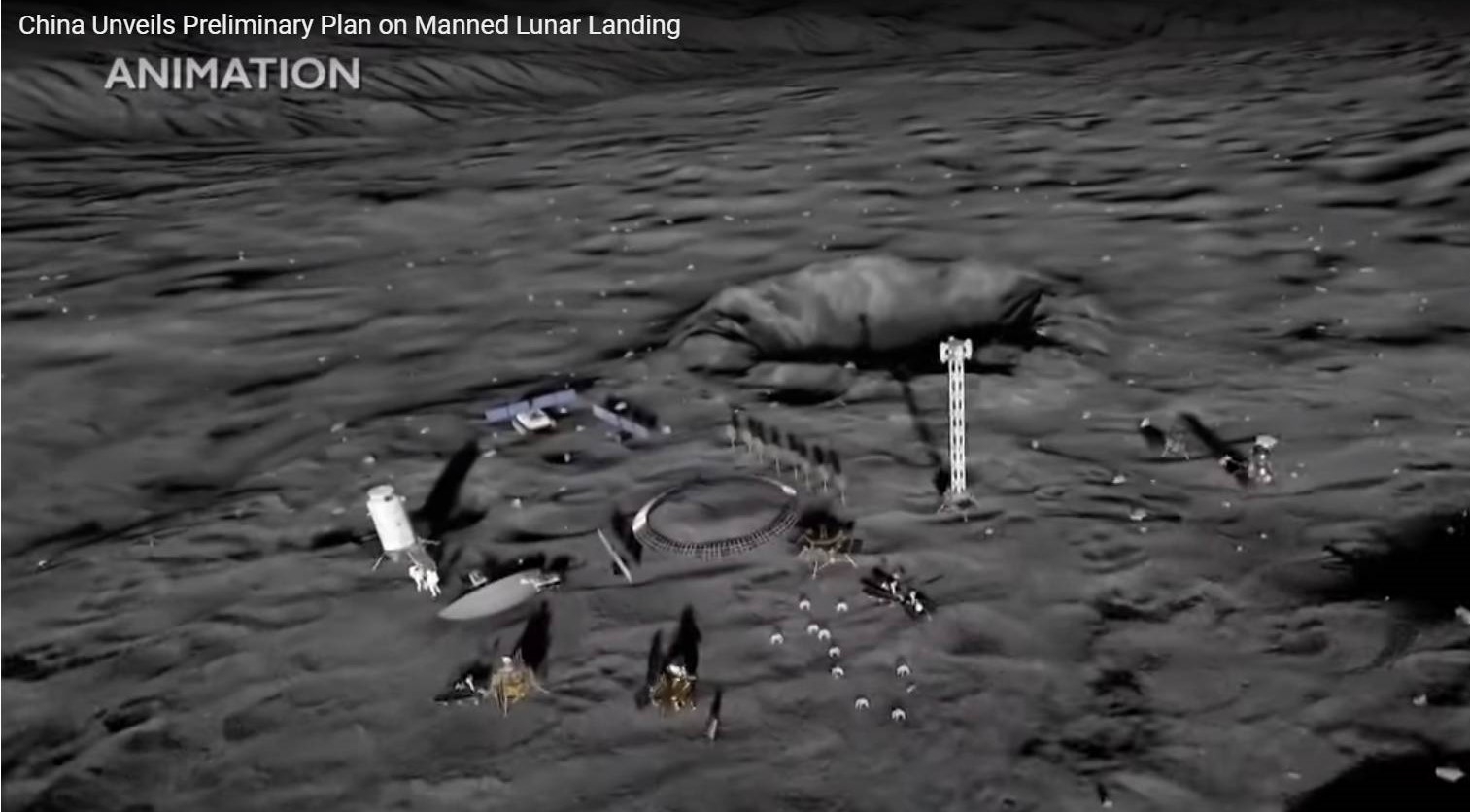
Artist’s view of International Lunar Research Station to be completed by 2035. Credit: CNSA
“Considering its long-term space mission, Queqiao-2 is designed with a long life span of eight years in order to complete all its missions,” Zhang Kuang, an engineer with the Beijing Aerospace Flight Control Center, told CCTV.
The Chang’e-6 is expected to be launched in the first half of 2024, reports CCTV.
China’s Chang’e-7 is to head moonward around 2026, with Chang’e-8 to be launched in a projected 2028 time period. These back-to-back Moon explorers signal the start up of orchestrating China’s lunar research station activities.
Go to this informative video at:
https://www.facebook.com/NewsContent.CCTVPLUS/videos/976621627182476/

Image credit: CNSA/CCTV/Inside Outer Space Screengrab
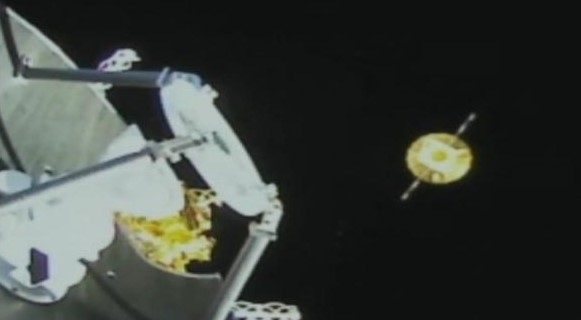
China’s Queqiao-2, or Magpie Bridge-2, is released from a Long March 8 carrier rocket.
Image credit: CNSA

Early image captured on April 8 by Tiandu-2, an experimental satellite launched on Queqiao-2 mission.
Image credit: CNSA
Catch and release. ISS robot arm is used for grabbing and letting lose space hardware.
Image credit: NASA
In what may be judged as a bizarre and twisted case of “assault and battery,” a high-speed cylindrical object weighing nearly two pounds hit the roof of Alejandro Otero’s home last month in Naples, Florida, smashing through a ceiling and punching through a floor.
There is speculative finger-pointing going on as to origin of the high-speed intruder, a straight up verdict that, yes, it came from outer space – and in the form of space junk.
The still-to-be-verified close encounter with clutter from the cosmos has already sparked technical and legal banter about the worrisome escalation of Earth-circling, human-made leftovers.
During the uncontrolled fall of space hardware, seconds and minutes count. They can add up to de-orbiting riff raff plunging into isolated ocean waters or reaching land.
(Image credit: The Aerospace Corporation/Center for Space Policy and Strategy)
As the saying goes, timing-is-everything. However, this event appears to be years in the making.
Go to my new Scientific American story – “Suspected Space-Junk Strike in Florida Signals New Era of Orbital Debris – Three years ago astronauts threw out the largest piece of trash ever tossed from the International Space Station. Now some of it seems to have punched a hole through a house in Naples, Fla. – at:

Image credit: Reflect Orbital
There’s a new space startup under the Sun. And what Reflect Orbital wants to do is cast some of that sunshine to customers.
The group’s ambitions have been in the dark for a bit, but the leader of the idea has been posting on X some tantalizing updates.
They are developing a constellation of specialized satellites to sell sunlight to thousands of solar farms after dark.

Image credit: Reflect Orbital
“We think sunlight is the new oil and space is ready to support energy infrastructure,” explains Ben Nowack, CEO of the company.
On-Earth airborne test
According to their website, Nowack led automated hardware projects for validating Crew Dragon propulsion components at SpaceX. He then worked as senior engineer at Park and Diamond, Director of Engineering at Tri-D Dynamics, and led launcher design at Zipline.

Image credit: Reflect Orbital
“By precisely reflecting sunlight that is endlessly available in space to specific targets on the ground, we can create a world where sunlight powers solar farms for longer than just daytime, and in doing this, commoditize sunlight,” Nowack adds.

Image credit: Reflect Orbital
On August 31st, 2023, Reflect Orbital completed its final on-Earth testing of the idea.
“This airborne test was the last piece needed before we launch above the atmosphere,” Nowack notes. “We are currently designing our first satellite.”
Their goal: “Sunlight after dark…Providing the Earth’s primary source of energy on demand.”
Go to the Reflect Orbital website at: https://www.reflectorbital.com/
Also, check out this informative video at: https://twitter.com/i/status/1767961251186163857

Reflect on this logo for the group.
Image credit: Reflect Orbital

SpaceX/Inside Outer Space screengrab
Join SpaceX top rocketeer, Elon Musk, in his quest to make life multiplanetary…and why.
“The goal of SpaceX is to build the technologies necessary to make life multiplanetary. This is the first time in the 4-billion-year history of Earth that it’s possible to realize that goal and protect the light of consciousness,” a SpaceX posting notes.
At Starbase in Texas on Thursday, April 4, SpaceX Chief Engineer Elon Musk provided an update on the company’s plans to send humanity to Mars, the best destination to begin making life multiplanetary.

SpaceX/Inside Outer Space screengrab
Onward to Mars
“All of SpaceX’s current programs, including Falcon, Dragon, Starlink, and Starship are integral to developing the technologies necessary to make missions to Mars a reality,” the posting adds.
The update includes near-term priorities for Starship. “With more flight tests, significant vehicle upgrades, and missions returning astronauts to the surface of the Moon with NASA’s Artemis Program all coming soon, excitement will continue to be guaranteed with Starship,” the posting continues.

SpaceX/Inside Outer Space screengrab
Musk’s talk also includes the mechanics and challenges of traveling to Mars, making it a long-term, Earth-like planet, along with what is building today to enable sending around a million people and several million tonnes to the Martian surface in the years to come.
For this provocative talk by Musk, go to:
https://www.spacex.com/updates/#make-life-multiplanetary


Image credit: SpaceX/Inside Outer Space

Image credit: SpaceX/Inside Outer Space

Intuitive Machines’ Nova-C lander undergoes testing. It is a NASA Commercial Lunar Payload Services mission.
Image credit: Intuitive Machines
A new video captures the flight to the lunar south pole region of Odysseus, the commercial Intuitive Machines Moon lander.
Launched on February 15, 2024, this NASA-backed IM-1 lander via the space agency’s Commercial Lunar Payload Services (CLPS) initiative touched down on February 22 near the Malapert-A crater area 190 miles (300 kilometers) from the lunar south pole.
Odysseus became the first American spacecraft Moon landing since the Apollo 17 mission in December 1972.

Image from International Lunar Observatory Association’s ILO-X wide field-of-view imager taken on February 22, 2024 about 4.2 minutes prior to Odysseus touchdown. It shows craters in the Moon’s south pole region as well as the IM-1 Odysseus lunar lander.
Image credit: ILOA Hawai’i
Odysseus made a troubled landing, compromising radio communications with the craft.
High-level mission objectives were obtained: touching down softly and safely, as well as returning scientific data to customers, said Steve Altemus, chief executive of Intuitive Machines. “Both of those objectives are met, so in our mind this is an unqualified success.”

Rough and tumble landing of Odysseus Moon lander, damaging its landing gear in the process.
Image credit: Intuitive Machines
Scrappy little dude
In a post-landing IM-1 status report, Sue Lederer, CLPS project scientist at NASA’s Johnson Space Center said the bottom line was that every payload “met some level of their objectives,” labeling Odysseus “a scrappy little dude.”
About a month after Odysseus landed on the Moon, Intuitive Machines reported that they could not re-establish contact with the lander given the brutal, super-chilly 14-day lunar night, a situation that the vehicle was not designed for, thus bringing an end to the IM-1 mission.

Image credit: Intuitive Machines
“Our official IM-1 mission ended on February 29th, as Odie was not designed to survive the Moon’s harsh temperatures without sunlight. While we wait for the possibility of hearing from Odie once the sun shines on the solar panels prior to the end of the month, watch our mission recap below, which includes a heartfelt farewell from Mission Director @astro2fish, commemorating the lander’s groundbreaking voyage and the wealth of knowledge delivered from the lunar surface.”
Go to the Intuitive Machines video at:
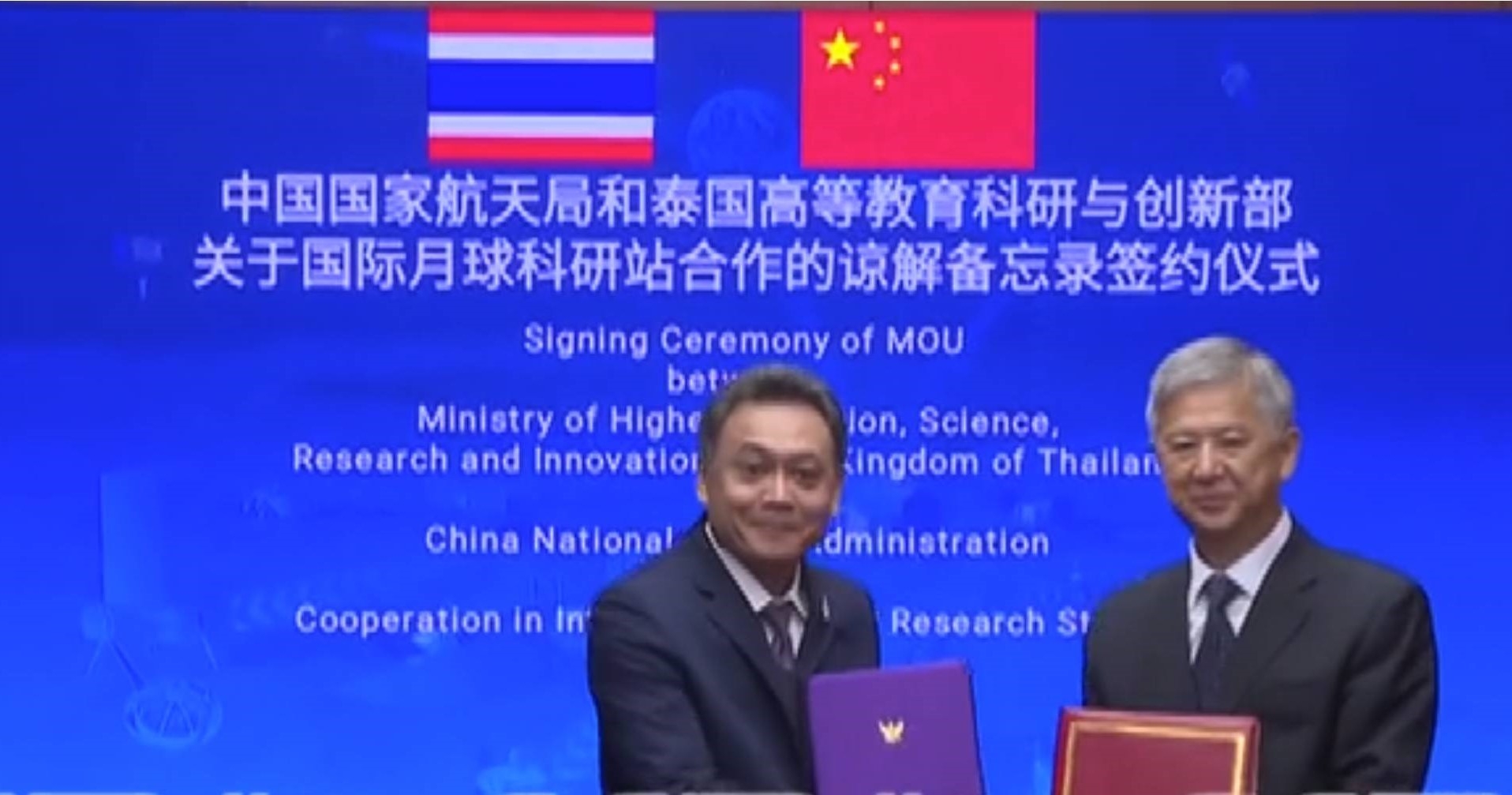
Image credit: CCTV/Inside Outer Space screengrab
A cooperative step in planting China’s international lunar research stations on the Moon now includes China and Thailand.
The China National Space Administration (CNSA) and the Thai Ministry of Higher Education, Science, Research and Innovation on Friday inked memorandums of understanding on Friday to carry out cooperation on space exploration, especially in lunar research.
China Central Television (CCTV) reports that the two countries will “set up joint committees and working groups on space exploration, applications and space capacity building, strengthening collaboration through joint space projects, scientific exchanges, personnel training, data sharing, and organizing symposiums and workshops.”
A focus of the cooperation is appraising, engineering and operating international lunar research stations.

Guan Feng, Director of the Lunar Exploration and Space Engineering Center of the China National Space Administration (CNSA). Image credit: CCTV/Inside Outer Space screengrab
Chang’e-7/Chang’e-8 missions
Guan Feng, Director of the Lunar Exploration and Space Engineering Center of the CNSA, spotlighted China’s future Chang’e-7 and Chang’e-8 robotic Moon probes.
“The Chang’e-7 mission has selected a global space weather monitoring device jointly developed by the Thai Ministry of Higher Education and the National Astronomical Research Institute of Thailand,” Guan told CCTV. That device will be used to observe cosmic radiation and space weather from the perspective of the Moon.
Guan added that the Chang’e-8 mission will offer a global cooperation opportunity to carry 200 kilograms of payload, “and we have received quite a few applications from Thailand for lunar operation robots and scientific payloads.”
China and Thailand will carry out extensive cooperation, Guan said, in the demonstration, implementation, operation and application of international lunar exploration.
Artist’s view of International Lunar Research Station to be completed by 2035. Credit: CNSA

