Archive for March, 2024
 Author:
  March 13th, 2024
A giant volcano hiding in plain sight in one of Mars’ most iconic regions.
Image credit: Background image: NASA/USGS Mars globe. Geologic interpretation and annotations by Pascal Lee and Sourabh Shubham (2024)
The Red Planet continues to surprise us. New research has unveiled a giant volcano and possible sheet of buried glacier ice.
Viewed as a groundbreaking announcement, the site on Mars for this new big reveal is in the eastern part of Mars’ Tharsis volcanic province, near the planet’s equator.
Due to its eroded, tough-to-spot nature, the feature has been missed since Mariner 9 imagery in 1971.
The finding has been reported during the 55th Lunar and Planetary Science Conference now under way in The Woodlands, Texas.
This just-reported study was conducted using data from NASA’s Mariner 9, Viking Orbiter 1 and 2, Mars Global Surveyor, Mars Odyssey, and Mars Reconnaissance Orbiter missions, as well as the European Space Agency’s Mars Express mission.

Newly discovered giant volcano is located in the “middle of the action” on Mars.
Image credit: Background image: NASA Mars Global Surveyor (MGS) Mars Orbiter Laser Altimeter (MOLA) digital elevation model.
Geologic interpretation & annotations by Pascal Lee and Sourabh Shubham (2024)
Potential destination?
The giant volcano had been hiding in plain sight for decades in one of Mars’ most iconic regions, at the boundary between the heavily fractured maze-like Noctis Labyrinthus (Labyrinth of the Night) and the vast canyon system of Valles Marineris (Valleys of Mariner).
The area in which the newly documented volcano sits is home to three other well known giant volcanoes: Ascraeus Mons, Pavonis Mons, and Arsia Mons.
Although more eroded and less high than these other volcanic counterparts, the newly discovered volcano rivals the others in diameter: about 280 miles (450 kilometers and measures roughly 29,600 feet in elevation.
“Its discovery points to an exciting new place to search for life, and a potential destination for future robotic and human exploration,” notes a statement from the SETI Institute.

Mars beckons. Human explorers can maximize the science output for unraveling the complex nature of the Red Planet.
Image credit: NASA/Pat Rawlings
Long-sought “smoking gun”
Lead author of the study is Pascal Lee, a planetary scientist with the SETI Institute and the Mars Institute based at NASA Ames Research Center.
“We were examining the geology of an area where we had found the remains of a glacier last year when we realized we were inside a huge and deeply eroded volcano,” Lee explains.
The volcano’s enormous size and complex modification history indicate that it has been active for a very long time. Furthermore, in its southeastern part lies a thin, recent volcanic deposit beneath which glacier ice is likely still present.
“This area of Mars is known to have a wide variety of hydrated minerals spanning a long stretch of Martian history,” explains Sourabh Shubham, a graduate student at the University of Maryland’s Department of Geology and the study’s co-author.
“A volcanic setting for these minerals had long been suspected. So, it may not be too surprising to find a volcano here,” Shubham added. “In some sense, this large volcano is a long-sought ‘smoking gun.’”

Human explorers on Mars will enlist a variety of tools to reveal the secrets of the Red Planet.
Image credit: NASA
Unknowns and mysteries
This new discovery, however, also underscores several mysteries.
For one, while it is clear that it has been active for a long time and began to build up early in Mars’ history, what is unknown is exactly how early. Likewise, although it has experienced eruptions even in geologically speaking “modern times,” it is not known if the feature is still volcanically active and might erupt again.
Mix in yet another unknown. If it has been active for a long time, could the combination of sustained warmth and water from ice have allowed the site to harbor life?
“It’s really a combination of things that makes the Noctis volcano site exceptionally exciting,” Lee senses. “It’s an ancient and long-lived volcano so deeply eroded that you could hike, drive, or fly through it to examine, sample, and date different parts of its interior to study Mars’ evolution through time.”

The huge canyon system of Valles Marineris is arguably Mars’ most dramatic landscape and offers a scientific bonanza for future expeditionary crews.
Image credit: ESA/DLR/FU Berlin (G. Neukum), CC BY-SA 3.0 IGO
Prime location
Lee concludes that its long history of heat interacting with water and ice “makes it a prime location for astrobiology and our search for signs of life.”
Finally, with glacier ice likely still preserved near the surface in a relatively warm equatorial region on Mars, “the place is looking very attractive for robotic and human exploration,” Lee said in the SETI statement.
The possible presence of glacier ice at shallow depths near the equator means that humans could potentially explore a less frigid part of the planet while still being able to extract water for hydration and manufacturing rocket fuel.
That made-on-Mars propellant is feasible by breaking down the water into hydrogen and oxygen.
For more details, go to “Giant Volcano Discovered on Mars” at:
https://www.seti.org/press-release/giant-volcano-discovered-mars
Also, go to the LPSC-presented paper detailing the new finding at:
https://www.hou.usra.edu/meetings/lpsc2024/pdf/2745.pdf
 Posted in

Image credit: Austrian Space Forum (OeWF)
The 14th Mars Analog Mission of the Austrian Space Forum is starting today, carried out in cooperation with the Armenian Space Agency.
This analog test site is within the province of Ararat, chosen for its geological and topographic similarity to Mars and led by a dedicated Mission Support Center in Austria.
The Austrian Space Forum (OeWF) is a private space research institution.
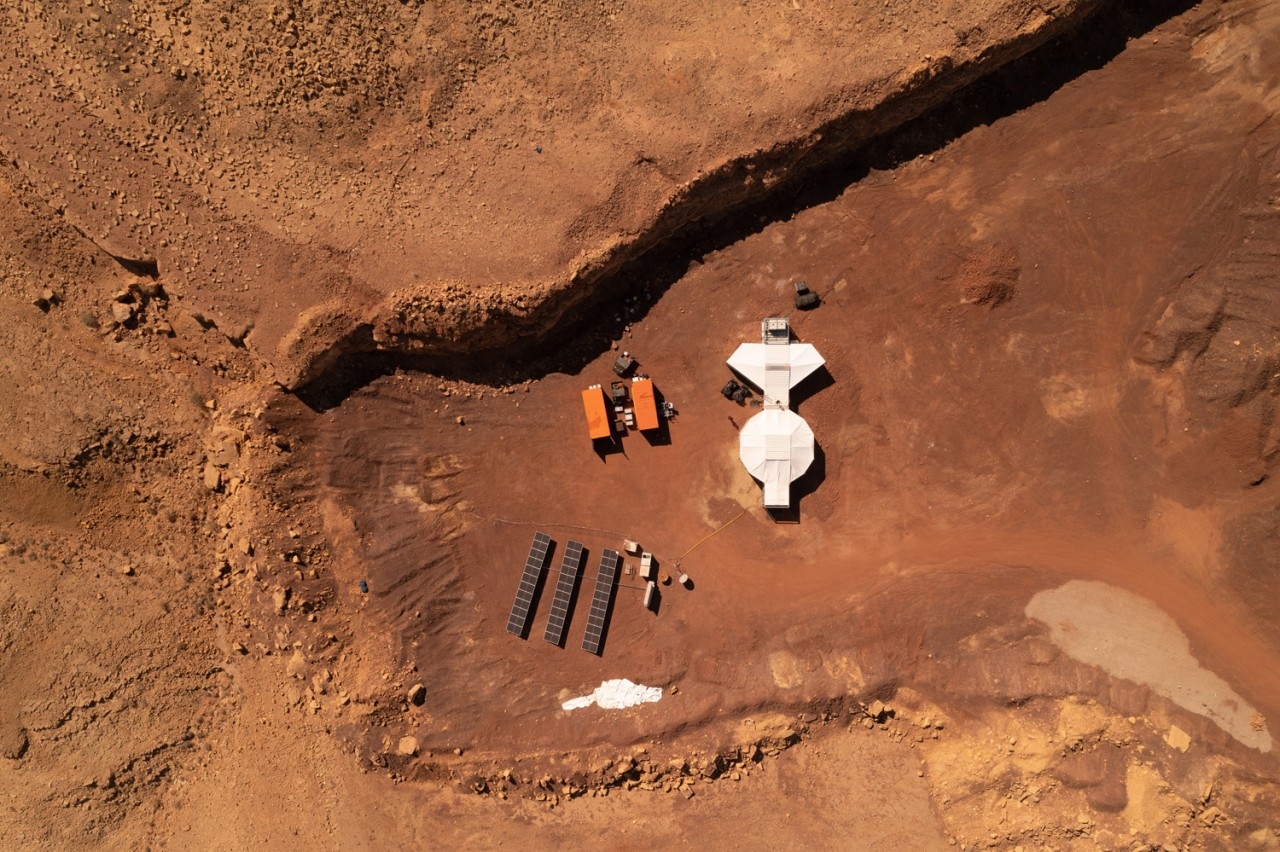
Image credit: Austrian Space Forum (OeWF)
Carrying out their analog Mars duties: Crew Commander Anika Mehlis from Germany, Deputy Commander Robert Wild from Austria, Carmen Köhler from Germany, Iñigo Muñoz Elorza from Spain, Simone Paternostro from Italy and Thomas Wijnen from the Netherlands.
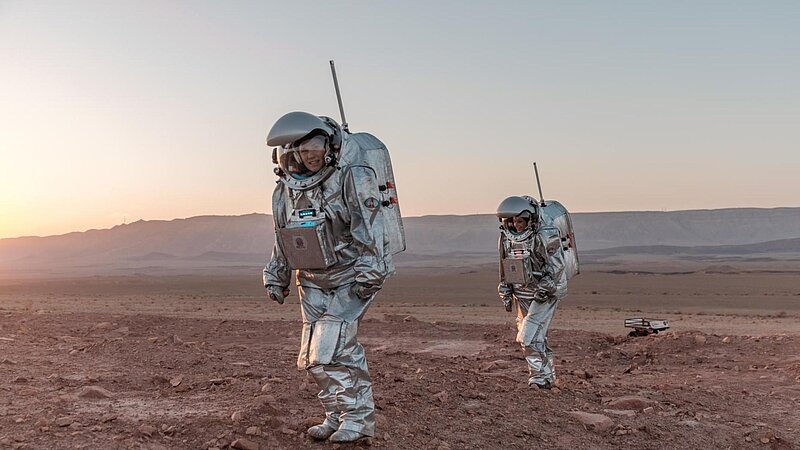
Image credit: Austrian Space Forum (OeWF)
Mission objectives
The AMADEE-24 mission has the following objectives:
— Explore instrument behavior while using instruments with the option of “humans-in-the-loop,” “humans as part of the workflow” (through two space suit prototypes with high realism, wearable systems, etc.).
— Developing platforms to test life detection or Earth science techniques and robotic support tools for astronautical missions. Creating concepts that enable high situational awareness for support teams that are not in the field.
— Investigating the analog as a model region for its Mars counterpart.
— Increasing the visibility of planetary science and human research activity.
— Develop the expertise to best manage astronaut missions to Mars: by providing a realistic model for a mission support center, planning the missions of analog astronauts*, and creating a comprehensive framework for decision making.
The AMADEE-24 analog mission can be viewed in a livestream presentation: Go to: https://www.youtube.com/live/gtokTylgR5g?si=Cc0KyRBGRGz4gIDo

Yucatan meets the Caribbean (red circle)
Image credit: Cambrian Foundation
That nearly 3-ton leftover tossed overboard from the International Space Station years ago has made a destructive plunge to Earth.
That multi-ton Exposed Pallet 9 (EP9) carrying 5,800 pounds of batteries was jettisoned in 2021 from the space station using the Canada-supplied robotic arm.

Taking out the trash. Multi-ton pallet tossed off years ago returns to Earth.
Image credit: NASA/Mike Hopkins
The Combined Space Operations Center (CSpOC), based at Vandenberg Space Force Base, Calif. published a final Tracking and Impact Prediction (TIP) message. That TIP gives reentry at 19:29 UTC plus or minus one minute, near 22.0 N, 85.5 W.

Image credit: SIBRS sensors monitor the Earth.
Image credit: US Air Force
The +- 1 minute suggests this is likely based on a Space Based Infrared System (SBIRS) satellite sensor observation of the reentry fireball, says Marco Langbroek, an expert satellite watcher in the Netherlands. “The position is where Yucatan meets the Caribbean,” he adds.
SIBRS data is also one likely input into the Jet Propulsion Laboratory-hosted Center for Near-Earth Object Studies (CNEOS).
U.S. government sensor information contributes to gauging atmospheric impact events. Bolide data, for example, is filtered into the CNEOS fireballs database – info useful for NASA’s Planetary Defense Coordination Office.
Casualty risk: low
According to a pre-reentry statement by the European Space Agency, the total mass of the batteries is estimated at 2.6 metric tons, most of which may burn up during the reentry. “While some parts may reach the ground, the casualty risk – the likelihood of a person being hit – is very low,” the ESA statement added.

During the uncontrolled fall of space hardware, seconds and minutes count. They can add up to de-orbiting riff raff plunging into isolated ocean waters or reaching land.
(Image credit: The Aerospace Corporation/Center for Space Policy and Strategy)
EP9 was loaded with old Nickel-Hydrogen batteries and had the approximate mass of a large SUV.
The EP9 was delivered to the ISS via Japan’s HTV-9 (Kountori 9) on May 20, 2020.
The EP9 carried six Lithium-Ion battery Orbital Replacement Units (ORUs) which replaced those existing ISS Nickel-Hydrogen batteries during an astronaut spacewalk.

Image credit:
EU Space Surveillance and Tracking (SST)
Note: Special thanks to Marco Langbroek and Bob Christy for reentry data.

Image credit: RPD/Sgt. Trong Nguyen
While the just-issued U.S. Department of Defense report on aerial strangeness found no link to extraterrestrial visitation, don’t tell that to the Roswell Police Department (RPD) in New Mexico.
Roswell is long associated with a reported 1947 site of an out-of-control UFO and its travel weary pilots. Dutifully, Roswell’s police have a new official patch – replacing an older emblem.

Older RPD patch.
Image credit: RPD
Small alien faces
“The new patch contains elements connecting it not only to the police department, but also the City of Roswell, the State of New Mexico and the Roswell community’s long association with UFO lore,”
The patch includes the city logo, a Zia symbol, a pair of small alien faces, and the phrasing, “Protect and Serve Those That Land Here.”
The patch also features the year the police department was established (1891), recognizing its 133-year history, and replaces a patch that has served RPD for more than 30 years and will now be retired.

Image credit: RPD
“The process to create a new patch began with an invitation to RPD employees – commissioned law enforcement officers as well as civilian staff – to submit design ideas,” notes an RPD statement.
Winning finalist
The new patch that will now represent the department was the one, from among the finalists, that proved the most popular among department employees who participated in an online survey. The chosen patch was crafted by Support Services Sgt. Trong Nguyen.
Distribution of the new patch to officers began March 6 “and will continue for some time as the department receives more patches from the company producing them,” the RPD posting adds.

Image credit: Roswell Daily Record
The ongoing transition to the new patch is expected to be completed by August 1.
As a new symbol of the department, the patch will be worn on the shoulders of officers’ uniforms and the image is to be used on various RPD printed and online materials.
No cover-up
Meanwhile, the DOD’s just-issued All-domain Anomaly Resolution Office (AARO) report states that there is no verifiable evidence that any UAP, aka UFO, sighting has represented extraterrestrial activity.
In UFO lore, the “Roswell incident” refers to the July 1947 “recovery of metallic and rubber debris from a crashed military balloon near Roswell Army Air Field personnel that sparked conspiracy theories and claims that the debris was from an alien spaceship” and part of a governmental cover-up, explains the new AARO report.

Image credit: DOD/AARO
The AARO document, citing earlier U.S. Air Force looks into the incident, points out that the USAF’s research did not locate or develop any information that indicated the Roswell Incident was a UFO event, nor was there any “cover-up” by the U.S. Government (USG).
Test dummies
Rather, those materials recovered near Roswell were consistent with a balloon of the type used in the then-classified Project Mogul. No records showed any evidence that the USG recovered aliens or extraterrestrial material, as explained in the AARO document.
The USAF subsequently published a follow-on report in 1997, The Roswell Report: Case Closed, with additional materials and analysis which supported its conclusion that the debris recovered near Roswell was from the U.S. Army Air Force’s balloon borne program.

Image credit: USAF/Alderson Laboratories anthropomorphic dummies of the type dropped from balloons.
The alleged “alien” bodies reported by some in the New Mexico desert, the Air Force “case closed” document explains, were test dummies that were carried aloft by U.S. Army Air Force high-altitude balloons for scientific research.
“Reports of military units that allegedly recovered a flying saucer and its ‘crew’ were descriptions of Air Force personnel engaged in the dummy recovery operations,” the Air Force Roswell report points out. “Claims of ‘alien bodies’ at the Roswell Army Air Force (RAAF) hospital were most likely the result of the conflation of two separate incidents: a 1956 KC-97 aircraft accident in which 11 Air Force members lost their lives; and a 1959 manned balloon mishap in which two Air Force pilots were injured.”
Taking out the trash. Multi-ton pallet tossed off years ago returns to Earth.
Image credit: NASA/Mike Hopkins
A nearly 3-ton leftover tossed overboard from the International Space Station is nearing its plunge toward Earth.
The multi-ton Exposed Pallet 9 (EP9) was jettisoned from the space station back in March 2021.
At the time, it was reported to be the most massive object ever tossed overboard from the International Space Station. Disposing of used or unnecessary equipment in such a way is common practice aboard the space station, as the objects typically burn up harmlessly in Earth’s atmosphere.

Image credit: Federal Office for Civil Protection and Disaster Relief, National Warning Center 1
Ahead of EP9’s reentry, the Federal Office for Civil Protection and Disaster Relief, National Warning Center 1 in Bonn, Germany issued this information:
“Luminous phenomena or the perception of a sonic boom are possible. According to current information, the probability of debris hitting Germany is considered to be very low. If the risk increases, you will receive new information.”
Design for demise
Over the years, work has been done on designing spacecraft that have less chance of leftovers reaching Earth – an engineering effort dubbed “design for demise.”
Regarding what types of materials survive an atmospheric re-entry, information from the German Aerospace Center (Deutsches Zentrum für Luft- und Raumfahrt (DLR) is instructive.
DLR experts note that so-called fiber-ceramic composite materials are significantly more heat-resistant over metal materials.
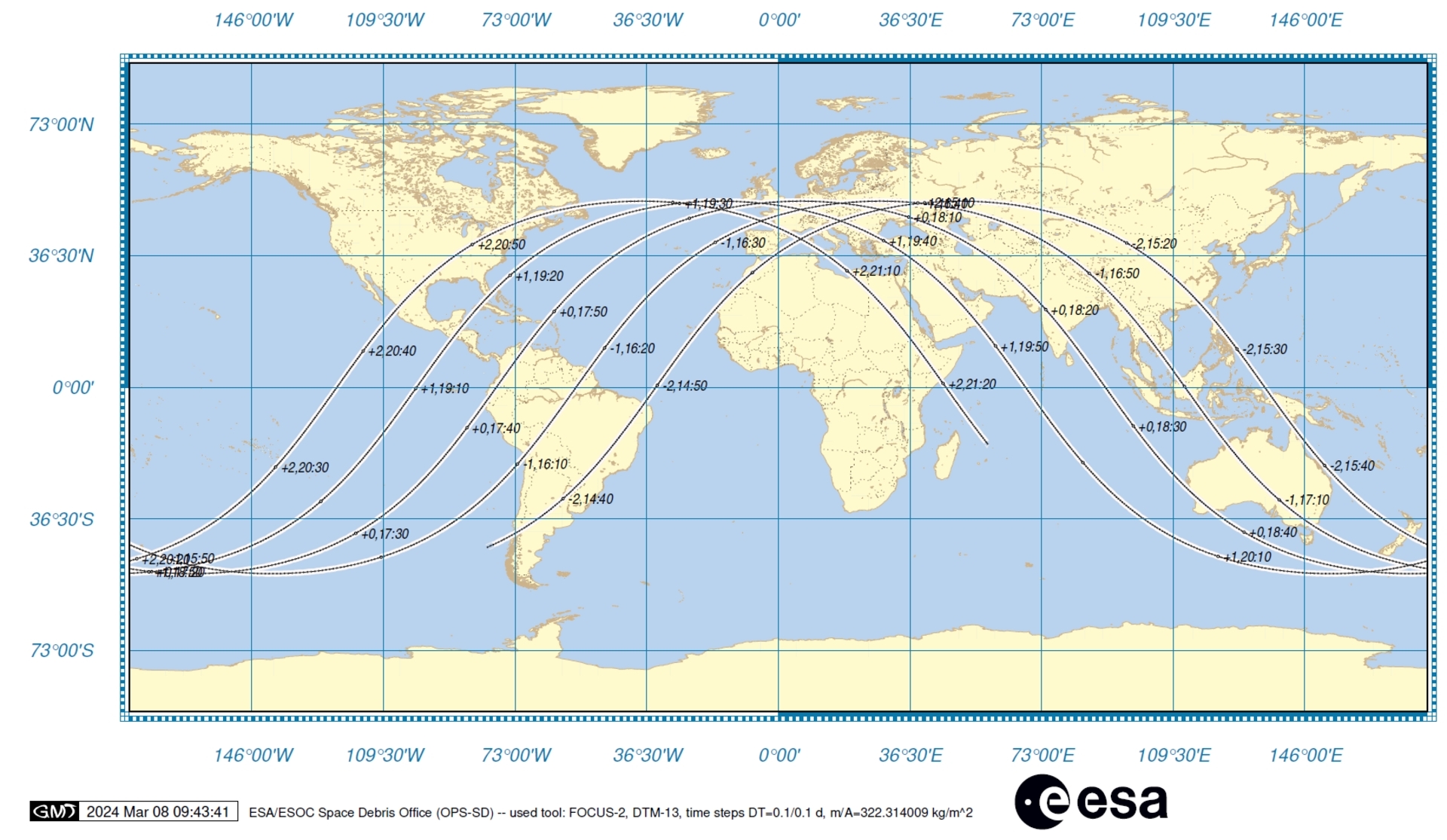
Chart shows ground track of a set of used Nickel-Hydrogen batteries jettisoned from the International Space Station in 2021. Chart indicates situation as of March 8, and forecasts a reentry between approximately 15:35 CET and 22:25 CET on Friday March 8. The reentry zone effectively stretches from -51.6deg south to 51.6deg north.
Image credit: ESA
Natural reentry
The European Space Agency (ESA) Space Debris and Independent Safety Offices are closely monitoring the reentry of the pallet of used ISS batteries.
The batteries, nine in total, will undergo “a natural reentry,” which is now predicted between approximately 15:35 CET and 22:25 CET on March 8.

Image credit: NASA
“The total mass of the batteries is estimated at 2.6 metric tonnes, most of which may burn up during the reentry,” the ESA statement adds. “While some parts may reach the ground, the casualty risk – the likelihood of a person being hit – is very low.”
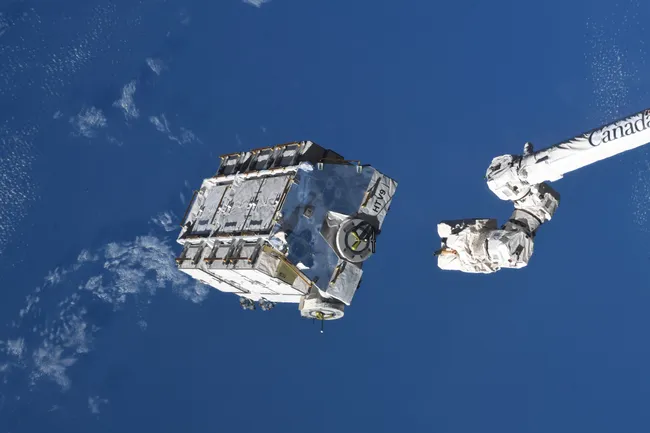
Catch and release. ISS robot arm is used for grabbing and letting lose space hardware.
Image credit: NASA
The reentry will occur between -51.6 degrees South and 51.6 degrees North.
ESA further notes that there are large uncertainties, primarily driven by fluctuating levels of atmospheric drag, that prevent more precise predictions.
“The closer we get to the expected reentry window, the better the concerned region can be geographically constrained,” ESA says, and also explains that a large space object reenters the atmosphere in a natural way approximately once per week. The majority of the associated fragments “burning up” before reaching the ground.
“Most spacecraft, launch vehicles and operational hardware are designed to limit the risks associated with a reentry,” ESA reports.

Image credit: The Aerospace Corporation/CORDS – Yellow Icon – location of object at midpoint of reentry window
Blue Line – ground track uncertainty prior to middle of the reentry window (ticks at 5-minute intervals)
Yellow Line – ground track uncertainty after middle of the reentry window (ticks at 5-minute intervals)
Pink Icon (if applicable) – vicinity of eyewitness sighting or recovered debris
Note: Possible reentry locations lie anywhere along the blue and yellow ground track. Areas not under the line are not exposed to the debris.
For more information, go to my Space.com update – “5,800 pounds of batteries tossed off the ISS in 2021 will fall to Earth today” – at:
Taking out the trash. Multi-ton pallet tossed off years ago returns to Earth.
Image credit: NASA/Mike Hopkins
A nearly 3-ton leftover tossed overboard from the International Space Station years ago is nearing its plunge toward Earth.
The Federal Office for Civil Protection and Disaster Relief, National Warning Center 1 in Bonn, Germany issued this information:
“Between midday on March 8th and midday on March 9th, a larger space object is expected to re-enter the Earth’s atmosphere and possibly fragment,” the translated statement explains. “The object is battery packs from the International Space Station (ISS). Luminous phenomena or the perception of a sonic boom are possible.”
The post from the warning center explains that “the probability of debris hitting Germany is considered to be very low. If the risk increases, you will receive new information.”
Image credit: Federal Office for Civil Protection and Disaster Relief, National Warning Center 1
Nickel-Hydrogen batteries
The multi-ton Exposed Pallet 9 (EP9) jettison from the space station took place back in March 2021.
This disposal of EP9 is loaded with old Nickel-Hydrogen batteries, NASA explained at the time, also explaining that EP9 has the approximate mass of a large SUV and is predicted to re-enter Earth’s atmosphere in two-to-four years.
The EP9 was delivered to the ISS via Japan’s HTV-9 (Kountori 9) on May 20, 2020. The EP9 carried six Lithium-Ion battery Orbital Replacement Units (ORUs) which replaced existing ISS Nickel-Hydrogen batteries during an astronaut spacewalk.
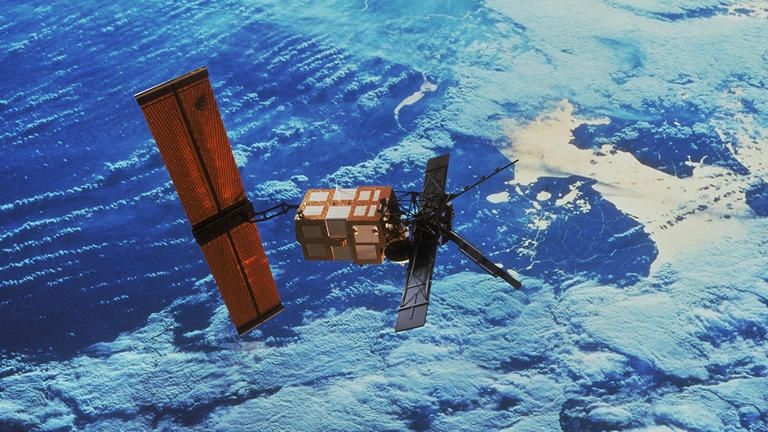
Image credit: ESA
There is residual fallout from the recent nosedive to Earth of the European Remote Sensing satellite, ERS-2.
Following its launch in April 1995, ERS-2 ran for nearly 16 years of observing the Earth. On February 21, the uncontrollable 2.3 ton spacecraft plowed through the Earth’s atmosphere to its demise in ocean waters.
During the uncontrolled fall of space hardware, seconds and minutes count. They can add up to de-orbiting riff raff plunging into isolated ocean waters or reaching land.
(Image credit: The Aerospace Corporation/Center for Space Policy and Strategy)
Cruise ship diversion
It was likely that parts of the ERS-2 did survive the reentry.
To that point, there was a reported ERS-2 debris-related warning issued to a Princess Cruises ship carrying 2,200 passengers. The prospect that odds and ends might fall into the area the pleasure boat was set to cross, en route to Port Luis, Mauritius, the ship steered clear of the area, taking a different course.
The willy-nilly nature of an out-of-control satellite raining down chunks of hot leftovers over inhabited landscape is cause for the willies, say experts.
But there’s more, as I discuss in my new Space.com story – “Big, dead satellite’s crash was a space-junk wakeup call, experts say” – at:
https://www.space.com/ers-2-satellite-crash-space-junk-wakeup-call

Ceremony with NASA Administrator Bill Nelson and Indian Ambassador Taranjit Sandhu, as India signs the Artemis Accords. U.S. Department of State, Deputy Assistant Secretary for India, Nancy Jackson, left, looks on.
Image credit: NASA/Bill Ingalls
In February, Uruguay became the 36th country to sign the Artemis Accords, a set of non-binding principles to spawn responsible actions on the Moon.
The Accords were established in 2020, formulated by NASA, in coordination with the U.S. Department of State. Since that time, there’s been a steady pace of countries inking the Artemis Accords.

Credit: NASA
A premise of the Accords is promoting “best practices and norms of responsible behavior.”
That’s a tall order given the tumult of the times.
I recently pulsed specialists as to how the Accords are playing globally, as well as within the eagle-eye, legal-beagle community.
Go to my Space.com story – “Cooperation on the Moon: Are the Artemis Accords enough?” – at:
https://www.space.com/artemis-accords-moon-cooperation-pros-cons-signing

Image credit: NASA

Image credit: ICON
Multiple nations are targeting the Moon as an off-Earth, snug and cozy camper spot for ever-longer stays of human visitors.
For NASA, getting a literal “leg-up” on the lunar landscape once again via its Artemis program is highly touted as the way to tromp and train for marching on to Mars.

China’s newly installed fifth scientific research station in Antarctic.
(Image credit: China Central Television (CCTV)
Playing nice
Antarctica is governed by about 30 countries, all of which are parties of the 1959 Antarctic Treaty System.
Perhaps that bleak, standoffish polar scenery is a template for working on the Moon, some say, even instructional on how best to play nice with a diversity of countries?
For details, go to my new Space.com article – “Can Antarctica serve as a model for international cooperation on the Moon?” – at:
https://www.space.com/moon-base-antarctica-international-cooperation

(Image credit: RAND Australia/Composite design by Carol Ponce adapted from images by Harryarts/Freepik and grebeshkovmaxim/Getty Images)

Image credit: CCTV/Inside Outer Space screengrab
The Shenzhou-17 crew members on China’s space station carried out a second spacewalking mission on Saturday.
Crew members Tang Hongbo, Tang Shengjie and Jiang Xinlin collaborated with the ground team to complete all planned tasks and returned to the space station during the 8-hour extravehicular activities.
Tang Shengjie remained inside the station’s core module. He assisted the other two crewmembers, including operating a robotic arm, to provide support for the space strolling duo outside the orbital complex.
Solar wing maintenance
According to China Central Television (CCTV), the primary objective of this mission was to carry out maintenance on the solar wing of the Tianhe core module on the station, eliminating impacts from collision by micro particles in space.

High-definition images of China’s space station were taken by the departing Shenzhou-16 crew last October 30.
Image credit: CMS
CCTV added that, following evaluation and analysis, the power generation of the repaired solar wing was back to normal. “This marks the first time that Chinese astronauts have conducted extravehicular maintenance activities on external spacecraft facilities.”
During the extravehicular activity, the astronauts also inspected the status of the space station cabin.

Wu Dawei, deputy chief designer of China’s crewed space program astronaut system.
Image credit: CCTV/Inside Outer Space screengrab
Six-month mission
Wu Dawei, deputy chief designer of China’s crewed space program astronaut system, said the astronauts’ performance were flawless.
“Although it was Jiang Xinlin’s first time engaging in extravehicular activities on the robotic arm, he showed composure and remained calm,” Wu told CCTV. “The coordination between him and fellow astronauts, and with the ground team, was perfect. The mission was completed perfectly following our designed procedures and plans in the whole process.”
The station inhabitants, the Shenzhou-17 crew, arrived at the space station on October 26, 2023 for a six-month mission.

Image credit: Shujianyang Wikimedia Commons, CC BY-SA

