Archive for March, 2024
 Author:
  March 23rd, 2024
Curiosity’s location as of Sol 4132. Distance driven 19.55 miles/31.46 kilometers since landing in Gale Crater on Aug. 5, 2012.
Image credit: NASA/JPL-Caltech/Univ. of Arizona
NASA’s Curiosity Mars rover at Gale Crater is now performing Sol 4134 duties.
The rover is driving south along the eastern edge of the upper Gediz Vallis Ridge or uGVR in geological shorthand, reports Sharon Wilson Purdy, a planetary geologist at the Smithsonian National Air and Space Museum in Washington, D.C.

Curiosity Right B Navigation Camera taken on Sol 4133, March 22, 2024.
Image credit: NASA/JPL-Caltech
Wide range of activities
“The rover drove up to the uGVR last summer and investigated several rocks; now with the beautiful ‘Fascination Turret’ section of the uGVR in sight,” Purdy notes, the team is excited to have another opportunity to “further characterize the material within the ridge and assess the nature of its contact with the underlying Mt. Sharp bedrock.”

Curiosity Right B Navigation Camera taken on Sol 4133, March 22, 2024.
Image credit: NASA/JPL-Caltech
Purdy notes that the robot’s excellent power situation for a recently scripted two-sol plan (Sols 4132-4133) yielded the ability to do a wide range of activities.

Curiosity Right B Navigation Camera taken on Sol 4133, March 22, 2024.
Image credit: NASA/JPL-Caltech

Curiosity Right B Navigation Camera taken on Sol 4133, March 22, 2024.
Image credit: NASA/JPL-Caltech

Curiosity Right B Navigation Camera taken on Sol 4133, March 22, 2024.
Image credit: NASA/JPL-Caltech

Curiosity Right B Navigation Camera taken on Sol 4133, March 22, 2024.
Image credit: NASA/JPL-Caltech

Curiosity Right B Navigation Camera taken on Sol 4133, March 22, 2024.
Image credit: NASA/JPL-Caltech
Laminated ridge
In the workspace in front of Curiosity, the Mars Hand Lens Imager (MAHLI) inspected a vertical banded rock with veins at “Col de Doodad.”
“We used the dust removal tool (DRT) and MAHLI to characterize the grain size and material in a flat bedrock target named ‘Three Tooth Doodad,” Purdy adds.
The rover’s Chemistry and Camera (ChemCam) Laser Induced Breakdown Spectroscopy (LIBS) was slated to analyze a laminated ridge within bedrock at the “Kuna Crest” target with Mastcam providing a complementary context image.

Curiosity Right B Navigation Camera taken on Sol 4133, March 22, 2024.
Image credit: NASA/JPL-Caltech
Upcoming route
Mastcam planned stereo mosaics within the workspace were scheduled to document “small-scale laminations and to investigate the nature of subtle variations between light and dark bedrock at the ‘East Vidette’ target. The ‘Giant Forest Mastcam mosaic was scheduled to document interesting fractures in the nearby bedrock,” reports Purdy.
“Looking off in the distance, the plan includes several observations of the Fascination Turret section of the uGVR so we can view it from different angles as we drive along our upcoming route,” Purdy observes.

Curiosity Chemistry & Camera (ChemCam) Remote Micro-Imager (RMI) photo acquired on Sol 4133, March 22, 2024.
Image credit: NASA/JPL-Caltech/LANL

Curiosity Mast Camera (Mastcam) Right image produced on Sol 4132, March 21, 2024.
Image credit: NASA/JPL-Caltech/MSSS
ChemCam was able to fit two long distance Remote Micro-Imager (RMI) photos into the plan that document interesting ledges within Fascination Turret, Purdy says, while Mastcam put together a mosaic of the lower portion of the ridge to evaluate the composition, structure, and its relationship with the underlying bedrock.
“Our plan incorporates several ENV [environment] activities including a dust devil survey, a suprahorizon movie, and a sky survey,” Purdy concludes. “Keep on humming along, Curiosity!”

Curiosity Mast Camera (Mastcam) Right image produced on Sol 4132, March 21, 2024.
Image credit: NASA/JPL-Caltech/MSSS

Curiosity Mast Camera (Mastcam) Right image produced on Sol 4132, March 21, 2024.
Image credit: NASA/JPL-Caltech/MSSS

Dust Removal Tool (DRT) close-up. Curiosity Mast Camera (Mastcam) Right image produced on Sol 4132, March 21, 2024.
Image credit: NASA/JPL-Caltech/MSSS
 Posted in
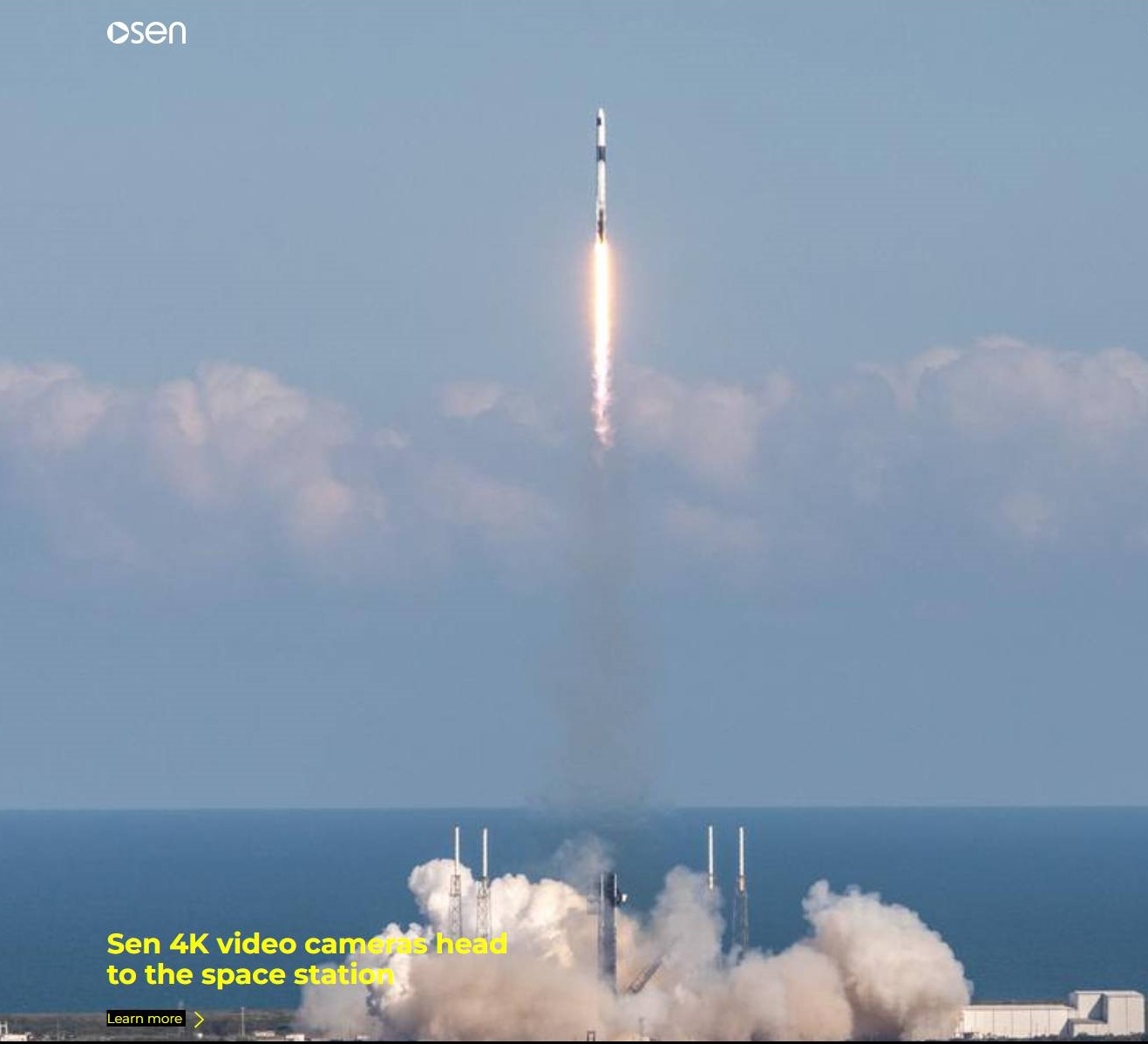
Image credit: Sen/Inside Outer Space screengrab
The vision is to democratize space using high-definition video.
That’s the mission of Charles Black, founder and CEO of the London-based Sen that was founded in 2014.
Sen’s mission to livestream Earth in 4K is literally a real-time event. Now onboard the SpaceX supply ship launched on March 21, the private group’s payload is due to arrive at the International Space Station on Saturday March 23.
May deployment
“Once at the space station it will be stored for a few weeks before it is placed on the outside of the station by the robotic arm,” Black says in a Sen communiqué. “It should be deployed in May after which we can start livestreaming Earth in 4K. We have two camera views of Earth – the horizon and straight down.”
Sen also have cameras pointing at the forward facing docking port of the space station to film coming and going spacecraft, Black adds.

Image credit: NASA
Commercial payload agreement
Sen’s payload, called “SpaceTV-1”, will be hosted on the outside of the ISS through a commercial payload agreement with Airbus U.S. Space & Defence, supported by the International Space Station National Laboratory.
All cameras will film in 4K and at least one camera will be livestreamed continuously.
In addition to 4K video, Sen is aiming to demonstrate real-time Augmented Reality, enabling viewers to see real-time mapping information on the nadir camera view as it orbits the Earth.

Image credit: Sen/Inside Outer Space screengrab
Tell the story
Sen’s own satellite, ETV-A1, is now in orbit and the company is working on launching further satellites from early 2025 as it works on building a constellation of satellites in low Earth orbit.
Black recently told BBC News: “Our goal is to bring a whole new way of seeing space, Earth and the Moon,” he said, noting Sen cameras are projected to be in lunar orbit, on the Moon itself and on lunar rovers.
“We want to tell that story,” Black said.

Artemis explorers at the Moon.
Image credit: NASA
Informed consent
According to Sen’s vision statement: “As humans and robots explore space beyond Earth, billions of people on Earth have an interest and a right to hear the story, to provide informed consent for a multi-world democracy. Sen’s mission is to tell the story of humanity’s exploration of the Solar System and one day beyond, democratizing space for all humanity.”
You can register on Sen.com – it’s free and you can view 4K videos from their first satellite. The livestream from the space station will be accessible on sen.com and in the app in due course, according to the group.
For more information about Sen, go to:

Image credit: IAA
There’s a growing and passionate call for preserving radio silence on the farside of the Moon.
A first-of-its-kind international symposium is being held this week, turning up the speaker volume to mull over the prospect of protecting real estate on the Moon’s farside exclusively for dedicated scientific purposes.
Yes, despite the Moon being surrounding by a vacuum, there’s an air of urgency to the meeting.

Cup a radio ear to listen for other starfolk via farside radio telescope observations.
(Image credit: Breakthrough Listen/Danielle Futselaar)
Held under the auspices of the International Academy of Astronautics (IAA), a Moon Farside Protection meeting is taking place March 21-22 in Turin, Italy.
The goal of the gathering is to set off a wake-up call that engages the global scientific, political, and industrial community to be aware of a growing list of concerns.
For more information go to my new Space.com story – Astronomers call for radio silence on the far side of the Moon – “We are at risk of a Wild West scenario” – at:

Departure of new Moon relay spacecraft. Image credit: CCTV/Inside Outer Space screengrab
All seems good to go with China’s en route to the Moon Queqiao-2 relay satellite – an essential element of the country’s expanding lunar exploration agenda.
Riding atop a Long March-8 Y3 carrier rocket departing on Wednesday (Beijing Time) from the Wenchang Spacecraft Launch Site, the relay craft entered a planned Earth-Moon transfer orbit.
Queqiao-2’s solar panels and communication antennas were unfolded, according to reports.

Image credit: CNSA
“It will undergo mid-course corrections and near-moon braking to a capture orbit, adjust and finally settle into the lunar orbit,” according to the China Global Television Network (CGTN).
Relay services
The satellite is an upgraded version of Queqiao, the relay satellite used for China’s Chang’e-4 lunar lander/rover.

Tiandu-1 and Tiandu-2 subsatellites are to trial-run lunar communications technology.
Image credit: Deep Space Exploration Laboratory (DSEL)
According to China Central Television (CCTV), as the designed lifespan of the first Queqiao is about to end, Queqiao-2 will continue to provide relay communication services for the Chang’e-4 lander/rover already on the Moon.

Chang’e-4 farside lander and Yutu-2 rover.
Image credit: CNSA/CLEP
Furthermore, this new relay satellite, also named Magpie Bridge 2, will provide relay support for the upcoming Chang’e-6 farside lander and follow-on Chang’e-7 and Chang’e-8 Moon missions.
Queqiao-2 is more powerful and has a longer lifespan for more missions.
The Long March-8 Y3 booster also carried two experiment satellites for trial-running lunar communications technology – the Tiandu-1 and Tiandu-2.
Step-by-step
In December 2021, the fourth phase of the lunar project was approved and put in motion, including the Chang’e-4, Chang’e-6, Chang’e-7 and Chang’e-8 missions.

Photo taking during Chang’e-5 surface sampling.
Credit: CCTV/Inside Outer Space screengrab
The Chang’e-4 was launched in December 2018, making the first soft-landing on the farside of the Moon. The Chang’e-4 mission began its survey of the Von Karman Crater in the South Pole-Aitken Basin on the farside of the Moon on January 3, 2019.
In December 2020, the Chang’e-5 lunar spacecraft hauled back to Earth 1,731 grams of samples from the Moon, marking the completion of China’s three-step lunar exploration program of orbiting, landing and return.

China’s Chang’e-6 lunar sample return mission elements.
Credit: CNSA
Upcoming, reportedly in May, sendoff of the Chang’e-6 mission to attempt a touch down on the Moon’s farside, then grab, stash, and return lunar specimens for return to Earth.
The follow-on Chang’e-7 and Chang’e-8 are planned to form the basic structure of a lunar research station.
Braking operation
China media reports that Queqiao 2 was developed by the China Academy of Space Technology, based on the CAST2000 satellite framework. It weighs about 1.2 metric tons and has two major payloads: a 4.2-meter parabolic antenna for communications with lunar probes and a 0.6-meter parabolic antenna used to transmit data to ground control.
Over the next few days, Queqiao 2 is to perform a series of maneuvers such as a mid-course trajectory correction and a braking operation before it enters an “elliptical frozen orbit” around the Moon.
Once arrived at its predetermined orbital position, Queqiao 2 will conduct two-way communication tests with the Chang’e-4 lander/rover mission now on the lunar surface as well as the soon-to-be-launched Chang’e-6, now being readied for flight to the Moon atop a Long March 5 heavy-lift rocket.

Change’6 lunar sample return scenario. Image credit: CNSA
Fourth phase
Due to the Moon’s perpetual one-side facing away from Earth, probes landing on the farside are obstructed by the Moon itself, hindering direct measurement, control communication, and data transmission with Earth.
“As the fourth phase of China’s lunar exploration project focuses on landing exploration and sampling sites primarily situated in the Moon’s south pole and farside areas, the need arises for more versatile and robust relay satellites. And these satellites will serve as a new relay communication station on the Moon for communication,” explains CCTV.
China’s fourth phase of lunar exploration has the goal of scientific investigation of the Moon’s south pole and set up a fundamental type of lunar scientific research station. Known as the International Lunar Research Station, this facility is to be constructed in the 2030s.
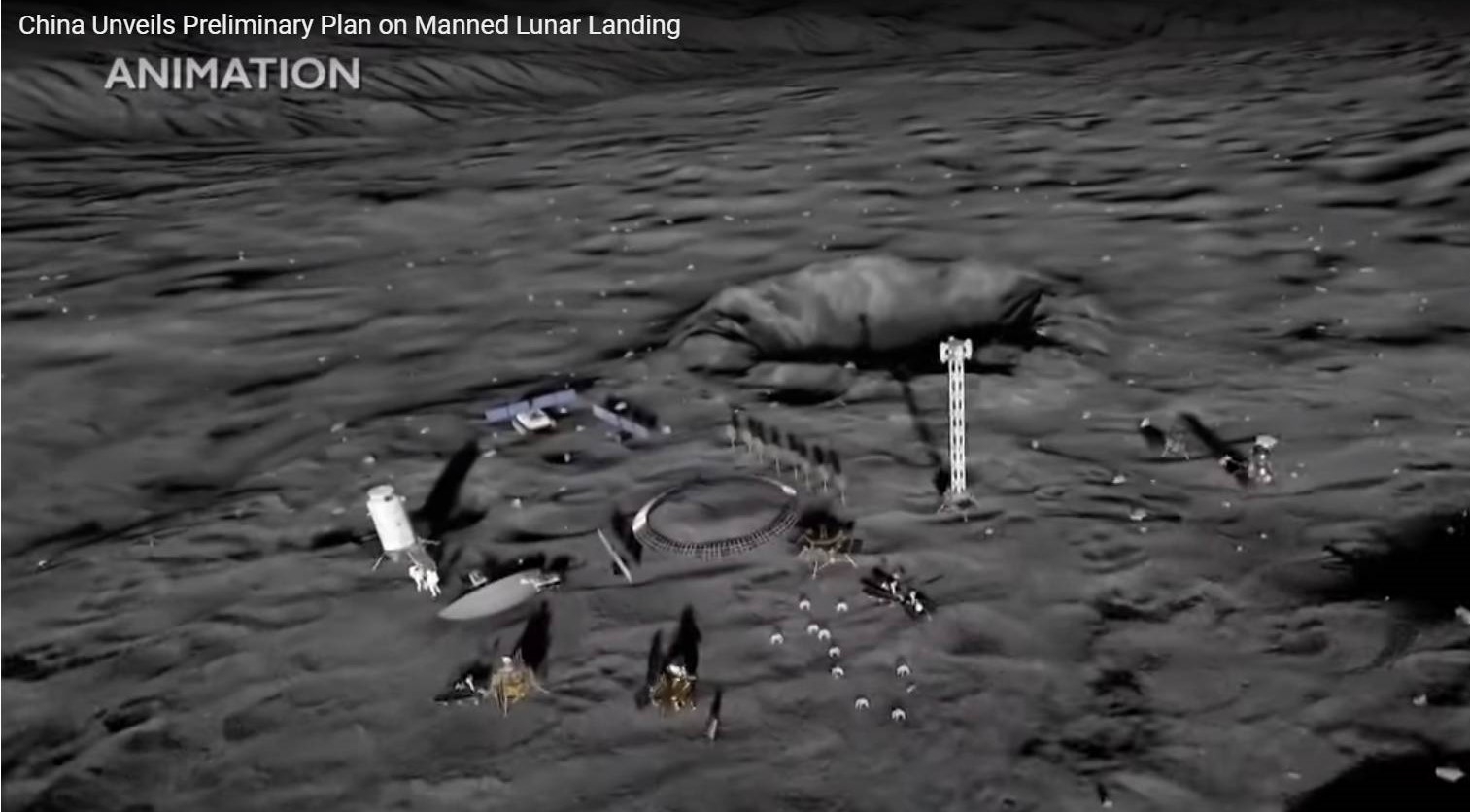
Artist’s view of International Lunar Research Station to be completed by 2035. Credit: CNSA
The fourth phase will be carried out in three steps, with the Chang’e-6, Chang’e-7 and Chang’e-8 probes being launched before 2030, CCTV notes. The Chang’e-8 will constitute, together with Chang’e-7, the basic model of a lunar research station.
Multi-level, multi-type cooperation
Ge Ping, deputy director of the Center of Lunar Exploration and Space Engineering of the China National Space Administration (CNSA) told CGTN that China is willing to carry out Moon exploration-related multi-level and multi-type cooperation with other countries and international organizations.
“China has opened up applications for Chang’e-5’s moon soil samples for the international science community. It’s also looking for cooperation in the lunar program’s fourth step and other planetary exploration projects,” Ge said.

Chang’e-5 return capsule holding lunar specimens.
Credit: National Astronomical Observatories, CAS
The CNSA opened applications for access to the returned cache of Chang’e-5 lunar samples to international scientists in late 2023.
Late last year, NASA worked with Congress to allow NASA-funded researchers to apply to CNSA for access to the Chang’e-5 samples. Subsequently, CNSA received nearly a dozen applications from U.S. proposers.
Still to come is NASA guidance on how space agency funding may be used to support research efforts on Chang’e-5 samples, according to Lori Glaze, director of NASA’s Science Mission Directorate’s Planetary Science Division.
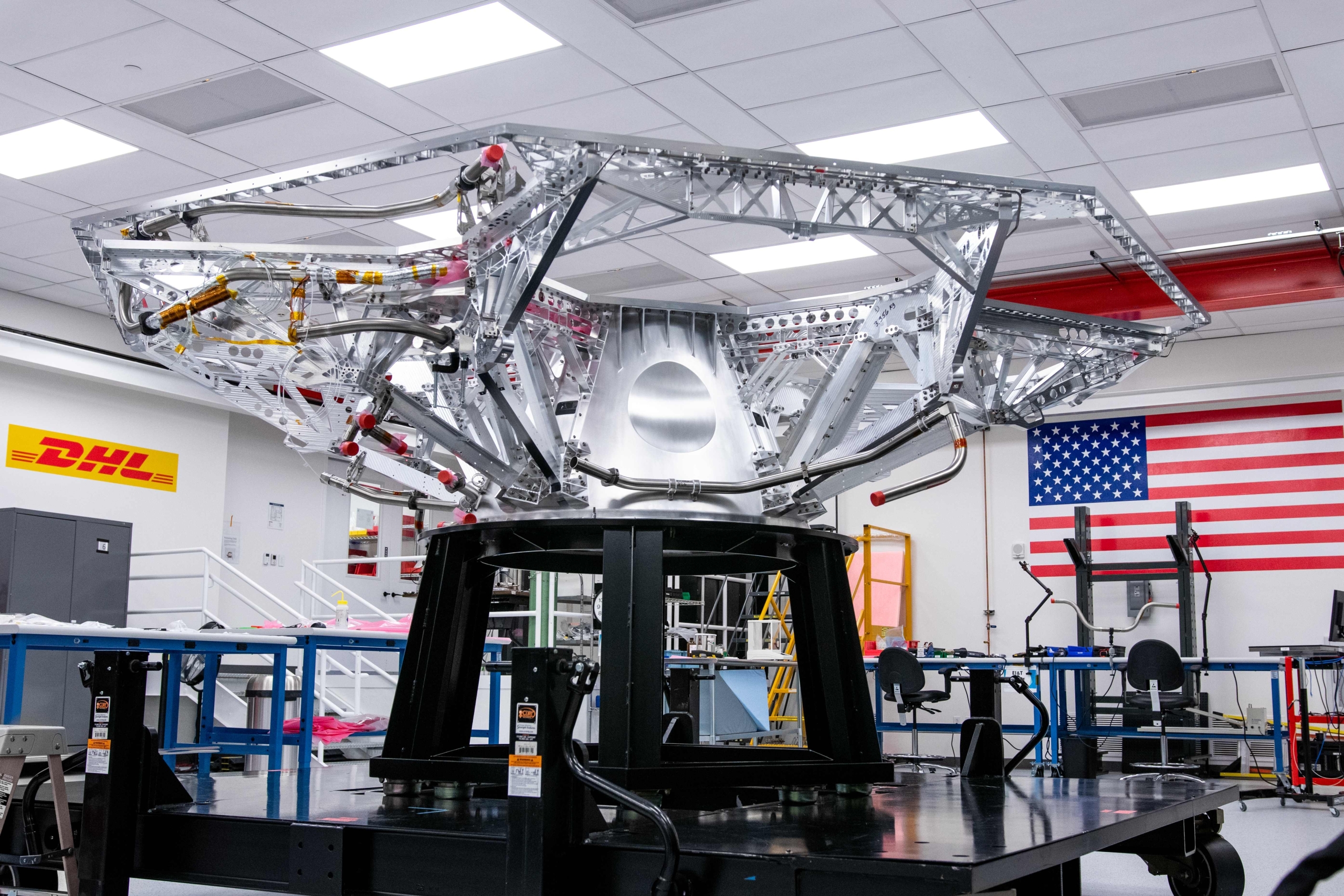
Factory floor work on readying the Astrobotic Griffin Mission One lunar lander that will carry to the moon NASA’s VIPER robot.
Image credit: Astrobotic Technology
Despite the failure of the first U.S. commercial lunar lander to ever operate in space, Astrobotic Technology is pressing forward on its next moon mission still on the calendar for sendoff before year’s end.
Notes a final update for the Peregrine Mission One on the Astrobotic website:
“Peregrine has flown so Griffin may land. Ad luna per aspera,” the communiqué concludes in a nod to a Star Trek motto, “To the stars through difficulty.”
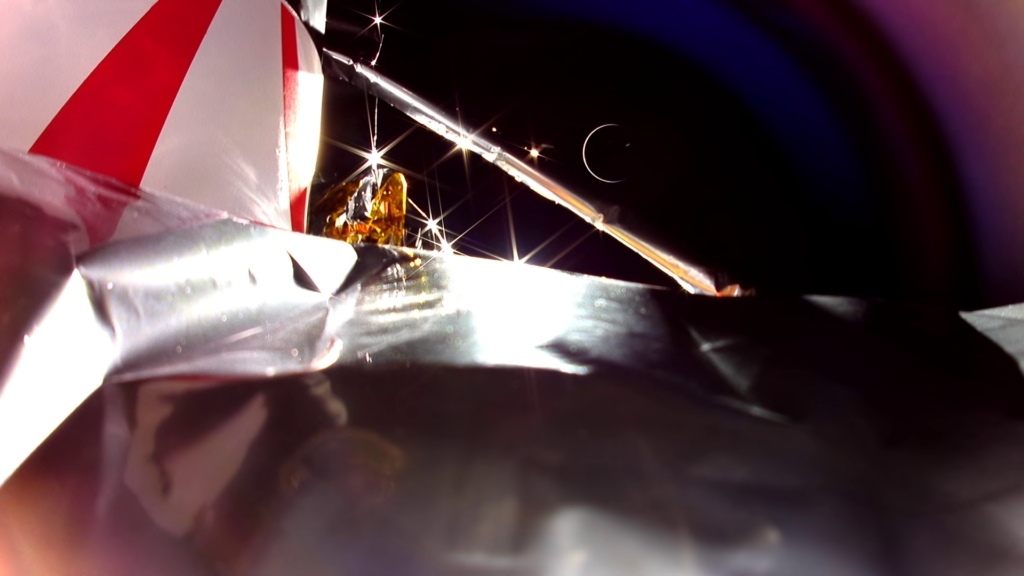
Peregrine lunar lander imaged the Earth as it headed for destructive dive into the South Pacific ocean.
Image credit: Astrobotic Technology
Now on view
The build-up of hardware for the Astrobotic Griffin Mission One lander is now on view at the Pittsburgh-based private firm from the adjoining Moonshot Museum.
Griffin is the largest lunar lander since the Apollo lunar module.
There’s no doubt about it. The upcoming flight is not just a big one for NASA’s Commercial Lunar Payload Services (CLPS) initiative in which American companies are contracted to deliver science and technology to the lunar surface.

Artwork depicts NASA’s VIPER, on the prowl for water and other resources.
Image credit: NASA Ames/Daniel Rutter
It also signals an important bridge to the NASA Artemis human exploration agenda for the moon via the space agency’s VIPER rover.
For more information, go to my new Space.com story – “Astrobotic readies next lunar lander following failed Peregrine moon mission” – at:
https://www.space.com/astrobotic-next-lunar-lander-failed-peregrine-mission

Wait-a-minute.
Image credit: Barbara David
China has reportedly embarked on a magnetic levitation (MagLev) system using an electromagnetic catapult to hurl a 50-ton space plane down a track at speeds up to Mach 1.6.
At the rail gun’s end, the space plane would use a propulsion system to reach orbit.
The South China Morning Post reports work on the idea is underway. Just how much momentum the research has behind it isn’t clear.
But if this sounds familiar…it is…and a wait-a-minute moment.

MagLifter concept. Image credit: NASA
Years ago, NASA’s Marshall Space Flight Center showcased a 50 feet (15 meters) MagLev test track.
NASA engineers working on the concept, however, couldn’t levitate, attract, and speed the necessary moolah their way to the idea – essentially derailing work.

Image credit: NASA
Mass drivers
Waaay back in 1974, work on “mass drivers” was undertaken by the late Gerard O’Neill and colleagues at Princeton University and also the Massachusetts Institute of Technology.
Mass drivers were viewed then as the logical means for transporting lunar raw material to special spots in space, namely L-5.
Those mass drivers were electromagnetic launchers that could accelerate payloads in re-circulating buckets with superconducting magnet coils at a repetition rate of about ten per second.

Artwork shows Mass driver on Moon. Courtesy: Space Studies Institute (SSI)
Raw power
One application O’Neill proposed for mass drivers: toss baseball-sized chunks of ore mined from the surface of the Moon into space. Once in space, the ore could be used as raw material for building space colonies and solar power satellites.
Now decades later, enter the world of today’s bullet trains, high-velocity artillery shells, airplane catapults, hyped-up hypersonic vehicles, new materials, and superconductor thinking – time for a MagLev re-look for space?
Space technologists in China seemingly think so.
Go to: “China building giant hypersonic railgun for space launches” by Gabriel Honrada in Asian Times at:
China building giant hypersonic railgun for space launches
Also, for more information, go to these previous Inside Outer Space stories:
https://www.leonarddavid.com/navy-rail-gun-progress-ideal-for-the-moon/
https://www.leonarddavid.com/electromagnetic-mass-driver-back-to-the-moon/
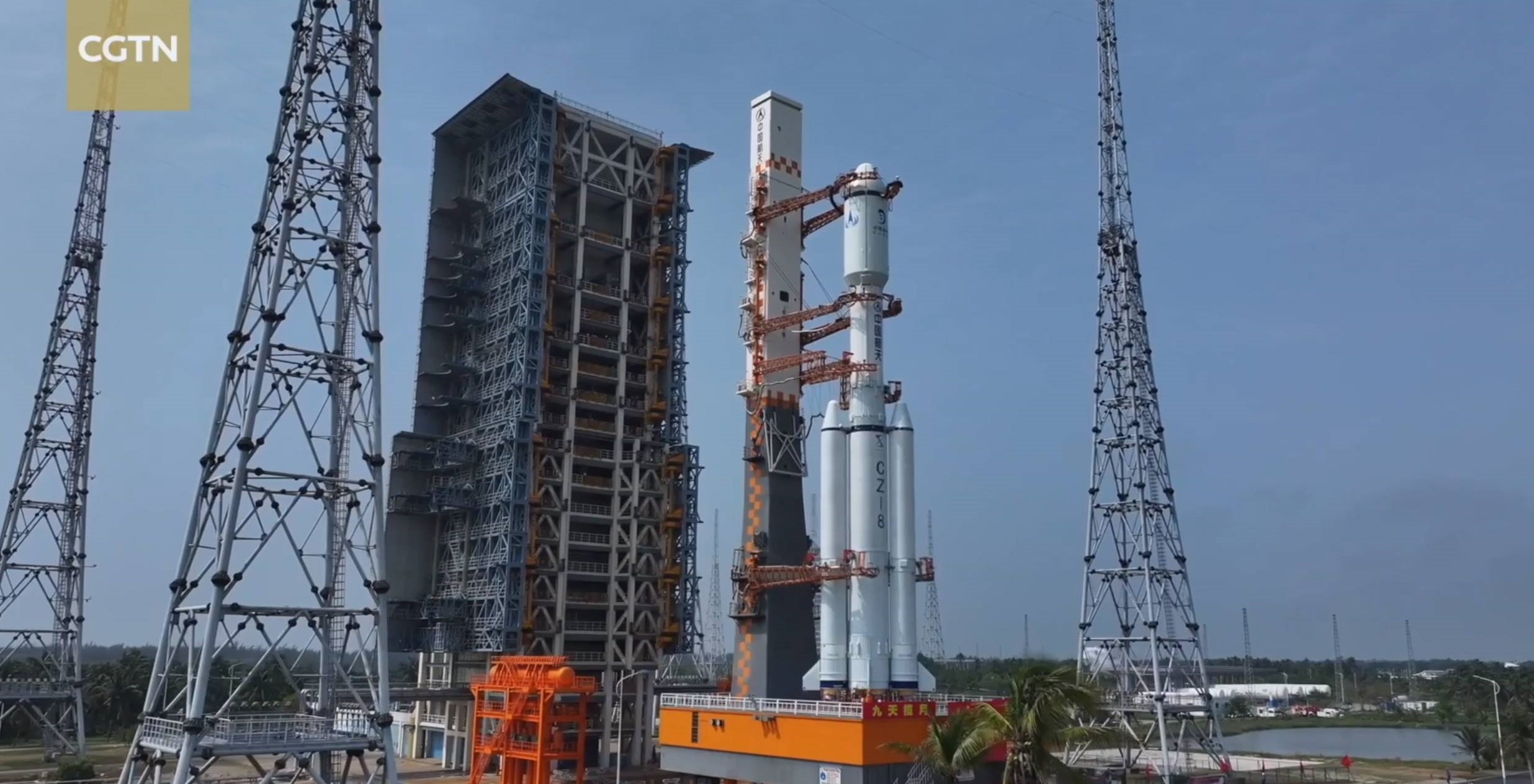
Image credit: CGTN/inside Outer Space screengrab
A Long March-8 Y3 booster is being prepped for sendoff at China’s Wenchang Space Launch Center in south China’s Hainan Province.
The Queqiao-2 spacecraft is expected to be launched in the next several days, states the China National Space Administration (CNSA).
If successfully lofted, Queqiao-2 — or Magpie Bridge-2 – is built to serve as a relay platform and is an element of China’s fourth phase of the country’s lunar exploration program.
Frozen orbit
To achieve better visibility of the Moon’s south pole region, the Queqiao-2 relay spacecraft is to be stationed in a stable, “frozen” elliptical orbit around the Moon.
Image credit: CNSA
Once in place, the relay craft will operate from a Distant Retrograde Orbit (DRO) of the Moon and support communications services for the already lunar-situated Chang’e-4, as well as the upcoming Chang’e-6, Chang’e-7, and Chang’e-8 Moon missions.
Once on duty, Queqiao-2 will make use of a 4.2 meter parabolic antenna to enable communication between China’s lunar surface operations and ground controllers.
Upgraded sentinel
This new and upgraded relay sentinel follows Queqiao-1, launched in May 2018. It supported China’s Chang’e-4 mission. That robotic lander and Yutu rover mission made the first soft landing on the far side of the Moon back in January 2019.
Queqiao-2 also totes a trio of scientific payloads: An extreme ultraviolet camera, an array neutral atom imager, and an Earth-Moon Very-long-baseline interferometry (VLBI) system.
This new lunar relay capability reportedly has a lifetime of more than 8 years.

Image credit: SpaceX
That milestone-making third test flight of the SpaceX Starship involved mishaps with the Super Heavy booster and the Starship vehicle.
The Federal Aviation Administration (FAA) is “overseeing the SpaceX-led mishap investigation to ensure the company complies with its FAA-approved mishap investigation plan and other regulatory requirements,” according to the federal organization.

Super Heavy booster liftoff, but failed to achieve “soft” landing in ocean waters. Image credit: SpaceX/Inside Outer Space screengrab
Public safety
In a post-launch FAA statement “a mishap occurred during the SpaceX Starship OFT-3 mission that launched from Boca Chica, Texas, on March 14. The mishap involved both the Super Heavy booster and the Starship vehicle.”
No public injuries or public property damage have been reported, the FAA statement points out. “A mishap investigation is designed to further enhance public safety, determine the root cause of the event, and identify corrective actions to avoid it from happening again.”

Up, up and away! Image credit: SpaceX/Inside Outer Space screengrab
Return to flight…when?
As for future launches of the Starship, the FAA will be involved in every step of the mishap investigation process they state, “and must approve SpaceX’s final report, including any corrective actions.”
Any return to flight will be based on the FAA determining that any system, process, or procedure related to the mishap does not affect public safety.
“In addition, SpaceX may need to modify its license to incorporate any corrective actions and meet all other licensing requirements,” the FAA statement concludes.
Go to SpaceX Starship launch replay at:
https://www.spacex.com/launches/mission/?missionId=starship-flight-3

Starship reentry, then breakup of vehicle. Image credit: SpaceX/Inside Outer Space screengrab
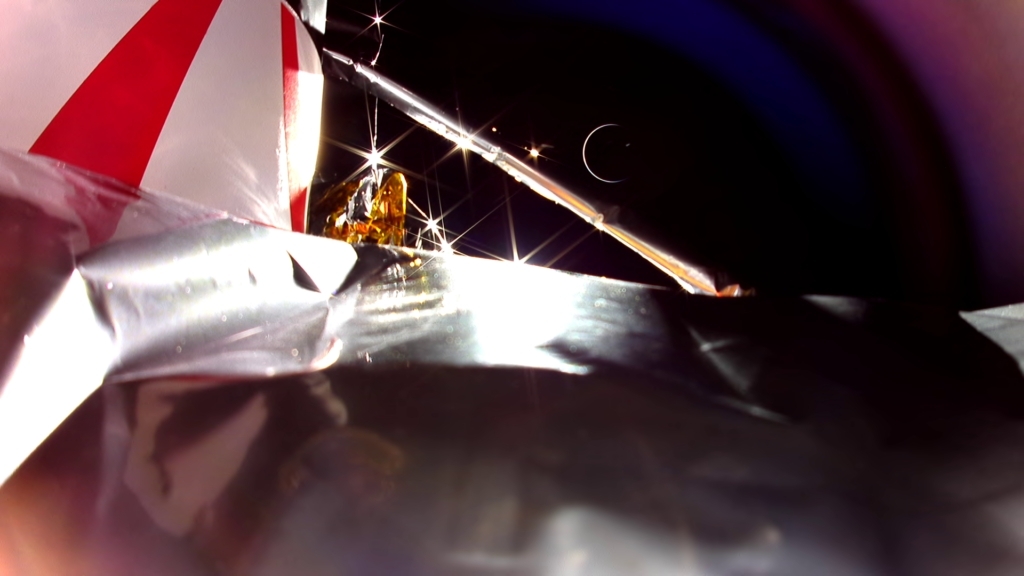
Peregrine commercial lunar lander imaged the Earth as it headed for destructive dive into the South Pacific ocean.
(Image credit: Astrobotic Technology)
It has been a rough and tumble start for hurling hardware and science experiments to the Moon under NASA’s Commercial Lunar Payload Services initiative, dubbed CLPS.
Under CLPS, American vendors have been contracted to assist the space agency in “re-booting” the Moon no earlier than September 2026 by way of an Artemis crew landing at the lunar south pole.
Commercial deliveries of scientific equipment, trial-running technologies, and showcasing capabilities, that’s what CLPS is about, a government-private sector partnership that adds up to a maximum of $2.6 billion in competitive contracts through 2028.
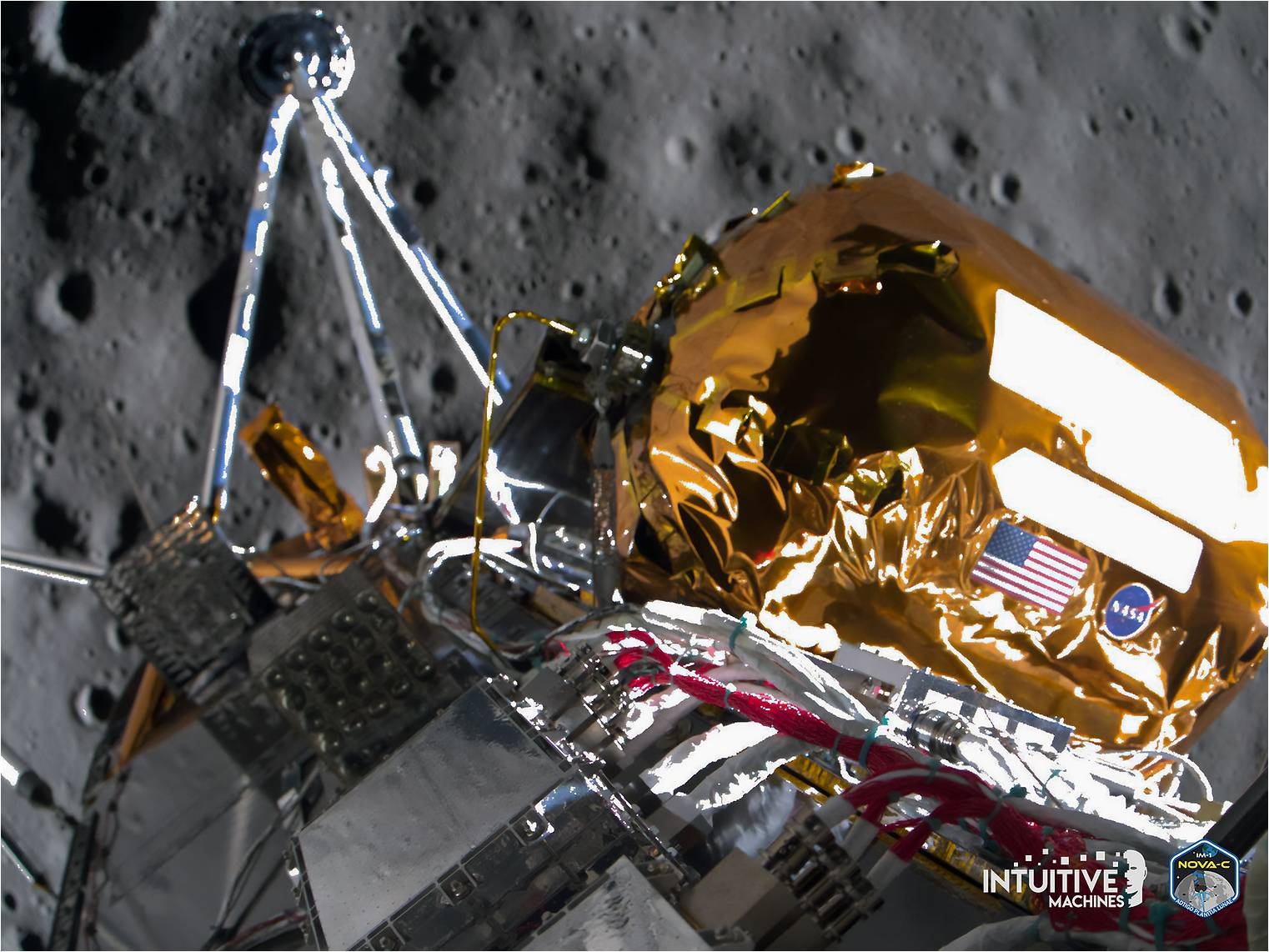
Odysseus captured this image less than 100 feet (30 meters) above the lunar surface while his main engine throttled down
Image credit: Intuitive Machines
Early speed bumps
NASA dollars, the agency relates, helps lay the foundation for sustained stays of human explorers on the Moon, while shoring up the creation of a lunar economy and gain the chops to march off to Mars.
That’s the off-and-running vision – but there are some early speed bumps.
Take a look at my new Scientific American story – “In NASA’s Push for the Moon, Commercial Partners Soar—And Stumble: NASA’s partnership with private industry to accelerate the U.S.’s return to the Moon is delivering lunar payloads—and mixed results” – at:
https://www.scientificamerican.com/article/whats-behind-nasas-commercial-lunar-hits-and-misses/

Image credit: SpaceX
The launch of SpaceX’s Starship OFT-3 has been given a go by the Federal Aviation Administration (FAA), as cited in a FAA License Modification Approval dated March 13, 2024.
“The FAA is authorizing the SpaceX Starship Super Heavy Orbital Flight Test 3 (OFT-3) launch. The FAA determined SpaceX met all safety, environmental, policy and financial responsibility requirements,” stated the FAA.
This flight – targeted for March 14 – was one part of the FAA’s license modification evaluation, a “Tiered Environmental Assessment” for the SpaceX Starship sortie and its Indian Ocean landing.

Record of decision
The FAA has issued a Finding of No Significant Impact Record of Decision.
This license applies to all phases of the proposed OFT-3 operation, the FAA notes in a statement. “This includes preflight preparations and liftoff from Texas, the water landing of the Super Heavy booster in the Gulf of Mexico, and the water landing of the Starship vehicle in the Indian Ocean.”
As posted by SpaceX, the third flight test of Starship is targeted to launch Thursday, March 14. The 110-minute test window opens at 7:00 a.m. Central Time.
A live webcast of the flight test will begin about 30 minutes before liftoff, and can be viewed via SpaceX and on X @SpaceX.

Starship departure in earlier test flight. Image credit: SpaceX/Inside Outer Space screengrab
Ambitious objectives
“As is the case with all developmental testing, the schedule is dynamic and likely to change, so be sure to stay tuned to our X account for updates,” reports SpaceX.
With two Starship tests under its belt, SpaceX explains that the third flight test “aims to build on what we’ve learned from previous flights while attempting a number of ambitious objectives.”
Those include:
— successful ascent burn of both stages
— opening and closing Starship’s payload door
— a propellant transfer demonstration during the upper stage’s coast phase
— the first ever re-light of a Raptor engine while in space
— a controlled reentry of Starship.

Image credit: SpaceX
New trajectory
As explained by SpaceX, this Starship flight will also fly a new trajectory, with the vehicle targeted to splashdown in the Indian Ocean.
“This new flight path enables us to attempt new techniques like in-space engine burns while maximizing public safety,” SpaceX adds.
For live coverage, go to: https://www.spacex.com/launches/mission/?missionId=starship-flight-3

