Archive for February, 2024
 Author:
  February 6th, 2024
Samples of asteroid Bennu are now in vials for intensive study at the University of Arizona.
Image credit: Chris Richards/University of Arizona Communications
Scientists are now inspecting snagged, bagged and tagged bits and pieces from asteroid Bennu, the cosmic mother lode delivered by NASA’s Origins, Spectral Interpretation, Resource Identification and Security – Regolith Explorer mission.
It’s known in acronymic astro-speak as OSIRIS-REx.
Scientists are now inspecting snagged, bagged and tagged bits and pieces from asteroid Bennu, the cosmic mother lode delivered to Earth last year by NASA’s Origins, Spectral Interpretation, Resource Identification and Security – Regolith Explorer mission.
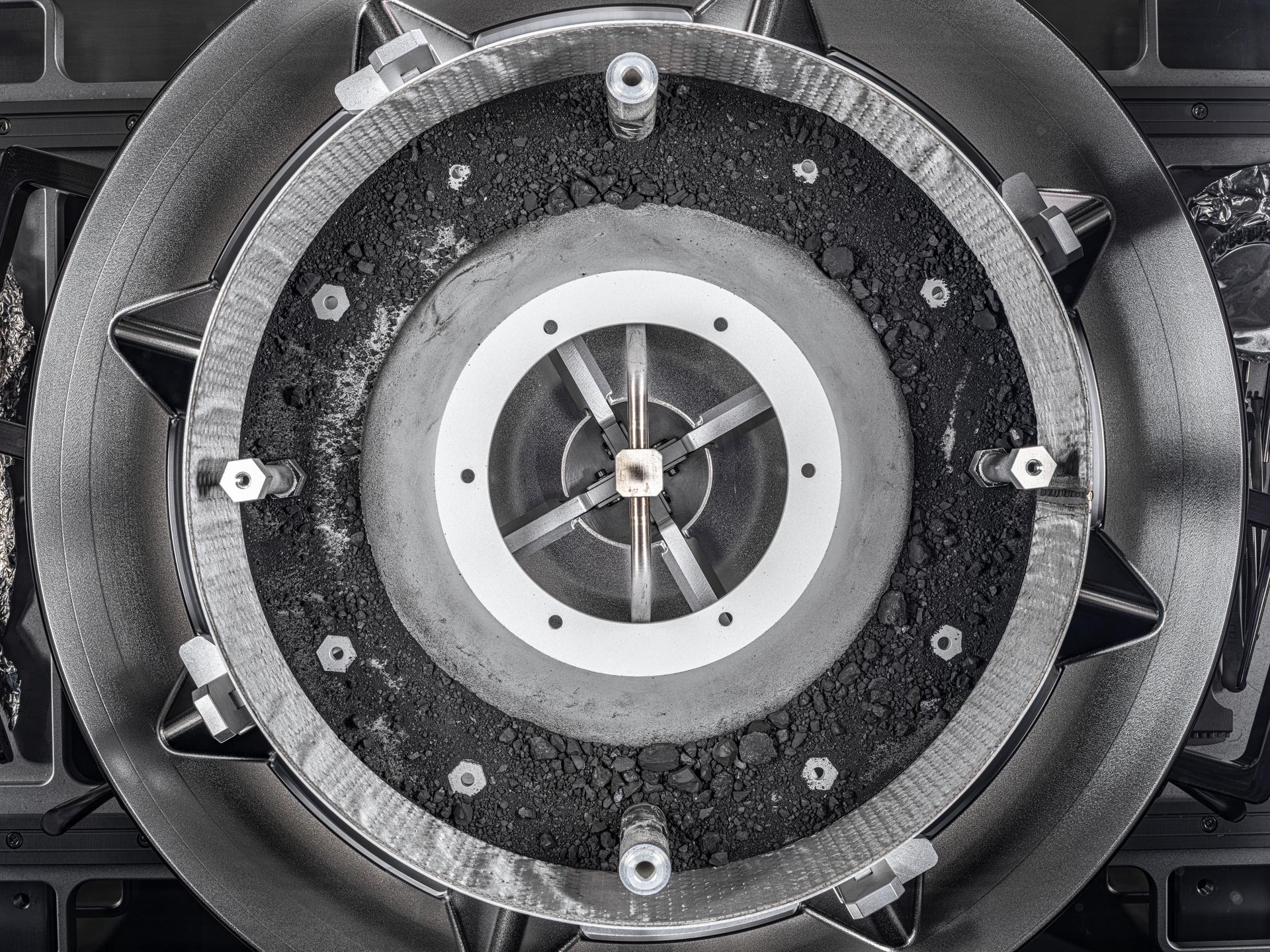
View of the OSIRIS-REx Touch-and-Go-Sample-Acquisition-Mechanism (TAGSAM) head with balky lid removed, unveiling the bulk of asteroid Bennu sample inside.
(Image credit: NASA/Erika Blumenfeld/Joseph Aebersold
Export control
I caught up with two leading scientists at the Univ. of Arizona’s “extraterrestrial export control central” now engaged in extracting what those darkish asteroid particles are illuminating, sorting out how these materials exported from Bennu came to be. But also what insights they hold for the origin of the worlds within our solar system, including Earth.
Go to my new Space.com story – “1st look at asteroid Bennu samples suggests space rock may even be ‘a fragment of an ancient ocean world’ – at:
https://www.space.com/asteroid-bennu-osiris-rex-samples-1st-look-surprises

Dante Lauretta, OSIRIS-REx’s principal investigator from the University of Arizona holds a mock up of the asteroid collection device – TAGSAM.
Image credit: Barbara David
 Posted in

Image credits: NASA/JPL-Caltech/ASU/Simeon Schmauß
NASA’s now off-duty and damaged Mars helicopter has been spotted by the Perseverance rover, the final resting place among the sand ripples in Neretva Vallis.

Image credits: NASA/JPL-Caltech/ASU/Simeon SchmaußA panorama has been assembled from six images taken by the rover’s right Mastcam-Z on Sol 1052.
Simeon Schmauß explains via X/Twitter that the images were up-scaled 2x and color processed to approximately match what the human eye would see.
After its 72nd flight on Jan. 18, 2024, NASA’s Ingenuity Mars Helicopter captured imagery of its rotor blades, damaged during touchdown.
Zooming in on Ingenuity's final resting place among the sand ripples in Neretva Vallis.
— Simeon Schmauß (@stim3on) February 5, 2024
Full resolution panorama: https://t.co/jbDkOAM5bB
Credit: NASA/JPL-Caltech/ASU/Simeon Schmauß #ThanksIngenuity #MarsHelicopter pic.twitter.com/EiBZYYjbZR

NASA’s Mars Perseverance rover acquired this image using its Right Mastcam-Z camera, a pair of cameras located high on the rover’s mast. This image was acquired on Feb. 4, 2024 (Sol 1052).
Image credit: NASA/JPL-Caltech/ASU

Ingenuity’s color camera acquired these post-flight damage images using its high-resolution color camera mounted in the helicopter’s fuselage.
Image credit: NASA/JPL-Caltech

Curiosity’s location as of Sol 4083, with distance driven at that time: 19.47 miles/31.33 kilometers.
Credit: NASA/JPL-Caltech/Univ. of Arizona
NASA’s Curiosity Mars rover at Gale Crater is now performing Sol 4086 duties.
Reports Sharon Wilson Purdy, a planetary geologist at the Smithsonian National Air and Space Museum in Washington, D.C., Curiosity continues its investigation of the light and dark banded sulfate terrain and started a two-sol (Sols 4084-4085) planning day with several beautiful rocks within the reach of the rover’s robotic arm.
“The rover is tantalizingly close to the base of the upper Gediz Vallis ridge and the team is very excited for the spectacular geology ahead,” Purdy adds.

Curiosity Left B Navigation Camera photo acquired on Sol 4085, February 2, 2024.
Image credit: NASA/JPL-Caltech
Flakey dark material
Mars researchers kicked off planning for sol 4084 by analyzing a finely layered rock named “Grizzly Lakes” with the dust removal tool (DRT), the Alpha Particle X-Ray Spectrometer (APXS) and Mars Hand Lens Imager (MAHLI) imaging.
Purdy explains that just beyond “Grizzly Lakes,” the robot’s Chemistry and Camera (ChemCam) and its Mastcam teamed up to characterize a crescent-shaped rock, “Gorge of Despair,” to investigate flakey dark material standing in relief on the surface of the rock.
The Mastcam team created a mosaic of the workspace in addition to three mosaics that characterized the local bedrock and sand at “Roads End,” “Knapsack Pass,” and “Rae Lake.”

Curiosity Right B Navigation Camera image taken on Sol 4085, February 2, 2024.
Image credit: NASA/JPL-Caltech
Small impact crater
Mastcam also took a mosaic of “Round Lake” to image what is likely a small impact crater, Purdy notes.
“We pushed the plan to the limit by including two long distance ChemCam Remote Micro-Imager (RMI) images of a dark band in the distance, and an outcrop along the upper Gediz Vallis Ridge to characterize the variety of rocks,” Purdy reports.
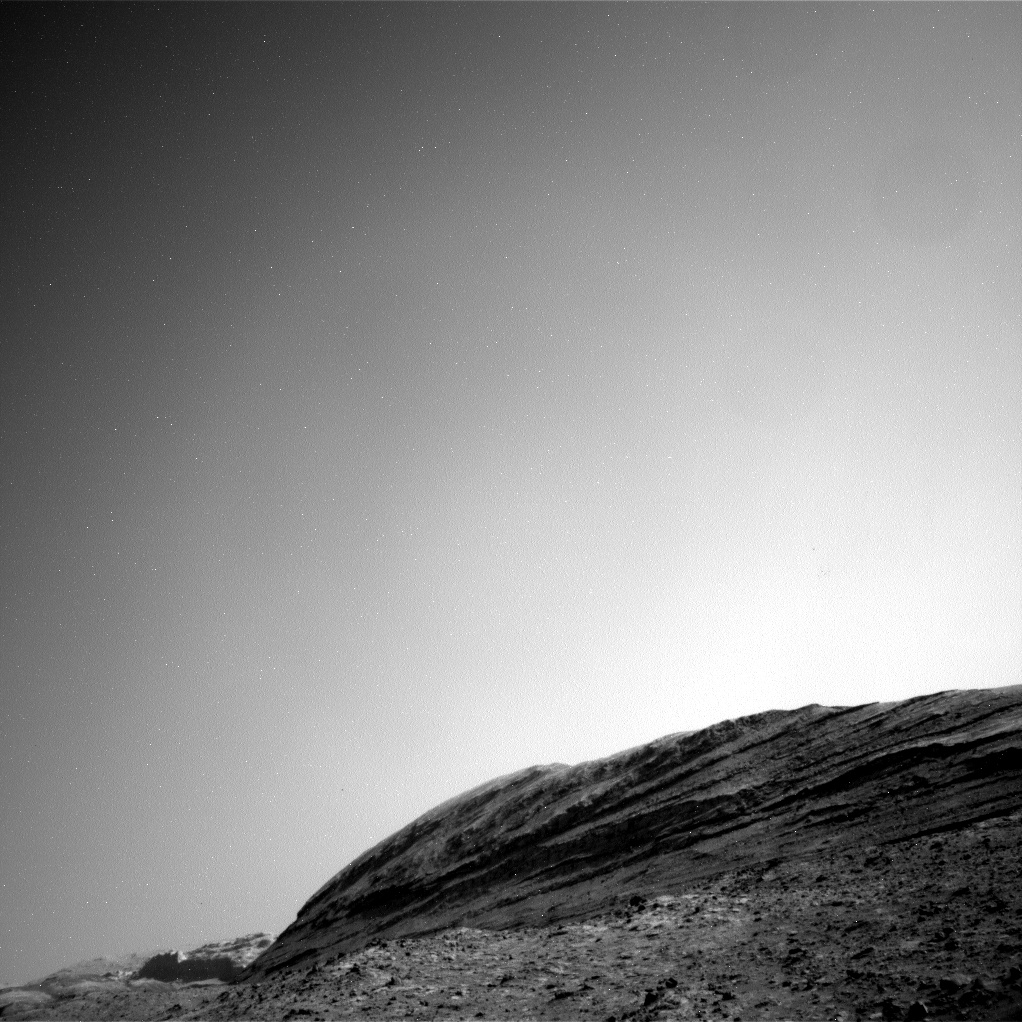
Curiosity Right B Navigation Camera image taken on Sol 4085, February 2, 2024.
Image credit: NASA/JPL-Caltech
Lastly, Mars team members included a Navcam mosaic of the view behind the rover, Purdy adds, to document several of the layers and buttes in Chenapau, Orinoco, and Kukenan that Curiosity drove by in recent months. “And then we hit the road!”
Mouth-watering vantage point
On the schedule is a planned drive of 33 feet (10-meters) that will put Curiosity on a “topographic bench,” Purdy explains, “that should provide a mouth-watering vantage point to document a section of the upper Gediz Vallis ridge that is informally named ‘Fascination Turret.’ We hope to evaluate the processes that deposited the sediment in this ridge to understand how it formed and how it was later eroded to its present-day form.”

Curiosity Right B Navigation Camera image taken on Sol 4085, February 2, 2024.
Image credit: NASA/JPL-Caltech
On the plan for Sol 4085, Mars researchers scheduled a ChemCam AEGIS activity.

Curiosity Left B Navigation Camera image acquired on Sol 4084, February 1, 2024.
Image credit: NASA/JPL-Caltech
Purdy explains that AEGIS is an acronym for Autonomous Exploration for Gathering Increased Science and is a mode where the rover identifies and selects a geological target from navigation camera images based on a set of guidelines set by scientists back here on Earth.
“Several environmental observations are included in the plan to monitor dust devil activity as well as zenith, suprahorizon, and Tau observations that will measure the amount of dust in the atmosphere,” Purdy concludes.

Curiosity Mast Camera (Mastcam) image produced on Sol 4084, February 2, 2024.
Image credit: NASA/JPL-Caltech/MSSS
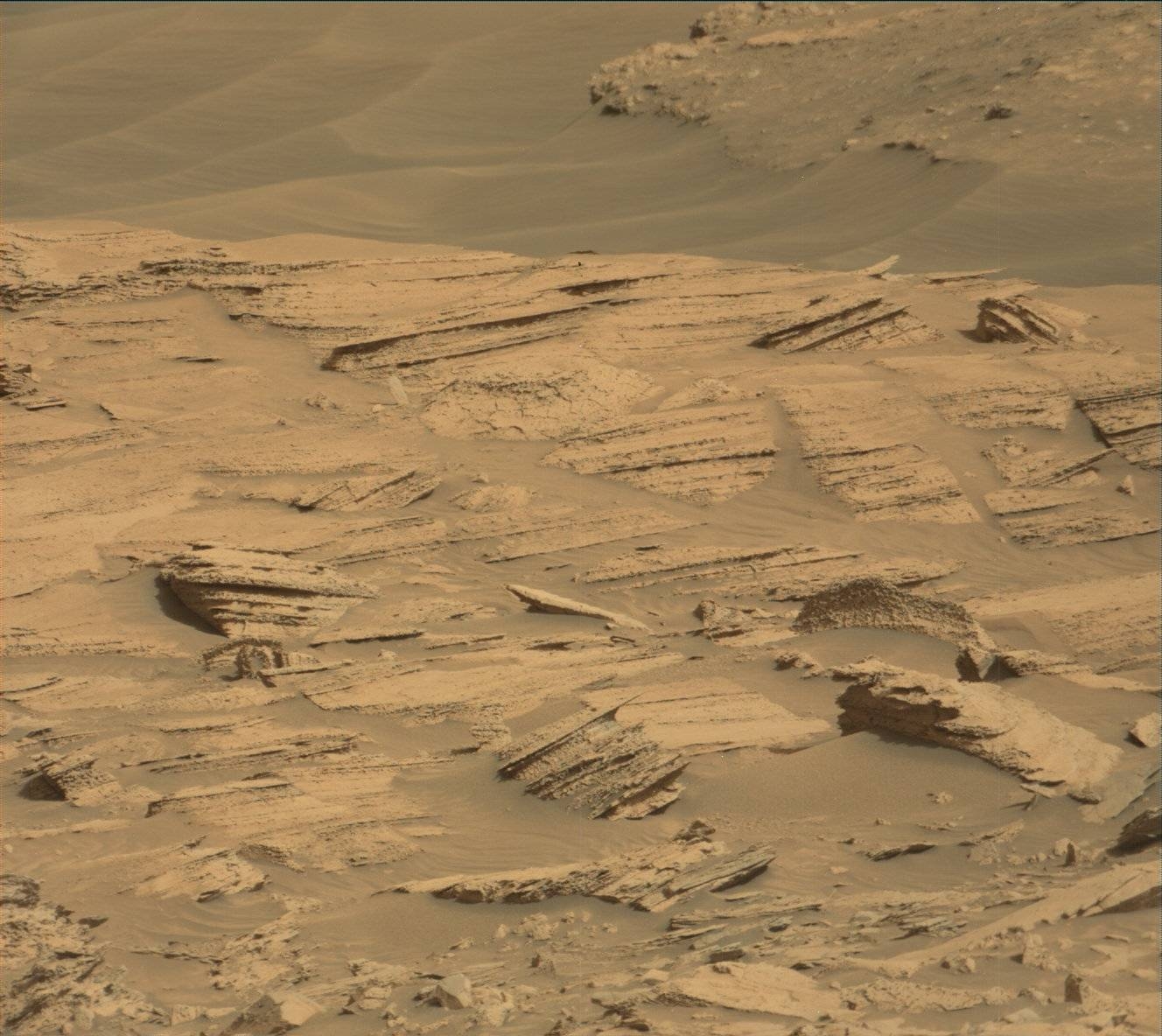
Curiosity Mast Camera (Mastcam) image produced on Sol 4084, February 2, 2024.
Image credit: NASA/JPL-Caltech/MSSS

The Intuitive Machines Odysseus Moon lander.. IM-1 mission is targeting Malapert-A crater near the Moon’s south pole.
Image credit: Intuitive Machines
Intuitive Machines is nearing launch of the company’s Nova-C class lunar lander, named Odysseus, via a SpaceX Falcon 9 rocket from NASA’s Kennedy Space Center in Florida.
This Intuitive Machines (IM-1) launch was selected through NASA’s Commercial Lunar Payload Services (CLPS) initiative in which NASA contracts with a commercial partner.
Given successful launch (possibly on Feb. 14 – Valentine’s Day), in-space operations, and Earth-to-Moon transfer maneuvers, Odysseus is to land near crater Malapert A near the south pole of the Moon.

Image credit: Intuitive Machines
Science objectives
The commercially built lander will carry five NASA payloads and commercial cargo.
As for the scientific objectives of the mission, they include studies of the lander’s plume-surface interactions, radio astronomy, and space weather interactions with the lunar surface.
Odysseus will also demonstrate precision landing technologies and communication and navigation node capabilities.
This Intuitive Machines lander is capable of operating for about 14 Earth days in lunar sunlight.
For more details, go to:
“Next Private Moon Lander Attempt to Fly in February” at:
https://www.leonarddavid.com/next-private-moon-lander-attempt-to-fly-in-february/
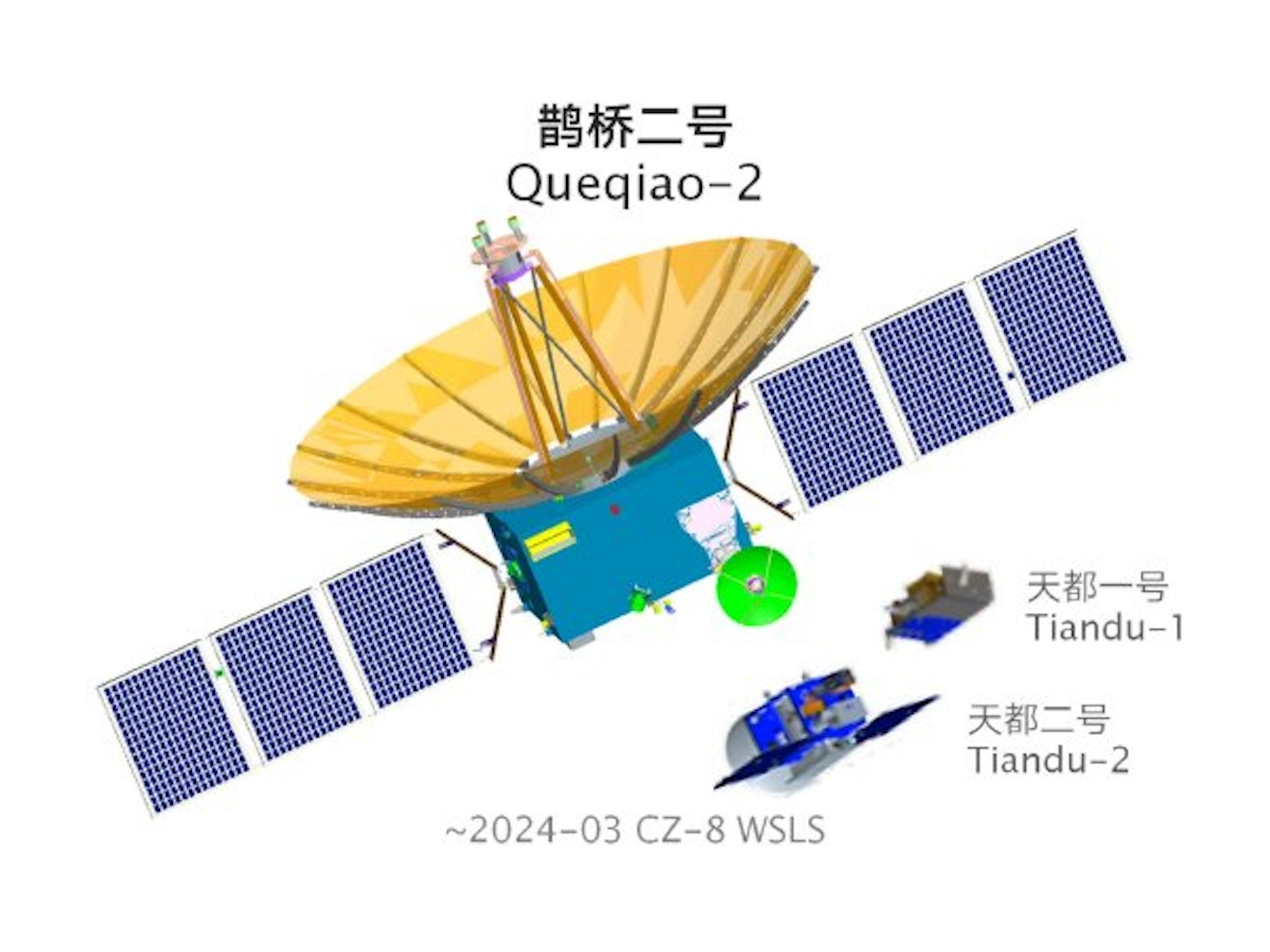
Image credit: CNSA
China’s Queqiao-2 – a relay satellite for the country’s Moon missions – arrived February 2 at the Wenchang launch center in south China’s Hainan Province.
According to China’s National Space Administration (CNSA), testing of the spacecraft will soon be underway with launch in the first half of this year.
Once on duty, Queqiao-2 will make use of a 4.2 meter parabolic antenna to enable communication between China’s lunar surface operations and ground controllers, providing relay support for the already on the Moon Chang’e-4, and upcoming missions of Chang’e-6, Chang’e-7 and Chang’e-8 robotic lunar probes.
Chang’e-6, to be launched later this year, is to attempt the first-ever sample return to Earth of lunar specimens from the Moon’s far side.

Image credit: CNSA
Fourth phase
Queqiao-2, or Magpie Bridge-2, is a key part of the fourth phase of China’s lunar exploration program, ahead of a projected human lunar expedition by 2030.
This new and upgraded relay sentinel follows Queqiao-1, launched in May 2018. It supported China’s Chang’e-4 mission. That robotic lander and Yutu rover mission made the first soft landing on the far side of the Moon back in January 2019.
Test satellites, science payloads
The upgraded Queqiao-2 relay reportedly will carry two Queqiao communication technology test satellites, Tiandu-1 and Tiandu-2 designed by China’s Deep Space Exploration Laboratory.

China’s Chang’e-6 lunar sample return mission elements.
Credit: CNSA
Queqiao-2 also totes a trio of scientific payloads: An extreme ultraviolet camera, an array neutral atom imager, and an Earth-Moon Very-long-baseline interferometry (VLBI) system.
To achieve better visibility of the Moon’s south pole region, the Queqiao-2 relay spacecraft is to be stationed in a stable, “frozen” elliptical orbit around the Moon.
Its designed lifetime is more than 8 years.
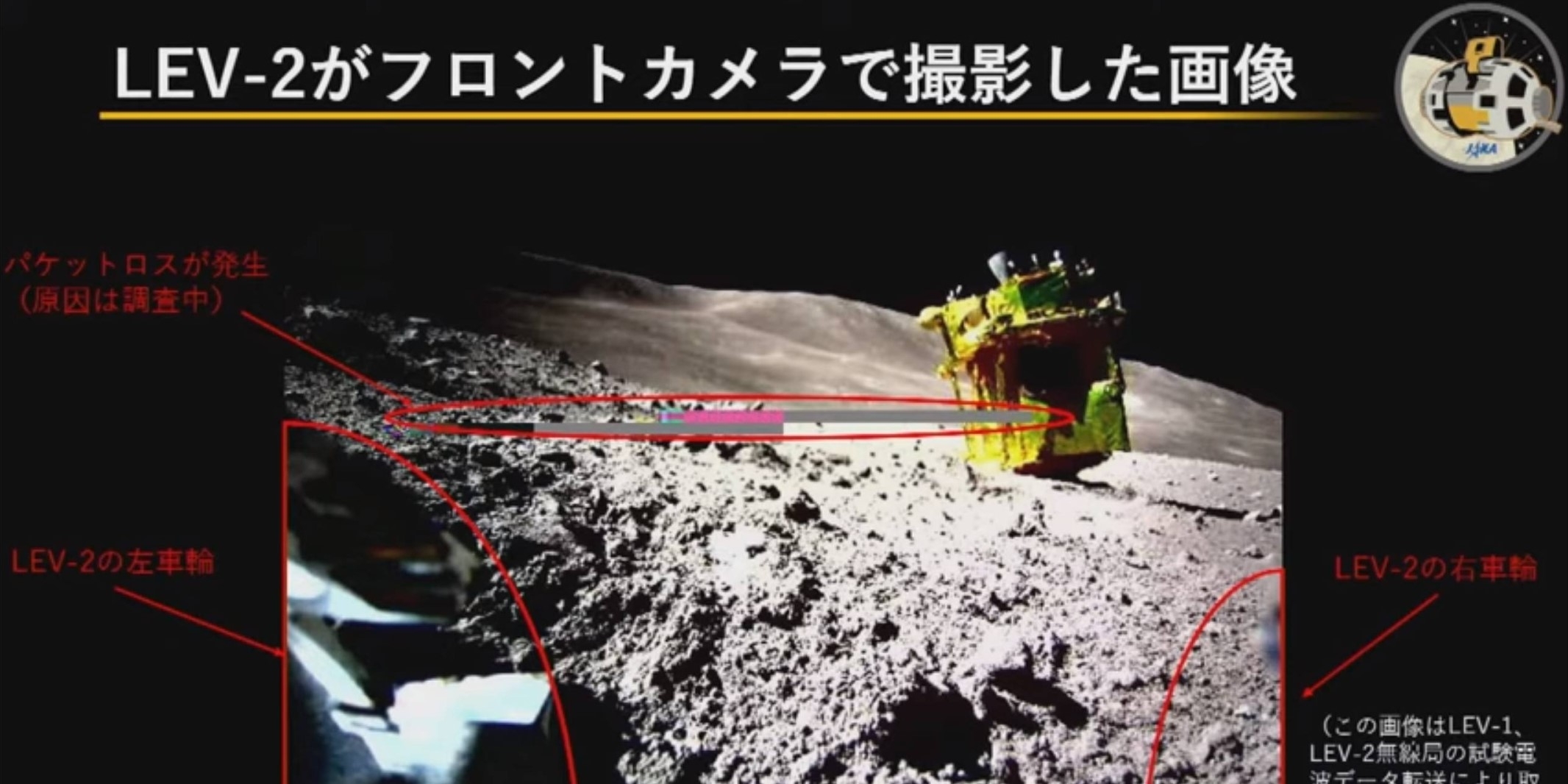
Ultra-small SORA-Q (LEV-2) photo of SLIM. Image credit: JAXA/Inside Outer Space screengrab
Japan’s SLIM lunar lander has now entered a dormant state, slipping into a two-week stint of sun-shy induced silence.
According to the Japan Aerospace Exploration Agency (JAXA) Institute of Space and Astronautical Science (ISAS), the ground control team for the Smart Lander for Investigating Moon (SLIM) said a last photo session was taken.

SLIM’s multi-band spectroscopic camera took this lunar landscape image created by synthesizing 257 low-resolution monochrome pictures. Based on this landscape image, the team is sorting out rocks of interest, assigning a nickname to each of them, with intent of communicating their relative sizes smoothly by the names.
Image credit: JAXA/Inside Outer Space screengrab
No response
“Last night [Jan. 31 into February 1] we sent a command to switch on SLIM’s communicator again just in case, but with no response, we confirmed SLIM had entered a dormant state.”
SLIM was launched last year, on September 6, 2023. Japan’s SLIM lander touched down on the Moon on January 19, making Japan the 5th nation to land on lunar territory.
Harsh lunar night
The spacecraft has now entered a two week dormancy period, a 14-day lunar night, 14-day lunar day cycle.

Image credit: JAXA/ISAS
“Although SLIM was not designed for the harsh lunar nights, we plan to try to operate again from mid-February, when the Sun will shine again on SLIM’s solar cells,” a JAXA/ISAS X/Twitter posting explained.
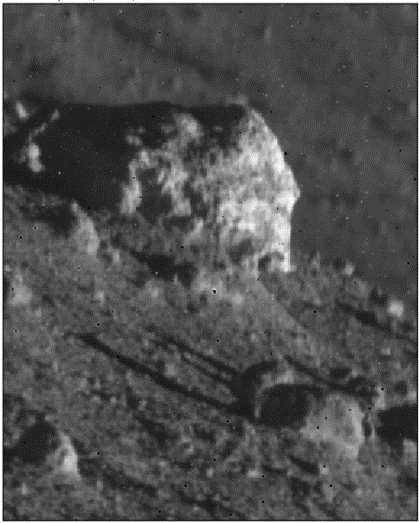
Image credit: JAXA/ISAS
Despite a failed rocket motor engine that led to blowing off its thruster nozzle, the craft made an unplanned “nose down” landing.
Descent landing woes aside, SLIM’s autopilot guidance led to a near pinpoint touchdown near Shioli crater – a goal of the mission.
Multiple robot exploration
Carried by SLIM was a multiband spectroscopic camera that relayed images before the craft’s power ebbed.

Image credit: JAXA/ISAS
In addition, imagery of the SLIM’s final, nose-down landing locale was taken by the SORA-Q, a baseball-sized mobile rover – a transformer-like toy device produced by the Takara Tomy Corporation.
During SLIM’s lunar descent, the ultra-small SORA-Q, dubbed LEV-2, was ejected. So too was LEV-1, a sidekick robot that executed leaping movements across the lunar landscape, including inter-robot test radio wave data transmission from the transformable lunar robot, LEV-2.

Artwork depicts the palm-sized Lunar Excursion Vehicle, LEV-2.
Image credit: JAXA/ISAS
LEV 1 and LEV 2 are the world’s first completely autonomous robots to explore the Moon, and the world’s first simultaneous lunar surface exploration by multiple robots, according to a JAXA statement.
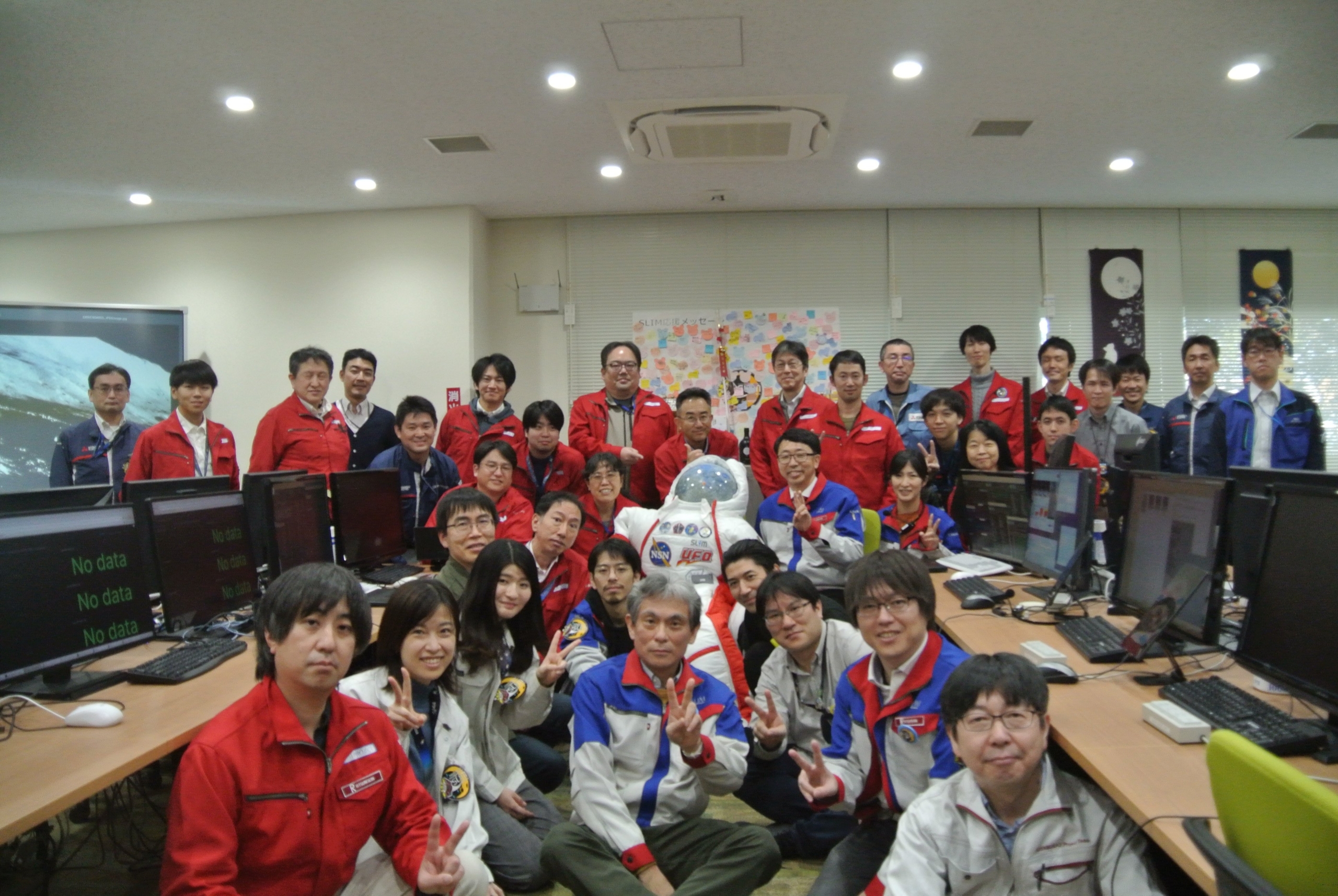
Japan’s SLIM team.
Image credit: JAXA/ISAS

