Archive for February, 2024
 Author:
  February 16th, 2024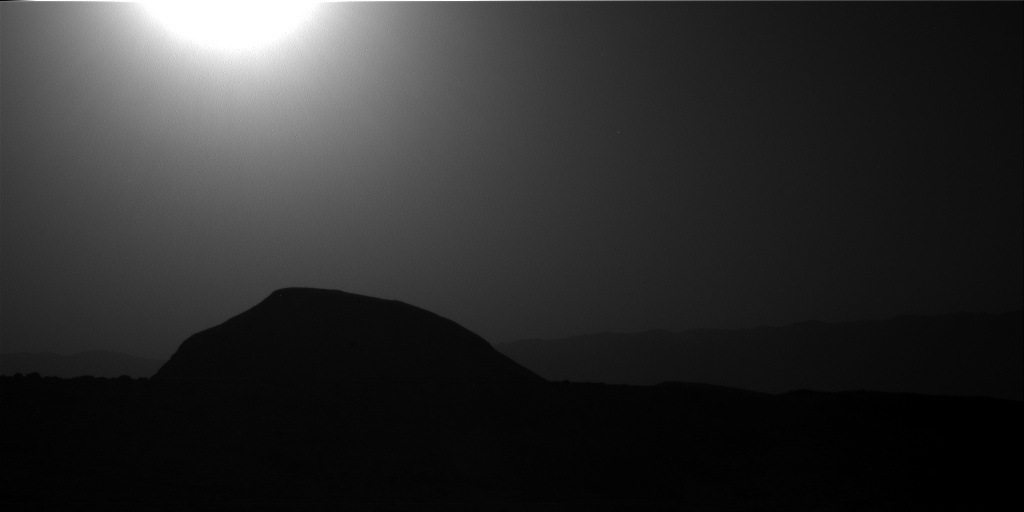
Curiosity Right B Navigation Camera photo acquired on Sol 4098, February 15, 2024.
Image credit: NASA/JPL-Caltech
NASA’s Curiosity Mars rover at Gale Crater is now performing Sol 4099 duties.
Alex Innanen, an atmospheric scientist at York University in Toronto, Ontario, reviews the rover’s new workspace. “There’s a lot to look at — different textures, different colors, different shapes.”
One of these is a contact science target, “Horseshoe Meadows,” a section of bedrock that is redder than what Mars researchers have been seeing recently.
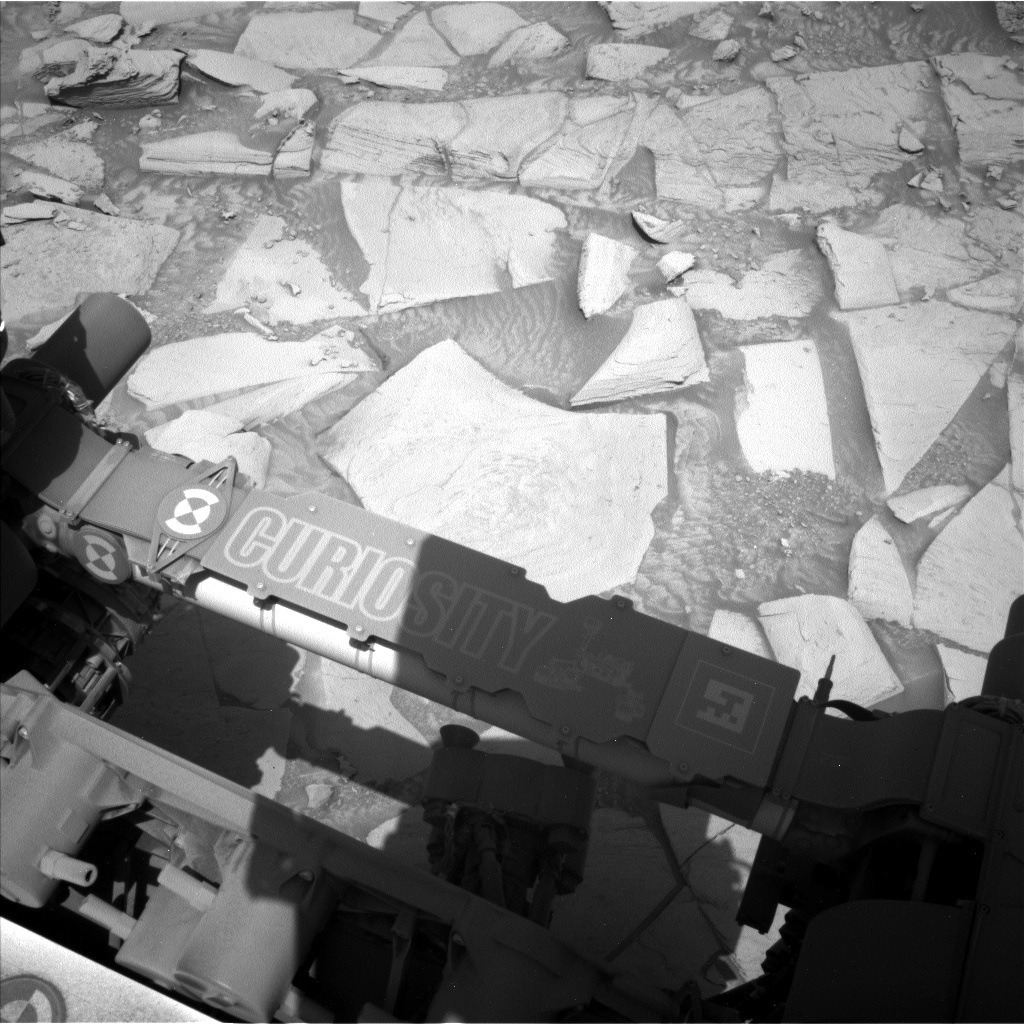
Curiosity contact science target, “Horseshoe Meadows,” is a section of bedrock observable in this image, right above where “Curiosity” is written. This image was taken by Left Navigation Camera on Sol 4096 February 13, 2024.
Image credit: NASA/JPL-Caltech
Familiar target
After the robot’s Alpha Particle X-Ray Spectrometer (APXS) takes a look, the science team is set to move into a main science block, Innanen points out, which starts with a session using Chemistry & Camera (ChemCam) Laser Induced Breakdown Spectroscopy (LIBS) on a different bedrock target, “Post Corral Creek.”
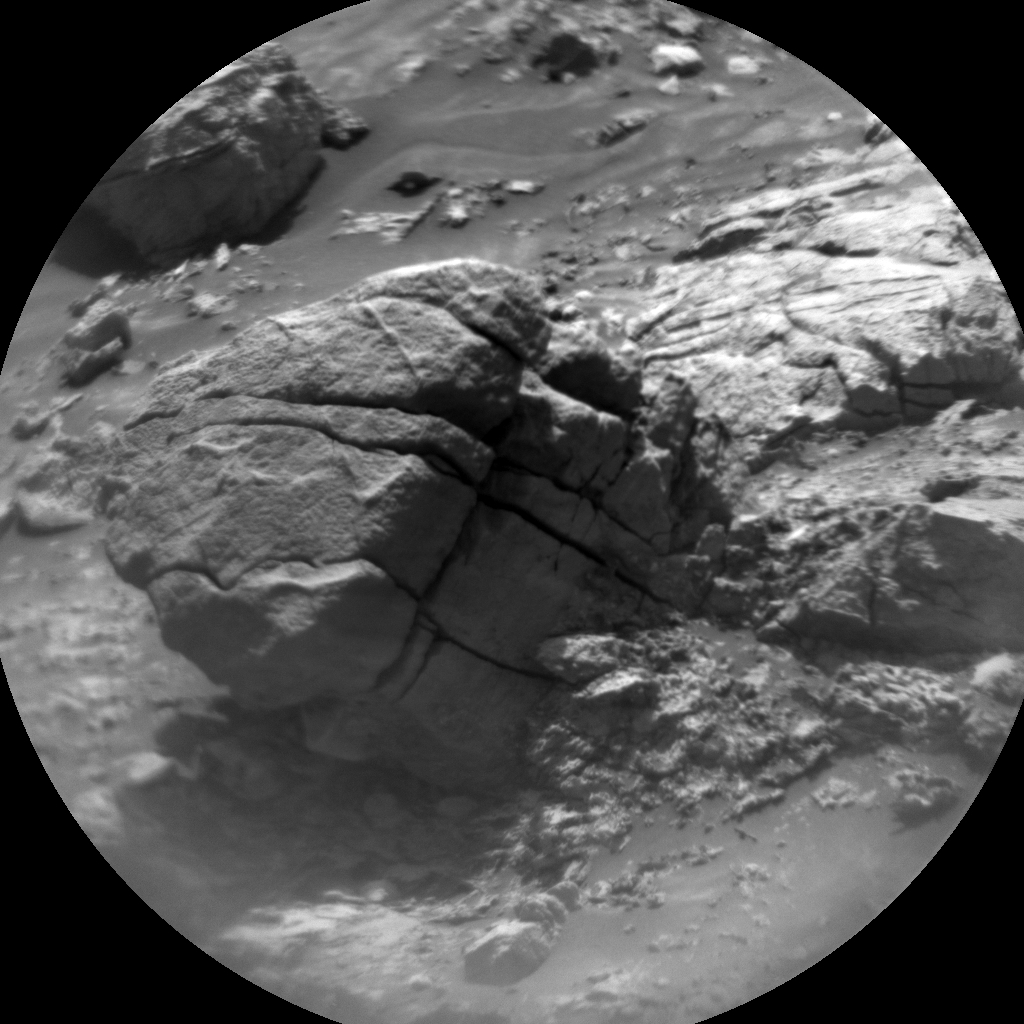
Curiosity Chemistry & Camera (ChemCam) Remote Micro-Imager (RMI) photo taken on Sol 4098, February 15, 2024.
Image credit: NASA/JPL-Caltech/LANL
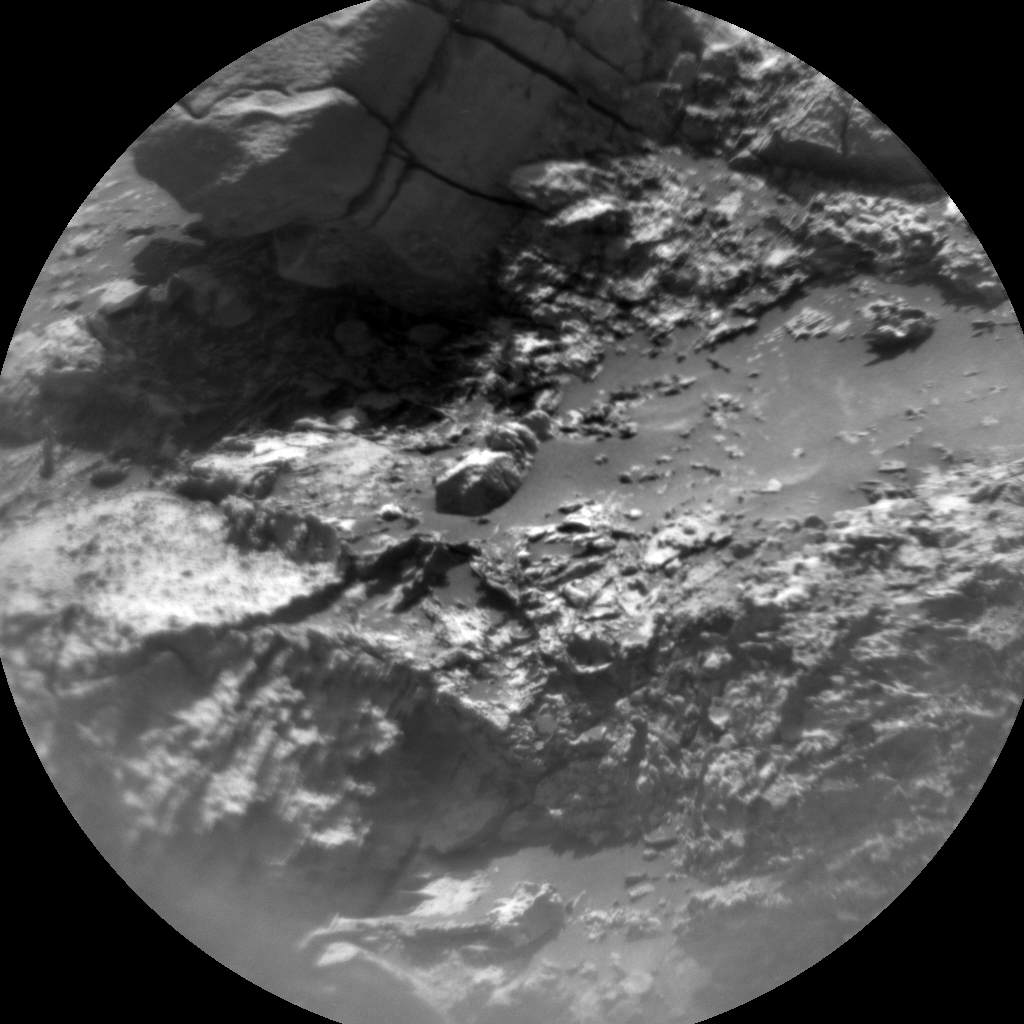
Curiosity Chemistry & Camera (ChemCam) Remote Micro-Imager (RMI) photo taken on Sol 4098, February 15, 2024.
Image credit: NASA/JPL-Caltech/LANL
“ChemCam will then set its sights further afield to a familiar target, Fascination Turret,” which Mastcam examined earlier.
Old friend
Mastcam was scheduled to start imaging two mosaics of the upper Gediz Vallis Ridge “and an old friend, the Orinoco Butte, which has been a regular companion of Curiosity for many, many sols,” Innanen adds.
Mastcam will also join ChemCam in imaging “Post Corral Creek.”
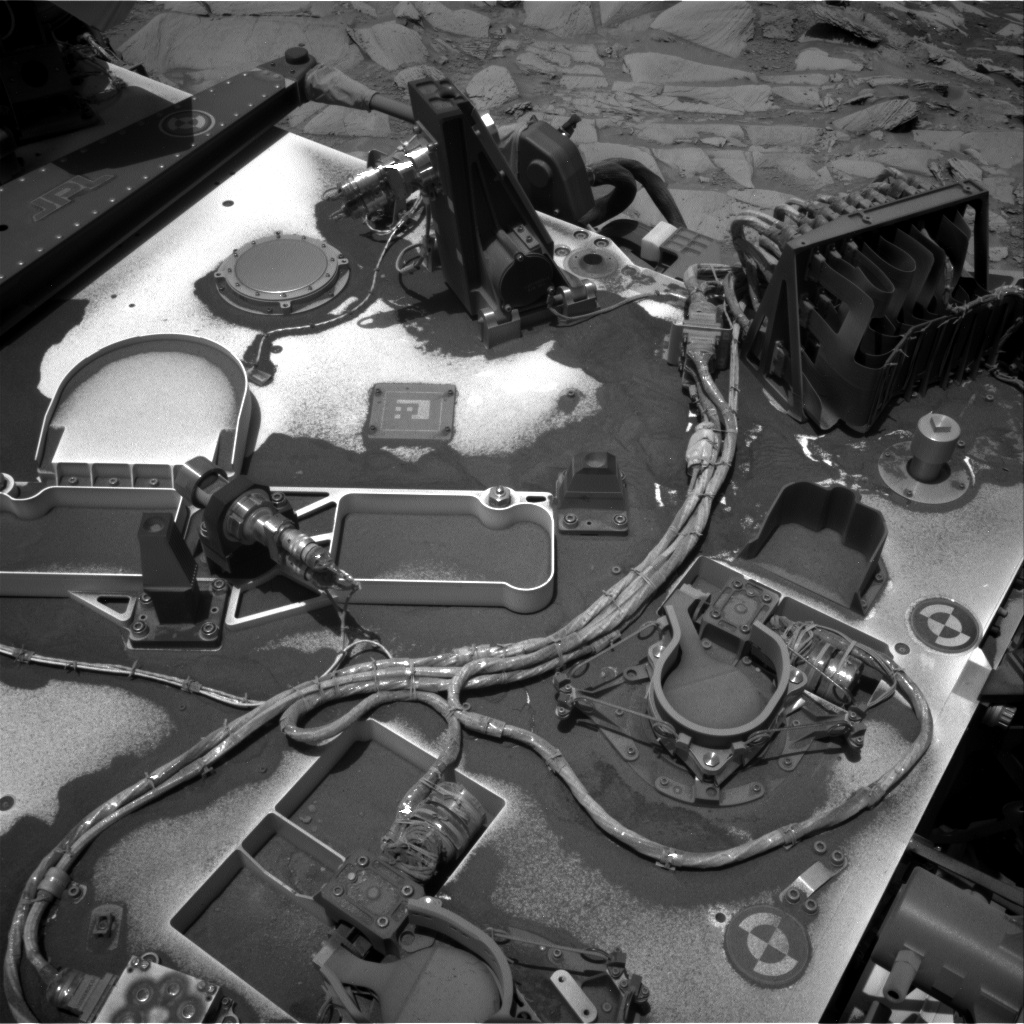
Curiosity Right B Navigation Camera photo acquired on Sol 4098, February 15, 2024.
Image credit: NASA/JPL-Caltech
“The science block finishes up with a deck monitoring image. We’ve been taking these recently before and after every drive to see how the dust that collects on the rover deck changes because of things like driving or wind,” Innanen reports.
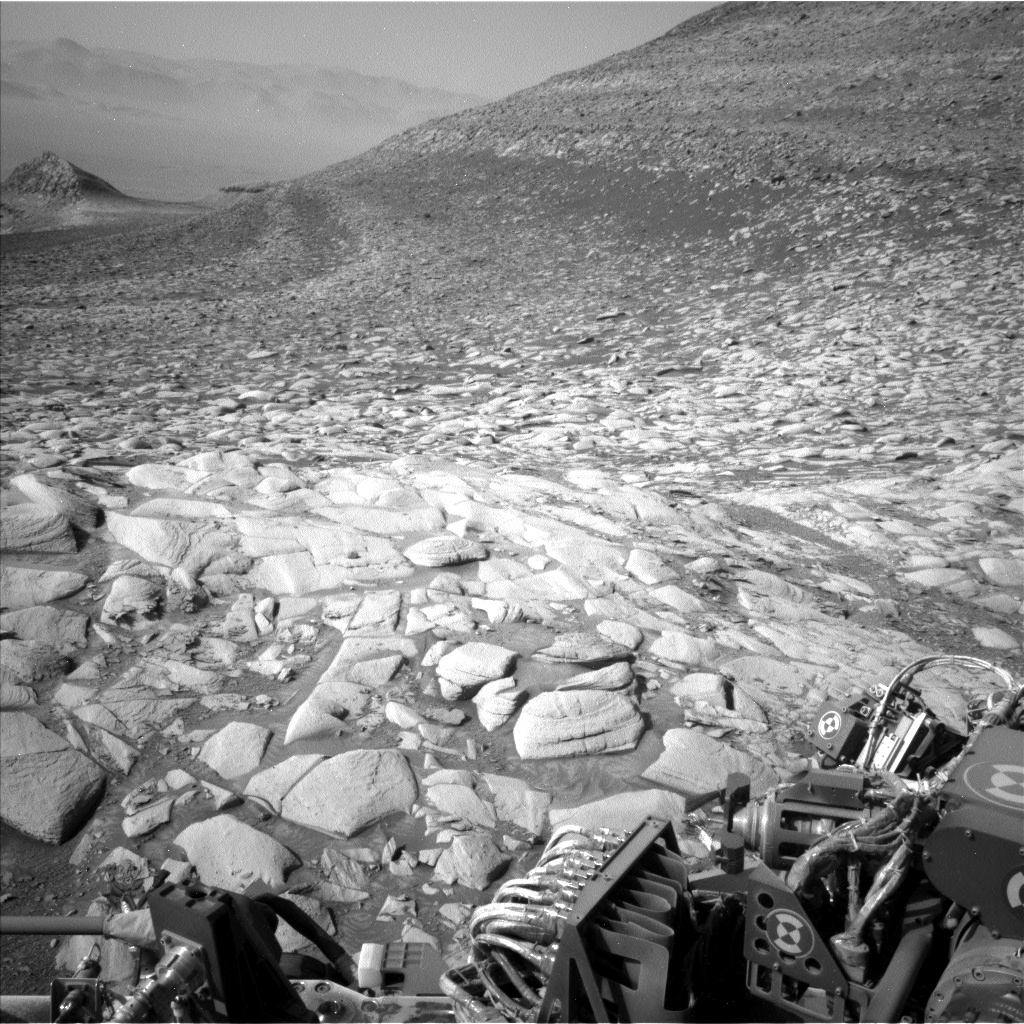
Curiosity Left B Navigation Camera on Sol 4098, February 15, 2024.
Image credit: NASA/JPL-Caltech
Bid farewell
After the science block, the plan is to return to Horseshoe Meadows with Curiosity’s Dust Removal Tool (DRT) and the Mars Hand Lens Imager (MAHLI), “and then it’s time to bid farewell to this workspace and drive away.”
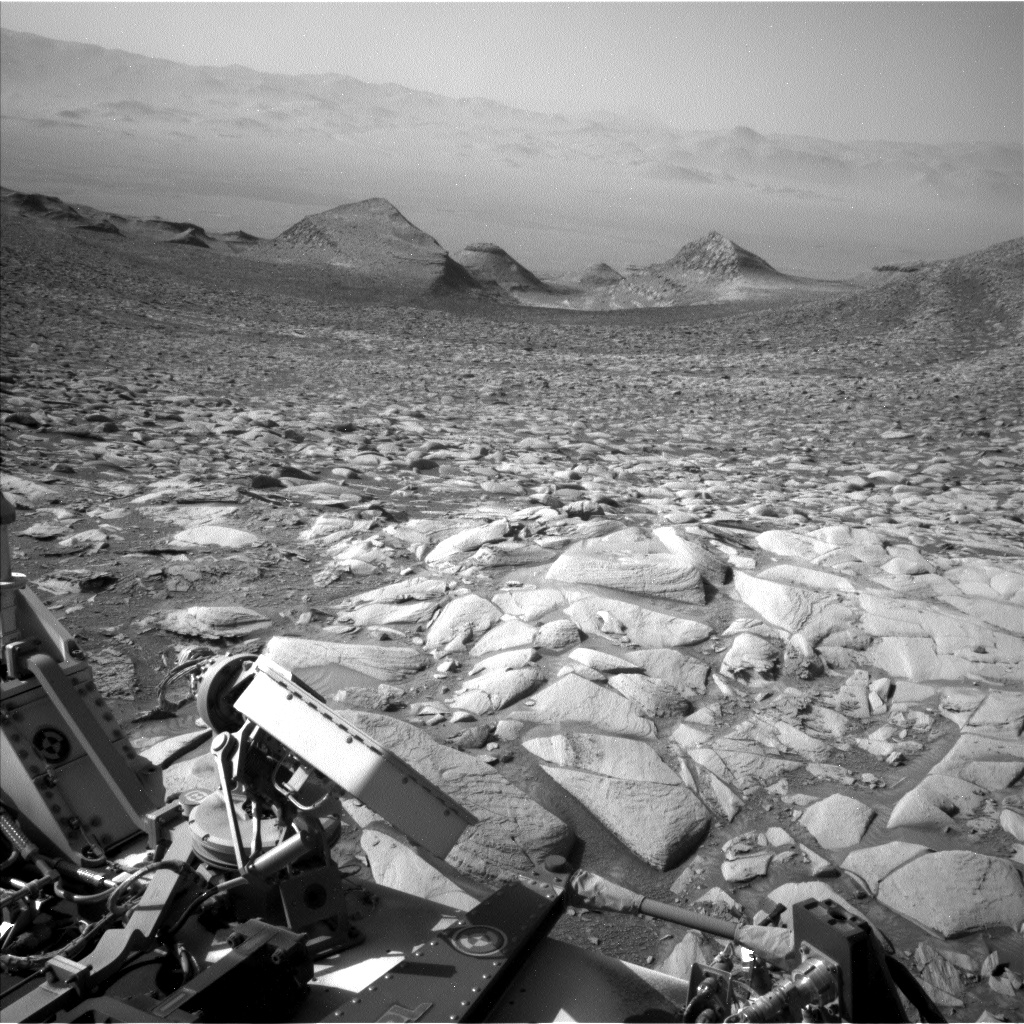
Curiosity Left B Navigation Camera on Sol 4098, February 15, 2024.
Image credit: NASA/JPL-Caltech
Sol 4098 was not set to end there, though. “After the drive we have another science block to sneak in some later afternoon environmental activities. These include a Mastcam observation and Navcam line of sight to look at dust in the atmosphere and a dust devil survey to look for dust being lifted from the ground as well as a cloud movie,” says Innanen.
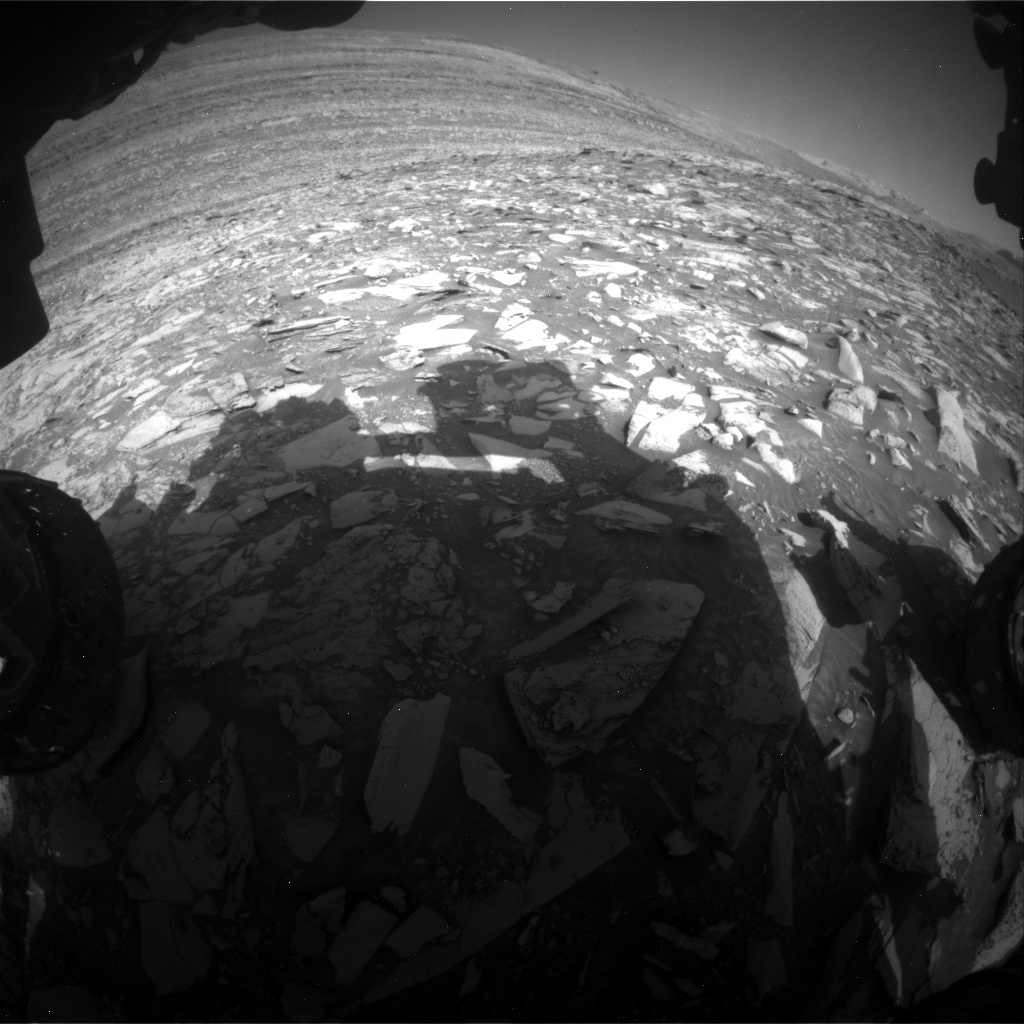
Curiosity Front Hazard Avoidance Camera Left B photo taken on Sol 4098, February 15, 2024.
Image credit: NASA/JPL-Caltech
Robot nap
Curiosity’s Sol 4099 was slated to not only have one science block a little before noon which includes a ChemCam AEGIS activity, a post-drive deck monitoring, another cloud movie and a long dust devil movie.
AEGIS stands for Autonomous Exploration for Gathering Increased Science) – a software suite that permits the rover to autonomously detect and prioritize targets.
“Once that’s wrapped up, Innanen concludes, “Curiosity will nap for the rest of the sol in preparation for a weekend plan.”
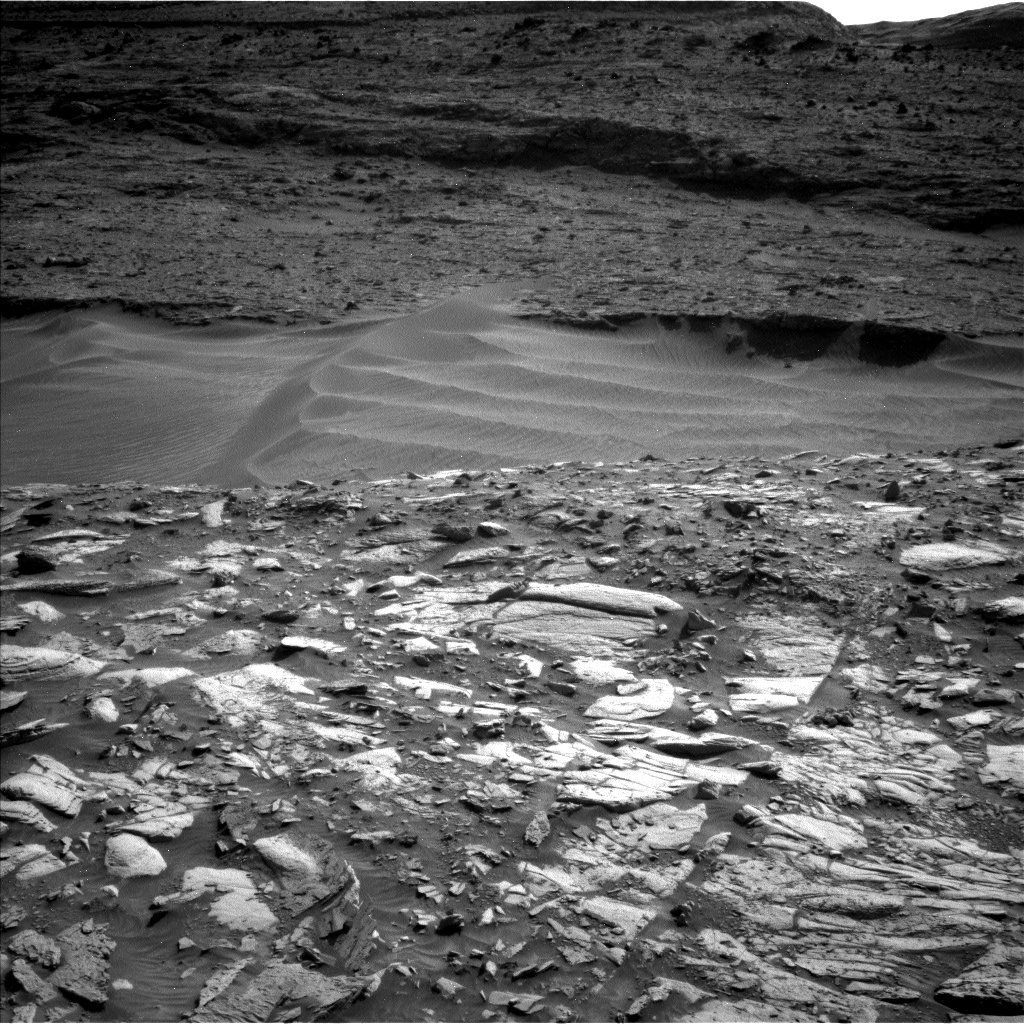
Curiosity Left B Navigation Camera on Sol 4098, February 15, 2024.
Image credit: NASA/JPL-Caltech
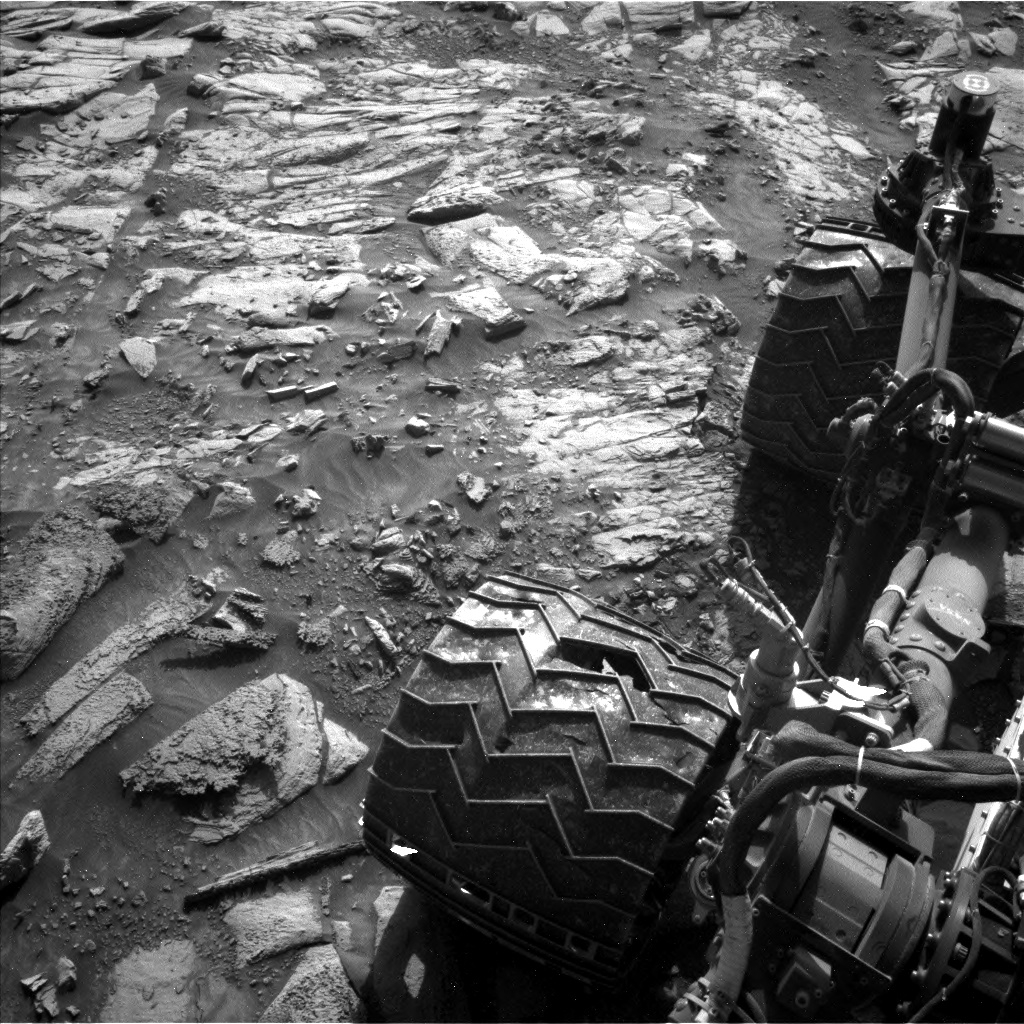
Curiosity Left B Navigation Camera on Sol 4098, February 15, 2024.
Image credit: NASA/JPL-Caltech
 Posted in

NASA’s Origins Spectral Interpretation Resource Identification Security Regolith Explorer (OSIRIS-REx) Courtesy: Lockheed Martin
The final count is in – 121.6 grams (4.29 ounces)!
That’s the total amount of collected bits and pieces of asteroid Bennu here on Earth, courtesy of NASA’s Origins Spectral Interpretation Resource Identification Security Regolith Explorer (OSIRIS-REx) mission.
The capsule containing the extraterrestrial goodies landed last September, parachuting into the Department of Defense Dugway Proving Ground in the Utah Test and Training Range, roughly 80 miles west of Salt Lake City, Utah.
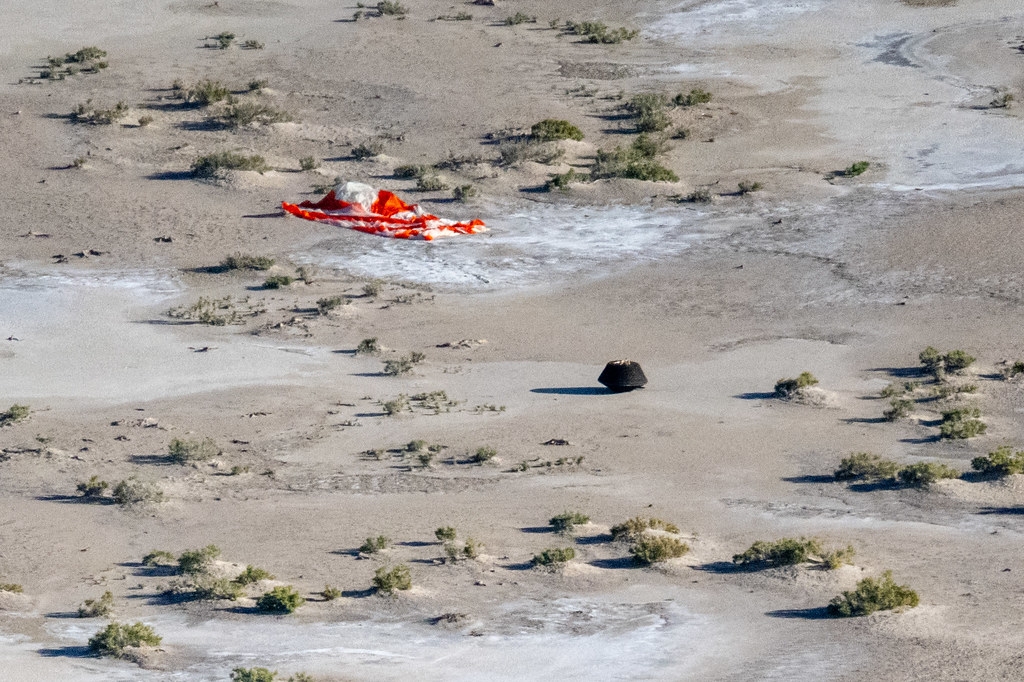
Following its high-speed re-entry, the OSIRIS-REx sample return capsule served as an artificial meteor before parachuting into the desert landscape of the Department of Defense’s Utah Test and Training Range.
Image credit: NASA/Keegan Barber
Due to hard-to-remove fastners, specialists were initially thwarted opening the Touch-and-Go Sample Acquisition Mechanism (TAGSAM) – where the bulk of Bennu collectibles were stored.
That issue was resolved in January.
Big reveal
The samples from afar include the rocks and dust found on the outside of the sampler head, as well as a portion of the bulk sample from inside the head, which was accessed through the head’s mylar flap.
What was not known was how much additional material remained inside the sampler head, to be added to the mass total.
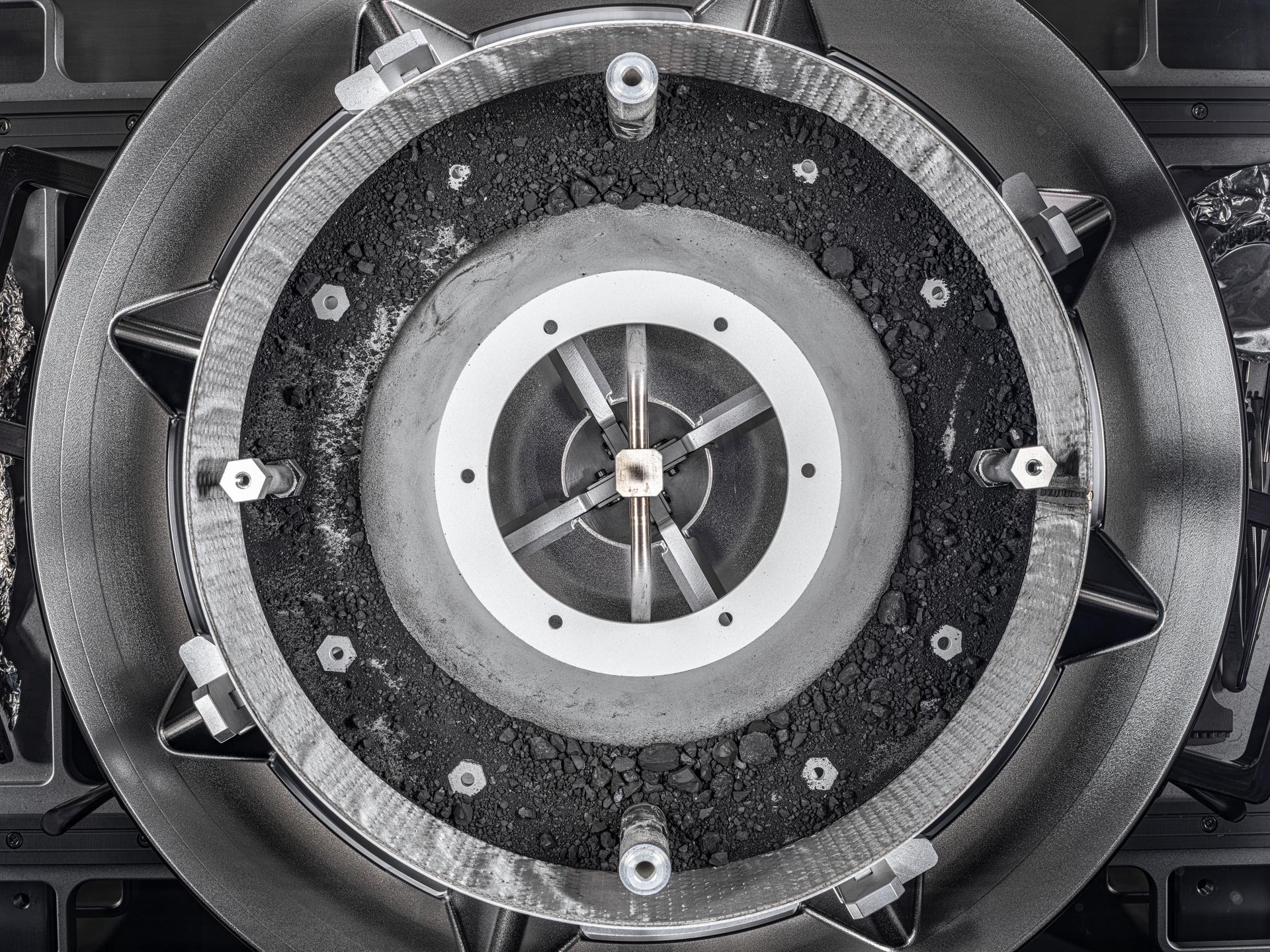
View of the OSIRIS-REx Touch-and-Go-Sample-Acquisition-Mechanism (TAGSAM) head with balky lid removed, unveiling the bulk of asteroid Bennu sample inside.
(Image credit: NASA/Erika Blumenfeld/Joseph Aebersold
The big reveal just announced by NASA:
The remaining Bennu sample was recently poured into wedge-shaped containers, amounting to 1.81 ounces (51.2 grams).
Final total
Combined with the previously measured 2.48 ounces (70.3 grams) and additional particles collected outside of the pour, the bulk Bennu sample mass totals 4.29 ounces (121.6 grams), NASA reports.
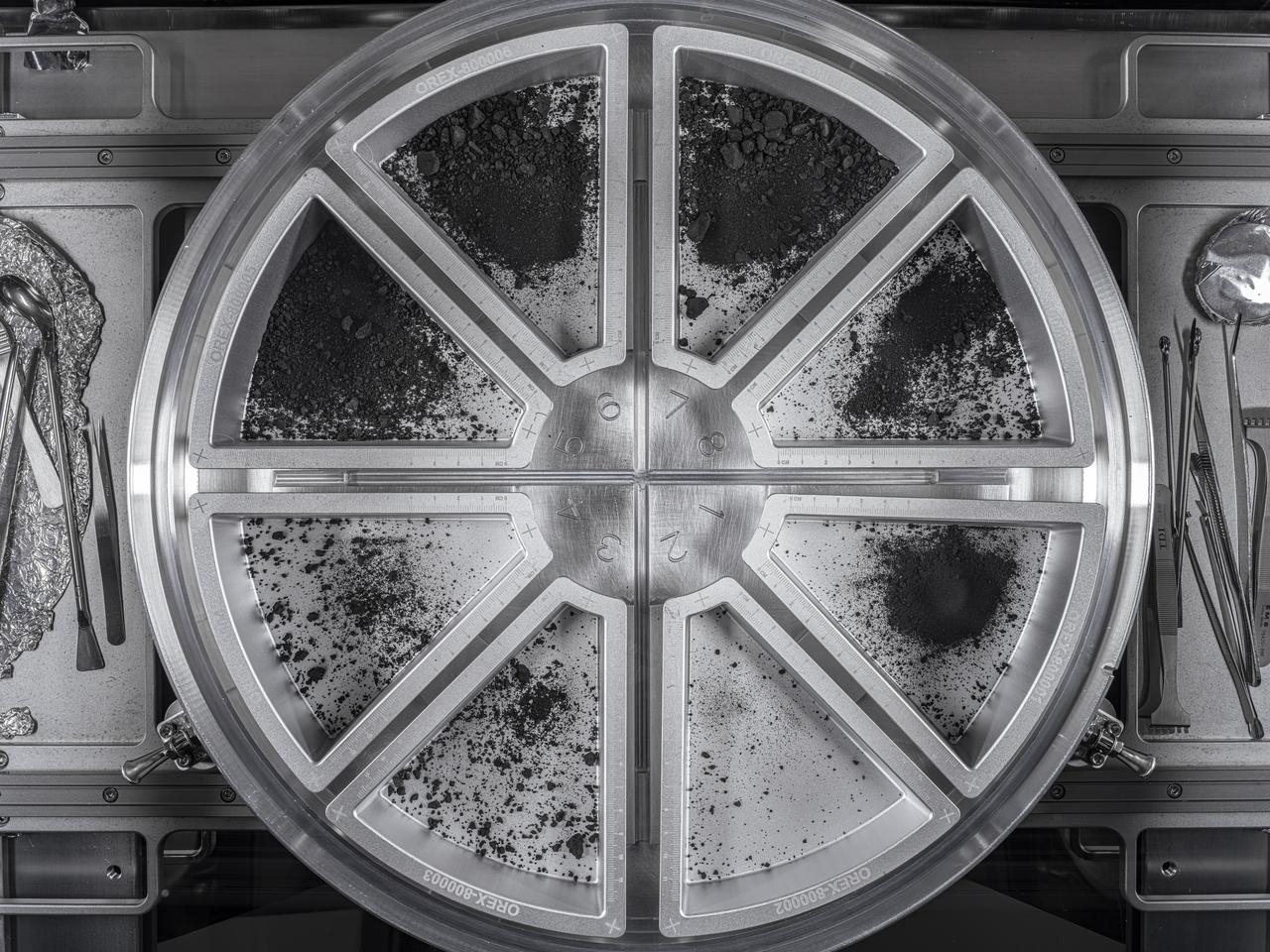
A view of eight sample trays containing the final material from asteroid Bennu. The dust and rocks were poured into the trays from the top plate of the Touch-and-Go Sample Acquisition Mechanism (TAGSAM) head. 51.2 grams were collected from this pour, bringing the final mass of asteroid sample to 121.6 grams. Image credit: NASA/Erika Blumenfeld & Joseph Aebersold
That final total is a little less than what OSIRIS-REx researchers originally thought snagged by the spacecraft – but twice what was promised prior to launching the asteroid mission on Sept. 8, 2016. The goal of the enterprise was to bring at least 60 grams to Earth.
Go to my earlier Space.com story on what’s being learned by analyzing the Bennu samples. Take a read of “1st look at asteroid Bennu samples suggests space rock may even be ‘a fragment of an ancient ocean world’” at:
https://www.space.com/asteroid-bennu-osiris-rex-samples-1st-look-surprises

Dante Lauretta, OSIRIS-REx’s principal investigator from the University of Arizona holds a mock up of the asteroid collection device – TAGSAM.
Image credit: Barbara David

Ambassadors ready to board Zero-G plane. From left to right is (top row) Mary Cooper, Dr. Sheri Wells-Jensen, Eric Shear, Apurva Varia, Sina Bahram, Zuby Onwuta, Dr. Mona Minkara, Viktoria Modesta, (bottom row) Sawyer Rosenstein, Dana Bolles, Eric Ingram, and Ce–Ce Mazyck. The four individuals in front are seated in wheelchairs, the two standing Ambassadors flanking the group each have visible prosthetic legs, and one of the blind Ambassadors is holding a white cane.
Image credit: AstroAccess
We are in a golden age of human spaceflight due to both governmental and private capabilities and knowhow.
To help enhance the roster of public space travel participation, attention is being paid to disabled and mixed ability individuals.
Exploratory research on parabolic zero-gravity flights has been performed underscoring the fact that disabled individuals can operate safely and effectively in weightless environments.
A new research paper highlights what types of technologies offer promising solutions for accessible design of space habitats, suits, and tools. The work also notes what accommodations can enable future disabled astronauts to operate safely in space.

An Ambassador used both hands to remove a prosthetic foot from her left leg. She is mostly floating with her other toe touching the floor.
Image credit: AstroAccess
AstroAccess
In the past, Disabled individuals have been excluded from human spaceflight opportunities in both the public and rapidly growing private sector, notes the paper: “AstroAccess: Testing accessibility accommodations for disabled and mixed-ability crews operating in space-like environments.”
That exclusion is due to perceptions that Disabled individuals “lack the physical endurance or capacity to function in extreme environments, ability to perform rigorous or dexterous athletic activity, or the ability to operate effectively as part of a team with nondisabled individuals,” the paper explains.
“Such perceptions are born from broadly pervasive and harmful societal assumptions about their ability to act and live independently,” the paper points out, “and from the lack of motivation on the part of individuals and institutions to invest in making the necessary modifications to our physical environments and daily behaviors required to make society more accessible.

NASA Gallaudet research participants chat in sign language while sitting in a zero gravity aircraft before take-off.
Image credit: U.S. Navy/Gallaudet University collection
While no public space agency has yet to “officially” fly a Disabled astronaut, the paper observes that individuals with conditions that may be considered disabilities in some contexts have been to space. They include NASA shuttle astronaut, Rich Clifford, with early signs of Parkinson’s, NASA’s Scott Kelly with Attention-deficit/hyperactivity disorder (ADHD), and Haley Arceneaux of the private Inspiration4 mission, a bone cancer survivor with an artificial femur.
Gallaudet Eleven
The paper spotlights NASA’s own history, flagging the space agency’s recruitment of the “Gallaudet Eleven.” This select group of deaf men back in the 1960s offered NASA insight into the effects of spaceflight on the body.
“Since they had sustained damage to their vestibular systems, they were immune to motion sickness and therefore able to endure physical challenges while being subjected to rotation, high acceleration forces, and weightlessness they may experience in space without becoming nauseous,” the paper reports.
“Unfortunately, this very advantage which made them excellent candidates for research,” the paper adds, “would have disqualified them from applying for astronaut candidacy.”
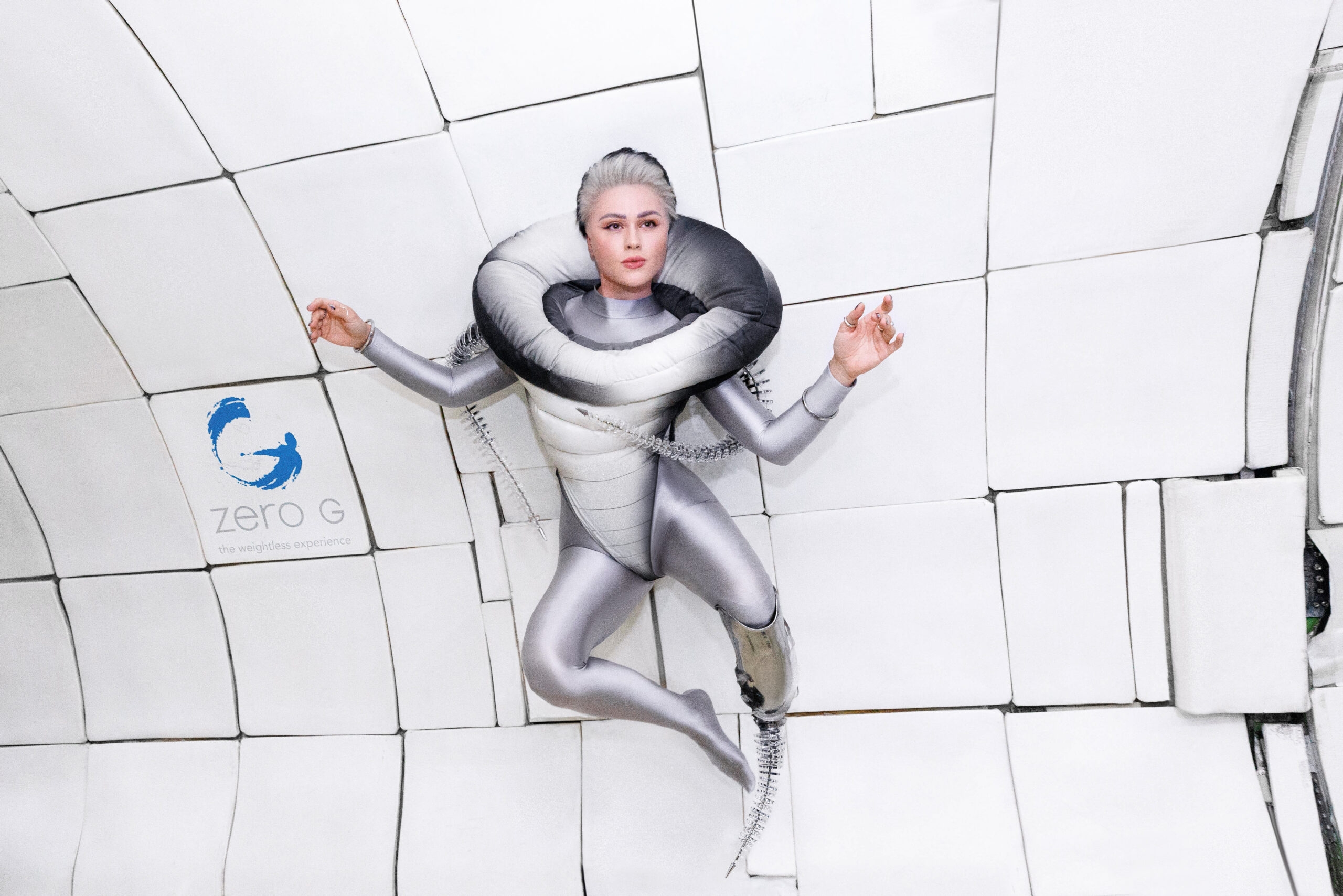
Image credit: AstroAccess
Ambassadors for microgravity
Fast forward to today.
Enter AstroAccess with its mission to allow the next generation of disabled scientists, students, athletes and artists to see that science, technology, engineering, and mathematics (STEM) is truly possible for them.
To bolster the cause, AstroAccess is advancing research on disability and human spaceflight by flying Disabled researchers on parabolic flights that produce stints of weightlessness.
Called the “Ambassadors,” these specifically recruited individuals came from three broad categories: Blind/Low Vision, Deaf/Hard of Hearing, and Mobility Disabilities.
“These categories do not represent the full spectrum of types of disabilities, but it was necessary to limit the scope of our efforts given the small size of the flight crew and the initial questions we wished to investigate,” the paper elucidates.
Evolving project
Since October 2021, AstroAccess Ambassadors have participated in five parabolic flights making use of the Zero Gravity Corporation’s spiffed up G-FORCE ONE Boeing aircraft.
Among the findings is that communication and way finding are primary challenges to mixed ability crews. Furthermore, for inclusive human spaceflight, redesign of emergency response systems is critical. Also, redundancy using varied solutions is key to accessible design and operations.
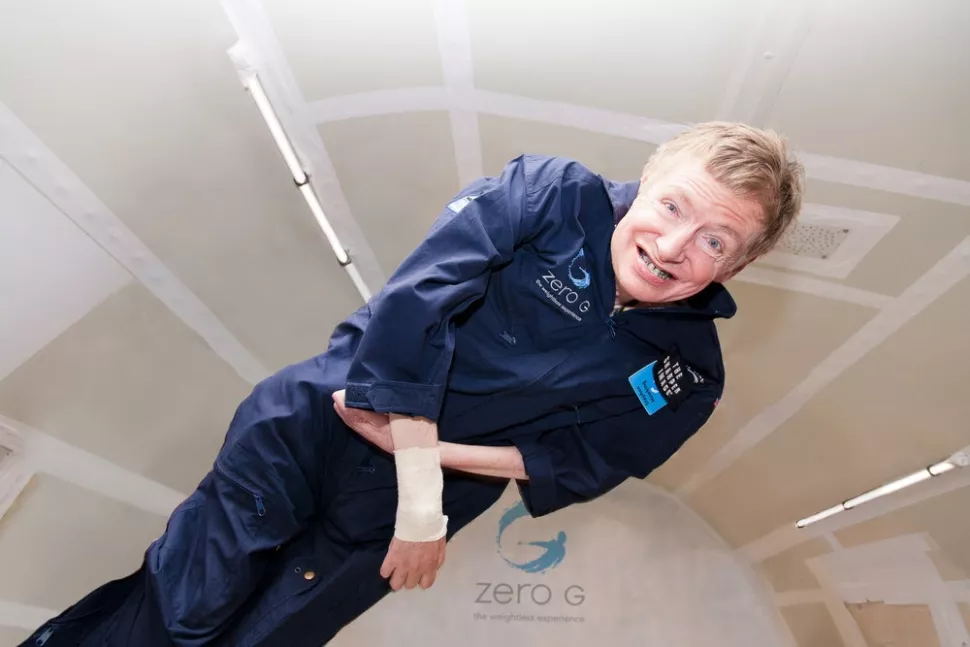
In 2007, wheelchair-bound theoretical physicist Stephen Hawking floated freely during a zero-gravity airplane flight. Hawking said of the experience: “For me, this was true freedom. People who know me well say that my smile was the biggest they’d ever seen. I was Superman for those few minutes.” (Image credit: Steve Boxall/ZERO-G Corporation via AstroAccess)
“This has been an evolving project over several years and multiple Zero-G flights, and our research has only touched the surface of topics to study in accessible human spaceflight,” said Jamie Molaro, a research scientist at the Planetary Science Institute.
Molaro is lead author of the research paper on AstroAccess that details the results from initial investigations.
Molaro told Inside Outer Space that the research project has spurred interest in building upon findings so far. “We’ve already seen discourse building around Disability within the public and private space sectors as a result,” Molaro said.
To learn more, go to “AstroAccess: Testing accessibility accommodations for disabled and mixed-ability crews operating in space-like environments” appearing in Acta Astronautica at:
https://www.sciencedirect.com/science/article/pii/S0094576524000699#sec2
For more information on AstroAccess, go to:
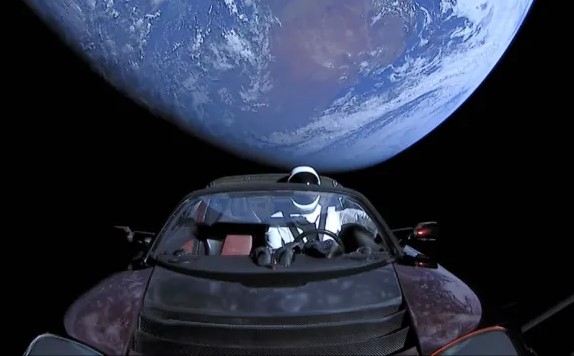
Starman coming your way. Image credit: SpaceX
A Tesla roadster is headed for a possible speeding ticket as it is cruising toward Earth at nearly 6,000 miles per hour.
On February 6, 2018 SpaceX launched the automobile on a Mars-crossing orbit.
But the car may hit the Earth… sometime within the next 15 million years – so don’t panic.
Random walk
Hanno Rein is at the University of Toronto’s Department of Physical and Environmental Sciences in Canada.
Rein and colleagues in 2018 wrote “The random walk of cars and their collision probabilities with planets” – as published in the journal, Aerospace.
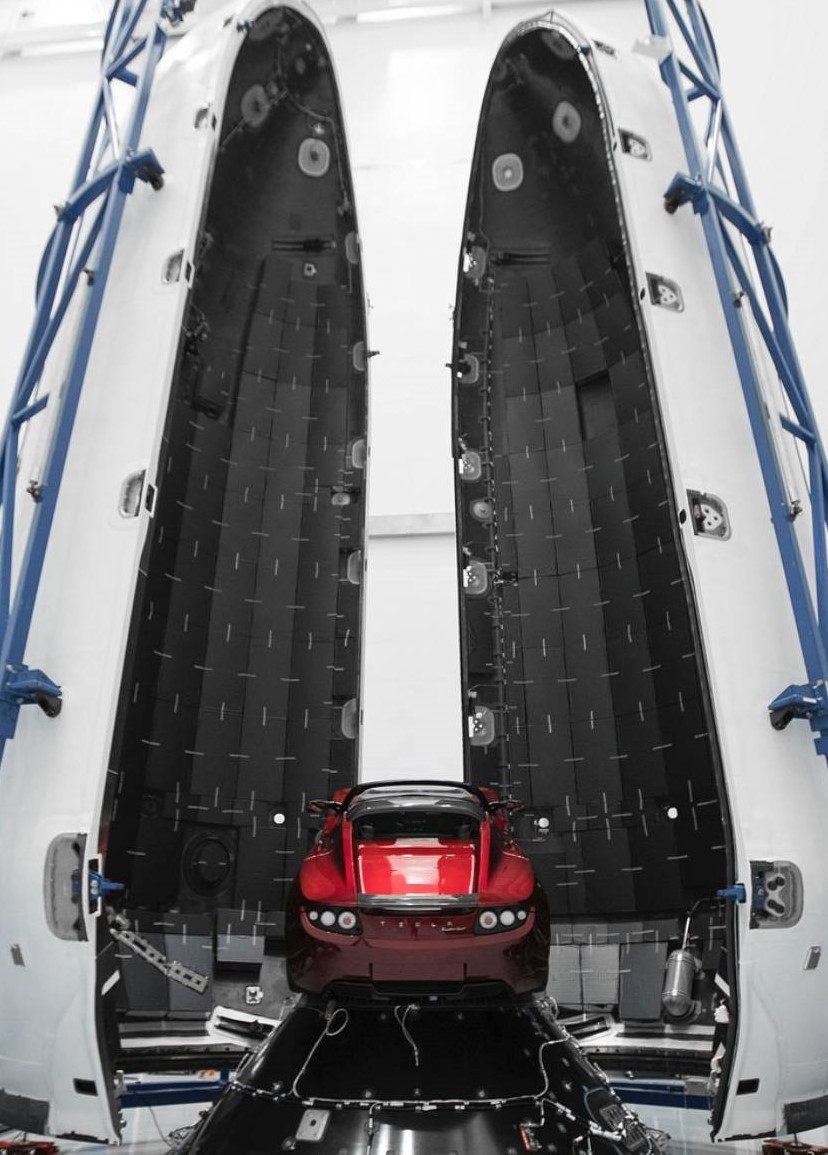
Dummy-carrying Tesla served as a dummy payload for the Falcon Heavy test flight.
They investigated the fate of the Tesla Roadster launched by SpaceX, with a caveat. “On timescales significantly longer than a century, continued close encounters will render precise long-term predictions of the object’s chaotic orbit impossible.”
First close encounter
Rein’s assessment implies the dynamical half-life of the Tesla to be 15 million years, similar to near Earth asteroids decoupled from major escape routes from the main belt.
On its celestial highway, the Tesla has been out and about for over six years.
According to Ben Pearson at Whereisroadster.com, the Tesla’s location is 64,332,500 miles from Earth, moving toward Earth at a speed of 5,849 miles per hour.
The roadster’s first close encounter, coming within a lunar distance of the Earth, will occur within the next 100 years, Rein and colleagues reported.
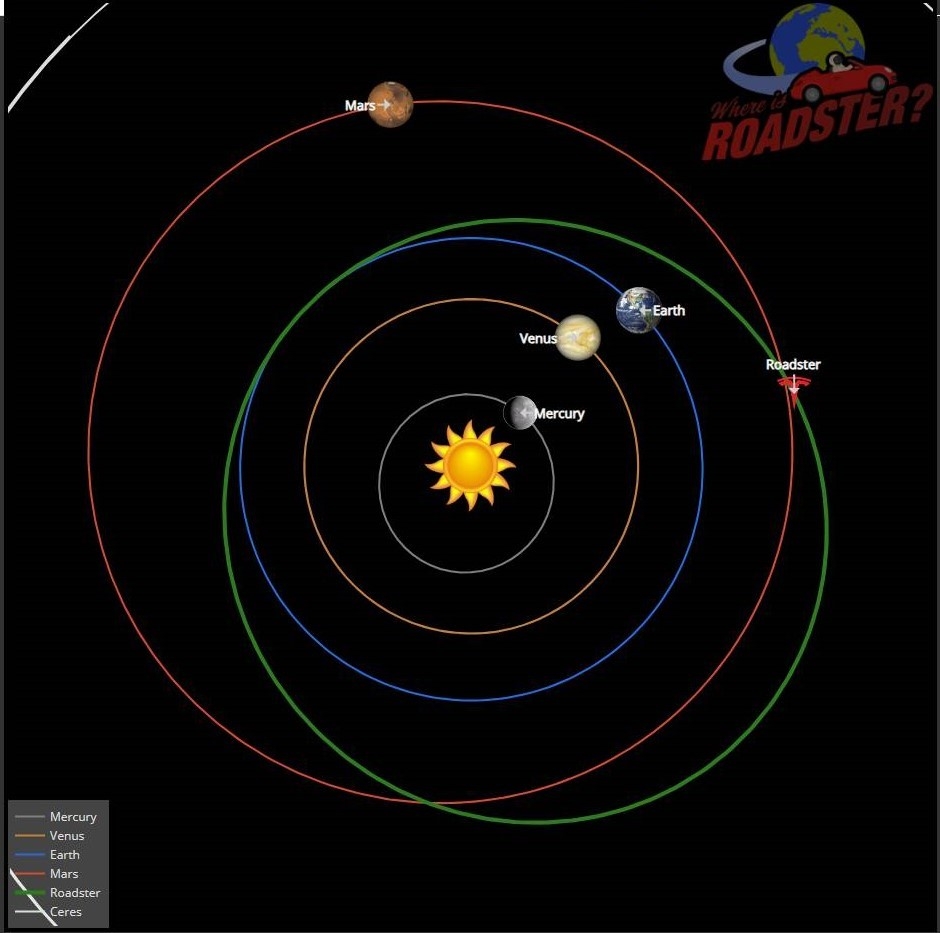
Image credit:
Roadster Tracker/Ben Pearson
Arguably, that’s just in time for a SpaceX Starship to rendezvous with the Sun-baked electric sports car for a battery charge!
To keep an eye on the space jaunting Tesla, go to:
https://www.whereisroadster.com/
For the paper — “The random walk of cars and their collision probabilities with planets” – go to:

Shenzhou-17 space station crew in celebration mood.
Image credit: CCTV/Inside Outer Space screengrab
The Spring Festival, which centers around the Chinese New Year, is being celebrated by China’s Shenzhou-17 space station crew: The Year of the Dragon
Festive decorations have been placed inside the Tiangong space station.

Image credit: CCTV/Inside Outer Space screengrab

Image credit: CCTV/Inside Outer Space screengrab

Image credit: CCTV/Inside Outer Space screengrab
Chinese astronauts Tang Hongbo, Tang Shengjie, and Jiang Xinlin pasted Spring Festival couplets on the walls of the station’s Tianhe core module, the Wentian experimental module, and the Mengtian experimental module.
Traditional New Year’s Eve dinner had the crew consume festive food such as dumplings, osmanthus cheese rice cakes, and other favorite snacks.

Image credit: CCTV/Inside Outer Space screengrab
In good health
This marks the third time that Chinese astronauts have celebrated the Spring Festival in space, far from Earth, following the Shenzhou-13 and Shenzhou-15 missions of the previous two years.
“After having been in orbit for more than 100 days, the entire astronaut crew is in very good working condition, physical and mental condition, and are in good health,” Wang Chunhui, deputy chief designer of astronaut system at the China Astronaut Research and Training Center told China Central Television (CCTV).
“They will resume work on the fourth day of the Chinese New Year and make a lot of preparations in advance for the following extravehicular missions and some on-orbit experiments,” said Wang.
The now-orbiting Shenzhou-17 crew was launched on Oct. 26 last year, with the three crew members assigned a six-month mission aboard the Tiangong space station.
Go to video at:

China space station is captured in this photo taken by the departing Shenzhou-16 crew.
Image credit: CMS

Image acquired by Curiosity’s Left Navigation Camera on Sol 4088, February 5, 2024.
Image credit: NASA/JPL-Caltech
NASA’s Curiosity Mars rover at Gale Crater is now performing Sol 4049 duties.
Amelie Roberts, a graduate student at Imperial College London, reports that Curiosity had a recent and successful imaging-based stint providing geologists new looks of Gediz Vallis Ridge and surrounding buttes as the imagery is downlinked to Earth.
Curiosity also completed a drive of roughly 40 feet (13meters), “an achievement considering the terrain,” Roberts adds.

Curiosity Front Hazard Avoidance Camera Left B image acquired on Sol 4093, February 10, 2024.
Image credit: NASA/JPL-Caltech
New workspace
The robot has approached its new workspace with a closer view of Gediz Vallis Ridge and a large wind-blown ridge “which is either a Transverse Aeolian Ridge (TAR), a wind-formed mound of sand smaller than a dune, or maybe a megaripple,” Roberts points out.
The targeted part of the plan the first sol (Sol 4089) was very sand-focused.

Curiosity Right B Navigation Camera photo taken on Sol 4093, February 10, 2024.
Image credit: NASA/JPL-Caltech
“While widespread on Mars, TARs and megaripples are much rarer on Earth,” Roberts reports, “so we seize any opportunity to study these features up-close and in situ.”
Sand target
Most of the “opportunistic science time” of the rover was planned to be spent imaging the sand target, named “Knapsack Pass”, with an extensive 32 frame Mastcam mosaic and a Chemistry and Camera (ChemCam) passive raster to improve our understandings of its chemistry and formation, Roberts explains.

Curiosity Right B Navigation Camera photo taken on Sol 4093, February 10, 2024.
Image credit: NASA/JPL-Caltech
“We also continued our investigation of the layered sulfates,” Roberts adds.
The recent plan calls for contact science, using the Alpha Particle X-Ray Spectrometer (APXS) and the Mars Hand Lens Imager (MAHLI) to target sulfate bedrock, “Willow Springs”, a ChemCam Laser Induced Breakdown Spectroscopy (LIBS) to target flakey sulfate bedrock, “Triple Falls”, and planned Mastcam coverage of a small bowl-shaped depression in the sulfates, “Elinore Lake”.

Curiosity Right B Navigation Camera photo taken on Sol 4093, February 10, 2024.
Image credit: NASA/JPL-Caltech
Imaging campaign
“Even after all of these activities, there was still enough time to work towards our other science goal, the imaging campaign of Gediz Vallis ridge, through capturing part of the ridge with both ChemCam and Mastcam coverage,” Roberts says.
After a short drive, the untargeted part of the plan on the second sol (Sol 490) will be focused on some environmental science-theme group activities.

Curiosity Mars Hand Lens Imager photo produced on Sol 4093, February 10, 2024.
Image credit: NASA/JPL-Caltech/MSSS

Curiosity Mars Hand Lens Imager photo produced on Sol 4093, February 10, 2024.
Image credit: NASA/JPL-Caltech/MSSS
“At the moment, on Mars, we’re in dust storm season so the environmental scientists are keeping their eyes out on all things dust, Roberts concludes. “This means that planning is focused on dust devil movies and surveys. We finished off the plan with one of ChemCam’s automated AEGIS (Autonomous Exploration for Gathering Increased Science) activities.”

Curiosity Right B Navigation Camera photo taken on Sol 4093, February 10, 2024.
Image credit: NASA/JPL-Caltech

Image credit: S.D.Katz/Infinity Fuel Cell & Hydrogen Inc.
The Moon calls!
But setting up a future lunar outpost to sustain long-term crews there is an energy-hungry undertaking.
One eye-catching concept is regenerative fuel cell energy systems, the ability, for one, to energize a Moon base through the 14-earthday-long and super-cold lunar night.
Infinity Fuel Cell & Hydrogen Inc. of Windsor, Connecticut began work with NASA in 2020 to develop the fuel cell component for a Moon-situated system.

Payload carrying New Shepard (NS-24) capsule nears touchdown.
Image credit: Blue Origin
Suborbital trial run
Power and energy for extreme operating environments, like space and underwater – require rugged, compact and gravity-independent solutions, the company’s website explains. “Why do we operate in extreme environments first? If you can do it there, you can do it anywhere.”
The company recently took part in Blue Origin’s New Shepard (NS-24) West Texas launch under a NASA-sponsored Tipping Point program. That suborbital, uncrewed flight on December 19 carried 33 payloads from NASA, academia, research institutions, and commercial companies.
Initial indications, according to Infinity, are that “the system generated required power throughout the entire flight as designed, even operating in three minutes of microgravity.”

Artemis explorers at the Moon.
Image credit: NASA
Scalable modular system
Flown onboard New Shepard was Infinity’s NASA Space Technology Mission Directorate-funded, Advanced Modular Power and Energy System (AMPES) Tipping Point fuel cell experiment.
Earlier, on September 12, 2022, AMPES operated on Blue Origin’s NS-23 suborbital launch, despite an anomaly that cut that mission short.
“The AMPES system is a scalable modular system that employs Infinity’s patented non-flow through, air-independent fuel cell technology,” a company statement explains. “The technology could be used to power landers, rovers, surface equipment and habitats on the Moon or Mars.”
To view a video design by S.D.Katz showing a conception — not an actual NASA design — of a future Moon base being powered by a combination of solar power and hydrogen fuel cell power, go to:
https://www.youtube.com/watch?v=rijXZNGQg6Y
For more information on Infinity Fuel Cell & Hydrogen Inc., go to:

Image credit: SpaceX
That secretive mission of the U.S. Space Force X-37B, lofted into a classified orbit by a SpaceX Falcon Heavy booster last December has been spotted by eagle-eyed satellite trackers.
This novel space trek of the winged craft is dubbed Orbital Test Vehicle-7 (OTV-7).

U.S. military’s X-37B space plane is encapsulated in launch faring and features the United States Space Force (USSF) logo for the first time.
Image credit: Boeing
Classified doings
A recent posting by Tomi Simola, a sky watching hobbyist in Finland, captured the craft’s whereabouts.
“OTV 7 found!” Simola wrote, sharing his observations with a global family of equipment-running members of the SeeSat-L community. SeeSat-L is a mailing list for visual satellite observers.
The classified doings of the maneuverable X-37B has apparently reached new heights, zooming from 200 miles at its closest to Earth, outward to over 24,000 miles at its highest point – at least for now.
This X-37B craft is in a 59.1 degree inclined highly elliptical orbit.

Image credit: Tomi Simola
For an excellent story on this sighting, go to Stephen Clark’s article at Ars Technica at:
Also, go to this earlier informative video from Shelby Holliday at the Wall Street Journal at:
https://youtu.be/pXyIT_GWIYE?si=FOTssaHyTjh08xED
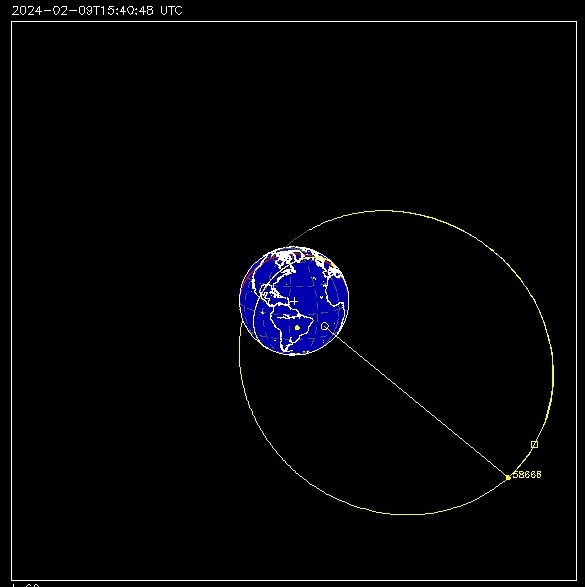
Image credit: Tomi Simola
Distinctive mission
This mission of the U.S. military’s unique X-37B robotic space plane is decidedly distinctive.
For the first time, the Boeing-built craft was hurled spaceward atop a SpaceX Falcon Heavy booster, “with a wide range of test and experimentation objectives,” explains a U.S. Space Force press statement. Reportedly OTV-7 is the fourth flight of this particular craft; there are believed to be only two vehicles for the program.

OTV-6 in-space photo. Image credit: Boeing/Inside Outer Space screengrab
The past flights of an X-37B made use of the Atlas V 501 launcher for the most part, although OTV-5 was placed in orbit via a SpaceX Falcon 9 Block 4 launcher.
New orbital regimes
The Department of the Air Force Rapid Capabilities Office, in partnership with the United States Space Force, launched the vehicle on December 28 from Kennedy Space Center, Florida.

Image credit: Boeing/Inside Outer Space screengrab
Designated USSF-52, the space plane tests include operating in new orbital regimes, experimenting with future space domain awareness technologies, and investigating the radiation effects on materials provided by NASA.
A previous flight, OTV-6, was the first mission to introduce a service module that expanded the capabilities of the spacecraft.
“We are excited to expand the envelope of the reusable X-37B’s capabilities, using the flight-proven service module and Falcon Heavy rocket to fly multiple cutting-edge experiments for the Department of the Air Force and its partners,” said Lt. Col. Joseph Fritschen, the X-37B Program Director.
Hotfooting back to Earth
Given the X-37B’s jaunt to high orbit, what about its return and the speed the vehicle is cruising? In particular, is the craft outfitted with a different reentry tile system than earlier flights?
I asked noted space tracker Marco Langbroek what’s up with this craft getting back down to Earth. He’s a lecturer in optical Space Situational Awareness (SSA) at Delft Technical University, the Netherlands.
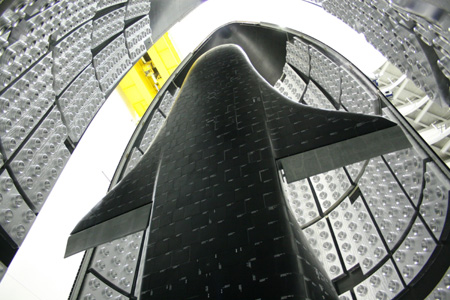
Reentry tiles as seen from earlier X-37B mission.
Image credit: Boeing
Previous OTV missions in Earth orbit are slower than its velocity at high Earth orbit.
“It is about 2.5 kilometers per second above the speed of previous missions, so definitely significantly higher,” Langbroek told Inside Outer Space. “We do not know if the X-37B heat-shield and structural integrity can handle that – perhaps it can, perhaps it cannot.”
But one way for this X-37B vehicle to de-orbit for landing on Earth, Langbroek said, would be to first do a burn to lower apogee around Earth and circularize the orbit, before de-orbiting.
“That brings the speed down to the speed of earlier missions. A vehicle like the OTV can use aerobraking once in perigee and at the top of the atmosphere, making use of atmospheric drag, to circularize the orbit at low Earth orbit altitude, and then de-orbit from there,” Langbroek said.

OTV-6 return. Image credit: Boeing/Inside Outer Space screengrab
Details: skimpy and classified
Since the X-37B first launched in 2010, Boeing has empowered the reusable spaceplane “with more capability, new technology, and pushed the boundaries of what’s possible with each ensuing mission,” the company points out.
OTV-6, after circling Earth for a record-setting 908 days — completed that mission with a successful landing at Kennedy Space Center on November 12, 2022.
As in previous missions, details of the OTV-7’s in-space agenda are skimpy and classified.
A Space Force statement did note that the NASA experiment onboard will expose plant seeds to the harsh radiation environment of long-duration spaceflight. Known as “Seeds-2,” that investigation is paving the way for future crewed space missions.

OTV-6 was the first mission to introduce a service module that expanded the capabilities of the spacecraft.
Image credit: Staff Sgt. Adam Shanks
Service module
As explained in the Air Force statement, the last space plane flight, OTV-6, was the first mission to introduce a service module that expanded the capabilities of the spacecraft.
That module hosted more experiments than any of the previous space plane missions. In the OTV-6 flight, the service module was detached in orbit from the space plane before its landing, necessary due to the aerodynamic forces seen by the X-37B vehicle upon re-entry.
Once detached, the free-floating service module was later disposed of “in compliance with best practices,” according to the Air Force.
First use technologies
In past Boeing-supplied information, the company says the X-37B is designed to operate in low-Earth orbit, 150 to 500 miles above the Earth.
Additionally, the vehicle makes use of several “first use in space” technologies including:
— Avionics designed to automate all de-orbit and landing functions.
— Flight controls and brakes using all electro-mechanical actuation; no hydraulics on board.
— Use of a lighter composite structure, rather than traditional aluminum.
— New generation high-temperature wing leading-edge tiles and toughened uni-piece fibrous refractory oxidation-resistant ceramic (TUFROC) tiles and advanced conformal reusable insulation (CRI) blankets.
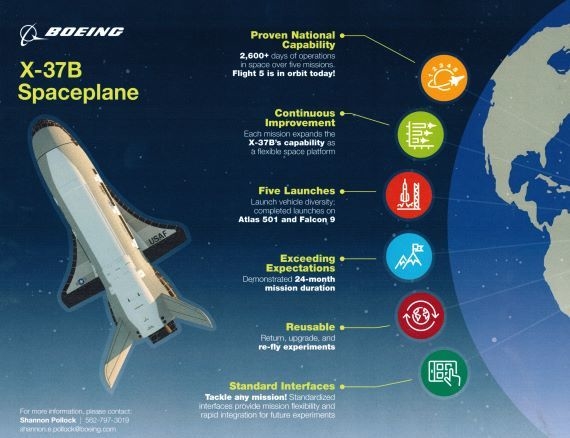
X-37B handout.
Credit: Boeing
Flight roster
Here’s a listing of previous flights of the space plane:
OTV-1: launched on April 22, 2010 and landed on December 3, 2010, spending over 224 days on orbit.
OTV-2: launched on March 5, 2011 and landed on June 16, 2012, spending over 468 days on orbit.
OTV-3: launched on December 11, 2012 and landed on October 17, 2014, spending over 674 days on-orbit.
OTV-4: launched on May 20, 2015 and landed on May 7, 2015, spending nearly 718 days on-orbit.
OTV-5: launched on September 7, 2017 and landed on October 27, 2019, spending nearly 780 days on-orbit.
OTV-6: Launched on May 17, 2020 and landed on November 12, 2022, circling Earth for 908 days.

This size chart shows how the Boeing-built X-37B robot space plane compares to NASA’s space shuttle, a larger version of the spacecraft called the X-37C and an Atlas 5 rocket.
Image: © AIAA/Grantz/Boeing/povided to Inside Outer Space via AIAA
Derivative plan?
There are known to be at least two X-37B vehicles.
Curiously, back in late 2011, a technical paper popped up at a major aerospace conference. It outlined new plans for the spacecraft and a scaled-up version to support space station cargo deliveries or even haul astronauts into orbit.
An X-37B OTV and derivatives plan assessment sketched out a variety of scaled-up versions of the X-37B space plane.
What is not known, however, is whether such a plan was advanced within Boeing or the Air Force.
Go to this informative Boeing video released last April, complete with head-banging, heavy metal music that offers a look at the OTV-6 mission at:
https://www.boeing.com/features/2023/04/x-37b-breaks-records-brings-home-experiments.page

Wait-a-Minute!
Image credit: Barbara David
There’s some interesting “wait a minute” fallout from the upcoming nose dive to Earth of the European Remote Sensing satellite, ERS-2.
According to the European Space Agency (ESA), the spent ERS-2 satellite weighing 2.3 tons is predicted to slip into Earth’s atmosphere on February 19 – with a current uncertainty of +/- 2.8 days.
“No intervention can be made from the ground, so ERS-2 will return entirely naturally – now a common occurrence as on average one spacecraft reenters Earth’s atmosphere per month,” an ESA statement explains.
The bit about “return entirely naturally” is an interesting, user-friendly substitute for “uncontrolled.”

Artwork of incoming ERS-2. Image credit: ESA
End of life
Following its launch in April 1995, ERS-2 ran for nearly 16 years of observing the Earth.
In 2011, ESA took the decision to bring the mission to an end.
That was followed by ground-activated de-orbit maneuvers. Those lowered the satellite’s average altitude and mitigated the risk of collision with other satellites or space debris, ESA notes.
The spacecraft was also “passivated” to reduce the risk of fragmentation. Passivated is getting rid of internally stored energy, like unused propellant, even de-charging batteries.
Wake-up call
All that said there are those that see the fall of ERS-2 as a calling card from space that doubles as a wake-up call – and on several fronts.
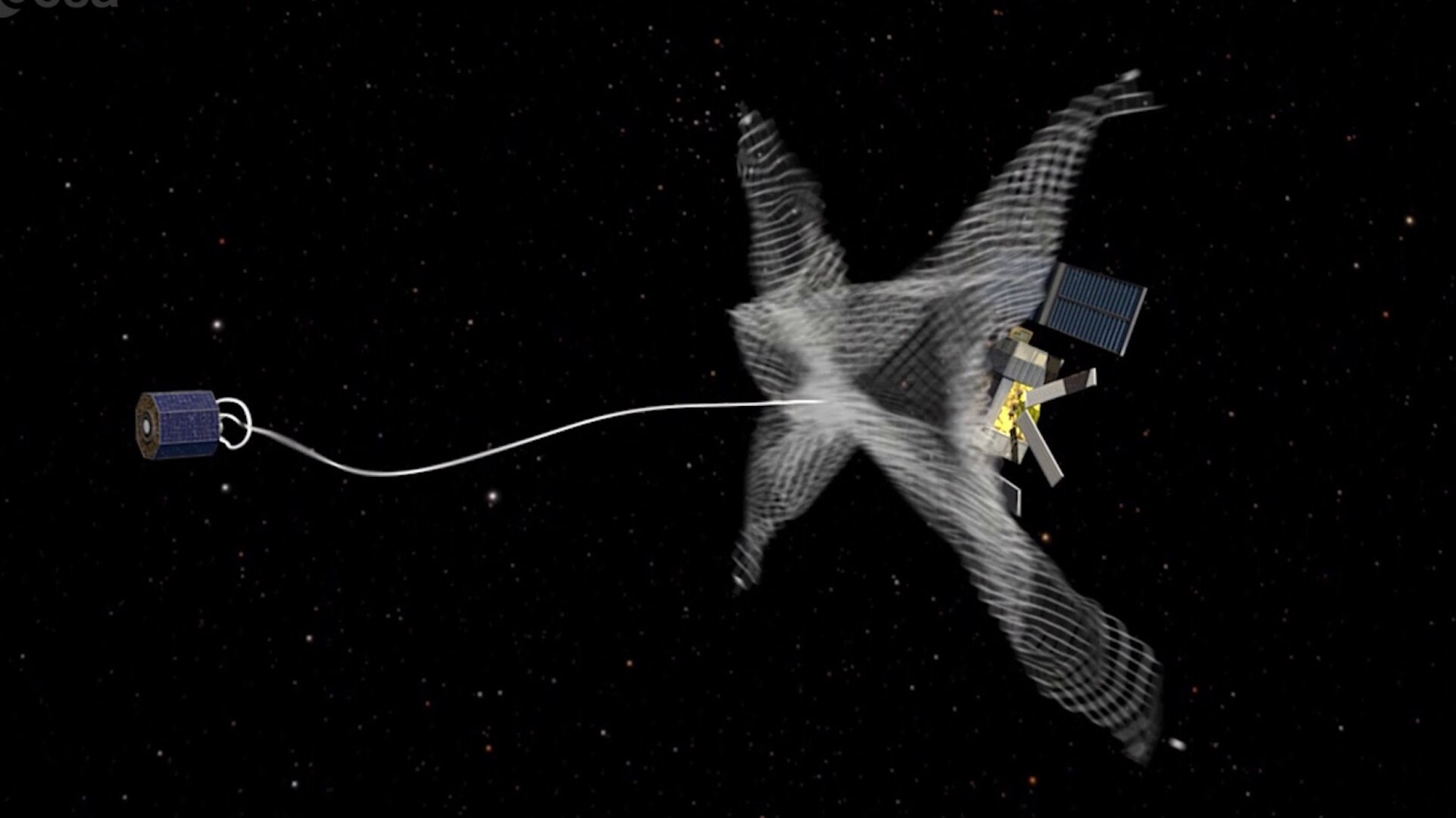
Netting of orbital debris has been studied, with ERS-2 as the catchable bait in a mix of junk-snatching ideas.
Image credit: ESA/D.Ducros
“While the ESA should be lauded for its efforts to de-orbit the ERS-2, it should be unsurprising that a 2.3-ton satellite launched into Earth orbit without any enforceable orbital debris regulation will then return to Earth’s atmosphere as orbital debris in an explosive uncontrolled reentry,” said Michael Runnels, an assistant professor of business law at California State University, Los Angeles.
“Indeed, these events highlight the continuing need for enforceable orbital debris regulation to support the sustainable exploration and scientific investigation of outer space,” Runnels told Inside Outer Space.
Someone someday
Ewan Wright is a PhD candidate at the University of British Columbia and Junior Fellow of the Outer Space Institute. He is actively focused on the sustainability of the outer space environment.
ERS-2 is a three decade old Earth Observation satellite with a mass about that of a Ford F-150, Wright said. “ERS-2 won’t burn up entirely when it reenters the atmosphere, so there is a chance that debris will hit someone on the ground, or disrupt air traffic.”

ERS-2 artwork.
Image credit: ESA
Wright told Inside Outer Space that, fortunately, the probability of someone getting hit is small. “But if we keep doing this again and again, someone someday will get hurt.”
Random reentries
Last year, 30 satellites larger than 500 kilograms uncontrollably reentered the atmosphere.
In total, in 2023, about 55 tons of satellite reentered randomly, Wright stated. ESA was responsible in lowering ERS-2’s orbit to make sure it didn’t become permanent space debris, he said.
“But in the future, all large satellites should do controlled reentries. Operators should control them to reenter over the oceans, away from people, aircraft and ships,” Wright concluded.
Minimize risk
The incoming ERS-2 is something that happens quite regularly with defunct satellites, said Leonard Schulz, a researcher at the Technische Universität Braunschweig’s Institute of Geophysics and Extraterrestrial Physics in Braunschweig, Germany.
Such falls will only increase in the future, Schulz added, due to the growing number of objects brought into low Earth orbit.

Image credit: NOAA
“I think the mass of the object stands out, probably some parts of the satellite will survive reentry,” Schulz told Inside Outer Space. “And this is the reason why people try to make satellites burn up completely in the atmosphere, to minimize the risk to people on ground.”
Atmospheric effects
Schulz said that there’s need to consider the effects on the atmosphere from spacecraft re-entry, a hot topic that ESA is evaluating.
“Today, we are lacking information on many aspects when it comes to materials released and subsequent effects on the atmosphere,” Schulz pointed out.
Satellite reentries are a good opportunity to gather observational data with measurement campaigns, Schulz advised. However, such uncontrolled reentries as with ERS-2 are extremely difficult to observe, he said, as the uncertainty of where the satellite reenters is so high.
“But controlled reentries provide great measurement opportunities,” Schulz concluded, “which should be a focus in the future!”

Taking the fall. Space hardware dives into Earth’s atmosphere with some fragments making their way to the ground.
Image credit: ESA/D.Ducros

Mars beckons. Human explorers can maximize the science output for unraveling the complex nature of the Red Planet.
Image credit: NASA/Pat Rawlings
The future of Mars exploration will be greatly enhanced by humans that make the sojourn to the Red Planet. Indeed, flesh and bone on that distant world far outstrips what mechanized Mars machinery can attain – but yes, certainly at far greater cost.
NASA is blueprinting a moon-to-Mars strategy that identifies science as one of three pillars upon which the agency’s quest for a sustained human exploration throughout the solar system is built.

The huge canyon that is Valles Marineris is arguably Mars’ most dramatic landscape and offers a scientific bonanza for future expeditionary crews.
Image credit: ESA/DLR/FU Berlin (G. Neukum), CC BY-SA 3.0 IGO
What’s now being plotting out is the architecture for achieving that goal.
Shoe-horning in science
Arguably, the science conducted on the surface of Mars by astronauts will have the most impact on the scope and scale of that architecture. Therefore, deciding on science priorities warrant early attention.
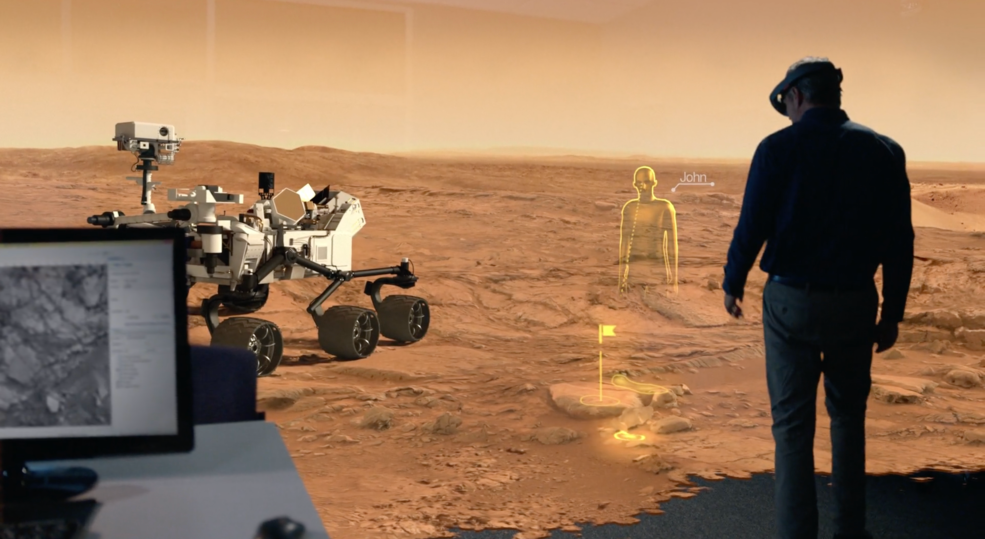
NASA’s Jet Propulsion Laboratory has experimented with virtual and mixed reality environments as ways to improve exploration of Mars.
Image credit: NASA/Human Centered Design Group at JPL
Recent history demonstrates the issue of shoe-horning in science tasks for astronauts too late.
That is a central message from a recent study for the Mars Exploration Program Analysis Group (MEPAG), one that suggests how and where on the Red Planet humans can maximize exploration and science output.
To read my new Space.com story – “Humans on Mars could conduct far better science than any machine: ‘It is important to think about what supporting instruments and technologies need to be developed now to equip our astronauts for doing outstanding science at Mars.'” – go to:

