Archive for January, 2024
 Author:
  January 6th, 2024
Image credit: Privateer Space
New tool to predict Starlink satellite reflections is available from Privateer Space. As a space decision intelligence platform organization, the Wayfinder app is now available.

Image credit: Privateer Space
Maui-based Privateer was co-founded in 2021 by tech and space veteran Alex Fielding, Silicon Valley titan Steve Wozniak, and astrodynamicist Moriba Jah to serve as the data engine for sustainable space economy growth.
The National Geographic Society funded the work specifically so it could be globally accessible and free to everyone.
 Posted in

Enigmatic Venus – Cloudy with a scattering of life?
Image credit: NASA
New research has focused on the clouds of Venus saturated with sulfuric acid, work that enhances the potential habitability of that world – not at its surface, but high above the planet’s hell hole-like landscape.
Just-published research calls for the start of a new branch of astrobiology and a new branch of organic chemistry.
“The search for signs of life beyond Earth is a motivator in modern-day planetary exploration, but life on other planets does not have to have the same biochemistry as our life here on Earth,” says Janusz Pętkowski, a research affiliate at the Massachusetts Institute of Technology (MIT) in Cambridge. “Life needs some sort of liquid medium to function, but does it always have to be water?”
For detailed information, go to my new Space.com story – “Alien life could thrive in Venus’ acidic clouds, new study hints” – at:
https://www.space.com/alien-life-venus-clouds-amino-acids-stable-sulfuric-acid

Rocket Lab mission to Venus – a private affair.
Image credit: Rocket Lab
NASA/Jet Propulsion Laboratory has confirmed flight #70 of the Ingenuity Mars helicopter. The flight occurred on December 22, 2023, flying a horizontal distance of 260 meters (roughly 853 feet), gaining a maximum altitude of 12 meters (approximately 39 feet) and flew for 132.9 seconds over martian landscape.

NASA’s Ingenuity Mars Helicopter acquired this image using its navigation camera mounted in the helicopter’s fuselage and pointed directly downward to track the ground during flight.
This image was acquired on Dec. 22, 2023. This was the date of Ingenuity’s 70th flight.
Image credit: NASA/JPL-Caltech
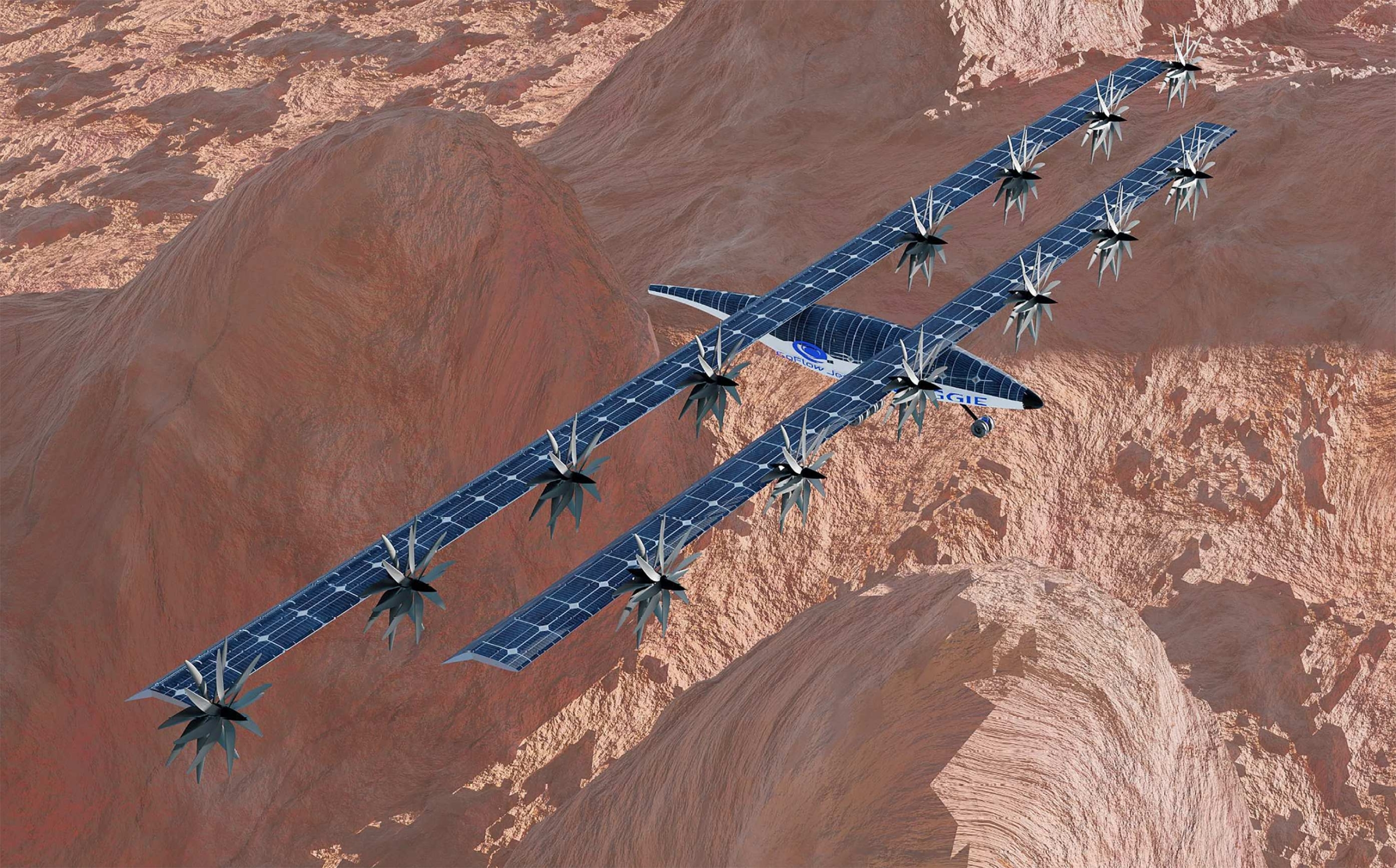
Graphic depiction of Mars Aerial and Ground Global Intelligent Explorer (MAGGIE) Image credit:
Ge-Cheng Zha
Be it returning samples from the surface of Venus to propelling a swarm of tiny spacecraft to Proxima Centauri – there’s a big high-tech future out there, big enough to think about never-done-before types of exploration.

Graphic depiction of Sample Return from the Surface of Venus.
Image credit: Geoffrey Landis
The NIAC (NASA Innovative Advanced Concepts) program fosters pioneering ideas by funding early-stage technology concept studies for future consideration and potential commercialization.
Never short on wild ideas, NASA has selected the 2024 Phase I awardees for its NIAC program.

Graphic depiction of a lunar long-baseline optical imaging interferometer: Artemis-enabled Stellar Imager (AeSI).
Image credit: Kenneth Carpenter
NIAC-funding can help transform future agency missions. From proposals to explore low Earth orbit to the stars, the 13 concepts chosen stem from companies and institutions across the United States.
For more information on the newly-selected awardees, go to:
https://www.nasa.gov/news-release/funding-future-tech-nasa-names-2024-innovative-concept-studies/

Image credit: Astrobotic
The upcoming liftoff of a Moon lander – the Peregrine Mission One – is a nail-bitter for many reasons. As a privately-built spacecraft it represents an undertaking advanced by NASA’s Commercial Lunar Payload Services (CLPS) initiative.
That lunar lander is a product of tender loving care provided by Astrobotic, a Pittsburgh, Pennsylvania-based firm, packed with NASA and commercial payloads.
Yes, consider Pittsburgh as a gateway to the Moon – right up there with Houston’s Johnson Space Center and regular ear-splitting rumbles of rockets departing from California and Florida. At the Astrobotic headquarters there is an adjoining Moonshot Museum that offers the public first-hand looks at lunar lander development.
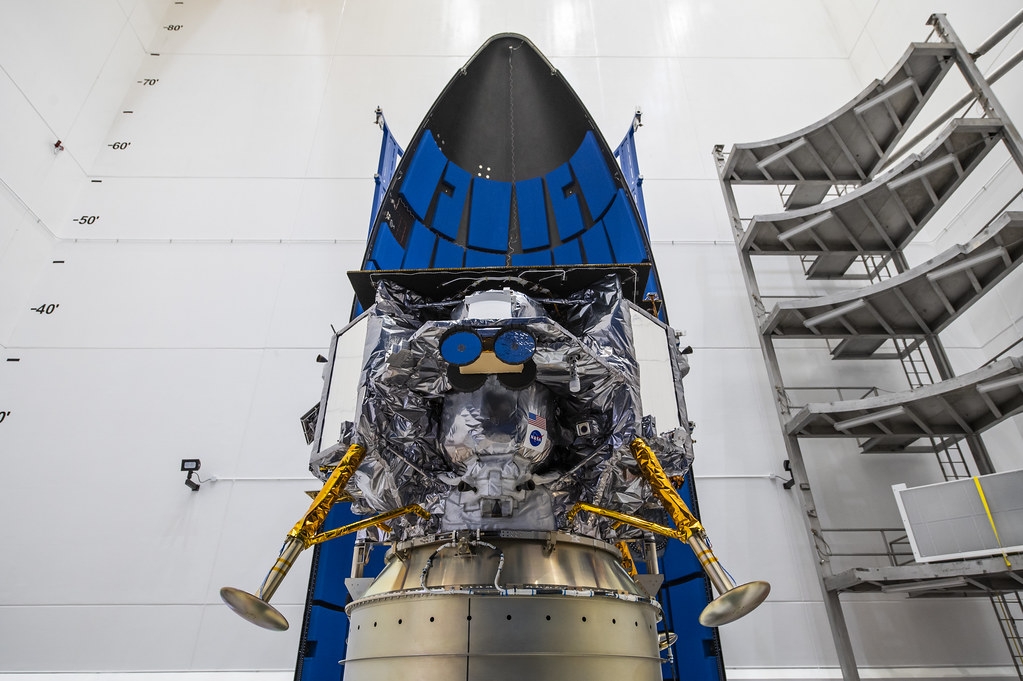
Moon lander to be launched by maiden flight of Vulcan booster.
Image credit: ULA/Astrobotic
Full stop
Peregrine Mission One will be hurled Moonward courtesy of the first takeoff of the United Launch Alliance’s Vulcan rocket.
The Moon lander is slated to come full stop in late February, firmly planting its legs at Sinus Viscositatis (Bay of Stickiness) adjacent to the Gruitheisen Domes. The touchdown target is on the northeast border of Oceanus Procellarum (Ocean of Storms).
For more information on this pioneering mission, go to my new Space.com story – “For Astrobotic, big risk (and bigger reward) ride on private Peregrine moon lander’s Jan. 8 launch – The Pittsburgh company aims to pull off the first-ever private moon landing” – at:
https://www.space.com/astrobotic-peregrine-private-moon-lander-risks-reward

Image credit: Astrobotic
A Moon-bound spacecraft houses photographs, novels, student artwork – as well as a piece of Mount Everest.
Ready for departure is the Peregrine Mission One built by Astrobotic.
The lunar lander is toting 21 payloads (cargo) from governments, companies, universities, and NASA’s Commercial Lunar Payload Services initiative, all riding atop the maiden blastoff of the United Launch Alliance’s Vulcan launch vehicle.
Celestial symmetry
Think of that outbound piece of Mt. Everest as a touch of celestial symmetry: A reach to space from the Everest Summit — the point on Earth closest to the lunar surface — to the Moon itself.

Image credit: Michael Kronmiller
“The payload is meant to commemorate a collaborative project I ran back in junior and senior year of high school,” says Michael Kronmiller. The adventurous story is captured in manuscript excerpts of “From Everest to the Moon – Against All Odds at the Frontiers of Possibility: ‘The Garuda Project.’”
It’s a tale spurred by a low-cost small unmanned drone design for applications such as high altitude search and rescue. Also involved are educators and students at Kanjirowa National Secondary School in Kathmandu, the capital city of Nepal. Then there’s Aang Tshering Lama a renowned guide that has summited Everest numerous times and conducted the highest ever rescue operation on the mountain. He gifted the summit fragment for packaging as a DHL MoonBox payload for inclusion on Peregrine Mission One.

Image credit: Michael Kronmiller
Strict rules
During Kronmiller’s time at Rensselaer Polytechnic Institute (RPI), he and a partner collaborated on the design to meet the payload limitations Astrobotic and DHL provided. “I was managing the finances for our campus makerspace the RPI Forge and was able to make some prototypes, the final version, and copies of the payload on our laser cutter,” he tells Inside Outer Space.
The effort also meant learning about what it takes to qualify a payload for space missions, complying with strict requirements and stringent limitations. Those rules called for payloads that did not exceed one inch in diameter and 0.125 inch in thickness.
The front payload itself includes the names of some of the key contributors on the project who were directly involved in the development and testing of the Small Unmanned Aircraft System (sUAS). The back features the project’s mission statement: “Humanitarian Relief, Innovation, Education, International Collaboration.”

Image credit: Michael Kronmiller
One rope at a time
Kronmiller points out that his project advisor, former NASA astronaut, Scott Parazynski, carried a Moon rock to Mt. Everest.
In February 2010 during the space shuttle STS-130 mission, a plaque containing moon rocks collected during the Apollo 11 mission and a rock from the summit of Mt. Everest made it to the International Space Station.
At a White House meeting of the National Space Council, in June 2018, Kronmiller adds, Parazynski recalled his Everest Summit climb and likened space exploration to mountaineering: “One rope at a time,” he said. Vice President Mike Pence, who was chair of the council gathering, thought for a moment, and then, repeated, ‘One rope at a time.’ He paused, again, and said, ‘I like that.’
Yes, life does have its symmetries, Kronmiller concludes.

Enigmatic Venus holds tight its secrets under thick clouds. Image shows the night side of Venus glowing in thermal infrared, captured by Japan’s Akatsuki spacecraft.
Credit: JAXA/ISAS/DARTS/Damia Bouic
Hellish Venus is blistering hot, not only temperature-wise. It’s also a hot topic for scrutinizing whether or not the cloud-enveloped world might be a haven for high-altitude life.
Sara Seager, professor of planetary sciences at the Massachusetts Institute of Technology (MIT) is principal science investigator for the privately launched Rocket Lab Mission to Venus. This January 2025 mission is a first step towards exploring the mysterious chemistry that might be a sign of life, under a series of projected Morning Star Missions to Venus.
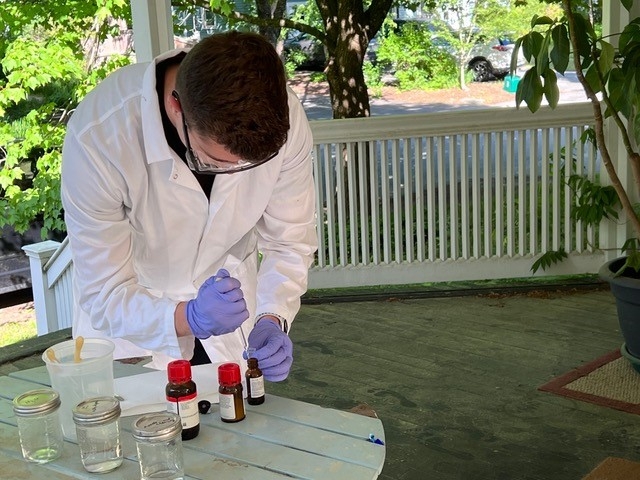
Vile work! Max Seager engages in sulfuric acid studies starting in an outdoor lab the summer 2022, with work now being done in an MIT laboratory.
Image credit: Sara Seager
Biochemistry
Last year, Seager and colleagues, including her university son, authored the research paper with a tell-all title: “Stability of nucleic acid bases in concentrated sulfuric acid: Implications for the habitability of Venus’ clouds.”
That work appeared in the Proceedings of the National Academy of Sciences (PNAS), a peer reviewed journal of the National Academy of Sciences.
“We’re trying to look into the possibility that sulfuric acid droplets could host a biochemistry, not our personal biochemistry, but a different biochemistry,” Seager told Space.com. “We have a lot of lab experiments ongoing and some are coming to fruition.”
For more information, go to my new Space.com story – “1st private mission to Venus will search for alien life in clouds of sulfuric acid” – at:
https://www.space.com/venus-private-mission-alien-life-sulfuric-acid

Image credit: Enigma
There is an increased uptick in research focused on Unidentified Aerial Phenomenon, or UAP. In many ways, serious looks into UAP is the classic unveiling of a riddle wrapped up in an enigma.
And that’s a perfect situation for an organization labeled Enigma. This group is focused on how to reach and serve people who have seen things they can’t explain in the skies.
To that end, Enigma has worked on improving sighting submissions by those encountering Unidentified Anomalous Phenomena, dubbed UAPs, and often linked — deservedly or not — to flying saucers from afar and Unidentified Flying Objects, or UFOs in popular jargon.

Image credit: Enigma
It took the group 10 months — from February to November 2023 — to cross the first 10,000 sightings submitted.
Discernable patterns
I asked Alejandro Rojas, Head of Research and Content for Enigma, to explain the data gleaned so far. Are there any patterns discernable?
“A couple of patterns that stood out were that reports correlate with population,” Rojas told Inside Outer Space. “In other words, where there are more people, there are more reports. That shows us people are seeing UAP everywhere.”
Rojas added that the other pattern that stands out was the similarity with Enigma findings regarding shapes that witnesses are reporting and the shapes reported to the U.S. government’s All-domain Anomaly Resolution Office (AARO).
Witnesses describe the majority of UAP as spheres and points of light.

Image credit: Enigma
Quality of reports
Given the public input so far, are there adjustments that must be made to maximize that public input? Are there any added “need to have” bits of information from observers?
Rojas said that Enigma has continually adjusted and improved their UAP reporting process to gather the necessary information and make the experience easy.
“However, educating the public has been essential to improve the quality of reports,” Rojas said. “We provide users with information regarding mundane objects commonly mistaken as UAP.”
Signal from the noise
Enigma personnel faced one facet of UAP reporting. What has been sorely needed is a tool to sort the signal from the noise. To that end, they have released an Augmented Reality (AR Lens) to serve as a noise reduction tool.
“We provide an AR Lens that currently tracks satellites so witnesses can rule them out. We also plan to provide more information to this lens, such as aircraft and astronomical data, so people can have a quick view of what else is in the sky that may account for what they see,” Rojas said.
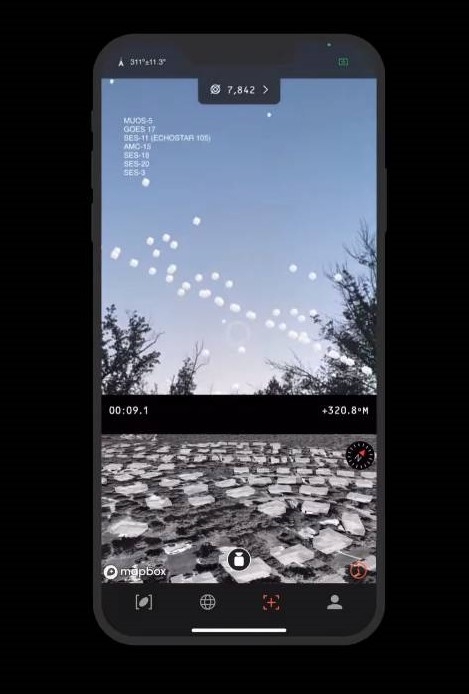
Enigma has released an Augmented Reality (AR) Lens to serve as a “noise reduction” tool.
Image credit: Enigma/Inside Outer Space screengrab
Augmented Reality lens
Enigma personnel faced one facet of UAP reporting.
What has been sorely needed is a tool to sort the signal from the noise. To that end, they have released an Augmented Reality (AR) Lens to serve as a “noise reduction” tool.
“We provide an AR Lens that currently tracks satellites so witnesses can rule them out. We also plan to provide more information to this lens, such as aircraft and astronomical data, so people can have a quick view of what else is in the sky that may account for what they see,” Rojas said.
Increasing the input
As for milestones ahead, Enigma is scoping out plans for the just-arrived New Year – 2024.
“We plan to improve our AR Lens and introduce new tools such as real-time triangulation, which can make calculations of distance, height, and speed when one object is captured on video by several witnesses,” Rojas explained.
Also on the 2024 Enigma agenda is increasing the input of reports to the group.
“We reached 10,000 reports within a year of launching, and the reports are still growing,” said Rojas. “With increased reports and by educating the public to provide better data over the coming months, we expect to share some exciting and mysterious incidents with the public while gathering vital data to help researchers discover more about UAP,” he concluded.
For more information on the AR camera to explore the sky, go to:
https://apps.apple.com/us/app/enigma-ufo-uap-sightings/id1548371173
The Enigma website is available at: https://enigmalabs.io/

