Archive for December, 2023
 Author:
  December 11th, 2023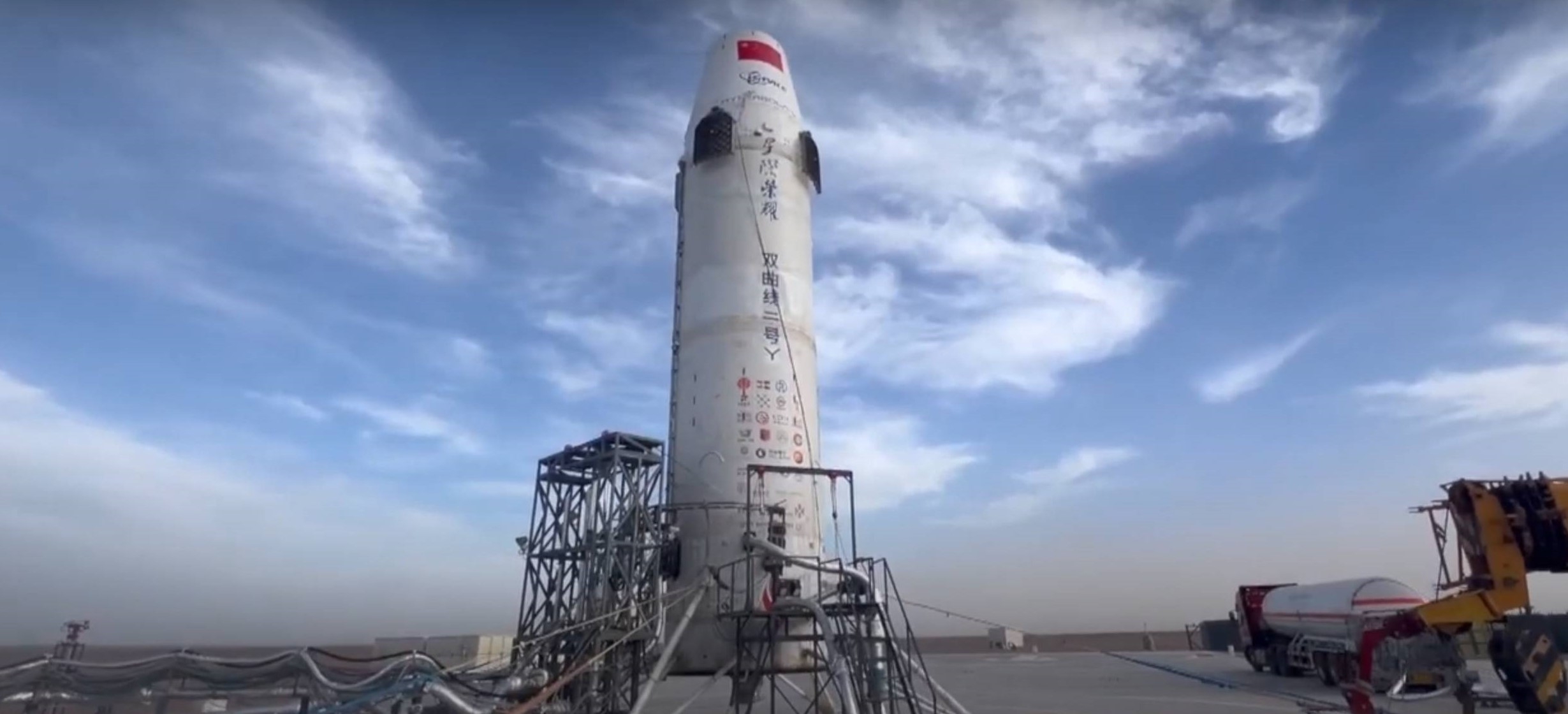
Image credit: CCTV/Inside Outer Space screengrab
It was a busy weekend for China rocketeers on the path to developing reusable launch capability.
Now underway is testing of the Hyperbola-2 methane-liquid oxygen reusable verification stage, built to evaluate its ability of vertical liftoff and landing. Testing is being performed in the Jiuquan Satellite Launch Center in northwestern China.
On Sunday, its second flight was performed. The initial test for vertical liftoff and landing was conducted in early November.
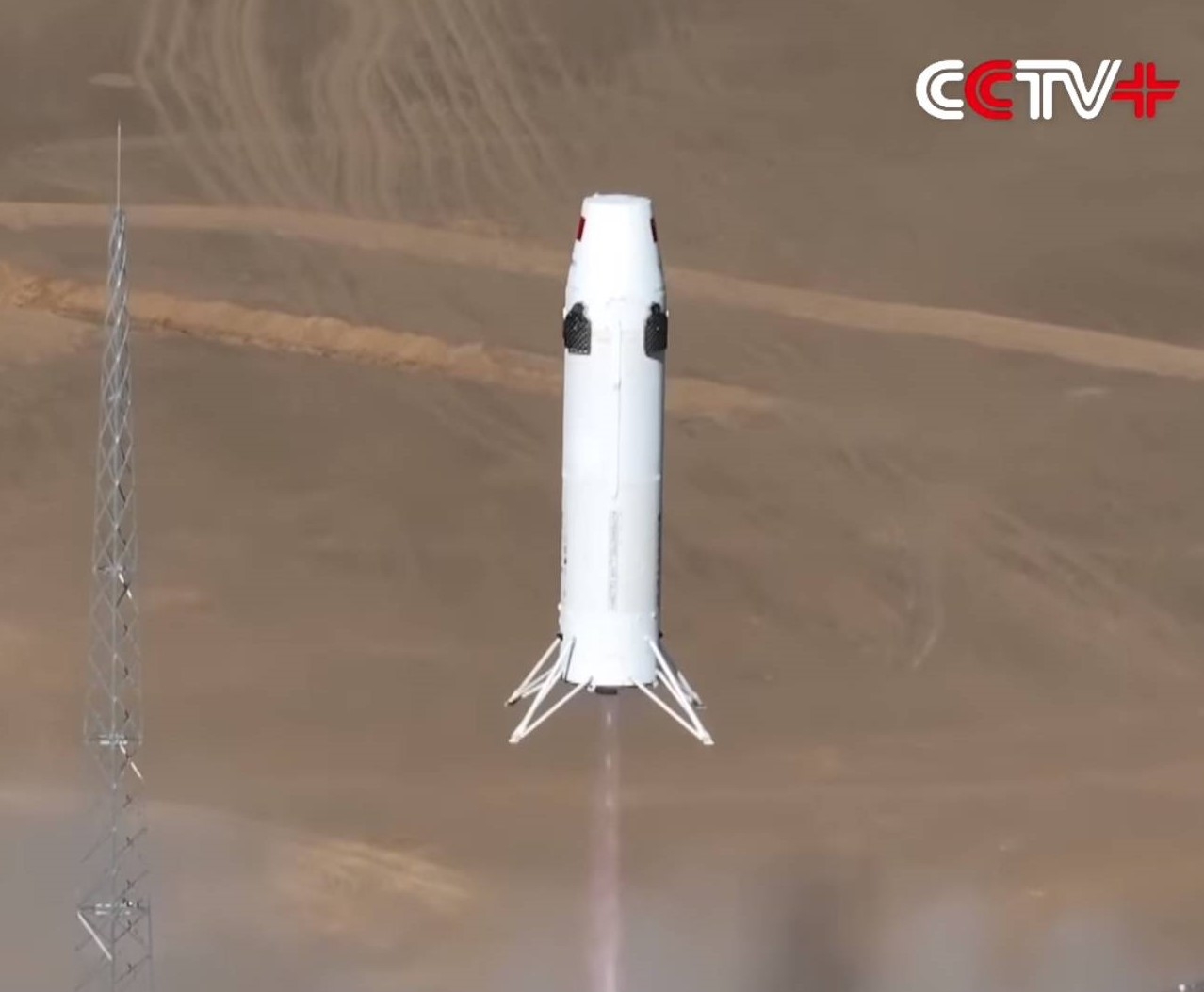
Image credit: CCTV/Inside Outer Space screengrab
Interstellar Glory
Ji Haibo, chief designer of Hyperbola 2Y at Interstellar Glory, said that after tests on the ground, they are planning to conduct one at sea next year, telling China Central Television (CCTV) that the proven reusable technologies will be applied in Hyperbola-3, a 70-meter-tall rocket powered by methane and liquid oxygen, and the rocket will be used in projects such as satellite internet.
The recent test flight of the Hyperbola-2 methane-liquid oxygen reusable verification stage is to fully evaluate the reusability of the rocket, said Jiang Yi, Designer of Liquid Rockets at Interstellar Glory.
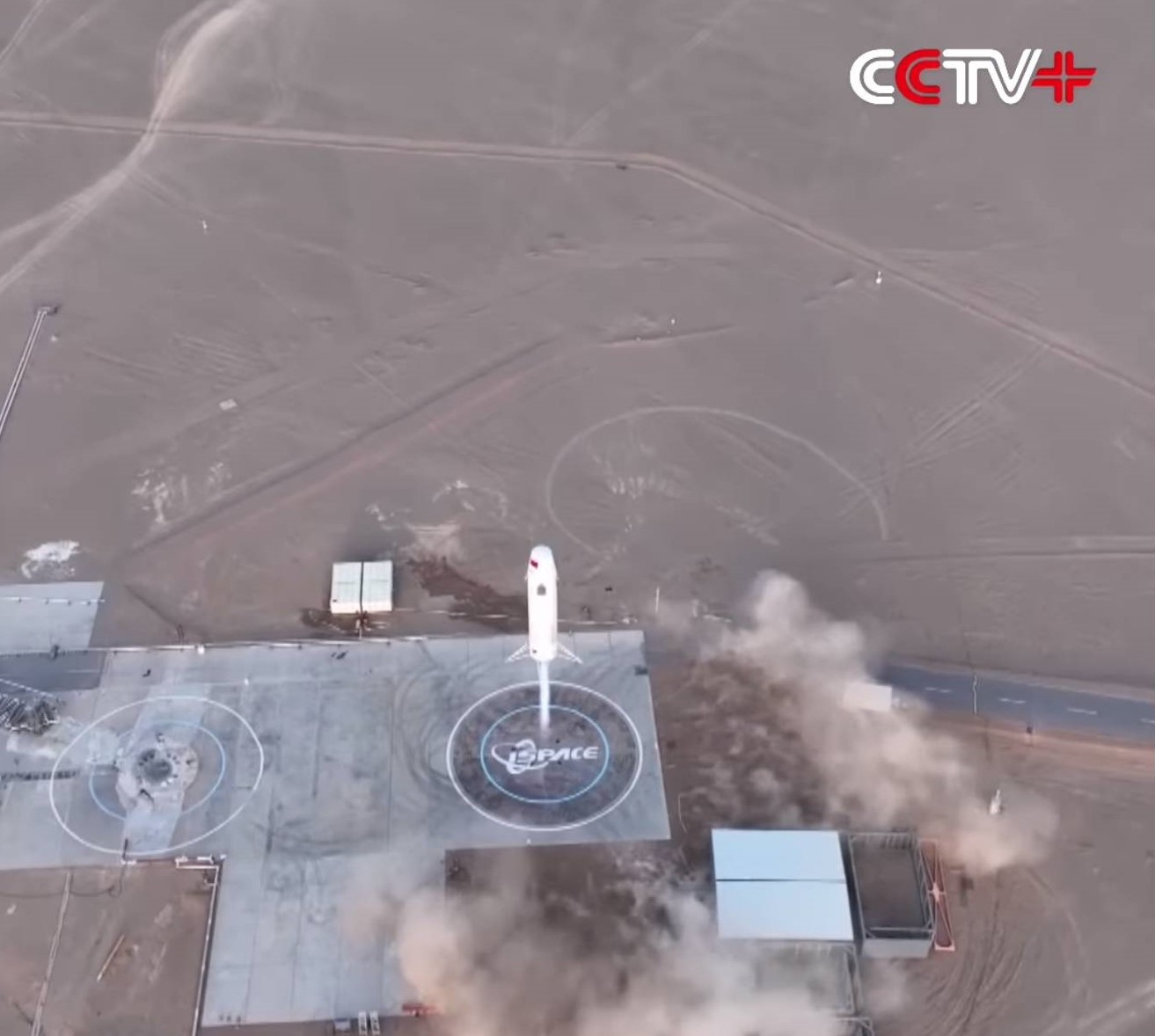
Image credit: CCTV/Inside Outer Space screengrab
Low-cost, reusable rocketry
On Saturday, LandSpace’s Zhuque-2 Y-3 carrier rocket was successfully launched into space from the Jiuquan Satellite Launch Center in northwest China, sending three satellites into orbit.
It was the third flight mission of the Zhuque-2 carrier rocket.
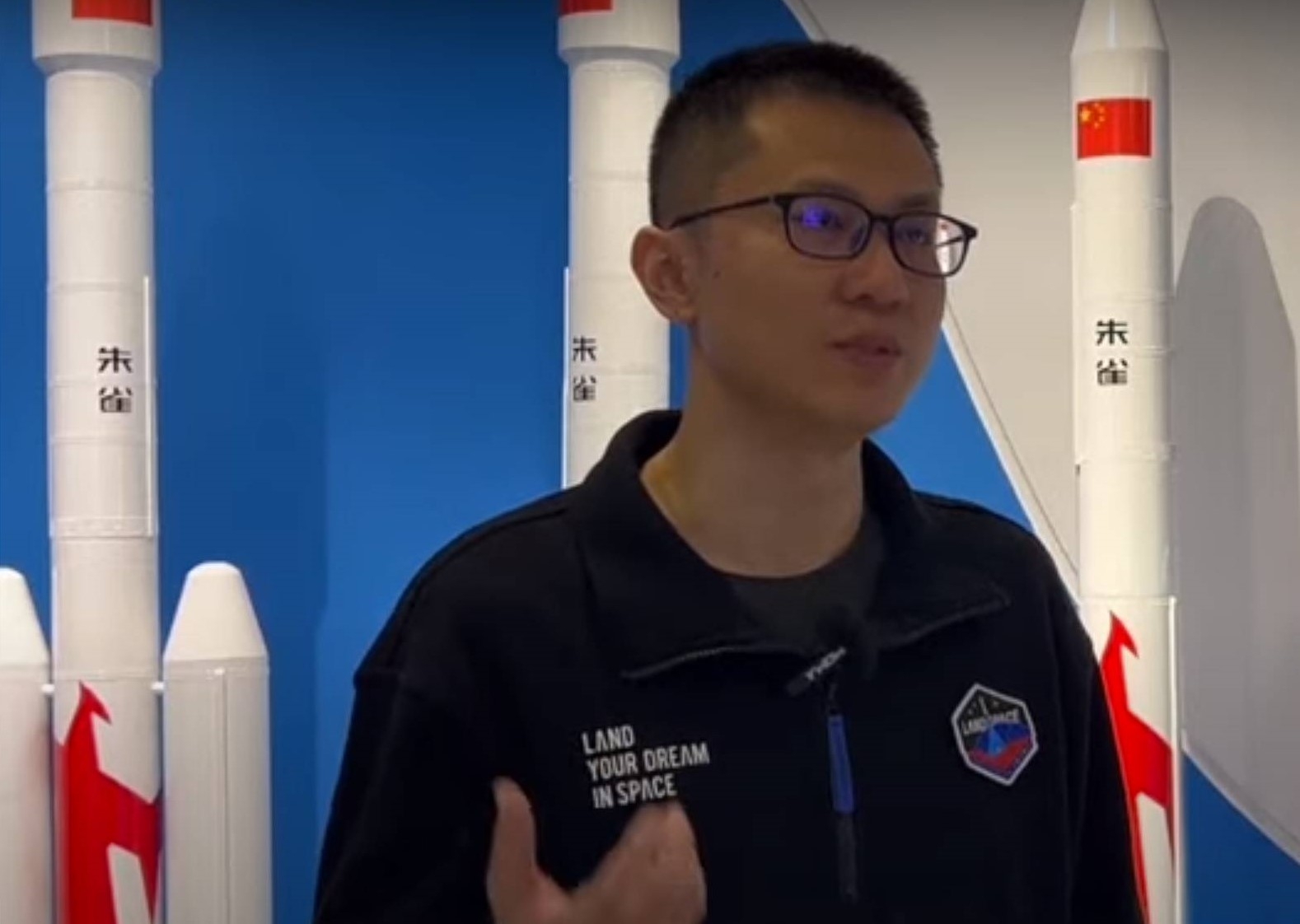
Dai Zheng, deputy chief designer and deputy commander of Zhuque-2 carrier rocket.
Image credit: CCTV/Inside Outer Space screengrab
Saturday’s successful launch of China’s liquid oxygen methane-fueled rocket Zhuque-2 Y3 marked a breakthrough in the development of low-cost reusable commercial rockets, which is crucial to expanding the space traffic portal in the future for the aerospace industry, said Dai Zheng, deputy chief designer of the rocket.
Stainless steel
Developed by the Chinese rocket company LandSpace, Zhuque-2 is China’s first medium-sized rocket powered by liquid oxygen and methane. Its upgraded version has an increased liftoff weight that meets the demand for low-Earth orbit satellite deployment and spacecraft launches.
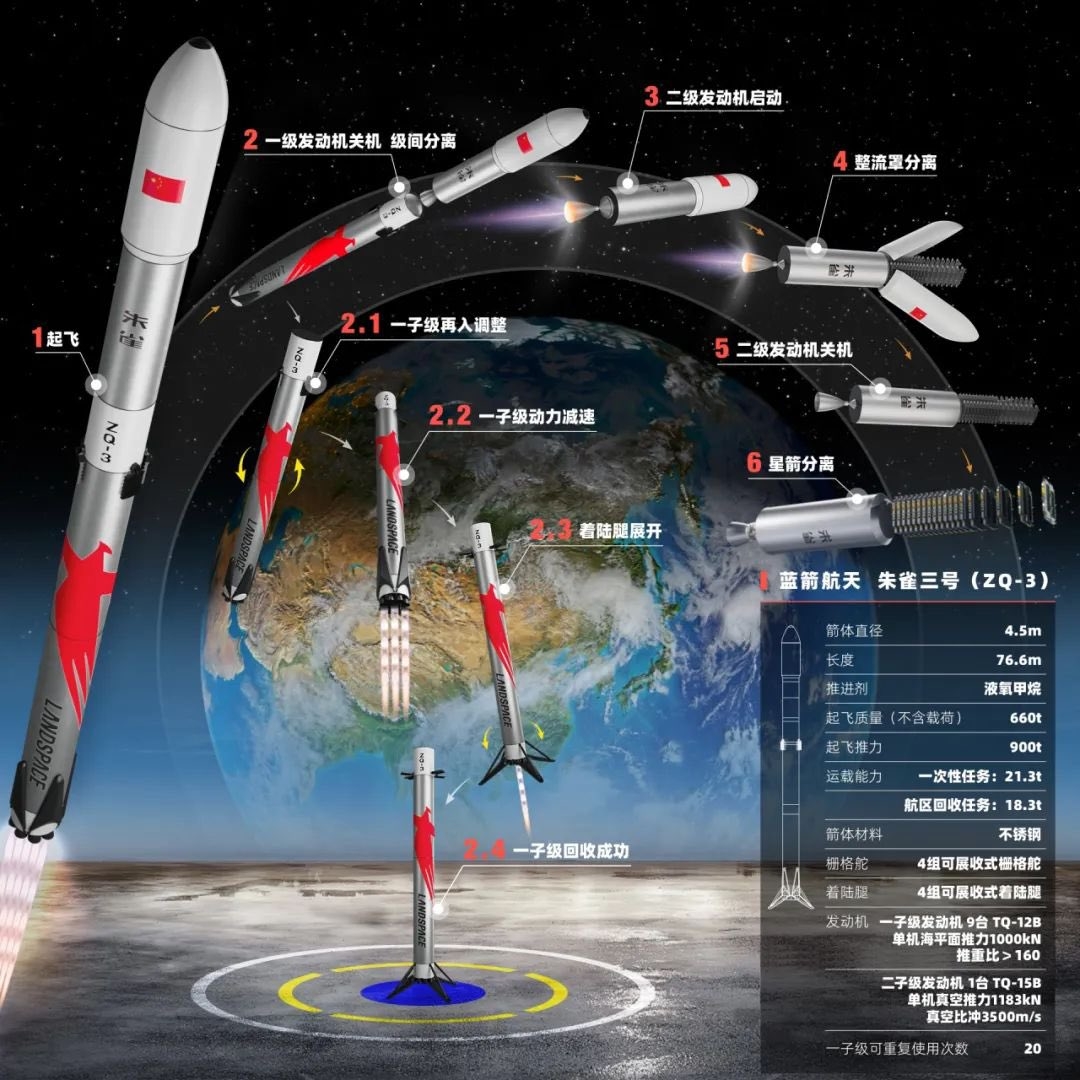
Image credit: Dongfang Hour
China’s methane-powered Zhuque-3 reusable carrier rocket is expected to take on its maiden flight in 2025.
The Zhuque-3 rocket will use Tianque methane engines developed by LandSpace. Its first stage will have nine Tianque-12B engines, which may be reused for up to 20 times. Zhuque-3’s second stage will employ a Tianque-15B vacuum engine.
The Zhuque-3 carrier rocket will be China’s first rocket made of stainless steel and will have a liftoff weight of about 660 tons and a carrying capacity of 21.3 tons.
Single-stage reusability
“The Zhuque-3 carrier rocket is a large-sized single-stage liquid oxygen methane reusable launch vehicle specifically developed in response to the market demand within the context of construction of China’s national satellite-based internet project,” said Zhang Changwu, CEO of LandSpace.
“We are also expected to achieve the milestone of product delivery in 2025. For the Zhuque-3 carrier rocket, we have made numerous breakthroughs in the fundamental experiments for making it. We have achieved groundbreaking progress in the rocket’s material, the upgrade of the thrust of the rocket engine and the algorithm for single-stage reusability,” Zhang told CCTV.
Go to this video focused on testing the Hyperbola-2 methane-liquid oxygen reusable verification stage at:
https://youtu.be/8wbxGIZ97LU?si=i3zOJ9ARvDMojPvN
Go to this video spotlighting launch of LandSpace’s ZhuQue-2 booster.
 Posted in

Apollo 11 footprint on the Moon.
Image credit: NASA
“That’s one small step”… but anthropologists and geologists at the University of Kansas say it’s time to recognize that humans have left their environmental footprint on the Moon, declaring it the “Lunar Anthropocene.”
The idea is much the same as the discussion of the Anthropocene on Earth, that is the exploration of how much humans have impacted our planet, states Justin Holcomb, a postdoctoral researcher with the Kansas Geological Survey (KGS) at KU.
“The consensus is on Earth the Anthropocene began at some point in the past, whether hundreds of thousands of years ago or in the 1950s. Similarly, on the Moon, we argue the Lunar Anthropocene already has commenced,” Holcomb points out in a university press statement.
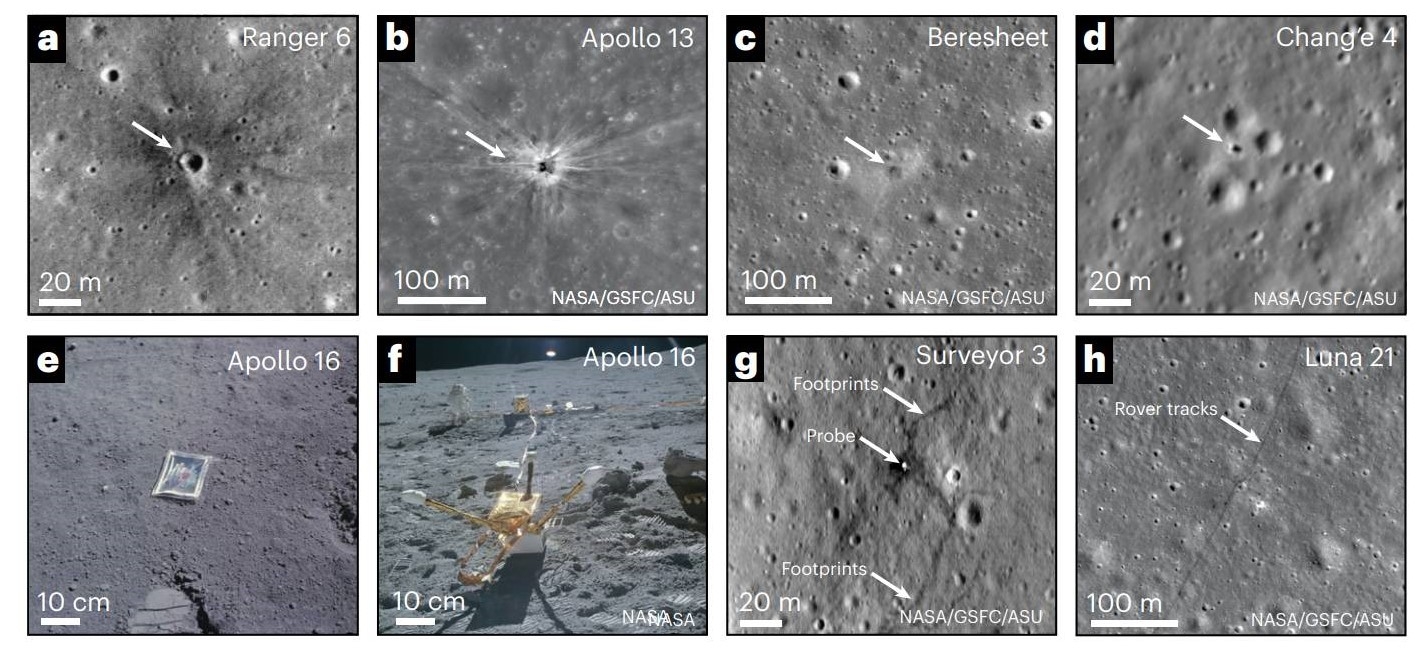
Examples of archaeological artifacts and features on the Moon. a) Crater formed by impact of USA’s Ranger 6 lunar probe in 1964; b) USA’s Apollo 13 Saturn IVB upper stage impact site from 1970; c) Israel’s Beresheet Moon lander crash site from attempted soft landing in 2019; d) China’s Chang’e 4 lunar lander, launched in 2018: e) Photograph and partial footprint left behind by astronaut Charles Duke during USA’s Apollo 16 mission in 1972; f) USA’s Apollo 16 Lunar Surface Magnetometer; g) USA’s NASA Surveyor 3 probe that landed in 1967 and footprints from Apollo 12 which occurred over three years later, resulting in the recovery of some lunar probe components; h) Tracks of Russia’s Lunokhod 2 rover deployed during the 1973 Luna 21 mission.
Image credit: Justin Holcomb, et al.
Lunar halo
Holcomb collaborated on the idea, published as a comment within the journal Nature Geoscience, co-written by Rolfe Mandel, University Distinguished Professor of Anthropology and senior scientist with KGS, and Karl Wegmann, associate professor of marine, earth and atmospheric sciences at North Carolina State University.
“We want to prevent massive damage or a delay of its recognition until we can measure a significant lunar halo caused by human activities, which would be too late,” Holcomb adds.
Holcomb said he hopes the Lunar Anthropocene concept might help dispel the myth that the Moon is an unchanging environment, barely impacted by humanity.

Artistic depiction of NASA astronauts at the lunar south pole carrying out early work to establish an Artemis Base Camp.
Image credit: NASA
Space heritage
“In the context of the new space race, the lunar landscape will be entirely different in 50 years,” Holcomb said. “Multiple countries will be present, leading to numerous challenges. Our goal is to dispel the lunar-static myth and emphasize the importance of our impact, not only in the past but ongoing and in the future. We aim to initiate discussions about our impact on the lunar surface before it’s too late.”
The field of “space heritage” would aim to preserve or catalog items such as footprints, rovers, flags…yes, even golf balls, that already dot the lunar topside.
Other evidence for human activity on the Moon includes bags of human excreta, scientific equipment, photographs and religious texts, Holcomb and colleagues write.
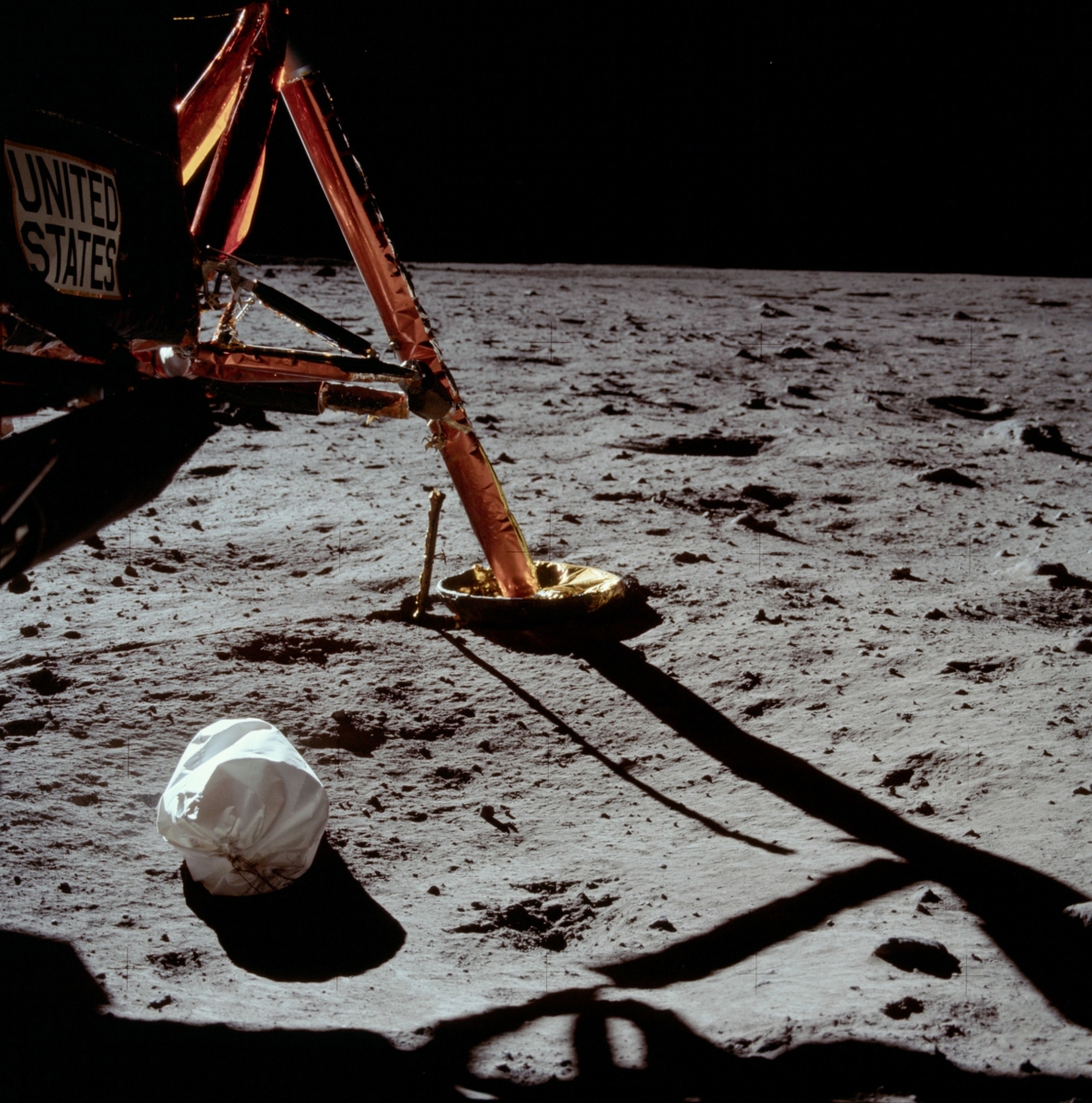
The first picture Neil Armstrong took during the Apollo 11 moonwalk shows a jettison bag under Eagle’s descent stage.
Credit: NASA
Humanity’s journey
“Footprints and rover wheel tracks are extensions of the human presence on the Moon and should be considered important cultural features of our species’ dispersal across our Solar System,” their paper explains.
“As archaeologists, we perceive footprints on the Moon as an extension of humanity’s journey out of Africa, a pivotal milestone in our species’ existence,” Holcomb said.
“These imprints are intertwined with the overarching narrative of evolution,” Holcomb continued. “It’s within this framework we seek to capture the interest of not only planetary scientists but also archaeologists and anthropologists who may not typically engage in discussions about planetary science.”
To access the comment – “The case for a lunar anthropocene” published in Nature Geoscience, go to:

Watch this cis-lunar space! To what extent will a future lunar framework support military prowess?
Image credit: NASA/ESA, Matthias Maurer
Over the last few years, the Defense Advanced Research Projects Agency, better known as DARPA, has increasingly zeroed-in on the Moon.
A trio of proactive DARPA Moon-related undertakings has been welcomed in some quarters.
On the other hand, could such initiatives trigger worries and spark counter-actions by other nations to install military might at the Earth’s moon?
What’s up with saluting the Moon for strategic, military purposes?
Go to my new Space.com story – “Why is there so much military interest in the moon?” — at:
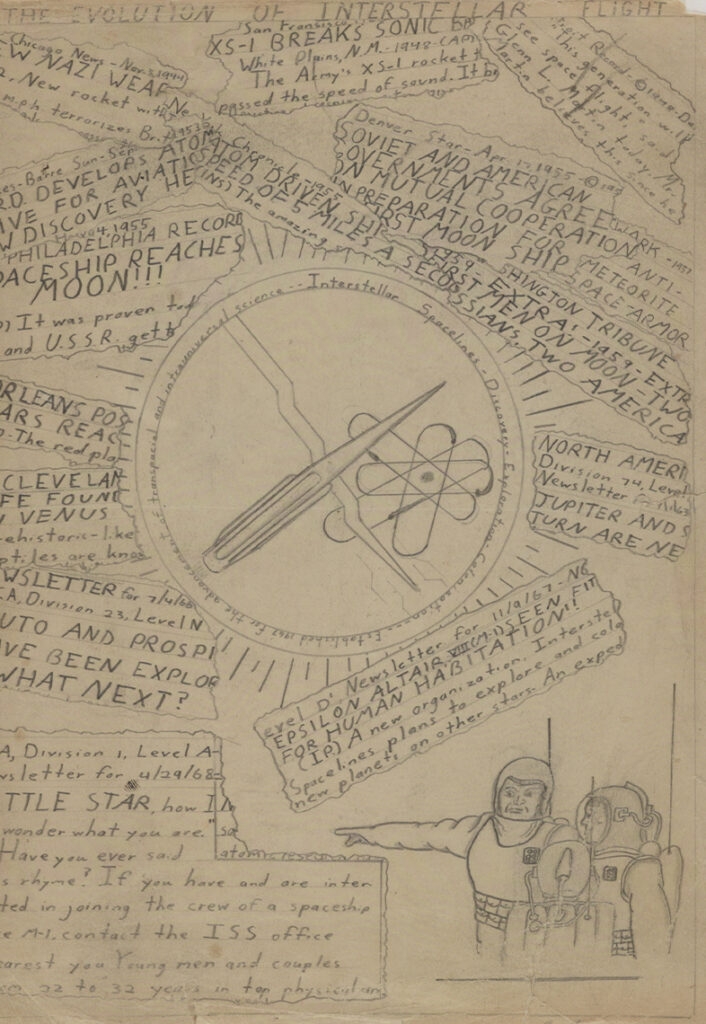
A young Carl Sagan sketched
this conception of future
space travel in the mid-1940s,
when he was 10 to 13 years
old. Courtesy of Druyan-Sagan
Associates Inc. All rights
reserved/Manuscript Division
Among the 595,000 items in the Seth MacFarlane Collection of the Carl Sagan and Ann Druyan Archive in the Library of Congress is a childhood drawing titled “The Evolution of Interstellar Flight.”
When Carl Sagan was 10 to 13 years old, sometime between 1944 and 1947, that drawing was created, an artistic vision of adventurers crossing the galaxy.
So notes Sahar Kazmi, a writer-editor in the Office of the Chief Information Officer, detailing this and other Carl Sagan childhood drawings of space travel in the November-December issue of the Library of Congress Magazine.
Savvy visions
“In one of the most thrilling notes of foresight from the young Sagan, three astronauts appear at the bottom right corner of the page. Their uniforms feature bubble helmets, thick jumpsuits and backpacks with antennae — familiar sights to modern readers, but unexpectedly savvy visions from a school kid in the 1940s,” Kazmi explains.
“That boyish wonder never left Sagan,” Kazmi adds. “Today, his enchantment with the cosmos lives on in an impressive body of work, ready to inspire a new generation of dreamers.”

Rock and Roll legend Chuck Berry with Carl Sagan at a Voyager 2 Neptune flyby celebration in August 1989. Berry’s “Johnny B. Goode” is the only rock song on the interstellar spacecrafts Voyagers 1 and 2.
Image credit: NASA/JPL-Caltech.

Uncrewed military space plane featuring the United States Space Force logo for the first time.
Image credit: U.S. Space Force/Courtesy Photo
The U.S. Space Force X-37B space plane is primed for a weekend takeoff.
The SpaceX Falcon Heavy booster to hurl the robotic space plane skyward is set to launch during a ten-minute window that opens December 10 at 8:14 p.m. Eastern Time from Launch Complex-39A at NASA’s John F. Kennedy Space Center in Florida.
According to a Space Systems Command statement, the Space Force mission will expand knowledge of the space environment for future space domain awareness technologies.
U.S. Space Force-52 is carrying the seventh mission of the X-37B Orbital Test Vehicle (OTV-7), which is an experimental test program that demonstrates technologies for a reliable, reusable, uncrewed space test platform for the U.S. Space Force.
For more details, go to:
U.S. Military Space Plane: Next Mission – What Will It Do? (Update)
https://www.leonarddavid.com/u-s-military-space-plane-next-mission-what-will-it-do/

Wait a minute!
Image credit: Barbara David
Scathing, blistering luncheon keynote: Former NASA Administrator, Mike Griffin, at American Astronautical Society’s Advancing Space: From LEO to Lunar and Beyond conference, held October 25-27, 2023 at the University of Alabama in Huntsville in Alabama.
As a former administrator, Griffin says he was the administrator not the Creator. “You’re told to do what you are told by the combination of the White House and the hill as best you can do it, but you know you’re lucky if they take your advice. You get a prescription you don’t write the prescription.”
Go to video at:
https://youtu.be/4L8MY056Vz8?si=MIbvSqACeKU1rpdi
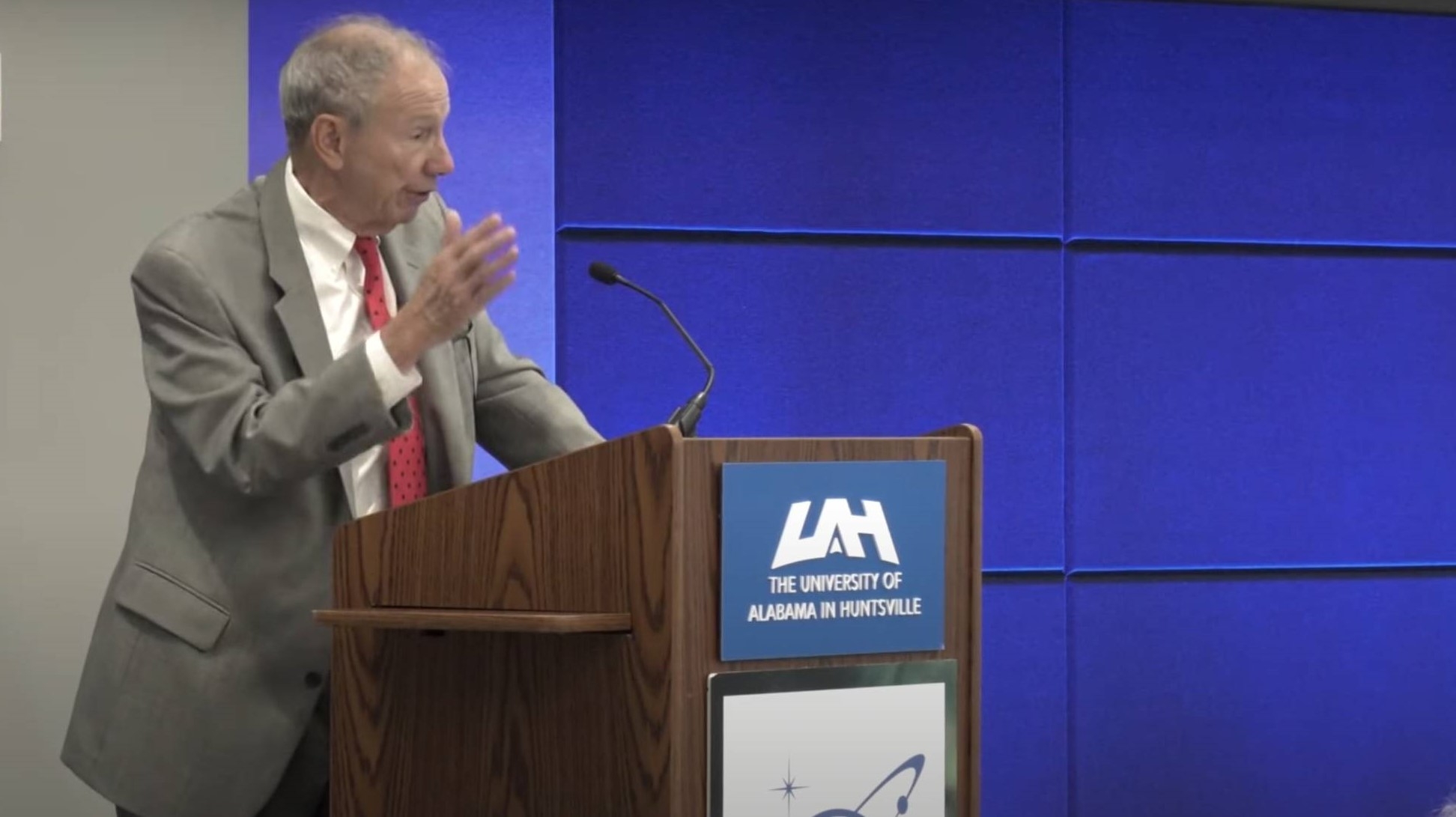
Mike Griffin, former NASA Administrator.
Image credit: AAS/Inside Outer Space screengrab

China’s space station work is likely to help the country fabricate solar power satellites. High-definition images of China’s space station were taken by the departing Shenzhou-16 crew on October 30.
Image credit: CMS
A number of teams in China are exploring technologies required to install in Earth orbit a space-based solar power facility.
Hou Xinbin is a senior researcher at the China Academy of Space Technology in Beijing and a member of the Committee of Space Solar Power of the Chinese Society of Astronautics.
“My colleagues at several domestic institutes and I have proposed a technology demonstration mission to the country’s space community, and are hoping it will happen in the near future,” Hou told China Daily in an interview last month in Beijing, on the sidelines of an international space industry forum.

China space station is captured in this photo taken recently by the departing Shenzhou-16 crew.
Image credit: CMS
Key step
According to Hou, there’s a key step to verifying the feasibility of space-based solar power generation.
“We want to make and place into orbit a pair of satellites — a large one that will collect solar power and convert it to microwaves and laser beams, and a smaller one responsible for receiving laser beams. Meanwhile, a ground station will be in charge of receiving the microwaves. The two satellites will form an in-orbit testing system for wireless power transfer,” Hou said.
A solar power satellite with laser transmission capability, Hou added, can operate in a lunar polar orbit and provide power supply to exploration programs in polar regions on the Moon.

Illumination map of the south polar region of the Moon. Areas in black receive no sunlight, and areas in warmer colors are illuminated a greater fraction of the time.
Image credit: Base image mosaic from NASA, Arizona State University, and Applied Coherent Technology Corp.
Challenges ahead
Hou also pointed to challenges ahead, such as developing high-performance components, not too big or too heavy, integrating those technologies into a satellite, and also ensuring that power beams from space to ground receiving stations can be done with great accuracy.
“In the long term, we need to figure out how to transport large, heavy parts to orbit and then assemble a colossal power station,” Hou told the State-run China Daily.

Pre-launch image shows parachute installation in the OSIRIS-REx sample return capsule.
Image credit: Lockheed Martin
The NASA OSIRIS-REx asteroid sample return capsule that parachuted into the Utah desert on September 24 also was a case of high-altitude drama.
Going over descent video of the capsule and other extensive documentation, project officials have determined that the landing sequence did not go according to plan, with a small parachute called a drogue not unfurling as scripted.
According to a December 5 statement from NASA’s Goddard Space Flight Center, Greenbelt, Maryland, it was found that “inconsistent wiring label definitions in the design plans likely caused engineers to wire the parachutes’ release triggers such that signals meant to deploy the drogue chute fired out of order.”
Out of order
In NASA’s statement, the word “main” was used inconsistently between the device that sends the electric signals, and the device that receives the signals.
“On the signal side, ‘main’ meant the main parachute. In contrast, on the receiver side ‘main’ was used as a reference to a pyrotechnic that fires to release the parachute canister cover and deploy the drogue. Engineers connected the two mains, causing the parachute deployment actions to occur out of order,” the NASA posting explains.

OSIRIS-REx capsule on main chute headed for landing.
Image credit: UTTR/NASA
In order to confirm the root cause of the parachute problem, NASA will be able test the system responsible for releasing the parachutes.
“This hardware is currently inside one of the glove boxes with the Bennu sample at NASA’s Johnson Space Center in Houston. Once the curation team there completes processing the sample material—the mission’s top priority at present—NASA engineers will be able to access the parachute hardware and verify the cause,” says the NASA statement.
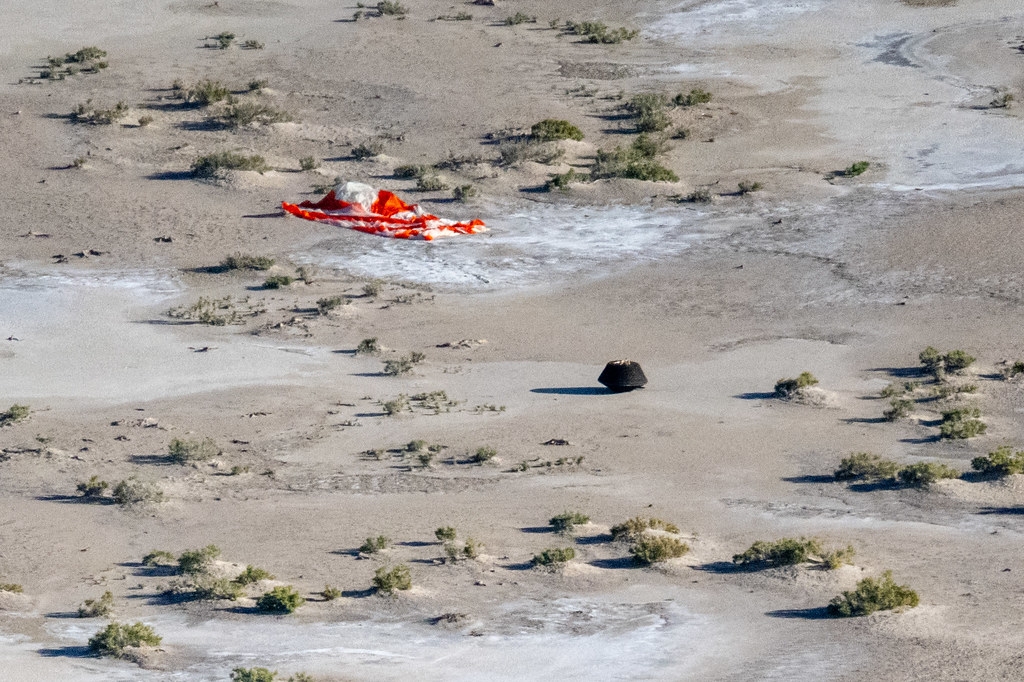
Following its high-speed re-entry, the OSIRIS-REx sample return capsule served as an artificial meteor before parachuting into the desert landscape of the Department of Defense’s Utah Test and Training Range.
Image credit: NASA/Keegan Barber
Technical hiccups
Even on capsule landing day in Utah, there was early suspicion that something in the parachute progression did not go as planned.
There may have been some technical hiccups in the capsule’s speedy and red-hot descent through Earth’s atmosphere, said Tim Priser, Lockheed Martin’s chief engineer for deep space exploration, in a post-capsule landing press conference in Utah.
Lockheed Martin designed and built the OSIRIS-REx spacecraft, asteroid sampling system and sample return capsule at its facilities near Denver. The company also operated the spacecraft from launch through sample return.
“Some things in our sequence may or may not have behaved itself exactly the way we expected it to but the subsequent things in the sequence made up for the fact,” Priser said. “At the end of the day when that main chute deployed it basically corrected any of the sins that may have happened ahead of it,” he said at the time.

Image credit: University of Arizona/Heather Roper
Reconstruct what happened
While there was now-confirmed drogue trouble, the return capsule’s dive through Earth’s atmosphere did perform a “soft as a dove” touchdown in Utah.
One of the advantages of landing at the Utah Test and Training Range, Priser added in the Utah press gathering, is the ground and aerial imagery capability used to monitor the capsule’s sky-rocketing re-entry.
“You have your data. You have your models. You have your observations and you’ve got to put all those pieces together so you reconstruct what happened,” Priser told Inside Outer Space at that September press event.

Genesis return capsule crash in Utah desert.
Image credit: NASA
Blast from the past
But in a blast from the past, that same stretch of Utah landscape has been witness to both calamity and victory.
In September 2004, NASA’s Genesis spacecraft, toting samples of solar wind, failed to deploy its parachutes due to a Lockheed Martin engineering error. A Mishap Investigation Board later identified that a likely cause was improper orientation of gravity-switch sensors that were to set off the capsule’s landing system. Those G-switch sensors had been installed upside down in the spacecraft so they did not detect the capsule’s deceleration and begin the parachute sequence. Also, the mishap board noted that this blunder wasn’t found early by oversight processes. This issue led to a severely banged up capsule and contamination of its prized shipment of solar wind particles.
This mishap was followed in January 2006 by NASA’s Stardust mission – also engineered by Lockheed Martin. Stardust successfully parachuted to Earth its capsule of particles spewed out by comet P/Wild 2, a rich bonanza of material for intense laboratory scrutiny.

Image credit: NBC News
New reporting on UFOs from NBC News’ Meet the Press
NBC News NOW, took a half-hour look at the current conversation around both the unexplained science as well as government transparency on the issue.

Broadcaster Chuck Todd interviews lawmaker Tim Burchett. Image credit: NBC News
The December 2 episode features reporting and interviews from NBC News Correspondent Sam Brock and host Chuck Todd, with guests including:
Rep. Tim Burchett (R-Tenn.)
Ryan Graves, Former F-18 pilot and the Executive Director of Americans for Safe Aerospace
Robert Powell, Chemist and Nanotech Expert; Co-Founder, Scientific Coalition on UAP Studies (featured in Netflix docuseries “Encounters”)
James Webb, Astrophysicist at Florida International University
Garrett Graff, Author, UFO: The Inside Story of the US Government’s Search for Alien Life Here—and Out There
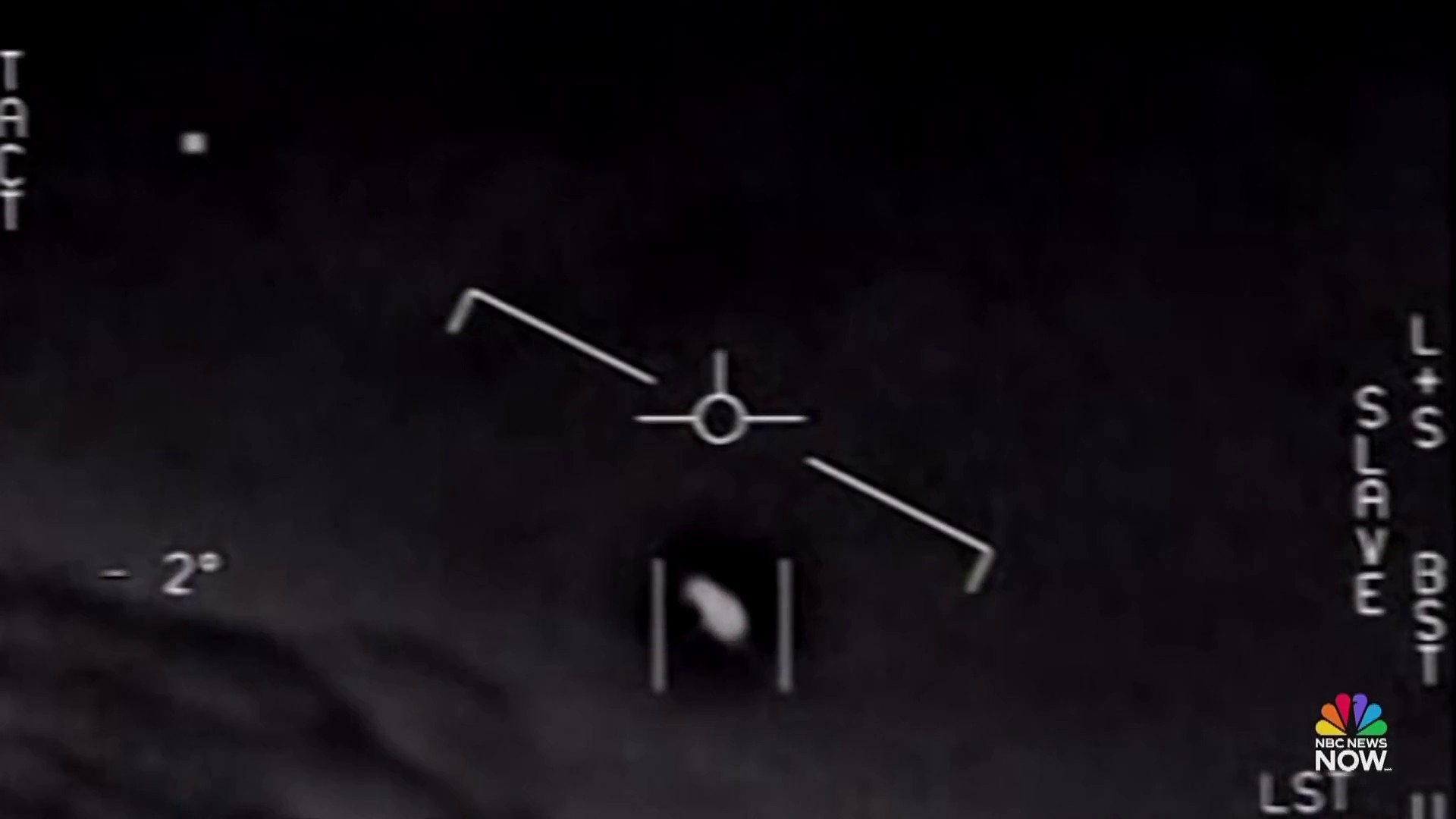
Image credit: NBC News
Take a video look at this broadcast — “UFOs: Is the truth out there? UFOs are out there. But why is the government keeping secrets?” – a Meet the Press Reports available at:
This broadcast is also available on-demand any time on Peacock.

Artist’s concept of NASA’s Ingenuity Mars Helicopter flying through the Red Planet’s skies. Credit: NASA/JPL-Caltech
NASA’s Ingenuity Mars helicopter has chalked up a new flight, #67.
The rotorcraft flew on December 2, zipping across its Jezero Crater exploration zone for 135.9 seconds.
It flew a horizontal distance of 393 meters (roughly 1,289 feet) and reached a maximum altitude of 12 meters (roughly 39 feet).
Chalking up mileage
Overall, since the vehicles first flight back in April 19, 2021, the aerial explorer has collectively attained roughly 121.1 minutes of flight time; Flown some 10 miles (roughly 15,303 kilometers); and shot up to 24 meters (roughly 79 feet) above the surface of the Red Planet.
Image here was taken by Ingenuity’s Navigation Camera mounted in the helicopter’s fuselage and pointed directly downward to track the ground during flight. This image was acquired on Dec. 2, 2023, the date of Ingenuity’s 67th flight, as posted by the NASA/JPL-Caltech Ingenuity Flight Log.
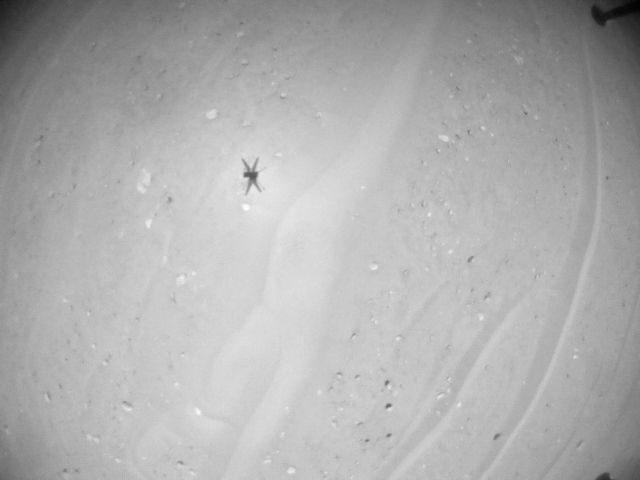
Image credit: NASA/JPL-Caltech

