Archive for December, 2023
 Author:
  December 21st, 2023
image credit: NASA/JPL-Caltech
NASA’s Ingenuity Mars helicopter has completed flight #69, doing so on December 20.
Horizontal distance flown was 705 meters (roughly 2,315 feet), gaining a maximum altitude of 16 meters (approximately 52 feet). The duration of the flight was 135.4 seconds.
In total, the Ingenuity flight log now is 69 flights, with an accumulated flight time of some 125.5 minutes and a total distance flown of 10 miles (16,711 kilometers). The highest altitude reached by the mini-rotorcraft is 24 meters, roughly 79 feet above the surface of the Red Planet.
Since its first flight on April 19, 2021 the aerial craft has attained a maximum ground speed of 22.4 miles per hour (10 meters a second).

Dynamic duo: Earlier released image captures Ingenuity Mars helicopter and Perseverance rover.
Image credit: NASA/JPL-Caltech
 Posted in

Image credit: CGTN/Inside Outer Space screengrab
China’s Shenzhou-17 crew completed their first space walk activity on Thursday, according to the China Manned Space Agency (CMSA).
The astronauts have been stationed in China’s orbital complex, the Tiangong space station, for 54 days, nearly one-third of their six-month space mission.
The Shenzhou-17 crew is comprised of commander Tang Hongbo, 48, and operators Tang Shengjie and Jiang Xinlin, aged 34 and 35, respectively. This taikonaut trio is on tap to undertake a series of tasks, including in-orbit tests of space science and application payloads, extravehicular activities, installation of extravehicular payloads, and space station maintenance.

Image credit: CMSA
Launched into space on October 26, the Shenzhou 17 mission is the 12th crewed Chinese spaceflight and the 17th flight overall of the Shenzhou program.
Next up
Meanwhile, the Long March-7 Y8 carrier rocket that will loft the uncrewed Tianzhou-7 cargo ship has been transported to the Wenchang Spacecraft Launch Site in the southern province of Hainan on Thursday.
The rocket will undergo assembly and testing together with Tianzhou-7, which arrived earlier in November, the CMSA said. At present, all testing systems at the launch site are gearing up for the early next year launch as planned.
China has scheduled four missions to its space station in 2024, including two cargo spacecraft, the Tianzhou-7 and the Tianzhou-8.
Also, two piloted missions, the Shenzhou-18 and the Shenzhou-19 will be launched in 2024, the CMSA said.

Image credit: CGTN infographic by Yu Peng

Techniques for solar climate intervention have been widely discussed to increase the quantity of solar radiation reflected back into space.
Image credit: Chelsea Thompson, University of Colorado/CIRES and NOAA Chemical Sciences Laboratory
A group has been formed to study and promote a based-in-space sunshade to help fend off global climate change.
The idea has been discussed for years, but the Planetary Sunshade Foundation is cranking out support papers that spotlight the practicality of the approach.
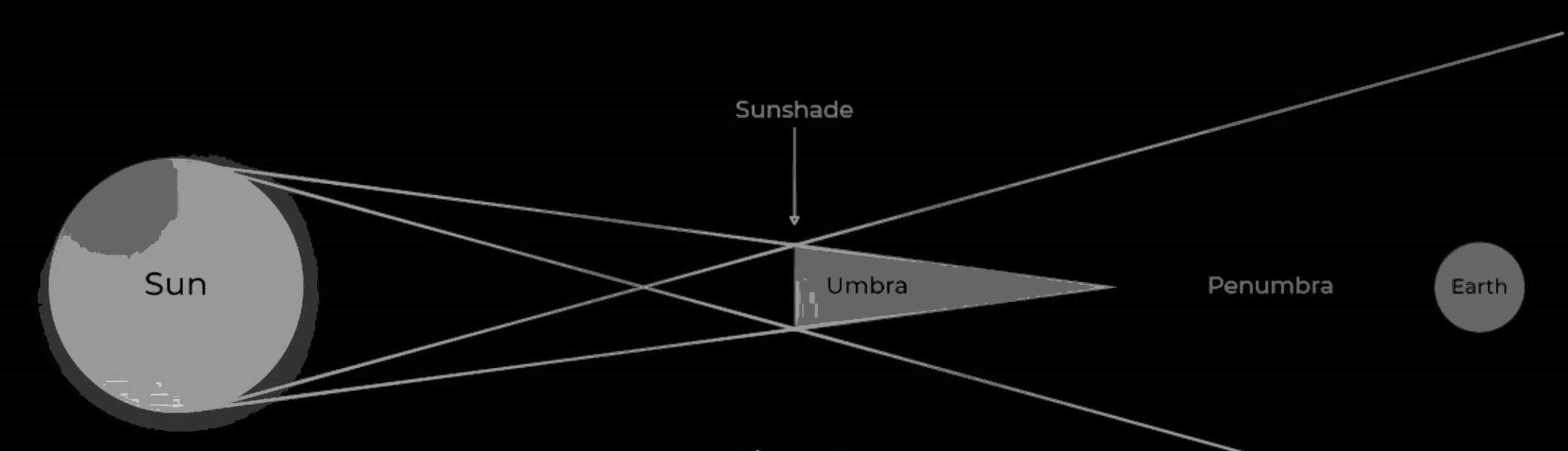
A sunshade would be installed at the Sun-Earth Lagrange-1 point to reduce radiative forcing — the trapping of heat in the atmosphere due to greenhouse gas emissions — by reflecting sunlight back into space.
Image credit: Planetary Sunshade Foundation
A planetary sunshade, they advise, could be the best solution for solar radiation management and should be viewed as a key part of countering worrisome indications of alterations in Earth’s climate.
For more information, go to my new Space.com story – “These scientists want to put a massive ‘sunshade’ in orbit to help fight climate change” – at:
https://www.space.com/sunshade-earth-orbit-climate-change

Keeping an eye out on the puzzle pieces of climate change. The National Oceanic and Atmospheric Administration’s Space Weather Prediction Center in Boulder, Colorado safeguards society by issuing space weather forecasts, warnings, and alerts.
Image caption: NOAA/Space Weather Prediction Center

Credit: James Vaughan (Used with permission) http://www.jamesvaughanphoto.com/directory-aerospace-defense-illustrations
“Mining in space is coming and the United States better be prepared.”
That’s the view of lawmaker Paul Gosar (R-Ariz.) who held a recent oversight hearing on mineral supply chains and the New Space Race.
“Mining in space is more important than some may realize, Gosar said. “Our competitors, including China, are far ahead of us.”
The hearing was held December 12 by the Committee on Natural Resources, Subcommittee on Oversight and Investigations.
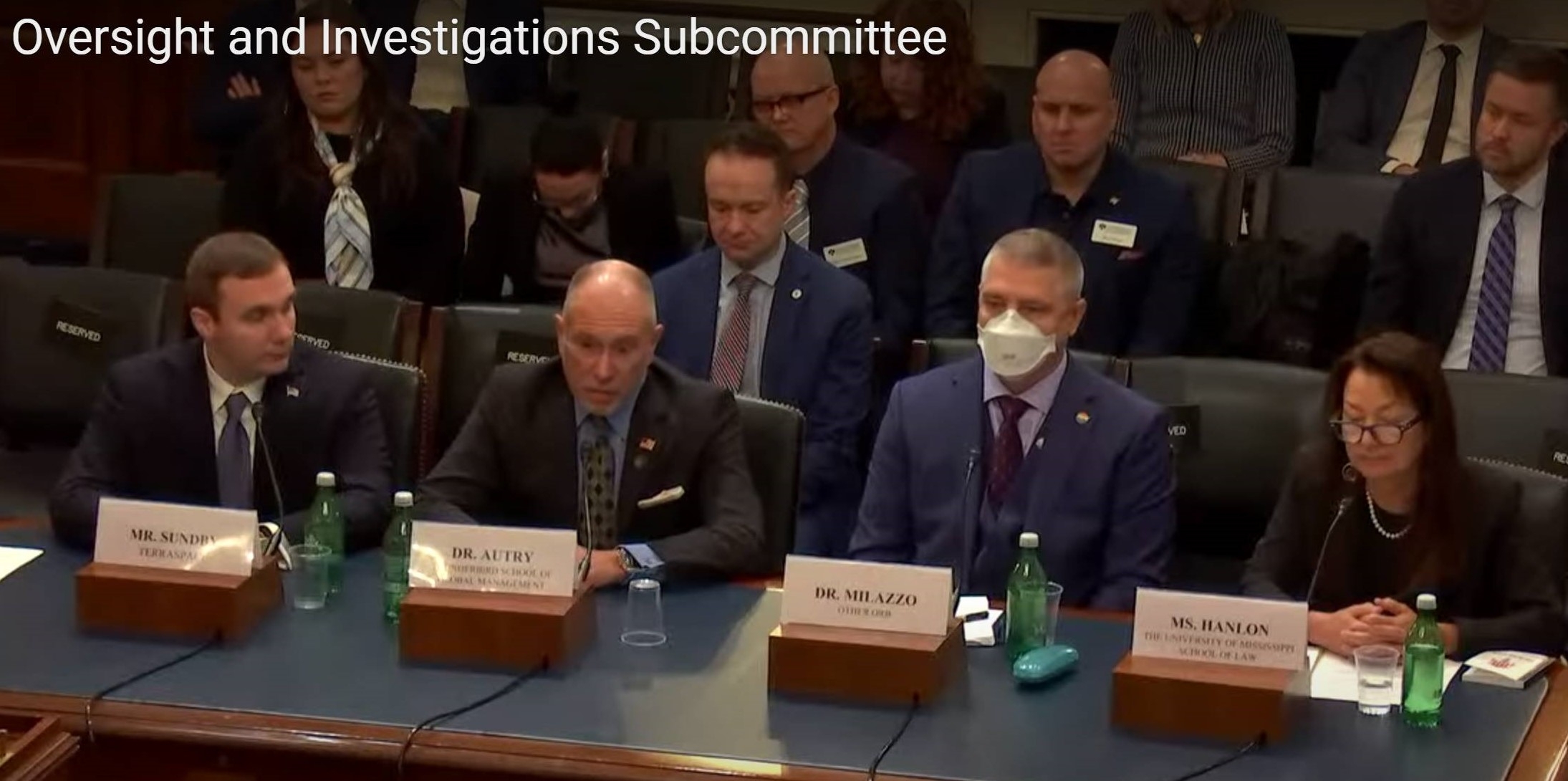
Image credit: Committee on Natural Resources, Subcommittee on Oversight and Investigations/Inside Outer Space screengrab
Modern way of life
As noted in a background statement, minerals like copper, lithium, cobalt and dozens of others are integral to our modern way of life. “They are used in almost all high-tech applications, including smartphones, satellites and missile defense systems. They are also essential for the function of renewable energy technologies, electric vehicles and battery storage. The global demand for minerals is expected to rise exponentially in the decades ahead.”
According to the World Bank, mineral demand will increase by nearly 500 percent by 2050. The global demand for minerals specifically used in electric vehicle batteries such as lithium and graphite will increase by even more, up to 4,000 percent in the decades ahead.
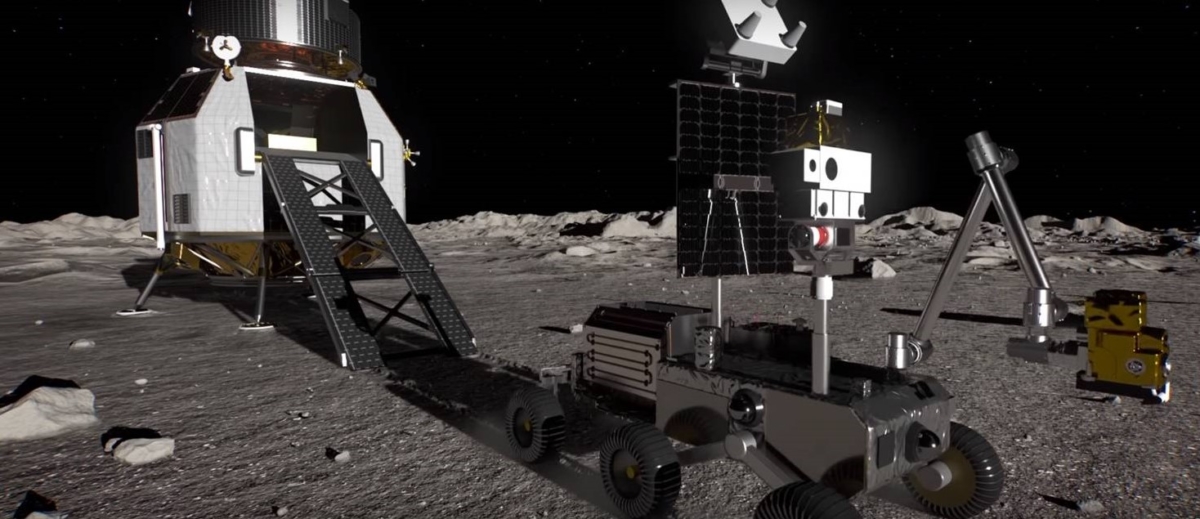
Credit: ESA/Screengrab Inside Outer Space
Feasibility of space mining
“Exponential growth in global mineral demand and China’s dominance of mineral supply chains threatens America’s national security and economic interests,” the backgrounder adds. “While there is uncertainty over the feasibility of space mining, accelerating investments from our foreign adversaries, notably China, to extract minerals from celestial bodies exacerbates America’s fragile mineral supply chain.”

Space cowboys? International lawyers are trying to agree on what legislation will be needed to control the exploration of mineral resources in space to avoid a new ‘Wild West’.
Credit: James Vaughan
The hearing focused on what steps need to be taken by America to secure the country’s mineral supply chains, flagging both mining and territorial control over expanding resources beyond Earth’s orbit.
Hearing experts
The hearing experts on the future of space mining:
Eric Sundby, Co-Founder & CEO of TerraSpace, Executive Director of the Space Force Association
Greg Autry, Director and Clinical Professor, Space Leadership, Policy, and Business, Thunderbird School of Global Management, Arizona State University
Moses P. Milazzo, Owner of Other Orb, Chief Scientist for NASA’s Planetary Data Ecosystem [Minority Witness]
Michelle Hanlon, Executive Director, Center for Air and Space Law, The University of Mississippi School of Law
To view video of the hearing and access the witness testimony, go to:
https://naturalresources.house.gov/calendar/eventsingle.aspx?EventID=415257

Possible design of China’s space plane.
Source: Homem do Espaco/Twitter
Update: SpaceX is now targeting no earlier than Thursday, December 28 for Falcon Heavy to launch the U.S. Space Force X-37B (USSF-52) to orbit from Launch Complex 39A at NASA’s Kennedy Space Center in Florida.
China’s reusable experimental spacecraft was lofted into orbit via a Long March 2F carrier rocket on Thursday from the Jiuquan Satellite Launch Center in Northwest China’s Gobi Desert.
As reported by the China News Network, this vehicle’s mission is the third that China has made public: first orbital test of a trial vehicle took place in September 2020, with the craft in orbit for just under two days.
The second test started in August 2022 and the spaceplane stayed in the Earth’s orbit for 276 days before landing in May 2023.
Both spacecraft in the previous two tests – it is not known whether they were of the same type – were launched by a Long March 2F rocket from the Jiuquan center, as noted by the China News Network.

China has had a long-standing interest in reusable space planes.
Courtesy: Jean Deville/China Aerospace Blog
No word on duration of flight
Thursday’s launch of the secretive craft was the 22nd flight of the Long March 2F rocket, typically used to launch China’s Shenzhou crewed spaceships.
The Long March 2F booster has a carrying capacity of just over 8 metric tons for delivery into low Earth orbit.
There is no word as to the duration of this new mission of the experimental vehicle.
According to Robert Christy of Orbital Focus, the Chinese craft’s mission duration may exceed one year.

Uncrewed military space plane featuring the United States Space Force logo for the first time.
Image credit: U.S. Space Force/Courtesy Photo
X-37B delayed flight
Meanwhile, the launch of the U.S. Space Force X-37B military space plane remains in limbo (see update above). According to SpaceX, the flight of USSF-52/X-37B/Orbital Test Vehicle-7 is standing down to perform additional system checkouts.
“The payload remains healthy while teams work toward the next best launch opportunity,” adds a SpaceX communiqué.

Image credit: SpaceX
This will be the fifth launch and landing of the Falcon Heavy side boosters, which previously supported USSF-44, USSF-67, Hughes JUPTER 3, and NASA’s Psyche mission.
Following booster separation, Falcon Heavy’s two side boosters will land on SpaceX’s Landing Zones 1 and at Cape Canaveral Space Force Station in Florida.

Image credit: SpaceX
For a view of this X-37B robotic craft, and the mission’s known tasks, go to:
U.S. Military Space Plane: Next Mission – What Will It Do?
https://www.leonarddavid.com/u-s-military-space-plane-next-mission-what-will-it-do/
For a perspective on China’s reusable spacecraft – “May be like US’s X-37B,” go to:
https://www.leonarddavid.com/chinas-reusable-spacecraft-may-be-like-uss-x-37b/

Asteroid Bennu as viewed in this mosaic montage using images from NASA OSIRIS-REx return sample spacecraft.
Image credit: NASA/Goddard/University of Arizona
In the last several years, a spate of up-close encounters and smash-ups with various asteroids has taken place. Interestingly, the rubble pile composition of asteroids has been surprising in several cases.
Asteroid probes from several nations have found countless pieces of gravel and boulders loosely bound together by the object’s own small gravity field.
This revelation is drifting through the planetary defense community. How best to deal with incoming space rocks that are double-trouble: Bad for Earth, but also tough to deal with due to their makeup?
Go to my new Space.com story – “Could we defend Earth against a ‘rubble pile’ asteroid?” at:
https://www.space.com/asteroids-rubble-piles-earth-planetary-defense

The Atacama Large Millimeter/submillimeter Array (ALMA) in northern Chile’s Atacama desert.
Credit: ESO/B. Tafreshi (twanight.org)
The question of whether we might one day make contact with an extraterrestrial intelligence, whether near or far seems close at hand.
A new research paper examines the social consequences of first contact with other star folk and calls for humanity to prepare for an encounter with an extraterrestrial intelligence.
First of all, the consequences of a first contact strongly depend on the way it takes place. The paper offers the view that first contact with extraterrestrials poses considerable risks for humanity. Additionally, a first contact event could also take place without being culturally recognized.

Image credit: Andreas Anton, et al.
This intriguing research paper published in Acta Astronautica is led by Andreas Anton of the Institute for Frontier Areas of Psychology and Mental Health in Freiburg, Germany.
Scenarios
Anton and colleagues serve up a set of scenarios:
The signal scenario is the basis of SETI programs in which radio astronomers search for extraterrestrial civilizations. It assumes that radio telescopes pick up artificial signals from the far reaches of space.
The technosignature scenario is one where future powerful telescopes will find evidence of past or present extra-terrestrial technology.

Image credit: SETI Post-detection Hub
The artifact scenario assumes that one day, somewhere in our solar system (or even on Earth itself), we will come across the material remains – such as a space probe – of an extraterrestrial civilization.
The encounter scenario involves the appearance of an extraterrestrial spacecraft in near-Earth space that can be assumed, based on its flight maneuvers or other actions, to be controlled by a (biological or artificial) intelligence.
Biological beings or artificial intelligence?
The prospect of an encounter scenario, the paper points out, raises an important question: Whether the alien technology is controlled by a biological life form or an artificial intelligence.

The late Frank Drake with cosmic equation to gauge the presence of intelligent life in the cosmos. The Drake Equation identifies specific factors believed to play a role in the development of civilizations in our galaxy.
Image credit: SETI Institute
“A biological life form, we suspect, could potentially cause greater anxiety, as the immediate question would be what ‘they’ want here. It also has an inbuilt assumption that they have a relatively nearby base or have superfast travel (maybe faster than light) and would thus be very far ahead of us technologically. However, the question of whether the encounter is with a biological life form or the emissaries of a machine civilization could remain unresolved for a long time,” Anton and co-authors suggest.
Be prepared
The paper concludes with acknowledging that the more we know about the Universe and the further we penetrate into the cosmos through our own research activities, “the more likely it is that we will be confronted with alien civilizations, their signals or their legacies.”
That being the case, the order of the day, the researchers suggest there seems need to be prepared as a global society for this scenario.
“In the political sphere, the question of how to deal with this discovery and possible communication with extraterrestrial civilizations would lead to a global discourse,” notes the paper. “International cooperation would be essential to develop a unified approach to dealing with this new reality.”
This research paper – “Meeting extraterrestrials: Scenarios of first contact from the perspective of exosociology” – is available at:
https://www.sciencedirect.com/science/article/pii/S009457652300629X?via%3Dihub

More power to you! LUNARSABER is a Honeybee Robotics concept selected by DARPA’s LunA-10 program. LUNARSABER utilizes onboard gimbaled lights to illuminate local terrain during lunar night.
Image credit: Honeybee Robotics
A lighthouse for the Moon – what a bright idea.
In long-form engineering speak it is called Lunar Utility Navigation with Advanced Remote Sensing and Autonomous Beaming for Energy Redistribution.
But in a muted, dimmed down word it’s just called LUNARSABER.
The idea comes from Honeybee Robotics, a concept selected as part of the Defense Advanced Research Projects Agency’s 10-year Lunar Architecture (LunA-10) initiative.
Check out my new Space.com story — Massive ‘lighthouses’ on the moon could light the way for future lunar astronauts – at:
https://www.space.com/moon-lighthouse-technology-honeybee-robotics
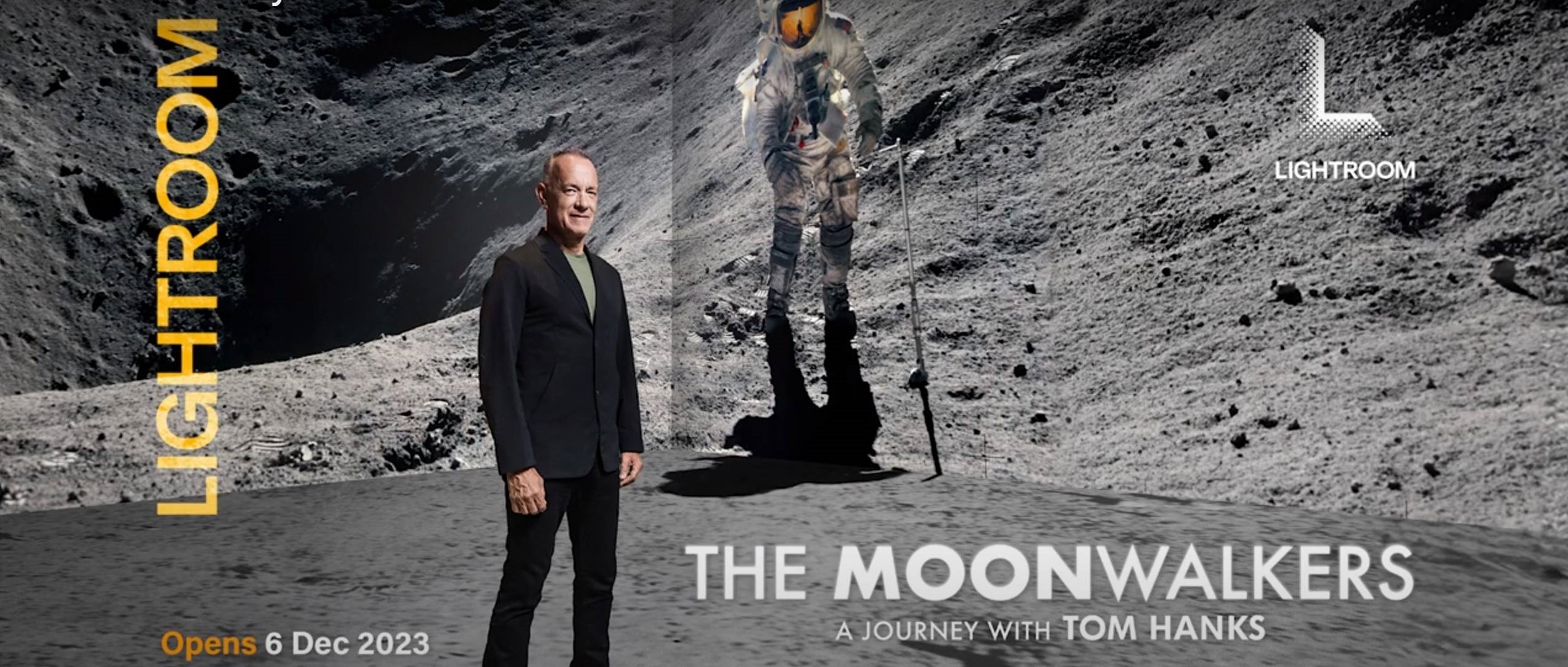
Image credit: Lightroom
A new show has opened at London’s Lightroom that offers a unique new perspective on humankind’s past and future voyages to the Moon.
The Moonwalkers: A Journey With Tom Hanks is a collaboration between the movie actor, Chris Riley (writing), Andy Saunders (Apollo Remastered imagery), Anne Nikitin (music) and 59 Productions.
The world premier took place on December 5 in London, a work that tells the stories of the Apollo missions in intimate detail. Joining Hanks at the premiere, the three-person Artemis II crew.
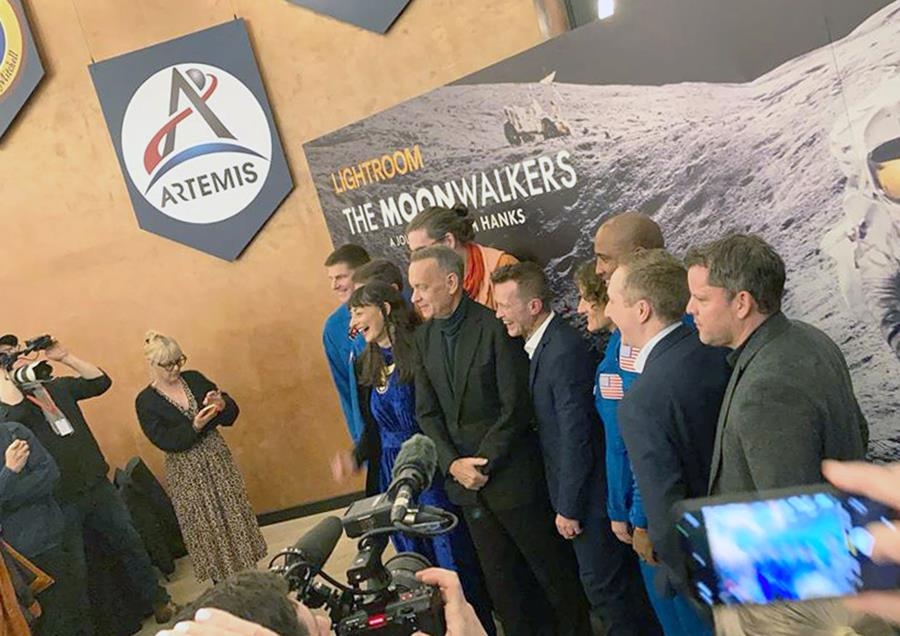
Image credit: Lightroom
Powerful projection
The Moonwalkers also provides an insight into the impending return of crewed surface missions by going behind-the-scenes of the Artemis program, including interviews between Tom Hanks and Artemis astronauts.
Lightroom’s powerful projection and audio technology transforms the immense space into a vehicle for a spectacular immersive voyage to our closest celestial neighbor – the Moon.
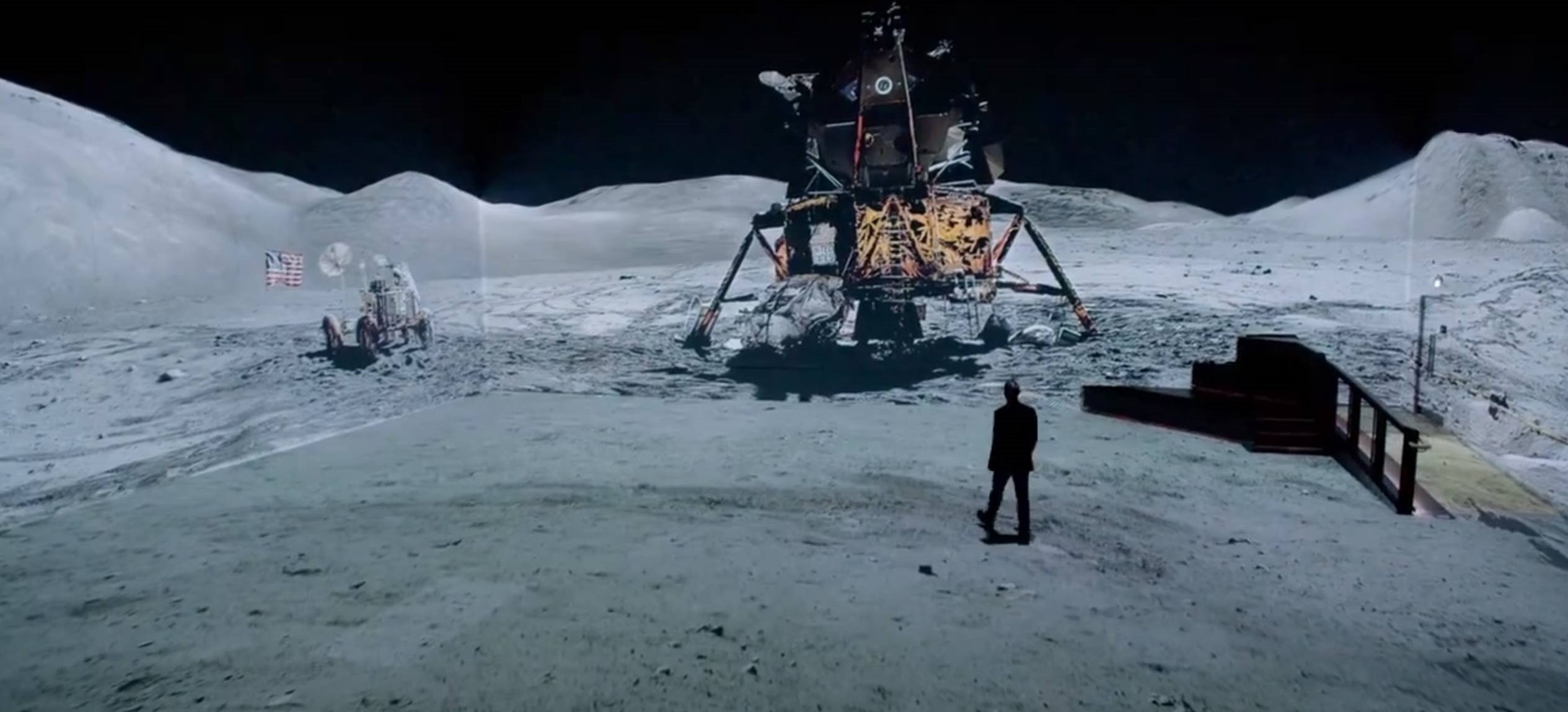
Image credit: Lightroom
The Moonwalkers is a combination of storytelling by Tom Hanks, co-written by Chris Riley, along with a splendid score from Anne Nikitin, and visuals from the seminal book by Andy Saunders: Apollo Remastered.
Images are projected at huge scale at Lightroom, London. The 800-speaker system pulsates during the Saturn V launch sequence. Once at the Moon, panoramic images envelop the viewer.
For more information, go to this sites:
https://lightroom.uk/whats-on/the-moonwalkers/
https://youtu.be/M7No_LSfeQM?si=IEghRVMpz2-umVTK
https://youtu.be/ZgdLYHsNNmU?si=SnJnD4t007OLwBdi

Original NASA footage and breath-taking images from Andy Saunders’ Apollo Remastered.
Image credit: Black Dog & Leventhal

NOAA image of humpback whale encounter.
Image credit: NOAA
You could say it’s a “whale of an idea” – but that sound’s corn-fried fishy as an opening line for a search for extraterrestrial intelligence story.
But a team of scientists from the SETI Institute, University of California Davis and the Alaska Whale Foundation, had a close encounter with a non-human intelligence of the aquatic kind.
A Whale-SETI team has been studying humpback whale communication systems and a new paper on the work has been published, led by Brenda McCowan of U.C. Davis, a professor in the university’s school of veterinary medicine and a core scientist in neuroscience and behavior.
Intelligence filters
The Whale-SETI research is being done in an effort to develop “intelligence filters” for other star folk out there in the cosmological ether.

Image credit: Brenda McCowan, et al.
According to the recently published research, in response to a recorded humpback “contact” call played into the sea via an underwater speaker, a humpback whale given the name Twain approached and circled the team’s boat, while responding in a conversational style to the whale “greeting signal.”
Playback call
According to a SETI Institute statement, “during the 20-minute exchange, Twain responded to each playback call and matched the interval variations between each signal.”
The Whale-SETI team is studying intelligent, terrestrial, non-human communication systems to develop filters to apply to any extraterrestrial signals received.

Image credit: Jodi Frediani
Important assumption
“Because of current limitations on technology, an important assumption of the search for extraterrestrial intelligence is that extraterrestrials will be interested in making contact and so target human receivers,” said Laurance Doyle of the SETI Institute, a coauthor on the paper.
“This important assumption is certainly supported by the behavior of humpback whales,” Doyle said.
Other members of the Whale-SETI group and coauthors of the paper are Josie Hubbard, Lisa Walker, and Jodi Frediani, with specialties in animal intelligences, humpback whale song analysis, and photography and behavior of humpback whales, respectively.
To access the paper in a recent issue of the journal Peer J. entitled: “Interactive Bioacoustic Playback as a Tool for Detecting and Exploring Nonhuman Intelligence: ‘Conversing’ with an Alaskan Humpback Whale,” go to:
https://peerj.com/articles/16349/

Image credit: UCLA SETI

