Archive for September, 2023
 Author:
  September 3rd, 2023
Image credit: ISRO
India’s Chandrayaan-3 Moon lander/rover mission is busily gathering science data since its touchdown on August 23 with the country chalking up a first by landing in a region of the Moon’s south pole.
According to the Indian Space Research Organization (ISRO), the mooncraft mission activated a number of experiments:

Image credit: ISRO

Image credit: ISRO

Image credit: ISRO
The Instrument for Lunar Seismic Activity (ILSA) payload on the Chandrayaan-3 Lander is the first instance of a Micro Electro Mechanical Systems (MEMS) technology-based instrument on the Moon. It has recorded the vibrations occurring due to the movements of India’s on-the-prowl rover and other payloads.
ILSA is a cluster of six high-sensitivity accelerometers, with a primary objective to measure ground vibrations generated by natural quakes, impacts, and artificial events.

The vibrations recorded during the rover’s navigation on August 25, 2023, are depicted in the figure. Additionally, an event, seemingly natural, recorded on August 26, 2023, is also shown. The source of this event is currently under investigation.
Image credit: ISRO
Lunar plasma
The Radio Anatomy of Moon Bound Hypersensitive ionosphere and Atmosphere – Langmuir Probe (RAMBHA-LP) payload onboard the Chandrayaan-3 Lander has made the first on-the-spot measurements of the surface-bound lunar plasma environment over the south polar region.

Image credit: ISRO
The Langmuir probe is a device used for characterizing a plasma. It features a metallic spherical probe mounted on a one-meter boom attached to the Chandrayaan-3 Lander’s upper deck. The extended boom length ensures that the spherical probe operates within the undisturbed lunar plasma environment, isolated from the lander’s body.
The initial assessment indicates that the plasma encompassing the lunar surface is relatively sparse, characterized by a number density ranging from approximately 5 to 30 million electrons per cubic meter. This evaluation specifically pertains to the early stages of the lunar daytime.
“These ongoing observations hold significant implications for comprehending the process of charging within the lunar near-surface region,” ISRO explains, “particularly in response to the fluctuations in solar space weather conditions.”

India’s Moon rover operates its Alpha Particle X-ray Spectrometer (APXS).
Image credit: ISRO
Soil and rock analysis
Toted by the lunar rover is an Alpha Particle X-ray Spectrometer (APXS) for in-situ analysis of the elemental composition of soil and rocks on the surface of planetary bodies having little atmosphere, such as the Moon.
APXS carries radioactive sources that emit alpha particles and X-rays onto the surface sample. The atoms present in the sample in turn emit characteristic X-ray lines corresponding to the elements present. By measuring the energies and intensities of these characteristic X-rays, researchers can find the elements present and their abundances.
“APXS observations have discovered the presence of interesting minor elements, including sulfur, apart from the major expected elements such as aluminum, silicon, calcium, and iron,” an ISRO website explains.
In addition, the LASER Induced Breakdown Spectroscope (LIBS) instrument onboard the rover also confirmed the presence of sulfur. LIBS can derive the chemical composition and infer mineralogical composition of the lunar topside.
Detailed scientific appraisal of these observations is in progress.

India Moon lander makes use of Surface Thermo physical Experiment (ChaSTE) and Instrument for Lunar Seismic Activity (ILSA)
Image credit: ISRO
Rover re-activation?
In a statement from ISRO, the Chandrayaan-3 rover has completed its assignments.
“It is now safely parked and set into sleep mode. APXS and LIBS payloads are turned off. Data from these payloads is transmitted to the Earth via the Lander. Currently, the battery is fully charged. The solar panel is oriented to receive the light at the next sunrise expected on September 22, 2023. The receiver is kept on,” ISRO states.
“Hoping for a successful awakening for another set of assignments! Else, it will forever stay there as India’s lunar ambassador,” the ISRO X tweet concludes.

Image credit: ISRO

Image credit: ISRO
Retro-reflector array
Now on the Moon, mounted atop the Chandrayaan-3 Moon lander is a NASA laser retro-reflector array. In NASA acronym-land, the device is better known as an LRA, supplied by the LRA project based at NASA’s Goddard Space Flight Center.

Image credit: ISRO/NASA
The ultra-small, compact LRA is designed to use reflected laser light from a laser altimeter or lidar on a spacecraft orbiting the Moon or landing on the Moon. They are too small to be radiated by laser light shot from the Earth.
An LRA consists of eight tiny retro-reflectors mounted on a small, high hemispherical platform. Total mass of the LRA is 20 grams, and requires no power.
“Since LRA is a passive payload, there are no milestones for the LRA unit itself beyond a safe landing,” said Daniel Cremons of Goddard’s Planetary Geology, Geophysics, and Geochemistry Laboratory.

Image credit: ISRO/NASA
Cremons told Inside Outer Space that the Lunar Orbiter Laser Altimeter (LOLA) on NASA’s Lunar Reconnaissance Orbiter (LRO) is the only NASA laser altimeter capable of ranging to LRA in lunar orbit right now.
The LOLA team will be attempting to range to LRA using LOLA once the Chandrayaan-3 lander and rover missions are complete, Cremons said. “Since LOLA was not designed for precision targeting, this may not be successful on the first attempt but that is our plan right now,” he said.
 Posted in

Image credit: RAND
Moving day in space has a “you-haul” feel to it.
But is there a business in removing space junk from Earth orbit? Numbers of groups are coming up with concepts on grappling with worrisome debris. Nonetheless, estimates of how much troublesome litter – from huge chunks of space scrap to tiny paint chips and even radioactive particles – are daunting and tricky projections.

Photo illustration by Thomas Gaulkin for the Bulletin of the Atomic Scientists’ January 2022 issue (used with permission)
Leftover litter
When a satellite receives a come-to-blows punch by leftover litter or an explosion occurs in Earth orbit, particularly at higher altitudes, the detrimental results are additive. The debris resulting from these high-speed happenings lingers for years, decades, even centuries.
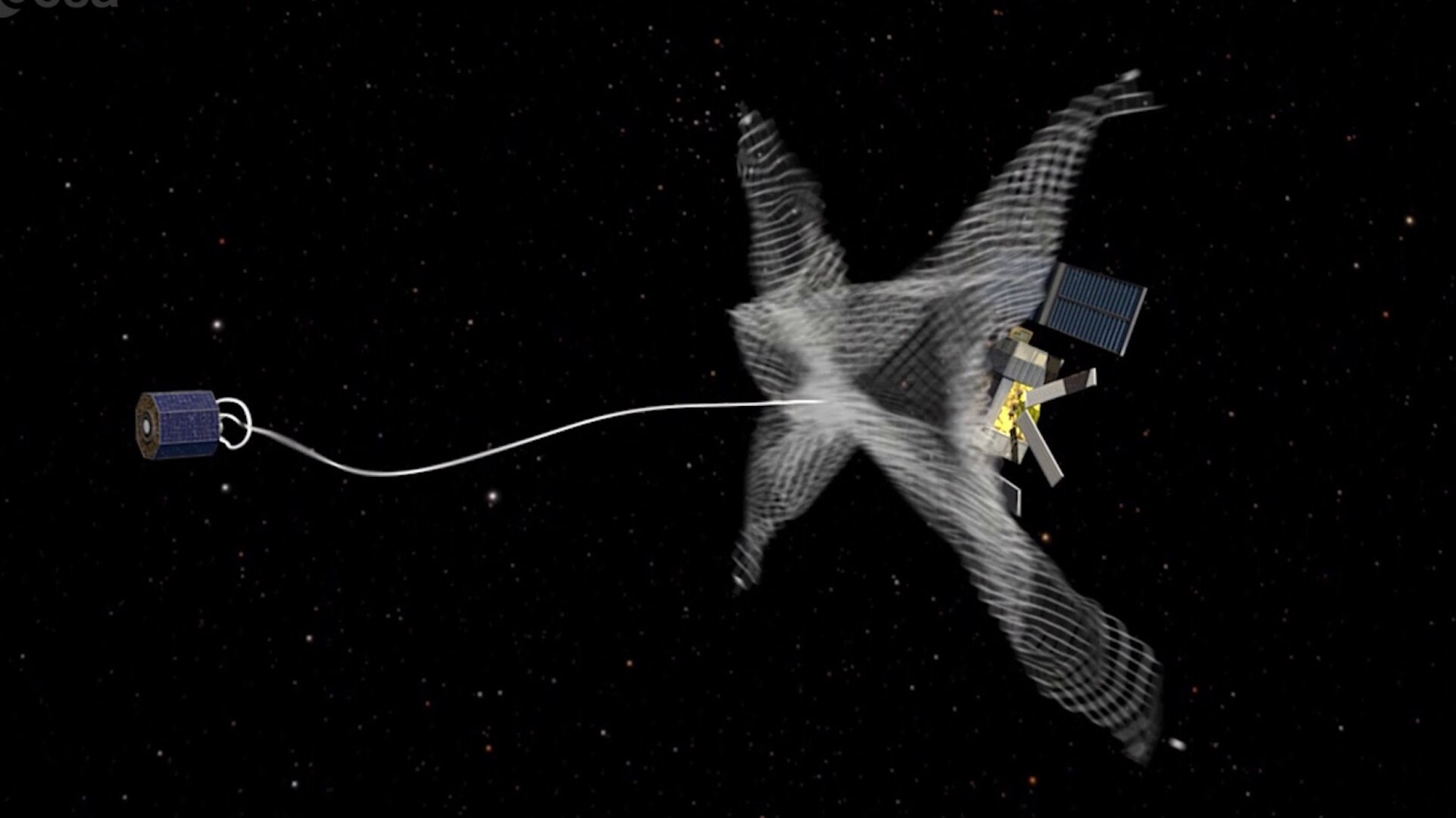
Netting of orbital debris has been studied, among a number of space junk-snatching ideas.
Image credit: ESA/D.Ducros
There’s no doubt about it. Earth orbit is a messy place.
For more information, go to my new Space.com story — “Taking out the trash: Here’s how private companies could be vital for space debris removal – To keep a watchful, more-informed eye on orbital debris, much better approaches are needed” – at:

Image credit: NASA/JPL-Caltech
More air time for NASA’s Ingenuity Mars helicopter.
New imagery shows the August 26th flight, the date for the craft’s 56th soaring journey.
The stats: Horizontal Distance roughly 1,345 feet (410 meters); Maximum altitude about 39 feet (12 meters); Flight duration 140.9 seconds.

Image credit: NASA/JPL-Caltech
Black and white imagery was acquired by the rotorcraft using its navigation camera, mounted in the helicopter’s fuselage and pointed directly downward to track the ground during flight.
Color imagery was also gained using Ingenuity’s high-resolution color camera, mounted in the helicopter’s fuselage and pointed approximately 22 degrees below the horizon.

Image credit: NASA/JPL-Caltech

Image credit: NASA/JPL-Caltech

During preparations for descent to the surface, Russia’s Luna-25 Moon lander experienced an anomaly that caused it to impact into the southwest rim of Pontécoulant G crater on Aug. 19, 2023, at 7:58 a.m. EDT (11:58 a.m. UTC).
Image credits: NASA’s Goddard Space Flight Center/Arizona State University
The lunar leftovers of Russia’s failed Luna-25 robotic craft have likely been spotted by NASA’s Lunar Reconnaissance Orbiter (LRO).
Before and after imagery of the suspected Luna 25 impact site taken by LRO’s powerful LROC imaging system show landscape disturbance at the southwest rim of Pontécoulant G crater. The kicked-up terrain from the impact is roughly 250 miles (400 kilometers) short of Luna 25’s intended landing point.

Before and after images of Luna-25 impact site (click to activate). This GIF alternates between LRO views from June 27, 2020, and Aug. 24, 2023 – before and after the appearance of a new impact crater likely from Russia’s Luna 25 mission.
Credits: NASA’s Goddard Space Flight Center/Arizona State University
“Since this new crater is close to the Luna 25 estimated impact point, the LRO team concludes it is likely to be from that mission, rather than a natural impactor,” according to a NASA statement.
The fresh crater is about 33 feet (10 meters) in diameter. The impact point was on the steep (greater than 20-degree grade) inner rim of Pontécoulant G crater.

Image credit: Roscosmos/IKI/NPO Lavochkin
Off-design orbit
During the descent to the surface, the Russian spacecraft Luna 25 experienced an anomaly that caused it to impact.
As noted by Russia’s Roscosmos, in accordance with the flight program of Luna-25, on August 19 it was planned to issue an impulse to form its pre-landing elliptical orbit.

Russian mishap group is deciphering why Luna-25 mission failed.
Image credit: Roscosmos
However, “due to the deviation of the actual pulse parameters from the calculated ones, the automatic station switched to an off-design orbit and ceased to exist as a result of a collision with the lunar surface,” Roscosmos stated. Attempts on August 19-20 to regain contact with Luna-25 “did not produce any results.”
A specially formed interdepartmental commission has been established to identify the reasons for the loss of Luna-25.
Launched on June 18, 2009, NASA’s LRO is managed by the space agency’s Goddard Space Flight Center in Greenbelt, Maryland for the Science Mission Directorate at the agency’s Headquarters in Washington, D.C. LRO continues to collect a treasure trove of data, operated under the guidance of Arizona State University in Tempe, Arizona.

Artwork depicts NASA’s venerable Lunar Reconnaissance Orbiter (LRO), on-duty since swinging into orbit around the Moon on June 23, 2009.
Image credit: NASA/Goddard Space Flight Center

