Archive for September, 2023
 Author:
  September 8th, 2023
Wenchang Space Launch Center in south China’s Hainan Province.
Credit: CCTV
China’s Wenchang Spacecraft Launch Site in south China’s Hainan Province is in construction mode to put in place a new-generation launch complex.
These new facilities will support the country’s human Moon exploration enterprise, according to Liao Guorui, the Wenchang launch commander.

Liao Guorui, the Wenchang launch commander.
Image credit: CCTV/Inside Outer Space screengrab
As noted by China Central Television (CCTV), the Wenchang site involves technological breakthroughs, including high-flow filling of cryogenic propellants and parallel test launches of large and medium-sized rockets powered by cryogenic liquid fuels.
“The Wenchang Space Launch Site will also carry out the construction of launch complexes for next-generation manned lunar landing missions and heavy-lift rockets, providing strong support for China’s manned moon landing mission, deep space exploration, and planetary exploration,” Liao told CCTV. “We will do our best to build a world-class space launch site for in-depth space exploration.”

Image credit: China Manned Space Agency

Image credit: China Manned Space Agency

Image credit: China Manned Space Agency
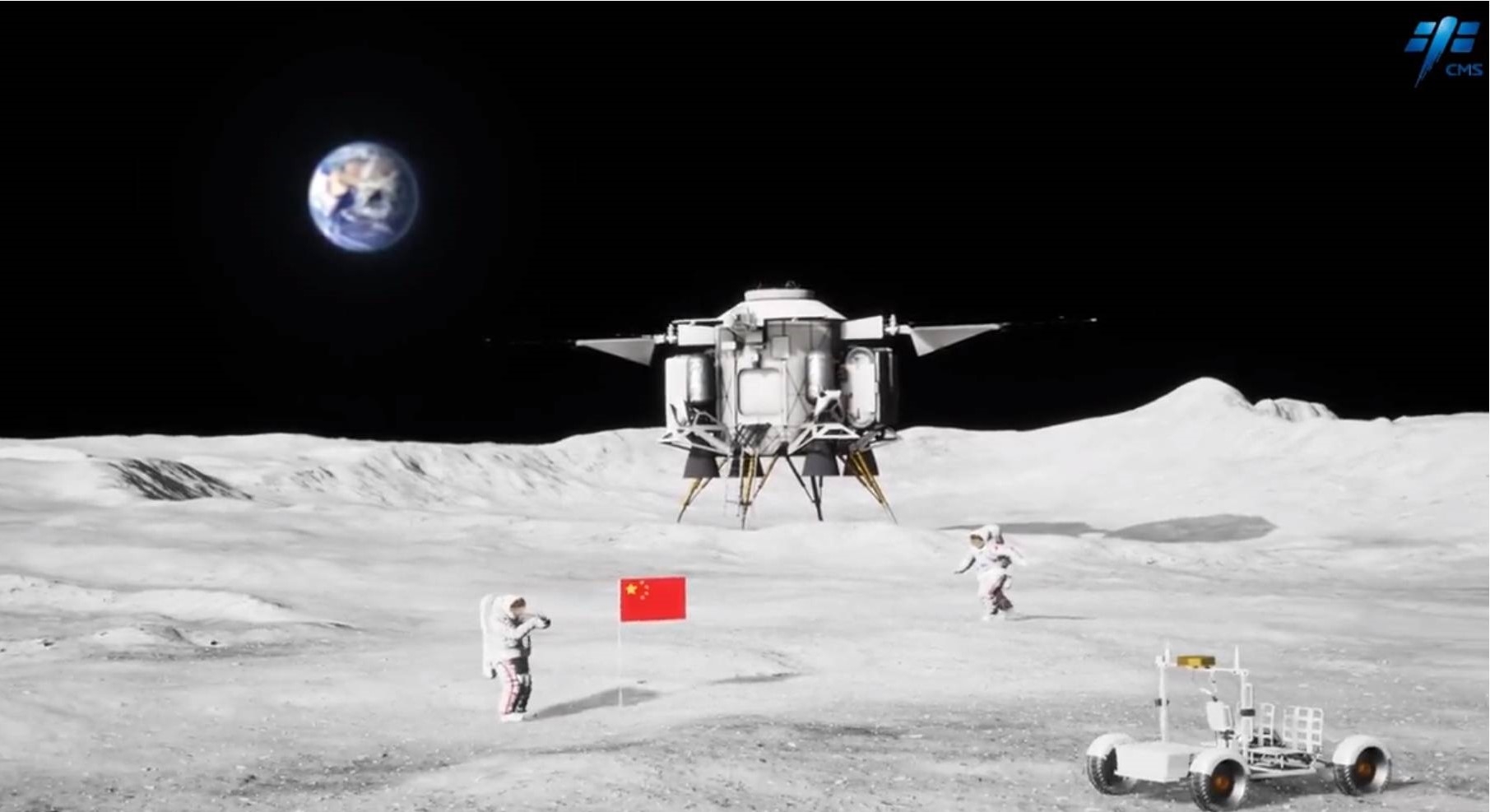
Image credit: China Manned Space Agency
 Posted in

Image credit: SpaceX
The FAA has closed the SpaceX Starship Super Heavy mishap investigation. The final report cites multiple root causes of the April 20, 2023 mishap and 63 corrective actions SpaceX must take to prevent mishap reoccurrence.
“The closure of the mishap investigation does not signal an immediate resumption of Starship launches at Boca Chica,” a FAA statements explains.

Image credit: SpaceX/Inside Outer Space screengrab
“SpaceX must implement all corrective actions that impact public safety and apply for and receive a license modification from the FAA that addresses all safety, environmental and other applicable regulatory requirements prior to the next Starship launch.”
For full FAA statement, go to:
https://www.faa.gov/newsroom/faa-closes-spacex-starship-mishap-investigation

Success at today’s Friday, September 8 Virgin Galactic suborbital spaceflight. This is the company’s fourth spaceflight in four months.
Who was onboard?
“We are excited to announce the successful completion of ‘Galactic 03’. This marked our fourth successful spaceflight in four months, and the three crew members onboard were the first from our Founder Future Astronauts:
• Astronaut 014 Ken Baxter from the United States of America
• Astronaut 015 Timothy Nash from South Africa
• Astronaut 016 Adrian Reynard from the United Kingdom
“Like so many of our customers, they each held lifelong dreams of spaceflight, and today they were able to fulfil them. They’ve shown how powerful and transformative space travel can be, and we look forward to making this experience accessible for many more people worldwide.”
Next flight, October
“The team will now proceed with post-flight inspections and analysis, in preparation for our next commercial space mission, ‘Galactic 04,’ which is planned for early October.
For updates on X (formerly known as Twitter).
Keep an eye on: https://twitter.com/virgingalactic
and
https://www.facebook.com/hashtag/galactic03

Image credit: Virgin Galactic

Image credit: Virgin Galactic/Inside Outer Space screengrab

Image credit: Virgin Galactic/Inside Outer Space screengrab

Image credit: Virgin Galactic/Inside Outer Space screengrab

NASA’s Space Launch System rocket carrying the Orion spacecraft launches on the Artemis I flight test, Wednesday, Nov. 16, 2022, from Launch Complex 39B at NASA’s Kennedy Space Center in Florida. Image credit: NASA/Bill Ingalls
The General Accounting Office (GAO) finds that original Space Launch System (SLS) cost baselines, or committed costs, were tied to the launch of Artemis I.
“Without a baseline to track these production costs for upcoming missions, future program costs are less transparent and harder for NASA and Congress to monitor,” the GAO report explains. “NASA should act on our prior recommendations to improve transparency and monitoring of this program.”
For full report, go to: https://www.gao.gov/assets/gao-23-105609.pdf
For a GAO Podcast – “As NASA Plans Its Return to the Moon, Greater Visibility Into Spending Could Help Address Cost Concern” – go to:

Chinese astronauts may be investigating the Moon up-close before 2030.
Image credit: China Manned Space Program
China’s blossoming space exploration agenda includes sending the country’s astronauts to the Moon, a master plan that calls for a target time before 2030.
For the last several months, China space experts have repeatedly rolled out how-to-do humans-to-the-Moon exploration. Although cited as preliminary, their strategy is bolstered by Wu Weiren, chief designer of China’s lunar exploration program. He has frequently emphasized that by 2030, “the Chinese people will definitely be able to set foot on the Moon. That’s not a problem.”
For detailed information on China’s emerging Moon plan, go to my new Multiverse Media SpaceRef story – “Piecing Together China’s Big Plans To Send Astronauts to the Moon Before 2030” – at:

Image credit: NASA/JPL-Caltech
The Mars Oxygen In-Situ Resource Utilization Experiment (MOXIE) has generated oxygen for the 16th and final time aboard NASA’s Perseverance rover on August 7th. Its operations are concluding.
Since 2021, MOXIE has generated a total of 122 grams of oxygen. MOXIE was built and operated at the Massachusetts Institute of Technology.
Give an ear to MOXIE running on the Red Planet at:
Also, go to my recent story – “Out of Thin Air, Mars Oxygen: MOXIE Sets Record Output” – at:
https://www.leonarddavid.com/out-of-thin-air-mars-oxygen-moxie-sets-record-output/

Image credit: ISRO

Image credit: NASA Lunar Reconnaissance Orbiter (LRO) spots Indian Moon lander. Image credit: NASA/GSFC/Arizona State University

Image of India’s Moon lander as observed by the Chandrayaan-2 lunar orbiter.
Image credit: ISRO

Image credit: ISRO
Image credit: NASA/GSFC/Arizona State University
India’s Chandrayaan-3 Moon Lander site has been eyed by NASA’s Lunar Reconnaissance Orbiter (LRO).
The Indian Space Research Organization’s (ISRO) Chandrayaan-3 lander/rover touched down on the Moon on August 23, 2023.

NASA’s Lunar Reconnaissance Orbiter (LRO).
Credit: NASA’s Goddard Space Flight Center Conceptual Image Lab
NASA’s LRO high-powered LROC system acquired this oblique view (42° slew angle) of the lander four days later.
The Chandrayaan-3 mission landing site is located over 370 miles (about 600 kilometers) from the lunar south pole.
The bright halo around the vehicle resulted from the rocket plume interacting with the fine-grained regolith (soil).
For more information on LRO’s spotting of the Indian lunar lander, go to:
https://www.lroc.asu.edu/posts/1314

Curiosity took 17 images in Gale Crater to create this mosaic making use of its mast-mounted Right Navigation Camera (Navcam). The rover took the images on August 28, 2023, Sol 3931. Image credit: NASA/JPL-Caltech
NASA’s Curiosity Mars rover at Gale Crater is now performing 3938 tasks.

Curiosity Right B Navigation Camera image acquired on Sol 3935, September 1, 2023.
Image credit: NASA/JPL-Caltech
Amelie Roberts, Graduate Student at Imperial College London, reports that the robot’s Mastcam has been busy producing two large, stereo mosaics of upper Gediz Vallis ridge and the nearby well-layered bedrock, which features enigmatic polygonal fractures.
“Curiosity will embark on its next drive along the layered sulfates, continuing the investigation on the cause of the alternating dark and light-toned banding,” Roberts notes.

Curiosity Right B Navigation Camera image acquired on Sol 3937, September 3, 2023.
Image credit: NASA/JPL-Caltech

Curiosity Right B Navigation Camera image acquired on Sol 3937, September 3, 2023.
Image credit: NASA/JPL-Caltech

Curiosity Front Hazard Avoidance Camera Left B image taken on Sol 3937, September 3, 2023.
Image credit: NASA/JPL-Caltech

Curiosity Mars Hand Lens Imager (MAHLI) photo produced on Sol 3937, September 3, 2023.
Image credit: NASA/JPL-Caltech/MSSS

Image credit: IET
On the Moon face of it, lunar football in the near-future may appear a little “poles apart” activity – a non-contact sport, with no out-of-bounds play and flexible suits with artificial reality (AR) helmets to deal with the harsh conditions of space.
“But, it will still remain an exciting game of skill, passion and creativity and we can’t wait for kick-off,” explains the Institution of Engineering and Technology (IET), one of the world’s largest engineering institutions with more than 154,000 engineering and technology professionals in 148 countries.
Must haves
An IET-sponsored team of visionary engineers and technology professionals have appraised the future of lunar football.
The vision is scoping out how to play football on the Moon as early as 2035.

Image credit: IET
“But, given the Moon has one-sixth of Earth’s gravity, a surface of dusty soil and no breathable atmosphere, the game will look very different,” according to an IET website spotlighting the first-ever Lunar Football Rule Book.
For instance, each player must carry their own oxygen tank and be wearing an airtight suit.
Due to the high contrast of light on the Moon, Lunar Football must take place at lunar noon to maximize visibility and avoid shadows.

Image credit: IET
Ball bounce
Then there’s the ball itself. It must be 1.5 times the size of a terrestrial football – making it a size 8 football. Ideally the ball will be mostly black to contrast with the lunar soil.
The ball must have a core of next-generation Aerogel to give the ball a compressibility to allow bouncing while not containing any air.
IET has created a science, technology, engineering, and mathematics (STEM) competition for kids that entails designing a “Moon United Football Kit” and open for entries from now until September 15, 2023.
To access the rule book, go to:
https://eabw.theiet.org/media/3476/lunar-football-moon-united-rule-book.pdf
For information on IET and its various innovative activities, go to:

