Archive for September, 2023
 Author:
  September 14th, 2023
NASA has released its Unidentified Anomalous Phenomena (UAP) report completed by an independent study team the space agency commissioned in 2022.
On June 9, 2022, NASA announced that the agency is commissioning a study team to examine unidentified anomalous phenomena (UAPs) – that is, observations of events in the sky that cannot be identified as aircraft or known natural phenomena – from a scientific perspective. The study will focus on identifying available data, how best to collect future data, and how NASA can use that data to move the scientific understanding of UAPs forward.
In an earlier posting, the UAP study group made note that there are currently a limited number of high-quality observations of UAP, which make it impossible to “draw firm scientific conclusions about their nature.”
That just-issued report is available at:

Image credit: NASA
Whole-of-government framework
In an executive summary, the report explains that “NASA is in an excellent position to contribute to UAP studies within the broader whole-of-government framework” – led by the All-domain Anomaly Resolution Office (AARO).
The report explains that the study of Unidentified Anomalous Phenomena (UAP) presents a unique scientific opportunity that demands a rigorous, evidence-based approach.
“Addressing this challenge will require new and robust data acquisition methods, advanced analysis techniques, a systematic reporting framework and reducing reporting stigma.”
Public engagement: crowdsourcing
The new NASA report explains that engaging the public is also a critical aspect of understanding UAP.

Image credit: Scientific Coalition for UAP Studies
The panel sees several advantages to augmenting data collection efforts using modern crowdsourcing techniques, including open-source smartphone-based apps that simultaneously gather imaging data and other smartphone sensor metadata from multiple citizen observers worldwide.
“NASA should therefore explore the viability of developing or acquiring such a crowdsourcing system as part of its strategy.
According to the report, NASA’s very involvement in UAP will play a vital role in “reducing stigma associated with UAP reporting, which almost certainly leads to data attrition at present.”
According to NASA chief Bill Nelson, the space agency has selected a still-to-be-named Director of UAP Research, a person that will develop and oversee the implementation of NASA’s scientific vision for UAP research, “including using NASA’s expertise to work with other agencies to analyze UAP and applying artificial intelligence and machine learning to search the skies for anomalies. NASA will do this work transparently for the benefit of humanity.”
Airspace threat
Finally, the report also points out that the threat to U.S. airspace safety posed by UAP is “self-evident.”
“NASA’s long history of partnership with the FAA should be leveraged to investigate how advanced, real-time analysis techniques could be applied to future generations of air traffic management (ATM) systems.”

Image credit: Yannick Peings, Marik von Rennenkampff/AIAA
As the report concludes, “at this point there is no reason to conclude that existing UAP reports have an extraterrestrial source. However, if we acknowledge that as one possibility, then those objects must have traveled through our solar system to get here.”
“Using unclassified data was essential for our team’s fact-finding, open-communication collaboration, and for upholding scientific rigor to produce this report for NASA,” said David Spergel, president of the Simons Foundation and chair of the UAP independent study team. “The team wrote the report in conjunction with NASA’s pillars of transparency, openness and scientific integrity to help the agency shed light on the nature of future UAP incidents. We found that NASA can help the whole-of-government UAP effort through systematic data calibration, multiple measurements and ensuring thorough sensor metadata to create a data set that is both reliable and extensive for future UAP study.”

A weather ballooon sails into the sky after release from the Cape Canaveral weather station in Florida. Image credit: NASA
 Posted in

A new report — Thriving in Space: Ensuring the Future of Biological and Physical Sciences Research: A Decadal Survey for 2023-2032 – underscores a major finding:
Continued U.S. leadership in human and robotic space exploration will require increased government commitments to research at the frontiers of biological and physical sciences.

Image credit: NASA
Public trust, global cooperation
One takeaway in the report deals with public trust and global cooperation.
Space exploration in the next decade will be undertaken in a landscape of conflicting national and corporate interests and growing legal complexities, with private space entrepreneurship expected to expand, and more countries likely to launch space agencies to join the over 70 currently in existence, the report notes.
Though governed by international treaties and the emerging field of space law, abilities to enforce compliance are currently limited, and ethical conduct in space will depend on international cooperation, mutual respect, and dialogue over shared values.

Earth orbit is a junkyard of human-made space clutter.
Credit: Space Junk 3D, LLC. Melrae Pictures
Controversial matters
It is critical, the report adds, that biological and physical sciences (BPS) researchers and NASA generally, work to increase public trust and ensure that space exploration proceeds in a transparent manner where benefits are shared.
Public engagement is needed on potentially controversial matters such as the use of animals in space research, the environmental consequences of low Earth orbit satellites and associated space debris, and alteration of habitats on other planets through natural resource extraction.
For more information on the report — Thriving in Space: Ensuring the Future of Biological and Physical Sciences Research: A Decadal Survey for 2023-2032 – go to these informative resources at:
— https://nap.nationalacademies.org/resource/26750/interactive/
— https://nap.nationalacademies.org/resource/26750/BPS-decadal-slides.pdf

Curiosity Right B Navigation Camera image acquired on Sol 3946, September 12, 2023.
Image credit: NASA/JPL-Caltech
NASA’s Curiosity Mars rover at Gale Crater is now performing Sol 3947 duties.
Lauren Edgar, a planetary geologist at the USGS Astrogeology Science Center in Flagstaff, Arizona reports:
“Curiosity is making good progress towards our next potential drill location in a region of alternating light and dark banding,” reports “Before we get there, we’re collecting a lot of great contact science on these blocks of broken up bedrock to document compositional and textural changes.”

Curiosity Front Hazard Avoidance Camera Left B photo taken on Sol 3946, September 12, 2023.
Image credit: NASA/JPL-Caltech
Power, data, time
A recent two-sol plan (Sols 3946-3947) scripted contact science and driving on the first sol, followed by untargeted remote sensing on the second sol.
Edgar notes that planning comes together and fits within the robot’s power, data, and time of day constraints, while accomplishing important science.
The recent plan was to start by using the Dust Removal Tool (DRT) to expose a fresh surface at the bedrock target “Antikythera,” followed by use of the Alpha Particle X-Ray Spectrometer (APXS) to assess its chemistry.
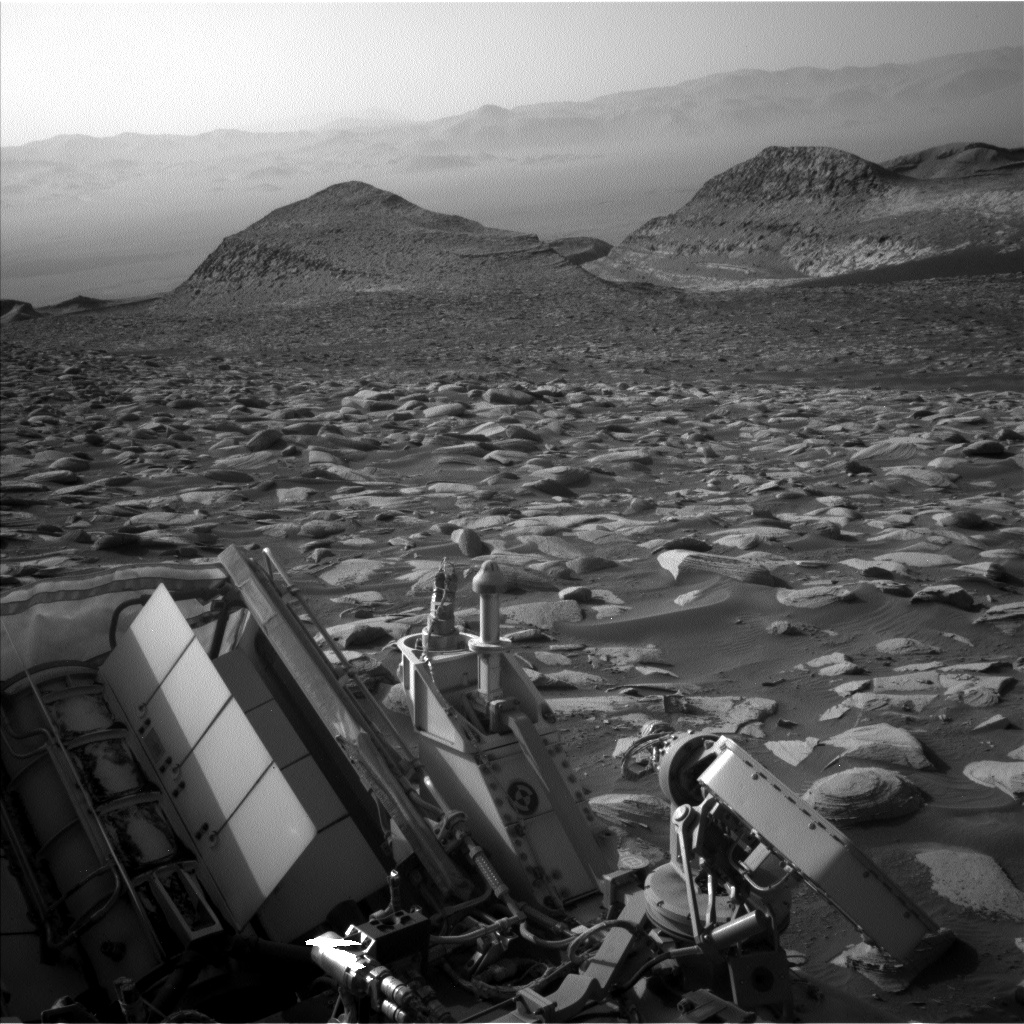
Curiosity Left B Navigation Camera image taken on Sol 3946, September 12, 2023.
Image credit: NASA/JPL-Caltech
Then there’s use of Curiosity’s Chemistry and Camera (ChemCam) and Mastcam multispectral to collect some additional chemistry observations on the same target, Edgar adds.
Edge-on view
“The team also planned several Mastcam mosaics at “Delphi,” “Mycenae,” and “Zagori” to assess the local bedrock and some resistant fins, and to document a nearby ripple field with an edge-on view of the bedform crests,” Edgar reports.
Also on the plan was using the ChemCam Remote Micro-Imager (RMI) to acquire a long distance mosaic looking back towards Peace Vallis, and take a Mastcam tau observation to assess atmospheric opacity.
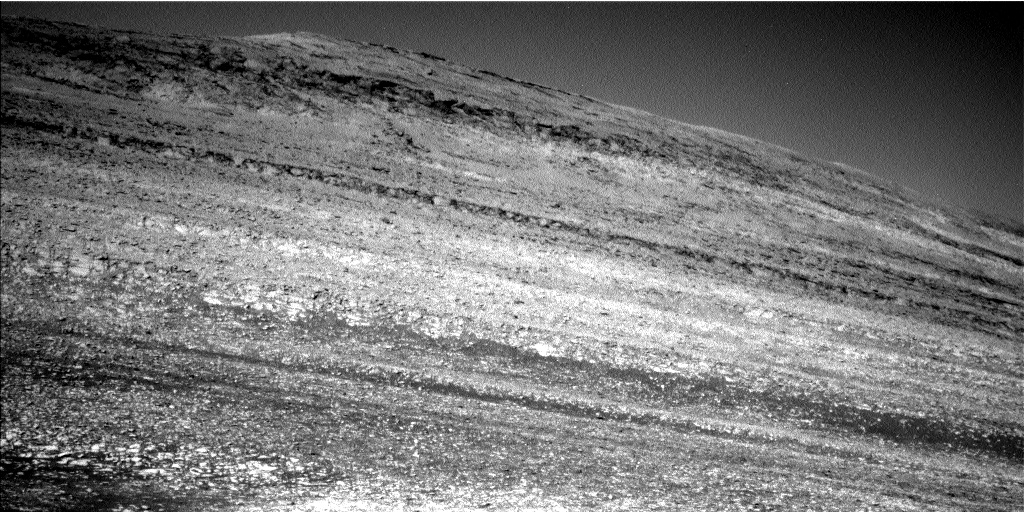
Curiosity Left B Navigation Camera image taken on Sol 3946, September 12, 2023.
Image credit: NASA/JPL-Caltech
In the afternoon, MAHLI will image the DRT target “Antikythera,” followed by a rover drive of 85 feet (roughly 26 meters) and imaging to prepare for the next plan. The second sol includes an autonomously selected ChemCam target, and Navcam observations to assess dust in the atmosphere and search for dust devils.

Curiosity Left B Navigation Camera image taken on Sol 3946, September 12, 2023.
Image credit: NASA/JPL-Caltech
Bishop quad
“The planned drive should put us in a new mapping quadrangle, informally known as the Bishop quad,” Edgar points out.
“Our informal naming convention is to divide up the exploration region into square quadrangles (0.025 degrees of latitude or longitude on a side) and each quad is assigned a name of a town with a population less than 100,000 people,” Edgar explains.

Curiosity Chemistry & Camera (ChemCam) Remote Micro-Imager (RMI) photo acquired on Sol 3946, Septembert 12, 2023.
Image credit: NASA/JPL-Caltech/LANL

Curiosity Rear Hazard Avoidance Camera Left B Sol 3946, September 12, 2023.
Image credit: NASA/JPL-Caltech
As Curiosity investigates targets within a quad, Edgar adds that the Mars study team assign names to targets that correspond to geological formations and features from near that town on Earth.
“Bishop California is located in Owens Valley, and is the starting point for trips into the High Sierra, including some awesome geology,” Edgar concludes. “It feels like a fitting name for the next part of Curiosity’s ascent of Mt. Sharp!”

Image credit: KARI/Ministry of Science, ICT
Korea’s lunar orbiter, Danuri, has imaged the landing spot of India’s Chandrayaan-3 Moon lander/rover mission.
A newly-released image of Shiv Shakti Point, the country-labeled touchdown locale of Chandrayaan-3, has been issued by the Ministry of Science, Information and Communication Technology, and the Korea Aerospace Research Institute (KARI).

Korea Moon orbiter.
Credit: KARI
To snag the shot, Korea’s robotic lunar orbiter used one of its payloads, a high-resolution camera, on August 27th from the lunar mission orbit of about 62 miles (100 kilometers) above the Moon’s surface.
The image is to commemorate humanity’s first-ever lunar south pole region landing by the Chandrayaan-3 on August 23rd.
Upcoming announcements
According to the Ministry of Science/IST (MSIT), Korea’s Moon-circuiting orbiter is planned to perform various scientific and technological missions while circling the lunar mission orbit until December 2025.
These missions include capturing images of potential lunar landing sites, observation of polarized light and gamma ray for drafting a map of lunar surface elements and minerals, measurement of lunar magnetic activity that will lead to the understanding of the origin of the Moon, and validation of space internet technology.
The Ministry of Science/IST statement added that in December, MSIT and KARI plan to disclose a variety of achievements, including photos of potential lunar landing sites, five types of lunar element maps, radiological environment measurements of the Moon, and many more, in order to commemorate the 1st anniversary of Danuri’s mission to the Moon.
Danuri is South Korea’s first lunar orbiter. The mission was launched in August 2022 and was inserted into orbit around the Moon on December 16, 2022.

Image credit: JAXA
It would seem odd that a spacecraft could seek the origin of fear and terror.
But that is the objective of Japan’s Martian Moons eXploration mission, a bold undertaking set to survey two oddballs circling Mars – the moons Phobos (fear) and Deimos (panic), name tags drawn from Greek mythology.

Phobos is 150-times smaller than Earth’s moon. Deimos in background is 280-times smaller than Earth’s moon and about half the size of Phobos.
Combined images credit: NASA’s Goddard Space Flight Center; NASA/JPL-Caltech; Malin Space Science Systems; Texas A&M University; University of Arizona
Backed by the Japan Aerospace Exploration Agency (JAXA), this ambitious Martian Moons eXploration (MMX) spacecraft is headed for a 2024 sendoff. It will visit the two moons loaded with a rich to-do list.
To learn more, go to my new Multiverse Media SpaceRef article — “Japan’s Mission to the Red Planet – Probing the Mysterious Moons of Mars” at:

Tianzhou-5 cargo craft departs for controlled re-entry.
Image credit: CCTV/Inside Outer Space screengrab
China’s resupply ship – the Tianzhou-5 cargo craft – decoupled from the orbiting Tiangong space station and has re-entered the atmosphere in a controlled manner early Tuesday, September 12, Beijing Time.
According to the China Manned Space Agency (CMSA), most of the spacecraft’s components burned up during the re-entry, and a small amount of its debris fell into the predetermined remote waters of the South Pacific.
Tianzhou-5 was lofted on November 12, 2022 from the Wenchang Spacecraft Launch Site in the southern island province of Hainan.

Tianzhou-5 cargo craft is guided in a controlled re-entry into Earth’s atmosphere.
Image credit: CCTV/Inside Outer Space screengrab
The cargo ship carried into Earth orbit propellants, materials for scientific experiments and supplies for crews onboard the orbiting facility.
In-orbit testing
According to the state-run Xinhua news group, the in-orbit test of space hydrogen-oxygen fuel cells was an experiment onboard the Tianzhou-5. It provided data and theoretical support for China’s future manned lunar explorations.
Other key payloads include space high-energy particle detection equipment, which completed an extravehicular mission.
At present, three batches of application projects have been carried by unpiloted Tianzhou supply ships into space. The CMSA said future crewed space missions will continue to open its cargo craft payloads to the public.

Now onboard China’s space station, the Shenzhou-16 crew.
Image credit: CCTV/Inside Outer Space screengrab
Independent flight
Prior to its demise, the cargo craft had separated from the space station combination on May 5, then re-docked with the space station after a 33-day independent flight, and continued to carry out space technology experiments before its ocean ditching.
The craft was undocked from the front port of China’s Tianhe core module – one of several modules that constitute the Chinese space station.
For a newly released video, go to:

Ready and waiting. Dante Lauretta, OSIRIS-REx’s principal investigator from the University of Arizona holds a mock up of the asteroid collection device.
Image credit: Barbara David
A NASA spacecraft is nearing Earth in express delivery mode.
Launched way back in September 2016, NASA’s Origins Spectral Interpretation Resource Identification Security Regolith Explorer (OSIRIS-REx) is toting a collection of asteroid bits and pieces. They were plucked from asteroid Bennu, an ancient rubble pile of odds and ends from the early days of solar system creation about 4.5 billion years ago.
Full-stop
On September 24, those deliverables are to parachute into the Department of Defense Dugway Proving Ground in the Utah Test and Training Range, roughly 80 miles west of Salt Lake City, Utah.
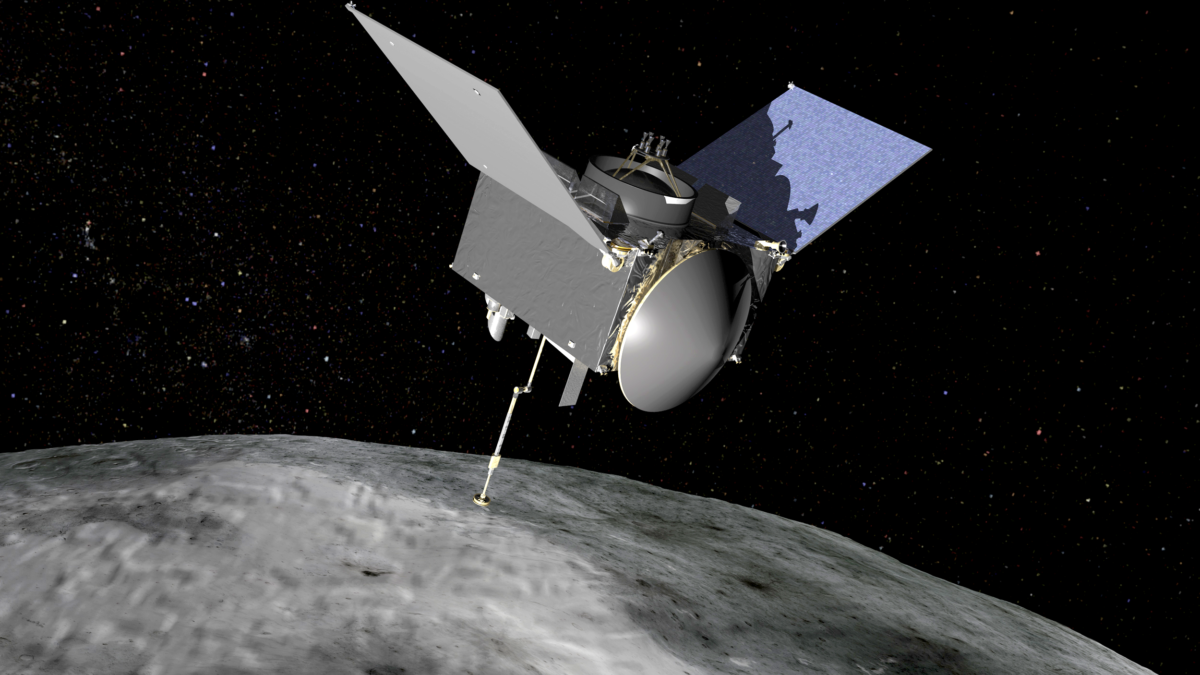
Artwork shows OSIRIS-REx spacecraft at Bennu.
Credit: NASA/University of Arizona
I recently talked with Dante Lauretta, OSIRIS-REx’s principal investigator from the University of Arizona in Tucson, in anticipation of the full-stop touchdown of specimens from asteroid Bennu.
For the full story, go to my new Space.com article – “OSIRIS-REx’s Dante Lauretta shares final preparations for Sept. 24 asteroid-sample return” at:
https://www.space.com/dante-lauretta-man-on-mission-osiris-rex-sample-recovery

Apollo 17 Moon lander: Ascent and Descent segments.
Image credit: NASA
Snap, crackle and pop! That’s the prognosis from the Apollo 17 landing site according to new research.
Back in the heady days of the Apollo lunar landing program, the moonwalkers deployed Apollo Lunar Surface Experiments (ALSEP) packages. Each was a little different for individual Apollo missions.
In 1972, the Apollo 17 ALSEP included a Lunar Seismic Profiling Experiment (geophones).
Deployed seismometers
According to work led by NASA’s Francesco Civilini, thousands of signals were recorded during an 8-month span from 1976 to 1977 on four seismometers deployed during the Apollo 17 activities on the Moon.

Left on the Moon – Challenger lunar lander descent stage.
Image credit: NASA/GSFC/ASU

Lunar Seismic Profiling Experiment (LSPE) Antenna, pre-flight photo.
Image credit: NASA/The Apollo Lunar Surface Journal
“We developed algorithms to accurately determine the arrival timing of the waves, measure the strength of the seismic signal, and find the direction of the moonquake source, Civilini and colleagues explain.
“We found that impulsive moonquakes are not due to natural processes, but are vibrations generated from the lunar module descent vehicle left by the astronauts in 1972.”
The research team found two classes of seismic signals: impulsive and emergent events produced by the lunar module and regolith processes respectively.

Apollo 17 landing site: Image credit: From Coordinates and Maps of the Apollo 17 Landing Site from Isabel Haase, et al.
Civilini and fellow researchers note that the duration of the non-impulsive events is correlated with temperature.
“The hotter the temperature, the longer the seismogram. We think that this behavior might be due to changes in regolith properties or stronger events during the day.”

Active seismic research hardware deployed during Apollo 17 mission in 1972.
Image credit: NASA/The Apollo Lunar Surface Journal
For an informative look at the new research, go to – “Mysterious moonquake traced to Apollo 17 lunar lander base” by Stefanie Waldek at Space.com.
Go to:
https://www.space.com/new-moonquakes-traced-to-apollo-17-lander
To access the research paper – “Thermal Moonquake Characterization and Cataloging Using Frequency-Based Algorithms and Stochastic Gradient Descent” – go to:
https://agupubs.onlinelibrary.wiley.com/doi/abs/10.1029/2022JE007704

Image credit: Virgin Galactic
Details of Virgin Galactic’s fourth successful suborbital flight in four months have been released by the space travel firm.
The completion of its second private astronaut flight, the mission flew three of Virgin Galactic’s first customers.
“Galactic 03” was the third flight of Virgin Galactic’s inaugural commercial spaceflight season.

Image credit: Virgin Galactic
The September 8 flight from New Mexico’s Spaceport America followed the company’s first research mission in June and first private astronaut mission in August.

Image credit: Virgin Galactic

Image credit: Virgin Galactic

Image credit: Virgin Galactic
Onboard Galactic 03:
Astronaut 014 Ken Baxter from the United States of America
Astronaut 015 Timothy Nash from South Africa, and British Citizen
Astronaut 016 Adrian Reynard from the United Kingdom
Spaceship VSS Unity was piloted by Commander Nicola Pecile and Pilot Michael Masucci. Chief Astronaut Instructor Beth Moses was also on board.
The mothership VMS Eve that released VSS Unity was piloted by commander Jameel Janjua and pilot Kelly Latimer.
In-flight facts
According to Virgin Galactic, the Galactic 03 in-flight facts:
- Take-off Time 8:34 am Mountain Time (Local)
- Altitude at Release 44,867 feet
- Apogee 55 miles
- Top Speed Mach 2.95
- Landing Time 09:36 am Mountain Time
Per Virgin Galactic, the company is proceeding with post-flight inspections and analysis in preparation for the next commercial space mission, “Galactic 04,” which is planned for early October.

Image credit: Virgin Galactic

Image credit: Virgin Galactic/Inside Outer Space screengrab
Image credit: Virgin Galactic

Image credit: Virgin Galactic

Curiosity Right Navigation Camera image taken on Sol 3940, September 6, 2023.
Image credit: NASA/JPL-Caltech
NASA’s Curiosity Mars rover at Gale Crater is now performing Sol 3943 duties.
“The rover is currently driving across bumpy terrain consisting of rounded bedrock sticking up between dark sand and drift as she drives south, and slightly uphill, along the Mt. Sharp Ascent Route,” reports Sharon Wilson Purdy, a planetary Geologist at Smithsonian National Air and Space Museum in Washington, D.C.
Due to the rugged ground, Purdy adds, the rover sometimes ends a drive with a wheel or two perched on a rock.

Curiosity Left B Navigation Camera image taken on Sol 3941, September 7, 2023.
Image credit: NASA/JPL-Caltech
When that happens, as the robot recently did, researchers are unable to safely unstow the arm to do contact science.
Sand and bedrock interaction
“We pivoted and planned a [Chemistry and Camera Laser Induced Breakdown Spectroscopy] ChemCam LIBS observation of target “Eleusis” to characterize the composition of smooth bedrock in our workspace.

Curiosity Right B Navigation Camera image acquired on Sol 3942, September 8, 2023.
Image credit: NASA/JPL-Caltech
A nearby exposure of bedrock was documented by a Mastcam stereo mosaic of the “Kechries” target.
Curiosity also took a Mastcam stereo image of a nearby trough to investigate the interaction between the sand and bedrock.
Off in the distance, Mars team members planned a Mastcam multispectral image and a long distance ChemCam Remote Micro-Imager (RMI) photo of “Kukenan” to further characterize and document the varying textures and layers within the butte.

Curiosity Right B Navigation Camera image acquired on Sol 3942, September 8, 2023.
Image credit: NASA/JPL-Caltech
Never a dull moment
A recent plan called for a drive of roughly 75 feet (23 meters) in a scripted 2-sol plan (Sols 3941-3942).
Curiosity was slated to collect environmental data including surveys to monitor dust devil activity, a movie to monitor cloud movement, and a solar tau to measure the optical depth of the atmosphere and to constrain aerosol scattering properties, Purdy reports.
“The science team ended the day with a look-ahead to Curiosity’s weekend plan,” Purdy concluded, “with lots of images to take and data to collect it’s never a dull moment for this rover on Earth or on Mars!”

Curiosity Right B Navigation Camera image acquired on Sol 3942, September 8, 2023.
Image credit: NASA/JPL-Caltech
Ridge – a relatively late feature
In an earlier report, Lucy Thompson, a planetary geologist at University of New Brunswick, noted the rover continues to acquire imaging of the Gediz Vallis ridge “in order to help us understand how this relatively late feature within Gale crater formed.”
Thompson said researchers continue to acquire imaging of the Gediz Vallis ridge in order to better understand how this relatively late feature within Gale crater formed.
“The abundant large blocks contained within the ridge deposits indicate a relatively high energy environment, e.g., a landslide, a flooding event or maybe glacial activity,” Thompson observed.

Laser pulsed target. Curiosity Chemistry & Camera Remote Micro-Imager (RMI) photo taken on Sol 3942, September 8, 2023.
Image credit: NASA/JPL-Caltech/LANL
Ridge deposits – questions
And there are many questions related to the ridge deposits, Thompson noted:
How do the included blocks relate to other rocks already encountered within Gale crater, and to the exposed stratigraphy higher up Mount Sharp?”
Are there separate packages or layers of sediment within the ridge that might represent different depositional events and processes?”
Are there noticeable changes in the ridge as we drive from north to south?
What is the nature of the contact with the sulfate-bearing unit?
A large Mastcam mosaic was on tap to be acquired, photography to help Mars scientists continue to address these questions. “To continue looking at the layering and structure within the Kukenan butte, and to aid in determining how the stratigraphy fits with what we are driving over, ChemCam will take a long distance RMI mosaic of the butte,” Thompson added.

