Archive for August, 2023
 Author:
  August 3rd, 2023
View of Giordano Bruno crater on the far side of the Moon.
Image credit: NASA
How can you transport materials across the Moon’s surface and keep annoying, debilitating dust out of lunar habitats?
Enter a Caltech team that is designing a Lunar Architecture for Tree Traversal in-service-of Cable Exploration, space speak boiled down to LATTICE.
The LATTICE team is looking into a self-deploying modular robotic system for transporting ice and other assets in and out of craters.

Image: Caltech LATTICE team.
The ski lift-like system would work like a zip line on the Moon, complete with driving stakes in the ground, cables are then attached to the stakes, and cargo would be transporting by the cables in robotic shuttles.
Prototype tested
LATTICE was among seven finalists in NASA’s 2022 Breakthrough, Innovative, and Game-changing (BIG) Idea Challenge.

Testing of hardware underway at Caltech.
Image credit: Caltech/LATTICE Team
Last November, the LATTICE team tested a small-scale prototype of its system in a desert in California’s Lucerne Valley.
The Caltech team has also blueprinted HOMES – shorthand for Habitat Orientable & Modular Electrodynamic Shield.
Check out this video at: https://youtu.be/i8O0wPSCtjg
 Posted in

Kathy Sullivan, the first American woman to walk in space and a veteran of three shuttle missions, created the highly-informative Kathy Sullivan Explores podcast.
Since June 2021, the podcasts have focused on science, art, space, and the most memorable moments of Sullivan’s life so far.
Listen to her short “Farewell for Now” episode and also revisit the wellspring of past podcasts that embrace the spirit of curiosity, adventure, and discovery.
Go to: https://www.kathysullivanexplores.com/podcast/farewell-for-now
And while there, go to Sullivan’s “Seven Astronaut Tips for Improving your Life on Earth,” at

India’s Chandrayaan-3 Moon lander.
Image credit: ISRO
India’s ambitious Moon exploration spacecraft, the Chandrayaan-3, is now en route to its lunar target. The lander is to unleash a rover, both stuffed with scientific instruments to inspect the lunar surface in the southern lunar hemisphere.
“Next stop: the Moon,” declared an Internet posting from the Indian Space Research Organization (ISRO). All appears on track for the Chandrayaan-3 to swing into lunar orbit on August 5.

NASA-supplied laser retroreflector array is mounted atop India’s lunar lander. Device can help precisely pinpoint the whereabouts of a Moon lander.
Image credit ISRO/NASA
India’s lander will then head for a touchdown on August 23 within the southern region of the Moon’s near side, soft landing about 13 miles (20 kilometers) west of the Manzinus U crater rim.
Go to my new Multiverse Media SpaceRef story – “India’s Moon Shot Adds to Country’s Growing Space Endeavors” – at:
https://spaceref.com/science-and-exploration/indias-moon-shot-countrys-growing-space-endeavors/

China’s Chang’e-7 lander launches hopper craft to search for lunar ice.
Image credit: CCTV/CNSA/Inside Outer Space screengrab
China’s Moon exploration plans call for deep diving into permanently shadowed areas of the lunar south pole. The country’s Chang’e-7 mission is slated to take place around 2026 and utilize a mini-flying probe to investigate the permanently-shadowed bottom of an impact crater.
The Chang’e-7 mission consists of an orbiter, lander, the hopper and a rover and is targeted for a touchdown in a southeastern area of Shackleton crater.

In this multi-temporal illumination map of the lunar south pole, Shackleton crater (19 km diameter) is in the center, the south pole is located approximately at 9 o’clock on its rim. The map was created from images from the camera aboard the Lunar Reconnaissance Orbiter.
Credits: NASA/GSFC/Arizona State University
A drilling tool on the mobile probe will sample lunar soil water-ice before a mechanical arm moves that sample into a heating furnace for spectral analysis. A Lunar Water Molecular Analyzer (LWMA) on the mini-flyer will appraise lunar soil water-ice in the surface frost layer.
Different depths
According to Yingzhuo Jia of the National Space Science Center in Beijing, the LWMA has the ability to “analyze samples for many times and can take samples at different depths and locations for many times, so as to obtain the data of water-ice content varying with depth and region.”

NASA Administrator Bill Nelson discusses lunar landing sites as he testifies during an April House Science, Space and Technology Committee hearing.
One photo – multiple nations headed for lunar territory.
Image credit: NASA/Bill Ingalls
Yingzhuo and colleagues note that results from the on-the-fly hopper “can also provide evidence of the composition and content of direct volatile matter, whether it contains H₂O, H₂S, NH3, SO₂, and other volatile matter, and whether more volatile matter is deposited in the permanent shadow areas compared with the existing results of Apollo samples or lunar meteorites.”
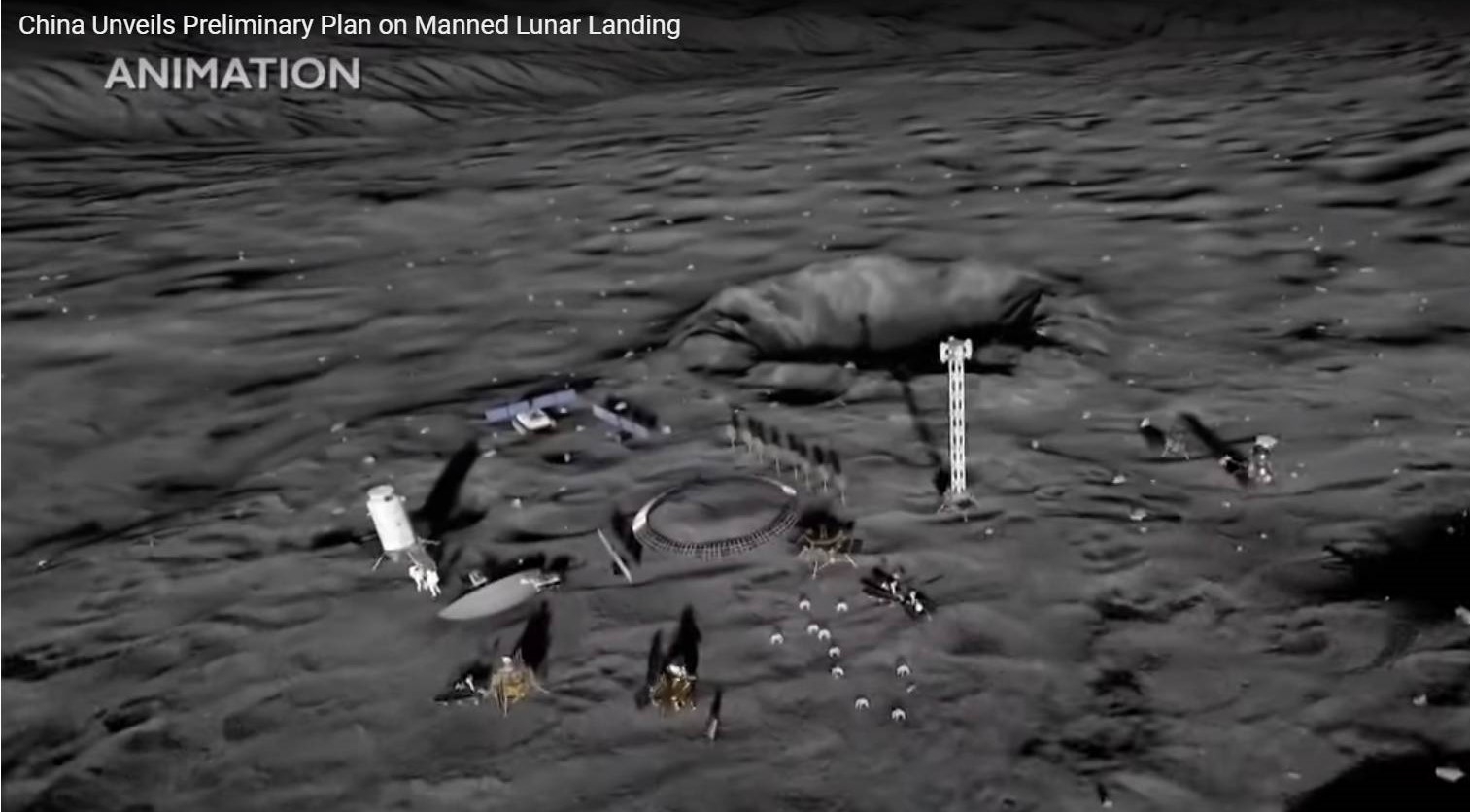
Artist’s view of International Lunar Research Station to be completed by 2035. Credit: CNSA
An overview of the Chang’e-7 mission objectives – “Research of Lunar Water-Ice and Exploration for China’s Future Lunar Water-Ice Exploration” has been published in the open access journal Space: Science & Technology at: https://spj.science.org/doi/10.34133/space.0026
In related Moon work, also published in the journal, go to – “Overview of the Lunar In Situ Resource Utilization Techniques for Future Lunar Missions” – at:

