Archive for August, 2023
 Author:
  August 19th, 2023
Artist’s concept of NASA’s Ingenuity Mars Helicopter flying through the Red Planet’s skies. Credit: NASA/JPL-Caltech
NASA’s Ingenuity Mars Helicopter flew a 55th time on August 12. The jaunt involved a horizontal distance of 263.99 feet (roughly 866 meters); altitude reached of 10 feet (roughly 33 meters); and air time was 142.9 seconds.
Imagery taken included these images making use of the mini-copter’s navigation camera mounted in the helicopter’s fuselage and pointed directly downward to track the ground during flight.
Also released are images from the craft’s high-resolution color camera. This camera is mounted in the helicopter’s fuselage and pointed approximately 22 degrees below the horizon.

Image credit: NASA/JPL-Caltech

Image credit: NASA/JPL-Caltech

Image credit: NASA/JPL-Caltech

Image credit: NASA/JPL-Caltech

Image credit: NASA/JPL-Caltech
 Posted in

Image credit: Roscosmos/IKI/NPO Lavochkin
NOTE: Russia’s Luna-25 in trouble? According to Roscosmos, in accordance with the Luna-25 flight program, today an impulse was issued to transfer the Moon-circling probe to a pre-landing orbit.
Russia’s Moon-circling Luna-25 has started to churn out science as the craft is readies for descent onto the lunar landscape. A reported landing date is August 21.
Analyzing newly collected data from Luna-25, investigators at the Space Research Institute of the Russian Academy of Sciences (IKI) have obtained several results.
Micrometeorite impact
Luna-25’s ADRON-LR neutron and gamma spectrometer has recorded intense lines of chemical elements of the lunar soil.
For the first time lunar orbit, the spacecraft’s ARIES-L ion energy-mass analyzer was turned on, designed to study the near-surface ion exosphere in the subpolar region of the Moon. That data is aiding the optimal operating setting of the device. It can gauge the energy spectra of particles in the energy range from 10 electron volts (eV) to 3000 eV.

Image credit: NPO Lavochkin
The Moon probe’s PML device is designed to detect microparticles levitating near the surface of the Moon and to determine the parameters of the surrounding plasma. This instrument registered a micrometeorite impact (most likely belonging to the Perseid meteor shower) during its flight to the Moon, according to IKI.

Image credit: Background: NASA Lunar Reconnaissance Orbiter LROC camera data. Photo: IKI RAS
Zeeman crater
By using Luna-25’s STS-L landing cameras on August 17, the processing of two frames of Moon imagery aided digital elevation model work by specialists from the IKI RAS and the Moscow State University of Geodesy and Cartography (MIIGAiK). This hardware will allow future spacecraft to significantly improve the accuracy of their position in orbit.
The Moon’s Zeeman crater, imaged by two STS-L landing cameras, is a unique feature, one of the twenty deepest craters of the southern hemisphere of the Moon. The crater has an unusual size ratio: diameter is about 118 miles (190 kilometers) with a depth of roughly 5 miles (8 kilometers).
“Its formation is associated with a very strong impact, which is possible if the velocity of the impactor is very high or its substance is very dense,” explains an IKI communiqué.

Image credit:
U.S. Postal Service
The U.S. Postal Service is issuing a “Forever stamp” to commemorate NASA’s OSIRIS-REx spacecraft and the samples of the asteroid Bennu, to be parachuted to Earth in September 2023.
This new 20-stamp pane shows the capsule containing the sample parachuting into the Utah Test and Training Range, a U.S. Department of Defense facility in the desert.
A depiction of Bennu’s surface appears at the bottom of the pane’s selvage with outer space above — deep blue and dappled with celestial bodies.

Near-Earth asteroid Bennu is 1,600 feet (500 meters) wide and contains hydrated minerals, according to scientists working on the NASA OSIRIS-REx spacecraft mission.
Image credit: NASA/Goddard/University of Arizona
Sample pluck
NASA lofted OSIRIS-REx from Cape Canaveral, Florida on September 8, 2016. The spacecraft arrived at the asteroid in December 2018, photographing, mapping and assessing space rock Bennu’s surface to determine the best spot from which to pluck samples.
In October 2020, the spacecraft slowly descended toward the asteroid’s surface with an extended robotic arm.
A novel collection device at the hand-end of the arm released a puff of nitrogen gas that sent up a cloud of dust and rocks from Bennu’s surface.

Ready and waiting. Dante Lauretta, OSIRIS-REx’s principal investigator from the University of Arizona holds a mock up of the asteroid collection device.
Image credit: Barbara David
It is believed that more than 2 ounces of these materials were captured in a special container in the collection device, which then closed and retracted into the spacecraft.
Forever stamp ceremony
On May 10, 2021, OSIRIS-REx began its flight back toward Earth.
Its container of asteroid dust and rocks, enclosed in a special capsule, will parachute to the Utah desert on Sept. 24, 2023.

Utah drop zone landscape.
Image credit: NASA/Keegan Barber
As for the commemorative stamp and pane, it sports an illustration of Alan Dingman, based on images supplied by NASA.
Antonio Alcalá, an art director for USPS, designed the stamp and pane.
The OSIRIS-REx stamp is being issued as a Forever stamp, which will always be equal in value to the current First-Class Mail 1-ounce rate.
A First Day of Issue Dedication Ceremony for the stamp is to be held September 22, with the public invited. This event is to be held at Clark Planetarium in Salt Lake City, Utah.
For more information, go to:

Image credit: ISRO
A major milestone has been reached in India’s Chandrayaan-3 Moon lander/rover mission.
The Lander Module has successfully separated from the spacecraft’s Propulsion Module.
From the Indian Space Research Organization (ISRO) Lander Module: “Thanks for the ride, mate!”
The Lander Module is set to descend to a slightly lower orbit around the Moon given a modest de-boosting nudge planned for August 18.

Pre-launch photo shows Lander Module atop Propulsion Module.
Image credit: ISRO
A planned landing attempt is slated for August 23.
SHAPE I’m in (thanks Robbie!)
Meanwhile, the Propulsion Module will continue its journey in its current Moon orbit for months/years, ISRO states.
Onboard that Moon-circling module is the Spectro-polarimetry of HAbitable Planet Earth (SHAPE).

Image credit: ISRO
“Future discoveries of smaller planets in reflected light would allow us to probe into variety of exo-planets which would qualify for habitability (or for presence of life),” ISRO explains.
The SHAPE payload onboard would perform spectroscopic study of the Earth’s atmosphere and also measure the variations in polarization from the clouds on Earth.
This payload is “SHAPEd” by U R Rao Satellite Center/ISRO in Bengaluru, capital city of Karnataka state in southern India.

Curiosity Front Hazard Avoidance Camera Right B image acquired on Sol 3919, August 15, 2023.
Image credit: NASA/JPL-Caltech
NASA’s Curiosity Mars rover at Gale Crater is now performing Sol 3920 tasks.
“Curiosity is behaving much as you would as you climb a mountain. You pause occasionally to look around at what lies beneath your boots – the reward for your hard work up to that point,” reports Michelle Minitti, a planetary geologist at Framework in Silver Spring, Maryland. “You also take time to enjoy the view and turn your gaze uphill to the path ahead – the unknown enticing you forward.”

Curiosity Left B Navigation Camera photo taken on Sol 3919, August 15, 2023.
Image credit: NASA/JPL-Caltech
Workspace targets
The Curiosity rover has been appreciating the chemistry, mineralogy and texture of two targets in the workspace.
“Ntourntourvana” is on layered bedrock with a vein cutting through it, and “Agridi” is a spindly, almost flower-like, resistant feature poking out of the bedrock.

Curiosity Chemistry & Camera (ChemCam) RMI taken on Sol 3919, August 15, 2023.
Image credit: NASA/JPL-Caltech/LANL
“One could say we are stopping to smell the flowers. The latter will be achieved by acquiring multiple mosaics of the terrain of Gediz Vallis Ridge swelling ahead of us and an appreciative look to the east toward “Kukenan” butte,” Minitti points out.
Steady climb
Kukenan once towered above Curiosity as it entered “Marker Band Valley,” but the robot’s steady climb has brought Mars researchers high enough to now look edge on at some of its layers.

Curiosity Left B Navigation Camera photo taken on Sol 3919, August 15, 2023.
Image credit: NASA/JPL-Caltech
A recently scripted drive will have the rover image the terrain ahead of it to plot the next steps forward.
“Both before and after the next leg upward, we will keep a constant eye on the weather, to ensure we stay safe and warm in the chilly Gale winter,” Minitti concludes. “Onward and upward!”

Curiosity Left B Navigation Camera photo taken on Sol 3919, August 15, 2023.
Image credit: NASA/JPL-Caltech

Image credit: Roscosmos
Russia’s Moon lander, the Luna-25, has entered lunar orbit.
Thanks to the spacecraft’s corrective braking engine, one propulsive burn lasted 243 seconds, the second nudge, by soft landing engines, lasted 76 seconds.
The craft is now in Moon orbit, nearing the time for its attempted landing on the lunar surface.

Onboard camera shows spacecraft emblem and the bucket of the LMK lunar manipulator complex, visible (top left). Image credit: IKI RAS
Functioning normally
Roscosmos reports that “all Luna-25 systems are functioning normally, communication with it is stable. Sessions are being taken to measure the current navigational parameters.”
As noted by the Scientific and Production Association named after S.A. Lavochkin (part of the Roscosmos State Corporation), Luna-25 was sent to the natural satellite of the Earth for the first time in the modern history of Russia.
Tricky terrain
“As part of the mission, it is necessary to work out the technology of soft landing, take and analyze the soil and conduct long-term scientific research, including the study of the upper layer of the surface regolith in the region of the south pole of the Moon, as well as the lunar exosphere,” a Lavochkin statement explains.

Pre-launch photo of the LMK lunar manipulator complex.
Image credit: Roskosmos State Corporation, Vostochny CC and Yuzhny CC
In terms of landing, Luna-25 is fundamentally different from its predecessors.
The former Soviet Union lunar stations landed in the equatorial zone of the Moon. This new lander is to perform a soft landing in the circumpolar region with a much more complex terrain.

Image credit: NPO Lavochkin/Roscosmos
Landing targets
A reported landing date of the craft on the Moon is August 21.
Primary target for touchdown is north of the crater Boguslawsky. There are two “reserve areas” – southwest of the Manzini crater and south of Pentland A crater.
Lunar-25 is declared to have an active life on the surface of the Moon of at least one Earth year.

Selfie taken by Curiosity Mars rover at Gale Crater.
Credit: NASA/JPL-Caltech
While “X” may mark the spot – on Mars consider hexagonal features that indicate an environment conducive to the appearance of life.
Researchers making use of the NASA Curiosity Mars rover at Gale Crater have discovered deposits of salts forming a hexagonal pattern in sedimentary layers dated to 3.8 to 3.6 billion years ago.
The muddy mix forms a hexagon pattern due to seasonal variations in humidity.

Hexagonal fossil pattern in sedimentary rocks analyzed by Curiosity on the 3154th day of its advance through Gale Crater on Mars.
Image credit: NASA/JPL-Caltech/MSSS/IRAP/Rapin et al./Nature
Long-lasting climate
The hexagons constitute the first fossil evidence of a cyclic, regular and long-lasting Martian climate, organized into dry and wet seasons.
This work opens up new thinking on the origin of life, the remains of which have long-since disappeared here on Earth.
The just-published research is led by William Rapin of the Institut de Recherche en Astrophysique et Planétologie (CNRS/Université de Toulouse III) in Toulouse, Occitanie, France, along with experts at CNES (the French space agency), together with U.S. and Canadian colleagues.
Favorable to prebiotic evolution
“Our findings point to a sustained, cyclic, possibly seasonal, climate on early Mars,” the research team reports. “Furthermore, as wet–dry cycling can promote prebiotic polymerization, the Gale evaporitic basin may have been particularly conducive to these processes.”
According to the paper, the observed polygonal patterns are physically and temporally associated with the transition from smectite clays to sulfate-bearing strata, a globally distributed mineral transition.

Image credit: NASA/JPL/Caltech
Bottom line: “This indicates that the Noachian–Hesperian transition (3.8–3.6 billion years ago) may have sustained an Earth-like climate regime and surface environments favorable to prebiotic evolution,” the researchers conclude.
Ideal conditions
In a statement from the French National Center for Scientific Research (CNRS), similar to the hexagons observed in seasonally drying terrestrial basins, the features on Mars constitute the first fossil evidence of a cyclic, regular and long-lasting Martian climate, organized into dry and wet seasons.
“By allowing molecules to interact at different concentrations and repeatedly, independent experiments in the laboratory have shown that this environment provides the ideal conditions for forming complex compounds that are precursors and constituents of living organisms such as RNA.”

The Chemistry and Camera tool is known as ChemCam. ChemCam’s laser, camera and spectrograph work together to identify the chemical and mineral composition of rocks and soils.
Image credit: NASA/JPL-Caltech/Los Alamos
Fresh look
According to the CNRS statement, these new observations allow scientists to take a fresh look at the large-scale images obtained from orbit. Using that orbital imagery many terrains with a similar composition have been spotted. “They now know where to look for traces of the natural processes at the origin of life, of which no trace remains on Earth,” the CNRS statement explains.
This new research comes from use of Curiosity’s Chemistry and Camera (ChemCam), built by a Franco-American consortium under the responsibility of CNRS/University of Toulouse III – Paul Sabatier/CNES and the U.S. Los Alamos National Laboratory. In France, the design of this instrument has received support from CNES, CNRS, CEA and several universities.

Mars expedition probes the promise that Mars was a home address for past, possibly life today.
Credit: NASA
Fossil rivers and lakes
Since 2012, NASA’s Curiosity rover had already detected the presence of simple organic molecules that could be formed by geological or biological processes.
“Unlike the surface of the Earth, that of the planet Mars is not renewed by plate tectonics. It has thus preserved vast spectacular lands through the abundance of fossil rivers and lakes dating back several billion years,” adds the CNRS statement.
The research – “Sustained wet–dry cycling on early Mars” has been published in the journal Nature – at:
https://www.nature.com/articles/s41586-023-06220-3

The image was taken by the camera of the STS-L complex aboard the Luna-25 spacecraft on August 13, 2023 during the flight to the Moon. The emblem of the mission and the bucket of the LMK lunar manipulator complex are visible (top left). Photo: IKI RAS
En route to a rendezvous with the Moon, Russia’s Luna-25 has sent back first images from space.
Using the STS-L onboard television camera, images show the structural elements of Luna-25 against the background of the Earth and against the background of the Moon.
Another image shows the mission emblem and the onboard manipulator bucket.
So far, all spacecraft instruments show full operability and readiness for lunar exploration. Their analog and digital nodes and blocks worked perfectly, according to the Space Research Institute of the Russian Academy of Sciences (IKI RAS).

Image of the Earth taken by the camera of the STS-L complex aboard the Luna-25 spacecraft during the flight to the Moon on August 13, 2023, from a distance of about 310 thousand km from the Earth. Photos: IKI RAS

Image of the Moon taken by the camera of the STS-L complex aboard the Luna-25 spacecraft during the flight to the Moon on August 13, 2023, from a distance of about 310 thousand km from the Earth. Photos: IKI RAS

Image credit: RT/Inside Outer Space screengrab
Following its August 10 liftoff, Russia’s Moon-bound Luna-25 has switched on its scientific equipment. All systems on the spacecraft are working normally, reports Roscosmos, the Russian space corporation.
“Communication with it is stable, the energy balance is positive. Today, the first switching on of the complex of scientific equipment developed by IKI RAS,” [Space Research Institute of the Russian Academy of Sciences (IKI)].

Pre-launch testing.
Image credit: Roscosmos/IKI
“Service telemetric information from all devices showed their regular functioning. The first measurement data on the flight to the Moon have been received, and the project’s scientific team has begun processing them,” the Roscosmos statement notes.

Russia’s return-to-the-Moon Lunar-25 hardware undergoes testing.
Image credit: Roscosmos
Landing spots
Luna-25 will nudge itself into lunar orbit on August 16, a Roscosmos posting explains, and the craft’s soft landing on the Moon is scheduled for August 21.
Following its voyage to the Moon and multiple days in lunar orbit, the spacecraft is slated to set down at the Moon’s south pole, near the Boguslawsky crater.

Topographic map of the southern sub-polar region of the Moon showing the location of Boguslawsky crater.
Credit: Ivanov et al., 2015 via Arizona State University/LROC
Two backup landing spots are also in play: southwest of Manzini Crater and south of Pentland A Crater.
Luna-25 will work on the lunar surface for at least one Earth year.
Water ice
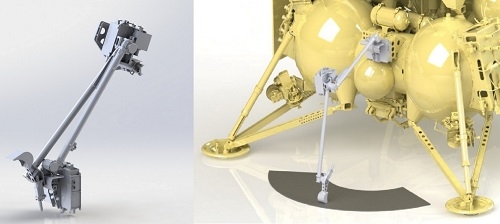
One key scientific quest of the probe makes use of a lunar manipulator complex (LMK) able to excavate lunar regolith and deliver that material directly into a laser mass spectrometer.
In addition, an infrared spectrometer installed on this hardware can remotely inspect the material, assessing the prospect of finding water ice.
Litvak Maxim Litvak, head of the IKI planning group for the Luna-25 scientific instrumentation complex, has said that the exact properties of the south pole soil is an unknown.
Credit: NPO Lavochkin/IKI/Roscosmos
Soil simulations
A special cryogenic vacuum bench was created at IKI as part of lunar soil simulations, and how the LMK will operate in dealing with south pole samples.
“We poured it into this stand, added water in different concentrations, froze it to ‘lunar’ temperatures and dug with a technological sample of the manipulator. This gave a lot of food for thought – how can we dig regolith on the Moon, including if there is water ice in it,” Litvak said in an IKI posted interview.
“With the help of the work at the stand, we learned that if about one percent of water is added to the soil and frozen in a vacuum, then in terms of strength it begins to resemble concrete,” Litvak said.

Credit: NPO Lavochkin
“Nevertheless, we were convinced that we can still dig such soil – the design of our LMK allows this. Of course, the excavation area remains limited – only near the spacecraft, Luna-25 is not a lunar rover that can move away from the landing site. But in the working area of the manipulator, you can try different places. If a stone is found in the ground, then it can be bypassed,” Litvak added.

Luna-26
Image credit: Roscosmos/IKI

Luna-27
Image credit: Roscosmos/IKI

Luna-28
Image credit: Roscosmos/IKI

Luna-28, sample return mission.
Image credit: NPO Lavochkin
Future missions
IKI’s Litvak emphasized that the Russian lunar program is already planning out future missions based on the development of Luna-25’s design. Luna-26, which will orbit the Moon, will be followed by two landing efforts: Luna-27 will deliver a drilling rig to the Moon, and Luna-28 is designed to deliver regolith from the Moon’s polar regions to Earth.
“Re-establishing Russia’s capability for landing robotically on the Moon after 47 years represents an important step in humanity returning to the Moon, this time to stay,” said Clive Neal, a leading lunar scientist at the University of Notre Dame in Indiana. “Congratulations to the Luna 25 team for a successful launch. I am looking forward to the subsequent Luna 26 and 27 missions.”
For more information about the Russian lunar program and Luna-25’s scientific and political meaning, go to: “Russia’s Return to the Moon With Luna-25: High Risk, High Stakes” at:

Image credit: NASA
The U.S. State Department is pressing forward on the concept of an “International Lunar Year” – coordinating programs around a one-to-two-year celebration of the study and exploration of the Moon later in the decade.
Such a celebration was put forth in a White House Office of Science and Technology Policy (OSTP) Cislunar Science & Technology Strategy Cislunar Science & Technology Strategy released in 2022.

Earth’s Moon and cislunar space looms large in our future.
Credit: ESA/NASA
Enhance transparency
Last month, the State Department’s Bureau of Oceans, and International Environmental and Scientific Affairs hosted presentations from various organizations as to how an International Lunar Year (ILY) could “advance lunar science, enhance transparency, and foster new scientific and technological cooperation on issues relevant to an enduring presence at the Moon,” according to a State Department communiqué.
That cooperation would include infrastructure, scientific data-sharing, and best practices for safe and sustainable lunar operations.

Credit: White House
Cross-border connections
The July discussion emphasized connections to past international science years that “leverage and celebrate scientists’ unique cross-border connections,” explains the State Department.
The White House-issued U.S. National Cislunar Science & Technology Strategy, was released in November 2022. That strategy endorsed the concept of an International Lunar Year to be named sometime later in the decade and modeled on historical examples like the International Geophysical Year of 1957-58 or the International Polar Year of 2007-08.
“Leave behind” lunar capabilities
In the White House strategy document, it explains that the “ILY can amplify U.S. objectives being achieved with the Artemis Accords by fostering developments such as the coordinated use of Lunar data centers, coordinated Moon-based research (such as Lunar geophysical networks, solar science, and far side radio astronomy), and similar joint ‘leave behind’ capabilities.”
In addition, the cis-lunar strategy notes that “the ILY can also demonstrate how these activities can be carried out responsibly for the benefit and in the interests of all nations, including developing countries, while enhancing transparency and building confidence and cooperation among Moon-faring entities.”

3D printing is gaining traction as a technique of choice for establishing Moon base structures.
Credit: LIQUIFER Systems Group 2018/René Waclavicek
Wanted: enduring presence at the Moon
“As multiple nations and commercial entities plan a near-term return to the Moon on an unprecedented scale, now is the right time to consider planning an International Lunar Year,” a State Department website adds.
“A sustained program might combine elements of public outreach and scientific collaboration to fashion a vibrant interdisciplinary and multilateral effort, demonstrating how lunar exploration can be responsible, peaceful, and sustainable, as we begin to establish an enduring presence at the Moon.”

NASA’s Artemis program wants to establish a sustainable presence on the Moon.
Image credit: NASA
What next?
The United States will continue discussions and public outreach over the next year to build national and international support for an International Lunar Year.
Together with NASA and the National Science Foundation, the State Department can also carry out precursor activities such as virtual town halls or solicitations of community input for a proposed ILY program.
For further information, go to:
https://www.state.gov/international-lunar-year/
To access the White House cislunar strategy, go to:
https://www.whitehouse.gov/wp-content/uploads/2022/11/11-2022-NSTC-National-Cislunar-ST-Strategy.pdf

