Archive for August, 2023
 Author:
  August 24th, 2023
Image credit: ISRO/Inside Outer Space screengrab
India’s “elite club” status is being heralded as the country’s Chandrayaan-3 Moon lander/rover mission continues to unfurl. It is the first nation to reach the south pole of the Moon and joins an exclusive set of countries succeeding in soft landing upon the lunar surface, the fourth country to do so following the former Soviet Union, the U.S. and China.

From the Indian Space Research Organization (ISRO), the lander successfully deployed the Chandrayaan-3’s Pragyan Rover via a ramp. “India took a walk on the Moon!” advises an ISRO X tweet. “Made in India. Made for the MOON!”

Image credit: ISRO/Inside Outer Space screengrab

Image credit: ISRO/Inside Outer Space screengrab

Pre-launch checkout of India’s lunar rover.
Image credit: ISRO
SHAPE payload
Meanwhile, the Chandrayaan-3 Propulsion Module from which the lunar lander detached is continuing its journey, set to orbit the Moon for months/years, ISRO states.
Onboard that Moon-circling module is the Spectro-polarimetry of HAbitable Planet Earth (SHAPE) experiment.
“Future discoveries of smaller planets in reflected light would allow us to probe into variety of exo-planets which would qualify for habitability (or for presence of life),” ISRO explains.
The SHAPE payload carried on the Moon-circuiting Propulsion Module is to perform spectroscopic study of the Earth’s atmosphere and also measure the variations in polarization from the clouds on Earth.
This payload is “SHAPEd” by U R Rao Satellite Center/ISRO in Bengaluru, capital city of Karnataka state in southern India.

NASA laser retro-reflector array mounted atop India’s Moon lander.
Image credit: ISRO/NASA

Close-up of NASA laser retro-reflector array mounted atop India’s Moon lander.
Image credit: ISRO/NASA
Retro-reflector array
Now on the Moon, mounted atop the Chandrayaan-3 Moon lander is a NASA laser retro-reflector array. In NASA acronym-land, the device is better known as an LRA, supplied by the LRA project based at NASA’s Goddard Space Flight Center.
The ultra-small, compact LRA is designed to use reflected laser light from a laser altimeter or lidar on a spacecraft orbiting the Moon or landing on the Moon. They are too small to be radiated by laser light shot from the Earth.
An LRA consists of eight tiny retro-reflectors mounted on a small, high hemispherical platform. Total mass of the LRA is 20 grams, and requires no power.
NASA Administrator Bill Nelson wrote on X, congratulating India on the lunar landing success, adding: “We’re glad to be your partner on this mission!”

Image credit: ISRO
 Posted in
Image credit: ISRO/Inside Outer Space screengrab
India has successfully landed its Chandrayaan-3 lander/rover on the Moon. Indian Space Research Organization (ISRO) broadcasts live coverage available via multiple platforms.
From ISRO via X tweet: “I reached my destination and you too!”

Image credit: ISRO via ESA
Along with the ISRO Website and the DD National TV channel go to:
YouTube at:
https://www.youtube.com/watch?v=DLA_64yz8Ss
Facebook at:

Image credit: Roscosmos
Russia’s emergency commission for the recent Luna-25 Moon landing failure has been appointed and has started its work. Their duty is to sort out in detail what led to the “abnormal operation” of the spacecraft’s engine, sending the probe to its destruction on the Moon’s landscape.
Reportedly, that engine ran for 127 seconds instead of the calculated 84 seconds, resulting in the crash.
Next lunar missions
Yuri Borisov, head of Roscosmos, advised the Rossiya-24 television channel that the results will be taken into account when implementing the country’s next robotic Moon missions.

Roscosmos chief, Yuri Borisov.
Image credit: Roscosmos
Work on the Luna-26 and Luna-27 missions would be accelerated, Borisov said, and expressed the hope that these missions, along with Luna-28 will be successful, as noted in an Astronautics News posting at Novosti-Kosmonavtiki.
For details on what’s ahead for Russian lunar exploration, and the implications of the failed Luna-25 mission, go to: “Russia’s Moon Probe Failure: Why and What Next?” at:
https://www.leonarddavid.com/russias-moon-probe-failure-why-and-what-next/
Also, as posted on Space.com, go to:
“What does the Luna-25 moon lander crash mean for Russia’s lunar exploration plans?” at:
https://www.space.com/russia-luna-25-moon-probe-failure-consequences

Curiosity Right B Navigation Camera photo taken on Sol 3924, August 21, 2023.
Image credit: NASA/JPL-Caltech
NASA’s Curiosity Mars rover at Gale Crater is now performing Sol 3925 duties.
“The Gediz Vallis Ridge has been a long-term, and, at times, seemingly impossible goal of the Curiosity Rover mission,” reports Deborah Padgett, Operational Product Generation Subsystem (OPGS) Task Lead at NASA’s Jet Propulsion Laboratory.
“Our path to it has repeatedly been diverted from our first difficult climb onto the Greenhugh Pediment way back in 2020, our dead-end foray onto and across the pediment through a steep side ravine of the Gediz Vallis, ultimately blocked by the potentially wheel-eating “Gatorback” ridges in 2022, and finally to our recent slip-and-slide circuitous climb out of the Marker Band Valley onto the Gedis Vallis ridge itself,” Padgett points out.

Curiosity Front Hazard Avoidance Camera Right B photo taken on Sol 3924, August 20, 2023.
Image credit: NASA/JPL-Caltech
Recently, team members called that Gediz Vallis (GV) ridge the “Bermuda Triangle” of Mt. Sharp.
Uncertain footing
“We are now just a few meters away from being able to reach the arm out and get contact science on some of the ridge material, and anticipation is growing,” Padgett adds.
A recent drive of Curiosity on Sol 3921 ended a few meters short of the intended destination — a cluster of boulders — due to some sideways sliding by the robot en-route.

Curiosity Left B Navigation Camera image acquired on Sol 3924, August 21, 2023.
Image credit: NASA/JPL-Caltech
“The uncertain footing also left our wheels unsafe to support a deployment of Curiosity’s arm,” Padgett reports, “so all of our weekend science activities will be via targeted remote sensing rather than use of the arm’s instruments for more detailed study.”
Sulfate-bearing bedrock
Padgett says that Curiosity’s Mastcam plan involved performing a 360 degree panorama, which should be spectacular!
Mastcam will also have large mosaics targeted at the transition between the dark “float” rock ridge material and the underlying sulfate-bearing bedrock, as well as multispectral imaging of the nearby “Skiathos” and “Skopelos” boulders.
ChemCam will zap those same rocks with its laser to study a possible surface coating and compositional variations between rock layers.

Curiosity Left B Navigation Camera image acquired on Sol 3924, August 21, 2023.
Image credit: NASA/JPL-Caltech
Robot bump
ChemCam will also use the telescopic mode of its Remote Micro-Imager (RMI) camera to zoom in on a light colored bedrock wall adjacent to a basin of dark sand and to continue its characterization of the amazing layering on Kukenan Butte. “Meanwhile, Navcam will take some dust devil movies and a measurement of dust in the air across Gale Crater, as well as imaging of clouds and their shadows on the beautiful peaks around us,” Padgett notes.
Another short drive of 6.5 feet (2 meters) was slated, which the team calls a “bump,” and should place Curiosity within arm’s reach of the boulder collection on Sol 3924.
Following the usual set of post-drive observations, Curiosity will perform AEGIS (Autonomous Exploration for Gathering Increased Science) – a software suite that permits the rover to autonomously detect and prioritize targets.

Curiosity Left B Navigation Camera image acquired on Sol 3924, August 21, 2023.
Image credit: NASA/JPL-Caltech
AEGIS and Mars Descent Imager (MARDI) imaging on Sol 3925 is to further document the geology of the robot’s new location. Also planned in the early morning of Sol 3926 was a set of atmospheric observations, including a dust measurement and a Navcam 360 phase function sky survey.
Decisional downlink
“With Monday’s plan, Curiosity will hopefully be able to finally perform contact science on a diverse cluster of GV Ridge boulders, presuming that our drive is successful and doesn’t leave our wheels perched on any of the abundant rocks on this steep slope,” says Padgett.
Another remaining challenge is a very tiny decisional downlink on Monday, “giving us very little data to decide on our next steps. In addition, on Monday, JPL is in the bull’s-eye of the very first tropical storm watch to ever be posted in Southern California by the National Hurricane Center, Padgett concludes. “Fingers crossed that the ‘GV Ridge Triangle’ will not claim another MSL [Mars Science Laboratory] plan before Curiosity reaches the top!”

Curiosity Left B Navigation Camera image taken on Sol 3924, August 20, 2023.
Image credit: NASA/JPL-Caltech

Here’s the scoop. The Phoenix Mars Lander confirmed the presence of ice and also surprised scientists by finding indications of perchlorate salts.
Image credit: NASA/JPL-Caltech
One finding from Mars exploration is that the Red Planet is a haven of pervasive perchlorate.
On one hand, the carpet of perchlorate chemistry found on Mars may boost the chances that microbial life exists on the Red Planet. However, perchlorates are also perilous to the health of future crews destined to explore that way-off world.
Then there’s the prospect of using perchlorate as a solid rocket propellant. It’s there in abundance and, quite literally, fuels the imagination of launching off that distant world to other destinations.
For more information, go to my new Multiverse Media SpaceRef story — “Perchlorate on the Red Planet: How a Toxin in Martian Soil Can Fuel Future Exploration” — at:

Pre-launch photo of Luna-25, now crash landed on the Moon.
Image credit: Roscosmos Television Video/Inside Outer Space screengrab
Russia’s revamping of Moon exploration is off to a rocky start – the plunge from lunar orbit of the country’s Luna-25 spacecraft, destroying itself as it crashed into the Moon’s bleak landscape.
Head of Russia’s Roscosmos, Yuri Borisov, reports that the main cause of the Luna-25’s failed mission was an engine failure. Instead of a planned propulsive nudge of 84 seconds, the engine operated for 127 seconds, more than the “required value” in readying the probe for its descent burn. This added impulse to Russia’s Luna-25 led to it crashing into the Moon, Borisov told Rossiya 24 television.

Image credit: Roscosmos
Modern Russia history
Following its August 10 liftoff, the Moon-bound Luna-25 had switched on its scientific equipment. All systems on the spacecraft were working normally, reported Roscosmos.
Spending multiple days in lunar orbit, the spacecraft was targeted to set down at the Moon’s south pole region, near the Boguslawsky crater. Two backup landing spots were also in play: southwest of Manzini Crater and south of Pentland A Crater.

Topographic map of the southern sub-polar region of the Moon showing the location of Boguslawsky crater.
Credit: Ivanov et al., 2015 via Arizona State University/LROC
Designed, built and tested by NPO Lavochkin, Luna-25 was to work on the lunar surface for at least one Earth year.
Luna-25’s sendoff from the Vostochny spaceport picked up where the former Soviet Union’s Moon-probing projects left off. It was back in 1976 that Luna-24 successfully rocketed to Earth about 170 grams of lunar topside samples.
Heralded as the first domestically produced Moon probe in modern Russia history, Luna-25’s flight was iconic in both political and scientific terms. The implications of its failure are likely to be non-trivial.

Image credit: Roscosmos
Low point
Following the Luna-25 crash, Russia quickly appointed an investigatory committee.
“We should expect an initial report in weeks. The immediate cause seems, in general, to be clear enough,” said Brian Harvey, a noted author and space historian in Ireland with a keen eye on past Soviet Union, now Russian, space exploits.
“The Luna-25 engine fired for 50 percent longer than planned,” Harvey told Inside Outer Space, making the low point in the orbit of the vehicle not the 11 miles (18 kilometers) intended, but far below surface level, a “minus” 9 miles (15 kilometers).
“The deeper causes will take more unraveling,” Harvey added. “The crash came not at the most risky point of the mission — the final stages of the descent to the surface — but during what should have been a routine firing to lower the orbit before the final descent.”

Image credit: NPO Lavochkin/Roscosmos
Unless it was purely an engine failure, Harvey added that it seems this failure is yet another instance whereby computer guidance and engine control issues in various forms have doomed soft-landings.
Automated descents
Harvey points to the failures of Beresheet (Israel), Chandrayaan-2 (India), Hakuto-R (Japan) and the Schiaparelli lander on Mars (Europe).
“Ironically, the Soviet Union pioneered successful automated descents from lunar orbit using radar and pre-digital control and guidance,” Harvey said, the Luna-16, 17, 20, 21 and 24 missions.
“Only China has a clean sheet in computer guidance and engine control descent from lunar orbit. For everyone else, it’s hard. Ironically too, Russian quality control has improved greatly in recent years, but people will remember this exception,” Harvey said.

Onboard camera shows spacecraft emblem and the bucket of the LMK lunar manipulator complex, visible (top left).
Image credit: IKI RAS
Below ground level
Space expert, Bob Christy of the informative and authoritative website OrbitalFocus explains that Luna-25’s orbit was around 62 miles (100 kilometers) circular at 87 degrees inclination.
A thruster firing by the Moon-circling craft was set to lower it to 10 miles x 62 miles (16 x 100 kilometers) and the next phase would have been the landing burn to put it down on the surface from that 10 miles (16 kilometers) altitude. The inclination, he said, allowed Luna-25 to pass over the polar target area.
“The perigee-lowering burn went on for too long either through failing to shut down or through the engineers programming it wrongly,” Christy told Inside Outer Space. “It would have resulted in perigee below ground level. The time of signal loss probably marks when it hit the surface.”
As for the Luna-25 failed attempt, “Russia was probably starting from scratch in planning and executing this mission as its experienced engineers from the 1970s had long passed retirement age. It wasn’t a simple evolution of the previous lunar mission,” Christy concluded.

Image credit: NPO Lavochkin

Luna-26 Moon orbiter
Image credit: Roscosmos/IKI

Luna-27
Image credit: Roscosmos/IKI
China’s confidence
According to Brian Harvey, the traditional reaction to a serious failure in the Russian and Soviet space program has been a punitive “heads-will-roll” approach and less funding.
This time, though, that is unlikely to help Russia maintain a lunar program (Luna-26, 27) to match its partner China’s (Chang’e-6, 7, 8), Harvey said.
“Chinese lunar engineers attended the Luna-25 launch at Vostochny for the first time, a short distance to travel geographically but a longer one politically and Russia must recover China’s confidence.”
It is not known if there is a Luna-25 backup or if a replacement can be constructed, Harvey said, but waiting several years for Luna 26 will not encourage China.

Russia’s Luna-28 Moon sample mission.
Credit: NPO Lavochkin
Deeper causes
“Although sanctions on computer parts and a limited tracking system have been blamed for the failure, these are insufficient explanations,” said Harvey. “The Soviet Union ran a successful lunar program from 1959 to 1976 despite a sanctions wall and with limited tracking networks.”
The deeper causes of the Luna-25 failure go back to the 1990s, Harvey continued, the period of “chaos capitalism” when the whole space program almost collapsed.
“Russian space spending now lags far behind the U.S., China, Europe and even Japan,” Harvey said. Space science suffered the most, he said, exemplified by the failed Roscosmos-operated Mars 96 (sometimes called Mars-8) mission, “completed by candlelight in an unheated hanger in winter.”

Factory floor integration of science instruments on Russia’s Luna-25 Moon lander.
Credit: Roscosmos
Underfunding
Apart from two successful observatories, Spektr R and Spektr RG, there have been hardly any scientific missions, Harvey said. Experience in running such complex missions is low, he said.
Before all contact with Russia was cut off, European visitors to Moscow contrasted the situation of the Lavochkin design bureau with the more generously-funded human spaceflight program run by the Energiya and Progress design bureaus, possibly rightly so when human lives are at stake, Harvey pointed out.
“By contrast, meetings with Lavochkin took place not in the bureau but in adjacent hotels, not, it seemed because of secrecy but because under-investment in the science program would be so obvious,” Harvey said. “Underfunding may be the real root of what went wrong.”

Pre-launch photo shows Lander Module atop Propulsion Module.
Image credit: ISRO
India’s Moon orbiter from the country’s previous Chandrayaan-2 mission has established two-way contact with the ready-for-prime-time landing attempt on August 23 of the Chandrayaan-3 lunar lander/rover.
“Welcome, buddy!” reports the Indian Space Research Organization (ISRO).
Meanwhile, new images have been released by ISRO of the lunar far side captured by the Chandrayaan-3 ‘s Lander Hazard Detection and Avoidance Camera. This camera will assist in spotting a safe landing area — without boulders or deep trenches — during the lander’s descent and attempted touchdown.

Image credit: ISRO

Image credit: ISRO

Image credit: ISRO

The National Security Space Association’s Moorman Center for Space Studies today released a paper entitled: “Strategic Implications of China’s Cislunar Space Activities.”
While some may discount China’s cislunar space aspirations because the United States has already gone to the Moon, the paper responds by saying there is risk of underestimating the political impact of Chinese astronauts landing on the lunar surface or working with Russian cosmonauts to build and operate the projected International Lunar Research Station (ILRS).
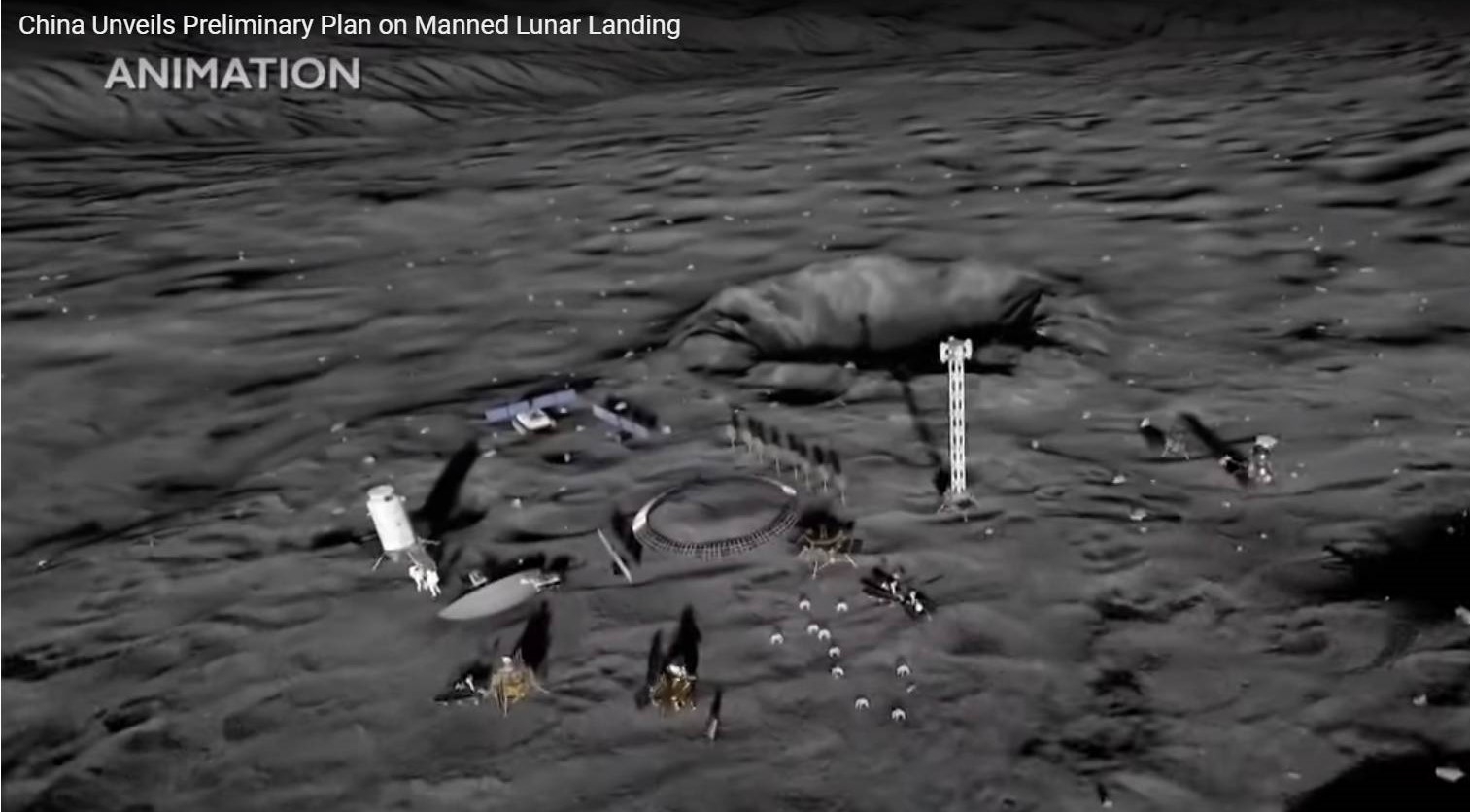
Artist’s view of International Lunar Research Station to be completed by 2035. Credit: CNSA
“When Chinese astronauts walk on the Moon or establish a base there, it is likely to be a significant event not just for the PRC [People’s Republic of China] but for the world with global repercussions.”
Keep out zones
For example, the PRC could establish an Exclusive Economic Zone in cislunar space, declare a Space Defense Identification Zone and “keep out” zones to protect it, conduct in-situ resource utilization to support operations on the lunar surface, and extract valuable resources such as rare Earth materials and water on the Moon to increase its international competitiveness, wealth, and military power.

Image credit: NASA
Indeed, the Chinese Communist Party could move to monopolize the market for rare minerals on the Moon, the paper suggests, as well as the use of lunar water as an energy source.
To access the National Security Space Association’s Moorman Center for Space paper — “Strategic Implications of China’s Cislunar Space Activities” – go to

Image credit: Roscosmos/IKI/NPO Lavochkin
Russia’s Roscosmos has reported that Luna-25 has crashed into the Moon.
On August 19, the Moon-orbiting lunar lander adjusted its orbit prior to a landing attempt. However, communication with the Luna-25 spacecraft was interrupted.
Subsequent measures to search for the spacecraft and re-establish contact “did not produce any results,” Roscosmos noted in a Telegram communiqué.
Collision with lunar surface
“According to the results of the preliminary analysis, due to the deviation of the actual parameters of the impulse from the calculated ones, the device switched to an off-design orbit and ceased to exist as a result of a collision with the lunar surface,” the statement added.
A specially-formed interdepartmental commission is being set up to help clarify the reasons for the loss of Luna-25 at the Moon, the terse Roscosmos statement concluded.
The implications of the Luna-25 failure were indicated in this earlier story posted on Multimedia’s SpaceRef — “Russia’s Return to the Moon: High Risk, High Stakes” at:
Pre-launch photo of Luna-25, now crash landed on the Moon.
Image credit: Roscosmos Television Video/Inside Outer Space screengrab

Interstellar – The Search for Extraterrestrial Life and Our Future in the Stars by Avi Loeb; a Mariner imprint of HarperCollins Publishers (2023); 256 pages, Hardcover: $28.99.
Avi Loeb is a provocative Harvard astrophysicist and this expressive, articulate, witty book details his fervor for thought-provoking views about our neighbors beyond Earth.
The book’s introduction immediately draws a line in the sand and challenges the reader. “I am convinced that we are tantalizing close not only to learning that terrestrial life is not the only life in the Solar System, and that human civilization is not the only civilization to exist or have existed. I am also convinced that most of humanity is not ready.”
Professor Loeb also underscores a predicament. He says we’re closer to a “D-class” civilization, or one that is vigorously trashing our world, creating unsustainable conditions that are necessary to prolong life and our hold on this planet. We must learn to lean into science, he writes, to survive and strive. In doing so, humanity can attain an upward trajectory while stepping into humanity’s interstellar future.
The book’s goal is to make and keep you excited about that future, Loeb adds. And within the volume’s 10 diverse chapters, a reader receives healthy doses of enthusiasm about what’s ahead.

Image credit: Galileo Project/Avi Loeb
Loeb is the longest serving Chair of Harvard’s Astronomy Department. He also heads the Galileo Project, an endeavor to bring the search for extraterrestrial technological signatures of other star folk from “accidental or anecdotal observations and legends” to the mainstream of crystal-clear, confirmed and systematic scientific research.
In up-to-date prose, among the many themes, Loeb dives into Unidentified Aerial Phenomenon (UAP). I don’t want to set off a spoiler alert, but the author calls for reimagining first contact and offers eye-opening, speculative thoughts on that topic.
Interstellar – The Search for Extraterrestrial Life and Our Future in the Stars is a mind-meld of philosophy, physics, and cutting-edge science. Loeb blueprints a radical approach to our search for ET – and how best to brace for the reality of what’s ahead.
In a closing part of the book, Loeb points out that you are not alone, but be aware, he notes that “not only are we not at the center of the cosmic stage, not only did we come late to the stage, but life as we know it among matter as we know it does not even represent most of the stuff that is presented on that stage.”
Be prepared to roam the Universe like never before. Do your utmost to grasp Loeb’s spirited and optimistic view of our cosmological destination as we ascend the ladder of civilizations.
For more information on this book, go to:
https://www.harperacademic.com/book/9780063250901/interstellar/
Updates on the Galileo Project and its on-going initiatives can be found at:

