Archive for May, 2023
 Author:
  May 24th, 2023
Wait a minute!
Photo credit: Barbara David
If you’re following the Unidentified Aerial Phenomenon trajectory, it’s an enigma wrapped in a riddle, seemingly packaged like a cosmic scene investigation (CSI) wanting of true detective work.
A new paper provides a detailed roadmap to tackle the swerving UAP issue that has resisted explanation and received little formal scientific attention for countless years – tied, perhaps inappropriately, to Unidentified Flying Objects that often bubbles up to “flying saucer” status.

Shown at Congressional hearing, Video 1 2021 flyby movie showing a purported UAP.
Credit: Counterterrorism, Counterintelligence, and Counterproliferation Subcommittee/Inside Outer Space screengrab
True detections
“The use of multispectral instruments and multiple sensor modalities will help to ensure that artifacts are recognized and that true detections are corroborated and verifiable,” states the paper. “Data processing pipelines are being developed that apply state-of-the-art techniques for multi-sensor data fusion, hypothesis tracking, semi-supervised classification, and outlier detection.”

Image credit: Galileo Project/Avi Loeb
The peer-reviewed and open access paper – “The Scientific Investigation of Unidentified Aerial Phenomena (UAP) Using Multimodal Ground-Based Observatories” – has been published in the Journal of Astronomical Instrumentation.
“The gold standard of scientific work is to make quantitative measurements using well-calibrated instruments under well understood conditions, and this is the approach taken in this work,” the paper explains.
Recognize anomalies
Highlighted in the research paper is the Galileo Project, an effort led by Harvard astrophysicist Avi Loeb to build an integrated software and instrumentation system designed to conduct a multimodal census of aerial phenomena and to recognize anomalies.
“UAP present a long-standing mystery that can and should be investigated by the tools of contemporary science,” the paper notes.
The primary science goal of the Galileo Project’s UAP investigation is to determine whether there are measurable phenomena in or near Earth’s atmosphere that can be confidently classified as scientific anomalies.
For access to the paper, led by Wesley Andrés Watters of the Whitin Observatory, Department of Astronomy at Wellesley College in Massachusetts, go to:
https://www.worldscientific.com/doi/epdf/10.1142/S2251171723400068
 Posted in

Time to turn in freefall for variable gravity?
Image credit: NASA
The emergence of private space stations is sparking renewed interest in harnessing centrifugal force to make life in Earth orbit – or in transit to other destinations – far less deleterious to the human body.
Recently joining in on “G-whiz” space stations is Airbus, the European multinational aerospace corporation. Last month, it unveiled LOOP, a multi-purpose orbital station.

The Airbus LOOP, a multi-purpose/multi-level orbital station.
Image credit: Airbus
But the idea of putting a spin on spacecraft to create artificial gravity has been a longtime love affair of engineers. There are a number of issues to conquer.
For more information on artificial gravity in space, go to my new Multiverse Media SpaceRef story – “Gravity of the Situation: Time for the “G-whiz” Factor?” – at:
https://spaceref.com/space-stations/gravity-situation-g-factor-artificial/

ESA’s ExoMars Trace Gas Orbiter.
Image credit: ESA
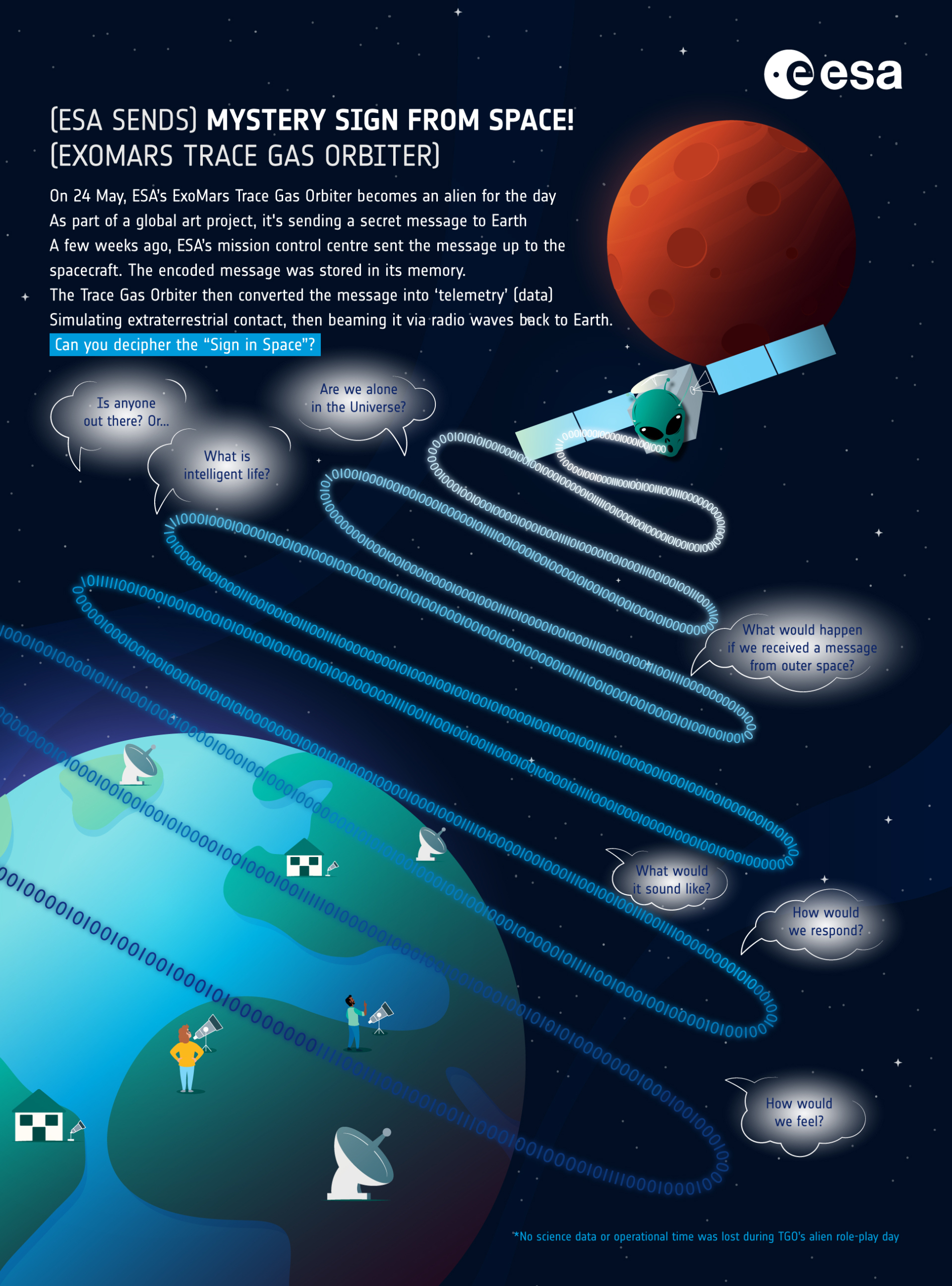
The European Space Agency’s ExoMars Trace Gas Orbiter is relaying a mysterious signal…on purpose.
Today the ESA Mars-circling spacecraft will transmit an “alien” message, specially concocted by the global “A Sign in Space” art project.
The cosmic communiqué will be picked up by antennas dotted around the globe: the Green Bank Telescope (West Virginia), the Medicina Radio Astronomical Station (Italy) and the Allen Telescope Array (California).
Developed by artist Daniela de Paulis in partnership with the SETI institute, Green Bank Observatory, ESA and others, the project asks “If we received an extraterrestrial message, how would we interpret it? What would it mean for humankind?”
The public and experts from all countries and cultures are being asked to decode and interpret the message, the content of which has been kept under lock and key for months, according to an ESA statement.
Practice message
As a practice makes perfect maneuver, the ExoMars Trace Gas Orbiter (TGO) flight control team prepared their own special message, part of early tests to ensure the feasibility of the endeavor and one that allows the ground-based observatories to fine tune their systems to be ready for the public event.
That message was a picture of the TGO team beamed down on March 14, TGO’s 7th launch anniversary.

TGO team members relayed test image from Mars-circling spacecraft.
Image credit: ESA
The actual ET-mimicking message was first sent up to TGO from ESA’s mission control centre in Darmstadt, Germany, on May 10. It was stored onto its memory, converted into ‘telemetry’ (data) and will this evening be beamed back down to Earth.
For more information on this creative use of space, time, and all things alien, go to:
Wanted: ET Message Decoders – Rehearse and Prepare!
https://www.leonarddavid.com/wanted-et-message-decoders-rehearse-and-prepare/

Image credit: UCLA SETI

On the prowl at Jezero Crater, NASA’s Mars Perseverance rover is loaded with scientific equipment.
Image credit: NASA/JPL-Caltech/MSSS
The Perseverance Mars rover is busy wheeling and dealing with Jezero Crater, prowling about that Red Planet scenery, stuffed with science gear. It landed on Mars in February 2021.
Tucked into the belly of this on-the-move Mars machinery is a novel device for producing oxygen from the carbon dioxide-rich Martian atmosphere.

Pre-launch lowering of the Mars Oxygen In-Situ Resource Utilization Experiment (MOXIE) instrument into the belly of the Perseverance rover.
Image credit: NASA/JPL-Caltech
In shorthand space lingo it’s called MOXIE – a verbal stand-in for Mars Oxygen In Situ Resource Utilization Experiment. The toaster-sized device is the first experiment to harvest and process a native resource on the surface of another planet.
That technology milestone occurred on April 20, 2021 when MOXIE first converted atmospheric carbon dioxide into oxygen via its solid-oxide electrolysis assembly.

Artist’s concept depicts astronauts and human habitats on Mars. NASA’s Mars Perseverance robot carries an oxygen-generating unit, viewed as a precursor for technologies that could make Mars safer and easier to explore for humans.
Image credit: NASA
In no small measure — albeit a humble whiff of 5 grams or so of oxygen was cranked out on its first run — MOXIE signifies something huge for the future.
For detailed information on this innovative experiment, go to my new Multiverse Media’s SpaceRef story – “Huffing and Puffing on Mars: It Takes MOXIE” at:
https://spaceref.com/science-and-exploration/huffing-puffing-mars-oxygen-moxie/

Image credit: NASA/GSFC/Arizona State University
That lost-to-the Moon robotic spacecraft, Japan’s Hakuto-R Mission1, has been spotted by NASA’s Lunar Reconnaissance Orbiter.

Click on image: Before and after comparison of the impact site. Arrow A points to a prominent surface change with higher reflectance in the upper left and lower reflectance in the lower right (opposite of nearby surface rocks along the right side of the frame). Arrows B-D point to other changes around the impact site Image credit: NASA/GSFC/Arizona State University
The impact site of the run-amok lunar lander was produced on April 26 (Japan Standard Time) within the Mare Frigoris region on the Moon’s near side.

ispace artwork depicts lunar lander. Image credit: ispace
After the planned landing time, ground controllers received no communication from the mooncraft. The spacecraft was later presumed not to have made a successful touchdown.

Somber setting as ispace team grapples with loss of spacecraft. Image credit: ispace/Inside Outer Space screengrab
High-speed crash
Hakuto-R M1 was built by the commercial group, ispace, inc., and carried commercial and government payloads. It was launched by a SpaceX Falcon 9 booster in December 2022.
Preliminary indications were that the spacecraft ran out of fuel high above the lunar landscape, went into free fall, smashing into the Moon at a speed that was not survivable.
NASA’s Moon-circuiting orbiter carries a powerful Lunar Reconnaissance Orbiter Camera (LROC) system. That imaging hardware was used to unearth the lunar crash zone and led by LROC investigators at Arizona State University in Tempe.

LROC Narrow Angle Camera (NAC) mosaic of the HAKUTO-R Mission 1 Lunar Lander impact site made from five NAC image pairs. The blue cross marks the impact site. Image credit: NASA/GSFC/Arizona State University
Hard landing
In a post-impact communiqué, ispace stated: “Based on the currently available data, the HAKUTO-R Mission Control Center in Nihonbashi, Tokyo, confirmed that the lander was in a vertical position as it carried out the final approach to the lunar surface. Shortly after the scheduled landing time, no data was received indicating a touchdown.”
According to the private group, ispace engineers monitored the estimated remaining propellant and shortly afterward the descent speed of the Moon lander rapidly increased. “After that, the communication loss happened. Based on this, it has been determined that there is a high probability that the lander eventually made a hard landing on the Moon’s surface,” the ispace statement added.
The group is now working on launching its second mission as part of the company’s commercial lunar exploration program.
The Lunar Reconnaissance Orbiter (LRO) is managed by NASA’s Goddard Space Flight Center in Greenbelt, Maryland, for the Science Mission Directorate at NASA Headquarters in Washington.
LRO is a Moon-circling veteran spacecraft launched on June 18, 2009. The orbiter has amassed a treasure trove of data with its seven powerful instruments and is a key player in appraising future Artemis crew landing spots.

Image credit: Scientific Coalition for UAP Studies
A new national survey has been done, a unique look at examining academia evaluations, explanations, and experiences regarding Unidentified Aerial Phenomenon (UAP) across 14 disciplines at 144 major research universities.
Survey results found that the academic evaluation of UAP information and more academic research on this topic is important. Curiosity outweighed skepticism or indifference, the research indicates.

Image credit: U.S. Senate/Inside Outer Space screengrab
“Faculty perceptions of unidentified aerial phenomena” appears in the Humanities and Social Sciences Communications journal.
Marissa Yingling and Charlton Yingling of the University of Louisville, led the effort, along with Bethany Bell of the University of Virginia, Charlottesville, Virginia.
What is occurring?
“The authors are unaware of a scholarly source that estimates the proportion of people who witness or report UAP in the United States or internationally,” the researchers explain. “More specifically, the authors are unaware of any thorough scholarly investigations about faculty thoughts on explanations for UAP.”

a Response to question, “Have you or anyone close to you ever observed anything of unknown origin to you that might fit the U.S. government’s definition of UAP?” b Response to question, “For you, what best explains UAP?” c Response to question, “Which of the following offers, or would offer, the most compelling evidence that UAP represents an unknown intelligence?
Image credit: Marissa Yingling, Charlton Yingling, Bethany Bell
The future of the UAP topic remains unclear the research team reports.
“Faculty reported average confidence in information released by the federal government. Without opening a discussion about UAP, academia will not have the vocabulary necessary to contribute to the conversation. Without a vocabulary, academia might relinquish a much-needed voice on a topic already complicated by classification, stigma, and perception management.”
In closing, the paper explains that by offering their results on faculty perceptions regarding this fraught subject, “we ask our capable peers across a range of disciplines equipped with unique methods and insights to consider not only answers to these inquiries but to form even better questions about what is occurring.”
To gain access to this paper – “Faculty perceptions of unidentified aerial phenomena” – go to:

Image credit: A Sign in Space
Break out your secret decoder ring!
There is an open call for the public, specialists and experts from all fields to take on the decoding of an extraterrestrial message, a communiqué crafted for A Sign in Space, an interdisciplinary project.
Shout out
As part of the venture, on May 24, 2023, the European Space Agency’s ExoMars Trace Gas Orbiter in orbit around the Red Planet will send out an encoded message to Earth to simulate receiving a signal from an extraterrestrial intelligence.

Artist’s impression of the ExoMars 2016 Trace Gas Orbiter at Mars.
Credit: ESA/ATG medialab
Putting their ear to the sky to receive the shout out is the Green Bank Telescope (West Virginia), the Medicina Radio Astronomical Station (Italy), the Allen Telescope Array (California) and the Very Large Array (New Mexico).
The subsequent decoding and interpretation process will determine both the technical and cultural content of the message.

Very Large Array (VLA) in New Mexico.
Credit: Bettymaya Foott, NRAO/AUI/NSF
Interdisciplinary project
A Sign in Space is an interdisciplinary project by media artist Daniela de Paulis, an established interdisciplinary artist and licensed radio operator who currently serves as Artist in Residence at the SETI Institute and the Green Bank Observatory.
De Paulis brought together a team of international experts, including SETI researchers, space scientists, and artists to stage the project.
The idea is to rehearse and prepare for the scenario of a received ET broadcast through global collaboration – “an open-ended search for meaning across all cultures and disciplines,” according to the project’s website.

Media artist Daniela de Paulis.
Image credit: de Paulis/SETI Institute
Take part
All are requested to submit your scientific data, thoughts, sketches, drawings, and ideas for the technical decoding and cultural interpretation of the message.
Contributions will be posted on the project’s website and social media associated with the project, sharing the process of decoding and interpreting the message with the world.
To participate, go to:
https://asignin.space/decode-the-message/
Go to the general website at:
To view an informative video on the endeavor, go to:

Image credit: China National Space Administration (CNSA)/China Central Television (CCTV)/Inside Outer Space screengrab
China rolled out to a launch pad Monday the combination Shenzhou-16 crewed spacecraft and the Long March 2F Yao-16 carrier rocket.
The three-person crew, still unnamed, will depart the Jiuquan Satellite Launch Center in northwest China, reportedly on May 29-30.
According to China Daily, the Shenzhou-16 crew may comprise members of the third generation of the Chinese astronaut corps, civilians recruited from researchers and engineers. There are 17 men and one woman in this generation in three groups: seven spacecraft pilots, another seven as spaceflight engineers and the last four as payload specialists.

Image credit: CNSA/CCTV/Inside Outer Space screengrab
Now in Earth orbit, China’s station residents are mission commander, Major General Fei Junlong, Senior Colonel Deng Qingming and Senior Colonel Zhang Lu.
Mission readiness

Image credit: CNSA/CCTV/Inside Outer Space screengrab
The Shenzhou-16 crew members will be arriving soon to take part in the tests and rehearsal. The Shenzhou-16 spacecraft served as backup vessel for the Shenzhou-15 mission.
“First, we have fully restored the ground facilities and equipment and created rescue conditions for emergency launch. Second, before the transport of the combination, we worked with colleagues from all relevant departments to run a comprehensive and systematic review and re-examination, including running operational examinations, in order to fulfill the mission at our best,” said Wang Xuewu, deputy director of Jiuquan Satellite Launch Center in a China Central Television (CCTV) interview.

Image credit: CGTN/Inside Outer Space screengrab
According to CCTV, the new crew will carry out spacewalks like their predecessors, and conduct scientific experiments and technology verification.
Station components
China plans to launch two crewed space missions and one or two cargo spacecraft into space every year, according to the China Manned Space Agency (CMSA).
The now-orbiting Shenzhou-15 trio are occupants of the China space station, a T-shaped basic structure that has already accommodated four groups of taikonauts.

Image credit: CGTN/Inside Outer Space screengrab
China’s Tiangong (Heavenly Palace) orbital outpost currently consists of three major components: the Tianhe core module and Wentian and Mengtian science lab modules. Also now part of the complex are the two visiting craft, the Shenzhou-15 crew ship and the Tianzhou 6 cargo ship.
China launched the Tianzhou-6 cargo spacecraft on May 10, which carried supplies for the Shenzhou-16 crew to the space station.
If all goes according to plan, the Shenzhou-17 crew will be launched in October.
For video of the Shenzhou-16 rollout, go to:

Curiosity Mars Hand Lens Imager (MAHLI) photo produced on Sol 3834, May 20, 2023.
Image credit: NASA/JPL-Caltech/MSSS
NASA’s Curiosity Mars rover at Gale crater is now performing Sol 3835 duties.
There has been confirmation of the success of the sample drop-off to the robot’s Sample Analysis at Mars (SAM) Instrument Suite and the start of the Evolved Gas Analysis (EGA).
“So for now, we’re still in a planning holding pattern until SAM decides if the Ubajara drill sample is tasty enough for further analysis,” reports Natalie Moore, a mission operations specialist at Malin Space Science Systems in San Diego, California.

Curiosity Mars Hand Lens Imager (MAHLI) photo produced on Sol 3835, May 21, 2023.
Image credit: NASA/JPL-Caltech/MSSS
Veins/nodules
“Something I’ve noticed at Ubajara is that everyone’s excited about the surrounding geological contacts and chemically-interesting veins/nodules in the bedrock around us,” Moore adds. “We’re also at a high vantage point of our traversed path, including Marker Band valley and its towering buttes like Deepdale, Bolivar, Amapa, and Chenapau – not to mention the crater rim shining through the fairly low atmospheric opacity. All of this visible diversity means our remote science teams are eager to fill up the plan as much as our battery will let us.”

Curiosity Front Hazard Avoidance Right B Camera image acquired on Sol 3835, May 21, 2023.
Image credit: NASA/JPL-Caltech
A recently scripted two-sol plan (Sols 3832-3833) was slated to start off with a Mastcam multispectral of the Jardinopolis dark vein target the rover’s Chemistry and Camera (ChemCam) shot with Laser Induced Breakdown Spectroscopy (LIBS) on sol 3830.
Rim shots
“ChemCam is using their one-LIBS-per-sol on a bedrock target named “Les Trois Dents” and treating the clear atmosphere as an opportunity to get high-resolution imaging of the crater rim,” Moore explains, “supplementing Mastcam’s most recent observation on sol 3830.”

Curiosity Right B Navigation Camera photo taken on Sol 3835, May 21, 2023.
Image credit: NASA/JPL-Caltech
Evening and night of sol 3832 is to feature environmental data collection from the Radiation Assessment Detector (RAD) and the Rover Environmental Monitoring Station (REMS) and pick up in the afternoon of sol 3833 with more Mastcam images of the atmosphere for tau measurements, the drill fines for measuring wind presence, and the ChemCam LIBS shots for color context.
“ChemCam will shoot the same block we drilled on a target named ‘Madeira’ for spectral diversity, and Navcam will take horizon movies to watch for any dust devils,” Moore reports.
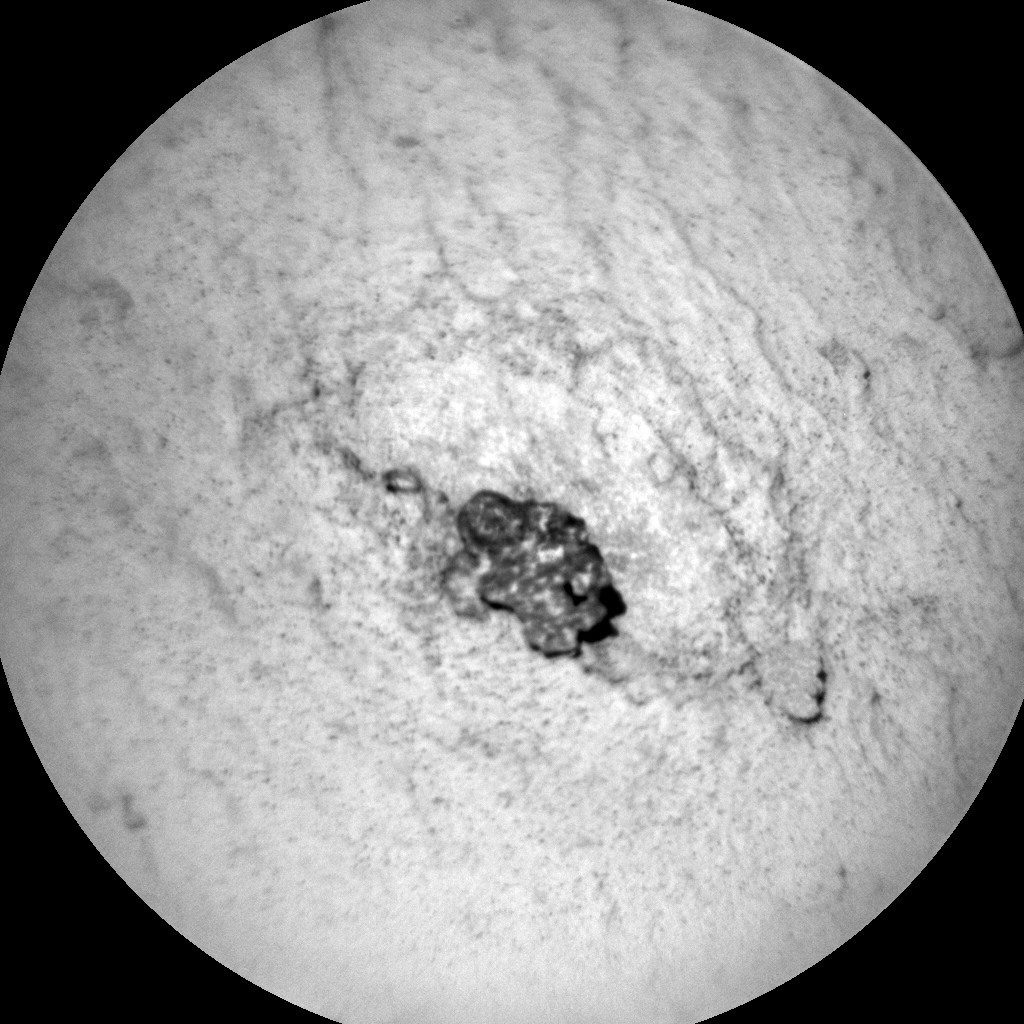
Curiosity Chemistry & Camera (ChemCam) Remote Micro-Imager (RMI) photo taken on Sol 3835, May 21, 2023.
Image credit: NASA/JPL-Caltech/LANL
Decision point
The plan was to finish with more environmental measurements and another Chemistry & Mineralogy X-Ray Diffraction/X-Ray Fluorescence Instrument (CheMin) analysis of some Ubajara drill sample to see if chemistry results differ over time.
“Our next plan’s fate now rests in the hands of the SAM team: to continue analyzing or wrap up this campaign and move on,” Moore concludes.

Image credit: Axiom Space
The upcoming liftoff of a SpaceX Falcon 9 rocket, with the Dragon Freedom crew of four private astronauts headed for the International Space Station, also makes possible technology testing of an array of new-to-space hardware.
The Axiom Mission-2 crew is led by former NASA astronaut and Ax-2 commander Peggy Whitson, also Axiom Space’s Director of Human Spaceflight. She leads first-time space flyers pilot John Shoffner of Knoxville, Tennessee and mission specialists Ali Alqarni and Rayyanah Barnawi from the Kingdom of Saudi Arabia.

AX-2 crew.
Image credit: Axiom Space
The multinational AX-2 astronaut crew will conduct more than 20 different experiments while aboard the space station.
Axiom Space is a private company eyeing expanded access to the International Space Station and low-Earth orbit. The organization’s intent is to lay the groundwork and establish the key capabilities needed to build out and operate Axiom Station – the world’s first commercial space station.

Image credit:
Rachel Frances Bellisle
Intravehicular apparel
One item for testing is the Gravity Loading Countermeasure Skinsuit. This intravehicular (inside habitable volume) activity suit is sponsored by the Massachusetts Institute of Technology’s (MIT) Media Lab’s Space Exploration Initiative in Cambridge.
The suit has been developed to simulate some effects of Earth’s gravity and help mitigate certain physiological impacts from microgravity, including spinal elongation, muscle atrophy, and sensorimotor changes.
“This wearable system is intended to supplement exercise during future missions to the Moon and Mars and to further attenuate microgravity induced physiological effects in future low-Earth orbit mission scenarios. The purpose of this study is to characterize the Skinsuit and its physiological effects on a short-duration low-Earth orbit mission,” explains an Axiom posting about the Skinsuit.

The Skinsuit Team. (left to right:) Rachel Bellisle (Project Lead), Allison Porter, Ciarra Ortiz, Dava Newman (Principal Investigator).
Image credit: Rachel Bellisle
Form and function
The goal of this project: Can the Skinsuit restore sensorimotor functions that are typically altered in microgravity?
The Skinsuit produces a static load from the shoulders to the feet with elastic material in the form of a skin-tight wearable suit.
This wearable system is intended to supplement exercise during future missions to the Moon and Mars. Exercise equipment at those locations may be too large and bulky, so the Skinsuit is a hoped-for way to further attenuate microgravity-induced physiological effects.
The Skinsuit was tested during a 2021 Zero-G parabolic flight, during which the participant performed arm movements with and without the Skinsuit for comparison to typical 1-G muscle activation patterns and postural control strategies.

Rachel Bellisle tests the Gravity Loading Countermeasure Skinsuit, an intravehicular activity suit for astronauts that has been developed to simulate the effects of Earth gravity.
Image credit: Steve Boxall/ZERO-G
Tech demo
The Skinsuit team is sponsored by the MIT Media Lab’s Space Exploration Initiative and led by Rachel Bellisle, PhD candidate in the Harvard-MIT Program in Health Sciences and Technology. Dava Newman, director of the MIT Media Lab is the principal investigator of the Skinsuit.
“Anytime we can get something into space as a technology demonstration, it’s an advantage,” Newman told Inside Outer Space. Having academia engaged means developing experiments in months, not years or decades, she added.
“We have the technology. Let’s demonstrate it in the real environment,” Newman said.

