Archive for March, 2023
 Author:
  March 15th, 2023
The annual report of worldwide threats to the national security of the United States has been issued by the U.S. Office of the Director of National Intelligence.
This 2023 Annual Threat Assessment Report includes appraisals of China and Russian space activities.
Overall, the report states that China is steadily progressing toward its goal of becoming a world-class space leader, with the intent to match or surpass the United States by 2045. Even by 2030, China probably will achieve world-class status in all but a few space technology areas.

Image credit: CGTN/Inside Outer Space screengrab
“China’s space activities are designed to advance its global standing and strengthen its attempts to erode U.S. influence across military, technological, economic, and diplomatic spheres,” states the report, adding:
— China’s space station began assembly and crewed missions in 2021, and reached full operational capability in 2022. Beijing plans to conduct additional lunar exploration missions, and it intends to establish a robotic research station on the Moon and later, an intermittently crewed lunar base.
— The People’s Liberation Army (PLA) will continue to integrate space services—such as satellite reconnaissance and positioning, navigation, and timing—and satellite communications into its weapons and command-and-control systems in an effort to erode the U.S. military’s information advantage.

China’s first commercial carrier rocket departs the Jiuquan Satellite Launch Center, northwest China.
Credit: CCTV-Plus
Commercial space
“China’s commercial space sector is growing quickly and is on pace to become a major global competitor by 2030. Beijing’s policies to encourage private investment in space activities have influenced a broad range of firms to enter the commercial market. State-owned enterprises and their subsidiaries will remain the primary players in the Chinese commercial space sector, which also includes research and development spinoffs, established companies, and a growing number of startups,” noting:
— Some Chinese commercial space companies will attempt to compete by providing services in niche markets with little or no global competition, such as hyperspectral imaging, and also will continue attempts to undercut the price of Western firms in more competitive markets. Counterspace operations will be integral to potential PLA military campaigns, and China has counterspace weapons capabilities intended to target U.S. and allied satellites. The PLA is fielding new destructive and nondestructive ground- and space-based antisatellite (ASAT) weapons.

China sea launch. Credit: CCTV/Inside Outer Space screengrab
— China already has fielded ground-based counterspace capabilities including electronic warfare systems, directed energy weapons, and ASAT missiles intended to disrupt, damage, and destroy target satellites. China also has conducted orbital technology demonstrations, which while not counterspace weapons tests, prove China’s ability to operate future space-based counterspace weapons.
Russia’s space-sector problems
Concerning Russia’s space activities, the intelligence report notes that Russia will remain a key space competitor, “but it may have difficulty achieving its long-term space goals because of the effects of additional international sanctions and export controls following its invasion of Ukraine, a myriad of domestic space-sector problems, and increasingly strained competition for program resources within Russia.”

Roscosmos chief, Yuri Borisov.
Image credit: Roscosmos
“Moscow probably will focus on prioritizing and integrating space services—such as communications; positioning, navigation, and timing; geolocation; and intelligence, surveillance, and reconnaissance—deemed critical to its national security,” the report adds.
— Moscow is capable of employing its civil and commercial remote sensing satellites to supplement military-dedicated capabilities that reduce the U.S. ability to perform sensitive military activities undetected. In addition to improving its launch capability, it is working to support human spaceflight and future deep space missions.
— Russia warned during a UN meeting in October 2022 that commercial infrastructure in outer space used for military purposes “can become a legitimate target for retaliation.”

Credit: SpaceX/Starlink
“Russia continues to train its military space elements and field new antisatellite weapons to disrupt and degrade U.S. and allied space capabilities. It is developing, testing, and fielding an array of nondestructive and destructive counterspace weapons—including jamming and cyberspace capabilities, directed energy weapons, on-orbit capabilities, and ground-based ASAT capabilities—to try to target U.S. and allied satellites,” states the report.
Similar to the space sector, resource and technology challenges could have an impact on the quality and quantity of Russia’s future counterspace capabilities, with the report observing:
— Russia is investing in electronic warfare and directed energy weapons to counter Western on-orbit These systems work by disrupting or disabling adversary C4ISR capabilities and by disrupting GPS, tactical and satellite communications, and radars. Russia also continues to develop ground-based ASAT missiles capable of destroying space targets in low Earth orbit.
To access the full report — 2023 Annual Threat Assessment Report – go to:
https://www.dni.gov/files/ODNI/documents/assessments/ATA-2023-Unclassified-Report.pdf
 Posted in

Interpretation of the “Relict Glacier” features. Image credit: Lee Pascal et al. 2023/SETI Institute
Remains of a modern glacier near Mars’ equator have been found. The finding implies water ice is possibly present at low latitudes on the Red Planet…even today.
The announcement comes from the now-in-session 54th Lunar and Planetary Science Conference being held in The Woodlands, Texas.
Scientists at the gathering revealed the discovery of a relict glacier near Mars’ equator.
Shallow depths
“This discovery raises the possibility that ice may still exist at shallow depths in the area, which could have significant implications for future human exploration. This discovery suggests that Mars’ recent history may have been more watery than previously thought, which could have implications for understanding the planet’s habitability,” explains a press statement from the SETI Institute.
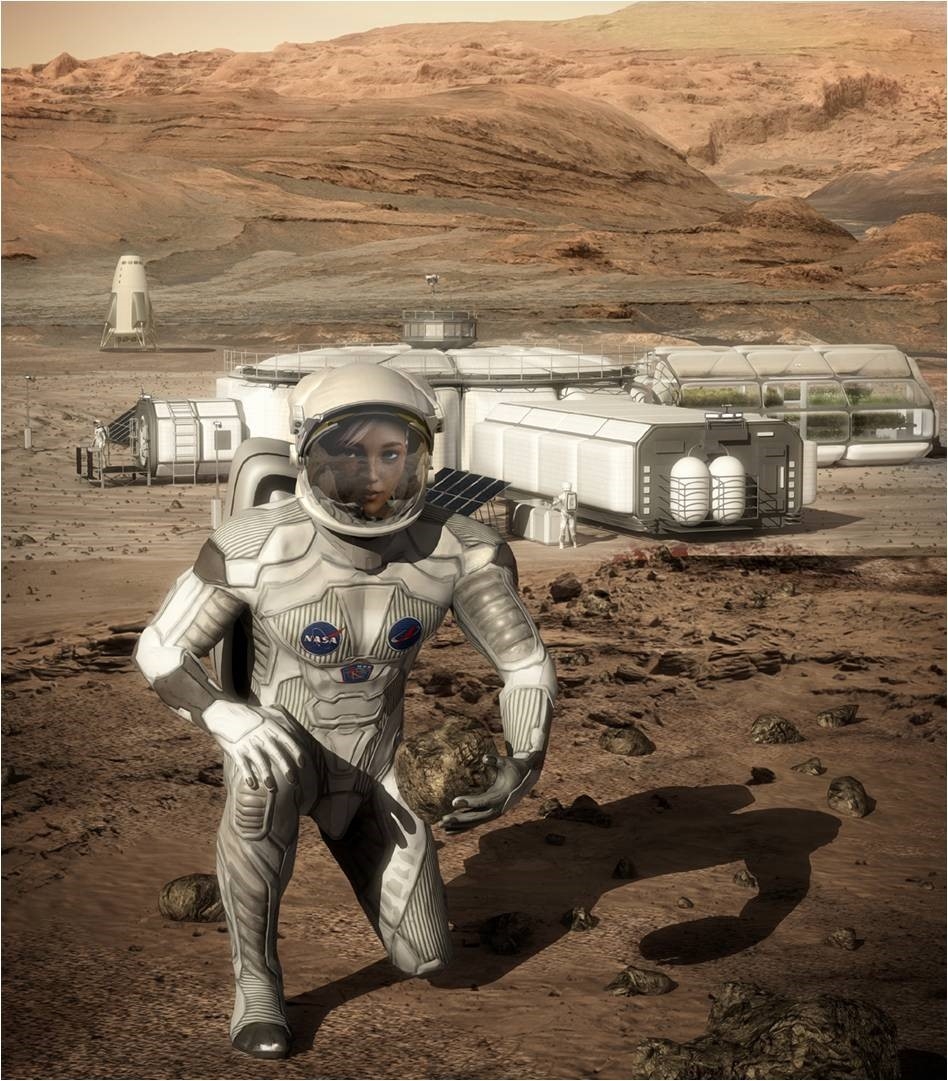
Credit: Bryan Versteeg
“What we’ve found is not ice, but a salt deposit with the detailed morphologic features of a glacier. What we think happened here is that salt formed on top of a glacier while preserving the shape of the ice below, down to details like crevasse fields and moraine bands,” said Pascal Lee, a planetary scientist with the SETI Institute and the Mars Institute, and the lead author of the study.
The glacier is estimated to be 4 miles (6 kilometers) long and up to 2.5 miles (4 kilometers) wide. This finding suggests that Mars’ recent history may have been more watery than previously thought. If so, the discovery could have implications for understanding the planet’s habitability.
Implications
If there is still water ice preserved at shallow depths at a low latitude on Mars, there would be implications for science and human exploration.
“The desire to land humans at a location where they might be able to extract water ice from the ground has been pushing mission planners to consider higher latitude sites,” Lee adds. “But the latter environments are typically colder and more challenging for humans and robots. If there were equatorial locations where ice might be found at shallow depth, then we’d have the best of both environments: warmer conditions for human exploration and still access to ice.”

A proposed International Mars Ice Mapper (I-MIM) mission concept along with four relay orbiters to spot and relay to Earth data regarding buried water ice on the Red Planet.
Image credit: NASA
Lee cautions, however, that more work still needs to be done.
“We now have to determine if, and how much, water ice might actually be present in this relict glacier, and whether other light-toned deposits might also have, or have had, ice-rich substrates,” Lee concludes.
“Identifying adequate and accessible water-ice reserves enables the identification of candidate sites for potential scientific discoveries worthy of sending humans. It also enables the identification of water-ice
resources to meet human operational needs on the Martian surface,” as noted in the final report of the International Mars Ice Mapper (I-MIM) mission concept.

Image credit: NASA

Curiosity Mars Hand Lens Imager (MAHLI) photo produced on Sol 3767 March 12, 2023.
Image credit: NASA/JPL-Caltech/MSSS
NASA’s Curiosity Mars rover at Gale Crater is now performing Sol 3770 duties.
A recent two sol scripted plan (Sols 3769-3770) called for the robot to wrap up its remaining drill campaign and workspace liens at the Tapo Caparo site.

Curiosity Mars Hand Lens Imager (MAHLI) photo produced on Sol 3769, March 15, 2023.
Image credit: NASA/JPL-Caltech/MSSS
A weekend plan ran successfully, “though we had a known issue which caused several of our remote sensing activities planned for the weekend to not execute,” reports Elena Amador-French, Science Operations Coordinator at NASA’s Jet Propulsion Laboratory. A more recent plan was therefore “jam packed with recovering any remaining remote sensing observations of our area and some contact science.”

Curiosity Right B Navigation Camera image taken on Sol 3769, March 14, 2023.
Image credit: NASA/JPL-Caltech
Float rock
For Curiosity’s robotic arm work, the Mars Hand Lens Imager (MAHLI) instrument was slated to look at two targets: “Tucupita” and “Mariapiri.”
Also, the plan called for use of the Alpha Particle X-Ray Spectrometer (APXS) instrument to investigate the composition of “Mariapiri” and an offset position of drill tailings.
“Tucupita is an interesting potential float rock in our workspace. A float rock is an out of place rock that does not appear to be part of the greater bedrock. On Earth (and Mars) these can appear after eroding from a different stratigraphic unit, for example,” Amador-French adds.

Curiosity Right B Nav Camera photo acquired on Sol 3768, March 13, 2023.
Image credit: NASA/JPL-Caltech
“Comparing the difference in composition and texture of Tucupita compared to the bedrock in the workspace can provide clues into how the region has eroded over millions of years,” Amador-French reports. “The Mariapiri target is a small fracture that formed after we drilled Tapo Caparo. This fracture provides a small window into what the subsurface looks like texturally in the area.”

Curiosity Right B Navigation Camera photo taken on Sol 3766, March 11, 2023.
Image credit: NASA/JPL-Caltech

Image credit: Roscosmos/NASA
For the second time in a month, the Russian-provided Progress MS-22 resupply spacecraft took the International Space Station (ISS) away from a collision with space debris.
Coupled to the ISS, the Progress and its engines fired for 135 seconds, giving out an impulse to boost the orbiting facility to 260 miles (419 kilometers), explains a Roscosmos Telegram posting.
“For the entire time of the station’s flight, 336 corrections were made to the altitude of its orbit (of which 35 were for the purpose of evading space debris), including 185 with the help of our Progress,” the Roscosmos posting adds.

Credit: The Aerospace Corporation’s Space Safety Institute
Dangerous situations
According to Maxim Penkov, Advisor to the General Director of TsNIIMash JSC, “the automated system for warning about dangerous situations in near-Earth space in 2022 recorded more than 16 thousand approaches of the ISS and Russian spacecraft with dangerous objects in orbit,” as reported by Russia’s TASS news agency.
Penkov adds that five space debris avoidance maneuvers were performed for the ISS, which “prevented the loss of a unique space complex worth more than 200 billion dollars, and also ensured the life and health of the station crew.”

Drawing shows Orbital Labs’ concept of operations — from launch of the high-altitude balloon platform and capsule to recovery.
Image credit: Orbital Labs
A Sub-Orbital Launch and Recovery (SOLAR) System capsule is being pursued by California State, Fullerton engineers and computer researchers.
The team at the university’s Orbital Labs is focused on a high-altitude balloon and capsule that reaches 150,000 feet, or 28 miles high above Earth, to provide an affordable launch service.
Along with microgravity experiments, specialists at Orbital Labs are also delving into re-entry and recovery concepts using the SOLAR System platform.

Drawing depicts the internal structure of the Sub-Orbital Launch and Recovery (SOLAR) System capsule. The capsule, or Recovery for Avionics and Payload Retrieval vehicle, will host scientific experiments and other important subsystems to recover scientific payloads. Image credit: Orbital Labs
Payload retrieval vehicle
Since last August, the interdisciplinary team of about 20 students — made up of electrical, mechanical and computer engineering, computer science, business and communications majors — has been working on designing and building the SOLAR System.
The project includes building a prototype of a 25-pound capsule, about 3 feet wide, which will carry future microgravity experiments. The capsule, or Recovery for Avionics and Payload Retrieval vehicle, attaches to a helium-filled balloon — the size of a small sedan — and houses avionics hardware and recovery equipment for launches, according to a Cal State Fullerton statement.

Bench testing.
Image credit: Orbital Labs
Filling in a gap
The large balloon will lift the capsule to between 100,000 and 150,000 feet high, and then detach from the balloon for freefall toward terra firma. Following the freefall period the capsule will deploy a drogue and main chute, and then drift back to Earth for recovery and payload collection.
According to Orbital Labs, there remains a gap in affordable, rapid deployment, microgravity experiment platforms for smaller industries, research groups and universities.

Next steps
Next steps of this design, according to the university statement, include fabrication, assembly, system integration and rigorous testing before the first test flight of the prototype by the end of 2023.
After the inaugural mission, the students intend to gather data, publish their findings and decide the best types of scientific payloads to perform microgravity experiments using the high-altitude platform.
“Our students are developing a middle ground to short-term and long-term solutions for microgravity experiments, while also researching re-entry and recovery concepts using a high-altitude balloon platform,” explains Yoonsuk Choi, associate professor of computer engineering, the team’s faculty mentor.
Choi also is assisting in finding collaborations with local industry as well as corporate support for the project. This semester, Orbital Labs members will participate in industry tours and hold student-run workshops.
For more information on Orbital Labs, go to:

Image credit: NASA/GSFC/Arizona State University
A possible NASA Artemis 3 Moon landing spot has been eyed by NASA’s veteran Lunar Reconnaissance Orbiter, making use of its high-powered LROC imaging system.
Malapert massif, an informal name, is a glorious peak (lower left of image) thought to be a remnant of the South Pole – Aitken basin rim, which formed more than 4 billion years ago.
LROC shuttered this view on March 3 when the Moon orbiting spacecraft was about 12 miles (20 kilometers) beyond Shackleton crater looking towards the nearside.
From this viewpoint, the back side of Malapert massif can be seen, assuming an Earth-centric reference.
The Artemis 3 candidate landing region is partially visible from this viewpoint.

Image credit: NASA/GSFC/Arizona State University
Sheer grandeur
The relatively flat area (86°S, 0°E) above the “5000” in this image (right) is the heart of the Artemis 3 landing region, which continues down the slope toward the Earth, as seen here.
Reports LROC’s principal investigator, Mark Robinson of Arizona State University:
“Imagine the view from the summit; it rises more than 5,000 meters (16,400 feet) above its base. Off in the distance, you could see a 3,500 meter (11,480 feet) tall cliff. One could argue that the sheer grandeur of this region makes it a prime candidate. But then again, a landing here might be too exciting?”

Shown here is a rendering of 13 candidate landing regions for NASA’s Artemis III mission. Each region is approximately 9.3 by 9.3 miles (15 by 15 kilometers). A landing site is a location within those regions with an approximate 328-foot (100-meter) radius.
Image credit: NASA
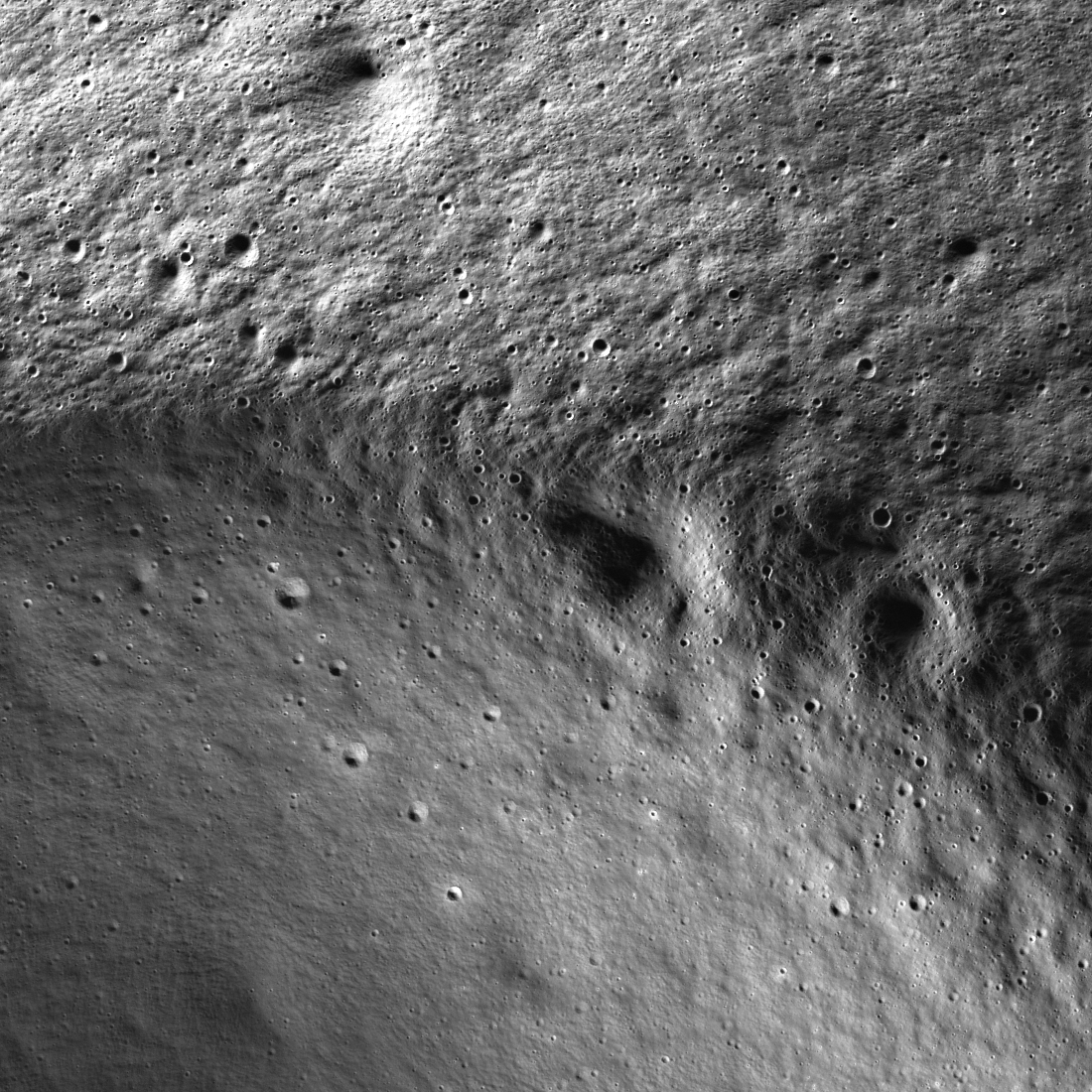
Rim of Marvin crater. Image credit: NASA/ Korea Aerospace Research Institute (KARI)/Arizona State University
The rim of Marvin crater, 2.9 miles (4.6-kilometers) in diameter arcs across the image from left to right.
This just-released image comes via the Korean Pathfinder Lunar Orbiter’s (KPLO) ShadowCam.
ShadowCam is a NASA-funded instrument hosted onboard the KPLO, provided by Arizona State University.
By collecting high-resolution images of the Moon’s permanently shadowed regions (PSRs), ShadowCam will provide critical information about the distribution and accessibility of water ice and other volatiles at the scales required to mitigate risks and maximize the results of future exploration activities.

The Korea Pathfinder Lunar Orbiter, KPLO, is set for a one-year agenda of research.
Credit: Korean Aerospace Research Institute (KARI)
Steep interior
The steep interior wall below the rim slopes down toward the bottom of the image.
The crater interior is in permanent shadow; the exterior was in shadow when this image sequence was acquired on February 28th. However, this area is not permanently shadowed.
The image width is 2200 meters, and the south pole is about 16 miles (26 kilometers0 to the right, a mosaic made from ShadowCam images.

Image credit: Roscosmos
NASA’s budget request this year includes seeking $180 million in fiscal year 2024 to safely de-orbit the massive International Space Station.
Completion of ISS operations is slated for 2030, with the huge structure undergoing a controlled re-entry dumping into ocean waters.
The new budget request includes $180 million in FY 2024, building on the $10 million provided in FY 2023 appropriations to initiate development of this capability.
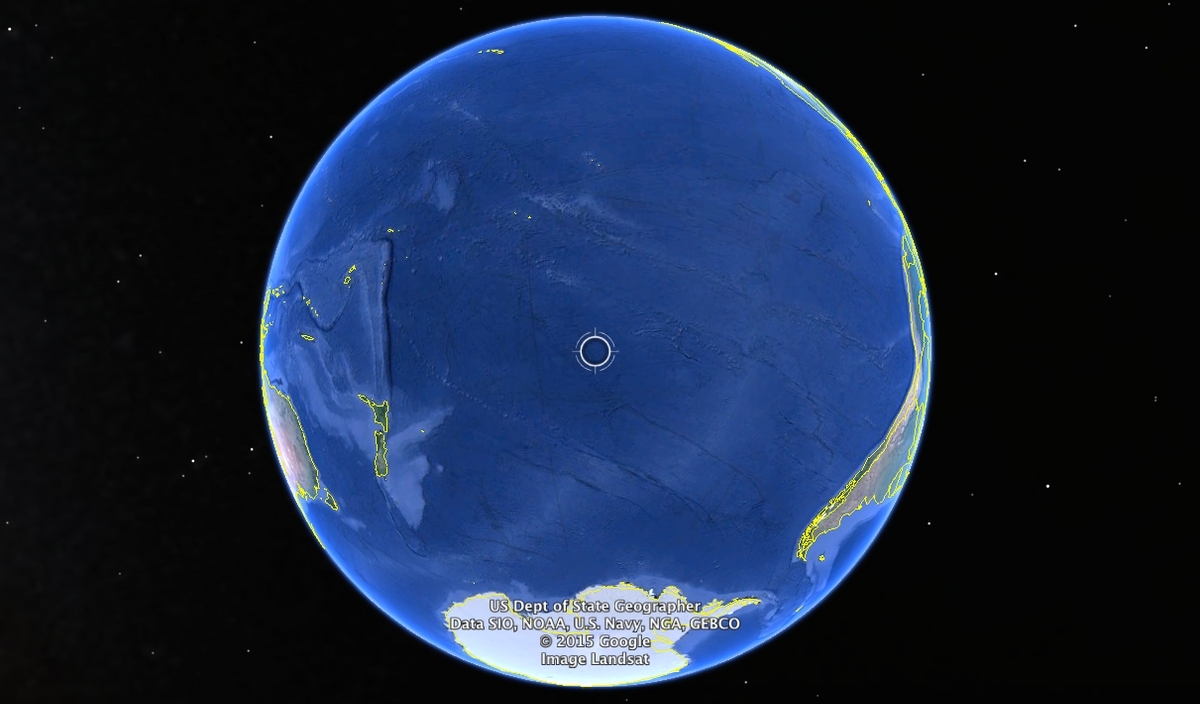
Possible splash down zone for the International Space Station, an area around Point Nemo, formally dubbed “the oceanic pole of inaccessibility.”
Credit: Google/Public Domain
Deorbit vehicle
“NASA and its partners have studied deorbit requirements and determined that additional capabilities are needed to reduce risk and provide for a more robust deorbit capability,” a NASA budget document explains, calling for an ISS de-orbit vehicle.
In 2023, NASA plans to release a Request for Proposal to provide the capability to design, develop, manufacture, launch, and provide the on-orbit operation to enable a controlled re-entry and the safe deorbit of the ISS. A contract award is planned for fall 2023.
“The deorbit vehicle will attach (via docking or berthing) to the ISS at least one year prior to the planned ISS reentry date to enable adequate time for on-orbit tests and checkouts,” the budget document adds. “Although nominal ISS end of life is late 2030, the Government requires that this deorbit capability be available as soon as possible to protect for contingencies that could drive early re-entry.”
For more information on this prospect, go to my Space.com story — “Watery graves: Should we be ditching big spacecraft over Earth’s oceans? It’s a form of pollution, after all” — at:
https://www.space.com/spacecraft-deorbiting-over-earth-oceans-ethical-concerns

Image credit: Roscosmos
Calling it the most expensive “abandonment” in the world, a new Russian Roscosmos Telegram posting has spotlighted the former Soviet Union’s Buran spaceship.
“In total, five Buran flight ships were to be created in the Soviet Union, but only two were fully assembled. The third was supposed to go into space in 1994 and was 50% ready at the time the program was closed,” the posting explains.
Until 2004, the unique spacecraft stood in the shops of the Tushino plant, now – in the museum of equipment of Vadim Zadorozhny in Arkhangelsk. “Backlogs on the fourth and fifth ships were destroyed,” the Roscosmos Telegram adds.
The Buran made an uncrewed flight in November 1988, circuiting the Earth twice prior to carrying out an autopilot landing at the Baikonur cosmodrome.

Image credit: Roscosmos
Combat space stations
“Energia-Buran is the most expensive and resource-intensive space program in the USSR, more than 1,200 enterprises participated in it,” the posting explains. Launched in 1974, the Energia-Buran effort ran in parallel with the similar American Space Shuttle project.
“Unlike the American twin, Buran could fly unmanned. It was launched into orbit by a two-stage Energiya, the most powerful domestic launch vehicle,” the posting says.
“One of the main tasks of ‘Buran’ was the launch of combat space stations into orbit. The Energia-Buran program was closed in 1993 after the collapse of the USSR,” the Roscosmos Telegram posting concludes.
Go to this video showcasing the launch of the Energia-Buran at:
That new NASA budget has been assessed, spotlighting which companies and institutions receive the most funds from the space agency. For fiscal year 2024, the White House is proposing a $27.2 billion budget for NASA.
The Budget requests $27.2 billion in discretionary budget authority for 2024, a $1.8 billion or 7-percent increase from the 2023 enacted level.
Statista, a leading provider of market and consumer data, notes that in the fiscal year 2022, the U.S. space agency awarded Musk’s company about $2 billion in contract volume out of its total approved budget of $24 billion.

Image credit: Statista
Florian Zandt, a “data journalist” for Statista, has taken a close look at the NASA budgeting, reporting:
“SpaceX received 25 percent more funds than in 2021 and overtook Boeing as the agency’s second-most-awarded contractor. In November, one month after the end of the previous fiscal year, NASA also announced $1.2 billion in funding for another Artemis lunar surface landing mission.”
Cash flow: JPL
“Apart from SpaceX, the California Institute of Technology benefitted the most from NASA’s budget. This can be explained by the fact that the university operates NASA’s Jet Propulsion Lab research facility,” Zandt explains. “Between October 2021 and the end of September 2022, about $2.7 billion flowed to the university, roughly 12 percent more than the previous year.”
By contrast, the other top contractors, including Boeing, Lockheed Martin and SAIC — not to be confused with the e-mobility joint venture between General Motors and Wuling — were in some cases awarded significantly less budget than in the previous year, Zandt observes.

Starship
Credit: Elon Musk/SpaceX
Starship
In another Statista data look, Zandt notes that SpaceX, owned by Tesla CEO Elon Musk, is currently preparing the first orbital test flight of its Starship system, scheduled for March 2023. “The latest rocket model is expected to transport people and cargo between Earth and the Moon in the future and, according to Musk, represents an essential building block in his plan to colonize Mars.”
“Currently, the Federal Aviation Administration (FAA) has yet to issue a license for the flight. The U.S. authority regulates rocket launches in the U.S., and numerous past planned launch dates have already been postponed due to the lack of a license. In principle, the FAA is likely to be well-disposed toward SpaceX. The company is one of NASA’s most important contractors.”

Image credit: Statista
Expensive business
Zandt underscores the point that launching rockets to deliver payloads into orbit is an expensive business.
“So costly that, thus far, only government space agencies or government-related companies have transported astronauts or satellites into space. Still, the private space industry has been booming in the last couple of years, with companies like Richard Branson’s Virgin Galactic, Jeff Bezos’ Blue Origin and Elon Musk’s SpaceX providing varying degrees of suborbital and orbital space travel and transportation.”
In 2022, according to Bryce Tech, an analytics and engineering firm, eleven private providers launched 94 rockets – of which SpaceX alone sent 61 rockets into orbit, Zandt adds.
“This compares with 71 launches by space agencies or government-related companies. The leader in this category is the prime contractor for the Chinese space program, the China Aerospace Science and Technology Corporation (35 launches). It is followed by Roscosmos (21 launches), the space agency of the Russian Federation. However, the private and public sectors are often intertwined rather than strictly separated. For example, SpaceX has been awarded NASA contracts worth $2 billion in the agency’s fiscal year 2022 alone.”
For more information on Statista, go to:

