Archive for January, 2023
 Author:
  January 2nd, 2023
Wait a Minute!
A recent item caught my eye.
Late last month, the ocean-going cruise ship – Viking Orion – was not permitted to pull into dock in Australia.
Over 800 ocean goers have been stranded offshore for nearly a week due to “biofoul” – a condition in which marine growth, a fungus, was carried on the Viking Orion’s hull.
An Australian fisheries department labeled it a “potentially harmful” fungus. The worry was that by introducing this invasive species into a new habitat, that organism could hamper the local biological species thriving in the area.

Image credit: Viking Cruises
Ship-shape steps have been taken by Viking Cruises, although it’s not clear when passengers will set foot back on land.
But more to the point – a space exploration point of view about hauling back samples from Mars.
Extraterrestrial goodies
Now in the works is the multi-nation, multi-billion dollar Mars Sample Return (MSR) campaign – a “cache and carry” project for the 2030’s to haul to Earth select specimens of Red Planet soil, rock and atmosphere.

Newly revised Mars Sample Return campaign makes use of a set of machines, including use of helicopters, to collect Martian soil, rock and atmospheric specimens for return to Earth.
Image Credit: NASA/JPL-Caltech
The plan is for the Mars samples – roughly a pound of extraterrestrial goodies — to be plopped into the Utah Test and Training Range (UTTR) in west-central Utah.
The MSR campaign team is developing specific transportation, storage, and curation protocols for the Mars samples, including transportation from the UTTR point of recovery to the yet-to-be-determined site of an MSR sample receiving facility.
Public comment
For its part, NASA recently posted for public comment a draft MSR “Programmatic Environmental Impact Statement” or PEIS for short. A 45-day public comment period began on November 4, 2022 and ended on December 19, 2022.

Proposed Utah landing zone (red ellipse) for the Mars sample return mission.
Image credit: NASA
As a result, the PEIS spurred nearly 75 comments.
There’s a mixed bag of support for rocketing back Mars collectibles to our planetary home, and a goodly number of those comments urged not bringing samples back to our home base before testing or studying them on Mars itself.
Others responded by being supportive of using an off-Earth lab, perhaps on the International Space Station, to use “protocols similar to ones described in the Andromeda Strain, minus the nuclear device.”
Another comment remarks: “The arrogance of scientists thinking their containment system is unbreakable reminds me of how the Titanic was supposedly unsinkable. The difference is that at least the Titanic had some lifeboats when it sank; the Earth has none.”

The Andromeda Strain – the 1971 movie, but how real for a 21st century return to Earth of Mars samples?
Credit: Universal Pictures
Miniscule risk
On the other hand, there were those supportive of the MSR endeavor.
“Risk is so small it is not worth it to go about this in a different way that wouldn’t be incredibly expensive. The entire point of this mission is to get the samples back to our state of the art labs, not some makeshift lab in LEO or cis-lunar space,” wrote one commenter.
“I am good with the miniscule risk in the name of science,” continued the person’s remark, “for anything to go wrong there would A) need to be dangerous live pathogens B) could interact with us and C) need to get through all containment protocols. The chances of all that happening is one tick above zero, we have found no life on Mars so the idea these samples would contain dangerous life that can infect species from another planet (Earth) is a bit absurd. Let’s go get them!”

Image credit: NASA/PEIS
Ongoing work
Chiming in on the draft environmental impact statement is the United States Environmental Protection Agency (EPA).
“Based on the review of the draft PEIS, EPA did not identify significant environmental concerns to be addressed in the Final EIS,” the December 7, 2022 EPA comment explains.
However, the EPA does note that the draft PEIS references in multiple places that studies regarding burnup/breakup, atmospheric release, contingency planning, and the possibility that Mars material will be distributed outside of the landing site radius are ongoing, and actions to recover MSR Earth Entry System (EES) fragments, if it is damaged upon reentry and landing, are still being worked.

Perseverance rover deposits select rock and soil samples in sealed tubes on Mars’s surface for future missions to retrieve and bring back to Earth for detailed study.
NASA/JPL-Caltech
Ship-to-shore signal?
In summary, observes the EPA, more work is to be done.
“We welcome the opportunity to discuss appropriate response authorities with NASA and are available to assist with additional information if required,” the EPA communiqué to NASA concludes.
In the meantime, NASA’s Perseverance rover is busy at work on Mars, scouting about for primo samples that are being cached for eventual pick-up and delivery to Earth-situated labs for intensive scientific inquiry.
Harkening back to the good ship Viking Orion, one wonders whether there’s a strong ship-to-shore signal.
What’s your view?
For more information on the Mars Sample Return and environmental impact comments/studies, go to:
https://www.nasa.gov/feature/nepa-mars-sample-return-campaign/
 Posted in
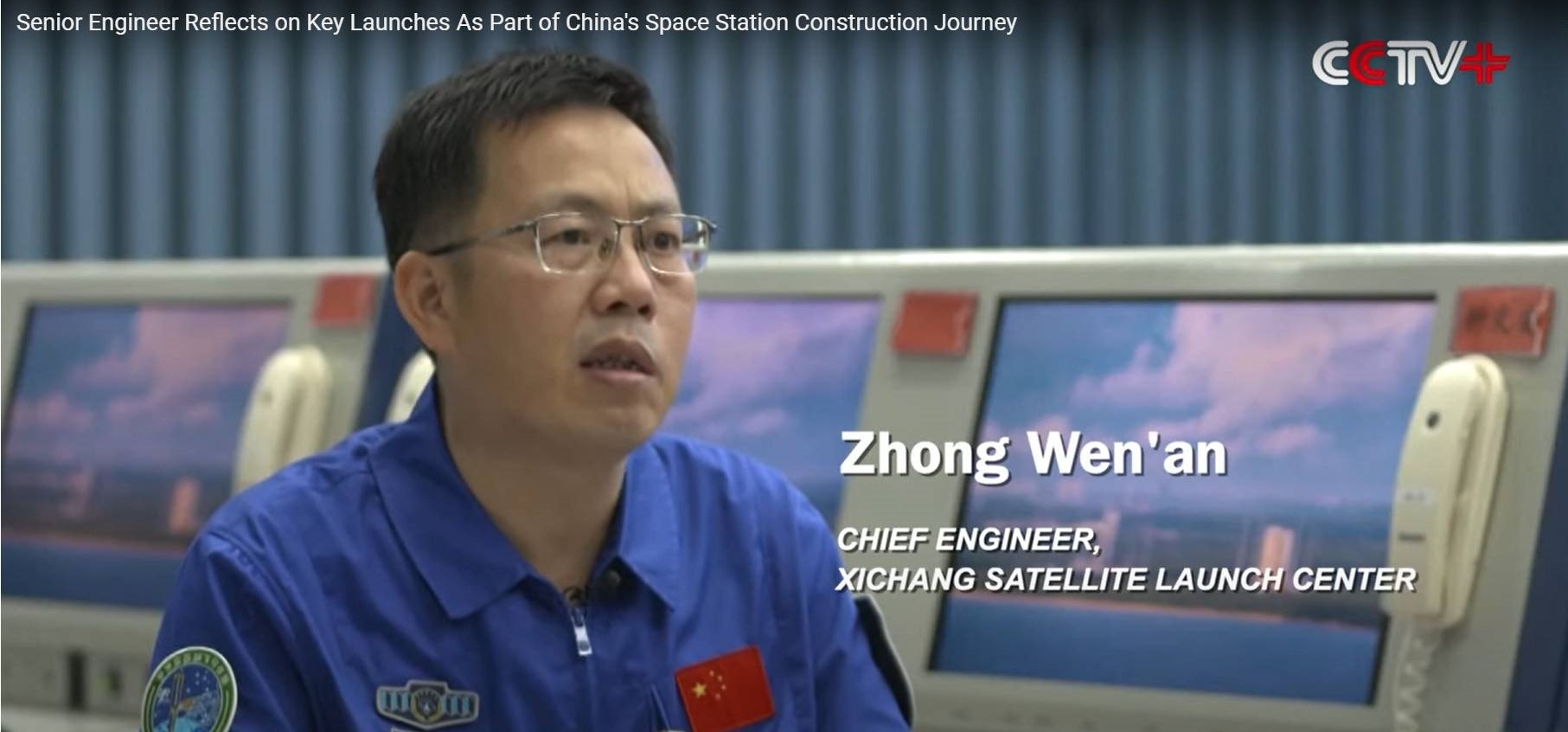
Image credit: CCTV/Inside Outer Space screengrab
China’s Wenchang Satellite Launch Center in the southern Hainan Province is set for an increase in launch rate.
Zhong Wen’an, chief engineer of the Xichang Satellite Launch Center that oversees operations at Wenchang, told China Central Television (CCTV):
“In the near future, Wenchang will see its launch frequency go from between six to eight times a year, to 20 or 30 times a year,” Zhong said. “This is not only a change in quantity but also one in quality. We are also going to add more sites for [the launch of] manned moon-landing missions, heavy rockets and commercial ones. The future of Wenchang is worth looking forward to,” he added.

A Long March-5 booster departs Wenchang launch site.
Credit: CASC
China launched 12 missions related to the building of the space station, with eight of these carried out at Wenchang.
Zhong said that in the future, the launch center is expected to play host to more critical missions on a more frequent scale.
Three-step program
The successful building of the space station is the final goal of China’s “three-step” human space program initiated 30 years ago.
CCTV notes that China’s space station project has completed two phases of the mission objectives: key technology verification and in-orbit construction.

Image credit: Shujianyang Wikimedia Commons, CC BY-SA
During that period of time, the country achieved breakthroughs in regenerative environmental control and life support technology, harnessed flexible solar cell wing driving technology, as well as carry out robotic arm auxiliary module rotation, large assembly control and other technologies.
“I think one of the most important things is that I was determined to make the Chinese space station the most economical space station with advanced technology,” Zhou Jianping, the chief designer of China’s human spaceflight program, told CCTV.

Credit: CCTV/Inside Outer Space screengrab
Station economics
“With respect to the economics of our space station, undoubtedly, it’s the most advanced of all the space stations,” Zhou said. “Thanks to technological advancement, we can dramatically reduce the cost of future supplies to the space station, which is a model of high-quality development.”
The space station is viewed as a new starting point for further space development.
“Our space station will enter the full application stage. It’s safe to say that it is a very important space science research and experiment platform for us to build an innovative country. Our next goal is to conduct manned moon landing in the near future,” Zhou concluded.
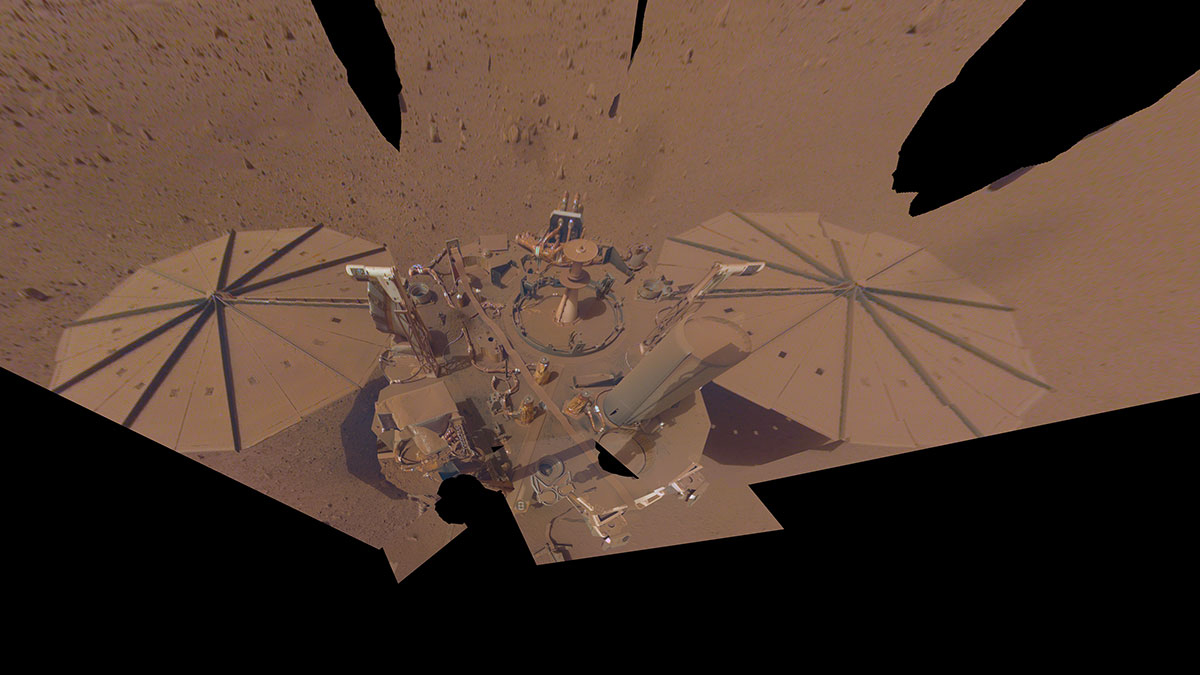
Image credit: NASA/JPL-Caltech
Mars Guy explains that after four years of operation, the NASA InSight lander succumbed to dust accumulation on its solar panels in December.

Image credit: NASA
Here’s why this matters for humans going to Mars and doesn’t matter for samples awaiting return to Earth.
Video at: https://youtu.be/U4ASrml5BjU

