Archive for November, 2022
 Author:
  November 2nd, 2022
Wait a Minute!
Note: “Wait a Minute!” is the first of a series of stories written to flag issues of concern, consternation, and constant aggravation.
Around and around it goes, where it ends up is anybody’s guess.
China’s “forget me not” Long March 5B core booster weighs an estimated 22.5-metric tons. That’s about the size of a 10-story building.
That core stage is a circling-the-Earth leftover associated with the recent launch of the third and final experiment module of China’s Tiangong Space Station, Mengtian.
Level of risk
“The uncertainty of where the large debris will ultimately land presents a level of risk to human safety and property damage that is well above commonly accepted thresholds,” explains The Aerospace Corporation and its Center for Orbital and Reentry Debris Studies (CORDS).
CORDS as is the U.S. military and a global network of satellite watchers are actively tracking the CZ-5B rocket body. And for good reason.
Notes The Aerospace Corporation, similar uncontrolled reentries of Long March rockets occurred in 2020, 2021 and most recently in July 2022 – of which, two resulted in large debris landing near populated areas.
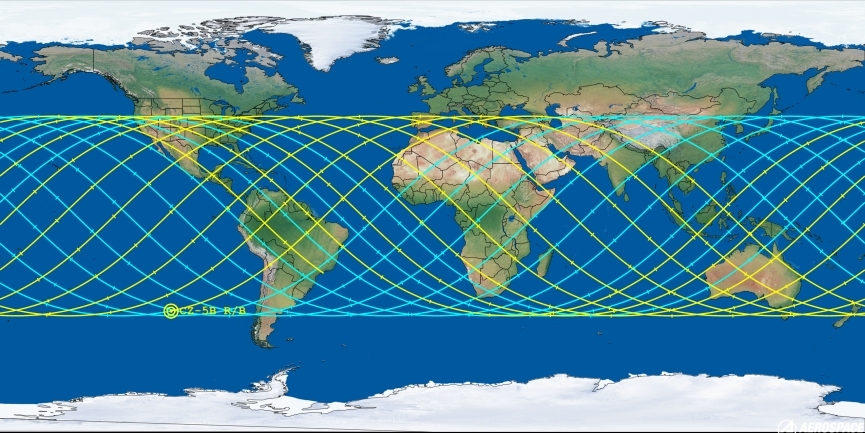
Predicted Reentry Time: November 5, 2022 04:51 UTC ± 14 hours.
Predicted Reentry Time 05 Nov 2022 04:51 UTC ± 14 hours.
Yellow Icon – location of object at midpoint of reentry window
Blue Line – ground track uncertainty prior to middle of the reentry window (ticks at 5-minute intervals)
Yellow Line – ground track uncertainty after middle of the reentry window (ticks at 5-minute intervals)
Pink Icon (if applicable) – vicinity of eyewitness sighting or recovered debris.
Credit: The Aerospace Corporation/CORDS
Precautionary preparation
“Over 88 percent of the world’s population lives under the reentry’s potential debris footprint. Factors such as the rocket core’s uncontrolled manner of descent and its size, which is too large to entirely burn up in the Earth’s atmosphere, collectively present risks high enough that require additional precautionary preparation around the world,” adds The Aerospace Corporation.
China’s Long March 5B core stage is predicted for a November 5th return to Earth: latest predictions at The Aerospace Corporation’s CORDS site are available here at:
https://aerospace.org/reentries/cz-5b-rb-id-54217
 Posted in
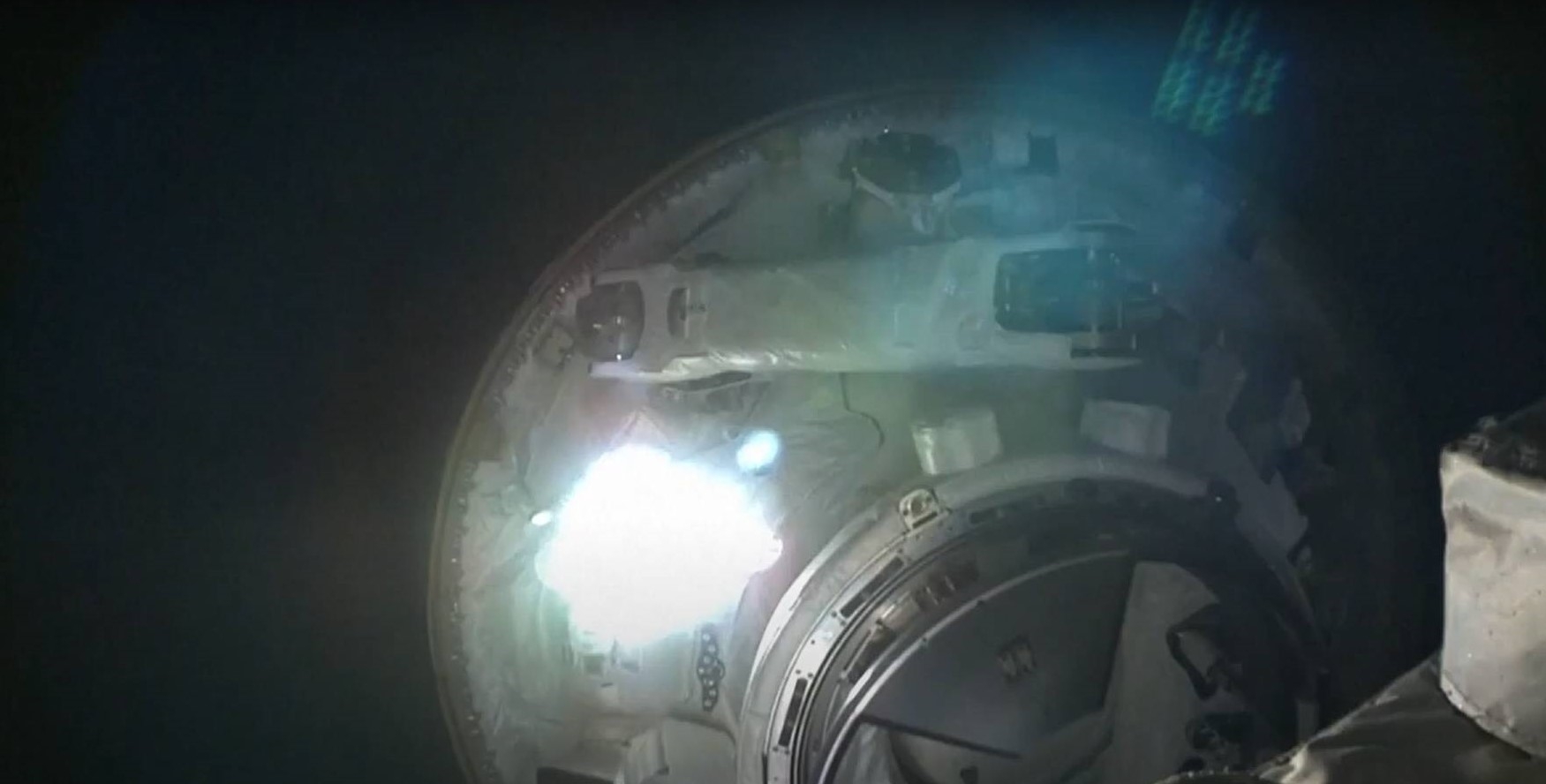
Credit: CNSA/CCTV/Inside Outer Space screengrab
China’s Mengtian lab module has docked with the Tianhe core module’s forward port. This hardware represents the third part of completing China’s Tiangong space station.
Following the lab’s launch, the process of rendezvous and docking took approximately 13 hours.
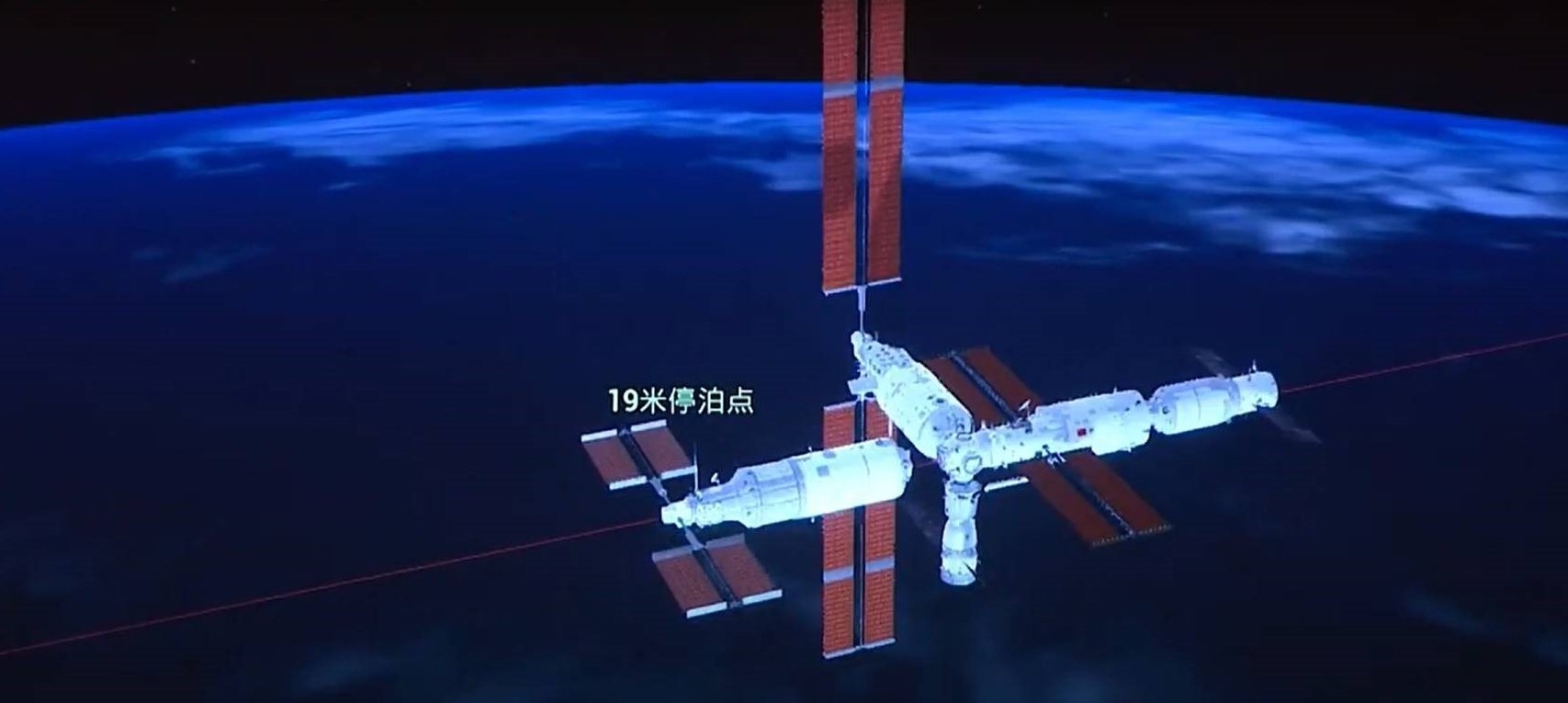
Credit: CNSA/CCTV/Inside Outer Space screengrab
Next step: Transposition of module
“After docking with the space station complex, it will start transposition, which is different from the [earlier launched and docked] Wentian lab module,” said Wang Saijin, deputy chief engineer, Beijing Aerospace Control Center. “Then the Mengtian will connect its system with the complex and create environment for human activities. Our crew members will enter the Mengtian after all these processes,” Wang told China Central Television (CCTV).

Credit: CNSA/CCTV/Inside Outer Space screengrab
The scientific equipment in the Mengtian module will be used for studying microgravity and carrying out experiments in fluid physics, materials science, combustion science and fundamental physics.
T-shape station
During the Mengitan transposition, that module will be moved by an angle of 90 degrees from the front docking port to a side port of the core module’s node cabin, forming a straight line with the Wentian lab module.
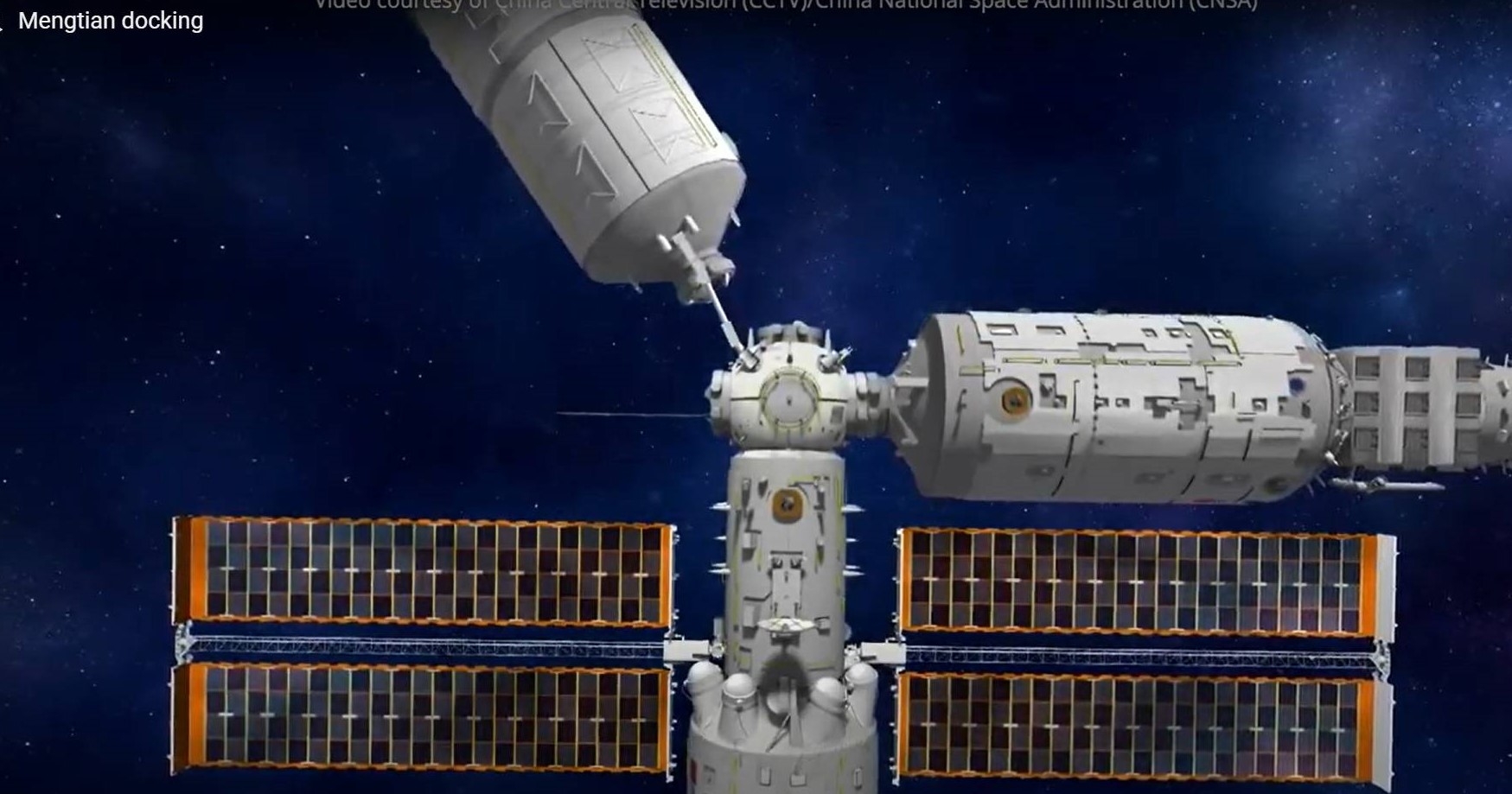
Credit: CNSA/CCTV/Inside Outer Space screengrab
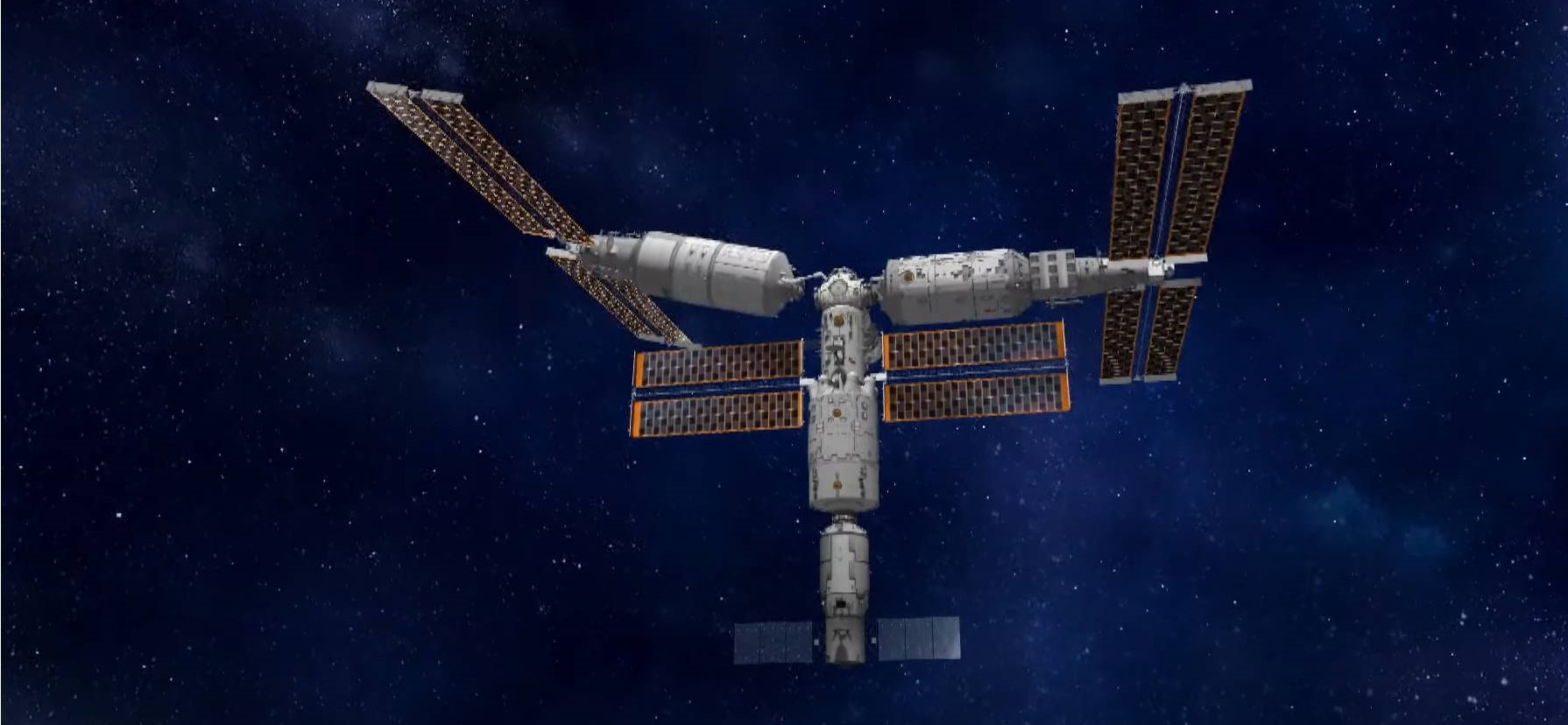
Credit: CNSA/CCTV/Inside Outer Space screengrab
The two lab modules, together with Tianhe core module, will then form a T-shape structure, the planned layout at the space station’s completion.
Malfunction response planning
“The Shenzhou-14 astronauts will cooperate with the ground control teams to adjust the settings of the space station combination. We only need to launch the transposition process at the right time, and then the whole transposition will be implemented automatically without control from the ground,” said Luo Chao, chief system designer for space station with the China Academy of Space Technology.
The transposition equipment weighing only around 220 pounds (100 kilograms) will move the over-20-ton Mengtian lab module during the process.

Station complete is set for year’s end.
Credit: CNSA/CCTV Video News Agency/Inside Outer Space screengrab
Station designers and engineers have arranged many in-orbit tests on the transposition equipment, Luo added. “We have designed plans and done ground tests and in-orbit tests targeting all the links that may give rise to problems. And we have prepared around 100 malfunction response plans to ensure completion of the procedures.”
Airlock serves as cargo port
The airlock cabin on the earlier launched Wentian module is designed for the access of astronauts.
Mengtian’s airlock cabin will enable automatic entry and exit of goods, serving the function of a “cargo port”, according to Liu Huiying, planning manager of the space station project office at the Shanghai Academy of Spaceflight Technology.
“The Wentian lab module also has an airlock cabin, which mainly serves as the exit-entry point for astronauts to conduct extravehicular activities. But the diameter of the cabin is limited, making it difficult to move goods with heavy payload out of the cabin,” Liu told CCTV.

Credit: CCTV/Inside Outer Space screengrab
“The airlock cabin of Mengtian is designed for the free entry and exit of cargoes, with a payload capacity of more than 400 kilograms. The entrance is 1.2 meters in length, width and height, allowing the free entry and exit of cargoes that are difficult for astronauts to carry around,” said Liu.
The three-member crew of the Shenzhou-14 mission now onboard the orbital complex will later be joined by three more astronauts in the coming months to complete the final construction of China’s space station by year’s end.
For newly issued videos regarding the docking and new module, go to:

Boulder-size blocks of water ice can be seen around the rim of an impact crater on Mars. Image taken by the High-Resolution Imaging Science Experiment (HiRISE camera) aboard NASA’s Mars Reconnaissance Orbiter (MRO). The crater was formed Dec. 24, 2021, by a meteoroid strike in the Amazonis Planitia region.
Credits: NASA/JPL-Caltech/University of Arizona
Meteorite impacts on Mars not only toss up dirt and ice, but also produce important data on the structure of the Martian crust.
For example, on December 24, 2021 a meteorite strike on the Red Planet generated surface waves that sped along the planet’s surface. At one point, on the receiving end of those waves was NASA’s InSight Mars lander, recording the hit at a distance of about 2,175 miles (3,500 kilometers) from the lander’s sensitive seismic gear.
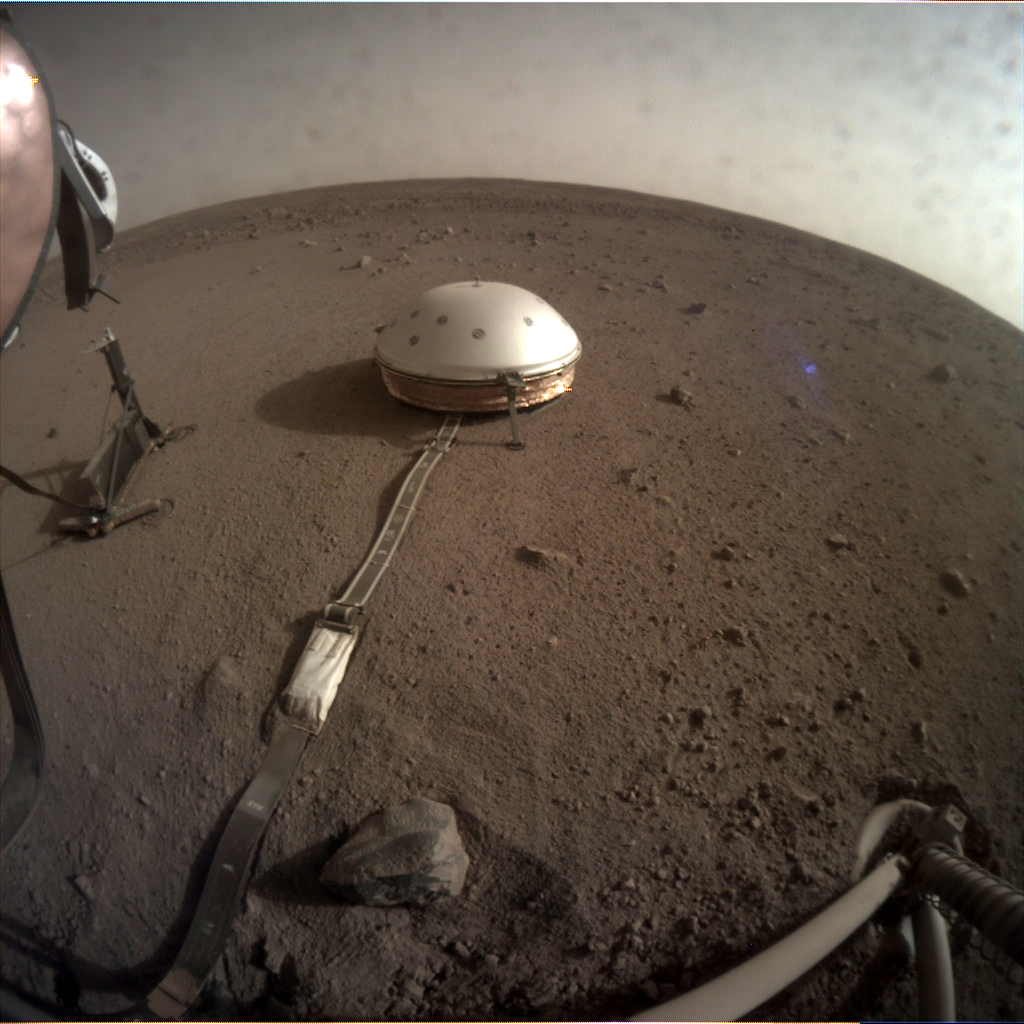
InSight’s Instrument Deployment Camera (IDC) acquired this image showing the HP3 experiment and SEIS seismometer (Seismic Experiment for Interior Structures) on Sol 99, March 8, 2019.
Credit: NASA/JPL-Caltech
Thanks to the Mars-circling NASA Mars Reconnaissance Orbiter, a crater more than 100 meters in diameter was later imaged.
Researchers also identified a meteorite impact at a distance of just under 4,600 (7,500 kilometers) from InSight as the source of a second shock.
Uniform structure
This research has been captured in a new paper published in Science – “Surface waves and crustal structure on Mars” – led by Doyeon Kim of the Institute of Geophysics, ETH Zürich, Zürich, Switzerland.

Cross section of the S1094b surface wave path through Mars.
Credit: Doyeon Kim, et al.
“Until now, our knowledge of the Martian crust was based on only one point measurement under the InSight lander,’ said Kim.
The result of the surface wave analysis: between the impact sites and InSight’s seismometer, the Martian crust has, on average, a very uniform structure and a high density.
“The new findings are so interesting because a planet’s crust provides important clues about the formation and evolution of the celestial body. It is the result of early dynamic processes in the mantle and subsequent magmatic processes,” explained a co-author colleague, Brigitte Knapmeyer-Endrun at the Bensberg Observatory, University of Cologne, Bergisch Gladbach, Germany.

Locations of two large meteorite impacts (yellow circles) identified in MRO images.
Credit: Doyeon Kim, et al.
InSight landing site
According to the Kim, the study lead, the structure of the crust beneath the InSight landing site may have formed in a unique way, like when material was ejected during a large asteroid impact more than three billion years ago.
“If so, the structure beneath the lander is probably not representative of the general crustal structure of Mars.”
For access to the paper — “Surface waves and crustal structure on Mars” – go to:
https://www.science.org/doi/10.1126/science.abq7157

