Archive for July, 2022
 Author:
  July 10th, 2022
Credit: Terran Orbital Corporation
NASA’s Cislunar Autonomous Positioning System Technology Operations and Navigation Experiment (CAPSTONE) is healthy and doing well.
The mini-probe suffered an anomaly during commissioning activities. The operations team began actively working the issue with the NASA Deep Space Network and identified a path forward.
Anomaly details
According to NASA in detailing the anomaly: “During commissioning of CAPSTONE, the Deep Space Network team noted inconsistent ranging data. While investigating this, the spacecraft operations team attempted to access diagnostic data on the spacecraft’s radio and sent an improperly formatted command that made the radio inoperable. The spacecraft fault detection system should have immediately rebooted the radio but did not because of a fault in the spacecraft flight software.”

Designed and built by Terran Orbital, CAPSTONE will support NASA’s Artemis program in reducing the risk for future Moon bound spacecraft.
Credit: Terran Orbital
“CAPSTONE’s autonomous flight software system eventually cleared the fault and brought the spacecraft back into communication with the ground, allowing the team to implement recovery procedures and begin commanding the spacecraft again,” the NASA statement explains.
Review of data
On Saturday morning, a trajectory correction maneuver (TCM) was rescheduled.
The CAPSTONE mission team rescheduled the TCM “to review additional data and perform additional analysis to support modeling of the spacecraft performance during maneuvers,” according to Advanced Space, owner and operator of outbound probe.

CAPSTONE team members install solar panels onto the Cislunar Autonomous Positioning System Technology Operations and Navigation Experiment – at Tyvak Nano-Satellite Systems Inc. in Irvine, California.
Credits: NASA/Dominic Hart
The rescheduled plan does not have any significant impact on the size of the planned correction maneuver which was part of the TCM-1 executed two days prior.
The spacecraft is healthy, communicating with NASA’s Deep Space Network (DSN) and in a nominal state.
Scheduled TCMs
TCM1 had three scheduled maneuvers:TCM1a, TCM1b and TCM1c.
According to Advanced Space, the purpose of these scheduled TCM1 series is:
— Cleaning up the launch injection deviations from the Lunar Photon vehicle
— Commissioning the thrusters which calibrates the propulsion system
TCM1a completed approximately 90% of the objectives of the TCM. With the healthy state of the spacecraft TCM1b did not need to be performed.
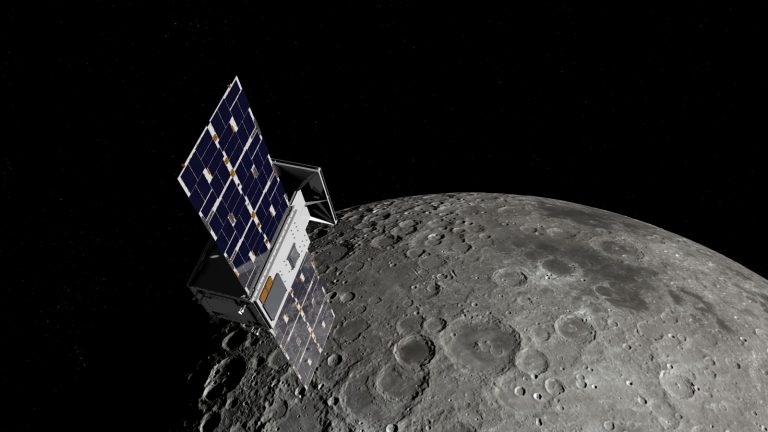
CAPSTONE
Credit: NASA
“In the typical course of spacecraft commissioning activity, schedules often are adjusted. The mission team continues to work around the clock on flight dynamics analysis, trajectory design, spacecraft commanding, communications and health check activities and looks forward to the next needed maneuver,” Advanced Space said in a statement.
“Overall, CAPSTONE is in a nominal state, healthy and still on schedule to arrival to the Moon in four months on November 13th.”
The destination for this microwave oven-size CubeSat is a near rectilinear halo orbit (NRHO), the orbit of choice planned for Gateway, the multipurpose outpost for long-term lunar missions as part of NASA’s Artemis program.
The Gateway in lunar orbit is where astronauts will transfer between the Orion piloted spacecraft and the lander on regular Artemis missions.
 Posted in

Credit: NPO Lavochkin
Russia’s reactivation of Moon exploration has made progress as the country’s Luna-25 probe has passed thermal vacuum tests.
Those tests put the spacecraft through extremely hot/cold soaks, reports Vasily Boyarkin, head of the Research and Testing Center of the Rocket and Space Industry near Moscow.

Russia’s Luna-25 will test lunar sampling skills.
Credit: NPO Lavochkin/IKI/Roscosmos
“The tests were carried out according to the program of complex experimental development. The device showed itself well, it withstood all thermal cycles, extremely cold and extremely hot modes,” Boyarkin reportedly said on Roscosmos TV.
The test chamber uses a complex system of mirrors, simulating the loads of solar radiation.

Factory floor integration of science instruments on Russia’s Luna-25 Moon lander.
Credit: Roscosmos
Launch period
After completion of the tests, a commission of designers carried out an inspection of Luna-25, a group that included experts from JSC NPO Lavochkin that designed and built the craft.
Luna-25 is intended to become the first domestic apparatus in modern Russia to head for the Moon. Roscosmos CEO Dmitry Rogozin said that the mission to the Moon should be launched before the end of September.

Topographic map of the southern sub-polar region of the Moon showing the location of Boguslawsky crater.
Credit: Ivanov et al., 2015 via Arizona State University/LROC
The probe is targeted for a region of the south pole of the Moon, touching down near the Boguslavsky crater.
Go to this video (in Russian) detailing the Luna-25 project:

On location!
Credit: Northrop Grumman
A NASA/European Space Agency/Canadian Space Agency/Space Telescope Science Institute team will next week reveal the James Webb Space Telescope’s first full-color images and spectroscopic data. The release of these first images marks the official beginning of Webb’s science operations.

Commissioning!
Credit: NASA GSFC/CIL/Adriana Manrique Gutierrez
Here’s what’s coming:
Carina Nebula
The Carina Nebula is one of the largest and brightest nebulae in the sky, located approximately 7,600 light-years away in the southern constellation Carina. Nebulae are stellar nurseries where stars form. The Carina Nebula is home to many massive stars, several times larger than the Sun.
WASP-96b (spectrum)
WASP-96b is a giant planet outside our Solar System, composed mainly of gas. The planet, located nearly 1,150 light-years from Earth, orbits its star every 3.4 days. It has about half the mass of Jupiter, and its discovery was announced in 2014.
Southern Ring Nebula
The Southern Ring, or “Eight-Burst” nebula, is a planetary nebula – an expanding cloud of gas, surrounding a dying star. It is nearly half a light-year in diameter and is located approximately 2,000 light years away from Earth.
Stephan’s Quintet
About 290 million light-years away, Stephan’s Quintet is located in the constellation Pegasus. It is notable for being the first compact galaxy group ever discovered. Four of the five galaxies within the quintet are locked in a cosmic dance of repeated close encounters.
SMACS 0723
Massive foreground galaxy clusters magnify and distort the light of objects behind them, permitting a deep field view into both the extremely distant and intrinsically faint galaxy populations.

Artist’s view of the James Webb Space Telescope (JWST) in space, up and operating tackling a full agenda of space science conquests.
Credit: Northrop Grumman

Chang’e-4 far side mission – lander and Yutu-2 rover.
Credit: CNSA/CLEP
China’s Chang’e-4 lunar lander and the Yutu-2 rover have been switched to dormant mode once again on Wednesday for the lunar night after working stably for a 44th lunar day. A lunar day is equal to 14 days on Earth, and a lunar night is of the same length.

Yutu-2 rover as imaged by Chang’e-4 lander earlier in the far side mission.
Credit: CNSA/CLEP
According to the Lunar Exploration and Space Program Center of the China National Space Administration (CNSA), the lunar rover, switching to dormant mode during the lunar night due to the lack of solar power, has traveled 4,068 feet (239.88 meters) on the far side of the Moon.

Chang’e-4’s far side landing zone.
Credit: NASA/GSFC/Arizona State University
In forget me not mode, the Chang’e-4 probe, launched on December 8, 2018, made the first-ever soft landing within the Von Karman Crater in the South Pole-Aitken Basin on the far side of the Moon on January 3, 2019.
At present, the Chang’e-4 lander and the rover Yutu-2 have been working for more than three years on the far side of the Moon, collecting over 3,800 GB science data.

X-37B now on the 6th mission of the space plane program.
Credit: Boeing
The Earth-circling U.S. military X-37B robotic space drone has broken a record, setting a new long-duration trek in space for the program.
The Orbital Test Vehicle (OTV-6), also called USSF-7 for the U.S. Space Force, was launched on May 17, 2020 atop an Atlas-V 501 booster and has now sailed past 780 days of time on orbit.
Flight of the previous record-holder was OTV-5 that spent nearly 780 days on-orbit.

The X-37B Orbital Test Vehicle mission 4 (OTV-4), the Air Force’s unmanned, reusable space plane, landed at NASA’s Kennedy Space Center Shuttle Landing Facility May 7, 2017.
Credit: USAF
Classified status
While the Boeing-built robotic space plane’s on-orbit primary agenda is on hush-hush, classified status, some onboard experiments were discussed pre-launch.

Air Force X-37B space plane.
Credit: Boeing
One experiment onboard the space plane is from the U.S. Naval Research Laboratory (NRL), an investigation into transforming solar power into radio frequency microwave energy. The experiment itself is called the Photovoltaic Radio-frequency Antenna Module, PRAM for short.
Along with toting NRL’s PRAM into Earth orbit, the X-37B also deployed the FalconSat-8, a small satellite developed by the U.S. Air Force Academy and sponsored by the Air Force Research Laboratory to conduct several experiments on orbit.

Recovery crew members process the X-37B Orbital Test Vehicle at Vandenberg Air Force Base after the program’s third mission complete.
Credit: Boeing
In addition, two NASA experiments are tucked onboard the space plane to study the effects of the space environment on a materials sample plate and seeds used to grow food.
Flight roster
Here’s a roster of X-37B missions showing the increasing duration of flight time.
OTV-1: launched on April 22, 2010 and landed on December 3, 2010, spending over 224 days on orbit.
OTV-2: launched on March 5, 2011 and landed on June 16, 2012, spending over 468 days on orbit.
OTV-3: launched on December 11, 2012 and landed on October 17, 2014, spending over 674 days on-orbit.
OTV-4: launched on May 20, 2015 and landed on May 7, 2015, spending nearly 718 days on-orbit.
OTV-5: launched on September 7, 2017 and landed on October 27, 2019, spending nearly 780 days on-orbit.
As to when and where OTV-6 will fly to a wheels-stopped landing, and where, is a guess, but likely Kennedy Space Center.
OTV-1, OTV-2, and OTV-3 missions landed at Vandenberg Air Force Base, California, while the OTV-4 and OTV-5 missions landed at Kennedy Space Center, Florida.
Vehicle features
Boeing, as the space plane maker, notes that the vehicle features many elements that mark a first use in space, including:
- Avionics designed to automate all de-orbit and landing functions.
- Flight controls and brakes using all electro-mechanical actuation; no hydraulics on board.
- Built using a lighter composite structure, rather than traditional aluminum.
- New generation of high-temperature wing leading-edge tiles and toughened uni-piece fibrous refractory oxidation-resistant ceramic (TUFROC) tiles.
- Advanced conformal reusable insulation (CRI) blankets.
- Toughened uni-piece fibrous insulation (TUFI) impregnated silica tiles.
Reusable vehicle

Credit: U.S. Air Force/Boeing
Presently, as far as known, there are just two X-37B vehicles in the program.
A Boeing fact sheet notes that “the X-37B is one of the world’s newest and most advanced re-entry spacecraft, designed to operate in low-Earth orbit, 150 to 500 miles above the Earth. The vehicle is the first since the Space Shuttle with the ability to return experiments to Earth for further inspection and analysis. This United States Air Force unmanned space vehicle explores reusable vehicle technologies that support long-term space objectives.”
At first designed to fly 270 days per mission, Boeing adds that “the X-37B has set progressive records for time on orbit during each of its five previous missions.”
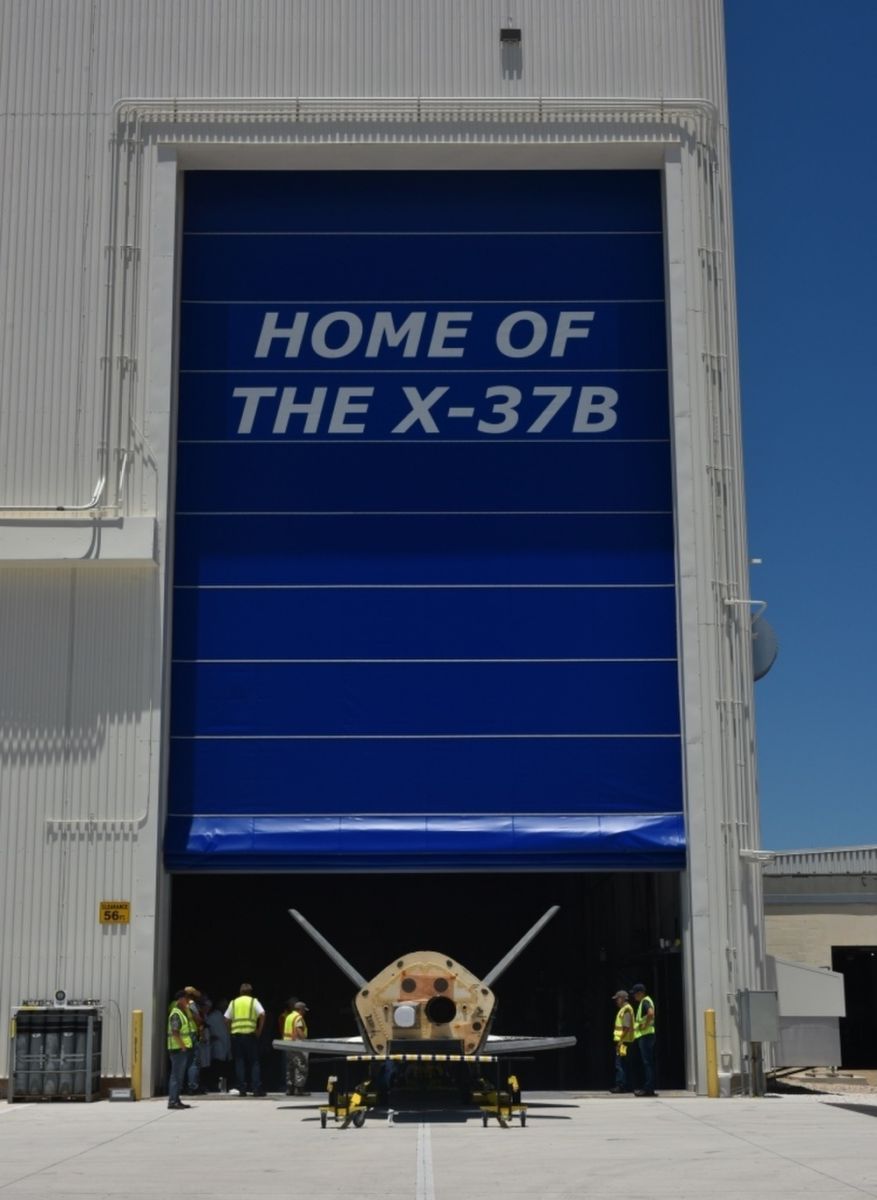
X-37B hangar at Kennedy Space Center.
Credit: Michael Martin/SAF
Credit: Advanced Space
Update: All went well on the TCM-1, reports Advanced Space.
That once troubled CubeSat headed for the Moon – CAPSTONE – is now scheduled for a trajectory correction maneuver-1 (TCM-1) at11:30 a.m. Eastern Time.
NASA’s Cislunar Autonomous Positioning System Technology Operations and Navigation Experiment (CAPSTONE) suffered an anomaly during commissioning activities. The operations team began actively working the issue with the NASA Deep Space Network and identified a path forward.

Rebecca Rogers, systems engineer, left, takes dimension measurements of the CAPSTONE spacecraft at Tyvak Nano-Satellite Systems, Inc., in Irvine, California.
Happy and healthy
The mission operations team is now confident based on telemetry that the spacecraft is healthy and functioning as expected, explains Advanced Space, owner and operator of the micro-explorer.
Initial data from the spacecraft suggests that it is “happy and healthy” and performed autonomously during the time it did not have communications from the ground including remaining properly pointed, maintaining battery charge, and conducting a momentum desaturation maneuver.
CAPSTONE
Credit: NASA
Anomaly cause
As for the cause of the anomaly, Advanced Space responded to an Inside Outer Space inquiry: “We are still actively working resolution of the issue however data and ground based testing suggest the anomaly was triggered during commissioning activities of the communications system. The issue is believed to be well understood and preventable moving forward.”

Orion spacecraft pulls up to Gateway.
Credit: NASA
CAPSTONE will take four months to reach the planned Near Rectilinear Halo Orbit around the Moon.
The microwave oven-sized mini-probe is supporting NASA’s Artemis program as a pathfinder for NASA’s Gateway station, a Moon-orbiting outpost.
The mission is to help reduce the risk for future spacecraft by validating innovative navigation technologies and verifying the dynamics of the Near Rectilinear Halo Orbit (NRHO).

Credit: Rocket Lab via Twitter
What happened today?
In a statement from Advanced Space, here’s what took place today and its significance:
At approximately 11:30 Eastern Time, the CAPSTONE spacecraft successfully executed its first trajectory correction maneuver on its way to the Moon and the spacecraft is in a healthy state.
“This maneuver is the first statistical maneuver of the mission meaning it is designed to clean up errors from the launch vehicle injection and does not change the baseline transfer approach or timing of arrival at the Moon on November 13th. Operations on the Ballistic Lunar Transfer and in Earth-Moon three-body orbits (such as Near Rectilinear Halo Orbits or NRHOs) require precise maneuvers and knowledge of the spacecraft state (position and velocity). The CAPSTONE propulsion system was specifically designed and optimized for these precise maneuvers and the navigation system was built from the ground up to be efficient and scalable. All of this is supported by a uniquely qualified team of flight dynamics experts at Advanced Space with specialized focus on operations in cislunar space and multi-body orbital operations.”

Jeffrey Parker, chief technology officer of Advanced Space (left) explains the CAPSTONE mission to U.S. Senator John Hickenlooper over a full-size model of the spacecraft.
Credit: Advanced Space/Jason Johnson
Post-burn stats
“This is the first maneuver executed by the CAPSTONE spacecraft using its on-board propulsion system. Prior to this maneuver the propulsion system was commissioned and demonstrated during initial de-tumble after spacecraft deployment on July 4th and during prior momentum desaturation maneuvers on July 6th and earlier today on July 7th.”
“The maneuver was designed by the Advanced Space flight dynamics team based on navigation information collected by the Deep Space Network and processed by the Advanced Space flight dynamics team.
The burn was commanded, and post-burn telemetry processed by operators at the Terran Orbital Mission Operations Center. The maneuver itself was designed to be approximately 20 m/s and initial radiometric-based reconstruction suggests it achieved approximately 19.85 m/s which represents an error of approximately 0.75 % which is well within expectations and predictions. These details will be further refined as more data is collected.”

Credit: Rocket Lab via Twitter
Closing in on the Moon
At the time of the TCM-1 burn execution, CAPSTONE was approximately 465,000 km from the Earth (~13 times further than the GEO belt and ~81,000 km further than the Moon).
“Prior to this maneuver the spacecraft was on a trajectory that would take it approximately 1.2 million km from Earth, after this maneuver the spacecraft is now targeting a trajectory that will take it approximately 1.4 million km from Earth (~39 times GEO, or 3.6 times the distance of the Moon).”
“As the team has continued to review data on the communications anomaly, the team remained confident with this conclusion prior to commanding the maneuver. Anomalies such as this are rarely a result of a single issue but instead are the result of a series of issues that converge in an unexpected way. For CAPSTONE, this series of events began during commissioning with an improperly formatted command that triggered a radio vulnerability and was compounded by a spacecraft flight software contingency response fault. The system was ultimately recovered by the team as a result of autonomous flight software system operations that cleared the fault and brought the system back into communication with the ground. During the communications outage the spacecraft autonomously operated, maintained pointing, battery charge, and performed a momentum desaturation maneuver.”
Credit: Terran Orbital Corporation
What next?
Up next for the CAPSTONE spacecraft is a second trajectory correction maneuver planned for Saturday July 9th at approximately 11:30 Eastern Time.
“This second maneuver will be much smaller than the first and will demonstrate the ability of the CAPSTONE spacecraft to perform very small and precise maneuvers, a capability that is critical to operations in the NRHO where it will arrive in November. This maneuver is designed to further clean up launch injection errors, and any execution errors that occurred in the execution of today’s maneuver. Over the next two days, the operations team will continue evaluating spacecraft status and continue commissioning the spacecraft,” notes the Advanced Space statement.
CAPSTONE is on track to reach its Near Rectilinear Halo Orbit (NRHO) around the Moon on November 13.
CAPSTONE team members install solar panels onto the Cislunar Autonomous Positioning System Technology Operations and Navigation Experiment – at Tyvak Nano-Satellite Systems Inc. in Irvine, California.
Credits: NASA/Dominic Hart
Looks like good news for that newly launched NASA Cislunar Autonomous Positioning System Technology Operations and Navigation Experiment (CAPSTONE) CubeSat.
During commissioning activities an anomaly was experienced related to the communication subsystem; the operations team began actively working the issue with the NASA Deep Space Network and identified a path forward.

Artwork depicts CAPSTONE spacecraft in a near rectilinear halo orbit (NRHO) around the moon.
Credit: NASA/Advanced Space
Recovery procedures
From Advanced Space, owner and operator of the micro-explorer:
In the last 24 hours the CAPSTONE team has identified the “likely cause” of the communications anomaly and has been working to recover from the issue. This work has included rapid engineering support and resources from many different mission partners. We are extremely grateful for this team effort and want to express our appreciation to all of those involved.
Jeffrey Parker, chief technology officer of Advanced Space (left) explains the CAPSTONE mission to U.S. Senator John Hickenlooper over a full-size model of the spacecraft.
Credit: Advanced Space/Jason Johnson
As of approximately 7:26 AM MT this morning, the operations team began receiving signal from the spacecraft. The signal confirmed the location of the spacecraft was consistent with the predictions generated from the initial acquisition activities. The team worked subsequent recovery procedures to obtain telemetry from the spacecraft at approximately 8:18 AM MT and initial indications suggest the spacecraft systems are functioning properly.
Happy and healthy
The team will continue with this work and once the communications system is fully recovered the team will review spacecraft status and telemetry to monitor for any addition issues since the communications outage began. Initial data from the spacecraft suggests that it is happy and healthy.
Rebecca Rogers, systems engineer, left, takes pre-launch dimension measurements of the CAPSTONE spacecraft at Tyvak Nano-Satellite Systems, Inc., in Irvine, California.
Once the system is determined to be back to operational capacity and a new state estimate has been obtained an updated trajectory correction maneuver will be designed and uploaded to the spacecraft for execution.
This is still a very dynamic situation, added Advanced Space, and as things progress further updates and corrections will be shared as appropriate.

Credit: CNAS/CCTV Video News Agency/Inside Outer Space screengrab
China’s three-member Shenzhou-14 crew are preparing for a busy month in space.
The country’s in-construction space station team is preparing for arrival of the Wentian lab module that is scheduled to be launched this month.
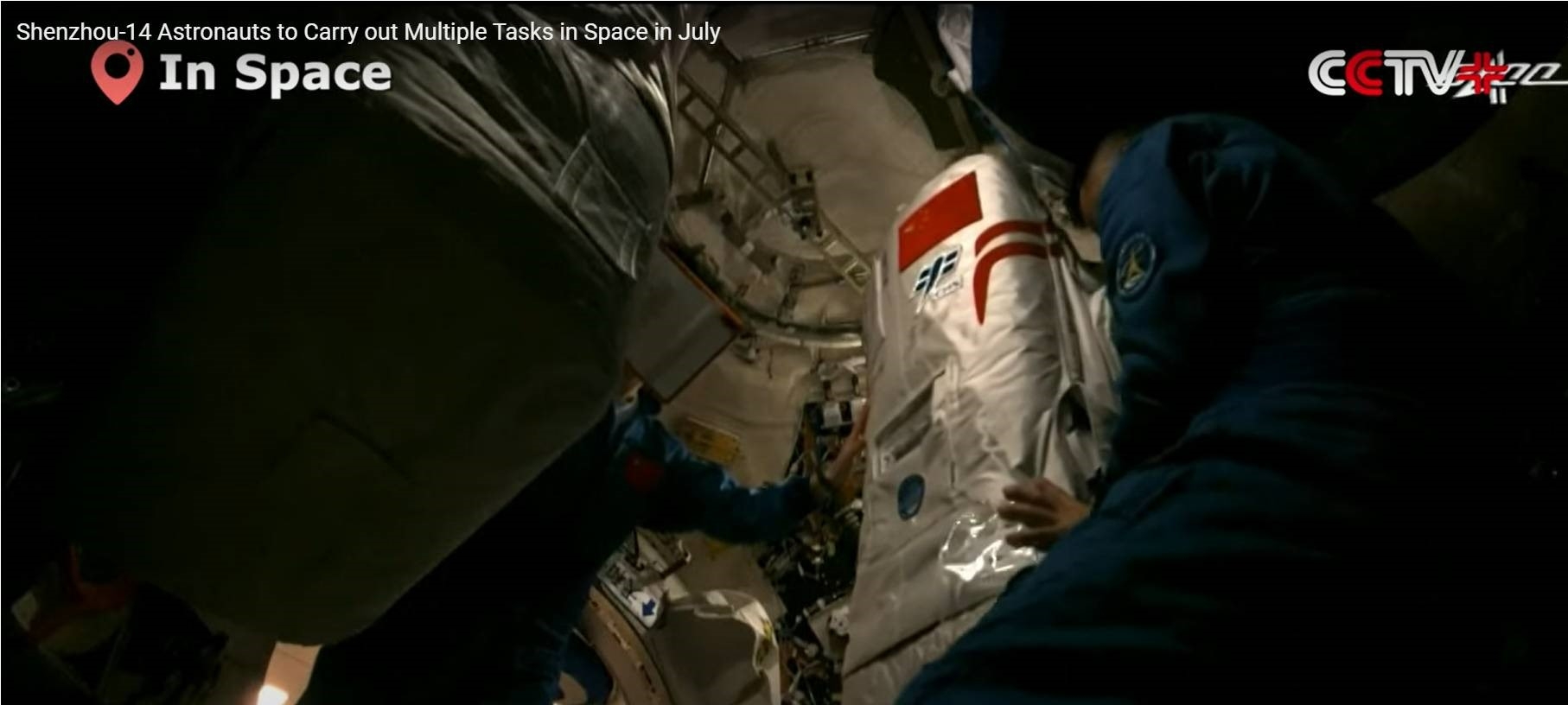
Spacewalk suit check. Credit: CNSA/CCTV/Inside Outer Space screengrab
Station commander Chen Dong recently tested a spacesuit, preparing for upcoming spacewalks that will depart from the Wentian module. Once attached, the astronauts will choose an appropriate time to get out of the spacecraft complex from the airlock part at the rear end of Wentian for spacewalk chores.

Credit: CNSA/CCTV/Inside Outer Space
The now-orbiting trio of taikonauts — Chen Dong, Liu Yang and Cai Xuzhe — are on a sixth month mission. During their stay in orbit, the crew will witness the outfitting of two lab modules to the Tianhe core module. Also on tap is to greet the Tianzhou-5 cargo craft and the Shenzhou-15 crewed spaceship.
China’s Tiangong space station is to be fully installed in Earth orbit by the end of 2022.
Large workload
As of Tuesday, the current crew have spent a full month working and living in the space station. According to China Central Television (CCTV), the Shenzhou-14 crew has successively completed various tasks, including material arrangement and movement of key items into the Tianhe module.

Credit: CNSA/CCTV/Inside Outer Space
“With the material management system, the astronauts have classified and sorted out the materials in the space station, which is quite a large workload,” said Wu Dawei, deputy chief designer, astronaut system, of the China Astronaut Research and Training Center.
“We have upgraded and improved the system for this mission, [making it easier for] the astronauts to take some photos and videos, sort out and record the information of materials in the space station, which has further facilitated the communication between the Earth and the space station,” Wu told CCTV.

Credit: CCTV/Inside Outer Space screengrab
Launch schedule
China is set to launch the Wentian laboratory module to dock with the current complex of China’s space station in late July and then loft the Mengtian laboratory module at the end of this year. Most of laboratory cabinets prepared for carrying out space station experiments will be confined within the Wentian and Mengtian modules.
Following this phase, the Tianzhou-5 cargo craft and the Shenzhou-15 piloted spacecraft will arrive at the complex later this year.
The crew members of the Shenzhou-15 will join the Shenzhou-14 taikonauts aboard the Tiangong for the station’s first-ever crew handover.
For video updates on activities on the station core module by the Shenzhou-14 crew, go to:
Credit: NASA
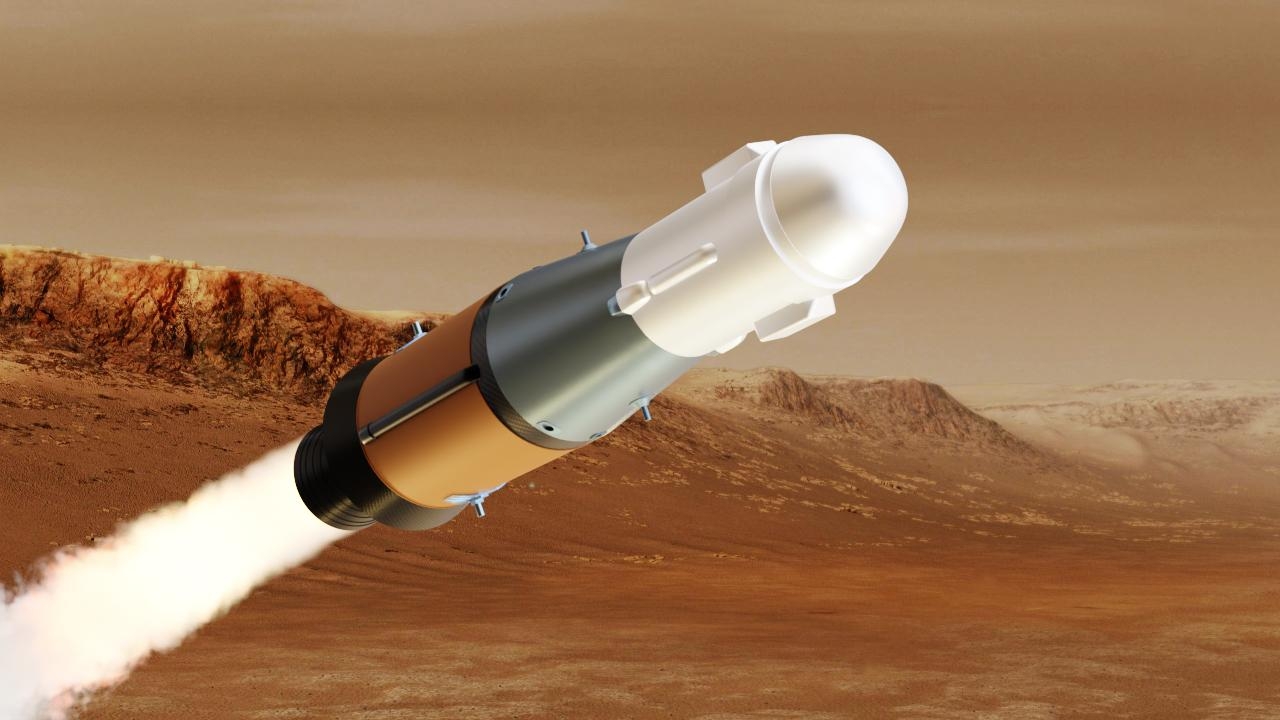
Work is progressing on a vital part of NASA’s Mars Return Sample plans.
The Mars Ascent Vehicle (MAV) is a small, lightweight, two-stage solid propellant rocket with a big assignment: hurl rock, sediment, and atmospheric samples from the surface of the Red Planet.
Developer of the MAV is Lockheed Martin Space of Littleton, Colorado, with this “cache and carry” transport device crucial to enable the first rocket launch from another planet.
The MAV would be packaged within NASA’s Sample Retrieval Lander, another central part of the campaign, with the all-in-one spacecraft (lander and MAV) touching down near or in Jezero Crater. That’s the spot where the Perseverance rover is already busily gathering Mars specimens, some of which are destined to be shot back to Earth in the early 2030’s.

Credit: NASA/JPL-Caltech
For more details, take a look at my new Space.com story – “How NASA will launch Mars samples off the Red Planet – Meet the 10-foot-tall (3 meters) Mars Ascent Vehicle” at:
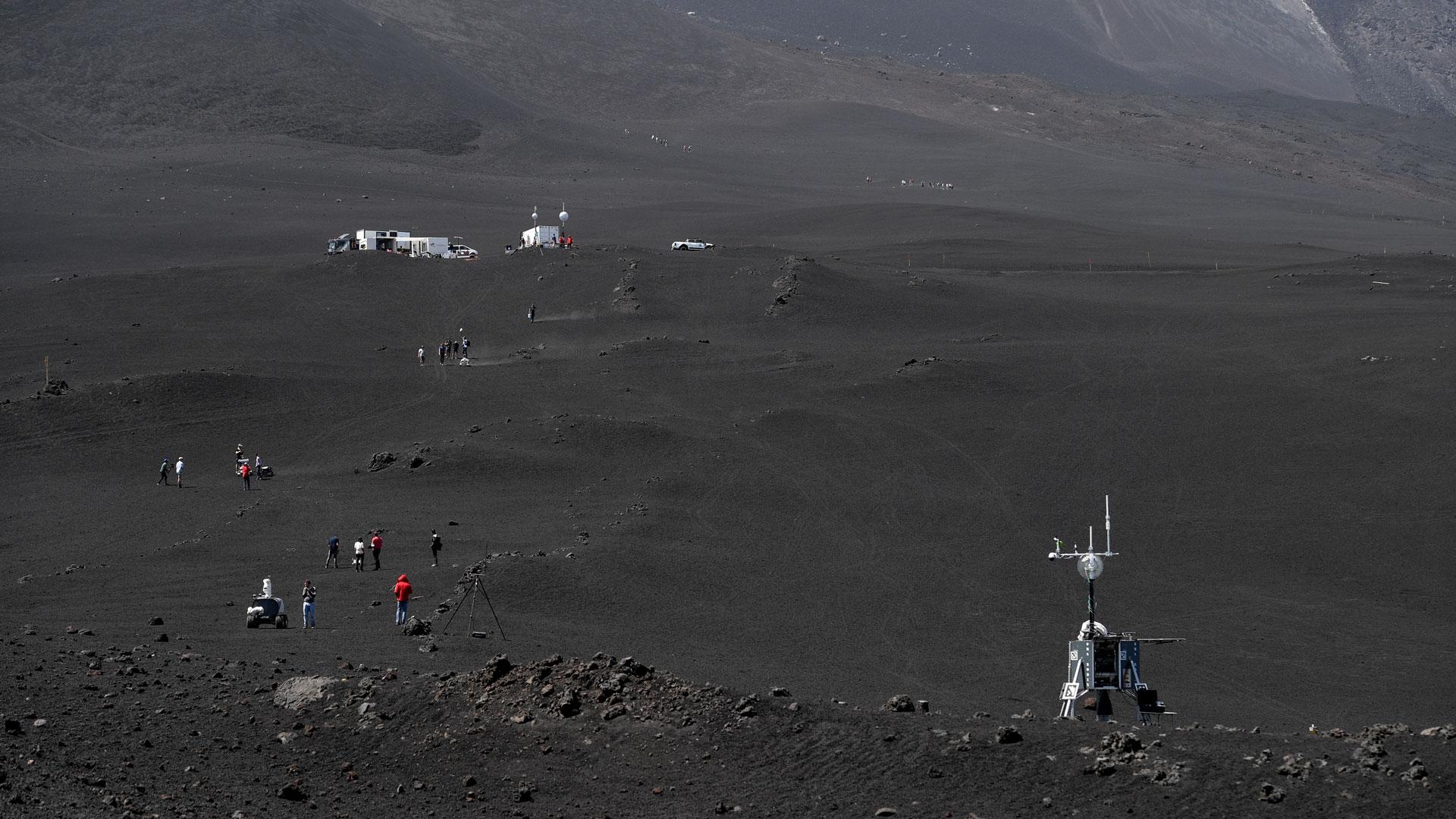
Simulated lunar exploration on Mount Etna, a volcano in Italy.
Credit: DLR (CC BY-NC-ND 3.0)
The Helmholtz Future Project Autonomous Robotic Networks to Help Modern Societies (ARCHES) has wrapped up simulated lunar exploration on Mount Etna, a volcano in Italy.
The German Aerospace Center (Deutsches Zentrum fuer Luft- und Raumfahrt; DLR) organized the venture that also involved the European Space Agency’s “Analog-1” project.
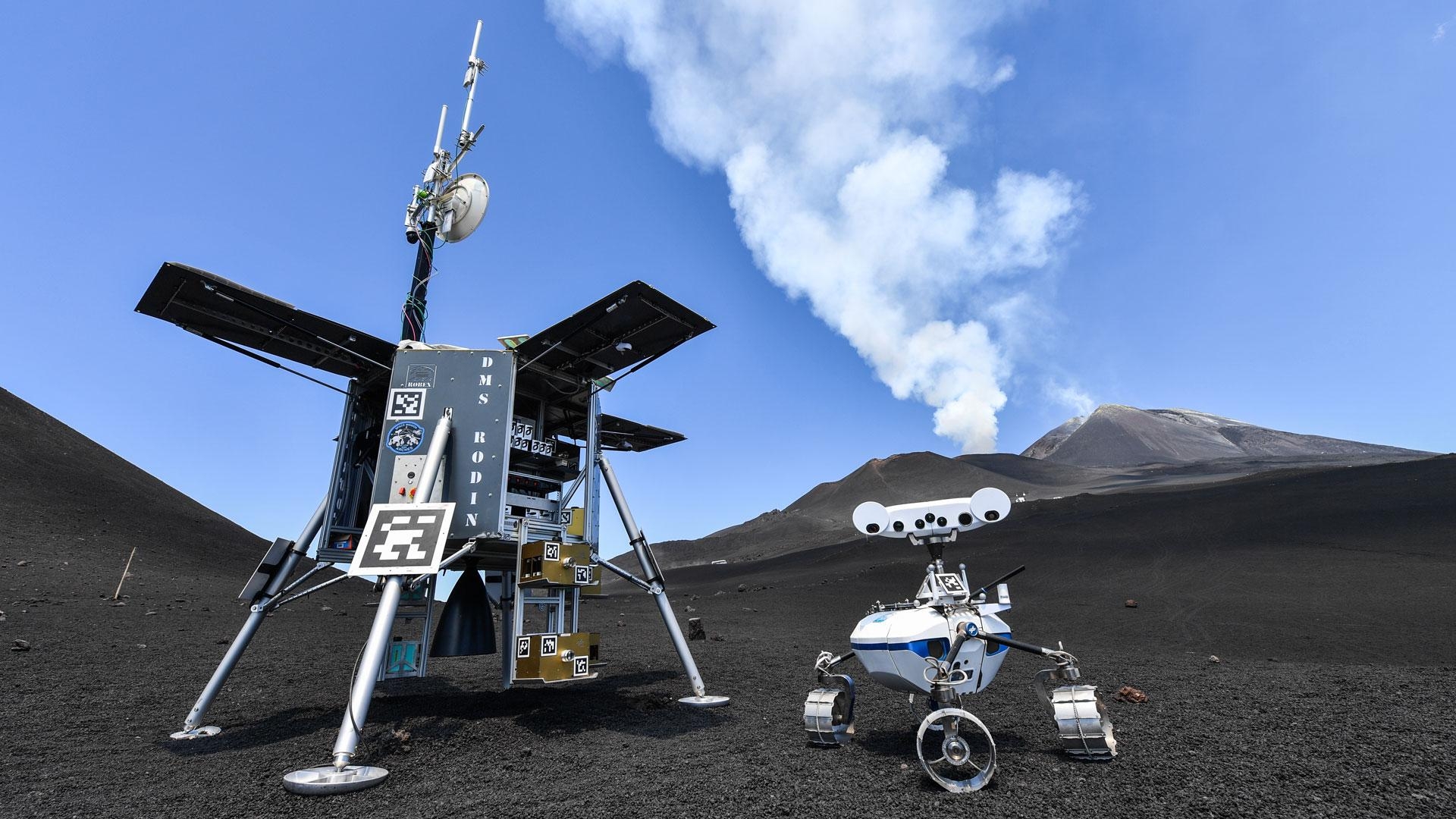
DLR lander and rover working together.
Credit: DLR (CC BY-NC-ND 3.0)
The Mount Etna site resembles the lava landscape on the Moon. In addition to the loose, coarse-grained surface composition, the solidified lava layers also present realistic challenges for exploration missions.
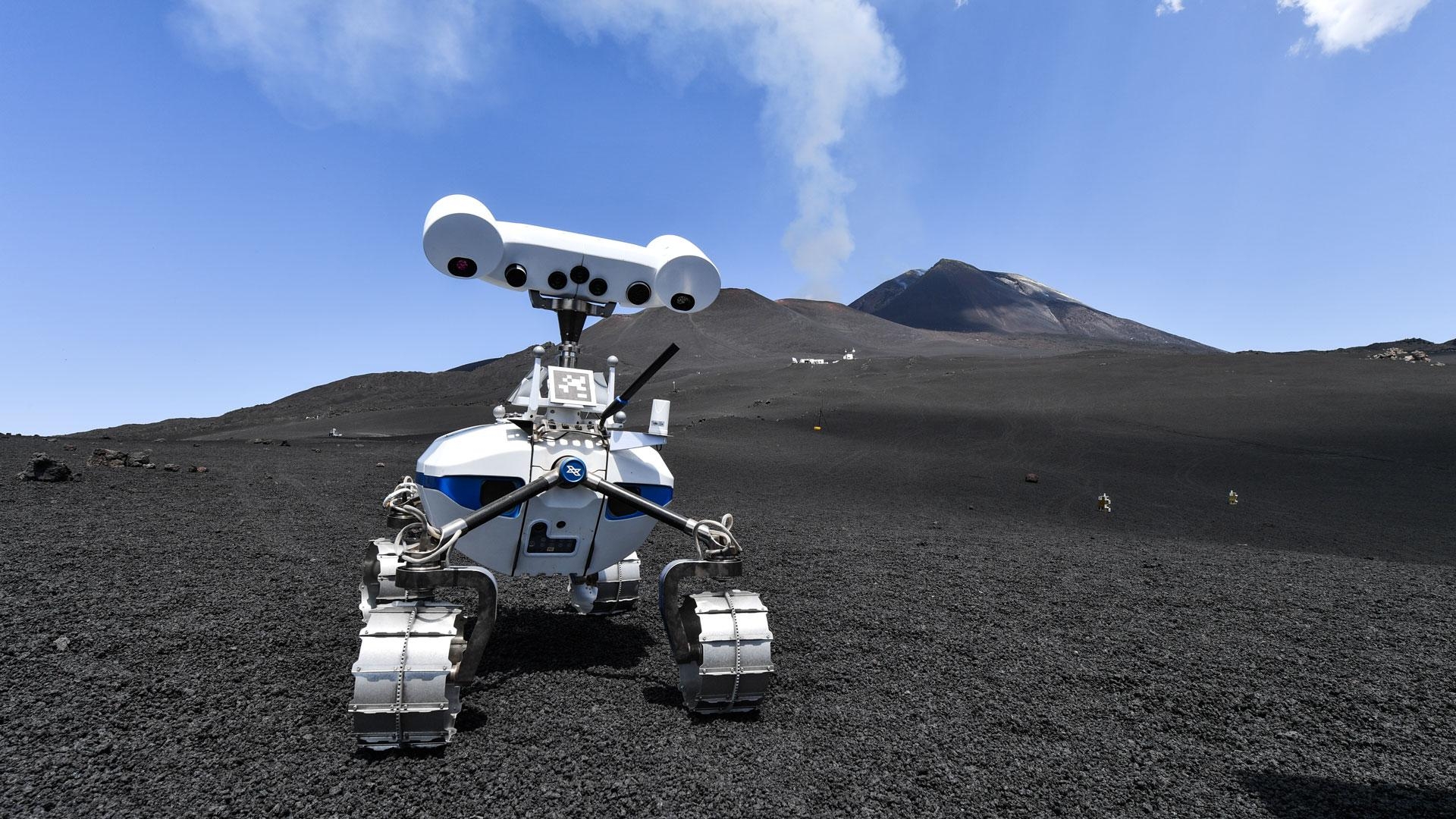
DLR Lightweight Rover Unit 1 (LRU1).
Credit: DLR (CC BY-NC-ND 3.0)
Robot menagerie
According to the DLR, two robots moved around together autonomously. They were joined by a drone. Also practiced was control of the robots from a simulated station in orbit. For maximum realism a second of signal delay was added to the rover control system, equivalent to the time it would take commands to travel between the Gateway station and the lunar surface. The force feedback control method has been designed to operate with such delays.
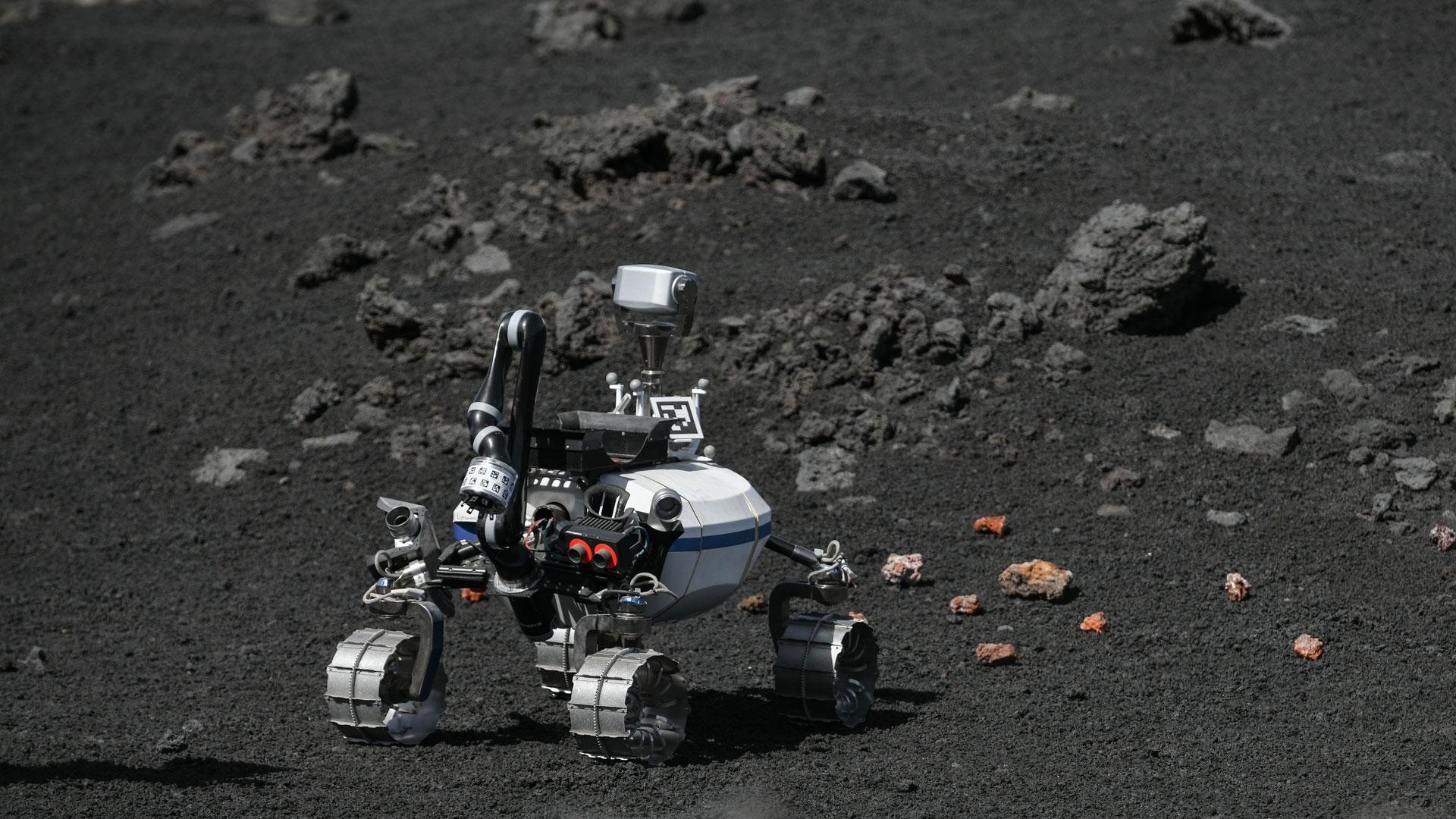
LRU2 robot took on the role of “assistant.”
Credit: DLR (CC BY-NC-ND 3.0)
During this demonstration activity, German astronaut Thomas Reiter carried out this task from a special control room, in fact a hotel room, in Catania, Sicily about 14 miles (23 kilometers) away.
- The Lightweight Rover Unit 1 (LRU1) robot evaluated soil samples using its cameras and is considered the “scientist” of the team.
- LRU2 took on the role of “assistant,” collecting surface samples, then analyzed them using Laser-Induced Breakdown Spectroscopy (LIBS).
- ESA’s four-wheeled Interact rover collected rock samples and brought them to a lander. The Interact Rover has a camera arm and a gripper arm that also provide haptic feedback. This means that the remote scientists can obtain a tactile “feel” for the rock samples. ESA’s Interact rover was built by the Agency’s Human Robot Interaction Lab and modified for the rugged slopes of the volcano. Interact Rover operations were coordinated from the European Space Operations Centre (ESOC) in Germany.
- The ARDEA drone is considered the “scout” for the team and mapped the area.

Scout rover in the lava landscape.
Credit: DLR (CC BY-NC-ND 3.0)
Far side simulation
Various scenarios were played out, including the “LOFAR Experiment.” It involved simulating the installation and maintenance of a low-frequency radio antenna array. The LRU rover and the ARDEA drone demonstrated the installation of an antenna system on the far side of the Moon. A similar antenna could be directed from the lunar surface into deep space.
Heterogeneous, autonomous, networked robotic systems have been in development since 2018 as part of the ARCHES initiative. This involves a number of different robots and fields of application.

ESA’s Interact Rover chose rock samples and brought them to DLR’s RODIN lunar lander.
Credit: ESA
Extension of human arms and eyes
Thomas Reiter commented: “We’ve learned a lot about collaboration between ground control on Earth and the crew aboard a space station orbiting the Moon, both operating a rover on the surface – this ‘shared’ operation can be extremely efficient –much more efficient than if either side does it alone.”
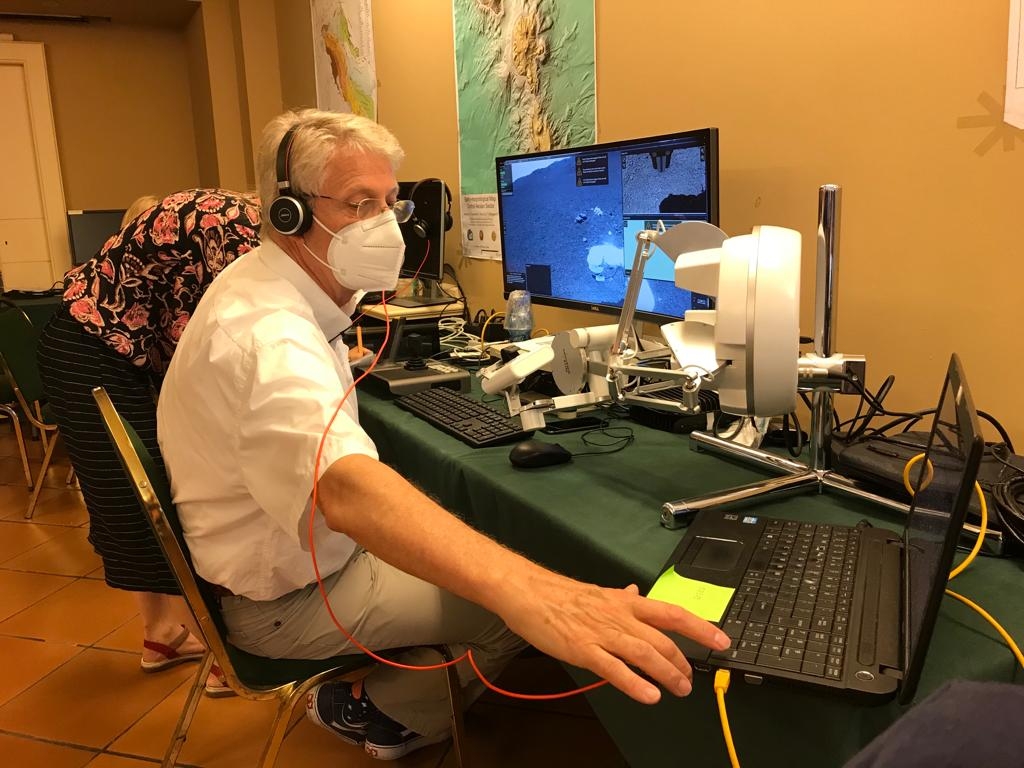
ESA astronaut Thomas Reiter at the controls.
Credit: ESA
“Teams of mobile robots have an important role to play in future space missions. Operating in heterogeneous teams, the robots complement and support each other with their different capabilities. They serve as an extension of human arms and eyes,” explains Armin Wedler, Project Manager at the DLR Institute of Robotics and Mechatronics in a DLR statement.
In addition to opening up the exploration of the Solar System, ARCHES also opens the way for environmental monitoring of the oceans and can provide assistance during crises on Earth.

