Archive for June, 2022
 Author:
 June 5th, 2022

Credit: CCTV/Inside Outer Space screengrab
Following launch from the Jiuquan Satellite Launch Center in northwest China, the Shenzhou-14 crew docked with the core module Tianhe.
Commander Chen Dong and co-astronauts Liu Yang and Cai Xuzhe have entered the core module Tianhe on Sunday, according to the China Manned Space Agency to begin a six-month stay in orbit.

Credit: CCTV/Inside Outer Space screengrab

Credit: CCTV/Inside Outer Space screengrab
The Shenzhou-14 completed a computer-orchestrated rendezvous and docking with the radial port of the in-orbit space station core module Tianhe, forming a complex with the core module and the cargo crafts Tianzhou-3 and Tianzhou-4.

Credit: CCTV/Inside Outer Space screengrab
Three modules
The trio will cooperate with the ground team to complete the assembly and construction of the Tiangong space station – from a single-module structure into a national space laboratory with three modules: the core module Tianhe and modules Wentian and Mengtian.
The Wentian lab module is set to be launched in July and Mengtian in October.
During their stay in orbit, the Shenzhou-14 crew will also witness the docking of the Tianzhou-5 cargo craft and Shenzhou-15 crewed spaceship with the core module. The two individual crews will live and work together for multiple days, with the Shenzhou-14 trio returning to Earth in December.
China’s Tiangong space station is designed to be a versatile space lab, capable of accommodating 25 experiment cabinets for scientific exploration.
Interdisciplinary research
“Each cabinet is a small-sized lab in space, capable of supporting single subject or interdisciplinary research in space science experiments,” said Lin Xiqiang, deputy director of the agency, at a press conference.

Credit: CCTV/Inside Outer Space screengrab
During the construction phase of the space station, nearly 100 experimental research projects have been planned, Lin said.
Multi-level biological experiments on molecules, cells, tissues and organs will be carried out in Wentian by using diverse online detection methods, such as by visible light, fluorescence or microscopic imaging.
Wentian can also provide a variable gravity simulation environment to support the comparative study of the biological growth mechanism in different gravity conditions.

Credit: CCTV/Inside Outer Space screengrab
The Mengtian lab module will mainly support microgravity research, with experiment cabinets for the study of physics of fluids, material science, combustion science and basic physics. It also has cabinets for space technology experiments, Lin said.
Go to these videos that detail the launch and docking of Shenzhou-14 to begin full build-out of the Tiangong space station:
 Posted in


Credit: CCTV/Inside Outer Space screengrab
The upcoming Shenzhou-14 crewed space mission will loft Chen Dong, Liu Yang and Cai Xuzhe.
The Long March-2F carrier rocket for the Shenzhou-14 piloted launch is being fueled Saturday, making the final preparations for the launch at 10:44 on Sunday (local time).
Shenzhou-14 will fly a fast automated rendezvous and docking with the radial port of the space station core module Tianhe, forming a complex with Tianhe as well as the cargo spacecraft Tianzhou-3 and Tianzhou-4.

Credit: CMG/CCTV/CASC/Inside Outer Space screengrab
The Shenzhou-14 mission will complete the construction of the Tiangong space station, with a basic three-module structure consisting of the core module Tianhe and the lab modules Wentian and Mengtian.
National space laboratories
The two lab modules are scheduled to be launched in July and October, respectively, and will host many large-scale and multidisciplinary scientific research experiments for astronauts in orbit following the completion of the space station construction, according to the China Manned Space Agency (CMSA).

Credit: CCTV/Inside Outer Space screengrab
“As national space laboratories, the modules on China’s space station will be equipped with 25 experiment cabinets, with each cabinet serving as a small-scale space lab for single-disciplinary or interdisciplinary scientific experiments. Overall, they have reached international advanced levels,” said Lin Xiqiang, deputy director of the CMSA.
“The Wentian lab module will be mainly used for space life science research as it is be equipped with experiment cabinets for research on life ecology, biotechnology and variable gravity science. It can support research on the growth, development, heredity and senescence of plants, animals and microorganisms under space conditions, as well as experimental research on an enclosed ecosystem. Through visible light, fluorescent light, microscopic imaging and other online monitoring means, it can support multi-level biological experimental research like on the levels of molecule, cell, tissue and organ. It can also provide variable gravity simulation with a range from 0.01 g to 2 g to support comparative research on the growth mechanisms of organisms under different gravity conditions,” said Lin.

Credit: GLOBALink/Inside Outer Space screengrab
“The Mengtian lab module will be mainly used for microgravity science research as it is equipped with multidisciplinary experiment cabinets for research on fluid physics, materials science, combustion science, fundamental physics and aerospace technology experiments. It can support cutting-edge experimental research like research on the essential laws of materials such as multiphase flow, phase change heat exchange, basic combustion process, and material solidification mechanism in microgravity, as well as research on ultra-cold atomic physics,” Lin said.

Credit: GLOBALink/Inside Outer Space screengrab
Cold atomic clock system
Mengtian will also carry the world’s first space-based cold atomic clock system consisting of a hydrogen clock, a rubidium clock and an optical clock, which will become humanity’s most accurate timekeeping device.
“In the meantime, built on the cold atomic clock system in the Tiangong-2 lab, we will establish the world’s first space-based cold atomic clock system [in the Mengtian lab module] which will consist of a hydrogen clock, a rubidium clock and an optical clock, forming the most stable and accurate time and frequency system in space to support frontier scientific research on gravitational redshift, measurement of fine-structure constant and others,” Lin said.

Credit: GLOBALink/Inside Outer Space screengrab
The world’s first-ever cold atomic clock that operates in space was developed by Chinese scientists. It was launched with the Tiangong-2 space lab in 2016 and has a margin of error of less than one second in 30 million years.
Shenzhou-14 crew
China’s Shenzhou-14 spaceflight commander is Chen Dong. This is Chen’s second time to work in space. He served as a crew member of Shenzhou-11 in October 2016.
Liu Yang, the first Chinese woman in space, flew aboard Shenzhou-9 in 2012 – a 13-day mission.
The new Chinese astronaut, Cai Xuzhe, was selected as a member of China’s second batch of astronauts in May 2010.
China has so far completed eight piloted space missions, sending 13 astronauts into Earth orbit and it is now prepping for its 9th crewed launch.
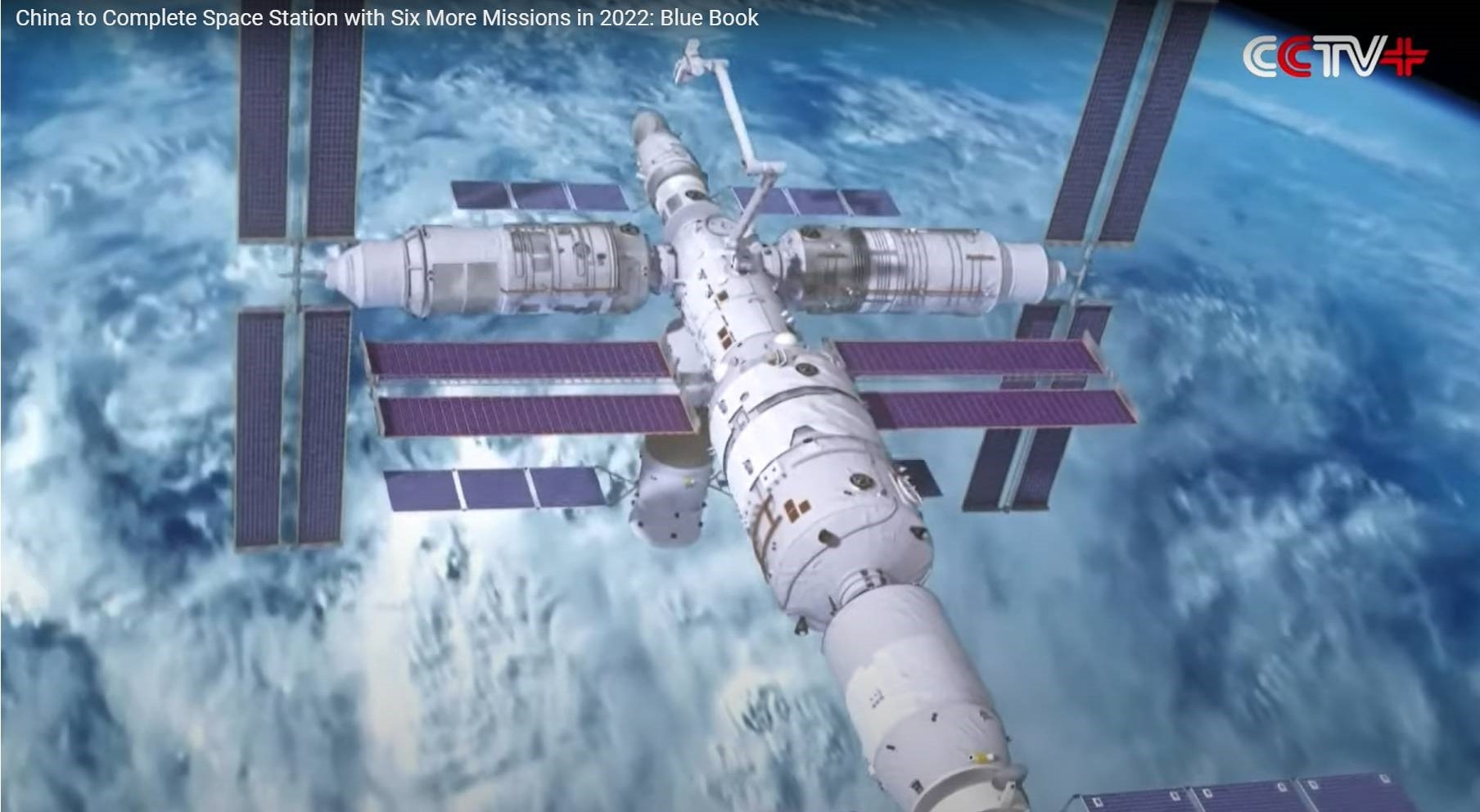
China’s space station to be completed by end of 2022.
Credit: CCTV/Inside Outer Space screengrab
Mission overview
“The Shenzhou-14 crew will work with the ground team to complete the rendezvous, docking and transposition of the two lab modules with the core module, enter the Wentian and Mengtian lab modules for the first time and help make the environment suitable for their stay,” Lin said.
“They will also cooperate with the ground team to carry out tests on the two-module space station complex, the three-module space station complex, large and small mechanical arms, and the exit function of the airlock cabin. The crew will, for the first time, use the airlock cabin in the Wentian lab module to carry out extravehicular activities for two to three times, and unlock and install a dozen of scientific experiment cabinets in the Wentian and Mengtian lab modules,” Lin said.
There is a small mechanical arm installed on the Wentian lab module and the larger robotic arm on the Tianhe core module. They can work independently or together.
According to Lin, the two mechanical arms can be connected to form a combination that can transfer a heavier load for a larger area range.
“The small arm can be grasped by the bigger one to form a combination, so that they can cover a wider range in extravehicular activities (EVAs), transfer for a larger area range and reach different positions for detailed operations,” Lin said.
For more information on the upcoming Shenzhou-14 mission, go to these videos at:

Shenzhou-14 mission set for early June liftoff.
Credit: China Media Group(CMG)/China Central Television (CCTV)/China Aerospace Science and Technology Corporation (CASC)/Inside Outer Space screengrab
Final preparations are underway for launching the Shenzhou-14 crewed spaceship from the Jiuquan Satellite Launch Center in northwest China’s Gansu Province.
The three-member crew for the six-month in-orbit mission is to be unveiled on Saturday morning.
The Shenzhou-14 mission is expected to blastoff on Sunday, June 5, local time, then dock with China’s in-construction space station.
Critical sprint period
Meanwhile, launch crews are in a “critical sprint period,” according to China Central Television (CCTV).
A comprehensive rehearsal including pre-launch function checks and joint tests for the launch were conducted earlier Friday to ensure that facilities and equipment at the launch site are all in good condition, CCTV reports.
Apart from ignition and liftoff, the rehearsal covered all links of the launch mission.
Good status
Joint debugging and joint tests were carried out between the Beijing Aerospace Command and Control Center, other Telemetry, Tracking and Control stations and space-tracking ship, Yuanwang-3.

Credit: Chinese People’s Liberation Army
According to Qin Tong, a senior designer of the Long March-2F carrier rocket with the China Academy of Launch Vehicle Technology (CALT), the launching system of the Shenzhou-14 mission is in good status for takeoff.
“The results of launch rehearsals and tests on the entire system show that the Long March-2F carrier rocket is fully up to the standard. And all functional indicators can meet the requirements for the launch mission,” Qin told CCTV.
Workflow
“The rehearsals helped us test matching of the interfaces of all systems and correctness of the workflow, as well as completeness of the security work. Now the performance of the spacecraft and the rocket is good, and the work for the astronauts is going on well, which means that conditions allow the rocket to be filled with propellant, a critical step for the launch,” Deng Xiaojun, code-zero commander told CCTV. He is tasked with the countdown to ignition for the launch of the Shenzhou-14 crewed mission.
The combination of the Shenzhou-14 crewed spaceship and a Long March-2F carrier rocket was transferred to the launching area on May 29.

Wheel Watch 2022: Curiosity Mars Hand Lens Imager (MAHLI) photo produced on Sol 3492 June 3, 2022.
Credit: NASA/JPL-Caltech/MSSSNASA’s Curiosity Mars rover at Gale Crater has just made a routine check of its set of aluminum wheels.
NASA’s Curiosity Mars rover at Gale crater has just made a routine check of its set of aluminum wheels.
Of late, the robot has encountered tough terrain in its quest to scale Mount Sharp (apparently an apt name!).
Each of Curiosity’s six wheels is about 20 inches (50 centimeters) in diameter and 16 inches (40 centimeters) wide, milled out of solid aluminum.

Selfie taken by Curiosity Mars rover at Gale Crater.
Credit: NASA/JPL-Caltech
The wheels contact the Mars terrain with a skin that’s about half as thick as a U.S. dime, except at thicker treads.

Curiosity Mars Hand Lens Imager (MAHLI) photos produced on Sol 3492, June 3, 2022.
Credit: NASA/JPL-Caltech/MSSS
The grousers are 19 zigzag-shaped treads that extend about a quarter inch (three-fourths of a centimeter) outward from the skin of each wheel. The grousers bear much of the rover’s weight and provide most of the traction and ability to traverse over uneven terrain.
Dust devils and wind gusts
Meanwhile, shift over to NASA’s Perseverance rover at Jezero Crater.

Credit: Claire Newman, et al.
A new paper — “The dynamic atmospheric and aeolian environment of Jezero crater, Mars” – has been published in the journal, Science Advances. Lead author is Claire Newman of Aeolis Research.
Perseverance rover’s novel environmental sensors and Jezero crater’s dusty environment are detailed, giving rise to a study of dust devils and wind gusts at the site.
“One such event covered 10 times more area than the largest dust devil, suggesting that dust devils and wind gusts could raise equal amounts of dust under nonstorm conditions,” the paper notes.
Why is Jezero Crater so active compared to most other landing sites?
Wind patterns in Jezero crater exhibit strong daytime winds largely controlled by convection cells superimposed on regional, Isidis basin–scale slope winds, and weaker nighttime winds, suggesting blocking of regional winds by local crater slopes, the paper adds.
To read the full paper, go to:
https://www.science.org/doi/pdf/10.1126/sciadv.abn3783

Click to see dust devils in action! Credit: NASA/JPL-Caltech
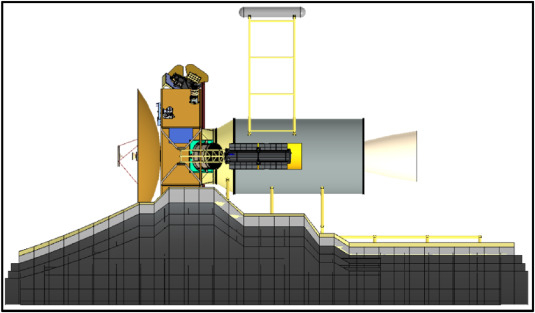
Baseline spacecraft for Option 3 Interstellar Probe with “interstage” (yellow), ballast (top), Orion 50XL kick stage, undeployed RTGs (one visible at center), and thermal shield
assembly (TSA) designed for 2 Rs perihelion.
Credit: Ralph McNutt Jr. et al.
It has been decades in the making, bolstered by study after study and numerous name changes.
Now tagged as the “Interstellar Probe,” the concept has matured to enable new discoveries that can be made in no other way, by going places yet to be explored.
For the Interstellar Probe mission especially: “It isn’t about where we are going. It’s about the journey out there. And it is a journey now long overdue.”
That’s the assessment of a research paper newly appearing in the journal, Acta Astronautica. Lead author is Ralph McNutt Jr. of the John Hopkins University Applied Physics Laboratory (APL) in Laurel, Maryland.

Point-design matrix to flesh out the Interstellar Probe concept.
Credit: Ralph McNutt Jr. et al.
Unified view
Interstellar Probe is a mission that can capture a unified view of our heliosphere and its surroundings from the Earth and out into nearby interstellar space.
“Understanding the dynamics and structure of our heliosphere is fundamental to understanding those of other astrospheres, the ‘heliospheres’ which apparently surround all stellar systems, and how they interact with the galaxy, and how those interactions, in turn, inform the knowledge of habitability in other stellar systems besides our own,” the paper explains.
As now envisioned, Interstellar Probe would utilize today’s technology to take the first explicit step on the path of interstellar exploration, and can pave the way, scientifically, technically, and programmatically for more ambitious future journeys – and more ambitious science goals.

Credit: NASA/MSFC
Furthermore, with the new class of super heavy-lift launch vehicles — notably NASA’s Space Launch System (SLS) – the paper suggests that a scientifically compelling Interstellar Probe mission can now become a reality.
Relay race
Interstellar Probe is a decades-long mission to reach several hundreds of astronomical units while providing new unified, measurements of the conditions throughout the heliosphere and through the heliosheath – the outer shell of the bubble of charged particles around our Sun.

This artist’s concept shows NASA’s two Voyager spacecraft exploring a turbulent region of space known as the heliosheath, the outer shell of the bubble of charged particles around our sun. After more than 33 years of travel, the two Voyager spacecraft will soon reach interstellar space, which is the space between stars.
Credit: NASA
By moving forward on Interstellar Probe, “it will take up the relay race that began with Pioneer 10 and is running with less and less energy with Voyager 1 and Voyager 2,” the paper notes.

Pioneer 10 was the plucky little spacecraft that was the first probe to leave the solar system.
Credit: NASA
To travel as far and as fast as possible with available technology, the use of the SLS Block 2 cargo version is enabling: carrying the spacecraft as well as a 3rd and 4th stage. Solar system escape speeds of at least twice that of Voyager 1 (i.e., up to 7.2 astronomical units per year) should be doable.
Wide net of possibilities
The research paper – “Interstellar probe – Destination: Universe! – makes the case for how fast can one realistically escape the solar system with a scientifically compelling and credible Interstellar Probe mission.
“Our team put a lot of work into making sure the study was as thorough and detailed as possible, while also casting a ‘wide net’ of possibilities,” said APL’s Ralph McNutt. “We eagerly look forward to what our colleagues with the Solar and Space Physics Decadal Survey have to say,” he told Inside Outer Space.
The paper can be found here at:
https://www.sciencedirect.com/science/article/pii/S0094576522001503

Curiosity’s location as of Sol 3489. Distance driven to date at that Sol: 17.44 miles/28.06 kilometers.
Credit: NASA/JPL-Caltech/Univ. of Arizona
NASA’s Curiosity Mars rover at Gale Crater is wrapping up Sol 3490 duties.
The rover recently made a steep, albeit short, climb, reports Abigail Fraeman, a planetary geologist at NASA’s Jet Propulsion Laboratory.
Curiosity drivers continue to assess the terrain the robot will cross in an upcoming drive.

NASA’s Mars rover Curiosity took 29 images on May 31, 2022, Sol 3489, in Gale Crater using its mast-mounted Right Navigation Camera (Navcam) to create this mosaic.
Credit: NASA/JPL-Caltech
A recent drive pushed the robot to crest onto a plateau and it was slated to finish climbing a small but steep slope.
Paved road
“The topography,” Fraeman adds, “actually reminds me a little bit of our ascent onto Vera Rubin ridge several years ago, where we similarly crested a steep slope onto a local flat expanse.”

You can get a sense of the rover’s non-horizontal position by looking at its orientation with respect to the ground in this image using its Left Navigation Camera way back on Sol 1809 (2017-09-07), site number 65.
Credit: NASA/JPL-Caltech
Curiosity starts the plan parked at an impressive 17˚ pitch (front up) and 17˚ roll (left up) for a total 24˚ tilt, Fraeman points out. “Even though this slope is getting close to the limit of what Curiosity can traverse, we don’t think we’ll have any problems unstowing the arm or driving the rest of the way to the top because of the terrain we’re on – nice smooth bedrock with only a thin sand cover is almost the Martian equivalent of a paved road.”

Curiosity Mast Camera (Mastcam) Left image taken on Sol 3489, May 31, 2022.
Credit: NASA/JPL-Caltech/MSSS
Vein and bedrock targets
Outside of the drive, Curiosity is on tap to continue documenting the surrounding geology and environment.
A newly scripted plan has the rover collecting Chemistry and Camera (ChemCam) Laser Induced Breakdown Spectroscopy (LIBS) observations of a vein target named “Lago Esmeralda” and bedrock target named “Lago de Rei,” as well as some long distance Remote Micro-Imager (RMI) mosaics of a part of the “Bolivar” mound.
“We’ll also grab some more Mastcam images of Bolivar, as well as several significant outcrops around the rover,” Fraeman reports.

Curiosity Mast Camera (Mastcam) Left image taken on Sol 3489, May 31, 2022.
Credit: NASA/JPL-Caltech/MSSS
Rounding out the plan

Dust Removal Tool, up close in this Curiosity Mast Camera (Mastcam) Right photo acquired on Sol 3489, May 30, 2022.
Credit: NASA/JPL-Caltech/MSSS
The rover’s Mars Hand Lens Imager (MAHLI) and Alpha Particle X-Ray Spectrometer (APXS) was slated to also participate in the science action, with observations of a Dust Removal Tool’ed bedrock target named “Parepona” and vein target named “Cabadiscana,” and also be use MAHLI to image the Curiosity wheels at the start of the new drive.

Dust Removal Tool action in this Curiosity Mars Hand Lens Imager (MAHLI) photo produced on Sol 3488, May 30, 2022.
Credit: NASA/JPL-Caltech/MSSS
Several Mastcam and Navcam observations designed to monitor the environment will round out the plan, Fraeman concludes.
As always, dates of planned rover activities are subject to change due to a variety of factors related to the Martian environment, communication relays and rover status.

Curiosity Mast Camera (Mastcam) Right image taken on Sol 3488, May 30, 2022.
Credit: NASA/JPL-Caltech/MSSS

