Archive for June, 2022
 Author:
  June 22nd, 2022
NASA’s Mars Perseverance rover acquired this image using its Right Mastcam-Z camera. Mastcam-Z is a pair of cameras located high on the rover’s mast. This image was acquired on June 13, 2022.
Credit: NASA/JPL-Caltech/ASU
The Perseverance rover at Jezero Crater has reached layered and weirdly eroded rocks at the edge of the ancient delta deposit.
“They get even weirder, with an obviously unnatural feature in one of them that sometimes disappears,” explains Mars Guy (Planetary scientist, Steve Ruff, at Arizona State University in Tempe).

Credit: Mars Guy
Get the full story by going to Episode 63 of Mars Guy at:
 Posted in

A composite image of Mars and its two moons, Phobos (foreground) and Deimos (background).
Credit: NASA/JPL/University of Arizona
Mining asteroids in the future would benefit from using Mars orbit as a base from which to access Main Belt Asteroids (MBAs) – asteroids that orbit between Mars and Jupiter.
As a result, a growing economy that utilizes space resources or large scale exploration missions will likely find Mars orbit convenient.
The stable platform and modest gravity afforded by Phobos – one of two moons of the Red Planet — would make it a natural first choice. “Once Mars orbit has a profitable economy, with high value trans-shipments, the Martian surface may also become an economically valuable outpost. This value may then stimulate settlement.”
That’s the view of the Center for Astrophysics (CfA)|Harvard & Smithsonian astronomers Martin Elvis, Jonathan McDowell, and past Harvard undergraduate Anthony Taylor.

NASA’s Perseverance Mars rover used its Mastcam-Z camera system to shoot video of Phobos. This is still from that video.
Credit: NASA/JPL-Caltech/ASU/MSSS/SSI
A walk in the PARC
The trio developed PARC, short for Python Asteroid Rendezvous Code. This problem solving code culls out maneuver schemes to rendezvous with any known asteroid from either Earth or Mars orbit given a specified launch date and time of flight.
PARC was used to investigate whether Phobos-like orbits around Mars at altitudes of roughly 5,592 miles (9,000 kilometers) are more energetically favorable and useful locations from which to dispatch missions to MBAs. Phobos orbits about six thousand kilometers from the surface of Mars.
The results show potentially very significant reductions to the costs of exploration. Known MBAs are much larger than near-Earth objects (NEOs), so the total mass that is accessible is larger by roughly 10,000 times the accessible mass in NEOs.

Credit: NASA/JPL-Caltech
Convenient and advantageous
The upshot of their investigation is that hundreds of thousands of MBAs are available for in-space mining purposes.
Whether or not a mission ultimately makes financial sense, the CfA statement adds, “depends on many other factors, but the authors demonstrate that the concept of a launching and then returning to an operations center based in a Phobos-like orbit, or even on Phobos itself, is relatively convenient and advantageous.”
They add that profitable large-scale mining from Martian orbit could also lead to routine access to the Martian surface.”
To access the paper – “Phobos and Mars orbit as a base for asteroid exploration and mining” – go to:
https://www.sciencedirect.com/science/article/abs/pii/S0032063322000368

Credit: Sierra Space
Add Spaceport America in New Mexico to be on the receiving end of an incoming Sierra Space Dream Chaser, a winged commercial spaceplane.
Spaceport America and Sierra Space of Broomfield, Colorado announced today the signing of a new Memorandum of Understanding (MOU) about the southern New Mexico site being a compatible runway where Dream Chaser could land.
Other sites include the Shuttle Landing Facility at NASA’s Kennedy Space Center and airports and landing sites in Huntsville, Alabama, Oita Airport, Japan, and Spaceport Cornwall in the United Kingdom.

Credit: Sierra Space
Dream Chaser is a multi-mission space utility vehicle designed for transporting crew and cargo to and from low Earth orbit destinations, including the International Space Station (ISS).
Commercial runways
The spaceplane is currently under contract with NASA for seven commercial resupply missions to the ISS providing cargo delivery, return and waste disposal services. The vehicle can deliver up to 12,000 pounds of cargo to the ISS at a time.
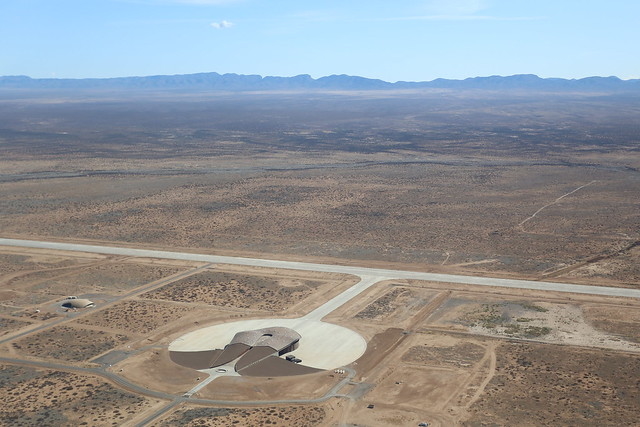
Aerial view of New Mexico’s Spaceport America.
Credit: Spaceport America
“It is the only commercial spacecraft capable of low-g Earth return to compatible commercial runways worldwide, allowing immediate access to high value payloads. Dream Chaser is set to launch in 2023,” states a Sierra Space statement.
According to Sierra Space, the new MOU outlines the two organizations’ mutual pursuit to increase Spaceport America’s capabilities and demand for Dream Chaser reentry at the spaceport. “As a result, in line with their shared vision, both parties will pursue a Part 433 reentry site operator’s license for Spaceport America from the Federal Aviation Administration (FAA).”
Go to this video showing the Tenacity Dream Chaser being built at:

Tenacity Dream Chaser under construction.
Credit: Sierra Space/Inside Outer Space screengrab

Life in Space – NASA Life Sciences Research During the Late Twentieth Century by Maura Phillips Mackowski, University of Florida Press (May 2022); 375 pages; Hardcover: $35.00.
This well-researched, well-written, and meticulously documented account of a somewhat concealed side of NASA offers a revealing look into the agency’s research in the space life sciences – and opportunities unfulfilled.
The book consists of 10 chapters, such as “Working in the Space Environment,” “Radiation and the Science of Risk Reduction,” “Design and Redesign: The Many Space Stations of NASA,” and “The Vision for Space Exploration.” There is also an extensive and in-valuable notes/reference section that is priceless.
In the introduction, the author says upfront: “Space life sciences had to struggle for an acknowledged and appreciated place at the Agency’s table, principally because NASA was formed purposely as an evolution of a predecessor engineering research agency, the National Advisory Committee on Aeronautics (NACA).”
Mackowski has written a bold story about NASA’s ambitious space life science program, but more importantly, why it is essential if dreams of lunar outposts and planting footprints on Mars are to become historical “done that” checkmarks in the future.
NASA’s space shuttle program brought with it a more diverse astronaut corps – gender, age, and nationalities. “This created a broader pool of human test subjects, making space research more applicable to Earth medicine. It also presented new challenges as the Agency worked to equip and maintain flight crews and manage programs carrying out increasingly ambitious research,” Mackowski writes.
The reader will find new insight into one opportunity lost and still lost-in-space – a high-tech centrifuge and work on artificial gravity. Keeping astronauts healthy, the author explains, meant re-looks into old ideas of artificial gravity, based on decades of learning about the medical impacts of microgravity.
A fascinating read is available on details dealing with troublesome radiation and risk reduction steps. “Fortunately for NASA’s life sciences budget, radiation was a danger no one knew much about but everyone wanted to understand,” the author points out.
This book is a significant volume of history, but also underscores what the future holds in carrying out productive life science research and what investigations are missing-in-action.
The volume builds upon the excellent quality of Mackowski’s research and writing in the past. She is a research historian based in Arizona and author of Testing the Limits: Aviation Medicine and the Origins of Manned Space Flight.
In publicizing this work, take note of a comment from John B. Charles, retired chief scientist of NASA’s Human Research Program: “Mackowski’s research is exhaustive, her analysis is spot-on, and her conclusions give us pause as we consider when and if to send our fellow humans deeper into space on longer missions with greater risk and less support from Mission Control than ever before.”
For more information on this book, go to:

Artist impression of BepiColombo flying by Mercury. The spacecraft makes nine gravity assist maneuvers (one of Earth, two of Venus and six of Mercury) before entering orbit around Mercury in 2025.
Credit: ESA/ATG medialab
The BepiColombo mission is gearing up for its second close flyby of Mercury on June 23.
For this second of six such flybys, BepiColombo needs to pass Mercury at a distance of just 124 miles (200 kilometers) from its surface. These gravitational flybys require extremely precise deep-space navigation work.
Joint mission
BepiColombo is a joint mission of the European Space Agency (ESA) and the Japan Aerospace Exploration Agency (JAXA). The spacecraft is entering Mercury orbit in late 2025 and was launched back in October 2018.

Artist’s impression of the BepiColombo spacecraft at Mercury. The mission comprises ESA’s Mercury Planetary Orbiter (foreground) and JAXA’s Mercury Magnetospheric Orbiter (background).
The image of Mercury was taken by NASA’s Messenger spacecraft.
Credits: Spacecraft: ESA/ATG medialab; Mercury: NASA/Johns Hopkins University Applied Physics Laboratory/Carnegie Institution of Washington
According to a ESA statement, a unique aspect of the BepiColombo mission is its dual spacecraft nature. The ESA-led Mercury Planetary Orbiter and the JAXA-led Mercury Magnetospheric Orbiter, Mio, will be delivered into complementary orbits around the planet by a third module, ESA’s Mercury Transfer Module, in 2025.
Monitoring cameras
For this upcoming flyby, BepiColombo’s three monitoring cameras will be taking black-and-white photos.
ESA explains that the first images will be downlinked within a couple of hours after closest approach; the first is expected to be available for public release during the afternoon of June 23.
Subsequent images will be downlinked throughout the remainder of the day and a second image release, comprising multiple new images, is expected by Friday morning. All images are scheduled to be released to the public in the Planetary Science Archive on Monday June 27.

The joint European-Japanese BepiColombo mission captured this view of Mercury on October 1, 2021 as the spacecraft flew past the planet for a gravity assist maneuvere.
Credit: ESA/BepiColombo/MTM, CC BY-SA 3.0 IGO
Geological features
“For the closest images it should be possible to identify large impact craters and other prominent geological features linked to tectonic and volcanic activity such as scarps, wrinkle ridges and lava plains on the planet’s surface,” explains ESA.
“Mercury’s heavily cratered surface records a 4.6 billion year history of asteroid and comet bombardment, which together with unique tectonic and volcanic curiosities will help scientists unlock the secrets of the planet’s place in Solar System evolution,” the ESA statement adds.
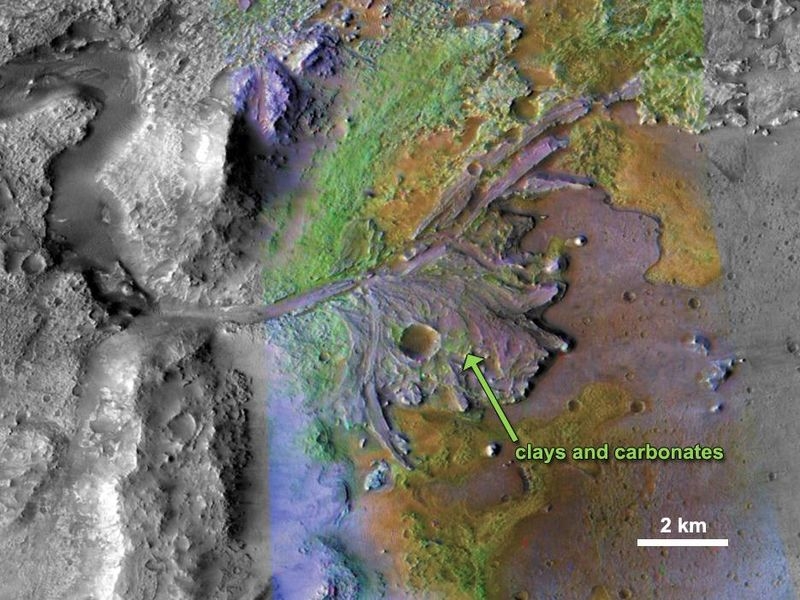
The Jezero Crater delta, a well-preserved ancient river delta on Mars. New research suggests sedimentary rocks made of compacted mud or clay, like those found in the Jezero Crater delta, are the most likely to contain microbial fossils.
Credit: NASA/JPL-Caltech/MSSS/JHU-APL
NASA’s Perseverance Mars rover is busy at work exploring Jezero Crater.
“From orbit, this crater shows all the promising signs of a place that was likely friendly to life in the distant past,” explains a JPL website dedicated to the mission.
“The rover’s goal is to study the site in detail for its past conditions and seek the very signs of past life. Its mission is to identify and collect the most compelling rock core and soil samples, which a future mission could retrieve and bring back to Earth for more detailed study,” adds the website.

Signs of ancient life on Mars could be preserved in layered rocks like those shown in this illustration of NASA’s Perseverance rover in Jezero Crater.
Credit: NASA/JPL-Caltech
Indeed, imagery being taken by the rover is first-rate – but are we close to detecting past life on the Red Planet?
Compelling evidence
“The best case scenario for Perseverance finding compelling evidence of past life is the identification of biomediated structures that can be observed with cameras,” said Steve Ruff, a leading planetary geologist at Arizona State University in Tempe, Arizona.
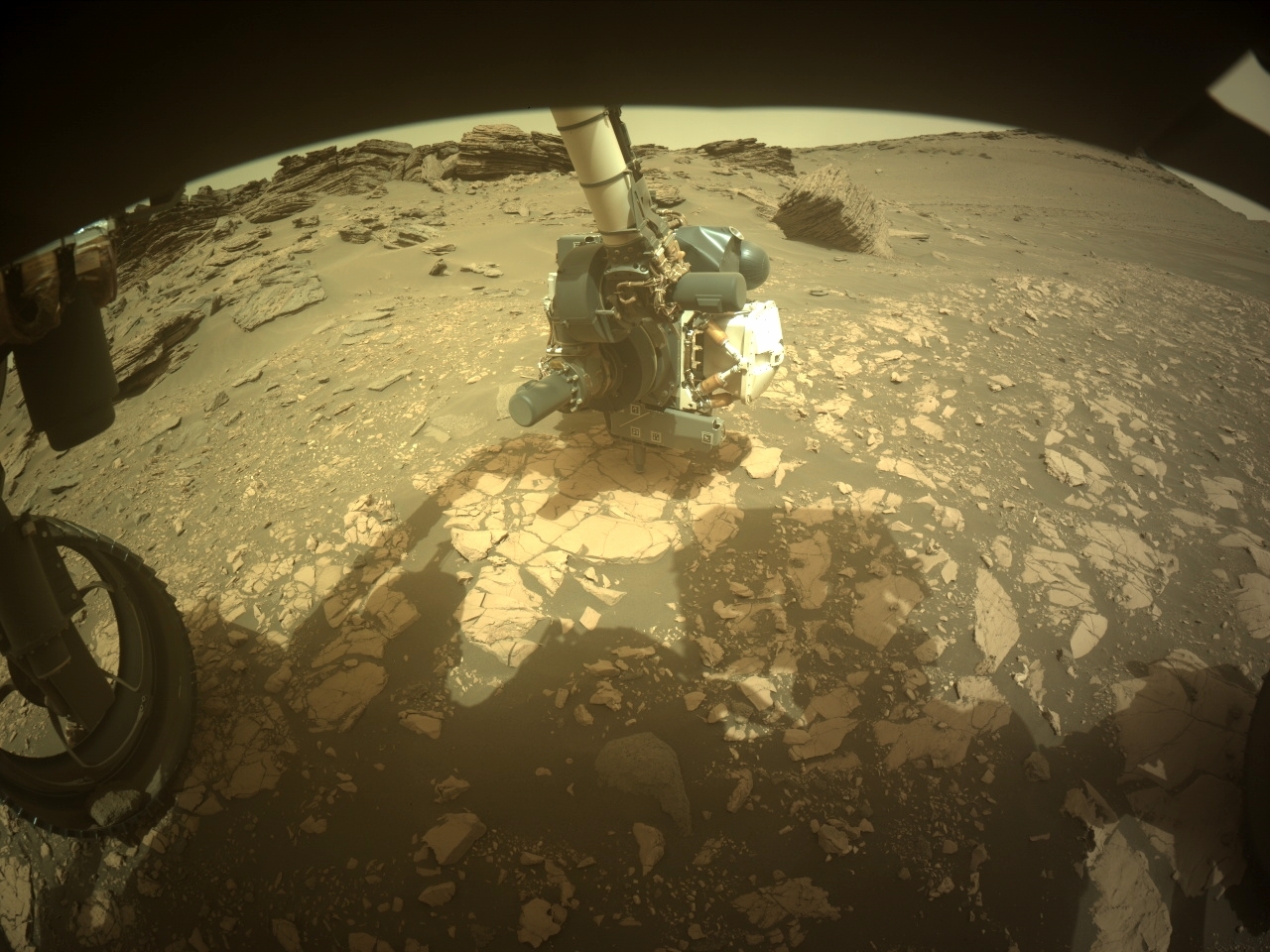
NASA’s Mars Perseverance rover acquired this image on June 17, 2022 of the area in front of it using its onboard Front Left Hazard Avoidance Camera A.
Credit: NASA/JPL-Caltech
Ruff said that features like stromatolites, which occur at scales of millimeters to meters in size are candidates.
“They form in standing water where microbial mats are mineralized, building up layers of biology and geology that can be preserved for billions of years, like found in ancient rocks on Earth,” Ruff told Inside Outer Space.
Huge win
If something like that were found by Perseverance and then sampled, this would be a huge win for the mission, Ruff said. “The sample would still need to be subjected to a battery of measurements in labs on Earth to really prove that microbes played a role.”

NASA’s Mars Perseverance rover acquired this image on June 10, 2022 using its onboard Right Navigation Camera (Navcam) located high on the rover’s mast and aids in driving.
Credit: NASA/JPL-Caltech
In terms of that material rocketed back to our planet, the risk to Earth is nil, Ruff said. “The ‘bugs’ that contributed to a stromatolite would have been dead for billions of years, since the time there was a lake in Jezero, which is when such structures could have formed. Long dead microbes from Mars, at best, are now just degraded organic matter, probably the equivalent of tar-like compounds. So zero risk of infecting Earth.”
Scientific triumph
The still-in-work Mars Sample Return mission was envisioned to go after a scenario like this, said Ruff, “finding evidence of long dead Martian microbes in samples returned to Earth,” he said.
Bottom line: “This scenario would be a scientific triumph and change our understanding about the potential for life beyond Earth,” Ruff said. “A second data point would be confirmed.”

To support the campaign to return samples from Mars, multiple robots team up to ferry to Earth select samples that are now being gathered by NASA’s Mars Perseverance rover.
Credit: NASA/ESA/JPL-Caltech
Long-sought mission
NASA is pressing ahead on the agency’s long-sought vision of rocketing back to Earth pieces of Mars. A Mars Sample Return (MSR) campaign is now being orchestrated by NASA and the European Space Agency, a multi-spacecraft enterprise.
This fast-paced, multi-billion dollar endeavor is dedicated to hauling back planetary particulars from the Red Planet to our world in the early 2030’s.
Christopher Carr, an assistant professor within Georgia Institute of Technology’s School of Earth and Atmospheric Sciences once worked on Mars Sample Return at NASA’s Jet Propulsion Laboratory in the summers of 1999 and 2000.
“My first reaction after reading a stack of slide presentations was, you’ve got to be kidding, this is so complicated,” said Carr. “It turns out the complexity was and is highly driven by the requirement to have a low probability of releasing even a very small particle of Mars material into the Earth biosphere.”

Departure of Mars Ascent Vehicle carrying Mars samples.
Credit: NASA
Carr added that even back then the technology existed to provide simultaneous protection of precious samples and protection against release of Mars particles using the right series of isolators with differential pressures.
“This is the kind of approach used, for example, in pharmaceutical manufacturing. It is not cheap and will require a specialized facility and specific work practices,” Carr said. This planetary protection burden he views as reasonable for legal, ethical, and moral reasons until we learn more about the risks, he advises.
Ultimately, Carr suspects such extreme measures will be unnecessary, in part because the surface of Mars today is uninhabitable to life as we know it. To date, he knows of no overlap between conditions required for replication and conditions present on the surface of Mars.
Uncontrolled mass experiment
“In contrast,” Carr continues, “there is a large overlap in the temperatures and pressures in the subsurface of Mars and the range of inhabited environments on Earth,” Carr said. “Earth also continues to receive Mars meteoritic material, although most of this arrives in the form of small particles that have been in space long enough to be sterilized.”

Mars: Home for past, perhaps present-day life? Credit: NASA
Carr tags the COVID-19 pandemic and variants as “an uncontrolled mass experiment in evolution” with a virus known to be hazardous to many and deadly to some. “In that context, the back contamination [from Mars] issue can almost seem like an academic exercise, and yet we do owe it to all humans to take reasonable precautions,” he said.
Safeguard our planet
Similar in view is astrobiologist Dirk Schulze-Makuch from the Technical University Berlin and the School of the Environment at Washington State University.
In his opinion, the danger from any microbes on Mars should be extremely small, “because there are naturally meteorites landing from Mars on Earth, and this has been going on for eons,” Schulze-Makuch notes.
“On the other hand,” Schulze-Makuch says, “Earth is our only biosphere and life line, so we have to do everything we can to safeguard our planet and its biosphere from any, even very small, risk,”
To ensure this, the construction of a specially designed Sample Receiving Facility on Earth to receive samples from Mars, Schulze-Makuch concludes, “should have already begun or at least start now right away.”

Curiosity’s location as of Sol 3506. Distance driven by this sol: 17.48 miles/28.14 kilometers.
Credit: NASA/JPL-Caltech/Univ. of Arizona
NASA’s Curiosity Mars rover at Gale Crater is now performing Sol 3507duties.
“The difficulty of driving on Martian terrain proves itself once again,” reports Natalie Moore, a mission operations specialist, at Malin Space Science Systems in San Diego, California.
Curiosity’s Sol 3504 drive did not complete successfully, leaving the robot in basically the same spot as an earlier plan.

Curiosity Chemistry & Camera (ChemCam) Remote Micro-Imager (RMI) photo taken on Sol 3506, June 17, 2022.
Credit: NASA/JPL-Caltech/LANL

Curiosity Chemistry & Camera (ChemCam) Remote Micro-Imager (RMI) photo taken on Sol 3506, June 17, 2022.
Credit: NASA/JPL-Caltech/LANL
“Thankfully, all the science we planned executed successfully,” Moore adds. There was an interesting Dust Removal Tool result on “Omai” showing erosion-resistant veins beneath the surface and a Mars Hand Lens Imager (MAHLI) closeup of the robot’s Chemistry and Camera (ChemCam) eye where the laser comes out.
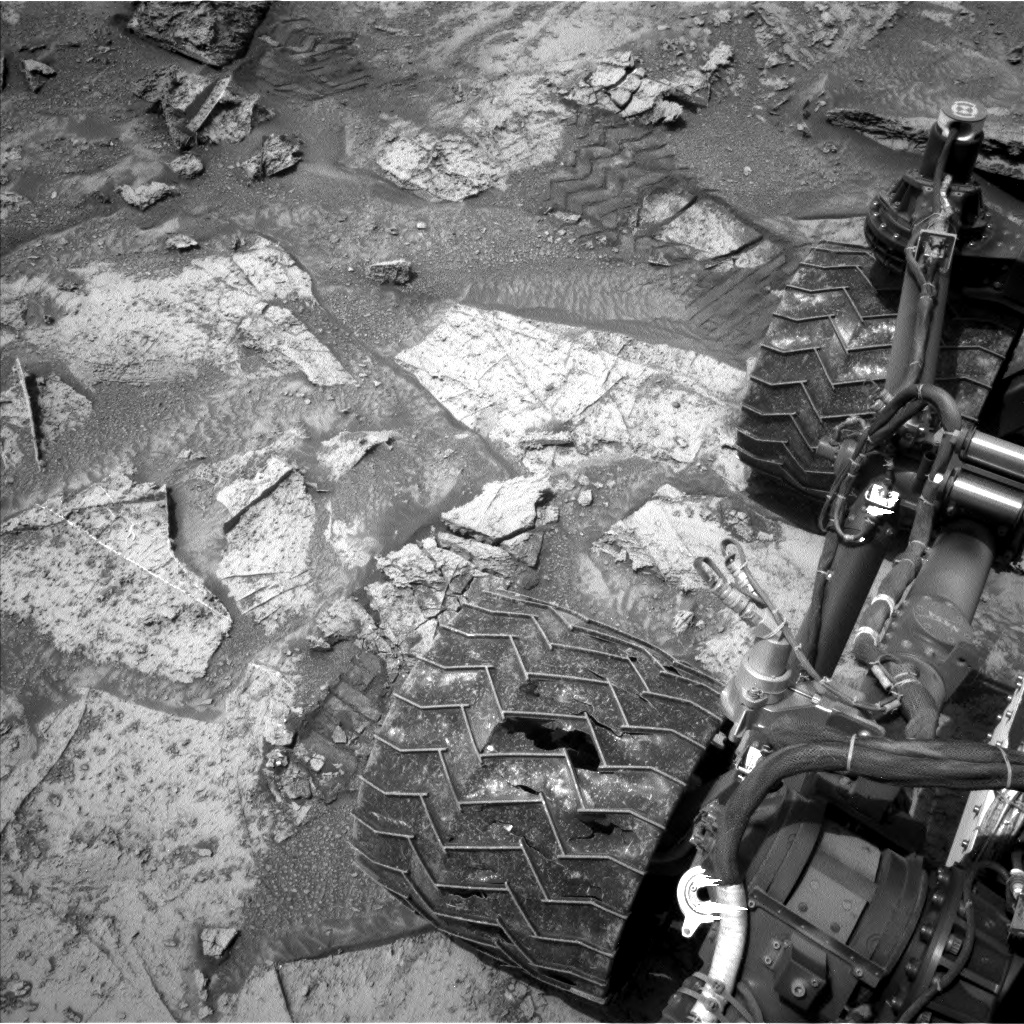
Curiosity Left B Navigation Camera image acquired on Sol 3506, June 17, 2022.
Credit: NASA/JPL-Caltech
More science
While resolute rover planners worked on scripting a drive to get the rover further down the road, there was agreement to fill up a new plan with even more science and instrument calibration activities.
“For geology-based science, ChemCam’s Sol 3503 laser target ‘Mahdia’ was so interesting they decided to shoot the same area again but this time have Mastcam take a suite of images in 7 color filters to document the area in various light wavelengths,” Moore explains.

Curiosity Left B Navigation Camera image acquired on Sol 3506, June 17, 2022.
Credit: NASA/JPL-Caltech
ChemCam is slated to shoot its laser on a thin plate of rock sticking out just above the Mahdia target area, named “Iwokrama” after a rain forest in central Guyana.
“While Mastcam is documenting ChemCam’s efforts in color,” Moore explains, “it will also be taking a stereo 2×2 mosaic of nearby sand ripples, named ‘Poci’ after the small town in Venezuela, which may help characterize Martian aeolian processes over time.”

Curiosity Left B Navigation Camera image acquired on Sol 3506, June 17, 2022.
Credit: NASA/JPL-Caltech
Atmospheric composition
For contact science with the arm, the team decided on a single MAHLI imaging activity on a layered rock named “Tipuru” after the village in Guyana. Due to the depth of Tipuru’s layers, MAHLI will be taking images at 8 focus positions and stacking them into a single image with best focus.
For environmental science, ChemCam is on tap to collect data passively while pointed at the sky for atmospheric composition characterization.

Curiosity Left B Navigation Camera image acquired on Sol 3506, June 17, 2022.
Credit: NASA/JPL-Caltech
Mastcam is slated to take images of the Sun with its solar filter for atmospheric opacity measurements.
Navcam is planning an image of crater rim for atmospheric opacity and a movie of the terrain to hopefully capture Martian dust devils.
Instrument calibration
The environmental team is also planning their normal Rover Environmental Monitoring Station (REMS), Radiation Assessment Detector (RAD), and Dynamic Albedo of Neutrons (DAN) activities for regular measurements of the rover’s spot in Gale Crater.

Curiosity Left B Navigation Camera image acquired on Sol 3506, June 17, 2022.
Credit: NASA/JPL-Caltech
There’s an opportunity to obtain plenty of instrument calibration and documentation activities logged.
Mastcam is planning two identical runs of images through the solar filter while not pointing at the Sun, which will return black images showing the state of the Mastcam charge-coupled devices (CCDs) to see how they’re holding up after nearly 10 years on Mars.
MAHLI is planning an image of the REMS ultraviolet sensor to show how much dust has accumulated and 4 images of the sky to use for processing MAHLI images after they arrive on Earth.
Sample Analysis at Mars (SAM) Instrument Suite has an electrical-baseline test (EBT) and the Chemistry & Mineralogy X-Ray Diffraction/X-Ray Fluorescence Instrument (CheMin) has an empty cell analysis activity planned for continued instrument calibration, Moore reports.

Curiosity Front Hazard Avoidance Camera Right B image taken on Sol 3506, June 17, 2022.
Credit: NASA/JPL-Caltech
Drive ahead
After the rover makes a drive of roughly 72-feet (22-meters), Mastcam is to take images of the Mars machinery’s new location.
Lastly, also in the planning is taking a single Mars Descent Imager (MARDI) image of the ground including part of the left-front wheel after sunset to get diffuse illumination of the dusty ground below.
“As of this plan,” Moore concludes, “we’ve driven 28 and 1/8th kilometers since landing!”
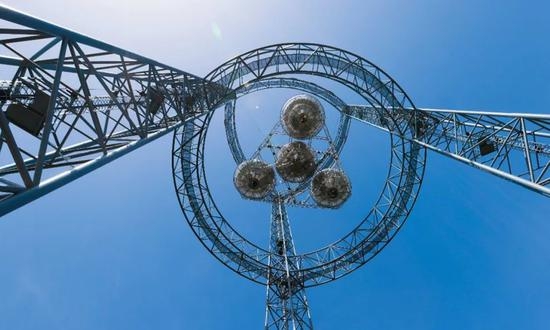
Credit: Xidian University
Codenamed Zhuri — or “chasing the Sun” – a research team with Xidian University is working on components of a space-based solar power station (SSPS).
A “ground recipient verification system” has been constructed to enable next-generation microwave power wireless transmission technology and space-based solar power plant technology.
The ground verification system is located in the southern campus of Xidian University. The supportive tower of the system is an over 245-feet (75 meters) high steel structure, and has five subsystems: Omega concentration and light-electricity conversion, power transmission and management, and a receiving antenna, reports China’s Ecns.cn, the official English-language website of China News Service (CNS).

Peter Glaser, the father of the solar power satellite concept.
Credit: Arthur D. Little Inc.
Space testing
The China Academy of Space Technology (CAST) plans to conduct a “Space high voltage transfer and wireless power transmission experiment” in low Earth orbit in 2028.
The OMEGA space-based solar power station reportedly will be capable of generating 10 kilowatts and carry a solar cell array, microwave transmitting antenna, a low power laser transmission payload, and a transmitting array to evaluate power transmission across distances of 400 kilometers from orbit, adds the Ecns.cn story.
To read the full story – “China prepares ground recipient system for space-based solar power station” – go to:
http://www.ecns.cn/news/sci-tech/2022-06-17/detail-ihaziuqy8693823.shtml

Curiosity Left B Navigation Camera image taken on Sol 3504, June 15, 2022.
Credit: NASA/JPL-Caltech
NASA’s Curiosity Mars rover at Gale Crater is now performing Sol 3504 duties.
Back on Sol 3496 the rover plan did not execute due to an issue onboard the rover that took a few days to investigate, reports Michelle Minitti, a planetary geologist at Framework in Silver Spring, Maryland.
Curiosity returned to normal operations, and researchers were able to accomplish everything that was in the Sol 3496 plan…and more.

Curiosity Chemistry & Camera (ChemCam) Remote Micro-Imager (RMI) photo acquired on Sol 3504, June 15, 2022.
Credit: NASA/JPL-Caltech/LANL
“More was possible because we had slightly different communication windows between Curiosity and Earth in this plan than in the Sol 3496 plan. This meant we could wait to drive to our next location on the second sol of this two sol plan giving us more time in this workspace,” Minitti adds.

Dust Removal Tool action as seen by Curiosity Mars Hand Lens Imager (MAHLI). Photo produced on Sol 3503, June 14, 2022.
Credit: NASA/JPL-Caltech/MSSS
Cool evening temperatures
First and foremost, added was use of the Alpha Particle X-Ray Spectrometer (APXS) because it could run in the cool evening temperatures of Sol 3503.
“We selected a nice smooth patch of bedrock,” Minitti notes, the target “Omai,” then brushed it with the Dust Removal Tool before imaging it with the Mars Hand Lens Imager (MAHLI) and analyzing it with APXS.
MAHLI will reattempt a small mosaic across the prominent resistant veins in this area at the target “Wandapa,” and will image the Chemistry and Camera (ChemCam’s) “eye” to monitor the state of that part of the instrument.

Curiosity Front Hazard Avoidance Camera Right B image taken on Sol 3503, June 14, 2022.
Credit: NASA/JPL-Caltech
Relationship to bedrock
“Another sol to plan meant we could add another ChemCam raster, as well. In addition to ‘Mahdia,’ the previously-selected bedrock target, we added ‘Murupu,’ a smoother material visible on the upper surface of the rock. This smoother material might be one of the veins that cut through the rocks here, so getting chemistry on it would be helpful to understand its relationship to the bedrock,” Minitti explains.
ChemCam replanned their long distance Remote Micro-Imager (RMI) mosaic of one of the features along the upper portion of “Gediz Vallis Ridge.”

Curiosity Left B Navigation Camera image taken on Sol 3504, June 15, 2022.
Credit: NASA/JPL-Caltech
“Mastcam had a mix of previously-planned and new observations,” Minitti points out. “The former included three stereo mosaics, two of which covered the dramatic stratigraphy and layering in this area at targets ‘Serra Mara’ and ‘Eboropu.’ The third covered a smaller, but still interesting, area of sand motion near the rover at target ‘Karto.’”

Curiosity Left B Navigation Camera image taken on Sol 3504, June 15, 2022.
Credit: NASA/JPL-Caltech
Clear sailing?
“New observations included two stereo mosaics that stretched from our workspace to our drive target to help scout the path ahead and provide context for where we are headed,” Minitti reports. “Mastcam will also observe the brushed surface at Omai with its multispectral capabilities.”

Curiosity Mars Hand Lens Imager (MAHLI) photo produced on Sol 3503, June 14, 2022.
Credit: NASA/JPL-Caltech/MSSS
Rover Environmental Monitoring Station (REMS), Radiation Assessment Detector (RAD), and Dynamic Albedo of Neutrons (DAN) are to be back at it at their usual cadence.
Navcam is slated to acquire a dust devil movie, cloud movie, and an image to monitor the amount of dust in the atmosphere.
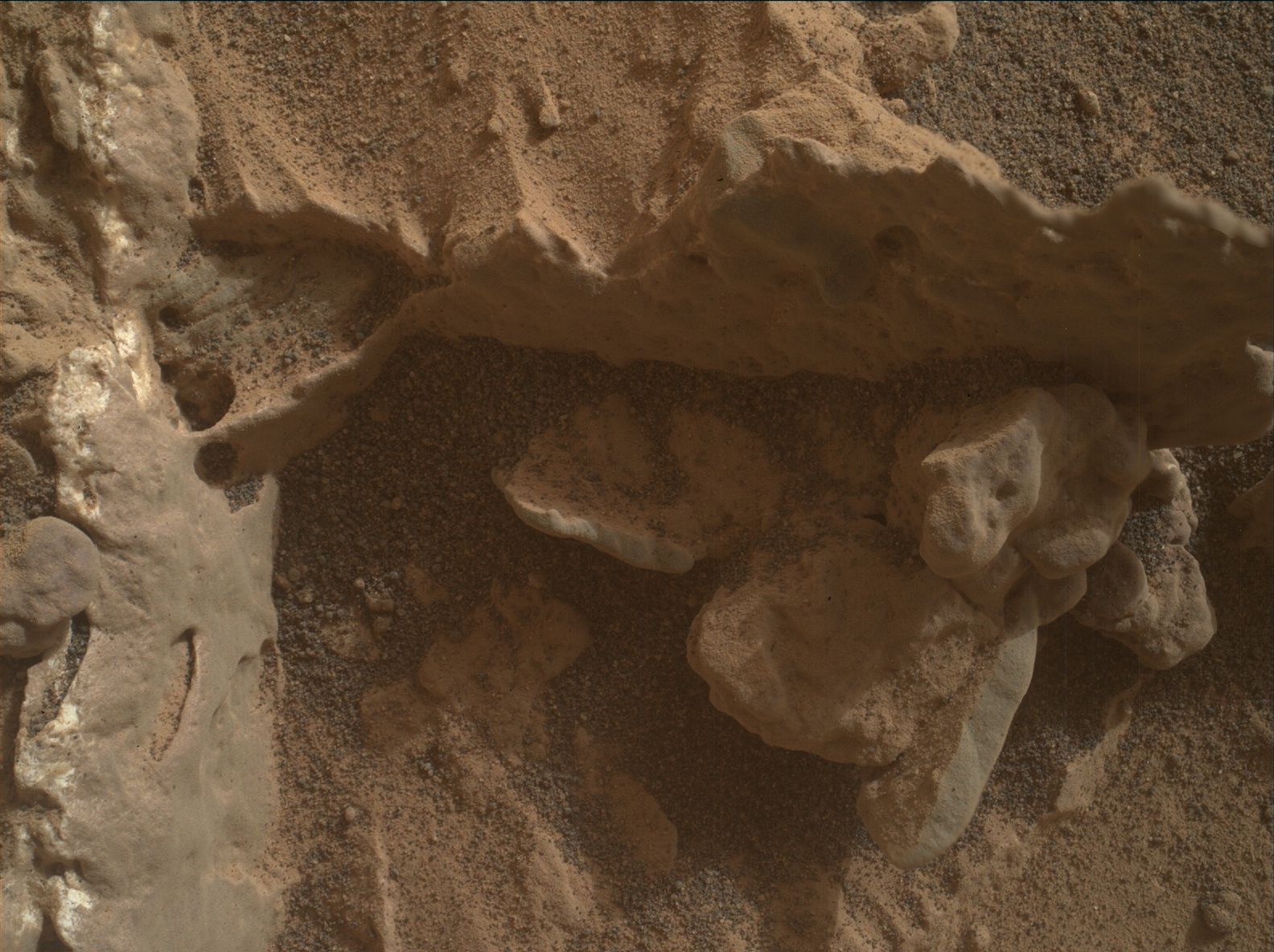
Curiosity Mars Hand Lens Imager (MAHLI) photo produced on Sol 3503, June 14, 2022.
Credit: NASA/JPL-Caltech/MSSS
“Hopefully Navcam sees clear sailing up ahead for Curiosity,” Minitti concludes, “after our break in the action!”
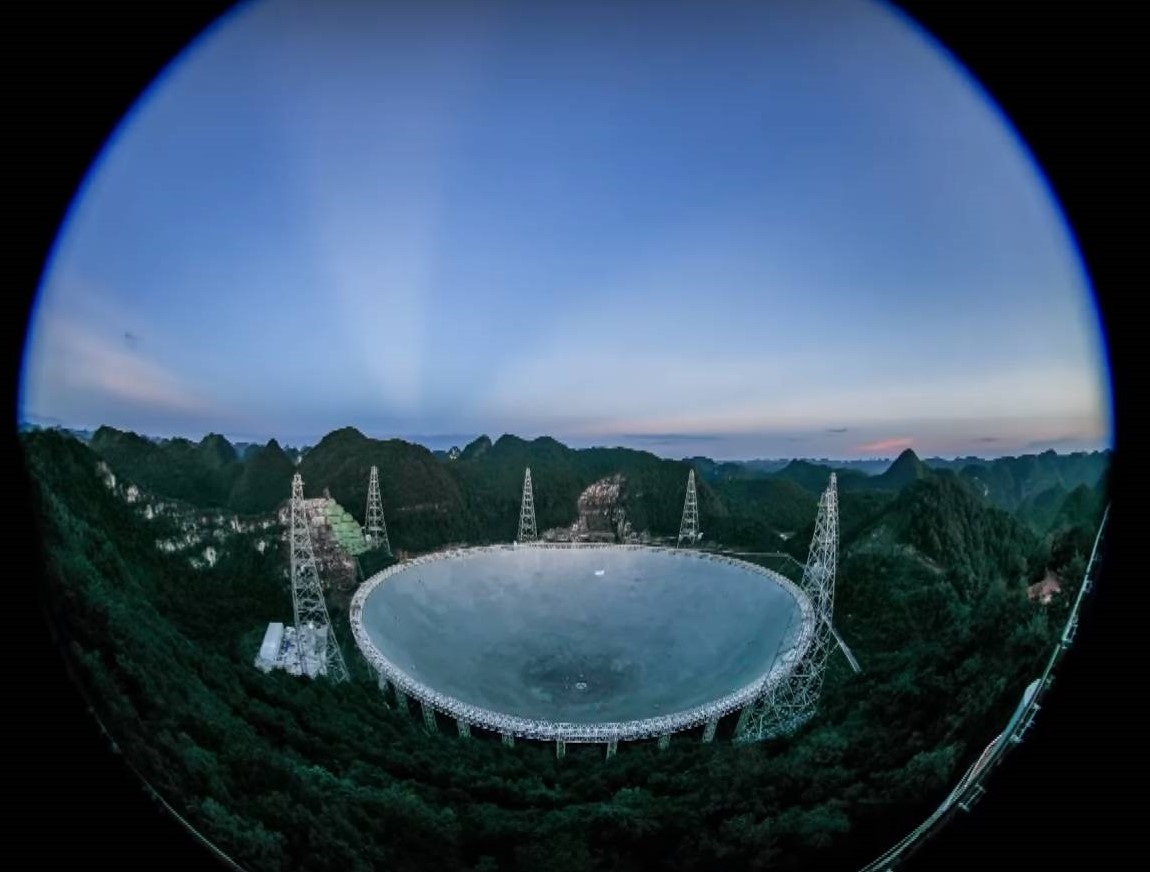
Credit: New China TV/XinhuaVideo/Inside Outer Space screengrab
Making the rounds on Twitter and various news feeds is that China may have picked up signals from alien civilizations.
China’s “Sky Eye” — better known as the Five-hundred-meter Aperture Spherical radio Telescope (FAST) radio telescope — is located in southwestern Guizhou province.
In one report, posted by the state-backed Science and Technology Daily (story now removed from the site) cites Zhang Tonjie, chief scientist of an extraterrestrial civilization search team co-founded by Beijing Normal University, the National Astronomical Observatory of the Chinese Academy of Sciences and the University of California, Berkeley.

Credit: GLOBALink/Inside Outer Space screengrab
Zhang is reported to have said that the team detected two sets of signals in 2020 while sifting through data gathered in 2019. Another signal was picked up this year amidst observation data of exoplanet targets.
However, Zhang reportedly also underscored the prospect that the signals are products of radio interference. As follow-up, repeat observations are reportedly on tap.
Radio pollution
Meanwhile, Inside Outer Space reached out to Dan Werthimer, the Marilyn and Watson Alberts SETI Chair in the Astronomy Department and Space Sciences Lab at the University of California, Berkeley. He works with the Beijing Normal University SETI researchers.

The search for extraterrestrial intelligence (SETI) is an international, collaborative affair. SETI scientist Dan Werthimer of the University of California, Berkeley, co-authored a recent paper on China’s SETI program with the Five-hundred-meter Aperture Spherical Radio Telescope (FAST). He is shown here with other FAST SETI collaborators. Credit: Dan Werthimer
These signals are from radio interference; they are due to radio pollution from earthlings, not from ET. The technical term we use is “RFI” – radio frequency interference. RFI can come from cell phones, TV transmitters, radar, satellites, as well as electronics and computers near the observatory that produce weak radio transmissions,” Werthimer said.
“All of the signals detected by SETI researchers so far are made by our own civilization, not another civilization,” Werthimer added. “It’s getting hard to do SETI observations from the surface of our planet. Radio pollution is getting worse, as more and more transmitters and satellites are built. Some radio bands have become impossible to use for SETI.”

Credit: Breakthrough Listen/Danielle Futselaar
Werthimer said that earthlings might eventually have to go to the backside of the Moon to do SETI. “A radio telescope on the backside of the Moon would be shielded from all of our planet’s radio pollution.”
For more information on China’s SETI plans, go to:
China Radio Telescope Embarks on ET Search
https://www.leonarddavid.com/china-radio-telescope-embarks-on-et-search/
Also, go to:
Ready, SETI, go: Is there a race to contact E.T.?
https://www.space.com/seti-race-alien-life-search-china.html

