Archive for October, 2021
 Author:
  October 3rd, 2021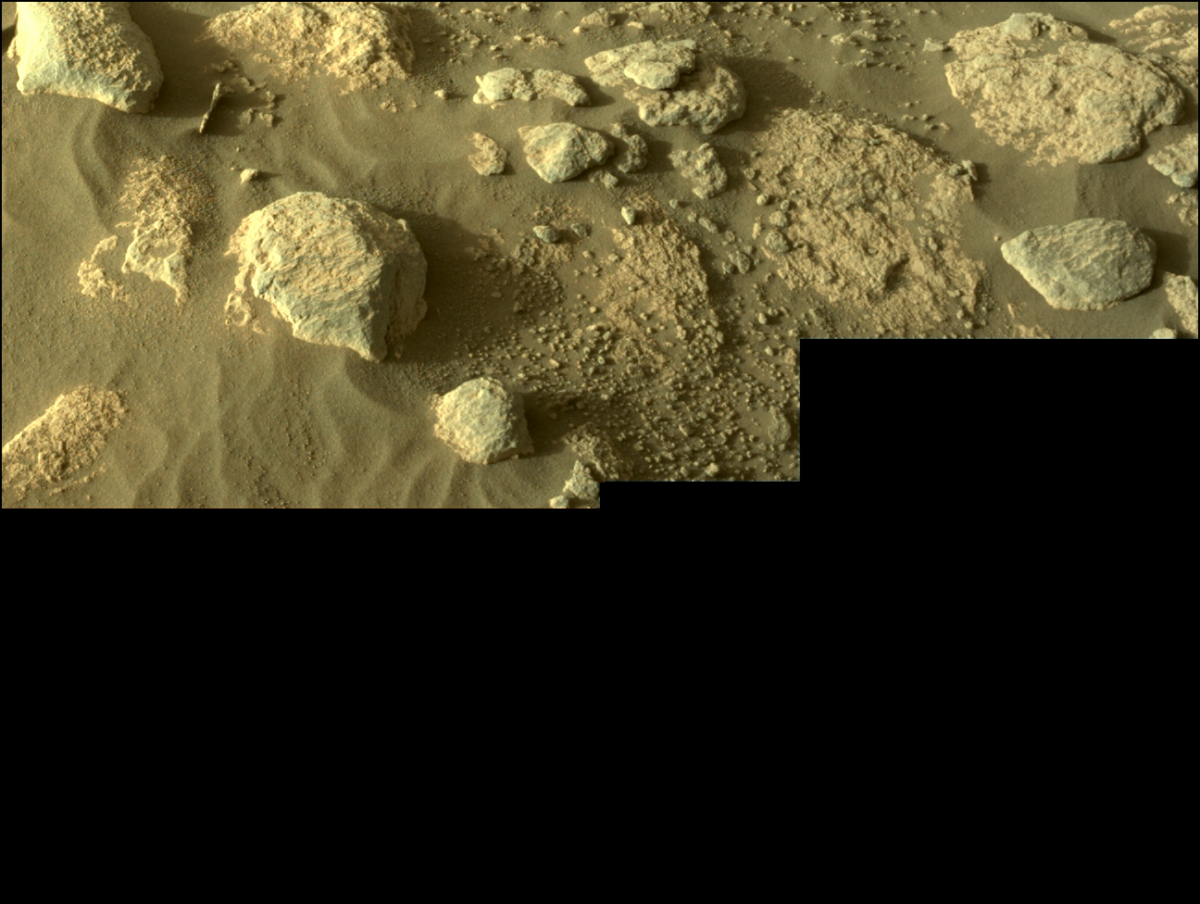
Mars Perseverance Right Navigation Camera image was acquired on September 29, 2021.
Credit: NASA/JPL-Caltech
NASA Mars landers are in pause-mode for some two weeks – operationally impacted by Mars solar conjunction, the period when the Sun comes between Mars and Earth, blocking signals.

Curiosity’s Front Hazard Avoidance camera took this photo on October 1, 2021.
Credit: NASA/JPL-Caltech
This means NASA land rovers, Curiosity and Perseverance, will temporarily pause relaying raw images from the Red Planet for about two weeks, with new imagery to be available after October 18.

NASA’s InSight stationary Mars lander acquired this image using its robotic arm-mounted, Instrument Deployment Camera (IDC) on September 27, 2021.
Credit: NASA/JPL-Caltech
Similarly, NASA’s stationary lander, InSight, will momentarily pause sending back raw images for about three weeks, until after October 22.

China’s Zhurong rover.
Credit: Liang Ding, et al.
Safe mode
Lastly, also affected by the solar conjunction is China’s Zhurong rover.
Since September 13, operations using the robot have been suspended for about 50 days. Zhurong has been put into “safe mode,” autonomously carrying out health assessments, self-monitoring and trouble-shooting until communication can be restored.
Zhurong communications are expected to be restored in late October.
 Posted in
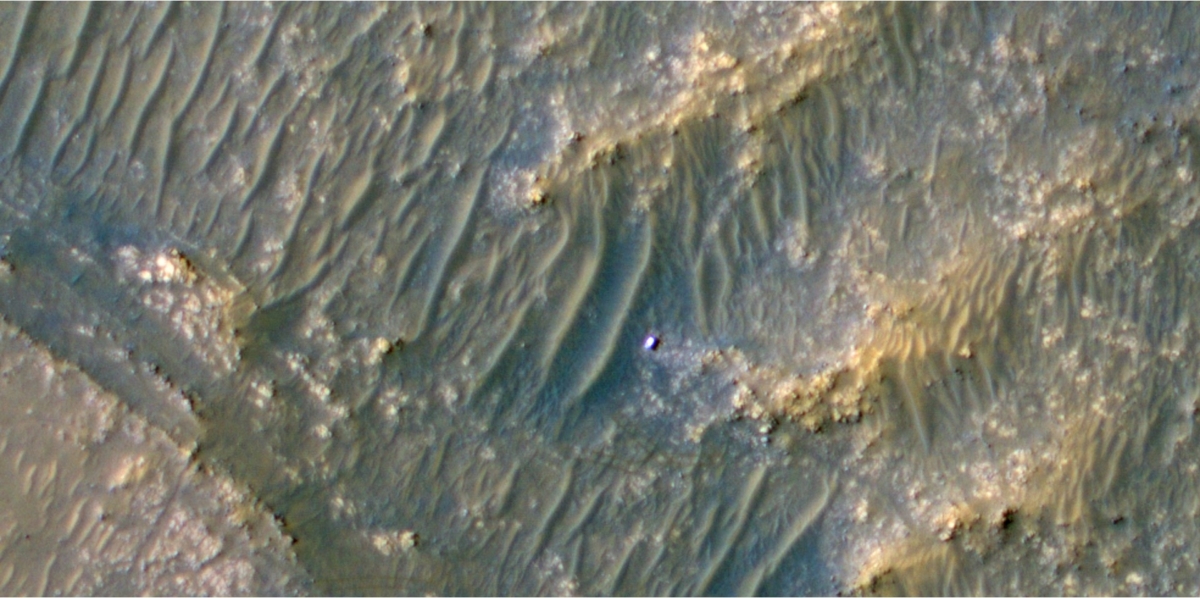
Credit: NASA/JPL/UArizona
Caught on camera!
NASA’s Perseverance rover now wheeling about in Jezero Crater has been imaged by NASA’s Mars Reconnaissance Orbiter using its powerful High Resolution Imaging Science Experiment (HiRISE).
Shane Byrne, HiRISE Deputy Principal Investigator at the University of Arizona explains that after a dramatic landing in February 2021, the Perseverance rover was re-imaged by HiRISE about 2,300 feet (700 meters) from its original landing site.
“The rover doesn’t drive in a straight line though, and has covered much more ground than that,” Byrne explains, pointing out faint wheel tracks on the nearby ground that are visible.
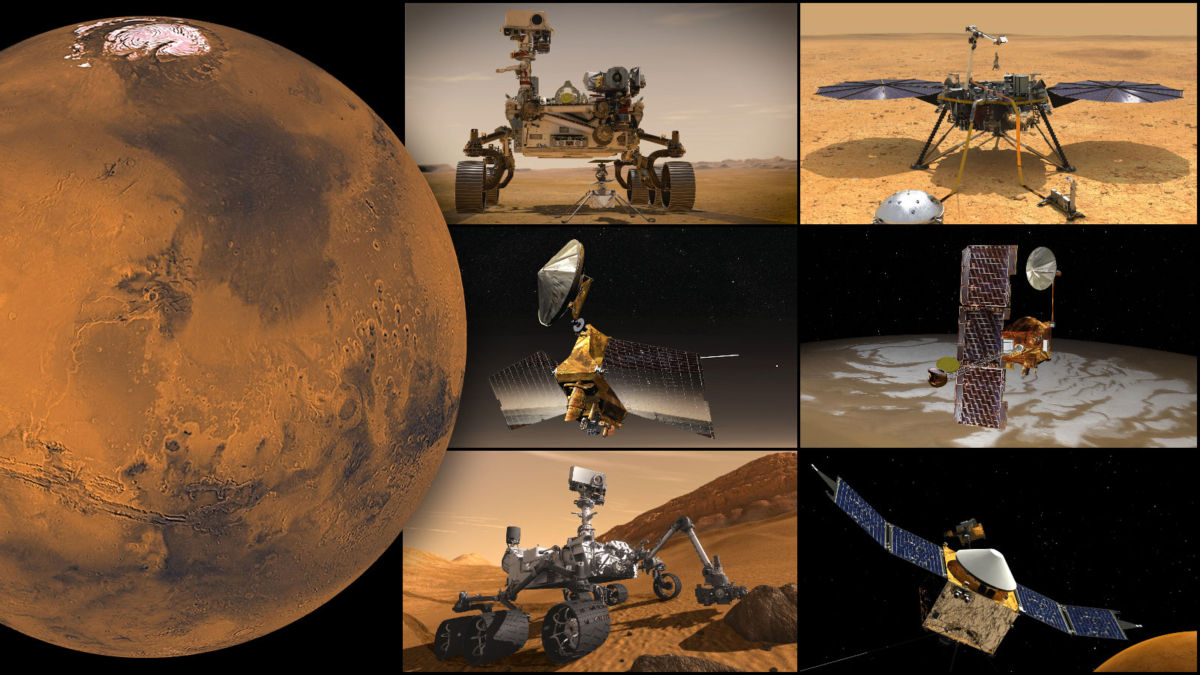
NASA’s Mars missions, clockwise from top left: Perseverance rover and Ingenuity Mars Helicopter, InSight lander, Odyssey orbiter, MAVEN orbiter, Curiosity rover, and Mars Reconnaissance Orbiter.
“HiRISE images like this one allow the rover team to choose the best route to get to their primary target and help put the rover’s observations in context within Jezero Crater,” Byrne adds.
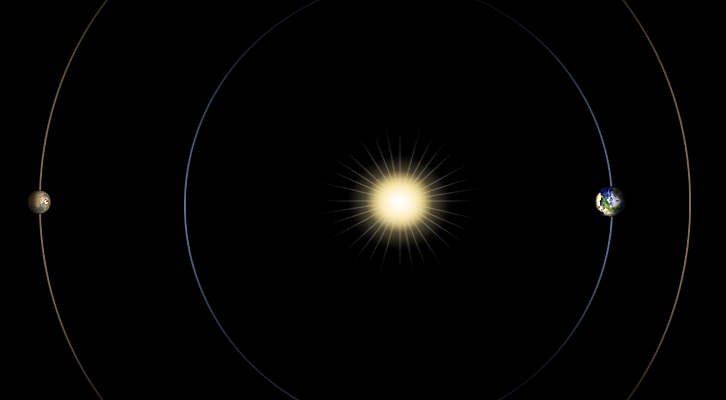
Conjunction junction. Credit: NASA/JPL/Caltech
Incommunicado
Meanwhile… the multi-nation armada of Mars missions are standing down from commanding Red Planet probes – orbiters and landers — for the next few weeks while Earth and the Red Planet are on opposite sides of the Sun. This period, called Mars solar conjunction, happens every two years.
As the Jet Propulsion Laboratory (JPL) explains, the Sun expels hot, ionized gas from its corona, which extends far into space. “During solar conjunction, when Earth and Mars can’t ‘see’ each other, this gas can interfere with radio signals if engineers try to communicate with spacecraft at Mars. That could corrupt commands and result in unexpected behavior from our deep space explorers.”

China’s Zhurong Rover.
Credit: CNSA/Inside Outer Space screengrab
This year, most missions will stop sending commands between Oct. 2 and Oct. 16. A few extend that commanding moratorium, says JPL, as it’s called, a day or two in either direction, depending on the angular distance between Mars and the Sun in Earth’s sky.

India’s MoM mission to Mars.
Credit: ISRO
Along with the slew of NASA Marscraft, also going virtually incommunicado: China’s Tianwen-1 Orbiter/lander/Zhurong rover, the UAE’s Hope Orbiter, Europe’s Mars Express and Trace Gas Orbiter, as well as India’s Mars Orbiter Mission (MOM).

UAE’s HOPE orbiter.
Credit: Mohammed bin Rashid Space Centre

ESA’s Mars Express.
Credit: ESA/AOES Medialab

Trace Gas Orbiter at Mars.
Credit: ESA/ATG medialab

Credit: Boeing
That enigmatic U.S. military X-37B robotic space drone has now chalked up more than 500 days circling the Earth.
The Orbital Test Vehicle (OTV-6) is also called USSF-7 for the U.S. Space Force, and was launched on May 17, 2020 by an Atlas-V 501 booster.
OTV-6 is the first to use a service module to host experiments. The service module is an attachment to the aft of the vehicle that allows additional experimental payload capability to be carried to orbit.

Credit: Boeing
Primary agenda: classified
While the Boeing-built robotic space plane’s on-orbit primary agenda is classified, some of its onboard experiments were identified pre-launch.
One experiment onboard the space plane is from the U.S. Naval Research Laboratory (NRL), an investigation into transforming solar power into radio frequency microwave energy. The experiment itself is called the Photovoltaic Radio-frequency Antenna Module, PRAM for short.

X-37B Air Force space plane.
Credit: Boeing/Inside Outer Space Screengrab
Along with toting NRL’s PRAM into Earth orbit, the X-37B also deployed the FalconSat-8, a small satellite developed by the U.S. Air Force Academy and sponsored by the Air Force Research Laboratory to conduct several experiments on orbit.
In addition, two NASA experiments are also onboard the space plane to study the effects of the space environment on a materials sample plate and seeds used to grow food.

Technicians tend Air Force X-37B space plane after tarmac touchdown.
Credit: U.S. Air Force
Previous flights
OTV-1: launched on April 22, 2010 and landed on December 3, 2010, spending over 224 days on orbit.
OTV-2: launched on March 5, 2011 and landed on June 16, 2012, spending over 468 days on orbit.
OTV-3: launched on December 11, 2012 and landed on October 17, 2014, spending over 674 days on-orbit.
OTV-4: launched on May 20, 2015 and landed on May 7, 2015, spending nearly 718 days on-orbit.
OTV-5: launched on September 7, 2017 and landed on October 27, 2019, spending nearly 780 days on-orbit.
OTV-1, OTV-2, and OTV-3 missions landed at Vandenberg Air Force Base, California, while the OTV-4 and OTV-5 missions landed at Kennedy Space Center, Florida.
There is no word on when and where OTV-6 will return to Earth.
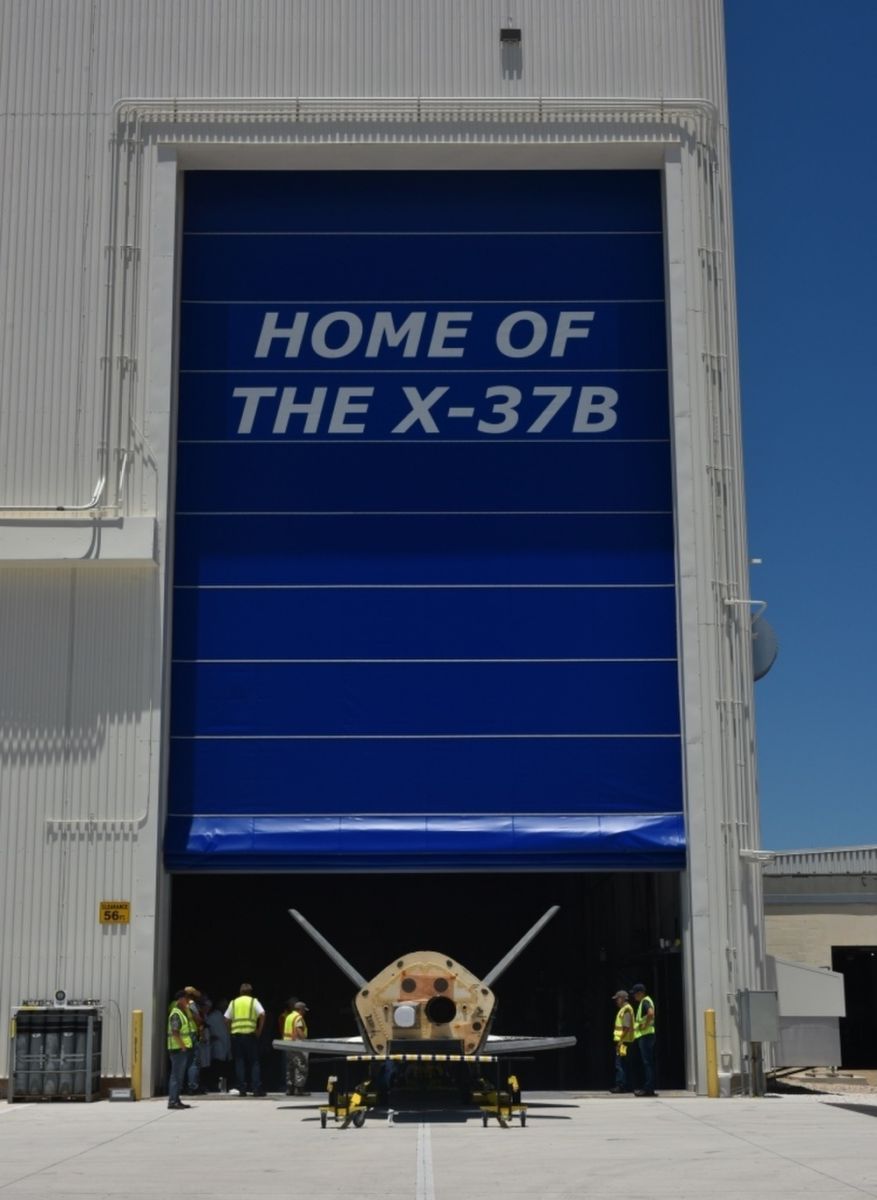
X-37B hangar at Kennedy Space Center.
Credit: Michael Martin/SAF
According to a Boeing fact sheet, “the X-37B is one of the world’s newest and most advanced re-entry spacecraft, designed to operate in low-earth orbit, 150 to 500 miles above the Earth. The vehicle is the first since the Space Shuttle with the ability to return experiments to Earth for further inspection and analysis. This United States Air Force unmanned space vehicle explores reusable vehicle technologies that support long-term space objectives.”
Delta 9
The X-37B program is flown under the wing of a U.S. Space Force unit called Delta 9, established and activated July 24, 2020.
“Delta 9 Detachment 1 oversees operations of the X-37B Orbital Test Vehicle, an experimental program designed to demonstrate technologies for a reliable, reusable, unmanned space test platform for the U.S. Space Force,” according to a fact sheet issued by Schriever Air Force Base in Colorado.
“The mission of Delta 9 is to prepare, present, and project assigned and attached forces for the purpose of conducting protect and defend operations and providing national decision authorities with response options to deter and, when necessary, defeat orbital threats,” the fact sheet explains. “Additionally, Delta 9 supports Space Domain Awareness by conducting space-based battlespace characterization operations and also conducts on-orbit experimentation and technology demonstrations for the U.S. Space Force.”

Credit: CCTV/Inside Outer Space screengrab
Making its public debut is China’s next-generation crewed spacecraft.
The once flown capsule is on display at the Airshow China 2021 in Guangdong Province’s Zhuhai City.
This craft is larger than the now-in-use Shenzhou spacecraft. China space officials say the new vehicle extends the qualities of reliability and safety, and will be reusable.

Huang Kewu, deputy head of the manned lunar exploration general department at the Fifth Research Institute of the China Aerospace Science and Technology Corporation (CASC).
Credit: CCTV/Inside Outer Space screengrab
Moon exploration capsule
In a China Central Television (CCTV) interview, Huang Kewu, deputy head of the manned lunar exploration general department at the Fifth Research Institute of the China Aerospace Science and Technology Corporation (CASC) said:

Credit: CCTV/Inside Outer Space screengrab
“The new generation of manned spacecraft is designed to meet the needs of our manned lunar exploration and space station operations in the future. The new generation of manned space transportation vehicle, which has been tested, could carry six to seven astronauts, while our Shenzhou spacecraft could only take three astronauts.”
With a launch mass of 21.6 tons, the next-generation piloted spacecraft is China’s largest return and reentry spacecraft launched with the largest amount of propellant. Some of the new technologies were successfully tested in its first flight in May of last year.

China’s next-generation piloted spaceship undergoes landing test using airbags.
Credit: CCTV/Inside Outer Space screengrab
Test flight
The prototype next-generation spacecraft was hurled into orbit by a Long March-5B launch vehicle from the Wenchang Space Launch Center, Wenchang, Hainan Province, China, on May 5, 2020. The craft landed safely on May 8 at the Dongfeng landing site and is designed for transportation of both astronauts and cargo.
The right side of the vehicle carried nearly 1,000 pieces of supplies to verify the spaceship’s cargo capacity. The left side of the craft was configured as a living area for astronauts, with a folding table and a toilet.
The experimental spaceship flew in orbit for two days and 19 hours, during which it carried out a series of space science and technology experiments, reported the China Manned Space Agency (CMSA).

Post-flight condition of China’s next-generation spaceship.
Credit: CCTV/Inside Outer Space screengrab
“We have achieved significant breakthroughs in thermal protection and precision control for the return and reentry, as well as in engine design and undamaged landing,” Huang told CCTV.
“The achievements in manned space transportation technologies have enabled us to take a leap from lagging behind the pacemakers to running beside them, and this lays a sound technological foundation for our future manned lunar spacecraft,” said Huang.
Go to this CCTV video at:
https://pv.news.cctvplus.com/2021/1001/8230227_PREVIEW_20211001180050702.mp4
Go to these Inside Outer Space stories at:
China’s New-gen Spaceship – First Inside Look (Updated)
https://www.leonarddavid.com/chinas-new-gen-spaceship-first-inside-look/
China’s New-generation Spaceship Readied for Return Home
https://www.leonarddavid.com/chinas-new-generation-spaceship-readied-for-return-home/
China’s New Spaceship: Space Station and Human Moon Exploration Plans
https://www.leonarddavid.com/chinas-new-spaceship-space-station-and-human-moon-exploration-plans/

