Archive for October, 2021
 Author:
  October 14th, 2021
Credit: CCTV
China’s 3-person Shenzhou-13 mission has been announced, a Taikonaut team that will stay in space for roughly 6 months, performing new construction tasks on the country’s space station.
The three astronauts are: Zhai Zhigang, Wang Yaping and Ye Guangfu. This will be the longest ever space mission for Chinese astronauts.
Launch schedule
Shenzhou-13 will be commanded by Zhai Zhigang, who became the first Chinese astronaut to carry out a spacewalk back in 2008.

Credit: GLOBALink/Inside Outer Space screengrab
Wang Yaping became China’s second ever female astronaut as part of the Shenzhou-10 mission in 2013 and will be the first woman to work on the station’s Tianhe core module.
Ye Guangfu is set to make his first spaceflight.
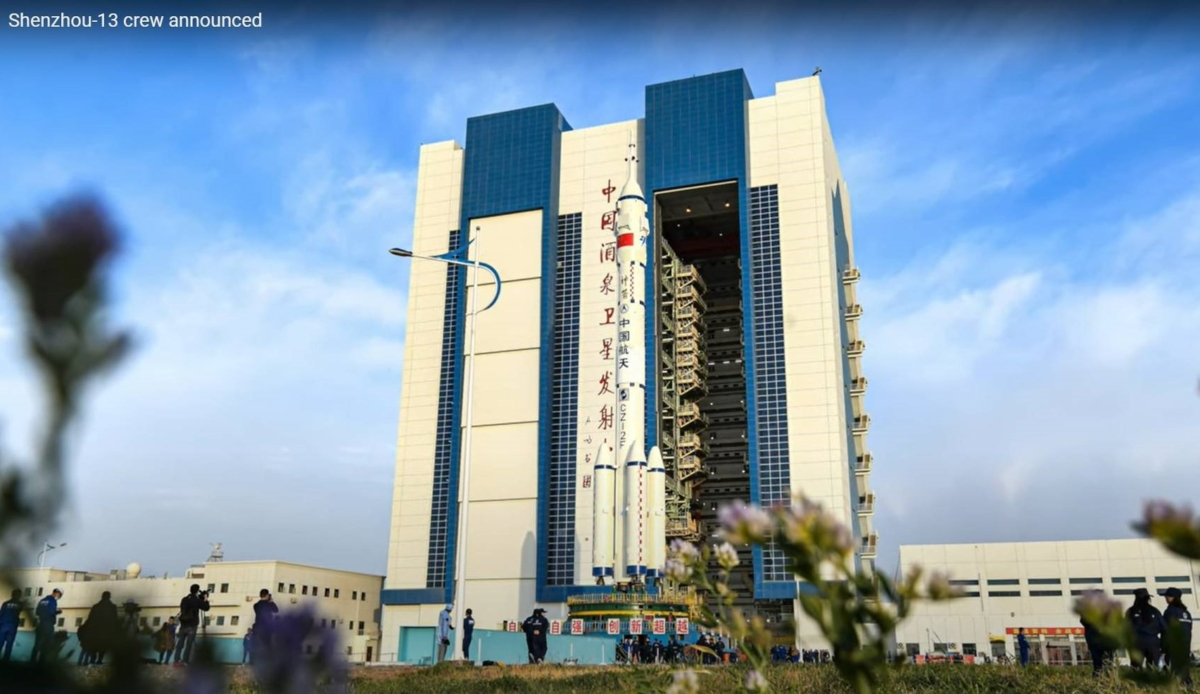
The Shenzhou-13 crewed spaceship will be launched at 12:23 a.m. Saturday (Beijing Time) from the Jiuquan Satellite Launch Center in northwest China.
Credit: CCTV/Inside Outer Space screengrab
After entering orbit, the spaceship will conduct a fast automated rendezvous and docking with the radial port of the in-orbit space station core module Tianhe, forming a complex with the core module and the cargo crafts Tianzhou-2 and Tianzhou-3.
Spacewalks
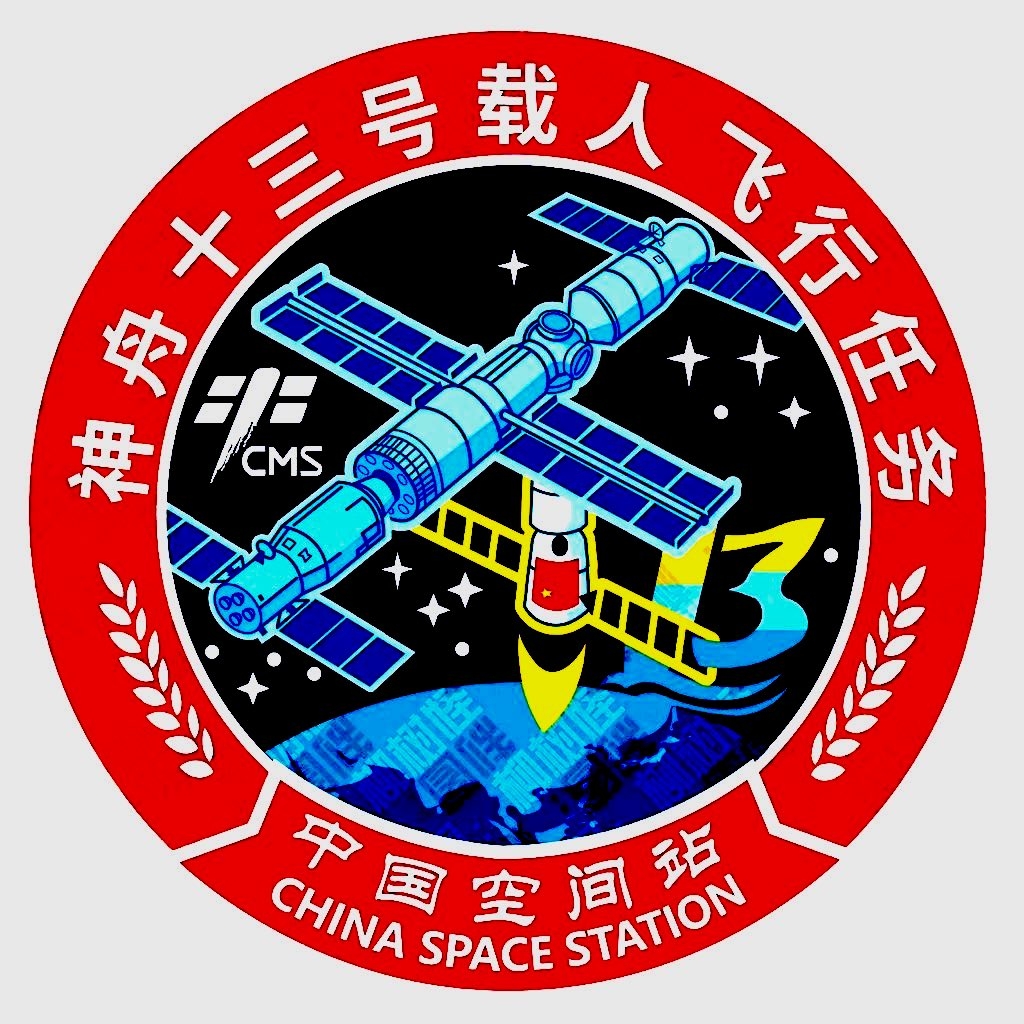
The upcoming Shenzhou-13 crewed space mission will include two or three extravehicular activities, installation of important devices for mechanical arms as well as various sci-tech experiments and application, according to the China Manned Space Agency (CMSA) on Thursday.
The Shenzhou-13 mission is part of a fast-paced series of launches to complete the building of China’s space station Tiangong by the end of 2022.
Credit: CMSA

Credit: GLOBALink/Inside Outer Space screengrab
Shenzhou-12 recap
Lin Xiqiang, deputy director of the China Manned Space Agency (CMSA) recapped during a press briefing the previous Shenzhou-12 mission. Its crew carried out a series of space science and technology experiments, and tested key technologies for the construction and operation of the space station, before returning to Earth safely on September 17.
“Shenzhou-12 mission achieved many firsts: the first time that Chinese astronauts stationed into Chinese space station; the first time that astronauts stayed on orbit for three months; the first autonomous rendezvous and docking which shortened the duration from two days to 6.5 hours; the first time that the astronauts conducted extravehicular activities supported by the robotic arm; the first time that an orbit regenerative life support technology has been demonstrated systematically and comprehensively,” said Lin.
“The other firsts achieved include the first dynamic on-orbit supplies management; the first flight of a combination of three spacecraft; the first onsite emergency rescue standby for human spacecraft and human launch vehicle, which demonstrated the strategy of backup enroll; the first astronauts search and recovery mission at Dongfeng landing site; the first realization of centralized plus distributed flight control support mode for longer term flight missions by six supporter centers including operation and planning center, crew support center and spacecraft on orbit support center,” Lin said.

Credit: GLOBALink/Inside Outer Space screengrab
Decisive, final battle
“The Shenzhou-13 mission is a decisive and final battle for the verification of key technologies of the space station,” Lin said, “as well as a critical threshold to the next phase of construction. The function and performance of each system to perform the space station mission, as well as the compatibility and coordination among the systems, will be assessed more comprehensively during the Shenzhou-13 mission.”
Lin added that the Shenzhou-13 astronauts will stay in orbit for six months for the first time, which will be the normal duration period of the astronauts during the operation of the space station. Furthermore, astronaut Wang Yaping will be the first female astronaut of China to conduct extravehicular activities.

China’s space station is projected to be completed in late 2022.
Credit: CAST
Pre-launch preparations
The Shenzhou-13 launch will be carried out with a Long March-2F carrier rocket, and all pre-launch preparations are basically completed, said Lin.
“At present, the Tianhe core module, Tianzhou-2 and Tianzhou-3 cargo ship assembly is in good working status with all equipment functioning well, ready for the rendezvous and docking as well as for the astronauts to move in,” Lin said. “All systems conducting the Shenzhou-13 mission has undergone tests and comprehensive rehearsal. The flight crew is in good condition and all pre-launch preparations are in order.”
Go to these newly issued videos detailing the mission and training activities:
 Posted in
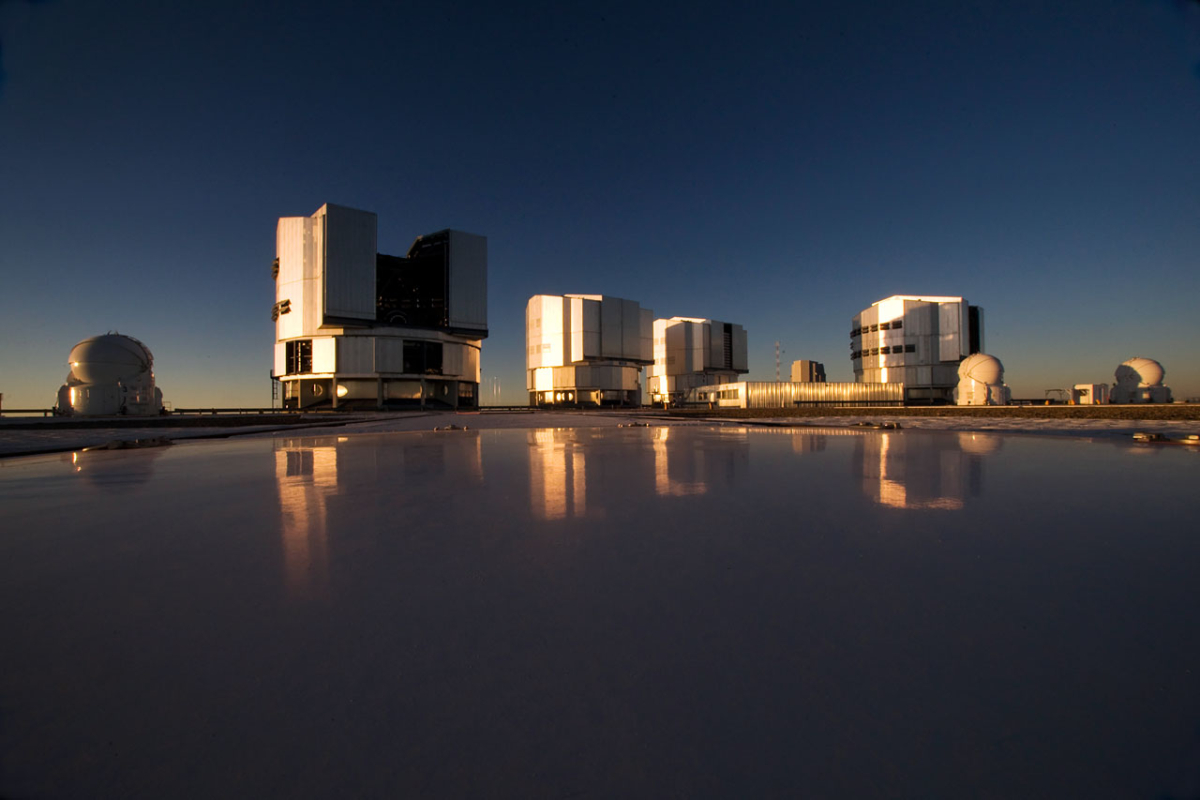
The Sun sets at ESO’s Very Large Telescope (VLT) in this image, taken at the observatory on Cerro Paranal in the dry Atacama Desert of Chile. Credit: Iztok Bončina/ESO
Never before has such a large group of asteroids been imaged so sharply.
That’s the word from The European Southern Observatory using its Very Large Telescope in Chile.
Forty-two of the largest objects in the asteroid belt between Mars and Jupiter have been imaged. Taken in the whole, the observations reveal a wide range of peculiar shapes, from spherical to dog-bone. That imagery can help astronomers trace the origins of the asteroids in our Solar System.
High level of detail
“Only three large main belt asteroids, Ceres, Vesta and Lutetia, have been imaged with a high level of detail so far, as they were visited by the space missions Dawn and Rosetta of NASA and the European Space Agency, respectively,” explains Pierre Vernazza, from the Laboratoire d’Astrophysique de Marseille in France, who led the asteroid study published recently in Astronomy & Astrophysics.
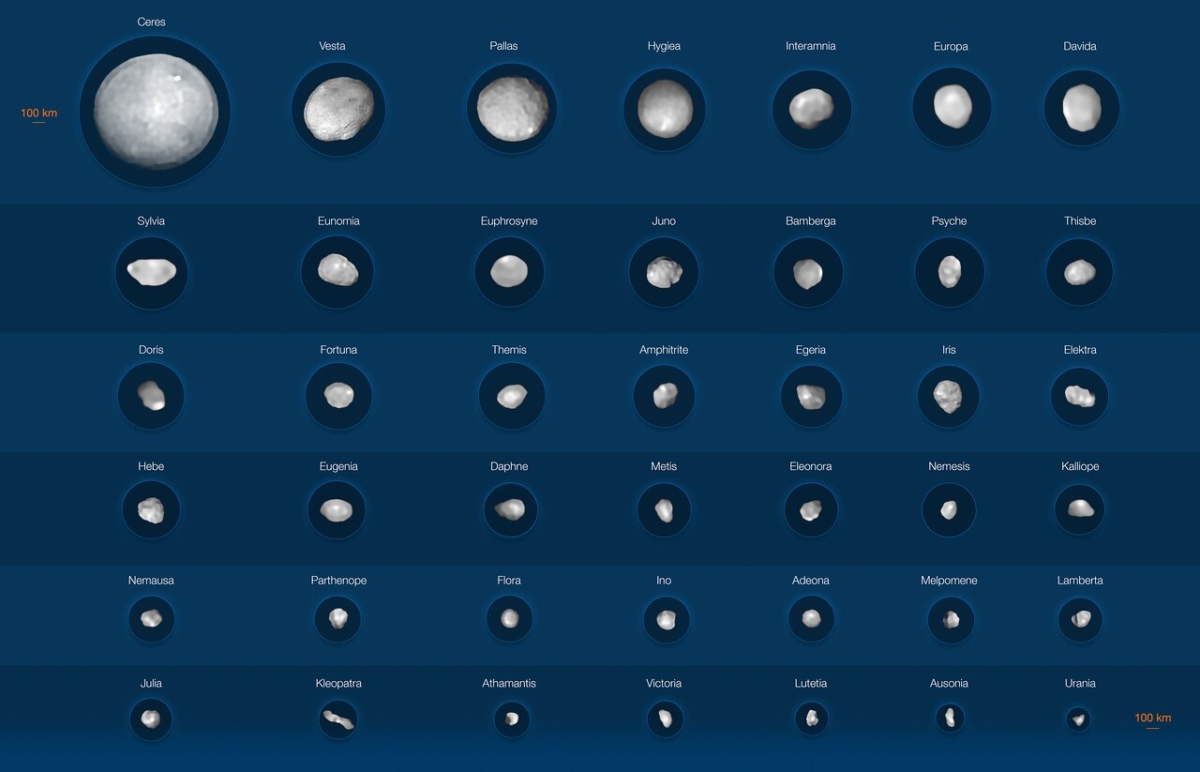
This image depicts 42 of the largest objects in the asteroid belt, located between Mars and Jupiter.
Credit: P. Vernazza, et al.
The four least dense asteroids studied, including Lamberta and Sylvia, have densities of about 1.3 grams per cubic centimeter, around the density of coal. The highest, Psyche and Kalliope, have densities of 3.9 and 4.4 grams per cubic centimeter, respectively, which is higher than the density of diamond (3.5 grams per cubic centimeter).
Object shapes
ESO’s VLT in Chile has made possible the reconstruction of the objects’ shapes. The team realized that the observed asteroids are mainly divided into two families. Some are almost perfectly spherical, such as Hygiea and Ceres, while others have a more peculiar, “elongated” shape, their undisputed queen being the “dog-bone” asteroid Kleopatra, explains an ESO statement.
“Our observations provide strong support for substantial migration of these bodies since their formation. In short, such tremendous variety in their composition can only be understood if the bodies originated across distinct regions in the Solar System,” explains Josef Hanuš of the Charles University, Prague, Czech Republic, one of the authors of the study. In particular, the results support the theory that the least dense asteroids formed in the remote regions beyond the orbit of Neptune and migrated to their current location.
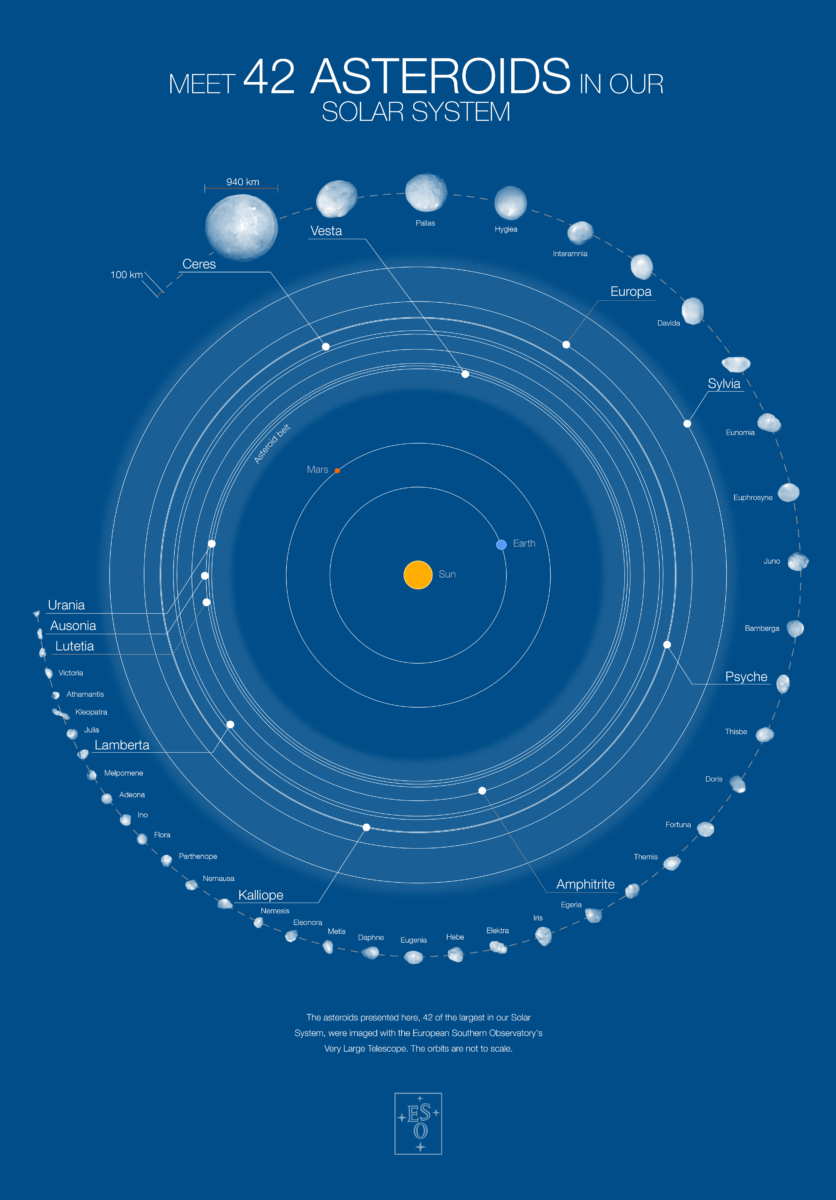
This poster shows 42 of the largest objects in the asteroid belt, located between Mars and Jupiter (orbits not to scale). The images in the outermost circle of this infographic have been captured with the Spectro-Polarimetric High-contrast Exoplanet REsearch (SPHERE) instrument on ESO’s Very Large Telescope. The asteroid sample features 39 objects larger than 100 kilometers in diameter, including 20 larger than 200 kilometers. The poster highlights a few of the objects, including Ceres (the largest asteroid in the belt), Urania (the smallest one imaged), Kalliope (the densest imaged) and Lutetia, which was visited by the European Space Agency’s Rosetta mission.
Credit: ESO/M. Kornmesser/Vernazza et al./MISTRAL algorithm (ONERA/CNRS)
SPHERE sensitivity
These findings were made possible due to the sensitivity of the Spectro-Polarimetric High-contrast Exoplanet REsearch (SPHERE) instrument mounted on ESO’s VLT.
“With the improved capabilities of SPHERE, along with the fact that little was known regarding the shape of the largest main belt asteroids, we were able to make substantial progress in this field,” says co-author Laurent Jorda, also of the Laboratoire d’Astrophysique de Marseille.
To access the paper – “VLT/SPHERE imaging survey of the largest main-belt asteroids: Final results and synthesis,” go to:
https://www.aanda.org/articles/aa/full_html/2021/10/aa41781-21/aa41781-21.html

Starlink satellites visible in a mosaic of an astronomical image.
Courtesy of NSF’s
National Optical-Infrared Astronomy Research Laboratory/NSF/AURA/CTIO/DELVE)
An international open Letter on kinetic anti-satellite (ASAT) testing has been sent to the United Nations General Assembly, urging that body to take up a treaty that would prohibit debris-generating anti-satellite weapon tests.
Coordinated by the Outer Space Institute (OSI) in Canada, the letter underscores the need for such a treaty, driven by the rapid escalation of satellites in orbit.

UN General Assembly.
Credit: UN
OSI, based at the University of British Columbia, is a transdisciplinary network of global space experts that addresses challenges facing the continued use and exploration of space.
Credit: OneWeb
Mega-constellations
“The number of active and defunct satellites in orbit has grown from 3300 to over 7600 in the last decade,” the letter explains, “with the potential addition of as many as 100,000 active satellites within the next ten years.”
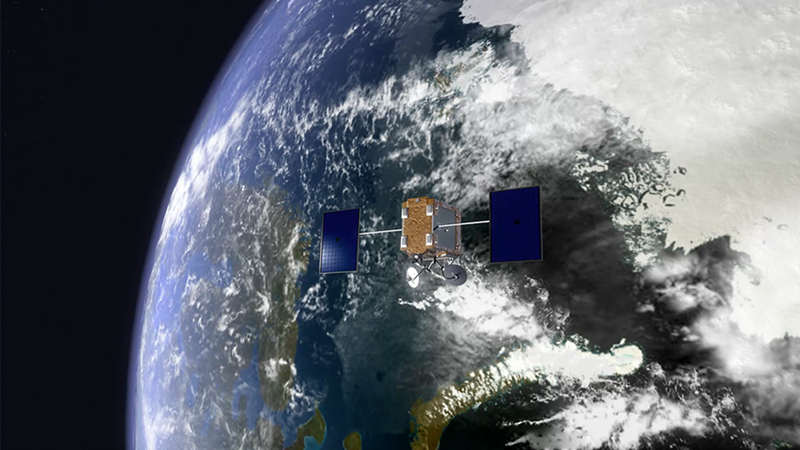
Spotlighting the near-future orbital environment, the letter points to at least four planned ‘mega-constellations’ from different countries:
- SpaceX’s Starlink (U.S.) with 42,000 satellites
- Amazon’s Kuiper (U.S.) with 3,236 satellites
- OneWeb (United Kingdom) with 7,000 satellites
- Guo Wang’s (China) StarNet with 12,992 satellites
“This rapid growth is raising concerns about collisions and the proliferation of space debris, endangering all forms of space use, from crewed missions, to communications, to Earth observations and environmental monitoring, to space-based astronomy,” the OSI open letter adds.
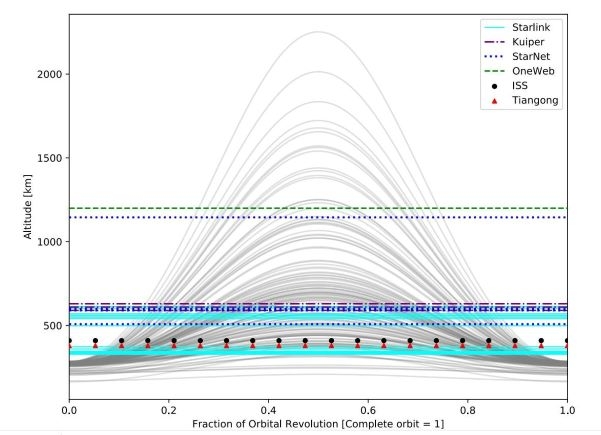
Consequences of a low-altitude kinetic ASAT test in a mega-constellation environment.
Credit: OSI – Data from USSPACECOM and FCC/ITU Filings
Wanted: major step
New practices are needed for the safe and sustainable use of space. To this end, a major step would be a kinetic ASAT test ban treaty, the letter explains. “Kinetic ASAT weapons, whether ground-based or space-based, employ high velocity physical strikes through the use of a ‘kill vehicle’ or shrapnel to destroy or disable objects in orbit.”
Due to the high impact energies involved, fragments from a kinetic ASAT test often ends up on highly eccentric orbits that cross multiple satellite “orbital shells” twice per revolution.
“If just one piece of debris from such a test collides with a satellite and causes a major fragmentation event,” the letter continues, “this could lead to additional events affecting all States, which could include further fragmentations, satellite failures, or service disruptions.”
Early signatories
As proposed, a kinetic ASAT test ban treaty would prohibit the use of any high velocity physical strikes during testing. “Fly by” tests would still be permitted, the letter adds.
For these reasons, the letter includes signatures from a who’s who of space authorities urging the United Nations General Assembly to take up consideration of a kinetic ASAT test ban treaty.
An appended list of early signatories is led by Michael Byers, Canada Research Chair in Global Politics and International Law, University of British Columbia and co-director of the Outer Space Institute.
To access the “International Open Letter on Kinetic Anti-Satellite (ASAT) Testing,” go to:
http://www.outerspaceinstitute.ca/docs/OSI_International_Open_Letter_ASATs_PUBLIC.pdf
Should you wish to add your name to the list, go to:
https://docs.google.com/forms/d/e/1FAIpQLSfqleWmvwV0RpCBQUrPfN4oeEYJlZEGjxAdGsOI1rZvu1xeSg/viewform
Credit: Andøya Space
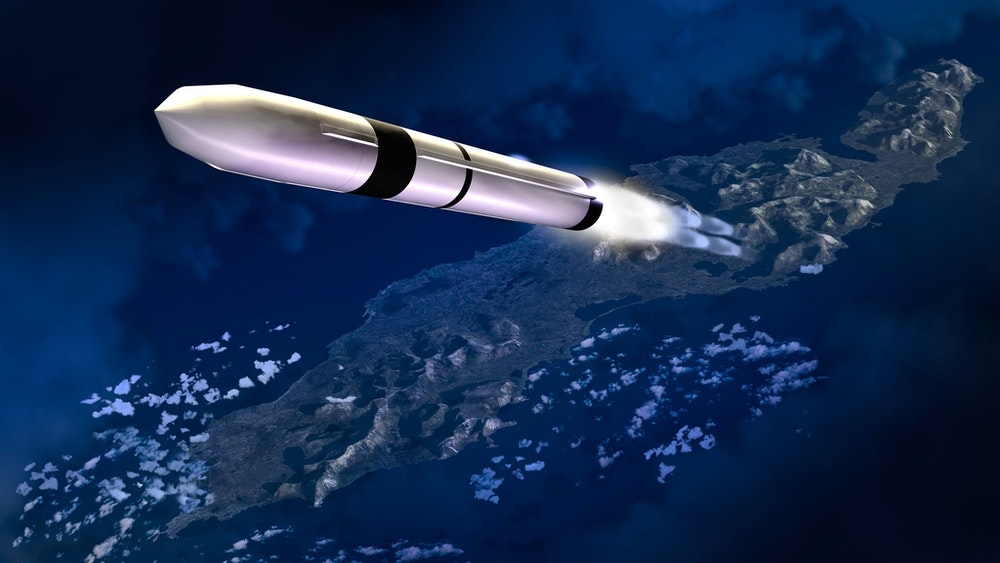
Norway’s Andøya Space has received go-ahead funding to establish a launch base for small satellites on Andøya.
The decision places Norway as one of the few countries that will be able to launch satellites from its own territory. The maiden satellite launch from Andøya is planned for third quarter 2022.
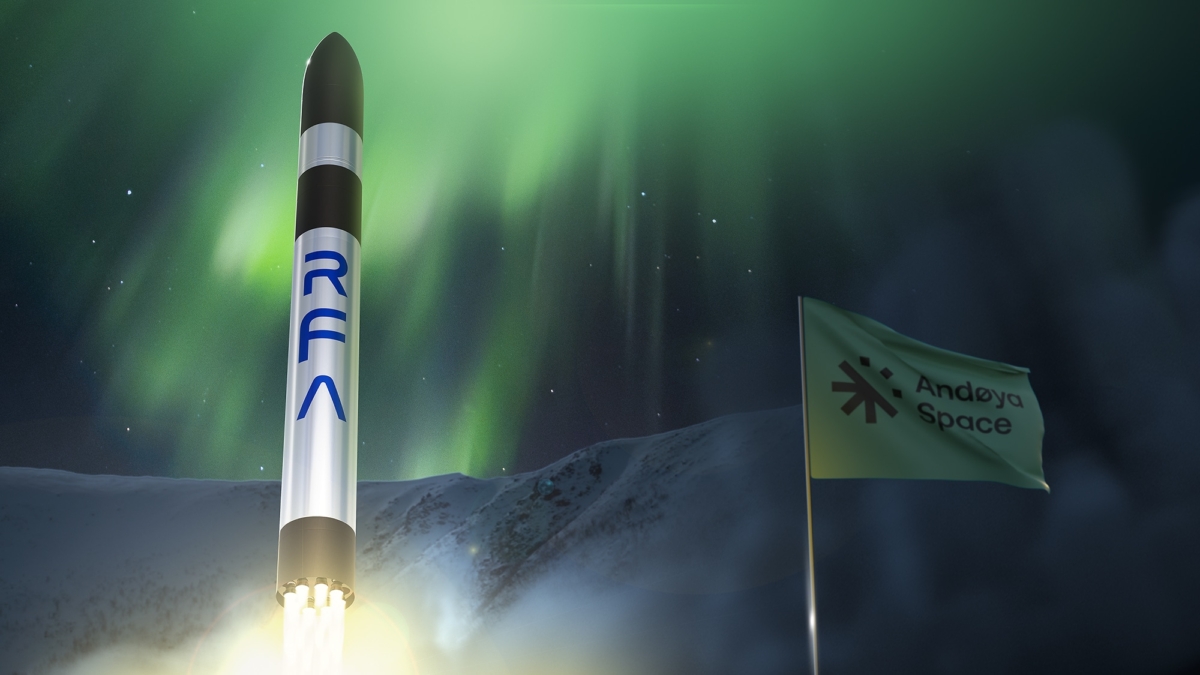
Andøya Space, as an orbital service provider, explains that the spaceport will serve launch vehicles designed to deliver payloads of up to 1.5 metric tons, primarily using liquid fuel.
Credit: RFA
Launch companies
Earlier, Andøya Space signed agreements with German satellite launch companies, Isar Aerospace and Rocket Factory Augsbur (RFA).
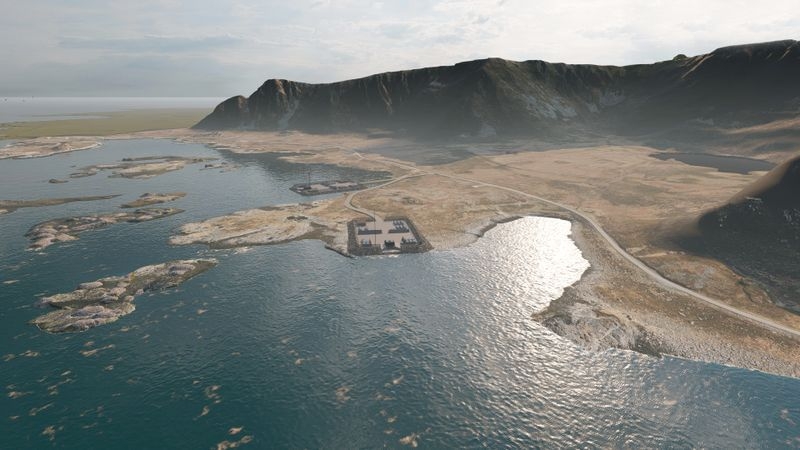
As a launch site operator, Andøya Space will supply the technical infrastructure, the launch pads and the buildings, while launch service providers bring their launch vehicles to the spaceport.

Credit: Google
Andøya is the northernmost island in the Vesterålen archipelago, situated about 190 miles (300 kilometers) inside the Arctic circle. Andøya is located in Andøy Municipality in Nordland county, Norway.
Flight path
Andøya Space intends to offer launch inclinations ranging from 87.4 to 108 degrees – favorable for both sun-synchronous and polar orbits.
Artist’s representation of new launch complex.
Credit: Andøya Space
The flight path of launchers ensures a trajectory whose ground track does not cross populated areas. The large impact and dispersion area in the Norwegian Sea enables safe disposal of spent rocket stages.
Commercial investment
The first request for funding for a satellite launch base on Andøya was received by the Ministry of Trade and Industry (NFD) in February 2019. Over the past 2.5 years, there has been a close dialogue between Andøya Space, NFD and NFD’s advisers on the project. The purpose has been to clarify whether the launch base can be realized as a commercial investment for the state.

Credit: Andøya Space
“The launch site on Andøya is an investment with great opportunities, but it also involves great risk,” says Minister of Trade and Industry Iselin Nybø. “From the government’s perspective, it’s been an absolute requirement to document that the equity invested is on terms a commercial investor would accept.”
For more information on Andøya Space, go to:

China’s Chang’e-5 lunar mission lobbed back to Earth samples of the Moon.
Credit: CNSA/CLEP
Results from China’s Moon sample effort and Mars lander mission are being presented in scientific journals, showcasing new findings.
China’s Chang’e-5 lunar sample return spacecraft landed on December 1, 2020, touching down in the Northern Oceanus Procellarum region of the Moon. The mission collected close to a total of 2 kilograms lunar collectibles, rocketing them back to Earth on December 16, 2020.

Chinese President Xi Jinping inspects Chang’e-5 lunar sample return capsule.
Credit: CCTV/Inside Outer Space screengrab
Young rocks
The Chang’e-5 lunar specimens have been identified as the youngest rocks ever found on the Moon, a billion years younger than lunar rocks previously gathered.
“Age and composition of young basalts on the Moon, measured from samples returned by Chang’e-5” has been published in Science magazine. Lead author of the work is Xiaochao Che of the Beijing Sensitive High Resolution Ion Micro Probe (SHRIMP) Center, at the Institute of Geology of the Chinese Academy of Geological Sciences in Beijing.
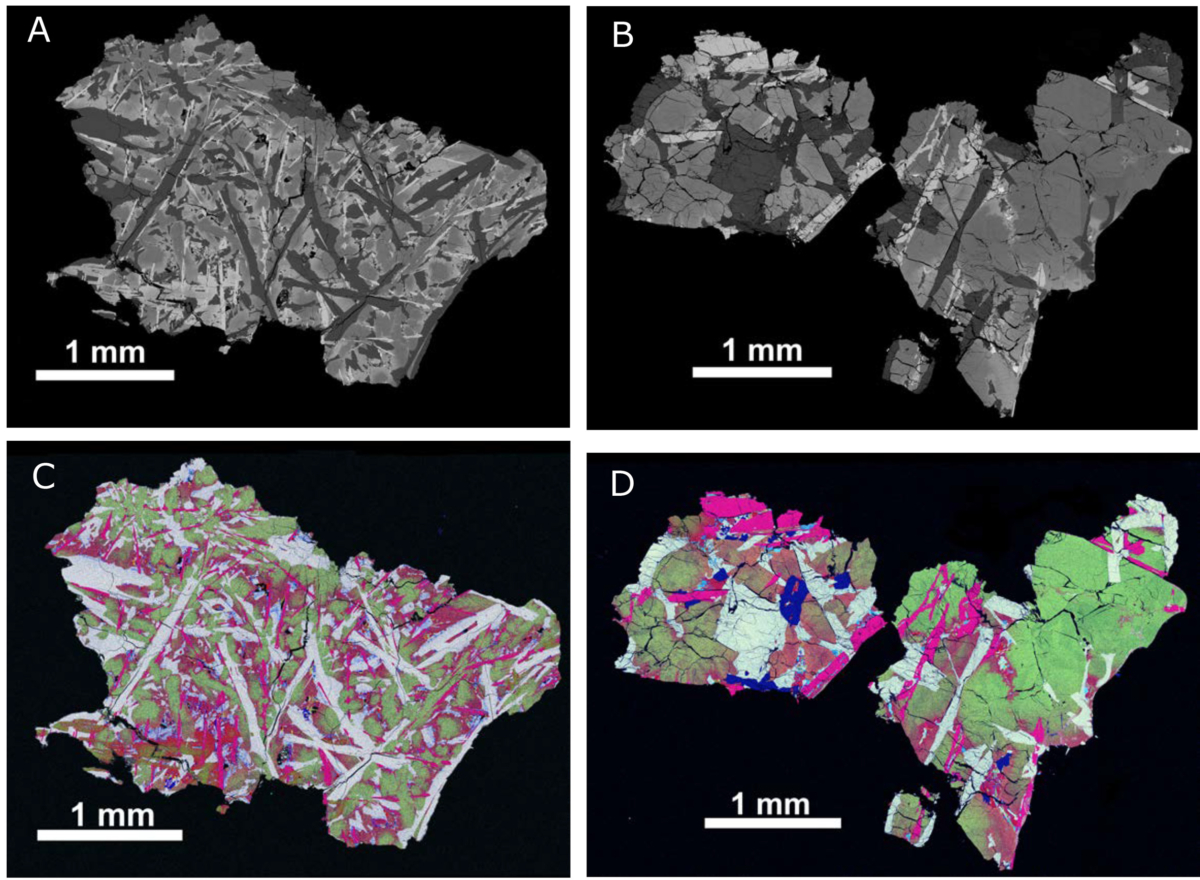
Age and composition of young basalts on the Moon, measured from samples returned by China’s Chang’e-5 mission.
Credit: Xiaochao Che, et al.
Orbital data indicate that the youngest volcanic units on the Moon are basalt lavas in Oceanus Procellarum, a region with high levels of the heat-producing elements potassium, thorium, and uranium.
Impact chronology
The Chang’e-5 mission collected samples of these young lunar basalts and returned them to Earth for laboratory analysis, the paper explains. The age of lunar lava, along with chemical and mineralogical examination of the specimens constrains the lunar impact chronology of the inner Solar System and the thermal evolution of the Moon.
Credit: CCTV/Inside Outer Space screengrab
“There is no evidence for high concentrations of heat-producing elements in the deep mantle of the Moon that generated these lavas, so alternate explanations are required for the longevity of lunar magmatism,” the paper points out.
Alexander Nemchin from the Space Science and Technology Center of Australia’s Curtin University is also an author of the research paper.
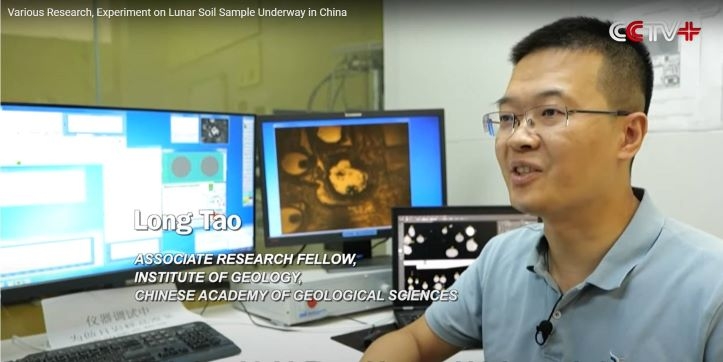
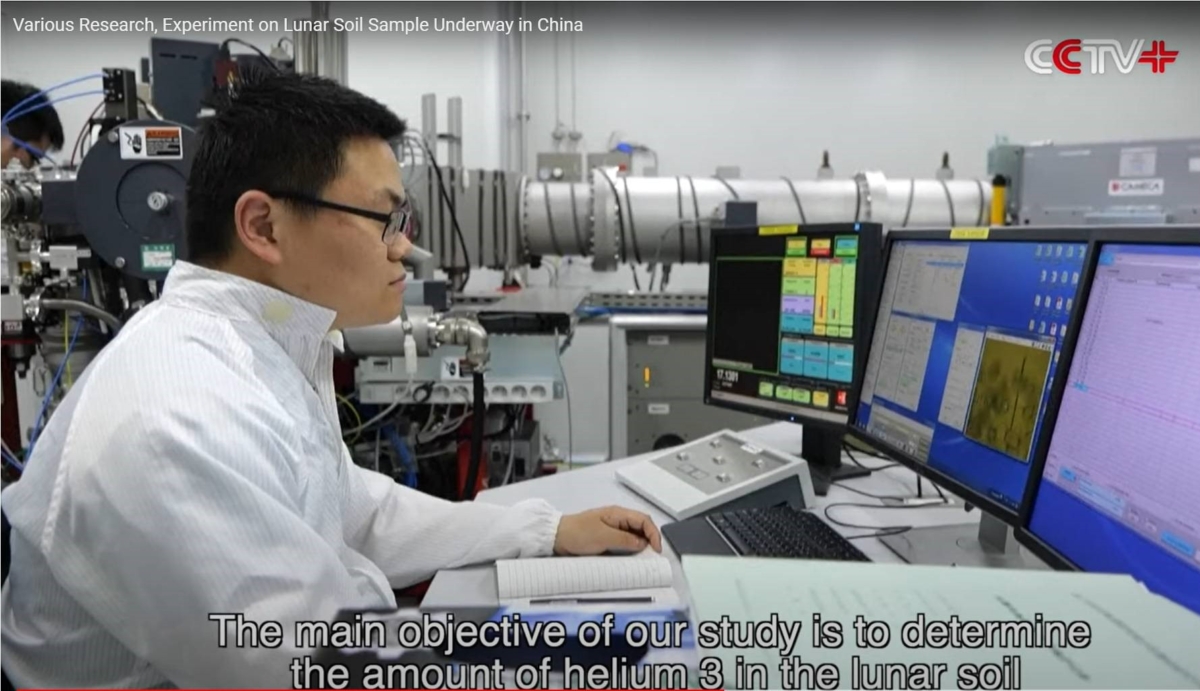
Nemchin said that researchers have determined the age of the lunar rock samples during remote sessions with the Beijing laboratory using large mass spectrometers.
Credit: CCTV/Inside Outer Space screengrab
Further questions
Another co-author of the research paper is Gretchen Benedix, also from Curtin’s Space Science and Technology Center.
The new results would provide researchers with more calibration points for cratering chronology, Benedix told the Xinhua news agency, enabling them to derive more accurate and higher resolution ages across many planetary surfaces.
“These results confirm what experts had long predicted based on remotely obtained images of the Moon and raise further questions as to why these young basalts exist,” Benedix said.
Xinhua reports that the task will now focus on finding a mechanism that will explain how this relatively recent heating of the Moon may have supported the formation of basaltic magmas with temperatures exceeding 1,000 degrees Celsius, and ultimately help researchers improve age dating of the entire Solar System.

Lander and Zhurong Mars rover.
Credit: CNSA/Inside Outer Space screengrab
Mars lander
Meanwhile, in a new paper published in the Earth and Planetary Science Letters journal, China’s Mars landing mission has also provided some intriguing new findings.
The lead author of the paper – “Geomorphologic exploration targets at the Zhurong landing site in the southern Utopia Planitia of Mars” – is Binlong Ye of the Department of Earth Sciences and Laboratory for Space Research at the University of Hong Kong.
Credit: CCTV/CNSA/Inside Outer Space screengrab
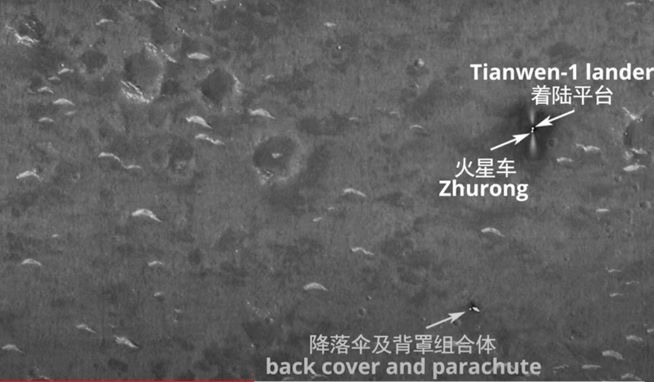
The Zhurong rover has been wheeling about within the southern Utopia Planitia since May 2021. According to the newly released paper, the landing site exhibits volatile-driven periglacial landforms and pitted cones. The landing site itself is located near a key geomorphological boundary between landforms. Zhurong’s ground penetrating radar will provide critical ice detection and resource characterization.

China’s Zhurong rover.
Credit: Liang Ding, et al.
Mud volcanism
“The Zhurong landing site contains a wide range of geomorphic exploration targets including troughs, raised ridges, pitted cones, mesas, sand dunes and crater ejecta,” the paper explains.
Aspects of all of these features, the paper continues, “suggest formation through interactions between volatiles, sediments, and magma. Pitted cones are invaluable windows into the subsurface and intriguing astrobiology targets for Martian life considering that they potentially formed from diapiric upwelling of fine-grained sediments (i.e. mud volcanism), a process that on Earth is often associated with methane release.”

China’s Zhurong Rover.
Credit: CNSA/Inside Outer Space screengrab
The ground-penetrating radar onboard Zhurong is intended to “provide fundamentally new perspectives on the presence, distribution, and abundance of subsurface water-ice, a strategic natural resource for future crewed Mars exploration,” the paper notes.
To access “Age and composition of young basalts on the Moon, measured from samples returned by Chang’e-5,” go to:
https://www.science.org/doi/10.1126/science.abl7957
Also, go to this video detailing the research and experiments on the Chang’e-5 lunar soil samples now underway in China at:
To access “Geomorphologic exploration targets at the Zhurong landing site in the southern Utopia Planitia of Mars,” go to:
https://www.sciencedirect.com/science/article/abs/pii/S0012821X21004544

On the scene. NASA’s new robotic Mars explorer, the Perseverance rover.
Credit: NASA/JPL-Caltech
NASA’s Perseverance Mars rover has solved a big unknown after landing within Jezero crater – the crater was definitely a lake.
Two of Perseverance’s cameras, Mastcam-Z and the SuperCam Remote Micro-Imager (RMI), have relayed images of their surroundings, including long-distance photos of the outcrop’s edge and a formation known as Kodiak butte.
High resolution looks at the imagery has researchers observing distinct beds of sediment along Kodiak butte.
The rover also relayed to Earth similar photos of tilted sediment beds along the main outcrop. That imagery, together with those of Kodiak, confirm that the fan-shaped formation was indeed an ancient delta and that this delta fed into an ancient Martian lake.
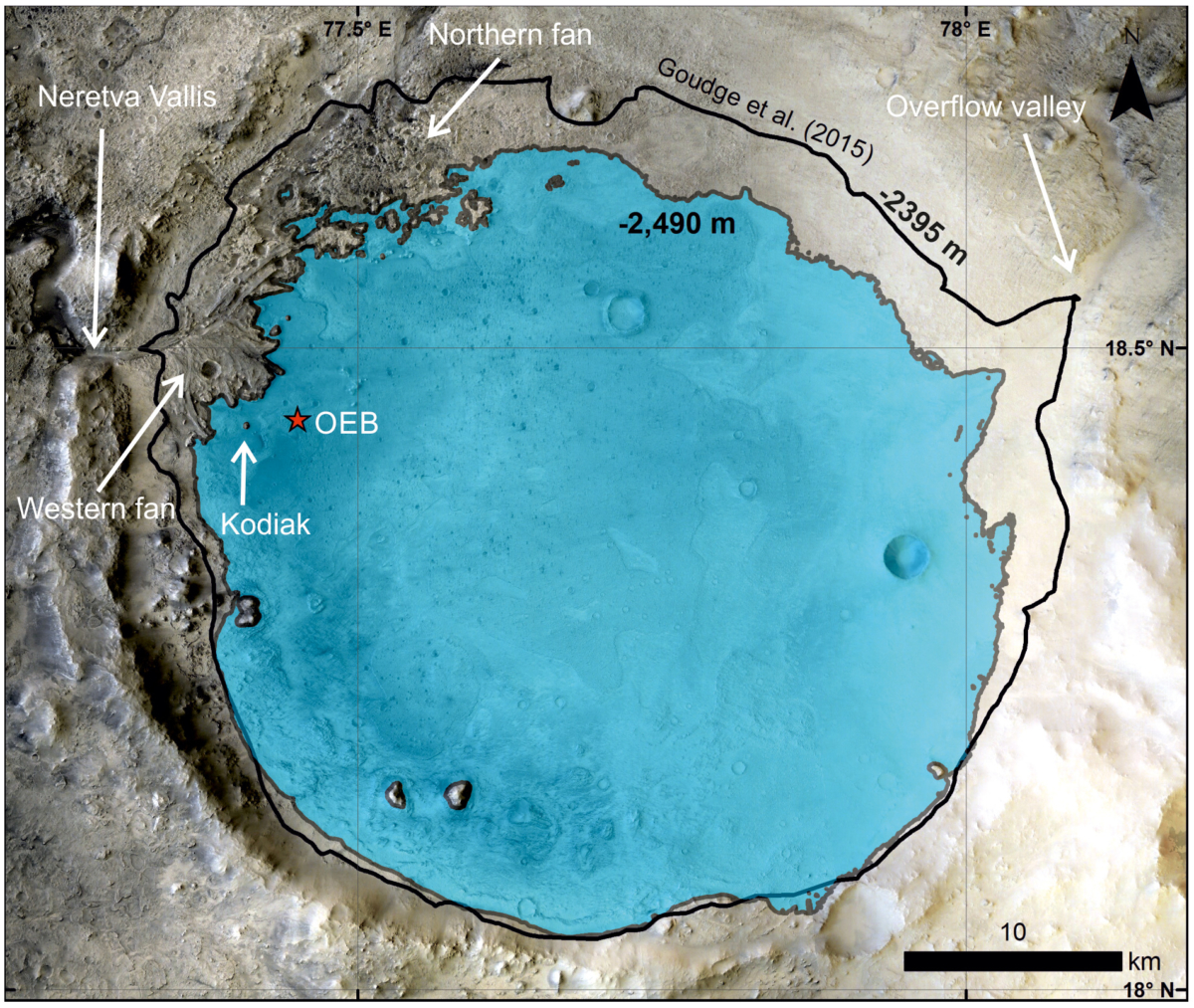
Inferred paleolake level inside Jezero crater at the time of Kodiak sediment deposition.
Credit: Nicolas Mangold, et al.
New analysis
The new analysis, published this week in the journal Science, bolsters the chance of detecting fossils and sampling for signs of life at Jezero Crater. This rover search site offers “high potential to preserve organic matter or potential biosignatures,” the Science paper notes.
The new research paper, written by over 30 scientists, was led by Nicolas Mangold of the Laboratoire Planétologie et Géodynamique in France.
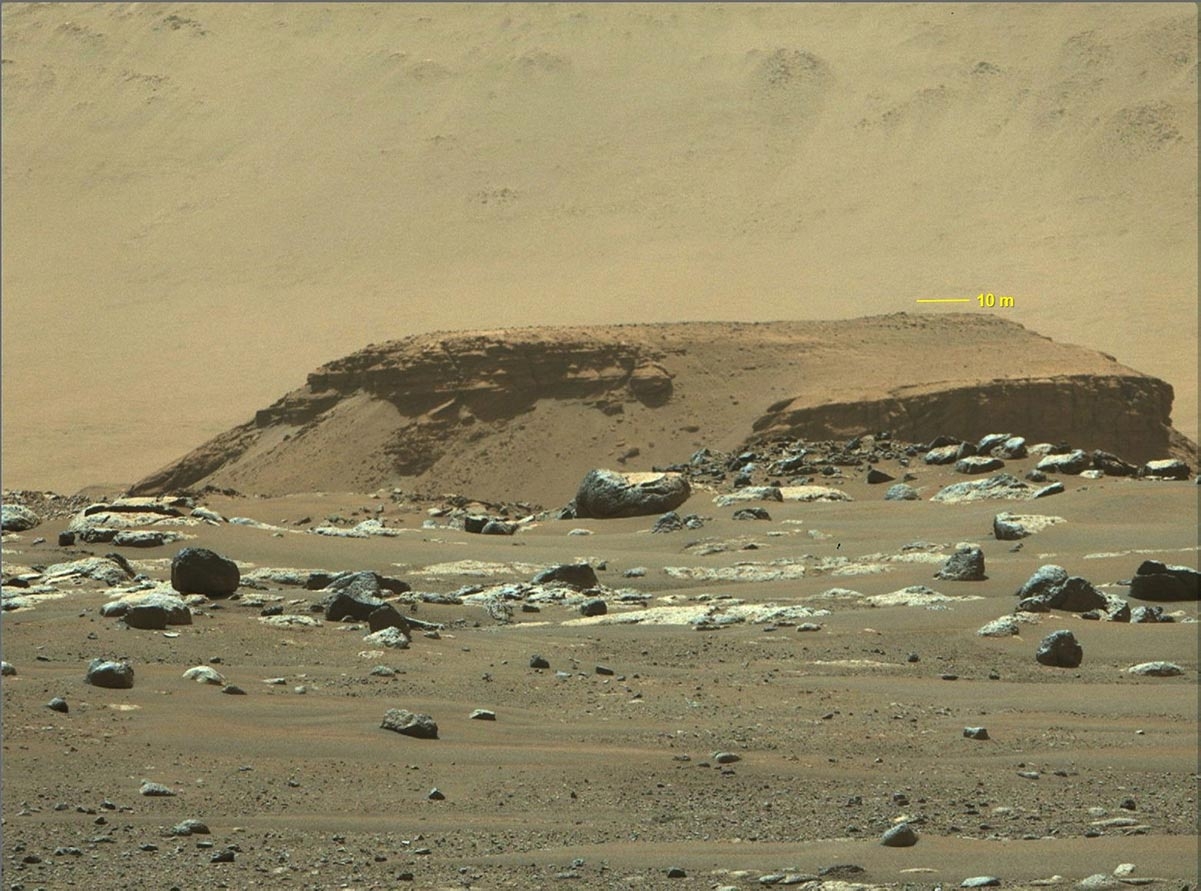
“Kodiak” butte as viewed from Perseverance rover.
Credit: NASA/JPL-Caltech
“The most surprising thing that’s come out of these images is the potential opportunity to catch the time when this crater transitioned from an Earth-like habitable environment, to this desolate landscape wasteland we see now,” says Benjamin Weiss, professor of planetary sciences in MIT’s Department of Earth, Atmospheric and Planetary Sciences and a member of the analysis team. “These boulder beds may be records of this transition, and we haven’t seen this in other places on Mars,” he stated in an MIT press statement.
To access the research paper — “Perseverance rover reveals an ancient delta-lake system and flood deposits at Jezero crater, Mars” – go to:

Credit: NASA
A NASA-funded study makes the case for making it simpler to send spacecraft to some areas of Mars while still protecting the planet from Earth-based contamination.
The just-issued study could allow robotic missions to certain locations on Mars to be carried out with less restrictive “bioburden” requirements designed to prevent harmful contamination by Earth-based microbes at Mars.
The Committee on Planetary Protection, a standing committee of the National Academies Space Studies Board, was tasked by NASA to write the report discussing criteria that could be used to designate regions on Mars where missions can land with less stringent bioburden requirements than currently in place.
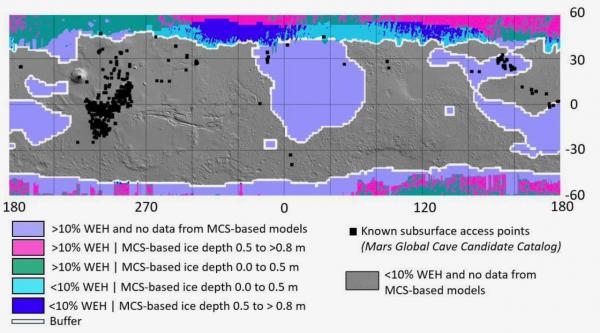
This map of Mars shows locations where ice is potentially located within 1 meter of the surface, based on neutron spectroscopy data (Mars Odyssey) or thermal infrared (IR) spectra (Mars Climate Sounder), and includes known subsurface access points from the Mars Candidate Cave Catalog. The gray regions are those lacking IR data and yielding water equivalent hydrogen (WEH) contents less than 10% from neutron spectroscopy. In the gray areas, closed-system ice or brine could potentially be present in the top 1 meter, but it is likely to be low in abundance and patchy in distribution. Gray regions may be appropriate for missions planning subsurface activities (as deep as 1 meter) with reduced bioburden requirements, if landing sites are a conservative buffer distance from subsurface access points.
Credit: A. Deanne Rogers, Stony Brook University, The State University of New York.
Imposing, costly, complex
Amanda Hendrix, a Planetary Science Institute senior scientist and co-chair of the committee said: “Currently, meeting planetary protection requirements – for instance, using rigorous sterilization techniques – can be seen as imposing, costly and complex, and it could be that these restrictions can be simplified and modernized, in some cases, which can help make some areas of Mars more accessible.”
The Committee’s findings,” Hendrix said, “can lead to making portions of Mars more accessible to both commercial and government endeavors by relaxing planetary protection requirements while remaining careful about access to potential habitable zones.”
“Biocidal” UV environment
The newly-issued report, for example, notes that for missions that do not access the subsurface, such regions could include a significant portion of the surface of Mars, because the UV environment is so biocidal that terrestrial organisms are, in most cases, not likely to survive more than one to two sols, or Martian days.

Location of candidate caves in the Tharsis region on Mars.
Credit: USGS
Furthermore, for missions that access the subsurface (down to 1 meter), regions on Mars expected to have patchy or no water ice below the surface might also be visited by spacecraft with more relaxed bioburden requirements, because such patchy ice is likely not conducive to the proliferation of terrestrial microorganisms.
Cave openings: keep your distance
The report also found that it is imperative that any mission sent to Mars with reduced bioburden requirements remain some conservative distance from any subsurface access points, such as cave openings.
Though less stringent than current requirements, these missions with relaxed bioburden requirements would still need some level of cleanliness, which could be achieved for instance using standard aerospace cleanliness practices.
The committee’s findings apply specifically to missions for which NASA has responsibility for planetary protection. For commercial missions in which NASA has no role or connection, the U.S. government still needs to designate a regulatory agency to authorize and continually supervise space activities in accordance with the Outer Space Treaty, the report explains.
To access the full report — Evaluation of Bioburden Requirements for Mars Missions – go to:
Credit: CCTV/Inside Outer Space screengrab
China’s next step in the country’s space station assembly program has taken place.
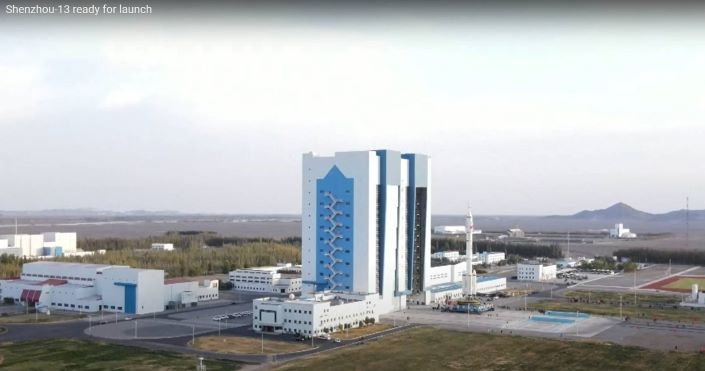
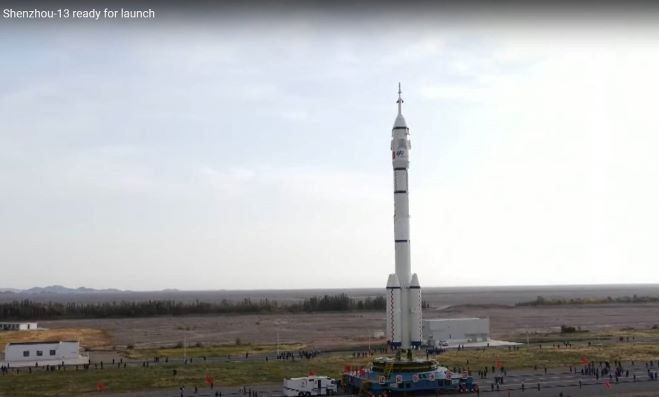
The Shenzhou-13 crewed spaceship atop a Long March-2F carrier rocket has been rolled out to the launching area of Jiuquan Satellite Launch Center in northwest China on October 7th.
Shenzhou-13 and its 3-person crew will be launched in the near future at an appropriate time, the China Manned Space Agency (CMSA) stated.
The facilities and equipment at the launch site are in good condition, and various pre-launch function checks and joint tests will be carried out as planned, said the CMSA.
Half-a-year mission
Once lofted, the trio of Chinese taikonauts will live and work on the space station core segment, residing there for half-a-year before returning to Earth.
Credit: CCTV/Inside Outer Space screengrab
The upcoming flight is one more of a series of launches to complete the building of the new station by late 2022.
Previously, China launched the Tianhe core module, two Tianzhou cargo ships and the piloted, Shenzhou-12 spacecraft to construct the space station.
Launch drill
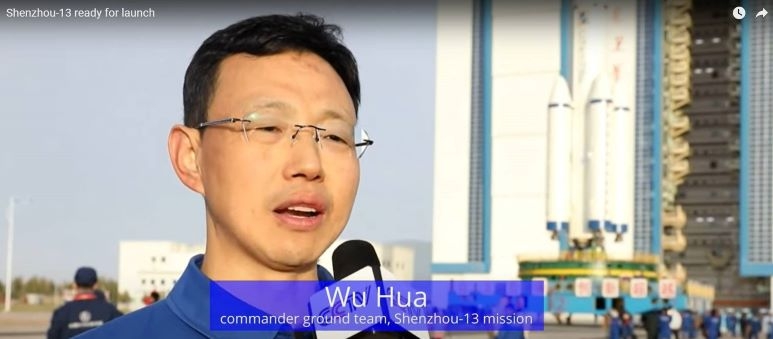
Prior to the transfer of the Shenzhouo-13/Long March-2F, “we have completed the main work in the technical area, such as the function check of the rocket subsystem, the general check and test of matching, the comprehensive electrical test of the spacecraft, fueling and installing payload fairing to the rocket,” Wu Hua, “00” commander of the Shenzhou-13 manned mission told China Central Television (CCTV).
Credit: CCTV/Inside Outer Space screengrab
“After the rocket-spaceship combo is transferred to the launching area, a series of work will be completed, such as the functional test of the spaceship and rocket, the joint adjustment and joint test with various systems, the on-site confirmation of astronauts and the launch drill of the whole system. We are fully prepared for the launch mission,” Wu said.
Plan-B rescue rocket
Prepped as the first rocket in Chinese space history with both emergency rescue and launch capabilities, the Long March-2F-Y13 rocket has been standing by at the Jiuquan Satellite Launch Center for months. Given the return of the Shenzhou-12 mission, this rocket no longer needed to be on a “plan-B” rescue capability.

Shenzhou-13 crew will link up with station core module and the Tianzhou cargo ship (left) for 6-month tour-of-duty.
Meanwhile, China’s space tracking ship the Yuanwang-3 set sail on Thursday for the Pacific Ocean from the dock of the China Satellite Maritime Tracking and Controlling Department in east China’s Jiangsu Province for its upcoming maritime monitoring missions.
For a video look at Shenzhou-13 launch preparations, go to these videos by China Media Group(CMG)/China Central Television (CCTV)/China Aerospace Science and Technology Corporation (CASC) at:

Artist’s impression of a close flyby of the metal-rich near-Earth asteroid 1986 DA. Astronomers using the NASA Infrared Telescope Facility have confirmed that the asteroid is made of 85% metal.
Credit: Addy Graham/University of Arizona.
Metal-rich Near-Earth asteroids are being eyed as potential mining targets.
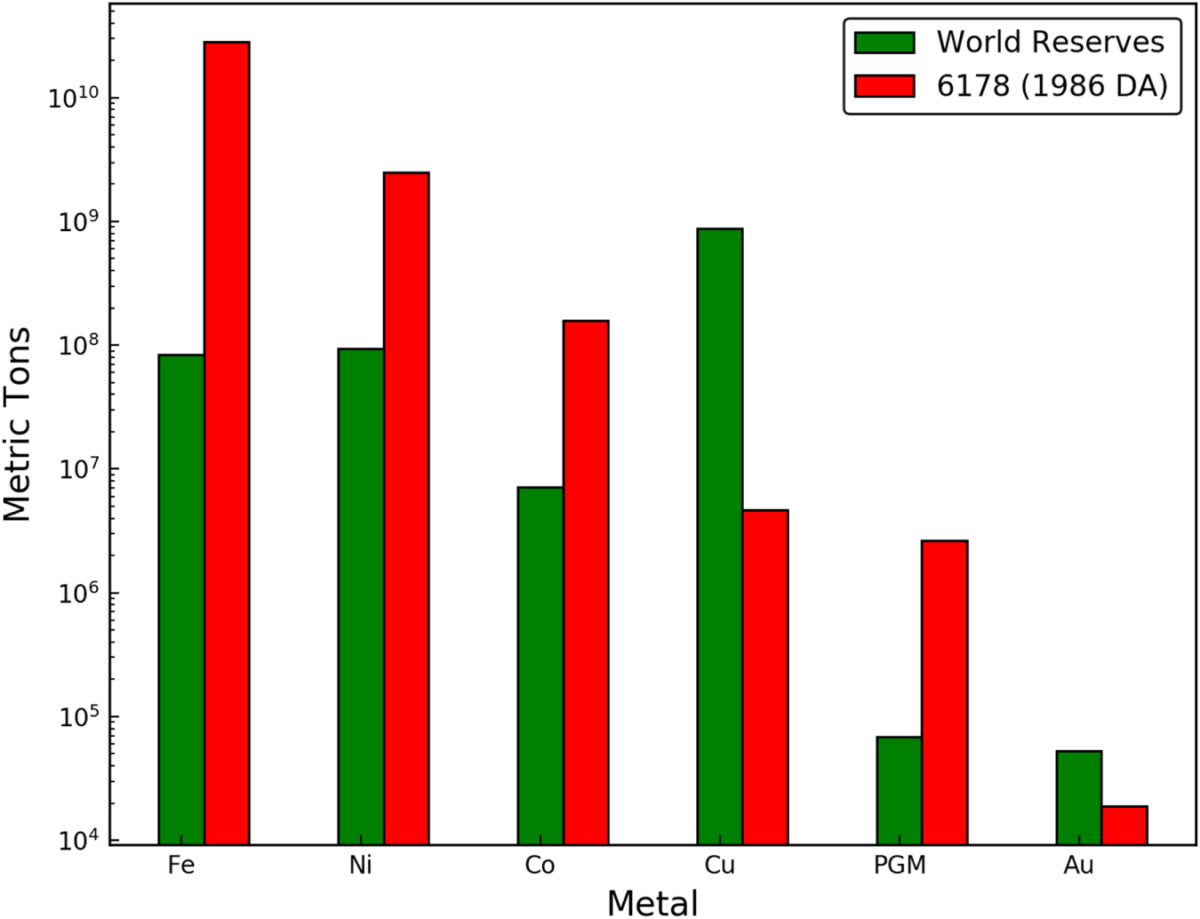
New research, for example, underscores the value of asteroid 1986 DA, loaded with iron, nickel, cobalt, and platinum-group metals (PGM). Those characteristics present on the asteroid would exceed the global reserves of these metals here on Earth.
In fact, if 1986 DA is mined and the metals marketed over 50 years, the annual value of precious metals for this object would be roughly $233 billion.
This new appraisal stems from research published in the Planetary Science Journal, titled “Physical Characterization of Metal-rich Near-Earth Asteroids 6178 (1986 DA) and 2016 ED85,” work led by Juan Sanchez of the Planetary Science Institute in Tucson, Arizona.

NASA Infrared Telescope Facility (IRTF).
Credit: Institute for Astronomy, University of Hawaii
The paper’s findings are based on observations from the NASA Infrared Telescope Facility on the island of Hawaii. The work was funded by the NASA Near-Earth Object Observations Program, which also funds that facility.
Meteorite relationship
“Metal-rich near-Earth asteroids (NEAs) represent a small fraction of the NEA population that is mostly dominated by S- and C-type asteroids,” the paper explains. “Because of this, their identification and study provide us with a unique opportunity to learn more about the formation and evolution of this particular type of bodies, as well as their relationship with meteorites found on Earth.”

Credit: JPL’s Solar System Dynamics (SSD) website
Sanchez and colleagues present near-infrared (NIR) spectroscopic data of NEAs 6178 (1986 DA) and 2016 ED85. Contrary to 1986 DA, there are no radar data available for 2016 ED85. For this reason, in the present study this object is considered as a candidate metal-rich body.
“Our analysis shows that both NEAs have surfaces with 85 percent metal such as iron and nickel and 15 percent silicate material, which is basically rock,” said lead author Sanchez in a University of Arizona statement. “These asteroids are similar to some stony-iron meteorites such as mesosiderites found on Earth.”
Mesosiderites have been found to have similar pyroxene chemistry and produced a good spectral match when metal was added, suggesting similarities between the parent body of the NEAs and the parent body of these meteorites.
Exposed cores
Pointed out in the research paper is that metal-rich asteroids are thought to represent the exposed cores of differentiated asteroids whose crusts and mantles were stripped away following a catastrophic disruption.
Credit: NASA/Arizona State University
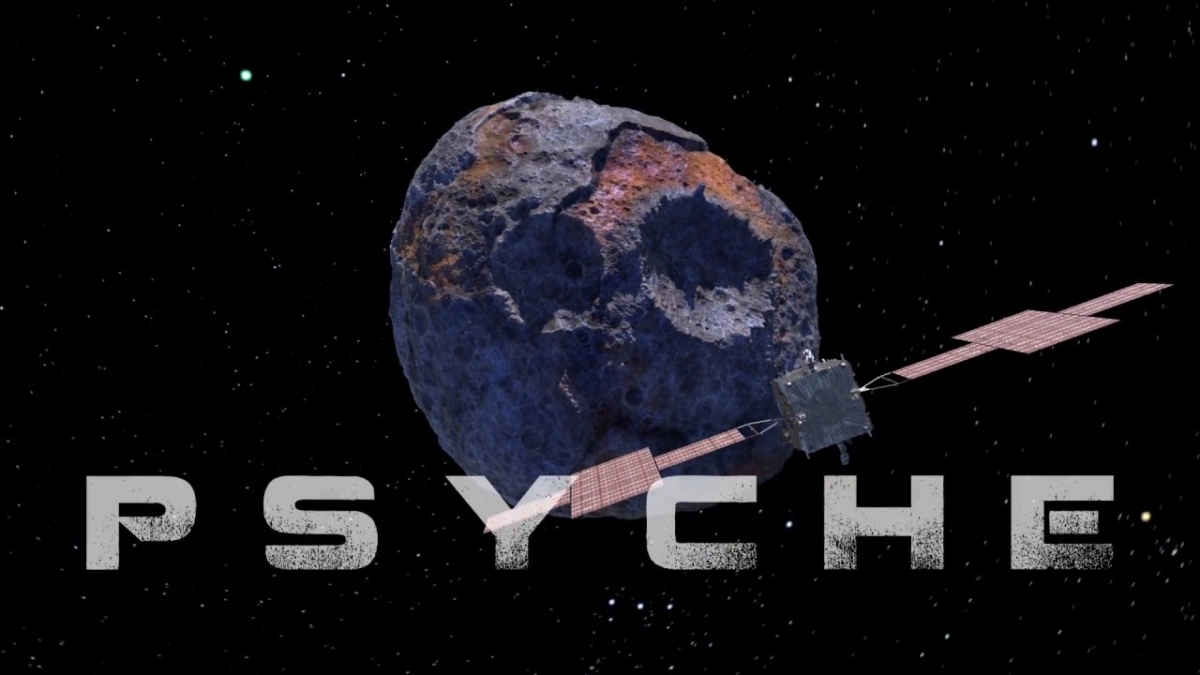
A more recent theory suggests that some of these objects, in particular asteroid Psyche, might still preserve a rocky mantle, and that the metal present on the surface could be the result of ferrovolcanic eruptions that covered the rocky material with liquid.
Indeed, asteroid 16 Psyche is thought to be the largest metal-rich body in the solar system, situated in the main asteroid belt between the orbits of Mars and Jupiter rather than near Earth. This space rock is the target of NASA’s Psyche mission.
Psyche is set to launch next year, marking the first time NASA has set out to explore an asteroid projected to be richer in metal than rock or ice.
Credit: Juan Sanchez, et al.
Compositional survey
Some of the largest known metal-rich asteroids are located in the middle and outer part of the asteroid belt.
“We started a compositional survey of the NEA population in 2005, when I was a graduate student, with the goal of identifying and characterizing rare NEAs such as these metal-rich asteroids,” said Vishnu Reddy, a University of Arizona planetary science associate professor and principal investigator of the NASA grant that funded the just-published work. “It is rewarding that we have discovered these ‘mini Psyches’ so close to the Earth,” he said in the University of Arizona statement
To access the paper — “Physical Characterization of Metal-rich Near-Earth Asteroids 6178 (1986 DA) and 2016 ED85,” go to:

Credit: World View
World View, the stratospheric ballooning company, announced today taking passengers to the edge of space, launching from iconic global landmarks, starting with Grand Canyon National Park.
World View’s mission is to bring as many people as possible to the edge of space so that at 100,000 feet, they’ll see a world without borders, a company press statement explains.
Flights would loft eight participants and two World View crew members in a zero-pressure stratospheric balloon and pressurized space capsule to 100,000 feet altitude, nearly 23 miles into the stratosphere, an experience that will last six to 12 hours.

Credit: World View
World View Spaceports
The plan calls for World View participants to rise from spaceports across the world, gently floating in the atmosphere for hours to experience the Earth’s curvature and the darkness of space, taking them four times higher than a commercial aircraft flight.
The voyages, originating out of World View Spaceports at the Seven Wonders of the World, are built around a 5-day fully immersive experience. Participants will be offered excursions from the Spaceports, enabling them to fully experience and immerse themselves in the beauty, fragility, history, and importance of the areas surrounding the Seven Wonders.
Along with the Grand Canyon in the United States, the other launch locales identified are:
- Great Barrier Reef, Queensland, Australia;
- Serengeti, Kenya
- Aurora Borealis, Norway
- Amazonia, Brazil
- Giza Pyramids, Egypt
- Great Wall of China, Mongolia

Credit: World View
Overview Effect
“The company believes that by reaching a critical mass of people experiencing what has been labeled the Overview Effect that humanity will be able to markedly improve the future of our fragile Earth,” the company statement adds.
World View is now accepting deposits for its edge-of-space trips. With an initial deposit of $500, participants can reserve their place in line for commercial flights. The up-and-going price tag is $50,000 per seat with flexible financing options available.
World View has designed the Explorer Space Capsule to offer an elevated luxury experience including a personal in-flight concierge, in-flight dining and bar, internet data connection, access to Earth-view cameras and star-view telescopes, individual viewing screens, fully reclining seats and, thankfully, an on-board lavatory.

Credit: World View
First Commercial Flights
World View’s first commercial flights are expected to begin in early 2024 with non-profit Space For Humanity securing the inaugural commercial flight.
Space For Humanity, a nonprofit group, is organizing the first Sponsored Citizen Astronaut Program, where leaders, from any walk of life, can apply for an opportunity to go to space and experience the Overview Effect: the cognitive shift in awareness that occurs when a human being looks down on the Earth from space.
For more information, go to: www.worldview.space and www.spaceforhumanity.org

