Archive for May, 2021
 Author:
  May 3rd, 2021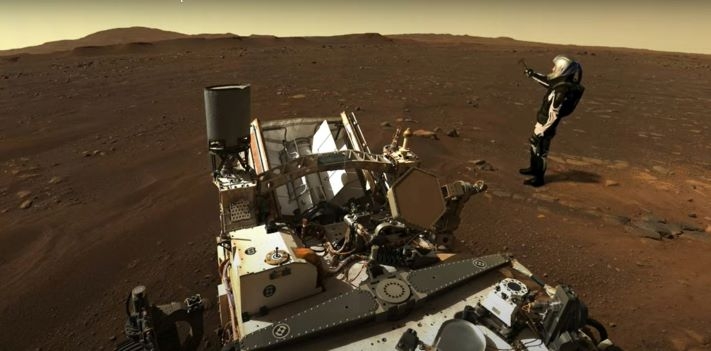
Credit: Mars Guy/Steve Ruff
A new Mars Guy video showcases spectacular high resolution images from NASA’s Perseverance rover. They reveal a textbook example of an Earth delta deposit, but this one actually is on the Red Planet.

Credit: Mars Guy/Steve Ruff
 Posted in

Credit: China Central Television (CCTV)/China National Space Administration (CNSA)/United Nations Office for Outer Space Affairs (UNOOSA)/China Manned Space Agency (CMSA)/Inside Outer Space screengrab
China’s bid to build and operate a space station by the close of 2022 involves its use to carry out a suite of scientific experiments. The Tianne core module of the station now circling the Earth is the first and main component of the station.
According to Zhou Jianping, chief designer of China’s manned space engineering project, the country’s orbiting outpost will have onboard nine international scientific experiments, with a second batch of projects to be announced.

Credit: CAST
In selecting the science experiments, China is collaborating with the United Nations Office for Outer Space Affairs, Zhou said in a recent China Central Television (CCTV) interview.

Credit: China Central Television (CCTV)/China National Space Administration (CNSA)/United Nations Office for Outer Space Affairs (UNOOSA)/China Manned Space Agency (CMSA)/Inside Outer Space screengrab
Experiment racks
Zhong Hongen, deputy chief engineer, space application system of China’s Manned Space Flight Project, detailed the use of experiment racks to be utilized on the space station.
“It’s the first time that we have applied experiment racks of advanced international standards to large-scale experiment facilities,” Zhong said in the CCTV video. “The rack is supported by general-purpose technologies with multiple functions. It is constructed with supporting structures for power supply, measurement and control, information recording and cooling.”

Credit: China Central Television (CCTV)/China National Space Administration (CNSA)/United Nations Office for Outer Space Affairs (UNOOSA)/China Manned Space Agency (CMSA)/Inside Outer Space screengrab
Zhong added that it is also the first time that China has operated scientific experiment facilities which weigh 500 kilograms, close to the mass of a medium-sized satellite.
Astronaut participation
As for the experiments that will be carried out in the recently launched core module, they are mainly categorized into two kinds: containerless experiments on material science, and high-quality microgravity scientific experiments.
“Both of these experiments require intensive participation of the astronauts. For instance, after the completion of the experiment on one batch of samples in a rack for containerless material scientific experiment, the astronauts should put new samples into the rack,” Zhong said.

Credit: China Central Television (CCTV)/China National Space Administration (CNSA)/United Nations Office for Outer Space Affairs (UNOOSA)/China Manned Space Agency (CMSA)/Inside Outer Space screengrab
Large-scale facilities
Carrying out these tasks within the core module means China will take a fundamental and critical step in space science application of the space station, Zhong added, underscoring the need to master the key technologies of large-scale space experiment facilities.
Additionally, China will use a space-ground integrated system, designed to bring long-term experiment results to fruition.
Credit: China Central Television (CCTV)/China National Space Administration (CNSA)/United Nations Office for Outer Space Affairs (UNOOSA)/China Manned Space Agency (CMSA)/Inside Outer Space screengrab
Space telescope
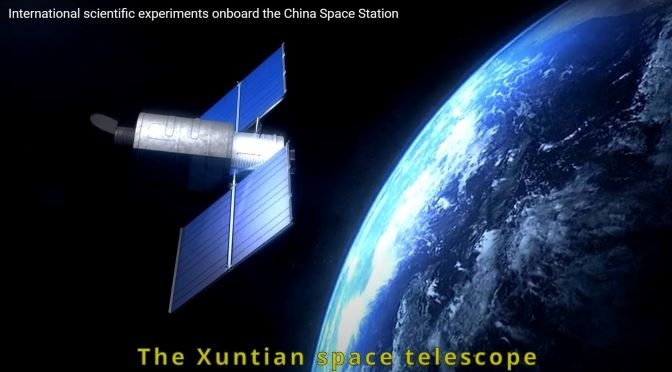
Lastly, Zhong described the Xuntian Space Telescope that’s part of China’s space station.
“They will be two independent spacecraft operating on the same orbit,” Zhong said. “If we need to update the telescope, we can dock it with the space station to let the astronaut enter it and change the optical modules.”
To view this new video credited to: CCTV/China National Space Administration (CNSA)/United Nations Office for Outer Space Affairs (UNOOSA)/China Manned Space Agency (CMSA), go to:
Here are the already selected experiments to be flown on China’s space outpost:




On the scene. NASA’s new robotic Mars explorer, the Perseverance rover.
Credit: NASA/JPL-Caltech
A House Committee on Science, Space, and Technology Space and Aeronautics Subcommittee hearing on April 29th was entitled: “What do Scientists Hope to Learn from NASA’s Mars Perseverance Rover?
Witnesses:
Dr. Michael A. Meyer, Lead Scientist, Mars Exploration Program, National Aeronautics and Space Administration
Dr. Bethany L. Ehlmann, Professor of Planetary Science and Associate Director of the Keck Institute for Space Studies, California Institute of Technology; President, The Planetary Society; Co-Investigator, Mars 2020 Perseverance mission
Dr. Luther Beegle, Principal Investigator of the Mars Perseverance Scanning Habitable Environments with Raman & Luminescence for Organics & Chemicals (SHERLOC) Instrument, Jet Propulsion Laboratory
Dr. Tanja Bosak, Returned Sample Science Co-Lead, Mars 2020 Perseverance Rover; Professor and Lead of the Option in Geology, Geochemistry, and Geobiology, Department of Earth, Atmospheric, and Planetary Sciences, Massachusetts Institute of Technology
Opening statements
Video of the hearing is available at:

Ingenuity Mars rotorcraft – a forerunner of things to come.
Credit: NASA/JPL-Caltech
NASA’s Ingenuity Mars helicopter has shown the “Wright stuff” on the Red Planet. Multiple sorties of the rotorcraft have been so successful that the device is now moving into an operational role supporting the Perseverance rover’s scientific sleuthing ahead.
The future use of airborne tools on Mars is also being tested in the Holuhraun, Iceland lava flow field. This activity is under the wing of the University of Arizona’s Lunar and Planetary Laboratory (LPL) programs.
LPL’s Christopher Hamilton and colleagues have been investigating a next-generation Mars exploration concept, dubbed RAVEN, short for Rover–Aerial Vehicle Exploration Networks. The effort draws upon recent developments in drone technology.

Christopher Hamilton launches a drone during flight tests in the Holuhraun, Iceland lava flow field.
Credit: University of Arizona’s Lunar and Planetary Laboratory
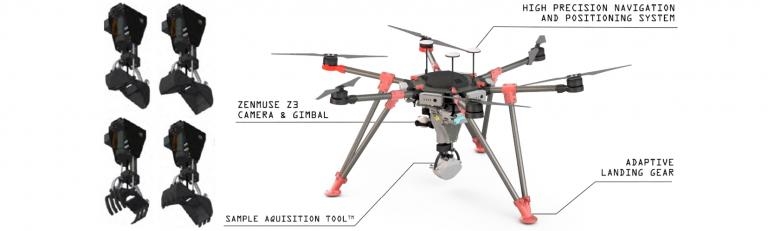
For example, there’s the RAVEN Claw a prototype Unmanned Aerial System (UAS) developed by Honeybee Robotics. It is a sample acquisition device to test new methods of sample characterization and collection within Mars analog environments, like the Highlands of Iceland.
Credit: University of Arizona’s Lunar and Planetary Laboratory/Honeybee Robotics
Maximize scientific output
A $3.1 million NASA grant is geared to develop a new concept combining rovers and unmanned aerial systems to explore areas of the red planet that have been previously inaccessible.

Future human Mars expeditions may use aerial vehicles to enlarge their exploration zones.
Credit: NASA/JPL
According to Hamilton, RAVEN adds an entirely new approach to NASA’s paradigm of planetary exploration, one that traditionally has centered around four steps – flyby, orbit, land and rove.
“With RAVEN, we’re adding ‘fly’ to that list,” Hamilton says. “The concept is geared toward building new technology for two robots to work together on an extraterrestrial body. We are going to look at how a rover and a drone can work together to maximize the scientific output of such a mission.”
For more information on RAVEN, go to:

